
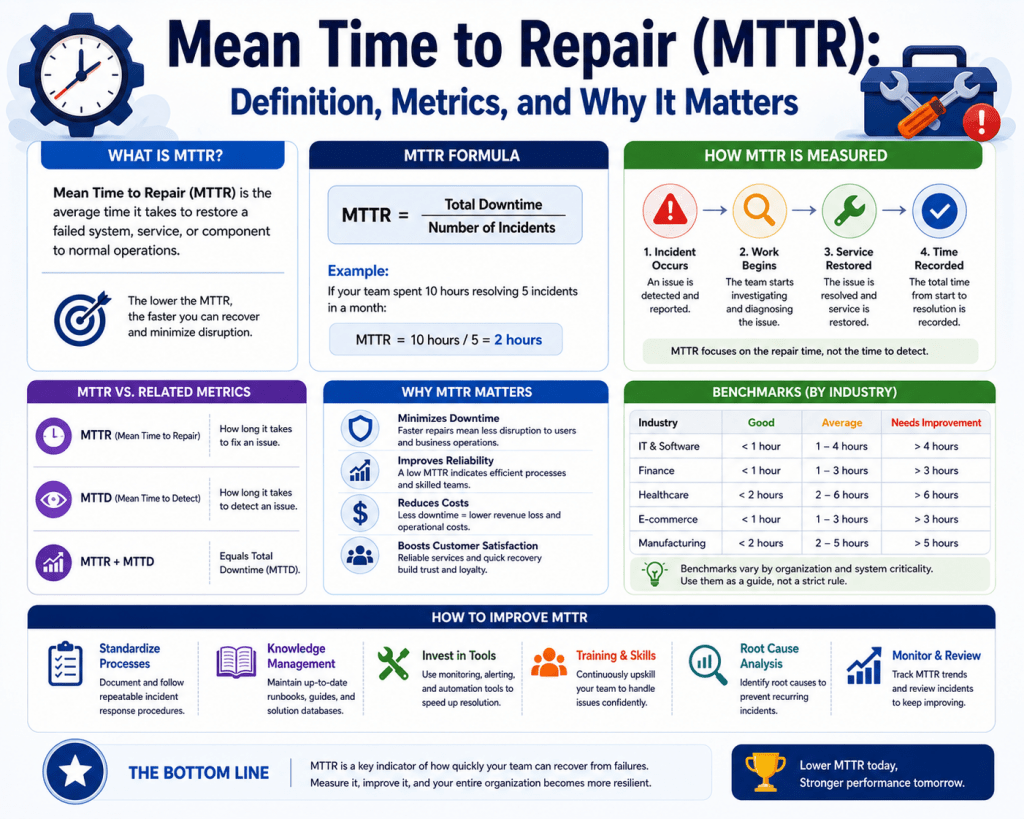
Mean Time to Repair, widely known as MTTR, is a core operational metric used to measure how quickly a system, service, or infrastructure component can be restored after a failure. In modern digital environments where organizations depend heavily on continuous uptime, MTTR has become a central indicator of operational strength and resilience. It reflects not only technical capability but also the efficiency of processes, coordination between teams, and the readiness of infrastructure to handle unexpected disruptions. Across IT operations, cloud services, enterprise networks, and industrial systems, MTTR is used as a standard measure to evaluate how effectively downtime is managed and minimized.
MTTR is more than a simple time measurement. It represents the entire recovery journey from the moment a failure occurs until normal operations are fully restored. This includes detection of the issue, acknowledgment by the responsible team, identification of the root cause, implementation of corrective actions, and final validation of system stability. Each of these stages contributes to the overall recovery time, making MTTR a reflection of both technical and organizational efficiency.
What MTTR Means in Practical Operations
In practical environments, MTTR represents the average duration required to restore a failed system to normal functioning. It is calculated over multiple incidents to provide a consistent understanding of recovery performance. Rather than focusing on a single outage, MTTR highlights overall trends in how quickly problems are resolved across repeated events.
For example, when a server crashes or a network service becomes unavailable, the time taken to bring it back online contributes to MTTR. If similar incidents occur multiple times, the average recovery time becomes a useful benchmark for evaluating operational effectiveness. This makes MTTR a valuable metric for understanding how efficiently technical teams respond to and resolve failures.
In real-world operations, MTTR is used to evaluate performance in environments where downtime has direct consequences. These include e-commerce platforms, financial systems, communication networks, and enterprise applications. In such environments, even small delays in recovery can have a significant operational and financial impact.
Why MTTR Matters in Digital Infrastructure
MTTR plays a crucial role in digital infrastructure because system downtime directly affects productivity, user experience, and revenue generation. In highly connected environments, services are expected to operate continuously, and any disruption can lead to immediate consequences. A lower MTTR indicates faster recovery, which helps maintain service continuity and reduces negative impact on users.
From a business perspective, MTTR is closely tied to operational efficiency. When systems recover quickly, organizations can minimize financial losses associated with downtime. This is especially important in industries where transactions, data processing, or customer interactions depend on real-time availability. Faster recovery also helps maintain customer trust, as users are less likely to experience prolonged disruptions.
MTTR is also important because it reflects the maturity of internal processes. Organizations with well-defined incident response procedures, skilled personnel, and effective monitoring systems tend to achieve lower MTTR values. This indicates that not only is the technology reliable, but the supporting processes are also optimized for efficiency.
How MTTR is Calculated and Interpreted
MTTR is calculated using a straightforward formula that provides insight into average recovery performance over time. The formula divides total downtime by the number of repair incidents within a given period. This produces an average time required to restore systems after failure.
While the calculation itself is simple, interpreting MTTR requires a deeper understanding. A low MTTR generally indicates efficient recovery processes, but it does not automatically mean the system is flawless. Similarly, a higher MTTR may not always indicate poor performance, especially in systems with complex architectures or rare but severe failures.
The interpretation of MTTR depends on context, including system complexity, availability of resources, and nature of failures. For example, systems with high redundancy may experience fewer but more complex failures, which can affect recovery time differently than simpler environments. Therefore, MTTR should always be evaluated alongside other operational metrics to gain a complete picture of system performance.
Role of MTTR in System Stability and Reliability
MTTR is closely connected to system stability and reliability because it directly reflects how quickly a system can recover from disruptions. In highly reliable environments, systems are designed not only to prevent failures but also to recover quickly when failures occur. MTTR helps measure how effectively this recovery process works in practice.
System reliability is often viewed as a combination of failure frequency and recovery speed. Even if a system experiences occasional failures, a low MTTR can ensure that the overall impact remains minimal. This is why many organizations focus heavily on reducing MTTR as part of their reliability strategy.
In mission-critical environments such as financial systems, healthcare platforms, or communication networks, reducing MTTR is essential for maintaining continuous service availability. In these cases, even short downtime periods can have significant consequences, making rapid recovery a top priority.
Operational Factors That Influence MTTR
Several operational factors directly influence MTTR and determine how quickly systems can be restored. One of the most important factors is the quality of documentation. When systems are well-documented, technical teams can quickly identify configurations, dependencies, and potential failure points. Poor documentation often leads to delays in diagnosis and increases overall recovery time.
Another key factor is resource availability. This includes access to skilled personnel, diagnostic tools, replacement hardware, and system access permissions. If any of these resources are delayed, recovery time increases significantly. In distributed systems, geographical distance and logistical constraints can further affect response speed.
System complexity also plays a major role in determining MTTR. Older systems or highly customized environments often require longer troubleshooting periods due to outdated architecture or a lack of standardized processes. Modern systems with automation and centralized monitoring tend to achieve faster recovery because issues can be detected and resolved more efficiently.
Communication efficiency within teams is another important factor. When roles are clearly defined and escalation paths are established, incidents are resolved more quickly. Poor communication or unclear responsibilities can lead to delays and extended downtime.
Incident Response Lifecycle and Recovery Speed
The incident response lifecycle is a critical component in determining MTTR. The lifecycle begins with detection, where monitoring systems or users identify a failure. Faster detection reduces the time systems remain in an unknown state and allows response teams to act immediately.
The next stage is acknowledgment, where the incident is officially recognized by technical teams. Delays at this stage can significantly increase MTTR, as no corrective action can begin until the issue is acknowledged.
Diagnosis follows acknowledgment and involves identifying the root cause of the failure. This stage often consumes the most time, especially in complex systems where multiple components are interconnected. Efficient diagnostic tools and access to system logs can greatly reduce this phase.
Once the issue is identified, corrective action is taken to restore normal functionality. This may involve restarting services, reconfiguring systems, replacing components, or rolling back recent changes. The speed and effectiveness of this stage directly influence MTTR.
Finally, validation ensures that the system is stable and functioning correctly before full restoration. This step confirms that the issue has been resolved and prevents recurring failures from being overlooked.
Organizational Impact of MTTR in IT Environments
MTTR has a significant impact on organizational performance because it reflects how efficiently technical teams respond to failures. Organizations with lower MTTR values tend to have stronger operational resilience and better service reliability. This improves user satisfaction and reduces the risk of service disruptions affecting business operations.
MTTR also influences decision-making within organizations. Repeated high recovery times may indicate the need for infrastructure improvements, better monitoring systems, or enhanced training for technical teams. Over time, organizations use MTTR trends to identify weaknesses in their operational structure and implement targeted improvements.
In large-scale IT environments, MTTR also affects collaboration between teams. Efficient recovery often requires coordination between multiple departments, including network teams, system administrators, and application support teams. Strong collaboration reduces delays and improves overall recovery speed.
Evolving Importance of MTTR in Complex Systems
As modern systems become more complex and interconnected, MTTR continues to grow in importance. Cloud-based architectures, microservices, and distributed systems introduce new challenges in monitoring and recovery. In such environments, identifying the source of failure can be more difficult, making efficient MTTR management even more critical.
Automation and advanced monitoring tools are increasingly being used to reduce MTTR. These tools help detect issues faster, provide real-time diagnostics, and sometimes even trigger automated recovery processes. This reduces reliance on manual intervention and improves overall response time.
With the growing dependence on digital infrastructure, MTTR is now considered a key indicator of operational maturity. Organizations that continuously optimize their recovery processes are better equipped to handle unexpected failures and maintain consistent service availability in complex environments.
MTTR in Complex Digital Ecosystems
Modern digital ecosystems are far more complex than traditional IT environments, and this complexity has a direct influence on Mean Time to Repair. Systems today are built using distributed architectures, cloud-native components, microservices, and interconnected APIs that depend on each other to function correctly. When a failure occurs in such environments, the challenge is not only fixing the issue but also identifying which layer of the system is responsible. This increases diagnostic effort and can extend recovery time if systems are not properly designed for observability and traceability.
In these environments, MTTR becomes a reflection of architectural clarity. Systems with well-structured components and clear separation of concerns tend to recover faster because failures are easier to isolate. On the other hand, tightly coupled systems often experience longer recovery cycles because one failure can cascade across multiple dependencies. This interconnected nature makes MTTR an essential metric for evaluating system design quality in modern infrastructures.
Expanding the Meaning of Recovery Time in Operations
Recovery time in operational environments is not limited to simply restarting a service or fixing a broken component. It involves multiple coordinated steps that ensure the system is not only restored but also stable and reliable after restoration. These steps include detection, acknowledgment, investigation, mitigation, resolution, and validation. Each phase contributes to the total recovery duration and influences overall MTTR performance.
Detection is often the starting point, where monitoring systems or users identify abnormal behavior. The speed of detection plays a crucial role in reducing MTTR because early identification prevents prolonged system downtime. A delay in detection automatically increases recovery time, even if resolution is efficient.
Acknowledgment follows detection and represents the point at which the incident is officially recognized by the responsible team. Delays in acknowledgment often occur due to alert fatigue or poorly configured monitoring systems, both of which negatively impact MTTR.
Investigation involves analyzing logs, system behavior, and environmental conditions to determine the root cause of failure. This phase is often the most time-consuming, especially in systems lacking proper observability tools or structured logging practices.
Operational Factors That Shape Recovery Efficiency
Several operational elements directly influence how quickly systems can be restored. One of the most significant factors is system observability, which refers to the ability to understand internal system states through external outputs such as logs, metrics, and traces. When observability is strong, engineers can quickly pinpoint issues, significantly reducing MTTR. Weak observability leads to prolonged investigation periods and slower recovery.
Another important factor is infrastructure readiness. Systems that are designed with redundancy, failover capabilities, and automated recovery mechanisms tend to have lower MTTR values. These features ensure that even when one component fails, another can take over immediately, minimizing downtime impact.
Human resource readiness also plays a critical role. The availability of skilled engineers who understand system architecture and failure patterns can significantly improve recovery speed. If expertise is limited or not readily available during incidents, MTTR tends to increase due to delays in decision-making and troubleshooting.
Communication efficiency is another key contributor. In high-pressure outage situations, clear and structured communication channels help teams coordinate faster. Poor communication often leads to duplicated efforts, confusion, and delayed resolution.
Role of System Design in Reducing Downtime Duration
System design is one of the most influential factors affecting MTTR. Well-designed systems prioritize resilience, fault isolation, and automated recovery. These design principles ensure that when failures occur, their impact is contained and recovery is faster.
Redundancy is a critical design element that directly reduces MTTR. When systems have backup components or parallel services, failures can be bypassed without requiring manual intervention. This reduces downtime significantly and improves overall reliability.
Modular architecture also contributes to faster recovery. By dividing systems into independent components, failures can be isolated without affecting the entire system. This makes it easier to identify and fix issues without disrupting unrelated services.
Automation in system design further improves MTTR by enabling self-healing capabilities. Automated scripts and orchestration tools can detect failures and initiate recovery actions without waiting for human intervention. This reduces response time and ensures consistent recovery performance.
Understanding MTTR in Relation to Other Operational Metrics
MTTR is often analyzed alongside other operational metrics to provide a comprehensive view of system performance. One closely related metric is Mean Time Between Failures, which measures the average time between system failures. While MTTR focuses on recovery speed, Mean Time Between Failures focuses on system reliability and stability.
Another related metric is Mean Time to Acknowledge, which measures how quickly teams respond to alerts. This metric is important because delays in acknowledgment can significantly increase overall downtime, even if resolution is fast.
Mean Time to Failure is another important indicator that measures how long a system operates before experiencing a failure. It is particularly relevant for non-repairable components or systems where replacement is required rather than repair.
Together, these metrics provide a holistic understanding of system health. MTTR alone cannot fully describe operational efficiency, but when combined with related metrics, it offers deep insights into performance trends and reliability.
Incident Response Maturity and Its Impact on Recovery
The maturity of an organization’s incident response process has a direct influence on MTTR. Mature organizations typically have well-defined procedures, clear escalation paths, and automated monitoring systems that enable faster response and resolution.
In immature environments, incident response is often reactive rather than proactive. This leads to delays in detection, inconsistent communication, and longer resolution times. Over time, this increases MTTR and negatively affects system reliability.
Mature incident response processes also emphasize post-incident analysis. After each failure, teams review what happened, why it happened, and how it can be prevented in the future. This continuous improvement cycle helps reduce MTTR over time by eliminating recurring issues and improving response strategies.
Another aspect of maturity is the use of structured escalation procedures. When incidents are escalated efficiently, they reach the right level of expertise quickly, reducing unnecessary delays in resolution.
The Role of Monitoring and Visibility in Recovery Speed
Monitoring systems are essential for reducing MTTR because they provide real-time visibility into system health. Without effective monitoring, failures may go undetected for long periods, significantly increasing downtime.
Effective monitoring systems track key performance indicators such as response time, system load, error rates, and resource utilization. When anomalies are detected, alerts are generated to notify relevant teams. The speed and accuracy of these alerts directly impact recovery time.
Visibility is equally important. When teams can clearly see system behavior through dashboards and logs, they can diagnose issues more quickly. Poor visibility leads to guesswork, which slows down resolution and increases MTTR.
Advanced monitoring systems also support predictive analysis, which helps identify potential failures before they occur. This proactive approach reduces the likelihood of downtime and improves overall system reliability.
Influence of Automation on Recovery Optimization
Automation has become a major factor in reducing MTTR in modern systems. Automated processes eliminate the need for manual intervention in many stages of incident response. This includes detection, diagnosis, mitigation, and recovery.
Automated detection systems continuously monitor infrastructure and trigger alerts when anomalies are detected. This reduces detection time and ensures faster response initiation.
In some cases, automation can also initiate corrective actions without human involvement. For example, restarting failed services, reallocating resources, or switching to backup systems can be done automatically based on predefined rules. This significantly reduces recovery time.
Automation also improves consistency. Manual processes are prone to human error, which can delay recovery. Automated systems follow predefined workflows, ensuring that recovery steps are executed quickly and accurately every time.
Challenges That Increase MTTR in Real Environments
Despite advancements in technology, several challenges continue to increase MTTR in real-world environments. One major challenge is system complexity. As systems grow larger and more interconnected, identifying the root cause of failures becomes more difficult and time-consuming.
Another challenge is the lack of standardized processes. When teams follow inconsistent procedures, incident resolution becomes unpredictable, leading to longer recovery times.
Resource limitations also contribute to higher MTTR. Limited availability of skilled personnel, tools, or system access can delay resolution efforts.
Environmental dependencies, such as third-party services or external integrations, can also increase MTTR. When failures occur outside the organization’s control, recovery depends on external resolution timelines, which are often unpredictable.
Continuous Improvement Through Recovery Analysis
Analyzing past incidents is a key strategy for reducing MTTR over time. By reviewing previous failures, organizations can identify recurring issues and implement long-term fixes. This prevents repeated incidents and improves overall system stability.
Recovery analysis also helps identify inefficiencies in incident response processes. For example, if certain types of issues consistently take longer to resolve, it may indicate gaps in training, documentation, or tooling.
By continuously refining processes based on historical data, organizations can gradually reduce MTTR and improve operational resilience. This ongoing improvement cycle is essential for maintaining high performance in complex and evolving environments.
MTTR in Large-Scale Enterprise Environments
In large-scale enterprise environments, Mean Time to Repair becomes a critical performance indicator that reflects the organization’s ability to maintain operational continuity under pressure. Enterprises typically operate complex infrastructures that span multiple data centers, cloud platforms, hybrid environments, and distributed application layers. In such systems, failures are not isolated events but often interconnected disruptions that can affect multiple services simultaneously.
MTTR in this context is not just a technical measurement but an operational benchmark that influences service quality, customer satisfaction, and business continuity planning. Enterprises with optimized MTTR values are better equipped to handle large-scale outages because they have structured response mechanisms, automated recovery systems, and well-trained teams ready to act quickly when incidents occur.
The scale of enterprise systems introduces unique challenges. Even minor delays in detection or response can cascade into larger disruptions affecting thousands of users or critical business functions. Therefore, reducing MTTR becomes a strategic priority rather than just an operational goal.
Impact of Distributed Architectures on Recovery Time
Distributed architectures have fundamentally changed how systems are built and how failures are managed. Instead of relying on a single monolithic system, modern infrastructures are divided into multiple independent services that communicate over networks. While this approach improves scalability and flexibility, it also introduces complexity in failure detection and recovery.
When a failure occurs in a distributed system, it is not always immediately clear where the issue originated. A single service failure can propagate errors across multiple dependent services, making root cause analysis more difficult. This increases diagnostic time and directly affects MTTR.
In addition, network latency, service dependencies, and asynchronous communication can further complicate recovery. Engineers must analyze logs from multiple systems, correlate events across services, and identify the exact point of failure before corrective action can be taken.
Despite these challenges, distributed architectures also provide opportunities to reduce MTTR when designed properly. Redundancy, load balancing, and failover mechanisms allow systems to continue operating even when parts of the infrastructure fail. This reduces the impact of incidents and improves overall recovery performance.
Role of Cloud Infrastructure in Recovery Optimization
Cloud infrastructure has significantly influenced how organizations manage MTTR. Cloud-based environments offer scalability, automation, and built-in redundancy, which help reduce recovery time in many scenarios. When systems are hosted in cloud platforms, resources can be dynamically allocated, and failed components can often be replaced automatically.
One of the key advantages of cloud infrastructure is elasticity. When a failure occurs, additional resources can be provisioned quickly to replace or support affected components. This reduces downtime and improves recovery speed.
Cloud environments also support automated monitoring and alerting systems that detect anomalies in real time. These systems can trigger automated recovery workflows, reducing reliance on manual intervention.
However, cloud environments also introduce new complexities. Dependencies on third-party services, shared infrastructure layers, and global network variability can sometimes increase MTTR if not properly managed. Therefore, effective cloud architecture design is essential for maintaining low recovery times.
Human Factors and Their Influence on MTTR
While technology plays a major role in recovery efficiency, human factors remain equally important in determining MTTR. The skills, experience, and coordination of technical teams directly affect how quickly incidents are resolved.
Experienced engineers can quickly identify patterns, interpret logs, and diagnose issues based on prior knowledge. This significantly reduces investigation time and improves recovery speed. In contrast, less experienced teams may require additional time to analyze system behavior, increasing MTTR.
Team coordination is another critical factor. During incidents, multiple teams may need to collaborate, including network engineers, system administrators, application developers, and security personnel. Efficient coordination ensures that tasks are distributed effectively and resolution steps are executed without delay.
Fatigue and workload also influence performance. In high-pressure environments where incidents occur frequently, response quality may decline if teams are overburdened. This can lead to slower recovery times and increased MTTR values.
Importance of Real-Time Monitoring and Alert Systems
Real-time monitoring is essential for minimizing MTTR because it ensures that system issues are detected immediately after they occur. Monitoring tools continuously track system health, performance metrics, and error rates, providing visibility into operational status.
When anomalies are detected, alert systems notify relevant teams so they can begin an investigation without delay. The speed and accuracy of these alerts are critical because any delay in detection increases total recovery time.
Effective monitoring systems also provide contextual information that helps engineers diagnose issues more quickly. This includes logs, performance trends, dependency maps, and system snapshots. With this information readily available, teams can reduce investigation time and focus directly on resolution.
Poor monitoring, on the other hand, can significantly increase MTTR. If alerts are missed, delayed, or unclear, engineers may spend additional time identifying the problem before corrective action can begin.
Automation and Self-Healing Systems in Modern Infrastructure
Automation has become one of the most powerful tools for reducing MTTR in modern IT environments. Automated systems can detect, diagnose, and resolve certain types of failures without human intervention.
Self-healing systems are designed to automatically recover from predefined failure conditions. For example, if a service becomes unresponsive, an automated system may restart it, reroute traffic, or replace the failed instance. This reduces downtime and ensures consistent system availability.
Automation also improves consistency in recovery processes. Manual interventions can vary depending on individual expertise and decision-making speed, whereas automated workflows follow predefined logic that executes consistently every time.
However, automation must be carefully designed and tested. Incorrect automation rules can sometimes worsen incidents or create cascading failures. Therefore, organizations must balance automation with oversight to ensure safe and effective recovery processes.
Root Cause Analysis and Its Role in Reducing Future MTTR
Root cause analysis is a critical process that focuses on identifying the underlying reason behind system failures. While it does not directly reduce MTTR during an ongoing incident, it plays a significant role in preventing future occurrences and improving long-term recovery efficiency.
By analyzing past incidents, organizations can identify patterns and recurring issues. This allows them to implement permanent fixes rather than temporary solutions. Over time, this reduces the frequency of incidents and improves overall system stability.
Root cause analysis also helps improve documentation and knowledge sharing. When detailed incident reports are created, future response teams can reference them to resolve similar issues more quickly, indirectly reducing MTTR.
Additionally, insights gained from root cause analysis can be used to improve system design, making infrastructure more resilient and easier to maintain.
Scalability Challenges and Their Effect on Recovery Performance
As systems scale, maintaining low MTTR becomes increasingly difficult. Large-scale systems involve more components, dependencies, and potential failure points. This increases the complexity of diagnosing and resolving issues.
Scalability introduces challenges such as distributed logging, cross-service dependencies, and high-volume data analysis. Engineers must sift through large amounts of information to identify relevant signals during incidents, which can slow down recovery.
In addition, scaling systems often involves multiple teams working across different regions or time zones. Coordinating response efforts in such environments can introduce delays that impact MTTR.
Despite these challenges, scalable systems can also improve recovery when designed correctly. Load balancing, redundancy, and modular architecture help isolate failures and reduce their impact, leading to faster recovery times.
Knowledge Management and Its Contribution to Faster Recovery
Knowledge management plays an important role in reducing MTTR by ensuring that critical system information is accessible to all relevant teams. When documentation is well-organized and up to date, engineers can quickly reference solutions during incidents.
Knowledge bases often include system architecture diagrams, troubleshooting guides, historical incident reports, and configuration details. This information helps reduce diagnostic time and improves decision-making during recovery.
Without effective knowledge management, engineers may rely on individual expertise or trial-and-error approaches, both of which increase recovery time.
In large organizations, knowledge management also supports onboarding and cross-training, ensuring that multiple team members are capable of handling incidents, which improves response speed.
Security Incidents and Their Impact on MTTR
Security-related incidents often have a significant impact on MTTR because they require additional investigation and caution during recovery. Unlike standard system failures, security incidents may involve compromised data, unauthorized access, or malicious activity.
In such cases, recovery must be carefully managed to prevent further damage. This often involves isolating affected systems, analyzing logs for suspicious activity, and ensuring that vulnerabilities are fully addressed before restoring services.
These additional steps can increase recovery time compared to standard operational failures. However, they are necessary to ensure system integrity and prevent recurring security breaches.
Organizations with strong security monitoring and incident response frameworks are better equipped to handle such situations efficiently, reducing the overall impact on MTTR.
Long-Term Strategies for MTTR Optimization in Evolving Systems
Long-term reduction of MTTR requires continuous improvement across technology, processes, and people. Organizations must invest in better monitoring systems, automation tools, and training programs to enhance response efficiency.
System design improvements, such as modular architecture and redundancy, help reduce dependency-related delays during recovery. Similarly, investing in observability tools improves diagnostic speed and reduces investigation time.
Process optimization is also essential. Clear incident response workflows, structured escalation paths, and well-defined roles ensure that incidents are handled efficiently.
Over time, these combined efforts lead to a more resilient infrastructure where recovery is faster, more predictable, and less disruptive to operations.
Conclusion
MTTR remains one of the most important operational metrics in modern IT-driven environments because it directly reflects how effectively systems recover after failure. While many performance indicators focus on prevention or frequency of issues, MTTR focuses on recovery efficiency, which is often the most visible and business-critical aspect of system reliability. In real-world operations, failures are inevitable, regardless of how well systems are designed or maintained. The true measure of resilience lies in how quickly and effectively those failures are resolved, and MTTR provides a structured way to quantify that capability.
Across evolving digital infrastructures, MTTR has grown from a simple technical metric into a strategic indicator of organizational maturity. In earlier computing environments, systems were more centralized, and failures were often easier to isolate and resolve. However, with the rise of distributed systems, cloud computing, microservices, and hybrid architectures, the complexity of failure scenarios has increased significantly. A single disruption can now span multiple layers of infrastructure, affecting applications, databases, APIs, and network components simultaneously. This interconnected nature makes recovery more challenging and increases the importance of structured response mechanisms that directly influence MTTR.
One of the key insights that emerges from studying MTTR is that recovery speed is not determined by a single factor. Instead, it is the result of multiple interconnected elements working together. System design plays a foundational role, as architectures that emphasize modularity, redundancy, and fault isolation naturally support faster recovery. When systems are designed so that failures remain contained within small components, engineers can resolve issues without impacting the entire environment. This reduces both complexity and downtime, leading to improved MTTR performance over time.
Equally important is the role of observability. Modern systems generate vast amounts of data, including logs, metrics, and traces. When this data is effectively collected and correlated, it becomes significantly easier to understand system behavior during failures. Strong observability reduces the time spent diagnosing issues, which is often one of the longest phases in the recovery process. Without clear visibility, teams may struggle to identify root causes, leading to extended downtime and higher MTTR values. As systems continue to scale, observability becomes not just beneficial but essential for maintaining efficient recovery cycles.
Human factors also play a critical role in determining MTTR. Even in highly automated environments, human decision-making is still central to incident response. The experience level of engineers, the clarity of communication during outages, and the effectiveness of coordination between teams all influence recovery speed. In high-pressure situations, well-prepared teams with clear responsibilities can act quickly and decisively, while unclear roles or a lack of expertise can slow down resolution efforts. This highlights the importance of training, cross-functional knowledge sharing, and well-defined escalation procedures in reducing MTTR.
Automation has become one of the most transformative forces in improving recovery performance. Automated systems can detect anomalies, trigger alerts, and in some cases, initiate corrective actions without human intervention. This significantly reduces response time and minimizes the delay between detection and resolution. Self-healing systems, in particular, represent an advanced stage of operational maturity where certain failures are resolved automatically based on predefined conditions. However, automation must be implemented carefully, as poorly designed automation can introduce new risks or amplify existing issues. When executed correctly, it serves as a powerful mechanism for consistently lowering MTTR.
Another important dimension of MTTR is its relationship with organizational processes. Incident response workflows, escalation structures, and communication channels all influence how quickly systems are restored. Organizations with clearly defined procedures tend to respond more efficiently because teams know exactly what steps to follow during an incident. In contrast, environments with unclear or inconsistent processes often experience delays due to confusion or duplication of effort. Over time, refining these processes contributes significantly to improved recovery performance and reduced downtime.
It is also important to recognize that MTTR does not exist in isolation. It is closely connected to other operational metrics such as failure frequency, detection time, and system uptime. While MTTR focuses on recovery duration, it gains greater meaning when analyzed alongside these related indicators. For example, a system with frequent failures but fast recovery may still experience significant disruption, while a system with rare failures but slow recovery can also suffer operational inefficiencies. Understanding MTTR in the broader context of system reliability provides a more complete picture of performance and resilience.
As technology continues to evolve, the importance of MTTR is likely to increase further. Systems are becoming more distributed, dependencies are growing more complex, and user expectations for continuous availability are becoming stricter. In such an environment, even minor improvements in recovery time can have substantial impacts on business continuity and user satisfaction. Organizations that prioritize MTTR optimization are better positioned to handle unexpected disruptions and maintain stable service delivery under varying conditions.
Continuous improvement remains central to effective MTTR management. Each incident provides an opportunity to learn, refine processes, and strengthen system design. Through post-incident analysis, organizations can identify weaknesses, address recurring issues, and implement preventive measures that reduce future recovery time. This iterative approach ensures that MTTR is not static but evolves as systems and processes mature.
Ultimately, MTTR reflects the intersection of technology, process, and human capability. It captures how well an organization can respond to failure, adapt under pressure, and restore normal operations efficiently. In a world where digital systems underpin nearly every aspect of business and communication, the ability to recover quickly is just as important as the ability to prevent failure. MTTR provides a measurable way to understand and improve that capability, making it a foundational concept in modern operational strategy.