
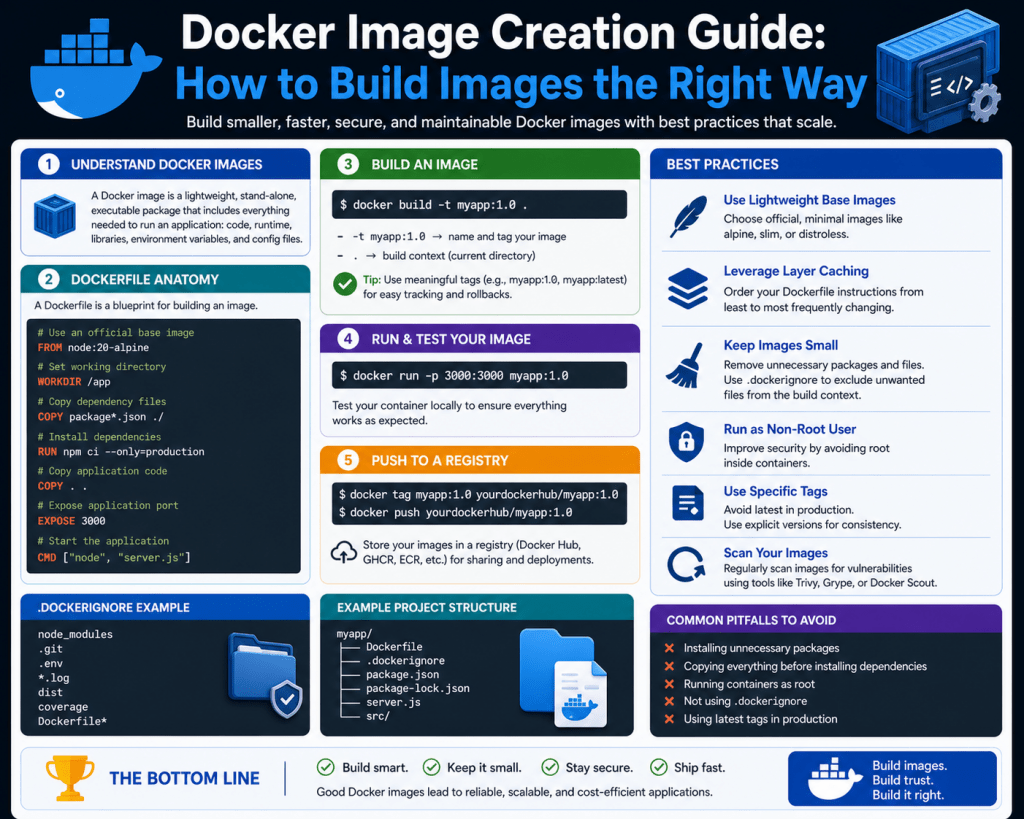
Docker represents a modern approach to software deployment that focuses on packaging applications into isolated environments called containers. These containers allow software to run consistently regardless of the underlying system configuration. Instead of installing applications directly on an operating system and dealing with compatibility issues, containerization wraps the application along with its required dependencies into a single unit. This unit can then be executed in any environment that supports container runtime functionality. The primary goal is to eliminate the differences between development, testing, and production environments so that software behaves the same everywhere. This consistency has become increasingly important as applications are now frequently deployed across cloud infrastructure, hybrid systems, and distributed architectures. Docker achieves this by using a lightweight virtualization approach that avoids the overhead of traditional virtual machines while still maintaining strong isolation between applications. In modern software engineering, this approach has shifted how developers design, test, and deploy applications, enabling faster release cycles and improved system reliability. It also reduces the complexity of managing software dependencies, which has historically been one of the most challenging aspects of application deployment. By standardizing how applications are packaged and executed, Docker provides a predictable and efficient deployment model that aligns with the needs of scalable and distributed systems.
Operating System Level Virtualization Explained
At the core of Docker lies operating system-level virtualization, a method that allows multiple isolated user spaces to run on a single operating system kernel. Unlike hardware virtualization, which creates complete virtual machines with separate operating systems, this model shares the host system’s kernel while isolating application processes. The kernel is responsible for managing critical system resources such as memory allocation, process scheduling, and hardware communication. In a containerized environment, multiple containers share this kernel but operate as if they are independent systems. Each container has its own file system view, network configuration, and process space, ensuring that applications do not interfere with one another. This isolation is achieved through kernel features such as namespaces and control groups, which separate system resources and enforce usage limits. The result is a highly efficient environment where multiple applications can run on the same machine without conflicts. Because containers do not require full operating systems, they consume significantly fewer resources and start much faster than virtual machines. This efficiency allows organizations to maximize hardware utilization while maintaining strong application isolation. It also simplifies deployment because the same host system can support many independent services without requiring additional infrastructure.
How Containers Differ from Traditional Virtual Machines
Containers and virtual machines both provide isolation for applications, but they differ significantly in architecture and resource usage. Virtual machines simulate entire hardware systems and require a full guest operating system for each instance. This means that every virtual machine includes its own kernel, system libraries, and background services. As a result, virtual machines are resource-intensive and take longer to start because they must boot an entire operating system. Containers, in contrast, share the host operating system’s kernel and only include the necessary application dependencies. This makes them significantly lighter in size and faster to initialize. While virtual machines are often measured in gigabytes due to their full operating system overhead, containers are typically much smaller because they only package application-specific components. Another key difference lies in scalability. Virtual machines require substantial resources to scale, whereas containers can be replicated quickly and efficiently across systems. This makes containers more suitable for environments where applications need to scale dynamically based on demand. Additionally, containers provide a more consistent runtime environment because they bundle all dependencies with the application, reducing the risk of configuration differences across systems. Virtual machines still play an important role in scenarios requiring full system isolation, but containers have become the preferred choice for modern application deployment due to their efficiency and flexibility.
Portability and Cross-Platform Execution
One of the most significant advantages of container technology is its portability. Applications packaged inside containers can run consistently across different computing environments without modification. This is because containers include everything needed to run the application, including libraries, runtime components, and configuration settings. As long as the host system supports container execution, the same container can run on a developer’s laptop, a testing server, or a cloud-based production environment. This eliminates the common issue of environment inconsistency, where software behaves differently depending on where it is deployed. Portability also improves collaboration between development teams, as the same container image can be shared and executed across different systems without compatibility concerns. This uniformity reduces debugging time and minimizes deployment errors caused by missing dependencies or version mismatches. Additionally, container portability supports hybrid and multi-cloud strategies, allowing organizations to move applications between different infrastructure providers without rewriting or reconfiguring the software. This flexibility is particularly valuable in modern IT environments where workloads are distributed across multiple platforms. By ensuring that applications are self-contained and environment-independent, containers provide a reliable foundation for scalable and portable software systems.
Internal Structure of Container Images
Container images are built using a layered architecture that defines how applications are packaged and executed. Each layer represents a specific set of instructions that modify the base environment. These layers are stacked on top of each other to form a complete application image. The base layer typically contains a minimal operating system environment, while subsequent layers add application code, dependencies, and configuration settings. This layered structure improves efficiency because unchanged layers can be reused across multiple images. For example, if several applications use the same base system layer, that layer does not need to be duplicated for each image. This reduces storage requirements and speeds up the build process. Another important aspect of layered architecture is caching. When an image is rebuilt, only the layers that have changed need to be recreated, while unchanged layers are retrieved from cache. This significantly reduces build time during development. The layered design also supports version control, allowing developers to track changes to specific parts of an application environment. Each layer is immutable once created, ensuring consistency and reliability across deployments. This structure makes container images highly efficient, reusable, and easy to manage in complex software systems.
Why Containerization Became Essential in Modern Development
The increasing complexity of software systems has made traditional deployment methods less efficient and more error-prone. Applications now often consist of multiple interconnected services that must run reliably across distributed environments. Containerization addresses these challenges by providing a standardized way to package and deploy software. It eliminates inconsistencies between environments, reduces dependency conflicts, and improves overall system reliability. In modern development workflows, speed and consistency are critical. Containers enable rapid iteration by allowing developers to build, test, and deploy applications quickly without worrying about underlying system differences. They also support modular application design, where large systems are broken into smaller independent services that can be developed and deployed separately. This modularity improves scalability and makes systems easier to maintain. Additionally, containerization aligns well with cloud-native architectures, where applications are designed to run in dynamic, scalable environments. By abstracting away infrastructure differences, containers allow developers to focus on application logic rather than system configuration. This shift has fundamentally changed how software is built and delivered, making container technology a central component of modern computing environments.
Solving Software Dependency Challenges in Modern Application Development
One of the most persistent challenges in software engineering has always been managing dependencies. Applications rarely function as standalone systems; they rely on external libraries, frameworks, runtime environments, and system-level configurations. Over time, these dependencies can become complex, especially when different applications require different versions of the same library. This often leads to conflicts where one application works correctly while another fails due to incompatible versions. Containerization addresses this issue by bundling all required dependencies directly within the application container. Instead of relying on the host operating system to provide the correct environment, each container includes everything needed to run the application. This self-contained approach ensures that applications do not interfere with each other, even when they are running on the same system. It also removes the need for manual dependency installation, which is often a source of human error. By encapsulating dependencies within isolated environments, container systems create predictable execution conditions that remain stable across different machines and infrastructures. This significantly reduces the time spent troubleshooting environment-related issues and allows developers to focus more on building application functionality rather than managing system configurations.
Achieving Consistency Across Development, Testing, and Production Environments
Software behavior often varies depending on the environment in which it is executed. In traditional development workflows, applications are built in one environment, tested in another, and deployed in a production environment that may differ significantly from the previous two. These differences can lead to unexpected bugs and system failures that are difficult to diagnose. Containerization solves this problem by ensuring that the same application environment is used across all stages of development and deployment. Since containers package the application along with its dependencies and configuration, they behave consistently regardless of where they are executed. This eliminates the classic issue of “it works on my machine but not on production.” Consistency also improves collaboration between teams because developers, testers, and system administrators all work with identical environments. This reduces miscommunication and ensures that issues can be reproduced accurately during debugging. The ability to maintain uniform environments across the entire software lifecycle has made containerization a foundational practice in modern application delivery systems, particularly in environments where rapid updates and continuous deployment are required.
Container Images as Standardized Application Blueprints
Container images serve as the foundation for creating running containers. An image is essentially a static, read-only blueprint that defines how an application environment should be constructed. It includes everything from the base operating environment to application code and required dependencies. When a container is launched, it is created from this image, ensuring that every instance of the application is identical. This standardization is critical in large-scale systems where multiple instances of the same application must run simultaneously across different servers or cloud regions. Images are created through a defined set of instructions that specify each step of the build process. These instructions are executed sequentially to construct the final environment. Once created, images can be stored, shared, and reused across multiple systems. This reusability significantly improves efficiency because developers do not need to rebuild environments from scratch each time an application is deployed. Instead, the same image can be used repeatedly to create consistent containers. This approach also supports version control, allowing different versions of an application to be maintained and deployed independently. As a result, container images act as standardized, portable blueprints that simplify complex deployment workflows.
Layered Architecture and Efficient Image Construction
A defining feature of container images is their layered architecture. Each image is composed of multiple layers, where each layer represents a specific modification or instruction applied during the build process. The base layer typically includes a minimal operating system environment, while additional layers add application code, dependencies, and configuration settings. These layers are stacked on top of one another to form a complete image. This design provides several important advantages. First, it improves efficiency by allowing shared layers to be reused across multiple images. If different applications use the same base environment, that layer is stored only once, reducing duplication. Second, it speeds up the build process through caching. When an image is rebuilt, only the layers that have changed need to be recreated, while unchanged layers are retrieved from cache. This reduces build time significantly, especially in large projects with frequent updates. Third, layered architecture enhances maintainability. Since each layer is independent, changes can be made to specific parts of the application without affecting the entire system. This modular structure makes container images easier to manage and optimize over time.
Improving Software Deployment Through Standardization
Traditional software deployment often involves manual configuration steps that can vary between environments. These variations introduce complexity and increase the likelihood of errors during deployment. Containerization simplifies this process by introducing standardization at every stage. Instead of configuring systems individually, applications are deployed using pre-defined container images that already contain all necessary configurations. This ensures that deployment processes are consistent and repeatable. Standardization also reduces the time required to deploy new applications or update existing ones. Since the environment is already defined within the container image, deployment becomes a matter of launching a pre-built unit rather than configuring a system from scratch. This approach is particularly valuable in large-scale infrastructures where multiple applications need to be deployed simultaneously. It also improves reliability because the same deployment process is used across all environments, reducing the risk of human error. As software systems become more complex and distributed, standardization through containerization has become an essential practice for maintaining operational efficiency.
Automation and Continuous Integration in Container-Based Workflows
Modern software development relies heavily on automation to improve efficiency and reduce manual intervention. Containerization plays a key role in enabling automated workflows, particularly in continuous integration and continuous deployment systems. In these workflows, code changes are automatically built, tested, and deployed using standardized container environments. This ensures that every stage of the process uses the same runtime configuration, eliminating inconsistencies between development and production systems. Automation also accelerates the development cycle by allowing rapid testing and deployment of new features. When a developer submits new code, the system can automatically create a container image, run tests inside a controlled environment, and deploy the application if all tests pass. This reduces the time required to release updates and improves overall software quality. Additionally, automation reduces the likelihood of human error, as repetitive tasks are handled by standardized processes rather than manual intervention. Container-based automation has therefore become a key component of modern software delivery pipelines.
Scalability and Resource Efficiency in Containerized Systems
Scalability is a critical requirement for modern applications, especially those that experience fluctuating workloads. Containerization provides an efficient way to scale applications by allowing multiple instances of the same container to run simultaneously. Since containers are lightweight and consume fewer resources than traditional virtual machines, they can be deployed quickly across multiple systems. This makes it easier to handle increased demand without requiring significant infrastructure changes. Resource efficiency is another important advantage of containers. Because they share the host operating system kernel, containers use fewer system resources such as memory and storage. This allows more applications to run on the same hardware, improving overall system utilization. Resource allocation can also be controlled at the container level, ensuring that each application uses only the resources it needs. This prevents resource contention and improves system stability. Together, scalability and efficiency make containerization a powerful solution for managing modern distributed systems.
Isolation and Process Separation in Container Environments
Isolation is a fundamental principle of container technology. Each container operates in its own isolated environment, with separate file systems, processes, and network configurations. This ensures that applications do not interfere with each other, even when they are running on the same host system. Process isolation is achieved using operating system features that separate resource usage between containers. This prevents one container from accessing or modifying the internal state of another container. File system isolation ensures that each container has its own view of the file system, even though they may share underlying system resources. Network isolation allows containers to have separate network interfaces and communication rules. This level of isolation improves security and stability by limiting the impact of potential failures or vulnerabilities. Even if one container encounters an issue, it does not affect other containers running on the same system. This makes containerized environments more resilient and reliable compared to traditional deployment models.
Role of Containerization in Modern Distributed Systems
As software systems become increasingly distributed, the need for consistent and efficient deployment mechanisms has grown. Containerization provides a unified approach to managing distributed applications by ensuring that each component runs in a standardized environment. This is particularly important in microservices architectures, where applications are divided into smaller independent services that communicate over networks. Each service can be deployed as an individual container, allowing for independent scaling and management. This modular approach improves system flexibility and makes it easier to update or replace individual components without affecting the entire system. It also simplifies fault isolation, as issues in one service do not necessarily impact others. In distributed environments, containerization ensures that applications remain portable, scalable, and consistent across different infrastructure layers. This has made it a foundational technology in modern cloud-native system design.
Building Container Images and Understanding the Image Construction Process
Containerized applications begin with the creation of an image, which serves as a structured blueprint for how an application environment should be assembled and executed. An image is not a running system but a static definition that contains all instructions required to build a working container instance. These instructions define the base environment, system dependencies, application code, configuration settings, and execution parameters. The image creation process is systematic and layered, ensuring that every step contributes to a reproducible outcome.
When an image is built, the system processes instructions sequentially, forming multiple layers. Each instruction creates a new layer that modifies the previous state. These layers are stored and reused whenever possible, which improves efficiency and reduces redundant work during repeated builds. The first layer usually defines a minimal operating environment, often based on a lightweight system foundation. Subsequent layers introduce required software packages, runtime environments, and application-specific files.
This structured approach ensures that images remain consistent and predictable. Once an image is built, it can be used to create multiple containers that behave identically regardless of where they are executed. This removes uncertainty in deployment environments and ensures that applications are not dependent on manual system configuration.
The build process also introduces a level of traceability. Each layer represents a specific change, making it easier to understand how an application environment was constructed. This layered design allows developers to modify specific parts of an image without rebuilding the entire system, improving efficiency during development cycles.
Execution of Containers from Pre-Built Images
Once an image has been created, it can be executed as a container. The execution process transforms the static image into a running instance that operates within an isolated environment. This instance uses the same definitions provided by the image but functions dynamically as an active process on the host system.
When a container starts, it initializes its environment based on the instructions defined in the image. This includes setting up file systems, configuring network interfaces, and launching the application process. Despite being isolated, the container shares the host operating system kernel, which allows it to operate efficiently without requiring a full operating system instance.
Each container runs independently, even if multiple containers are created from the same image. This independence ensures that changes inside one container do not affect others. Containers can be started, stopped, paused, and restarted without altering the underlying image. This separation between image and runtime instance provides flexibility in managing application lifecycles.
The execution process is also fast because containers do not need to boot an entire operating system. Instead, they initialize only the necessary components required to run the application. This results in significantly reduced startup times compared to traditional virtual machines.
Resource Management and System Efficiency in Container Environments
Container systems are designed to use system resources efficiently. Since containers share the host operating system kernel, they do not require separate operating systems for each instance. This reduces memory usage and improves CPU utilization.
Resource allocation can be controlled at the container level, allowing systems to define how much memory, processing power, and storage each container can use. This prevents any single container from consuming excessive resources and ensures fair distribution across multiple applications.
This controlled allocation is particularly useful in environments where multiple services run on the same infrastructure. It allows administrators to maintain system stability while supporting multiple workloads simultaneously.
Containers also reduce the overhead associated with system initialization. Because they do not need to boot an operating system, they avoid the heavy resource consumption typically associated with virtual machines. This makes them suitable for environments where efficiency and scalability are important.
The lightweight nature of containers allows more applications to run on the same hardware compared to traditional virtualization models. This improves overall infrastructure utilization and reduces operational costs in large-scale systems.
Networking and Communication Between Containers
Containers often need to communicate with each other and with external systems. This is achieved through a structured networking model that assigns each container its own network interface. These interfaces allow containers to send and receive data independently.
Communication between containers can occur within the same host system or across multiple systems in a distributed environment. Networking rules define how containers interact, including which ports are exposed and how data is transmitted.
Port mapping plays an important role in container networking. Internal container ports are mapped to external host ports, allowing external systems to access services running inside containers. This mapping ensures that multiple containers can run similar services without conflicts.
Containers can also be grouped into networks, allowing them to communicate directly without exposing services externally. This is useful in multi-service architectures where different components of an application need to interact securely.
The networking model in container systems is flexible and supports both simple and complex communication patterns. It enables the development of distributed applications that can scale across multiple environments.
Container Lifecycle Management and Operational Control
Containers follow a defined lifecycle that includes creation, execution, monitoring, and termination. Each stage of this lifecycle can be controlled independently, allowing precise management of application behavior.
During creation, a container is instantiated from an image. Once created, it enters the execution phase, where it runs as an active process. During execution, containers can be monitored to track performance, resource usage, and system health.
Containers can be paused or stopped without affecting the underlying image. Pausing a container temporarily suspends its operations while preserving its state. Stopping a container terminates its process but does not delete the image used to create it.
Restarting a container allows it to resume execution using the same configuration. This flexibility makes it easier to manage applications in dynamic environments where services need to be adjusted frequently.
Termination of containers removes the running instance but leaves the image intact. This separation between runtime and image ensures that applications can be redeployed quickly without rebuilding the entire environment.
Lifecycle management is essential in systems where applications are continuously updated and scaled. It allows operators to maintain control over running services while ensuring consistency and reliability.
Security Isolation and Risk Management in Container Systems
Security is a critical aspect of container environments. Although containers share the host operating system kernel, they are designed to operate in isolated environments that limit interaction between applications.
Each container has its own file system, process space, and network configuration. This isolation reduces the risk of one application affecting another. Even if a container becomes compromised, its impact is contained within its isolated environment.
Access control mechanisms define what resources a container can use. These controls limit permissions and restrict access to sensitive system components. This helps prevent unauthorized actions and reduces potential security risks.
Container images also play a role in security. Since images define the entire application environment, ensuring that they are built from trusted sources is essential. Secure image management practices help prevent vulnerabilities from being introduced during the build process.
Isolation does not eliminate all security concerns, but it significantly reduces the attack surface compared to traditional system-level deployments. Proper configuration and management are still required to maintain secure environments.
Scalability and Load Distribution in Container-Based Systems
Scalability is one of the most important advantages of container systems. Applications can be scaled horizontally by creating multiple instances of the same container. These instances can run across different machines or cloud environments, distributing workload efficiently.
When demand increases, additional containers can be deployed quickly to handle the load. When demand decreases, unnecessary containers can be removed to conserve resources. This dynamic scaling allows systems to adapt to changing workloads in real time.
Load distribution ensures that requests are evenly spread across multiple container instances. This prevents any single instance from becoming overloaded and improves system performance.
Container orchestration systems often manage scaling automatically, adjusting the number of active containers based on performance metrics. This automation improves efficiency and reduces manual intervention.
Scalability through containerization is especially important in modern applications that experience unpredictable traffic patterns. It ensures that systems remain responsive and stable under varying conditions.
Role of Container Systems in Modern Infrastructure Architecture
Container technology has become a fundamental part of modern infrastructure design. It supports cloud-native architectures where applications are built as modular, distributed systems.
In these architectures, applications are divided into smaller components that run independently. Each component can be deployed in its own container, allowing for independent development and scaling.
This modular approach improves flexibility and maintainability. Updates can be applied to individual components without affecting the entire system. This reduces downtime and simplifies maintenance.
Container systems also support hybrid infrastructure models, where applications run across multiple environments. This allows organizations to distribute workloads based on performance, cost, and availability requirements.
The ability to abstract infrastructure complexity has made containerization a key enabler of modern software systems. It allows developers to focus on application design while infrastructure management becomes more automated and scalable.
Operational Efficiency and Long-Term System Management
Container systems improve operational efficiency by simplifying deployment, scaling, and maintenance processes. Standardized environments reduce configuration errors and improve system reliability.
Over time, containerized systems are easier to manage because they rely on consistent, repeatable processes. Updates can be rolled out quickly, and older versions can be replaced without disrupting system operations.
This long-term stability makes container systems suitable for large-scale enterprise environments where reliability and performance are critical. The combination of portability, isolation, and efficiency ensures that containerization remains a central technology in modern computing infrastructure.
Conclusion
Container technology has fundamentally changed how software is developed, deployed, and maintained across modern computing environments. Its importance goes beyond being a development tool and extends into the core structure of how distributed systems are designed today. By introducing lightweight, portable, and isolated execution environments, container systems have replaced many of the inefficiencies that existed in traditional deployment models. The shift from hardware-centric virtualization to operating system-level virtualization represents a major evolution in infrastructure design, enabling applications to become more flexible, scalable, and consistent across different environments.
One of the most significant contributions of containerization is the standardization of application environments. In earlier software development models, applications often behaved differently depending on where they were deployed. This inconsistency created long debugging cycles, deployment failures, and unpredictable system behavior. Container systems resolve this issue by packaging applications along with their dependencies, configuration settings, and runtime requirements. As a result, the same application behaves identically in development, testing, and production environments. This consistency has improved software reliability and reduced operational complexity across the entire lifecycle of application delivery.
Another major impact of container technology is the separation of applications from infrastructure. In traditional environments, applications were tightly bound to the underlying operating system, which created dependency conflicts and limited portability. Containerization removes this dependency by allowing applications to run in isolated environments that share only the host kernel. This abstraction makes it possible to deploy applications across different systems without modification. Whether an application runs on a local machine, a cloud platform, or a hybrid infrastructure, its behavior remains consistent. This portability has become essential in modern computing, where systems are no longer confined to a single environment but are distributed across multiple platforms and regions.
Efficiency is another critical advantage introduced by container systems. Unlike virtual machines, which require full operating systems for each instance, containers share the host system’s kernel. This significantly reduces memory usage, storage requirements, and startup times. The lightweight nature of containers allows organizations to run more applications on the same hardware, improving resource utilization and reducing infrastructure costs. This efficiency is particularly valuable in large-scale environments where hundreds or thousands of services may need to run simultaneously. By minimizing overhead, container systems enable organizations to optimize performance without increasing hardware investment.
Scalability is also greatly enhanced through containerization. Modern applications often experience fluctuating workloads that require dynamic resource allocation. Container systems allow new instances of an application to be created quickly in response to increased demand. These instances can be distributed across multiple systems, ensuring balanced workloads and maintaining performance stability. When demand decreases, unnecessary instances can be removed, freeing up resources for other applications. This elasticity makes container-based systems highly adaptable to real-world usage patterns, especially in cloud environments where demand can change rapidly and unpredictably.
In addition to scalability, container systems improve system resilience. Since each container operates in an isolated environment, failures are contained within individual instances without affecting the entire system. This isolation reduces the risk of system-wide failures and improves overall reliability. If one container encounters an issue, it can be restarted or replaced without disrupting other services. This fault-tolerant design is particularly important in distributed systems where continuous availability is required. It ensures that applications remain operational even in the presence of failures or unexpected conditions.
Another important aspect of container technology is its role in enabling modern software development practices. Development methodologies have shifted toward continuous integration and continuous delivery, where applications are frequently updated and deployed. Container systems support these practices by providing consistent and reproducible environments for building, testing, and deploying software. Automated pipelines can use container images to ensure that every stage of development uses the same configuration, reducing inconsistencies and improving deployment accuracy. This automation accelerates development cycles and allows organizations to release updates more frequently while maintaining stability.
Security is also enhanced through containerization, although it requires proper configuration and management. Containers provide a level of isolation that limits the interaction between applications, reducing the potential impact of vulnerabilities. Each container operates in its own environment, with controlled access to system resources. This reduces the attack surface compared to traditional deployment models, where applications share the same system environment. However, because containers share the host kernel, maintaining security still requires careful management of permissions, image integrity, and runtime configurations. When properly implemented, container systems contribute to a more secure and controlled computing environment.
From an architectural perspective, containerization has enabled the rise of microservices-based systems. Instead of building large monolithic applications, developers now design systems as collections of small, independent services. Each service can be deployed in its own container, allowing it to be developed, scaled, and maintained independently. This modular approach improves system flexibility and makes it easier to update individual components without affecting the entire application. It also simplifies debugging and enhances system transparency, as each service operates in a well-defined environment.
Container systems have also played a key role in the evolution of cloud computing. Cloud platforms rely heavily on virtualization and resource abstraction, and containers provide a more efficient way to manage workloads in these environments. By enabling fast deployment and dynamic scaling, containers align perfectly with the needs of cloud-native applications. They allow infrastructure to be used more efficiently and support advanced orchestration systems that manage large clusters of applications across distributed environments.
In long-term system management, containerization simplifies maintenance and operational workflows. Standardized environments reduce configuration drift, where systems gradually become inconsistent over time. Since containers are defined by immutable images, they ensure that deployments remain consistent throughout their lifecycle. Updates can be applied by replacing old containers with new ones rather than modifying existing systems. This approach reduces complexity and ensures predictable behavior across infrastructure.
Overall, container technology represents a shift toward more modular, efficient, and scalable computing systems. It has transformed how applications are built and deployed, enabling faster development cycles, improved system reliability, and greater infrastructure flexibility. Its influence continues to expand as modern computing environments become increasingly distributed and cloud-based.