
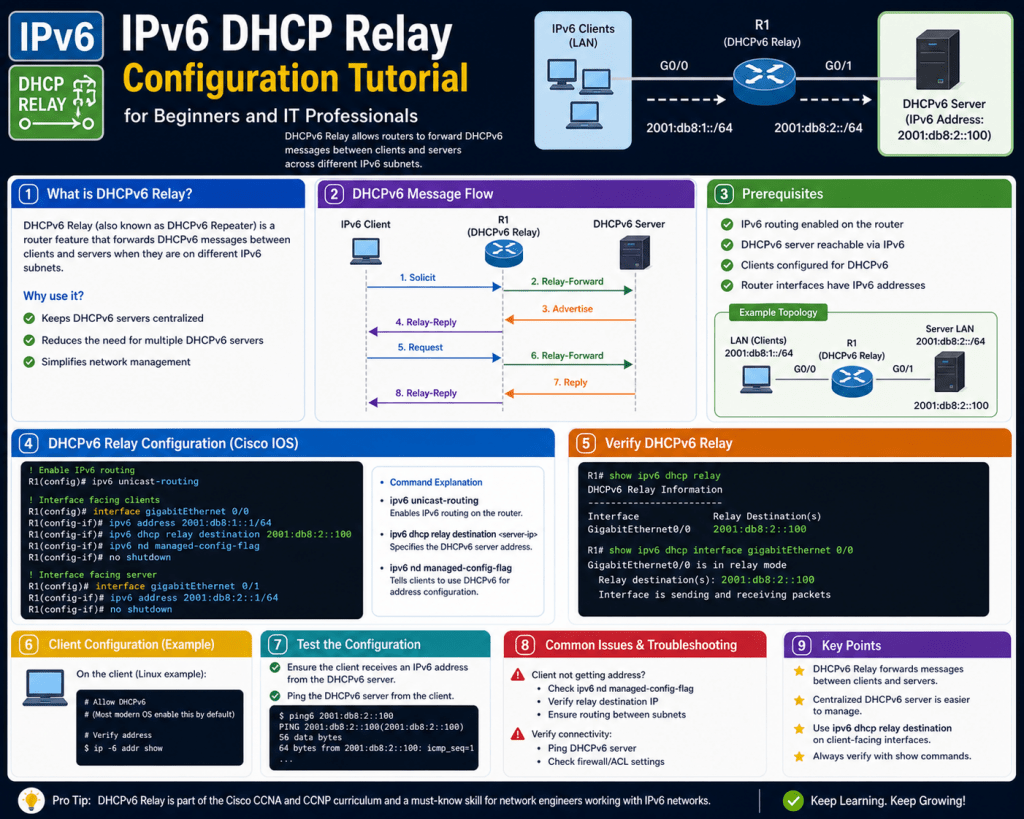
Dynamic Host Configuration Protocol is a core network automation service designed to eliminate manual IP configuration across devices. In both IPv4 and IPv6 environments, it provides a structured method for assigning network parameters such as IP addresses, subnet prefixes, default gateways, and DNS configuration. Without DHCP, administrators would need to configure each endpoint individually, which becomes impractical as networks grow in size and complexity.
The fundamental purpose of DHCP is operational efficiency. Instead of relying on static configuration, devices request network settings dynamically when they join a network. This ensures that endpoints can communicate immediately without requiring manual intervention. It also reduces configuration errors, which are common in large-scale environments where hundreds or thousands of devices may be deployed.
In IPv6 networks, DHCP continues to play an important role even though alternative mechanisms such as stateless address autoconfiguration exist. DHCPv6 is widely used in environments where centralized control is required. It allows administrators to enforce consistent configuration policies and manage address assignment in a controlled and predictable manner. This is particularly important in enterprise networks where compliance, auditing, and structured addressing schemes are required.
Role of the DHCP server in centralized network control
A DHCP server is the authoritative system responsible for managing IP address allocation and distributing network configuration parameters. It operates by maintaining organized pools of available addresses, typically mapped to specific subnets or network segments. When a client requests configuration information, the DHCP server selects an appropriate address from the relevant pool and assigns it along with additional configuration details.
This centralized model simplifies network management significantly. Instead of configuring each device individually, administrators define policies once at the server level. These policies are then applied consistently across all clients. This ensures uniformity in network behavior and reduces the likelihood of misconfiguration.
In addition to addressing assignments, DHCP servers also manage lease durations, renewal processes, and reservation rules. These mechanisms allow certain devices to receive consistent addresses while others receive dynamically allocated ones. In large-scale deployments, DHCP servers often operate in redundant pairs or clusters to ensure high availability. This prevents service disruption in the event of hardware failure or maintenance activities.
In IPv6 environments, DHCP servers are designed to work alongside router advertisement mechanisms. While routers provide basic network prefix information, DHCP servers extend functionality by delivering additional configuration parameters that are not handled by stateless mechanisms.
Challenges of DHCP in multi-subnet IPv6 networks
One of the primary challenges in DHCP-based network design is the limitation of discovery traffic across subnets. DHCP relies on clients sending discovery messages to locate available configuration services. In IPv6, these discovery messages use multicast communication rather than broadcast.
However, multicast traffic in DHCPv6 is restricted to the local link. This means that discovery messages cannot naturally cross router boundaries. As a result, a DHCP server located in one subnet cannot directly receive requests from clients in another subnet.
This limitation becomes more significant in large networks where multiple subnets are distributed across different routing segments. Without a mechanism to extend DHCP communication beyond local links, each subnet would require its own dedicated DHCP server. This approach is inefficient and does not scale well in enterprise environments.
Deploying separate DHCP servers per subnet introduces several operational challenges. Configuration consistency becomes difficult to maintain, administrative overhead increases, and troubleshooting becomes more complex. Additionally, ensuring redundancy across multiple servers significantly increases infrastructure requirements.
Introduction to DHCP relay in IPv6 environments
DHCP relay is a network function designed to overcome the limitation of local-only DHCP discovery traffic. It enables communication between clients and servers that reside on different subnets by forwarding DHCP messages across routed networks.
A DHCP relay agent is typically implemented on a router or layer 3 network device. Its primary function is to listen for DHCP discovery messages on connected interfaces and forward them to a centralized DHCP server. This forwarding process converts local multicast traffic into unicast communication directed at the server.
The relay agent also ensures that responses from the DHCP server are correctly routed back to the originating client subnet. This bidirectional communication allows a single DHCP infrastructure to serve multiple network segments without requiring individual servers in each subnet.
In IPv6 environments, DHCP relay plays a critical role in enabling scalable network design. It bridges the gap between localized multicast discovery and centralized address management, allowing organizations to maintain efficient control over large distributed networks.
How IPv6 multicast affects DHCP communication
IPv6 uses multicast addressing as a primary method for service discovery. In DHCPv6, clients send messages to a specific multicast group designed for DHCP communication. This group is limited to the local link scope, meaning that messages are not forwarded by routers.
The multicast group used for DHCP communication ensures that only devices on the same network segment receive the request. This design reduces unnecessary network traffic and improves efficiency within local subnets. However, it also restricts communication between subnets.
Because routers do not forward link-local multicast traffic, DHCP servers located in different subnets cannot directly receive client requests. This is where DHCP relay becomes essential. The relay agent intercepts multicast messages and forwards them as unicast traffic directed at the appropriate DHCP server.
This transformation allows DHCP communication to extend beyond local network boundaries while preserving the integrity of the original request. It ensures that the DHCP server can process requests from multiple subnets without requiring direct multicast visibility.
Importance of relay function in large-scale network design
In large network environments, scalability is a primary design consideration. DHCP relay supports scalability by reducing the need for a distributed DHCP infrastructure. Instead of deploying a server in every subnet, organizations can centralize DHCP services and use relay agents to extend functionality across the network.
This centralized approach simplifies administration. Network policies, address pools, and configuration parameters can be managed from a single location. Changes made at the DHCP server automatically apply across all connected subnets, ensuring consistency and reducing configuration drift.
From an operational standpoint, centralized DHCP with relay support also improves reliability. Fewer servers mean fewer points of failure, and redundancy can be implemented more efficiently at the central level. This reduces hardware requirements and simplifies maintenance procedures.
In contrast, decentralized DHCP deployment increases complexity. Each subnet requires independent configuration, monitoring, and troubleshooting. As the number of subnets grows, this approach becomes increasingly difficult to manage effectively.
Routers as DHCP relay agents in IPv6 networks
Routers serve as the primary devices responsible for implementing DHCP relay functionality. In IPv6 networks, routers are configured to monitor DHCP traffic on their interfaces. When a DHCP discovery message is detected, the router processes and forwards it to a configured DHCP server.
This forwarding process preserves essential information about the originating subnet. The DHCP server uses this information to assign an appropriate address from the correct address pool. This ensures that clients receive configuration parameters that match their network location.
Routers also maintain awareness of multicast group memberships relevant to DHCP communication. By joining specific multicast groups, they can detect and process DHCP-related messages efficiently. This allows them to act as intermediaries between clients and centralized services without disrupting normal routing behavior.
In addition to relay functions, routers also participate in IPv6 network configuration through router advertisements. These advertisements can include flags that indicate whether clients should use DHCP for additional configuration parameters. This coordination ensures that clients are properly guided in how they obtain network settings.
Network scalability through centralized DHCP architecture
Centralized DHCP architecture supported by relay agents provides a structured and scalable approach to network management. By consolidating DHCP services, organizations can maintain consistent configuration policies across all network segments.
This model reduces administrative complexity. Instead of managing multiple DHCP servers, administrators work with a single or a limited set of centralized systems. This simplifies configuration updates and reduces the risk of inconsistencies between different parts of the network.
It also improves visibility into network activity. Centralized DHCP logging provides a unified view of address assignments, lease usage, and client behavior. This information is valuable for capacity planning, troubleshooting, and network optimization.
From a design perspective, centralized DHCP with relay support aligns with modern network architecture principles that emphasize simplicity, consistency, and scalability. It enables organizations to grow their networks without proportionally increasing management complexity.
Transition to relay operation and configuration concepts
Understanding the foundational role of DHCP relay in IPv6 networks provides the basis for more detailed operational implementation. The relay mechanism integrates multicast discovery, unicast forwarding, and centralized address management into a unified system that supports distributed network environments.
In practical network deployments, relay functionality is typically configured on routers that connect client subnets to the broader routed infrastructure. These devices become responsible for ensuring that DHCP communication flows correctly between endpoints and centralized services.
The next stage of understanding focuses on how relay behavior interacts with interface-level configuration, router advertisement settings, and verification processes used to confirm correct operation across the network topology.
How DHCP relay processes client requests in IPv6 networks
In IPv6 environments, a DHCP relay operates as an intermediary system that captures client-generated DHCP messages and forwards them toward a centralized DHCP server. This process begins when a client attempts to join the network and sends a DHCPv6 Solicit message using multicast communication. Because this message is restricted to the local link, it is initially visible only to devices within the same subnet.
When a router configured as a relay agent receives this multicast request, it does not process it as a routing decision in the traditional sense. Instead, it identifies the packet as DHCP-related traffic and prepares it for relay handling. The router encapsulates the original client request and constructs a new unicast message directed toward the configured DHCP server.
This transformation is critical because it allows DHCP communication to cross subnet boundaries that would otherwise block multicast traffic. The relay agent preserves essential metadata about the client request, including the originating interface and subnet context. This ensures that the DHCP server can respond appropriately based on the correct address pool.
Once the DHCP server receives the relayed request, it treats it as a standard DHCP discovery event. It then selects an appropriate IPv6 address and associated configuration parameters from its database and prepares a response. This response is then sent back to the relay agent, which forwards it to the original client subnet.
Role of multicast scope in DHCPv6 communication
IPv6 networking relies heavily on multicast communication for service discovery, and DHCPv6 is no exception. The multicast group used for DHCP communication is limited to link-local scope, meaning that packets are only valid within the same physical or logical network segment.
This restriction is intentional and designed to reduce unnecessary network traffic across routed environments. By limiting multicast propagation, IPv6 ensures that discovery mechanisms remain efficient and localized. However, this design also creates a limitation when services such as DHCP are centralized.
Since multicast traffic does not cross routers by default, DHCP servers located outside the local subnet cannot directly receive discovery messages. This is the primary reason DHCP relay functionality is required in multi-subnet environments.
The relay agent effectively converts multicast traffic into unicast traffic, which is routable across the network. This allows DHCP communication to extend beyond the local link while preserving the original intent of the client request.
Router behavior when acting as a DHCP relay agent
When a router is configured to function as a DHCP relay agent, it assumes additional responsibilities beyond standard packet forwarding. It listens specifically for DHCPv6 traffic on connected interfaces and inspects incoming multicast packets for relay eligibility.
Upon detecting a DHCP Solicit message, the router does not modify the original content of the request. Instead, it encapsulates the packet and adds relay-specific information, such as the receiving interface identifier and optionally the source address context. This information is essential for the DHCP server to determine which subnet the request originated from.
The router then forwards the encapsulated request to the configured DHCP server using unicast communication. This ensures that the message can traverse multiple routing hops without being constrained by multicast limitations.
In addition to forwarding requests, the router also maintains awareness of DHCP-related multicast group memberships. This allows it to efficiently filter and process relevant traffic without impacting other routing functions.
Interaction between router advertisements and DHCP relay
In IPv6 networks, router advertisements play an important role in informing clients about network configuration options. These advertisements are sent periodically by routers and contain information such as network prefixes, default gateway settings, and configuration flags.
One of the key elements in router advertisements is the managed configuration flag. When this flag is enabled, it signals to client devices that they should use DHCPv6 for obtaining certain configuration parameters. This creates coordination between stateless configuration mechanisms and DHCP-based configuration.
When a DHCP relay agent is deployed, router advertisements and DHCP relay work together to guide client behavior. The router advertisement informs the client that DHCP services are available and should be used, while the relay agent ensures that DHCP requests reach the centralized server.
This combination allows networks to maintain flexibility in how configuration is delivered while still relying on centralized control where needed.
The encapsulation process used by DHCP relay agents
The core technical function of the DHCP relay in IPv6 is packet encapsulation. When a client sends a DHCP request, the original packet contains information that is valid only within the local link scope. The relay agent must preserve this information while also making the packet routable.
To achieve this, the relay agent creates a new outer packet that uses unicast addressing directed toward the DHCP server. Inside this outer packet, the original client request is embedded as payload data. Additional relay information is also included to provide context for the DHCP server.
This encapsulation ensures that the original request remains intact and unmodified while still being able to traverse routed networks. When the DHCP server receives the packet, it removes the outer layer and processes the original request as if it had been received directly from the client subnet.
This mechanism is essential for maintaining compatibility with DHCP protocol expectations while extending functionality across complex network topologies.
DHCP relay response handling and return path processing
Once the DHCP server processes a client request, it generates a response that must be returned to the originating subnet. In IPv6 DHCP relay scenarios, this response is sent back to the relay agent rather than directly to the client.
The relay agent then forwards the response to the appropriate client interface. This ensures that the response follows the correct network path and reaches the intended device.
This return process is symmetrical to the request forwarding mechanism. The relay agent maintains state information about active DHCP transactions to ensure that responses are correctly mapped to original requests.
This behavior is critical in environments with multiple subnets because it ensures that DHCP responses are not misdirected or lost in transit.
Addressing consistency and subnet awareness in relay environments
One of the key advantages of DHCP relay is its ability to maintain subnet-aware address assignment. Even though DHCP servers are centralized, they still need to assign addresses that correspond to the correct subnet.
The relay agent plays a critical role in preserving subnet context. When forwarding a DHCP request, it includes information about the interface on which the request was received. The DHCP server uses this information to determine which address pool should be used for assignment.
This ensures that clients always receive addresses that are valid within their local network segment. Without this mechanism, centralized DHCP servers would be unable to differentiate between requests from different subnets.
Subnet awareness is essential for maintaining proper routing behavior and ensuring that devices can communicate correctly within their designated network segments.
Multicast group participation and DHCP relay detection
IPv6 routers configured for DHCP relay must participate in specific multicast groups to detect relevant traffic. One of the key multicast groups used in DHCPv6 communication is reserved for DHCP agents and servers within the local link scope.
By joining this multicast group, the router ensures that it can receive DHCP discovery messages from clients. This allows the relay agent to intercept relevant traffic without needing to inspect all network packets.
Multicast group participation is an efficient mechanism for filtering traffic at the network layer. It ensures that routers only process DHCP-related messages when necessary, reducing unnecessary processing overhead.
This selective listening behavior is essential for maintaining performance in large-scale networks where high volumes of multicast traffic may be present.
Relay agent interaction with multiple DHCP servers
In more advanced network architectures, DHCP relay agents may be configured to forward requests to multiple DHCP servers for redundancy and load balancing. This ensures that DHCP services remain available even if one server becomes unreachable.
When multiple servers are configured, the relay agent can distribute requests based on predefined rules or simply forward copies of the request to all servers. Each server then responds independently, and the relay agent selects the appropriate response to forward to the client.
This approach enhances fault tolerance and ensures that DHCP services remain resilient in the face of infrastructure failures.
It also allows organizations to scale DHCP infrastructure horizontally without changing client-side configuration.
Timing and lease negotiation behavior in relayed environments
DHCP in IPv6 involves a sequence of message exchanges that establish address leases between clients and servers. When relay agents are involved, these exchanges may traverse multiple network segments, introducing additional considerations for timing and synchronization.
Despite this added complexity, the DHCP protocol maintains a structured exchange process that ensures reliable communication. Clients initiate requests, servers respond with offers, clients confirm acceptance, and servers finalize the lease assignment.
The relay agent simply facilitates the transport of these messages without altering their logical sequence. This ensures that DHCP behavior remains consistent regardless of network topology.
Proper timing and sequencing are essential to prevent lease conflicts and ensure that address assignments remain stable across distributed environments.
Transition toward configuration and verification processes
Understanding how DHCP relay operates at the packet level provides a foundation for implementing and verifying relay configurations in real networks. The interaction between multicast discovery, unicast forwarding, and centralized DHCP processing forms the core operational model.
In practical deployments, relay configuration is applied at the interface level on routers that connect client subnets to upstream network infrastructure. These configurations enable devices to intercept DHCP traffic and forward it appropriately.
The next stage of understanding involves examining how these configurations are implemented in network devices and how operational verification ensures that relay behavior is functioning correctly across all connected segments.
Configuring ipv6 dhcp relay on router interfaces
Configuring DHCP relay in an IPv6 environment is primarily an interface-level operation performed on layer 3 devices such as routers. The relay function is enabled on the interface that directly connects to client devices, not on the interface facing the DHCP server. This distinction is critical because the relay agent must first intercept client-originated multicast traffic before forwarding it toward the server.
The configuration process begins by entering the interface context where IPv6 clients reside. Once inside the interface configuration mode, the relay function is activated by defining the DHCP server’s IPv6 address as the relay destination. This instructs the router to forward any DHCPv6 discovery messages it receives on that interface to the specified server using unicast communication.
At a functional level, this configuration transforms the router into a DHCP intermediary. It does not generate DHCP responses or assign addresses itself unless explicitly configured as a DHCP server. Instead, it focuses on detection, encapsulation, and forwarding of DHCP messages.
In many enterprise deployments, this configuration is repeated across multiple interfaces on different routers. Each interface corresponds to a different subnet, allowing a single centralized DHCP server to support multiple network segments efficiently.
Understanding relay destination addressing and forwarding behavior
The relay destination configuration defines the IPv6 address of the DHCP server that will receive forwarded requests. This address is typically reachable through the routed network infrastructure and is often located in a centralized data center or service subnet.
When a DHCPv6 Solicit message is received on a client-facing interface, the relay agent encapsulates the packet and forwards it to this destination address. The forwarding process uses unicast transmission, which ensures that the message can traverse multiple routing hops without being restricted by multicast boundaries.
The relay agent may also specify an outgoing interface for the forwarded traffic. This is particularly important in scenarios where multiple paths or interfaces exist between the relay device and the DHCP server. Defining the outgoing interface ensures deterministic routing behavior and avoids ambiguity in packet forwarding.
This mechanism allows DHCP communication to function seamlessly across complex routed topologies while maintaining precise control over traffic flow.
Role of interface configuration in relay functionality
Interface configuration is the operational foundation of DHCP relay in IPv6 networks. Each interface on a router represents a distinct broadcast or multicast domain, and relay behavior is applied individually to each of these domains.
When relay is enabled on an interface, the router begins monitoring that interface for DHCPv6 multicast traffic. This includes Solicit, Request, and other DHCP-related messages originating from client devices. The router does not interfere with unrelated traffic, ensuring that normal routing operations remain unaffected.
The interface configuration also determines how the router interprets and processes incoming DHCP messages. It provides context about the subnet, which is later used by the DHCP server to assign appropriate addresses.
Without proper interface-level configuration, a DHCP relay cannot function correctly, as the router would have no mechanism to associate client requests with specific network segments.
Enabling managed configuration through router advertisements
In IPv6 networks, router advertisements play an important role in guiding client behavior. These advertisements are periodically sent by routers and contain network configuration information such as prefix length, default gateway, and configuration flags.
One of the key flags used in DHCP-enabled environments is the managed configuration flag. When this flag is enabled, it indicates that clients should use DHCPv6 to obtain network configuration parameters.
This flag does not directly perform DHCP assignment but instead signals client devices to initiate DHCP communication. When used in conjunction with DHCP relay, it ensures that clients are aware that centralized configuration services are available.
The managed configuration flag is particularly useful in environments where both stateless and stateful configuration methods coexist. It provides a standardized way to instruct clients to rely on DHCP services while still allowing router advertisements to deliver basic network connectivity information.
Verifying DHCP relay operation through network behavior analysis
Verification of DHCP relay functionality involves observing actual network behavior to ensure that client requests are being properly forwarded and processed. One of the primary indicators of correct operation is the presence of DHCPv6 message exchanges between client subnets and the centralized DHCP server.
When a client connects to the network, it generates a Solicit message. In a properly configured relay environment, this message is captured by the router and forwarded to the DHCP server. The server then responds with an Advertise message, followed by a sequence of Request and Reply messages that complete the lease assignment process.
Monitoring these exchanges provides clear evidence that relay functionality is working as intended. The presence of unicast traffic between the relay agent and the DHCP server confirms that multicast messages are being successfully translated into routable communication.
Network observation tools are often used to validate this behavior, allowing administrators to confirm that each stage of the DHCP process is functioning correctly across distributed network segments.
Interpreting DHCPv6 message exchange sequences
The DHCPv6 process follows a structured sequence of message exchanges that establish communication between clients and servers. When a relay is involved, this sequence remains logically unchanged but is physically distributed across multiple network segments.
The process begins with a Solicit message from the client, which is forwarded by the relay agent to the DHCP server. The server responds with an Advertise message, indicating available configuration options. The client then sends a Request message to accept the offered configuration, and the server finalizes the process with a Reply message.
Each of these messages is encapsulated and forwarded by the relay agent as necessary. The relay does not alter the logical structure of the exchange but ensures that messages reach their intended destinations across routed networks.
Understanding this sequence is essential for diagnosing issues and confirming that DHCP relay is functioning correctly in complex environments.
Role of relay agents in address pool selection
One of the most important functions of a DHCP relay is enabling correct address pool selection at the server level. Because the DHCP server is centralized, it relies on information provided by the relay agent to determine which subnet a client belongs to.
When a relay agent forwards a DHCP request, it includes metadata about the interface on which the request was received. This information is used by the DHCP server to match the request with the correct address pool.
This ensures that clients receive IP addresses that are valid for their local subnet. Without this mechanism, centralized DHCP servers would be unable to differentiate between requests from different network segments.
Accurate pool selection is essential for maintaining routing consistency and ensuring that devices can communicate effectively within their assigned network boundaries.
Troubleshooting common DHCP relay issues in IPv6 environments
When the DHCP relay is not functioning correctly, issues typically manifest as clients failing to receive IP addresses or experiencing delays in network configuration. These problems often stem from misconfigured relay destinations, incorrect interface settings, or missing routing connectivity to the DHCP server.
One common issue is failure to properly configure the relay agent on the correct interface. If relay is enabled on the wrong interface, client requests may never be intercepted, resulting in failed address assignment.
Another common problem is incorrect or unreachable DHCP server addresses. If the relay agent cannot reach the specified server, forwarded requests will not receive responses, causing clients to remain unconfigured.
Network path issues can also impact relay functionality. If routing between the relay agent and the DHCP server is not properly established, unicast traffic may be dropped or misrouted.
Diagnosing these issues requires a systematic analysis of interface configuration, routing tables, and DHCP message flow to identify where communication breakdowns occur.
Scalability considerations in distributed relay deployments
In large-scale networks, DHCP relay is often deployed across multiple routers and interfaces to support extensive subnet architectures. Each relay instance contributes to a distributed system that enables centralized DHCP management across the entire infrastructure.
Scalability is achieved by minimizing the number of DHCP servers while maximizing the number of relay-enabled interfaces. This allows organizations to expand their network without significantly increasing DHCP infrastructure complexity.
As the network grows, additional relay agents can be deployed on new routers or interfaces without requiring changes to the centralized DHCP configuration. This modular approach simplifies expansion and reduces operational overhead.
It also allows for consistent policy enforcement across all network segments, ensuring that configuration standards remain uniform regardless of network size.
Integration of relay functionality into enterprise network design
In enterprise environments, DHCP relay is a standard component of network design. It supports centralized management principles and enables consistent configuration across distributed locations.
Relay functionality is typically integrated into core routing infrastructure, ensuring that all client subnets are capable of reaching centralized DHCP services. This integration reduces infrastructure duplication and simplifies administrative workflows.
It also supports redundancy and high availability strategies by allowing multiple relay agents and DHCP servers to operate in coordinated configurations.
This design approach aligns with modern enterprise networking principles that emphasize scalability, consistency, and centralized control.
Operational summary of DHCP relay behavior in IPv6 networks
DHCP relay in IPv6 networks functions as a critical intermediary that enables communication between clients and centralized DHCP servers across multiple subnets. It converts local multicast discovery messages into routable unicast traffic, preserves subnet context, and ensures correct address assignment.
By integrating with router interfaces, multicast groups, and router advertisement mechanisms, DHCP relay provides a complete solution for scalable IP address management in distributed environments.
Its role is essential in modern network architectures where centralized control and efficient resource utilization are required to support large numbers of devices across multiple network segments.
Conclusion
In IPv6-based network environments, DHCP relay functions as a critical architectural component that enables scalable and centralized address management across distributed subnets. Without it, DHCP services would remain confined to local link boundaries, forcing organizations to deploy separate DHCP servers for every subnet. This approach quickly becomes unmanageable as network size increases, particularly in enterprise, campus, and service provider infrastructures where segmentation is extensive, and routing domains are highly distributed. DHCP relay resolves this limitation by extending DHCP communication beyond local multicast constraints and allowing centralized servers to service multiple network segments efficiently.
At its core, DHCP relay exists to solve a fundamental mismatch between how IPv6 discovery traffic operates and how modern networks are structured. IPv6 relies on link-local multicast for service discovery, which is intentionally non-routable to preserve efficiency and reduce unnecessary network propagation. While this design is effective for localized communication, it introduces a challenge when services like DHCP are centralized in separate subnets. The relay agent bridges this gap by intercepting multicast messages, encapsulating them, and forwarding them as unicast traffic to a designated DHCP server. This transformation preserves the integrity of the original client request while enabling it to traverse routed network paths.
The operational value of DHCP relay becomes most apparent in large-scale environments where network segmentation is unavoidable. Enterprises commonly design networks using multiple VLANs, subnets, and routed domains to isolate traffic, improve performance, and enhance security. In such architectures, centralized services are preferred for consistency and operational efficiency. DHCP relay enables this centralization by ensuring that IP address allocation can be managed from a single logical location while still serving clients across all network segments. This reduces configuration duplication, minimizes administrative overhead, and ensures uniform policy enforcement.
Another important aspect of DHCP relay is its role in maintaining subnet awareness during address assignment. Even though DHCP servers operate centrally, they must still assign addresses that are valid within the correct subnet context. Relay agents provide this context by inserting interface and subnet information into forwarded requests. The DHCP server uses this information to select the appropriate address pool, ensuring that clients receive configuration parameters that align with their network location. Without this mechanism, centralized DHCP would lack the ability to distinguish between requests originating from different subnets, leading to incorrect address allocation and network connectivity issues.
From a routing perspective, DHCP relay integrates seamlessly into layer 3 infrastructure. Routers configured as relay agents perform dual roles: they continue to forward standard IP traffic while simultaneously processing DHCP-specific multicast messages. This dual functionality allows the relay to be deployed without disrupting existing routing behavior. The router simply monitors relevant interfaces for DHCP traffic, encapsulates detected messages, and forwards them to the configured DHCP server. This makes relay implementation relatively lightweight from an operational standpoint while providing significant functional benefits.
The interaction between DHCP relay and IPv6 router advertisements further enhances network configuration efficiency. Router advertisements inform client devices about network parameters and can indicate whether DHCP services should be used through the managed configuration flag. When this flag is enabled, clients are directed to initiate DHCPv6 communication, which is then handled by relay agents if the DHCP server resides outside the local subnet. This coordination between stateless and stateful configuration mechanisms ensures that clients receive both immediate network connectivity and additional configuration parameters in a structured and predictable manner.
In terms of operational behavior, DHCP relay introduces a clear and structured message flow between clients and servers. The sequence begins with a client sending a Solicit message to discover available configuration services. The relay agent intercepts this message and forwards it to the DHCP server as unicast traffic. The server responds with an Advertise message, followed by a Request from the client and a final Reply confirming lease assignment. This structured exchange remains consistent regardless of network complexity, with the relay agent transparently handling message forwarding between segments. This ensures that DHCP behavior remains predictable even in highly distributed environments.
One of the most significant advantages of DHCP relay is its contribution to network scalability. As organizations grow, the number of subnets and routed segments increases, often dramatically. Without a relay, each new subnet would require additional DHCP infrastructure, leading to exponential growth in configuration complexity. With relay, however, new subnets can be added simply by enabling relay functionality on the relevant interface. The centralized DHCP server continues to operate without modification, making network expansion significantly more efficient.
Reliability is another key benefit of DHCP relay-based architectures. By centralizing DHCP services, organizations can implement redundancy more effectively at a single point rather than across multiple distributed servers. Relay agents can also be configured to forward requests to multiple DHCP servers, providing failover capabilities in case one server becomes unavailable. This ensures that IP address assignment remains consistent and uninterrupted even during maintenance or failure scenarios.
From a troubleshooting perspective, DHCP relay introduces clear diagnostic points within the network. Because the relay operates at the interface level, administrators can isolate issues related to specific subnets or routing paths. If clients fail to receive addresses, the investigation typically focuses on relay configuration, server reachability, or routing connectivity between relay agents and DHCP servers. This structured approach simplifies problem resolution compared to distributed DHCP deployments, where issues may span multiple independent servers.
In modern enterprise design, DHCP relay is not simply an optional feature but a foundational component of scalable network architecture. It aligns with broader networking principles such as centralization, automation, and modularity. By decoupling client-facing subnets from backend service infrastructure, relay enables organizations to build flexible and extensible networks that can evolve without significant redesign.
Ultimately, DHCP relay in IPv6 environments represents a convergence of efficiency, scalability, and operational simplicity. It allows networks to maintain centralized control over IP address management while supporting highly distributed topologies. Its integration with router functionality, multicast processing, and DHCP server logic creates a seamless system that supports modern networking demands. As networks continue to expand in size and complexity, relay mechanisms remain essential for ensuring that IP configuration services remain efficient, reliable, and manageable across all segments.