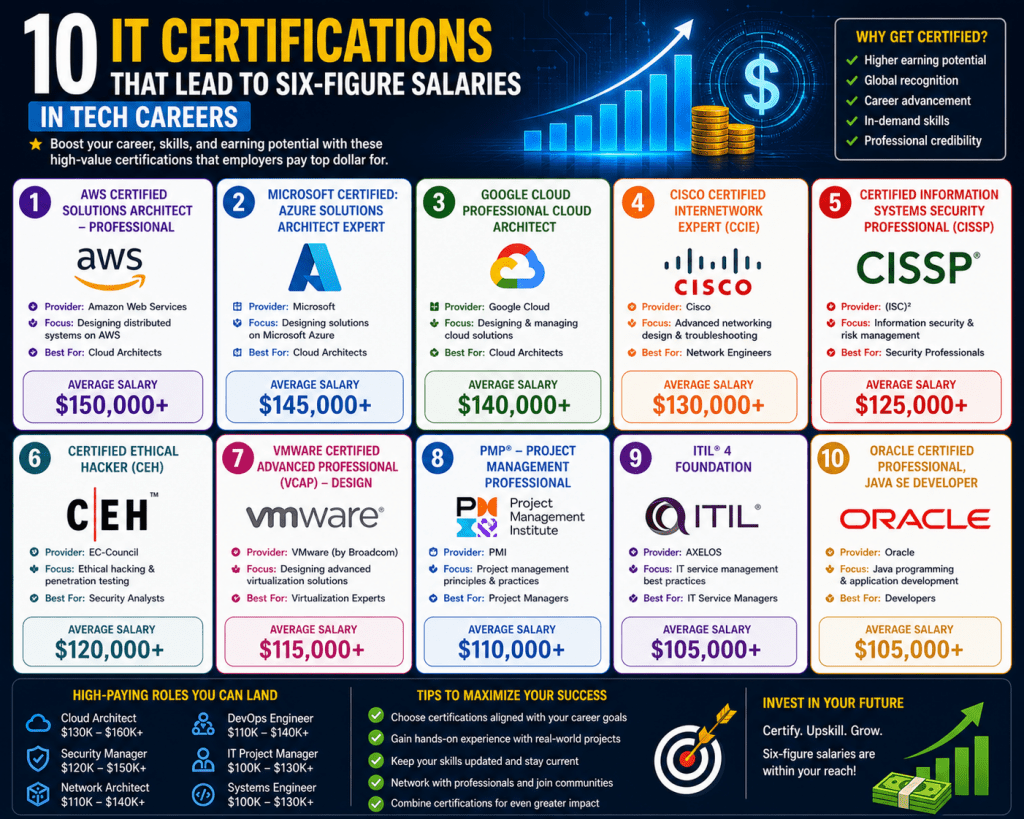
The modern IT industry is shaped by continuous digital transformation, where organizations are increasingly dependent on highly skilled professionals capable of managing complex infrastructure, securing sensitive data, and optimizing large-scale systems. As enterprises expand their reliance on cloud computing, cybersecurity frameworks, and automated network environments, the demand for validated technical expertise has increased significantly. IT certifications serve as standardized benchmarks that help employers assess an individual’s ability to perform in real-world technical roles without extensive onboarding delays.
In this evolving environment, certifications are not just educational milestones but strategic career assets. They demonstrate applied knowledge in specialized domains such as networking, cloud architecture, risk management, and security operations. Employers value certified professionals because they reduce operational uncertainty and bring structured knowledge aligned with industry best practices. This shift has contributed to a competitive job market where certified individuals often gain access to higher salary brackets, leadership opportunities, and specialized technical roles.
The expansion of hybrid infrastructures combining on-premises systems with cloud environments has further intensified this demand. Organizations now require professionals who can seamlessly integrate traditional IT systems with modern cloud-based solutions while ensuring security, scalability, and performance efficiency. This has elevated the importance of certifications that validate both foundational and advanced technical capabilities.
Transformation of IT Infrastructure Through Networking, Cloud, and Security Integration
The foundation of all digital systems lies in networking, which enables communication between devices, applications, and distributed systems. As organizations scale globally, network complexity increases, requiring professionals who understand routing protocols, switching mechanisms, IP management, and network security principles. At the same time, cloud computing has introduced dynamic infrastructure models that demand elasticity, automation, and distributed resource management.
Security has become an equally critical pillar due to rising cyber threats and increasing regulatory requirements. Modern IT environments are no longer isolated systems; they are interconnected ecosystems where a vulnerability in one area can impact the entire infrastructure. This convergence of networking, cloud computing, and cybersecurity has created a strong need for multidisciplinary professionals who can operate across all three domains.
In response to this complexity, certifications have evolved to reflect real-world job roles rather than theoretical knowledge alone. They now focus on scenario-based problem solving, architectural design, risk assessment, and operational decision-making. This shift ensures that certified professionals are better prepared to handle enterprise-level challenges.
Cisco Certified Network Associate and Foundational Networking Expertise
One of the most widely recognized certifications in the networking domain is the Cisco Certified Network Associate credential. It focuses on building strong foundational knowledge in network architecture, IP connectivity, routing protocols, and infrastructure services. Networking remains a critical component of IT operations because it enables communication between servers, applications, and end users across local and global environments.
Professionals who pursue this certification typically work with network configurations, troubleshoot connectivity issues, and ensure stable communication between systems. They are also responsible for implementing basic security measures to protect network infrastructure from unauthorized access and performance degradation. As organizations adopt cloud-based systems, networking professionals are increasingly required to understand hybrid connectivity models that link on-premises infrastructure with cloud environments.
The role of networking specialists has expanded significantly in modern enterprises. They are no longer limited to maintaining physical hardware but are actively involved in designing scalable architectures that support high traffic loads, distributed applications, and virtualized environments. This makes networking expertise a foundational requirement for many advanced IT career paths, including cloud architecture and cybersecurity engineering.
Project Management Professional Certification and Strategic IT Execution
Project management plays a crucial role in aligning technical execution with business objectives. The Project Management Professional credential is widely recognized for validating the ability to manage complex projects, coordinate cross-functional teams, and deliver results within defined constraints such as time, scope, and budget.
In IT environments, project managers are responsible for overseeing initiatives such as system upgrades, cloud migrations, software deployments, and infrastructure modernization. These projects often involve multiple technical teams, including developers, network engineers, security analysts, and system administrators. Effective coordination among these teams is essential for ensuring successful project outcomes.
A key aspect of project management in IT is risk management, which involves identifying potential challenges before they impact project delivery. This includes technical risks such as system incompatibility, security vulnerabilities, and integration failures. Project managers also play a critical role in stakeholder communication, ensuring that business leaders understand project progress, resource requirements, and expected outcomes.
As IT systems become more complex, the need for structured project management continues to grow. Organizations increasingly rely on certified professionals to ensure that technology initiatives are executed efficiently and aligned with strategic business goals.
Cloud Computing Expansion and AWS Solutions Architecture Role
Cloud computing has fundamentally transformed how organizations design, deploy, and manage IT infrastructure. Instead of relying solely on physical servers and data centers, businesses now use cloud platforms to achieve scalability, flexibility, and cost efficiency. This shift has created strong demand for professionals who can design and manage cloud-based systems.
The AWS Certified Solutions Architect Associate credential focuses on designing distributed systems that operate efficiently in cloud environments. Professionals in this role are responsible for selecting appropriate cloud services, configuring secure architectures, and ensuring system reliability under varying workloads. They must also consider factors such as latency, fault tolerance, and cost optimization when designing cloud solutions.
Cloud architects play a critical role in enabling digital transformation initiatives. They help organizations migrate legacy systems to the cloud, optimize existing cloud infrastructure, and implement scalable solutions that support business growth. Their expertise ensures that applications remain available, secure, and performant even under high-demand conditions.
As cloud adoption continues to grow, the role of cloud architects is becoming increasingly strategic. They are no longer limited to technical implementation but are actively involved in shaping enterprise IT strategies and long-term infrastructure planning.
Certified Ethical Hacking and Offensive Security Practices
Cybersecurity has become one of the most critical concerns for modern organizations due to the increasing frequency of cyberattacks and data breaches. Ethical hacking is a proactive approach to security that involves simulating malicious attacks to identify vulnerabilities before they can be exploited by real attackers.
Professionals in this field use penetration testing techniques to evaluate system security across networks, applications, and infrastructure components. They analyze weaknesses in authentication systems, misconfigured services, and insecure communication channels. The goal is to strengthen defenses by identifying and mitigating risks before they lead to security incidents.
Ethical hacking requires a deep understanding of attack methodologies, including phishing techniques, malware behavior, network exploitation, and web application vulnerabilities. Professionals must also be familiar with defensive countermeasures such as intrusion detection systems, firewalls, and encryption protocols.
In enterprise environments, ethical hackers play a vital role in maintaining security posture. Their findings help organizations implement stronger security controls, improve incident response strategies, and ensure compliance with regulatory standards. As cyber threats continue to evolve, the importance of offensive security expertise continues to increase across all industries.
Integration of Technical Disciplines in High-Salary IT Careers
The highest-paying roles in the IT industry are often those that combine multiple areas of expertise. Networking professionals who understand cloud architecture, cloud architects who understand security principles, and project managers who understand technical infrastructure are all highly valued in modern organizations.
This integration reflects the reality of today’s IT environments, where systems are interconnected and interdependent. A change in one area can impact multiple layers of infrastructure, requiring professionals who can analyze systems holistically rather than in isolation.
As a result, certifications that cover advanced and interdisciplinary knowledge tend to offer greater career opportunities and higher salary potential. Employers increasingly seek professionals who can operate across traditional boundaries and contribute to both technical execution and strategic planning.
Cybersecurity as a Core Driver of High-Value IT Careers
Cybersecurity has evolved from a specialized IT function into a core business requirement across nearly every industry. As organizations digitize operations, expand cloud adoption, and rely on interconnected systems, the attack surface for cyber threats has expanded significantly. This has created sustained demand for professionals who can design secure systems, identify vulnerabilities, and respond to security incidents in real time.
The financial impact of cyberattacks has also increased, making security investment a strategic priority rather than an optional expense. Enterprises now allocate substantial budgets to security architecture, risk management frameworks, and compliance enforcement. This shift has elevated cybersecurity certifications into some of the highest-paying credentials in the IT industry.
Security professionals are expected to understand both offensive and defensive strategies. On the defensive side, they implement security controls such as encryption, identity management, and intrusion detection systems. On the offensive side, they analyze attack methods and simulate breach scenarios to uncover weaknesses. This dual perspective is critical for building resilient digital infrastructures.
Modern cybersecurity roles are no longer limited to monitoring systems. They now involve architectural design, policy enforcement, regulatory compliance, and enterprise risk management. This expansion of responsibility has significantly increased salary potential for certified professionals.
Certified Information Systems Security Professional and Enterprise Security Leadership
The Certified Information Systems Security Professional credential is widely regarded as a senior-level certification in the cybersecurity domain. It validates expertise across multiple security domains, including risk management, network security, identity access control, and security architecture.
Professionals holding this certification are typically responsible for designing and managing enterprise-wide security programs. Their role includes defining security policies, ensuring compliance with industry standards, and coordinating incident response strategies. They also work closely with executive leadership to align security initiatives with business objectives.
A key aspect of this certification is its emphasis on holistic security management. Instead of focusing on a single technical area, it covers a broad range of security disciplines, making it suitable for leadership roles. This includes governance structures, security frameworks, and operational controls that ensure organizational resilience against cyber threats.
In large enterprises, security professionals with this certification often lead teams responsible for protecting sensitive data, securing network infrastructure, and managing security audits. Their expertise is critical for maintaining trust, regulatory compliance, and operational continuity.
Certified Information Security Manager and Strategic Risk Governance
The Certified Information Security Manager credential focuses on the management and governance aspects of information security. Unlike purely technical certifications, it emphasizes strategic oversight, risk assessment, and program development.
Professionals in this role are responsible for establishing enterprise security frameworks that align with business goals. They oversee risk management processes, ensuring that potential threats are identified, assessed, and mitigated effectively. This includes evaluating financial, operational, and technological risks associated with IT systems.
A significant part of this role involves designing security programs that integrate with organizational processes. This includes defining policies for data protection, access control, and incident response. Security managers also play a key role in ensuring compliance with regulatory requirements and industry standards.
As organizations become more dependent on digital systems, the need for structured security governance continues to grow. Certified managers are often involved in board-level discussions where they communicate security risks in business terms and recommend investment strategies for risk reduction.
Certified in Risk and Information Systems Control and Enterprise Risk Management
Risk management has become a central discipline in modern IT environments due to the increasing complexity of digital infrastructure. The Certified in Risk and Information Systems Control credential focuses on identifying and managing IT-related risks within enterprise systems.
Professionals in this domain evaluate potential vulnerabilities in information systems and develop strategies to mitigate operational, financial, and security risks. Their work involves analyzing system dependencies, assessing threat likelihood, and implementing control mechanisms to reduce exposure.
A key component of this role is cost-benefit analysis, where professionals evaluate the trade-offs between security investments and potential risk exposure. This ensures that organizations allocate resources efficiently while maintaining adequate protection levels.
Risk professionals also play an important role in compliance and audit processes. They ensure that IT systems meet regulatory requirements and internal governance standards. This includes documenting risk assessments, monitoring control effectiveness, and recommending improvements to security frameworks.
As organizations scale their digital operations, risk management becomes increasingly complex, requiring professionals with both technical and analytical expertise.
AWS Certified Security Specialty and Cloud Security Engineering
Cloud environments introduce unique security challenges due to their distributed and dynamic nature. The AWS Certified Security Specialty credential focuses on securing cloud infrastructure, applications, and data within cloud ecosystems.
Professionals in this field are responsible for implementing identity and access management controls, configuring encryption mechanisms, and securing network traffic within cloud environments. They also monitor cloud systems for anomalies and respond to potential security incidents.
Cloud security engineering requires a deep understanding of shared responsibility models, where security responsibilities are divided between cloud providers and customers. Professionals must ensure that their organization’s configurations align with best practices for securing cloud workloads.
Another critical aspect of cloud security is automation. Security professionals often use automated tools to detect vulnerabilities, enforce compliance policies, and respond to threats in real time. This reduces manual workload and improves response speed in large-scale environments.
As cloud adoption continues to grow, security specialists are becoming essential for ensuring that digital transformation initiatives remain secure and compliant.
Certified Ethical Hacker and Offensive Security Methodologies
Offensive security plays a crucial role in identifying system vulnerabilities before they can be exploited by malicious actors. Certified ethical hacking focuses on simulating real-world attacks to evaluate system defenses.
Professionals in this field use penetration testing techniques to assess network security, application vulnerabilities, and system configurations. They analyze how attackers might gain unauthorized access and develop strategies to prevent such breaches.
This role requires knowledge of multiple attack vectors, including social engineering, malware exploitation, and network intrusion techniques. Ethical hackers must also understand defensive mechanisms to recommend effective security improvements.
In enterprise environments, penetration testing is often conducted on a regular basis to ensure that systems remain secure against evolving threats. Findings from these tests are used to strengthen security controls and improve overall resilience.
Ethical hacking is particularly valuable in industries that handle sensitive data, such as finance, healthcare, and government systems. These sectors rely heavily on proactive security testing to prevent data breaches and ensure regulatory compliance.
AWS Solutions Architecture and Scalable System Design
Cloud architecture has become a fundamental skill in modern IT environments due to the widespread adoption of cloud computing. Solutions architects are responsible for designing scalable, reliable, and cost-effective systems that operate in cloud environments.
This involves selecting appropriate computing resources, designing storage strategies, and configuring network connectivity between services. Architects must also ensure that systems can handle varying levels of demand without performance degradation.
A critical aspect of cloud architecture is fault tolerance. Systems must be designed to remain operational even when individual components fail. This is achieved through redundancy, load balancing, and automated recovery mechanisms.
Cost optimization is another important responsibility. Cloud environments operate on usage-based pricing models, so architects must design systems that balance performance with cost efficiency. This includes selecting appropriate service tiers and optimizing resource utilization.
Cloud architects play a strategic role in digital transformation initiatives, enabling organizations to modernize legacy systems and adopt scalable infrastructure models.
Interdisciplinary Skill Integration in High-Salary IT Roles
High-paying IT roles increasingly require professionals to combine expertise across multiple domains. Networking, security, cloud computing, and project management are no longer isolated disciplines but interconnected components of enterprise IT systems.
For example, a cloud architect must understand networking principles to design efficient communication pathways between services. Similarly, a cybersecurity professional must understand cloud infrastructure to secure distributed systems effectively.
Project managers in IT environments must also possess technical awareness to coordinate teams working on complex infrastructure projects. This includes understanding system dependencies, deployment processes, and security considerations.
This interdisciplinary approach increases professional value in the job market. Employers prioritize candidates who can operate across multiple technical areas and contribute to both strategic planning and technical execution.
Enterprise Transformation Through Cloud and Security Convergence
The convergence of cloud computing and cybersecurity has fundamentally transformed enterprise IT strategies. Organizations are no longer building isolated systems but integrated digital ecosystems that require continuous monitoring and optimization.
Cloud environments provide scalability and flexibility, while security frameworks ensure data protection and regulatory compliance. Together, these disciplines enable organizations to innovate rapidly while maintaining operational security.
This convergence has also influenced certification structures, with many credentials now focusing on integrated skill sets rather than isolated technical knowledge. Professionals who understand both cloud architecture and security principles are particularly valuable in modern IT environments.
As digital transformation accelerates, the demand for professionals who can bridge multiple technical domains continues to grow, reinforcing the importance of advanced certifications in shaping high-paying IT careers.
Data-Driven Enterprises and the Rising Value of Specialized IT Expertise
Modern enterprises operate on data-intensive systems where decision-making, automation, and operational efficiency are increasingly driven by analytics and real-time information processing. This shift has created a strong demand for professionals who can manage secure data environments, design scalable infrastructures, and ensure compliance with evolving regulatory frameworks.
Organizations are no longer simply storing data; they are actively leveraging it for predictive analytics, customer behavior modeling, cybersecurity intelligence, and operational optimization. This transformation has elevated the importance of IT professionals who understand how to secure, manage, and govern data across distributed systems. Certifications that validate expertise in risk management, data protection, and systems architecture are now closely linked to high-paying career paths because they directly support business-critical outcomes.
As digital ecosystems expand, enterprises require professionals who can bridge the gap between technical systems and business intelligence. This includes ensuring data integrity, minimizing downtime, and optimizing system performance across hybrid infrastructures that combine cloud and on-premises environments.
Certified Data Privacy Solutions Engineer and the Future of Data Governance
Data privacy has become a central concern for organizations due to increasing global regulations and heightened awareness of personal data protection. The Certified Data Privacy Solutions Engineer credential focuses on designing and implementing privacy solutions within complex IT environments.
Professionals in this domain are responsible for ensuring that systems comply with privacy requirements while maintaining operational efficiency. This includes defining data classification policies, implementing encryption standards, and designing access control mechanisms that limit unauthorized data exposure.
A critical aspect of this role involves collaboration across multiple departments, including legal, compliance, engineering, and security teams. Privacy engineers must translate regulatory requirements into technical implementations that are scalable and sustainable across enterprise systems.
In modern organizations, data privacy is not treated as an isolated function but as an integrated component of system design. This means privacy considerations must be embedded into application development, infrastructure deployment, and cloud architecture from the earliest stages of planning.
As data-driven decision-making continues to expand, professionals specializing in data privacy are becoming essential for ensuring trust, compliance, and long-term operational stability.
Risk Management as a Strategic Pillar in Enterprise IT Systems
Risk management has evolved into a strategic discipline that influences every aspect of IT infrastructure. Organizations must constantly evaluate potential threats, ranging from cyberattacks and system failures to compliance violations and operational disruptions.
Professionals specializing in risk and information systems control are responsible for identifying vulnerabilities within IT environments and designing mitigation strategies that reduce exposure. This includes assessing system dependencies, analyzing threat probabilities, and implementing control mechanisms that ensure resilience.
Risk management is not limited to security concerns alone. It also includes financial, operational, and reputational risks associated with system failures or data breaches. As a result, risk professionals often work closely with executive leadership to align technical safeguards with business objectives.
In large enterprises, risk management frameworks are integrated into every stage of system development and deployment. This ensures that risks are continuously monitored and addressed throughout the lifecycle of IT systems rather than being treated as post-deployment issues.
The increasing complexity of digital ecosystems has made risk management a critical function for maintaining operational continuity and minimizing potential losses.
Certified Information Systems Auditor and Enterprise Compliance Assurance
Enterprise systems must comply with a wide range of regulatory and industry standards that govern data protection, financial reporting, and operational transparency. The Certified Information Systems Auditor credential focuses on evaluating and auditing IT systems to ensure compliance with these requirements.
Professionals in this role assess whether systems are properly designed, implemented, and managed to meet organizational and regulatory standards. This includes reviewing access controls, evaluating security policies, and verifying system integrity.
A key responsibility of auditors is to identify gaps between actual system performance and expected compliance standards. These findings are used to recommend corrective actions that improve system governance and reduce risk exposure.
Auditors also play a critical role in supporting external regulatory audits, ensuring that organizations can demonstrate compliance with legal and industry requirements. This is especially important in sectors such as finance, healthcare, and government services, where regulatory oversight is particularly strict.
As digital systems become more complex, the role of auditing has expanded beyond traditional compliance checks to include continuous monitoring and risk-based assessments.
Certified Information Security Manager and Organizational Security Strategy
Information security management focuses on designing and overseeing enterprise-wide security programs that protect digital assets and infrastructure. Professionals with this certification are responsible for aligning security strategies with business objectives while managing operational risks.
This role involves developing security policies, implementing governance frameworks, and ensuring that security practices are consistently applied across the organization. Security managers also oversee incident response planning, ensuring that organizations can respond effectively to cyber threats.
A significant part of this role is communication between technical teams and executive leadership. Security managers must translate complex technical risks into business terms that can inform strategic decision-making.
In addition, they are responsible for evaluating the effectiveness of existing security controls and recommending improvements based on evolving threat landscapes. This includes adapting to new technologies such as cloud computing, artificial intelligence, and automated security systems.
As organizations continue to digitize operations, security management has become a core leadership function with direct impact on organizational resilience and reputation.
Certified Ethical Hacking and Evolving Cyber Threat Landscapes
Cyber threats are constantly evolving, requiring organizations to adopt proactive security strategies that anticipate and mitigate potential attacks. Ethical hacking plays a crucial role in this process by simulating real-world attack scenarios to identify vulnerabilities.
Professionals in this field conduct penetration testing across networks, applications, and system infrastructures. They analyze system weaknesses, exploit vulnerabilities in controlled environments, and provide detailed reports on security gaps.
This process helps organizations understand how attackers might gain unauthorized access to sensitive systems and data. By identifying these weaknesses in advance, organizations can implement stronger security controls and reduce the likelihood of successful attacks.
Ethical hacking also involves continuous learning, as attackers constantly develop new methods and techniques. Professionals must stay updated on emerging threats, exploit patterns, and defensive technologies to remain effective in their roles.
As cybercrime becomes more sophisticated, ethical hacking has become an essential component of enterprise security strategies across all major industries.
Cloud Architecture Evolution and Scalable Infrastructure Design
Cloud computing continues to redefine how organizations build and manage IT systems. Cloud architects are responsible for designing scalable, reliable, and secure infrastructures that support dynamic business needs.
These professionals must consider multiple factors when designing systems, including performance requirements, cost constraints, security policies, and system availability. Cloud environments require flexible architectures that can adapt to changing workloads without compromising efficiency.
A key aspect of cloud architecture is redundancy, which ensures that systems remain operational even in the event of component failures. This is achieved through distributed systems, load balancing mechanisms, and automated recovery processes.
Cloud architects also play a critical role in optimizing resource utilization. Since cloud services operate on consumption-based pricing models, efficient design directly impacts operational costs. This requires balancing performance requirements with financial considerations.
As organizations continue migrating to cloud-native architectures, the role of cloud architects has become increasingly strategic, influencing both technical implementation and long-term IT planning.
Integration of Security, Cloud, and Risk in Modern IT Frameworks
Modern IT systems are built on the integration of multiple disciplines, including cybersecurity, cloud computing, networking, and risk management. These areas are no longer independent but interconnected components of a unified digital ecosystem.
Security must be embedded into cloud architectures from the design stage, ensuring that systems are protected against threats before deployment. Similarly, risk management frameworks must be applied continuously to monitor system behavior and identify potential vulnerabilities.
Networking provides the foundational connectivity that enables communication between distributed systems, while cloud computing provides the infrastructure that supports scalability and flexibility. Together, these components form the backbone of modern enterprise IT environments.
Professionals who understand how these domains interact are highly valued in the job market because they can contribute to multiple areas of system design and management. This interdisciplinary expertise is a key factor in achieving high salary potential in the IT industry.
Enterprise Digital Transformation and Future Skill Demands
Digital transformation is reshaping how organizations operate, innovate, and compete in global markets. This transformation is driven by the adoption of cloud computing, automation, artificial intelligence, and advanced cybersecurity frameworks.
As organizations modernize their infrastructure, the demand for skilled IT professionals continues to grow. Certifications that validate expertise in cloud architecture, security management, risk governance, and networking remain highly relevant in this evolving landscape.
Future IT roles will increasingly require hybrid skill sets that combine technical expertise with strategic thinking. Professionals will need to understand not only how systems function but also how they contribute to broader business objectives.
This shift is driving continuous evolution in certification frameworks, ensuring that they remain aligned with real-world industry requirements and technological advancements.
Conclusion
The landscape of high-paying IT certifications reflects a broader transformation in how technology skills are valued across modern enterprises. What was once a primarily technical field focused on isolated systems has now evolved into a deeply interconnected ecosystem where cloud infrastructure, cybersecurity, risk governance, networking, and data management operate as unified components of business strategy. This convergence has fundamentally reshaped career paths, making certifications not just educational milestones but strategic tools for long-term professional positioning.
At the core of this transformation is the increasing dependence of organizations on digital systems for nearly every aspect of operations. From customer interactions and financial transactions to supply chain management and internal collaboration, nearly all business processes now rely on IT infrastructure. As a result, organizations are prioritizing professionals who can ensure these systems remain secure, scalable, and resilient. Certifications serve as a standardized way to validate that an individual possesses the required knowledge to handle these responsibilities effectively.
One of the most significant insights from examining high-paying certifications is the strong influence of cybersecurity and cloud computing on salary levels. These two domains consistently dominate the upper tiers of compensation because they directly impact organizational survival and competitiveness. Cybersecurity professionals are responsible for protecting sensitive data, preventing breaches, and ensuring compliance with regulatory frameworks. Cloud professionals, on the other hand, design and manage scalable infrastructures that enable digital transformation and business agility. Both skill sets are essential in a world where downtime, data loss, or security incidents can lead to massive financial and reputational damage.
Risk management and governance-focused certifications also play a critical role in shaping high-value IT careers. These certifications emphasize the ability to identify, assess, and mitigate risks across complex IT environments. Unlike purely technical roles, risk professionals operate at the intersection of technology and business strategy. They help organizations make informed decisions about security investments, operational priorities, and compliance requirements. This strategic perspective is increasingly important as enterprises face growing regulatory pressure and evolving cyber threats.
Another key theme across high-paying certifications is the shift from task-based roles to architecture-based and leadership-oriented responsibilities. Modern IT professionals are no longer limited to executing predefined tasks; they are expected to design systems, lead initiatives, and align technical solutions with business objectives. Certifications such as those focused on security management, cloud architecture, and enterprise risk reflect this shift by emphasizing decision-making, strategic planning, and cross-functional collaboration.
The integration of multiple disciplines is also a defining characteristic of today’s IT job market. Networking professionals must understand cloud connectivity and security implications. Cloud architects must consider security frameworks and cost optimization strategies. Security professionals must be familiar with cloud infrastructure and application design. Project managers in IT environments must understand technical constraints and system dependencies to effectively coordinate teams. This blending of responsibilities has increased the value of professionals who can operate across multiple domains rather than specializing in a single narrow area.
Salary trends associated with these certifications are not arbitrary but closely tied to business impact. Roles that directly influence system security, infrastructure scalability, regulatory compliance, and operational continuity tend to command higher compensation because they reduce organizational risk and enable growth. For example, preventing a major security breach can save an organization millions in potential losses, while designing a scalable cloud system can significantly reduce long-term infrastructure costs. Professionals who contribute to these outcomes are therefore rewarded at higher levels.
It is also important to recognize that experience plays a critical role alongside certification. While certifications validate knowledge, real-world experience demonstrates the ability to apply that knowledge under complex and unpredictable conditions. Many high-paying IT roles require a combination of both. This is especially true for advanced certifications in cybersecurity, cloud architecture, and risk management, where practical decision-making is just as important as theoretical understanding.
The evolution of IT certifications also reflects broader changes in how organizations approach workforce development. Instead of relying solely on traditional education pathways, employers increasingly value modular, skill-based credentials that can be updated as technology evolves. This allows professionals to stay relevant in a rapidly changing industry where new tools, frameworks, and threats constantly emerge. Certifications provide a structured way to continuously upgrade skills without requiring full academic retraining.
Another important factor driving the value of certifications is the global nature of the IT job market. Many of the highest-paying certifications are recognized internationally, allowing professionals to access opportunities across different regions and industries. This global recognition increases competition but also expands career mobility, enabling certified professionals to work in diverse environments and pursue higher compensation opportunities.
The rise of automation and artificial intelligence is also influencing the certification landscape. While automation reduces the need for certain repetitive tasks, it increases demand for roles that require critical thinking, system design, and security oversight. Certifications that emphasize analytical skills, architectural design, and strategic management are becoming more valuable as a result. Instead of replacing IT professionals, automation is shifting their responsibilities toward higher-level functions that require human judgment and decision-making.
In addition, the increasing complexity of regulatory environments is contributing to the demand for specialized certifications. Organizations must comply with data protection laws, industry standards, and internal governance policies. Failure to comply can result in significant legal and financial consequences. As a result, professionals who understand compliance frameworks and can implement them within IT systems are highly valued.
The long-term outlook for high-paying IT certifications remains strong due to continuous technological advancement. Cloud computing continues to expand, cybersecurity threats continue to evolve, and data-driven decision-making continues to grow in importance. Each of these trends reinforces the need for certified professionals who can adapt to new challenges and implement effective solutions.
Ultimately, high-paying IT certifications represent more than just technical validation. They reflect a broader shift toward specialized, interdisciplinary, and strategically aligned technology roles. Professionals who invest in these certifications are not only improving their technical capabilities but also positioning themselves for leadership roles in an increasingly complex digital economy.