
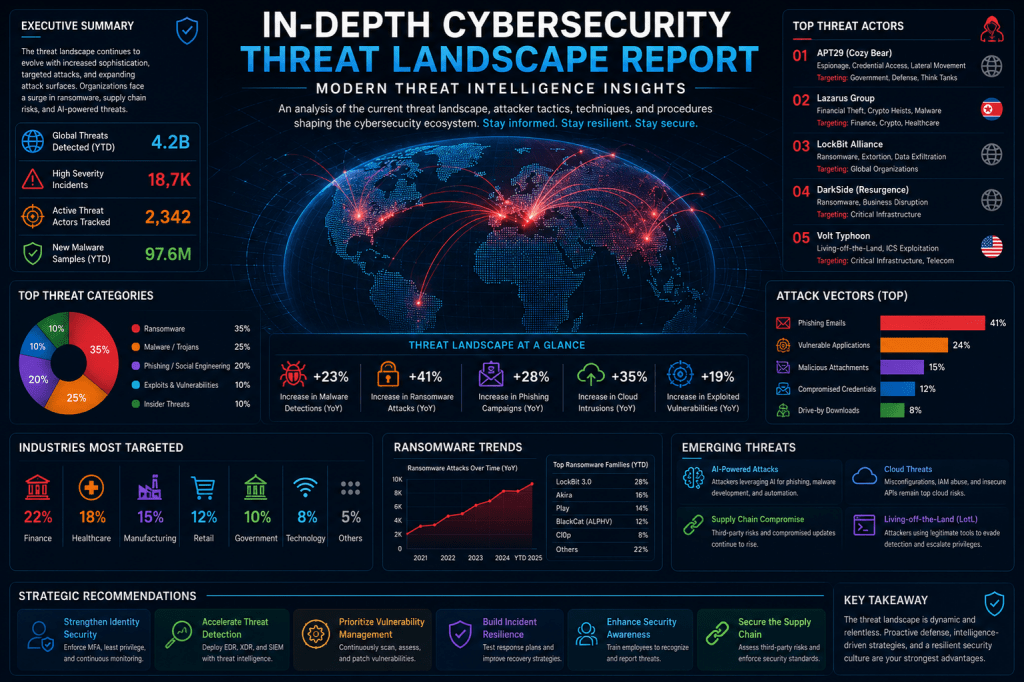
The cybersecurity environment is shaped by rapid technological progress, increasing digital dependence, and the growing sophistication of malicious actors. Attacks are no longer isolated or opportunistic events carried out by individuals with limited resources. Instead, they have become structured, financially motivated operations supported by underground economies, automation, and global collaboration among threat groups. This shift has significantly increased both the frequency and severity of cyber incidents affecting organizations of all sizes.
Digital transformation continues to expand across industries, introducing new systems, cloud environments, and interconnected services. While these advancements improve efficiency and accessibility, they also expand the number of potential entry points available to attackers. Every connected device, application, and user account represents a possible vulnerability if not properly secured. As a result, the attack surface is now broader and more complex than in previous years.
Another defining characteristic of the current environment is the speed at which threats evolve. Techniques that were considered advanced a short time ago are now widely available and automated. Attackers can rapidly adapt, modify tools, and scale operations with minimal effort. This has created a situation where defensive measures must continuously evolve just to maintain effectiveness. Understanding the nature of these changes is essential for anticipating risks and preparing resilient security strategies.
Emerging technologies reshaping cyber threats
One of the most influential developments shaping the threat environment is the rise of generative artificial intelligence. This technology enables attackers to automate and enhance various stages of cyber operations. It can be used to create highly convincing phishing messages that closely mimic legitimate communication styles, making them harder to detect. It also supports the creation of deepfake audio and video content, which can be used to manipulate individuals or impersonate trusted figures. In addition, automation allows attackers to scan systems for weaknesses at a scale and speed that was previously unattainable.
Quantum computing represents another long-term but significant concern. While still in a developing stage, its potential to process complex calculations at unprecedented speed raises concerns for modern encryption systems. Much of today’s digital security relies on cryptographic methods that could become vulnerable if sufficiently powerful quantum systems become widely available. This possibility is driving efforts to develop new cryptographic standards designed to resist quantum-based attacks, although widespread implementation will take time.
Ransomware-as-a-service has also transformed the threat landscape by lowering the barrier to entry for cybercrime. Instead of requiring advanced technical skills, individuals can now purchase or rent ransomware tools through underground platforms. These services often include user support, updates, and customizable attack options. This commercialization has significantly increased the volume of ransomware incidents, as more participants are able to engage in cyber extortion activities.
Supply chain compromise continues to be a major concern because of its indirect nature. Rather than attacking a target directly, threat actors infiltrate trusted vendors, software providers, or service dependencies. Once compromised, malicious code or unauthorized access can spread across multiple organizations simultaneously. This type of attack is particularly dangerous because it exploits trust relationships that are difficult to monitor continuously.
Key forces accelerating cyber threats
Several broader forces are contributing to the acceleration and expansion of cyber risks. One of the most significant is the democratization of attack tools. Many offensive capabilities that once required advanced expertise are now available through simplified kits and automated platforms. These tools often include prebuilt phishing templates, malware packages, and exploit frameworks that allow even inexperienced actors to launch effective attacks.
The increasing use of digital currencies has also influenced the threat landscape. Cryptocurrencies provide attackers with a method of receiving payments that is difficult to trace through traditional financial oversight systems. This has strengthened ransomware operations and other forms of digital extortion by making transactions more discreet and harder to investigate.
Geopolitical tensions are another major factor shaping cyber activity. Nation-backed groups often engage in cyber operations aimed at intelligence gathering, disruption, or strategic advantage. These operations are typically more sophisticated and better resourced than financially motivated attacks. Targets often include critical infrastructure, research institutions, and organizations with valuable intellectual property. The blending of political objectives with cyber capabilities has added a new layer of complexity to global cybersecurity dynamics.
At the same time, increasing interconnectivity between systems has amplified risk exposure. Organizations rely heavily on third-party services, cloud platforms, and integrated software ecosystems. While this improves operational efficiency, it also means that a vulnerability in one component can have widespread consequences across multiple connected systems.
Industries facing heightened exposure
While all sectors face cybersecurity risks, certain industries are consistently targeted due to the value of their data and the potential impact of disruptions. Government and public sector organizations remain primary targets because of the sensitive information they manage and their role in national stability. Attacks on these systems can lead to significant disruption, intelligence exposure, or erosion of public trust.
Critical infrastructure sectors such as energy, water, and transportation are also highly exposed. These systems are essential for daily life, and any disruption can have immediate and widespread consequences. Cyber incidents affecting these environments may result in service outages, economic disruption, and safety risks for large populations.
The financial sector continues to be a key target due to its direct connection to monetary systems and transaction networks. Online banking platforms, payment processors, and emerging decentralized financial systems are particularly attractive to attackers seeking financial gain. Even small vulnerabilities in these environments can result in large-scale financial losses.
Retail and digital commerce environments are frequently targeted because of the high volume of personal and payment data they handle. Attackers often exploit third-party payment systems or marketplace integrations to gain access to sensitive information across multiple organizations simultaneously.
Healthcare systems face unique challenges due to the sensitivity of patient data and the critical nature of their services. Interruptions in healthcare operations can directly affect patient outcomes, increasing pressure on organizations to restore systems quickly. This urgency often makes them more vulnerable to extortion-based attacks.
Approaches to reducing risk and improving resilience
Managing modern cyber risk requires a layered and continuously evolving security approach. One of the most important elements is human awareness. Many successful attacks begin with user interaction, often through deceptive messages or manipulated communication. Strengthening awareness of suspicious behavior, authentication practices, and secure handling of information reduces the likelihood of successful intrusion.
Technical defenses also play a central role in modern security strategies. Endpoint monitoring systems are widely used to detect unusual activity on devices and servers. These systems analyze behavior patterns to identify potential threats before they escalate. When combined with broader detection frameworks, they provide visibility across complex digital environments.
Another important strategy is adopting security models that assume no implicit trust within a network environment. Instead of automatically trusting users or devices, access is continuously verified based on context, behavior, and identity validation. This reduces the risk of unauthorized movement within systems even if an initial breach occurs.
Organizations are also increasingly focusing on segmentation and access control. By limiting how systems communicate with each other and restricting permissions based on necessity, the potential impact of a compromised account or system can be significantly reduced.
Continuous monitoring and incident response preparation are equally important. Rapid detection and response capabilities help limit damage when breaches occur. The ability to isolate affected systems, analyze incidents, and restore operations quickly is a key factor in reducing long-term consequences.
Conclusion
The cybersecurity environment is defined by rapid change, increased automation, and expanding digital interdependence. Emerging technologies such as artificial intelligence and quantum computing are reshaping both offensive and defensive capabilities. At the same time, the commercialization of cybercrime and the rise of organized threat groups have made attacks more accessible and more frequent.
Industries across the board face significant exposure, particularly those that rely heavily on data, connectivity, or essential services. As digital systems continue to integrate deeper into everyday operations, the consequences of security failures become more severe.
In response, resilience must remain the central focus of cybersecurity efforts. Absolute prevention is not realistic in a landscape characterized by constant evolution. Instead, the emphasis must be placed on detection, adaptation, and recovery. Organizations that prioritize layered defenses, continuous monitoring, and adaptive strategies are better positioned to withstand the pressures of an increasingly complex threat environment.