
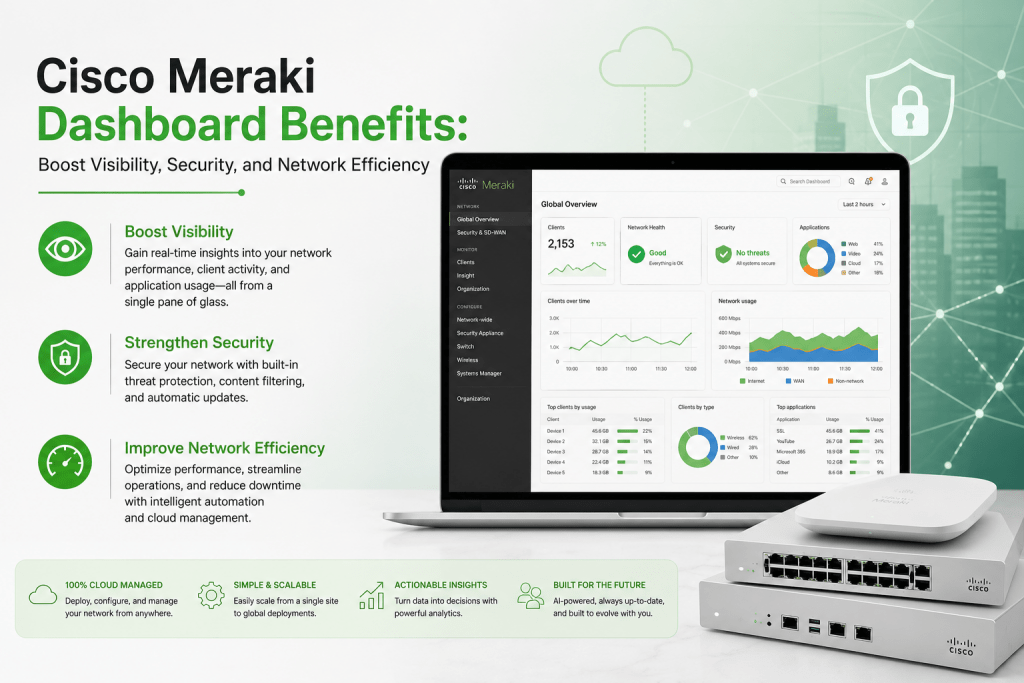
Modern network environments require more than basic device configuration and manual monitoring. As infrastructure becomes distributed across multiple sites, cloud-managed platforms provide a unified operational layer that simplifies control, visibility, and decision-making. A centralized dashboard approach changes how network teams interact with infrastructure by replacing fragmented tools and reactive troubleshooting with structured, real-time intelligence. This shift enables administrators to handle growing complexity while maintaining consistency, reliability, and performance across all connected environments.
Data-Driven Network Operations and Real-Time Awareness
Traditional network operations often depend on user complaints or support tickets before issues are detected. This reactive model leads to delays in identifying problems and increases downtime impact. A data-driven approach changes this by continuously collecting telemetry from network devices and presenting it in a structured operational view. Instead of waiting for reports, administrators can observe performance patterns, device health, and connectivity states as they evolve. This enables faster interpretation of issues and reduces dependency on end-user feedback. The shift toward continuous data visibility improves operational accuracy and shortens resolution cycles by giving teams contextual insight into what is happening across the infrastructure.
Centralized Dashboards for Unified Network Visibility
A centralized dashboard provides a single operational interface for managing multiple networks across different locations. Instead of navigating individual devices or separate management systems, administrators can view all network sites in one consolidated environment. Each network’s status is represented through health indicators that highlight operational conditions such as connectivity status, device availability, and performance anomalies. When an issue occurs, it is immediately visible through changes in the dashboard view, allowing administrators to isolate affected segments and drill into specific details. This unified visibility reduces the need for multiple monitoring tools and eliminates the complexity of managing distributed systems independently. It also provides a consistent operational model that scales easily as new sites are added.
Alerting Systems and Faster Incident Response
Automated alerting mechanisms enhance operational efficiency by notifying administrators of network events without requiring constant dashboard monitoring. Alerts can be configured to trigger based on predefined conditions such as device failure, connectivity loss, or performance degradation. These notifications can be delivered through multiple channels, including email or messaging systems integrated through programmable interfaces. This flexibility allows teams to incorporate alerts into existing communication workflows. In larger environments, alerts can also be extended to trigger automated responses or notify external stakeholders responsible for supporting infrastructure components. This reduces the time between issue detection and response initiation, improving overall recovery speed and minimizing service disruption.
Proactive Infrastructure Monitoring and Maintenance
A key advantage of centralized network management is the ability to move from reactive troubleshooting to proactive maintenance. Instead of waiting for hardware to fail or performance to degrade significantly, administrators can monitor lifecycle indicators and system health trends. These insights help identify aging devices, potential hardware instability, or configurations that may require adjustment. Proactive monitoring also includes visibility into software version alignment, ensuring that devices remain updated with consistent firmware across the network. Additionally, topology mapping provides a visual representation of how devices are interconnected, making it easier to understand dependencies and identify potential failure points before they escalate into outages.
Policy-Based Network Configuration and Standardization
Managing network configurations individually across multiple devices can lead to inconsistencies and operational inefficiencies. Policy-based configuration models address this by allowing administrators to define rules at a higher level that automatically apply across selected devices or groups. These policies can govern access control, traffic behavior, and routing preferences. Once defined, they ensure that all devices within a specific scope maintain consistent behavior without requiring manual configuration on each unit. This reduces configuration drift and minimizes human error. It also simplifies ongoing maintenance because changes to policies automatically propagate across the network, ensuring uniform enforcement of operational standards.
Traffic Management and SD-WAN Optimization
Modern networks often support applications that are highly sensitive to latency and bandwidth variation, such as voice communication and video collaboration tools. SD-WAN functionality allows traffic to be intelligently routed based on link performance and application requirements. Instead of relying on static routing paths, traffic can dynamically shift between available connections depending on real-time conditions. This improves application reliability and user experience, particularly in distributed environments. Traffic shaping rules further refine how bandwidth is allocated by prioritizing critical application types over less sensitive traffic. This ensures that essential communication services maintain stability even under network congestion or fluctuating link quality.
Quality of Service Control Across Network Switches
Consistent application performance depends on how traffic is handled at the switching layer. Quality of Service configuration allows administrators to define prioritization rules that determine how different types of traffic are treated within the network. Voice and video traffic can be prioritized over general data traffic to maintain performance consistency for real-time applications. These rules can be applied globally across multiple switches, ensuring uniform behavior throughout the infrastructure. Administrators can also configure trust boundaries for traffic marking, allowing switches to recognize and preserve prioritization values set by connected devices. This structured approach ensures that critical services maintain predictable performance even in high-utilization scenarios.
Scalable Deployment Using Configuration Templates
As organizations expand, deploying consistent network configurations across new locations becomes increasingly important. Configuration templates provide a structured way to replicate standardized settings across multiple networks. Instead of manually configuring each new site, administrators can apply predefined templates that include policies, routing rules, alert configurations, and performance settings. This ensures that every new deployment aligns with established operational standards from the moment it becomes active. Templates also simplify large-scale updates. When a configuration change is required, it can be applied at the template level and automatically propagated to all associated networks. This reduces administrative overhead and ensures consistency across expanding infrastructures.
Operational Efficiency, Security Alignment, and Reliability Improvements
Centralized network management contributes to improved operational efficiency by reducing the complexity of managing distributed environments. It consolidates monitoring, configuration, and policy enforcement into a unified system, reducing the need for fragmented tools. From a security perspective, consistent policy enforcement ensures that access rules and traffic controls are uniformly applied, reducing configuration inconsistencies that could introduce vulnerabilities. Reliability is also improved through continuous monitoring and proactive alerts that help identify potential failures before they escalate. Combined, these capabilities create a more stable operational environment where administrators can focus on optimization rather than constant troubleshooting.
Conclusion
Cloud-based network management platforms fundamentally change how infrastructure is operated by combining visibility, automation, and policy control into a single operational framework. This approach reduces dependency on manual intervention, improves response times, and ensures consistent behavior across distributed environments. By enabling real-time monitoring, proactive maintenance, and scalable configuration models, it supports both operational stability and long-term growth. The result is a network environment that is more predictable, easier to manage, and better aligned with the demands of modern digital operations.
Beyond these core advantages, this model also strengthens the overall resilience of enterprise networks by making it easier to detect patterns that might indicate future failures or performance degradation. Instead of reacting to isolated incidents, administrators gain a broader operational context that helps them understand how different components interact over time. This leads to more informed decision-making and better long-term infrastructure planning. It also reduces operational silos by bringing networking, security, and performance monitoring into a unified system where data is continuously shared and interpreted in real time.
Another important benefit is scalability. As organizations grow, adding new sites, users, and devices does not require a proportional increase in operational complexity. Standardized policies and centralized control ensure that expansion can occur without introducing configuration inconsistencies or excessive manual effort. This makes it easier for IT teams to support business growth without compromising stability or security.
Ultimately, this approach represents a shift toward more intelligent and adaptive network operations, where systems are not only managed but continuously optimized through data-driven insights and automation.