
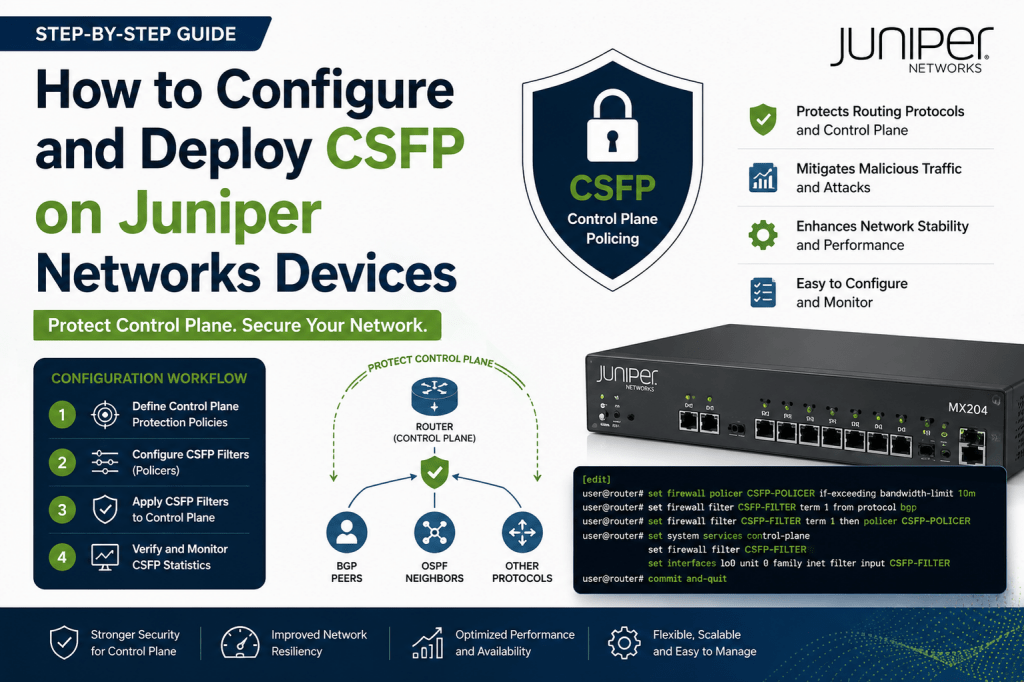
Constrained Shortest Path First, commonly known as CSPF, is an advanced routing calculation method used in Multiprotocol Label Switching environments to optimize traffic flow across a network. While traditional routing protocols focus primarily on finding the shortest available path, CSPF introduces intelligent traffic engineering by evaluating network constraints before selecting a route. This makes CSPF extremely valuable in enterprise, service provider, and large-scale carrier networks where bandwidth management and traffic prioritization are critical.
In Juniper environments, CSPF works closely with MPLS and RSVP signaling protocols to establish Label Switched Paths that satisfy predefined requirements. These requirements can include bandwidth reservations, administrative preferences, explicit routing rules, or link priorities. Instead of blindly forwarding packets through the shortest available route, CSPF calculates paths based on both topology information and operational constraints. This creates a more efficient, stable, and predictable routing environment.
Deploying CSPF on Juniper routers is an important skill for network engineers because modern networks demand more than basic connectivity. Businesses today rely on voice services, video conferencing, cloud applications, and real-time data synchronization. These services require guaranteed bandwidth and low latency. CSPF enables administrators to meet those expectations by intelligently selecting network paths capable of supporting the required performance levels.
The Difference Between OSPF and CSPF
To understand how CSPF operates, it is important to first understand the role of OSPF in routing environments. OSPF, or Open Shortest Path First, is a link-state routing protocol used by routers to exchange topology information. Each router builds a complete map of the network and calculates the shortest route to every destination using the SPF algorithm. The calculation is based primarily on path cost, which usually reflects link speed or administrative metrics.
Although OSPF is extremely efficient for dynamic routing, it does not evaluate application-specific requirements. For example, OSPF may choose a path that technically has the shortest metric even if that path lacks sufficient available bandwidth. This can result in congestion, packet drops, and poor application performance during periods of heavy traffic.
CSPF improves upon the standard SPF calculation by introducing constraints into the decision-making process. Before selecting a route, CSPF filters out any paths that fail to satisfy predefined requirements. Only paths that meet those conditions remain eligible for selection. The routing engine then chooses the best path from the remaining candidates.
This enhanced decision-making capability allows network administrators to engineer traffic more effectively. High-priority applications can receive guaranteed bandwidth, while less critical traffic can use alternate paths. This creates a more balanced and controlled network infrastructure.
Why CSPF Matters in Modern Networking
Modern network environments are far more complex than traditional enterprise infrastructures. Organizations frequently manage hybrid cloud environments, geographically distributed offices, data centers, and bandwidth-intensive applications simultaneously. Standard shortest-path routing is often insufficient for handling these demands.
CSPF helps address these challenges by allowing administrators to define routing expectations that align with business priorities. Instead of leaving traffic decisions entirely to dynamic metrics, administrators can influence path selection according to operational goals.
For example, a company may want video conferencing traffic to always use links with at least 500 Mbps of available bandwidth. Another organization may require backup replication traffic to avoid congested WAN circuits during business hours. CSPF makes these scenarios possible by integrating constraints directly into MPLS traffic engineering calculations.
Juniper routers are particularly effective in this area because Junos OS provides extensive MPLS and RSVP traffic engineering capabilities. When deployed correctly, CSPF enables Juniper devices to build highly optimized traffic-engineered tunnels that improve network utilization and service reliability.
Understanding MPLS Before Deploying CSPF
Before enabling CSPF on Juniper devices, administrators must understand the role of MPLS within the routing infrastructure. MPLS, or Multiprotocol Label Switching, is a forwarding technology that directs packets based on labels rather than destination IP addresses. This improves forwarding efficiency and enables advanced traffic engineering capabilities.
MPLS operates by assigning labels to packets as they enter the network. Routers within the MPLS domain use these labels to forward traffic along predefined Label Switched Paths. Because forwarding decisions are based on labels instead of routing table lookups, MPLS can achieve faster and more predictable traffic forwarding.
CSPF relies heavily on MPLS because MPLS provides the mechanism for creating engineered traffic paths. Without MPLS, CSPF would not have the framework necessary to establish constrained routes through the network.
In Juniper environments, MPLS traffic engineering typically works together with RSVP. RSVP is responsible for signaling and reserving resources along the selected path. CSPF performs the path calculation, while RSVP establishes and maintains the actual Label Switched Path.
This relationship between MPLS, RSVP, and CSPF forms the foundation of advanced traffic engineering in Juniper networks.
How RSVP Supports CSPF Operations
RSVP, or Resource Reservation Protocol, is another critical component of CSPF deployments. While CSPF calculates the optimal route based on constraints, RSVP handles resource reservation and signaling across the network.
When a Label Switched Path is created, RSVP communicates with routers along the selected route to reserve the required bandwidth and establish forwarding state information. This ensures that sufficient resources are available for the traffic carried through the tunnel.
Without RSVP, CSPF calculations would lack the ability to reserve network resources dynamically. Even if CSPF identified a suitable route, there would be no guarantee that bandwidth remained available once traffic began flowing.
Juniper routers use RSVP extensively in MPLS traffic engineering deployments. After enabling CSPF, administrators often monitor RSVP sessions carefully because RSVP status directly impacts tunnel establishment and operational stability.
If RSVP sessions fail or become unstable, CSPF-based Label Switched Paths may fail to establish correctly. This is why clearing RSVP sessions after modifying CSPF configurations is an important operational step during deployment.
Prerequisites for Deploying CSPF on Juniper Routers
Before enabling CSPF, administrators should verify several important prerequisites within the network infrastructure. Proper preparation reduces deployment issues and improves overall stability.
The first requirement is a functioning MPLS environment. MPLS must already be configured and operational across the routers participating in traffic engineering. Interfaces involved in MPLS forwarding should have MPLS enabled, and the routers must successfully exchange label information.
The second requirement is an operational Interior Gateway Protocol such as OSPF or IS-IS. CSPF relies on topology information learned through the IGP. Without accurate link-state information, CSPF calculations cannot determine viable network paths.
The third requirement involves RSVP configuration. RSVP must be enabled on participating interfaces so that bandwidth reservations and signaling operations can occur properly.
Bandwidth configuration is another important prerequisite. Since CSPF evaluates available bandwidth when calculating routes, interfaces should advertise accurate reservable bandwidth values. Incorrect bandwidth configurations can result in inefficient or failed tunnel calculations.
Administrators should also confirm that traffic engineering extensions are enabled within the IGP. OSPF traffic engineering extensions distribute additional topology attributes necessary for CSPF calculations.
Careful preparation ensures that CSPF deployment proceeds smoothly and minimizes troubleshooting later in the implementation process.
Accessing the Juniper Router Configuration Environment
Deploying CSPF on Juniper devices begins with accessing the command-line interface. Most administrators connect using SSH because it provides encrypted remote management capabilities.
After establishing the SSH session, administrators typically enter operational mode commands to inspect the current configuration and verify MPLS status. One of the most commonly used commands is the command that displays protocol configurations.
Reviewing the existing configuration is important because many Juniper routers already contain default MPLS parameters. Administrators should identify whether the configuration includes the parameter that disables CSPF functionality.
Juniper routers often contain a configuration line that explicitly disables CSPF operations. This line appears within the MPLS configuration hierarchy and prevents the router from performing constrained path calculations.
Understanding the existing configuration structure before making changes helps administrators avoid accidental modifications and improves deployment accuracy.
Understanding the No-CSPF Configuration Parameter
One of the most important aspects of deploying CSPF on Juniper routers is understanding the purpose of the no-cspf parameter. This configuration statement explicitly disables CSPF calculations within the MPLS environment.
When the no-cspf parameter exists, the router ignores traffic engineering constraints during path calculations. Instead, routing decisions rely solely on traditional shortest-path behavior.
Removing this parameter enables the router to evaluate traffic engineering constraints dynamically. Once removed, the router begins using CSPF automatically whenever appropriate constraints exist within the network configuration.
It is important to understand that removing the no-cspf parameter alone does not automatically create traffic-engineered tunnels. CSPF becomes active only when constraints such as bandwidth requirements are defined within MPLS traffic engineering configurations.
This behavior prevents unnecessary CSPF calculations in environments where traffic engineering is not required.
Entering Configuration Mode on Juniper Devices
After reviewing the existing configuration, administrators must enter configuration mode to modify router settings. Junos OS separates operational commands from configuration commands to reduce the likelihood of accidental configuration changes.
Configuration mode provides access to the hierarchical structure used throughout Junos OS. Administrators can navigate directly to specific protocol sections and make targeted adjustments without affecting unrelated settings.
This structured configuration approach is one of the reasons Juniper routers are widely respected in enterprise and service provider environments. The configuration hierarchy improves readability, simplifies troubleshooting, and enhances operational consistency.
Once inside configuration mode, administrators can safely modify MPLS settings required for CSPF deployment.
Removing the No-CSPF Parameter
The key step in enabling CSPF on Juniper routers involves deleting the no-cspf parameter from the MPLS configuration hierarchy. This change activates constrained path calculations within the router.
The configuration command used for this operation directly removes the parameter from the protocols MPLS section. Once removed, the router becomes capable of evaluating constraints during traffic engineering calculations.
This step may appear simple, but it fundamentally changes how the router evaluates available paths across the network. Instead of relying solely on shortest-path calculations, the router begins filtering routes according to traffic engineering requirements.
Because CSPF affects path computation behavior, administrators should implement this change carefully in production environments. Change windows and maintenance procedures are often recommended when deploying traffic engineering features across critical infrastructure.
Committing Configuration Changes Safely
After removing the no-cspf parameter, the modified configuration must be committed to activate the changes. Junos OS uses a candidate configuration model, which allows administrators to review pending changes before applying them.
This approach significantly reduces configuration risks because changes are not immediately activated as commands are entered. Administrators can validate modifications carefully before committing them to the active configuration database.
When committing changes related to MPLS and CSPF, administrators should review the configuration thoroughly to ensure that no unintended modifications exist. Even small syntax errors or misplaced statements can affect traffic engineering operations.
The commit process activates the new configuration and updates the router’s operational behavior accordingly.
Why RSVP Sessions Must Be Cleared After Deployment
After enabling CSPF, administrators typically clear RSVP sessions to ensure that the network rebuilds its traffic engineering state information using the updated configuration.
Existing RSVP sessions may continue operating with outdated path calculations if they are not refreshed. Clearing the RSVP session database forces the router to renegotiate Label Switched Paths using the newly enabled CSPF logic.
This process temporarily resets RSVP signaling state information. During the rebuild process, routers exchange updated reservation requests and establish refreshed tunnel information.
Although the operation is generally safe, administrators should understand that temporary traffic interruptions may occur depending on the network design and redundancy mechanisms in place.
Proper maintenance planning is important when clearing RSVP sessions in production environments.
Verifying CSPF Operation After Deployment
After enabling CSPF and clearing RSVP sessions, the next important step is verifying that the routing environment is functioning correctly. Many administrators mistakenly assume that removing the no-cspf parameter automatically guarantees proper traffic engineering operation. In reality, successful CSPF deployment depends on several interconnected components working together properly.
Verification begins with checking RSVP session status. Once RSVP sessions rebuild successfully, the routers should begin establishing Label Switched Paths using constrained calculations. Network engineers usually monitor tunnel establishment behavior carefully during this stage because any inconsistencies in bandwidth reservations or topology advertisements can prevent tunnels from coming online.
One of the primary operational checks involves examining RSVP session outputs. Active RSVP sessions indicate that routers are successfully exchanging signaling information and reserving resources across the MPLS domain. If sessions remain down or unstable, administrators must investigate interface configurations, bandwidth settings, or IGP advertisements.
It is also important to verify that the router is actually performing constrained calculations instead of default SPF calculations. If no traffic engineering constraints exist within the network configuration, CSPF may technically be enabled while never actively influencing path selection. This is a common misunderstanding during initial deployments.
Administrators should confirm that bandwidth requirements, explicit paths, or administrative constraints are defined properly within the MPLS tunnel configuration. Without these parameters, the router has no reason to invoke CSPF logic during route calculations.
Understanding Traffic Engineering Databases in Juniper Networks
CSPF relies heavily on the Traffic Engineering Database, commonly referred to as the TED. This database contains detailed topology information beyond what standard routing protocols normally advertise.
Traditional routing databases primarily store reachability information and path costs. The Traffic Engineering Database expands upon this by including additional operational attributes such as available bandwidth, administrative groups, affinities, shared risk link groups, and interface priorities.
Juniper routers build the TED using information learned through IGP traffic engineering extensions. OSPF and IS-IS distribute these enhanced attributes throughout the network so that routers maintain a synchronized view of available resources.
When CSPF performs a path calculation, it consults the TED to determine which paths satisfy the configured constraints. Any path that fails to meet those conditions is excluded from consideration before the shortest path algorithm completes its final calculation.
The accuracy of the TED is extremely important. Incorrect bandwidth advertisements or outdated topology information can cause CSPF to calculate inefficient or invalid routes. This is why consistent IGP operation and accurate interface configurations are critical components of successful traffic engineering deployments.
How CSPF Calculates Network Paths
CSPF path calculation involves multiple stages of decision-making. Unlike traditional SPF calculations that simply identify the shortest available route, CSPF performs filtering operations before selecting the optimal path.
The process begins when the router evaluates all available network links within the Traffic Engineering Database. It first eliminates any links that violate configured constraints. These constraints may include minimum bandwidth requirements, administrative policies, or affinity restrictions.
For example, if a Label Switched Path requires 500 Mbps of reservable bandwidth, CSPF removes any links incapable of satisfying that requirement. This filtering process dramatically changes the available topology before the shortest-path calculation even begins.
Once unsuitable paths are removed, the remaining topology is processed using a shortest-path calculation similar to standard SPF algorithms. The router identifies the most efficient route among the remaining candidates and establishes the tunnel using RSVP signaling.
This layered decision-making process is what makes CSPF such a powerful traffic engineering technology. It combines intelligent filtering with dynamic path optimization to create highly efficient MPLS forwarding paths.
The Importance of Bandwidth Reservation
Bandwidth reservation is one of the defining features of CSPF-based traffic engineering. In traditional routing environments, routers forward traffic without guaranteeing resource availability. This can lead to congestion during periods of heavy utilization.
CSPF addresses this issue by reserving bandwidth through RSVP signaling. When a Label Switched Path is established, RSVP requests a specific amount of bandwidth along the selected route. If sufficient resources exist, the reservation succeeds and the tunnel becomes operational.
This reservation process creates predictable traffic behavior because critical applications receive guaranteed network resources. Voice services, video streams, financial transactions, and cloud workloads all benefit from this consistency.
Juniper routers allow administrators to configure reservable bandwidth values on interfaces participating in MPLS traffic engineering. These values influence CSPF calculations because they determine which links qualify for tunnel establishment.
Proper bandwidth planning is extremely important in large-scale deployments. Overcommitting bandwidth reservations can create instability, while underutilizing available resources reduces network efficiency. Successful traffic engineering requires careful balancing between performance guarantees and infrastructure utilization.
Using CSPF for Network Optimization
One of the biggest advantages of CSPF is its ability to optimize network utilization dynamically. In many traditional routing environments, certain links become heavily congested while others remain underutilized. This imbalance occurs because shortest-path algorithms consistently prefer specific routes.
CSPF enables administrators to distribute traffic more intelligently across the network. By defining constraints and traffic engineering policies, administrators can steer applications through alternate paths that better align with performance goals.
For example, a service provider may reserve premium backbone links for latency-sensitive customer traffic while directing backup traffic across secondary routes. Similarly, enterprises may prioritize cloud application traffic over large file transfers during business hours.
This flexibility improves overall network efficiency and reduces the likelihood of congestion-related performance issues. Instead of relying on static routing decisions, CSPF continuously adapts path calculations according to available resources and defined policies.
Juniper routers are especially effective in these scenarios because Junos OS provides advanced MPLS traffic engineering features that integrate tightly with CSPF calculations.
Administrative Groups and Affinities in CSPF
Administrative groups, often called affinities or color bits, provide another powerful layer of control within CSPF deployments. These attributes allow administrators to categorize network links according to operational characteristics.
For example, administrators may assign specific affinity values to high-capacity fiber links, low-latency paths, satellite connections, or backup circuits. CSPF can then include or exclude these links during path calculations based on tunnel requirements.
This capability is especially valuable in complex networks where different applications require different routing behaviors. Mission-critical services may avoid lower-priority links entirely, while nonessential traffic may use any available route.
Administrative groups also improve operational flexibility during maintenance events. Engineers can temporarily adjust affinities to reroute traffic away from links undergoing maintenance without disrupting overall connectivity.
Juniper routers support affinity-based traffic engineering extensively within MPLS configurations. Combined with CSPF calculations, affinities create highly granular traffic control capabilities that improve network stability and application performance.
Explicit Paths Versus Dynamic CSPF Paths
CSPF deployments can use either dynamic path calculations or explicitly defined routing paths. Understanding the difference between these approaches is important for effective traffic engineering design.
Dynamic CSPF paths allow the router to calculate routes automatically according to defined constraints. This approach provides flexibility because the router adapts to changing network conditions dynamically. If a link fails or bandwidth availability changes, CSPF recalculates an alternate route automatically.
Explicit paths, on the other hand, allow administrators to define the exact sequence of routers or links used by a tunnel. This provides maximum control over traffic forwarding behavior but reduces flexibility because the path is manually specified.
Many organizations combine both approaches. Critical services may use explicit paths to guarantee predictable routing, while less sensitive traffic relies on dynamic CSPF calculations.
Juniper routers support both methods effectively. Administrators can configure primary explicit paths alongside secondary dynamic CSPF paths for redundancy and failover protection.
This hybrid approach provides operational consistency while maintaining resilience during network failures or maintenance events.
Common CSPF Deployment Challenges
Although CSPF deployment on Juniper routers is relatively straightforward from a configuration perspective, operational challenges frequently arise in production environments.
One common issue involves inconsistent bandwidth advertisements. If interface bandwidth configurations differ between routers, CSPF calculations may become inaccurate. This can result in failed tunnel establishment or inefficient traffic routing.
Another challenge involves incomplete RSVP configuration. Every interface participating in MPLS traffic engineering must support RSVP signaling properly. Missing RSVP configuration statements often prevent tunnels from establishing successfully.
IGP synchronization issues can also affect CSPF operation. Since CSPF depends on accurate topology information from OSPF or IS-IS, unstable IGP behavior directly impacts traffic engineering calculations.
Administrative group mismatches are another frequent source of problems. If affinity values are configured incorrectly, CSPF may exclude valid paths unintentionally or select suboptimal routes.
Troubleshooting these issues requires careful analysis of RSVP sessions, MPLS tunnel states, and Traffic Engineering Database information.
Monitoring CSPF in Production Environments
Successful CSPF deployment does not end after initial configuration. Ongoing monitoring is essential for maintaining stable traffic engineering operations.
Administrators typically monitor RSVP tunnel status, bandwidth utilization, Label Switched Path availability, and IGP topology consistency regularly. These metrics provide insight into overall network health and traffic engineering performance.
Bandwidth monitoring is especially important because traffic patterns evolve over time. Applications that originally required minimal bandwidth may eventually consume far more resources than anticipated. Without regular monitoring, bandwidth reservations can become outdated and reduce network efficiency.
Juniper routers provide extensive operational commands for inspecting MPLS and RSVP behavior. These tools allow administrators to verify tunnel status, inspect reservation details, and identify path calculation failures quickly.
Proactive monitoring also improves incident response during network failures. Engineers can identify affected tunnels rapidly and determine whether CSPF recalculations are functioning properly during topology changes.
CSPF and High Availability Design
High availability is one of the primary reasons organizations deploy CSPF in MPLS environments. Traditional shortest-path routing may converge slowly during failures or choose suboptimal backup routes. CSPF improves resilience by enabling engineered failover paths.
Administrators can design backup Label Switched Paths that satisfy specific performance requirements even during outages. This ensures that critical applications maintain acceptable performance levels despite infrastructure failures.
Fast reroute technologies further enhance availability by allowing MPLS tunnels to switch traffic rapidly during link failures. Combined with CSPF calculations, fast reroute minimizes downtime and improves application continuity.
Juniper routers support sophisticated redundancy mechanisms that integrate tightly with CSPF traffic engineering. This makes them highly effective for service provider backbones, enterprise WANs, and data center interconnect environments.
High availability design requires careful planning because backup paths must also satisfy bandwidth and policy constraints. Administrators should validate redundancy behavior thoroughly before deploying traffic engineering configurations into production networks.
Security Considerations for CSPF Deployments
Security is another important aspect of CSPF implementation. Because CSPF relies on dynamic signaling protocols and topology advertisements, securing the routing infrastructure is essential.
Unauthorized configuration changes can disrupt traffic engineering operations significantly. Incorrect bandwidth reservations or manipulated affinities may reroute sensitive traffic through undesirable paths.
Administrators should implement secure management practices such as encrypted SSH access, authentication controls, configuration auditing, and role-based access policies.
Protecting RSVP and IGP operations is equally important. Attackers targeting routing infrastructure may attempt to disrupt topology advertisements or overload signaling processes.
Juniper routers provide several security mechanisms that help protect control-plane operations, including routing protocol authentication, control-plane policing, and management access restrictions.
Combining strong security practices with proper operational monitoring helps maintain stable and secure CSPF deployments across enterprise and service provider environments.
Deploying CSPF in Enterprise Network Environments
Enterprise organizations increasingly depend on intelligent traffic engineering to support business-critical applications. Standard routing behavior often fails to provide the consistency required for modern workloads such as cloud collaboration, unified communications, virtualization platforms, and real-time analytics. CSPF helps solve these challenges by allowing Juniper routers to make routing decisions based on operational requirements rather than simple shortest-path calculations.
In enterprise environments, different types of traffic compete for the same network resources. Voice traffic requires low latency and minimal jitter, while backup operations may consume enormous amounts of bandwidth during scheduled synchronization windows. Without traffic engineering, these workloads can interfere with each other and reduce overall application performance.
CSPF allows administrators to create Label Switched Paths tailored for specific traffic categories. High-priority applications can receive dedicated bandwidth reservations, while less sensitive workloads use alternative paths through the network. This controlled traffic distribution improves user experience and helps maintain operational stability during periods of heavy utilization.
Juniper routers are commonly used in enterprise WAN architectures because they provide advanced MPLS and RSVP traffic engineering features that scale effectively across complex infrastructures. Organizations with multiple branch offices, data centers, and cloud connectivity requirements often rely on CSPF to optimize application delivery across geographically distributed environments.
Using CSPF for Service Provider Traffic Engineering
Service providers use CSPF extensively to manage backbone traffic across large-scale MPLS infrastructures. In these environments, efficient bandwidth utilization and predictable traffic flow are critical for maintaining customer service quality.
Carrier networks often transport enormous volumes of traffic across shared infrastructure. Without traffic engineering, some backbone links may become overloaded while others remain underutilized. CSPF enables providers to distribute traffic intelligently according to operational policies and available resources.
For example, premium customers may require guaranteed low-latency paths for voice or financial services. CSPF allows service providers to reserve bandwidth specifically for these applications while routing standard traffic across alternate paths.
Traffic engineering also helps providers maximize infrastructure investments. Instead of continuously adding expensive backbone capacity, operators can optimize existing resources by steering traffic more effectively through the network.
Juniper platforms are widely deployed in carrier environments because they support sophisticated traffic engineering capabilities, large-scale MPLS deployments, and highly scalable RSVP operations. CSPF plays a major role in maintaining service reliability within these demanding infrastructures.
How CSPF Responds to Network Failures
One of the most valuable features of CSPF is its ability to adapt dynamically during network failures. Traditional routing protocols eventually recalculate routes after topology changes occur, but the process may not always produce optimal traffic behavior.
CSPF improves failure response by recalculating paths according to both topology changes and traffic engineering constraints. If a primary link fails, CSPF evaluates alternative paths that still satisfy the required conditions before establishing new Label Switched Paths.
This behavior is particularly important for applications sensitive to latency, congestion, or packet loss. Instead of simply selecting the next shortest route, CSPF ensures that backup paths still meet operational requirements.
Juniper routers can also integrate CSPF with MPLS fast reroute technologies to minimize traffic disruption during failures. Fast reroute mechanisms establish backup forwarding paths in advance, allowing traffic to switch rapidly when link failures occur.
This combination of proactive backup planning and intelligent constraint-based routing significantly improves network resilience. Organizations operating mission-critical services often depend on these capabilities to maintain application availability during infrastructure outages.
Understanding Label Switched Paths in CSPF Deployments
Label Switched Paths, commonly known as LSPs, are central to MPLS traffic engineering and CSPF operation. An LSP represents the route that labeled traffic follows across the MPLS network.
When CSPF calculates a suitable path, RSVP signaling establishes the corresponding LSP between the ingress and egress routers. Packets entering the MPLS environment receive labels that determine how intermediate routers forward them toward the destination.
Unlike traditional IP routing, where each router independently evaluates the packet destination, MPLS forwarding uses pre-established labels to guide traffic along the engineered path. This improves forwarding efficiency and enables predictable traffic behavior.
Juniper routers support both dynamically calculated and explicitly configured LSPs. Dynamic LSPs rely on CSPF calculations to determine the best route automatically, while explicit LSPs follow administrator-defined paths.
Traffic engineering deployments often include multiple LSPs designed for different applications or service classes. Some tunnels may prioritize low latency, while others focus on maximizing bandwidth utilization or avoiding congested links.
Effective LSP design is essential for successful CSPF deployment because poorly planned tunnels can create inefficiencies or reduce redundancy within the network.
Bandwidth Management Strategies with CSPF
Bandwidth management is one of the primary reasons organizations deploy CSPF within MPLS environments. Modern networks support a wide range of applications with very different traffic requirements. Without intelligent resource management, bandwidth contention can degrade performance significantly.
CSPF enables administrators to allocate bandwidth strategically according to business priorities. Critical services receive guaranteed resources, while less sensitive traffic uses remaining capacity.
For example, organizations may reserve dedicated bandwidth for video conferencing, cloud application synchronization, or storage replication. CSPF ensures that tunnels carrying these applications use only paths capable of supporting the required bandwidth levels.
Juniper routers provide flexible bandwidth reservation mechanisms that integrate tightly with RSVP signaling. Administrators can configure reservable bandwidth values on interfaces and define tunnel requirements directly within MPLS traffic engineering configurations.
Bandwidth planning should account for both current and future traffic growth. Underestimating bandwidth requirements can lead to congestion and performance degradation, while excessive reservations may reduce overall network efficiency.
Continuous monitoring and periodic optimization are essential for maintaining effective bandwidth management strategies in CSPF deployments.
The Relationship Between CSPF and Quality of Service
Quality of Service, commonly called QoS, works closely with CSPF in many enterprise and service provider networks. While CSPF determines the physical path traffic follows, QoS controls how packets are prioritized and treated along that path.
Together, these technologies create a highly optimized traffic management framework. CSPF ensures that traffic uses appropriate network paths, while QoS ensures that packets receive the correct forwarding priority during congestion.
For example, voice traffic may travel through a CSPF-engineered tunnel with guaranteed bandwidth while also receiving low-latency QoS treatment on each interface. This combination improves call quality and minimizes jitter or packet loss.
Juniper routers support extensive QoS capabilities that integrate seamlessly with MPLS traffic engineering. Administrators can classify traffic into forwarding classes, apply scheduling policies, and enforce bandwidth guarantees across engineered paths.
Combining QoS with CSPF provides granular control over network behavior and helps organizations deliver consistent application performance across complex infrastructures.
Troubleshooting CSPF Path Calculation Issues
Troubleshooting CSPF deployments requires a strong understanding of MPLS, RSVP, and traffic engineering concepts. When tunnels fail to establish or select unexpected paths, administrators must analyze multiple operational components simultaneously.
One common troubleshooting step involves verifying Traffic Engineering Database consistency. If topology advertisements are incomplete or inaccurate, CSPF calculations may produce invalid results.
Administrators should also inspect RSVP signaling behavior carefully. RSVP failures often indicate interface configuration issues, bandwidth reservation conflicts, or signaling interruptions.
Bandwidth exhaustion is another frequent cause of tunnel establishment failures. If insufficient reservable bandwidth exists along available paths, CSPF cannot identify a valid route that satisfies the configured constraints.
Affinity mismatches may also prevent successful path selection. Incorrect administrative group configurations can unintentionally exclude otherwise valid links from consideration.
Juniper routers provide detailed operational commands that help administrators inspect tunnel states, reservation details, signaling messages, and path calculations. Effective troubleshooting depends on systematically analyzing each component involved in traffic engineering operations.
Optimizing Network Performance with CSPF
CSPF provides significant opportunities for performance optimization when deployed strategically. Instead of allowing traffic to follow default shortest paths automatically, administrators can design engineered traffic flows aligned with operational objectives.
For example, organizations may separate latency-sensitive applications from bulk data transfers by assigning them different Label Switched Paths. This prevents large file transfers from interfering with voice or video performance.
CSPF can also help balance traffic loads across multiple backbone links. By defining constraints strategically, administrators encourage traffic distribution across underutilized paths while avoiding congested circuits.
Another optimization strategy involves using affinity values to direct traffic according to link characteristics. High-capacity fiber links may carry premium traffic, while lower-priority applications use secondary infrastructure.
Juniper routers provide extensive flexibility for implementing these optimization strategies. Combined with real-time monitoring and performance analysis, CSPF enables organizations to maintain efficient and scalable network operations.
Scaling CSPF Across Large Networks
As networks grow larger and more complex, scalability becomes a critical consideration for traffic engineering deployments. Large enterprise and service provider infrastructures may contain hundreds or thousands of MPLS tunnels operating simultaneously.
CSPF calculations consume router processing resources because each path computation involves evaluating topology constraints and bandwidth availability. Improperly designed deployments can create excessive computational overhead and reduce routing performance.
Juniper routers are designed to handle large-scale traffic engineering environments efficiently, but administrators should still follow best practices for scalability.
One important strategy involves minimizing unnecessary tunnel complexity. Excessive numbers of highly granular tunnels can increase operational overhead and complicate troubleshooting.
Hierarchical traffic engineering designs often improve scalability by aggregating traffic into shared tunnels instead of creating dedicated paths for every application. This reduces signaling load while still providing effective traffic management.
Careful bandwidth planning, efficient affinity usage, and optimized RSVP configurations also contribute to scalable CSPF deployments.
The Role of IS-IS in CSPF Environments
Although OSPF is commonly associated with CSPF deployments, IS-IS is another popular Interior Gateway Protocol used in large MPLS environments. Many service providers prefer IS-IS because of its scalability and operational simplicity.
Like OSPF, IS-IS supports traffic engineering extensions that distribute topology and bandwidth information throughout the network. CSPF uses this information to calculate constrained paths dynamically.
Juniper routers support both OSPF and IS-IS traffic engineering configurations extensively. The choice between protocols often depends on organizational standards, operational experience, and network scale.
IS-IS deployments frequently appear in large backbone infrastructures where scalability and convergence performance are especially important. CSPF operates similarly regardless of which IGP distributes the Traffic Engineering Database information.
Understanding how different IGPs interact with traffic engineering is important for network engineers designing large MPLS infrastructures.
Operational Best Practices for CSPF Deployment
Successful CSPF deployment requires more than simply enabling traffic engineering features. Long-term operational stability depends on careful planning, consistent configuration standards, and proactive monitoring.
One important best practice involves documenting traffic engineering policies clearly. Administrators should maintain accurate records of bandwidth reservations, affinity assignments, and tunnel purposes.
Consistent interface bandwidth configurations are also essential. Inaccurate bandwidth advertisements can disrupt path calculations and reduce network efficiency.
Change management procedures should include thorough validation testing whenever MPLS or RSVP configurations are modified. Even minor changes can affect traffic engineering behavior significantly.
Monitoring systems should track RSVP sessions, tunnel states, bandwidth utilization, and topology changes continuously. Early detection of operational issues helps prevent service disruptions.
Juniper environments benefit greatly from automation and centralized management tools that simplify configuration consistency across large infrastructures.
Organizations that follow structured operational practices typically experience more stable and predictable CSPF performance over time.
Preparing for Advanced MPLS Traffic Engineering Features
CSPF serves as the foundation for many advanced MPLS traffic engineering capabilities. Once administrators understand constrained path calculations, they can begin exploring more sophisticated technologies that enhance network control even further.
Advanced traffic engineering features may include segment routing, bandwidth calendaring, dynamic tunnel optimization, path protection mechanisms, and automated service provisioning.
Juniper routers support many of these advanced capabilities within modern MPLS architectures. Organizations often begin with basic CSPF deployments before gradually expanding into more advanced traffic engineering strategies.
A strong understanding of CSPF concepts helps engineers build the operational knowledge required for these more sophisticated technologies. Because CSPF integrates deeply with MPLS, RSVP, and IGP operations, mastering it provides valuable experience for managing large-scale carrier and enterprise infrastructures.
Advanced Benefits of CSPF in Juniper Networks
CSPF improves traffic engineering in Juniper MPLS networks by selecting routes based on bandwidth and network constraints instead of only the shortest path. This helps create better and more stable traffic flow.
It improves application performance for services like voice, video, and cloud applications by avoiding congested links. CSPF also balances traffic across WAN connections, helping reduce congestion and improve bandwidth usage.
Another benefit is better failover during outages. If one path fails, CSPF can quickly calculate another suitable route. Juniper routers also provide useful monitoring tools that make troubleshooting and traffic management easier.
CSPF is highly scalable and helps administrators control traffic more efficiently in large enterprise and service provider networks.
Conclusion
Deploying CSPF on Juniper routers is an effective way to improve MPLS traffic engineering and overall network performance. By introducing constraints such as bandwidth requirements and routing policies, CSPF enables routers to make smarter forwarding decisions based on operational needs instead of relying only on shortest-path routing.
The deployment process is relatively simple and mainly involves enabling CSPF within the MPLS configuration and refreshing RSVP sessions. However, successful implementation also depends on proper MPLS configuration, bandwidth planning, and ongoing monitoring.
CSPF works closely with MPLS and RSVP to create optimized Label Switched Paths that improve bandwidth management, redundancy, scalability, and application performance. For organizations managing enterprise WANs or large service provider infrastructures, CSPF provides the flexibility and control needed to maintain efficient and reliable network operations.