
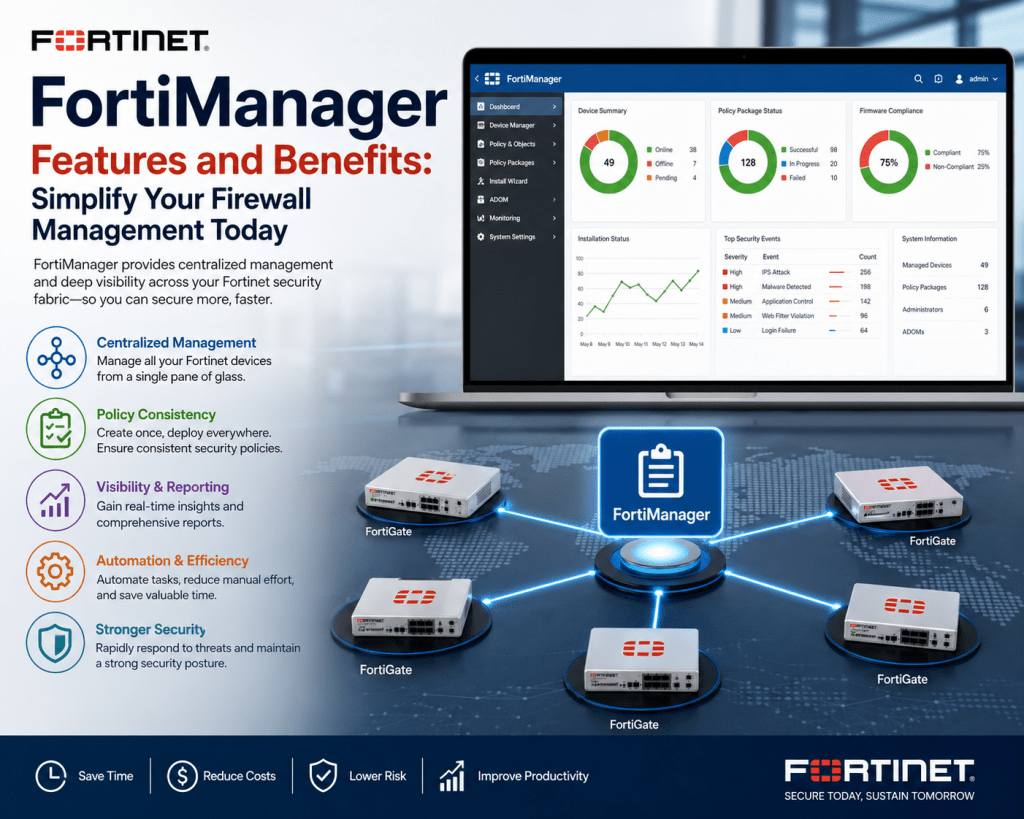
Managing network security at scale introduces complexity that grows exponentially with each additional device. While configuring a single firewall is relatively straightforward, the operational overhead increases significantly when organizations expand across multiple locations. This is where Fortinet FortiManager becomes a critical component in modern network administration, offering a centralized approach to handling distributed security infrastructure.
FortiManager functions as a unified control system designed to streamline how multiple FortiGate firewalls and related security devices are configured, monitored, and maintained. Instead of requiring administrators to log in to each firewall individually, it consolidates management tasks into a single interface, allowing for more efficient operations and significantly reducing the risk of inconsistencies.
In environments where dozens or even hundreds of firewalls are deployed, manual configuration quickly becomes inefficient and error-prone. Small differences in configurations between devices can lead to security gaps, making the network more vulnerable over time. FortiManager addresses this challenge by introducing a structured and repeatable approach to firewall management, ensuring that policies remain consistent across the entire infrastructure.
The Role of Centralized Management in Modern Networks
As organizations expand their digital footprint, their networks become more distributed. Branch offices, remote users, cloud integrations, and hybrid infrastructures all contribute to a complex security landscape. In such environments, centralized management is no longer optional but essential for maintaining control and visibility.
FortiManager provides this centralized capability by acting as a single source of truth for all firewall configurations. Administrators can define policies once and apply them across multiple devices, ensuring uniform enforcement of security rules. This eliminates the need for repetitive manual changes and reduces the likelihood of configuration drift.
Configuration drift occurs when devices gradually deviate from the intended configuration due to manual updates or inconsistent changes. Over time, these deviations can introduce vulnerabilities that are difficult to detect. By enforcing standardized configurations, FortiManager helps maintain alignment across all managed devices, improving overall network integrity.
Another key advantage of centralized management is improved operational efficiency. Tasks that would traditionally take hours, such as updating policies across multiple sites, can be completed in minutes. This efficiency becomes especially important in situations where rapid response is required, such as mitigating newly discovered threats.
Core Functions That Define FortiManager
FortiManager is built around several foundational capabilities that collectively simplify firewall management. These functions are designed to address the most common challenges faced by network administrators working in large-scale environments.
One of its primary roles is configuration management. Administrators can create, modify, and deploy configurations from a central interface, ensuring that all devices adhere to the same standards. This approach not only saves time but also minimizes the risk of human error.
Policy management is another critical function. Security policies define how traffic is handled within the network, including which connections are allowed or blocked. With FortiManager, these policies can be created once and applied universally, ensuring consistent enforcement across all locations.
Automation plays a significant role in enhancing these capabilities. Routine tasks such as firmware updates, policy deployments, and device provisioning can be automated, reducing the need for manual intervention. Automation not only improves efficiency but also ensures that tasks are executed consistently.
Additionally, FortiManager provides visibility into the state of managed devices. Administrators can monitor configurations, track changes, and identify potential issues from a centralized dashboard. This level of visibility is essential for maintaining control over complex network environments.
Integration Within a Broader Security Framework
FortiManager operates as part of a larger ecosystem of security tools, enabling seamless interaction between different components of the network. This integration enhances its functionality by allowing it to coordinate with other systems responsible for threat detection, analysis, and response.
Within this ecosystem, FortiManager acts as the control plane for policy and configuration management. It communicates with firewalls and other devices to ensure that the correct rules are enforced. When changes are made, they can be propagated across the network in a controlled and consistent manner.
The ability to integrate with additional security tools further extends its capabilities. For example, enhanced logging and analytics systems can provide deeper insights into network activity, while orchestration tools can automate complex workflows. This interconnected approach allows organizations to build a cohesive security strategy that goes beyond basic firewall management.
Such integration is particularly valuable in environments where rapid response to threats is required. By coordinating multiple security components, organizations can detect, analyze, and respond to incidents more effectively.
Scalability and Adaptability in Growing Environments
One of the defining characteristics of FortiManager is its ability to scale alongside organizational growth. As new devices are added to the network, they can be incorporated into the management framework without significantly increasing administrative overhead.
This scalability is achieved through features such as device grouping and template-based configurations. Devices can be organized into logical groups based on location, function, or other criteria. Policies and configurations can then be applied at the group level, simplifying management and reducing duplication of effort.
Templates play a crucial role in maintaining consistency across devices. By defining a standard configuration, administrators can ensure that all devices within a group adhere to the same baseline. When changes are required, updating the template automatically propagates those changes to all associated devices.
Adaptability is another important aspect. Networks are constantly evolving, with new technologies and requirements emerging over time. FortiManager provides the flexibility needed to accommodate these changes, allowing administrators to modify configurations and policies as needed without disrupting operations.
Reducing Operational Complexity Through Automation
Automation is a key factor in simplifying firewall management, particularly in large-scale environments. FortiManager incorporates automation into many of its core functions, enabling administrators to streamline repetitive tasks and focus on more strategic activities.
For instance, firmware management can be automated to ensure that all devices are running the latest versions. This not only improves security but also reduces the time required to manually update each device. Updates can be scheduled and deployed in a controlled manner, minimizing disruption to network operations.
Similarly, policy deployment can be automated to ensure rapid and consistent implementation of changes. When a new security rule is required, it can be defined once and distributed across all relevant devices. This eliminates the need for manual configuration and ensures that all devices are updated simultaneously.
Automation also extends to device provisioning. New devices can be configured automatically using predefined templates, reducing the time and effort required to bring them online. This is particularly useful in environments where new locations or devices are frequently added.
Enhancing Consistency and Reducing Errors
Consistency is a critical factor in maintaining a secure network. Even minor discrepancies in configurations can create vulnerabilities that may be exploited. FortiManager addresses this issue by enforcing standardized configurations across all managed devices.
By centralizing management, it ensures that all devices follow the same set of rules and policies. This uniformity reduces the likelihood of errors and simplifies troubleshooting, as administrators can rely on a consistent configuration baseline.
Error reduction is further supported by built-in validation mechanisms. Changes can be reviewed and approved before being deployed, allowing potential issues to be identified and addressed in advance. This controlled approach minimizes the risk of disruptions caused by incorrect configurations.
The ability to track changes also contributes to improved reliability. Detailed logs provide a record of all modifications, including who made the changes and when they were implemented. This information is invaluable for auditing purposes and helps maintain accountability within the organization.
Supporting Efficient Network Operations
Efficient network operations require a balance between control, visibility, and flexibility. FortiManager provides the tools needed to achieve this balance by simplifying complex management tasks and providing a clear overview of the network.
Administrators can manage multiple devices from a single interface, reducing the time and effort required to perform routine tasks. This centralized approach also improves coordination, as all changes are managed from a common platform.
Visibility into device status and configurations enables proactive management. Potential issues can be identified and addressed before they escalate, reducing downtime and improving overall network reliability.
Flexibility is maintained through the ability to customize configurations and policies based on specific requirements. While standardization is important, different environments may have unique needs that must be accommodated. FortiManager allows for this customization without sacrificing consistency.
Building a Foundation for Advanced Security Management
As networks become more complex, the need for advanced security management capabilities continues to grow. FortiManager provides a solid foundation for implementing these capabilities by centralizing control and enabling integration with other security tools.
This foundation supports the development of more sophisticated security strategies, including automated threat response, advanced analytics, and coordinated defense mechanisms. By simplifying the management of core security components, it allows organizations to focus on enhancing their overall security posture.
The ability to manage configurations, enforce policies, and automate tasks from a single platform creates a more cohesive and efficient security environment. This not only improves operational efficiency but also strengthens the organization’s ability to respond to emerging threats.
In large-scale deployments, where manual management is no longer feasible, FortiManager serves as an essential tool for maintaining control and ensuring consistency. Its centralized approach, combined with automation and scalability, makes it a key component in modern network security architecture.
Advanced Architecture of FortiManager in Enterprise Environments
In large-scale network deployments, the architecture of a centralized management system determines how efficiently security operations can be executed. FortiManager is designed with a distributed yet centrally controlled architecture that supports enterprises managing complex and geographically dispersed infrastructures. Rather than acting as a simple administrative tool, it functions as a structured management layer that sits above FortiGate firewalls and other Fortinet components.
At its core, FortiManager maintains a database-driven configuration system. This system stores device configurations, policy packages, object definitions, and revision histories in a centralized repository. By doing so, it ensures that all changes are tracked, versioned, and controlled before being deployed to managed devices. This structure allows administrators to maintain a clear separation between intended configurations and active device states.
One of the most important architectural elements is the concept of management domains. These domains allow segmentation of administrative responsibilities, enabling different teams or business units to manage their own set of devices independently. This is particularly useful in service provider environments or large enterprises with multiple subsidiaries, where isolation of management responsibilities is essential.
FortiManager also operates using a push-based deployment model. Once configurations are defined and approved, they are pushed from the central system to managed devices. This eliminates the need for devices to independently fetch configurations, ensuring tighter control over when and how changes are applied across the network.
Administrative Domains and Multi-Tenant Management Design
A key strength of FortiManager lies in its support for multi-tenant environments through Administrative Domains, commonly referred to as ADOMs. This structure enables logical separation of managed devices, policies, and administrative access within a single FortiManager instance.
Each ADOM acts as an isolated container where configurations and policies are maintained independently from other domains. This isolation ensures that changes made in one domain do not impact devices in another, significantly reducing operational risk in shared environments.
This model is particularly valuable in managed security service environments where a single organization is responsible for multiple clients. Each client can be assigned a dedicated ADOM, ensuring complete separation of their security configurations. This prevents accidental cross-configuration and improves compliance with data segmentation requirements.
Within each ADOM, administrators can define unique policy packages tailored to the needs of that specific environment. This flexibility allows organizations to maintain both standardization and customization simultaneously. While core security principles remain consistent, individual environments can still enforce specific rules based on their operational requirements.
The ADOM structure also improves scalability. As the number of managed devices increases, they can be distributed across multiple domains, preventing management overload and maintaining system performance. This ensures that FortiManager remains responsive even in large enterprise deployments.
Policy Package Lifecycle and Configuration Control
FortiManager introduces a structured lifecycle for policy management that ensures all changes are controlled, reviewed, and deployed in a predictable manner. This lifecycle begins with the creation of policy packages, which define how traffic is handled across the network.
Policy packages consist of multiple rules that determine how different types of traffic are processed. These rules may include allow or deny actions, security inspections, application controls, and routing behaviors. Instead of configuring these rules directly on individual firewalls, administrators define them centrally within FortiManager.
Once a policy package is created, it undergoes a validation process. This step ensures that configurations are logically consistent and do not contain conflicts or errors that could disrupt network operations. Validation helps prevent misconfigurations from reaching production environments.
After validation, the policy package can be staged for deployment. Staging allows administrators to prepare changes without immediately pushing them to devices. This is particularly useful in environments where changes must be reviewed or scheduled during maintenance windows.
Deployment itself is controlled and traceable. FortiManager records every change made to policy packages, including version history and modification details. This ensures that administrators can roll back to previous configurations if needed, providing a safety net for operational stability.
Device Management and Lifecycle Operations
Managing the lifecycle of network devices is a critical function of FortiManager. From initial provisioning to ongoing maintenance and eventual replacement, the platform provides tools that simplify each stage of device management.
When a new FortiGate device is introduced into the network, FortiManager can automate its initial configuration through predefined templates. This process eliminates the need for manual setup and ensures that new devices immediately conform to organizational standards.
Once devices are operational, FortiManager continuously monitors their configuration state. It compares the intended configuration stored in its database with the actual configuration running on each device. If discrepancies are detected, administrators are alerted, allowing them to correct inconsistencies before they become problematic.
Firmware management is another important aspect of device lifecycle operations. FortiManager allows administrators to schedule firmware upgrades across multiple devices simultaneously. This ensures that all devices remain up to date with security patches and feature enhancements.
Rollback capabilities are also built into the firmware management process. If an upgrade causes unexpected issues, administrators can revert devices to previous firmware versions. This reduces downtime and minimizes operational disruption.
Change Management and Operational Governance
In complex network environments, uncontrolled changes can lead to instability and security risks. FortiManager addresses this challenge through structured change management and governance mechanisms.
Every modification made within FortiManager can be subjected to approval workflows. These workflows ensure that changes are reviewed by authorized personnel before being applied to production systems. This introduces accountability and reduces the likelihood of unauthorized or incorrect configurations.
Change tracking is an integral part of this process. FortiManager logs detailed information about each modification, including the identity of the user, the time of the change, and the nature of the modification. This creates a comprehensive audit trail that can be used for compliance and troubleshooting purposes.
The platform also supports scheduled change deployment. Instead of applying changes immediately, administrators can define specific time windows for execution. This is particularly useful in environments where changes must be implemented during off-peak hours to minimize disruption.
By enforcing structured change management practices, FortiManager helps organizations maintain operational stability while still allowing for necessary updates and improvements.
Automation Framework and Operational Efficiency
Automation is a fundamental component of FortiManager’s design, enabling organizations to reduce manual workload and improve operational efficiency. The automation framework spans multiple areas of network management, including configuration deployment, policy updates, and device provisioning.
One of the key benefits of automation is consistency. Automated processes ensure that tasks are executed in the same way every time, eliminating variability introduced by human intervention. This consistency is essential for maintaining a stable and secure network environment.
Scripting capabilities further enhance automation. Administrators can create custom scripts to perform repetitive tasks or implement complex workflows. These scripts can be executed across multiple devices simultaneously, significantly reducing the time required for large-scale operations.
Automation also plays a critical role in incident response. When security threats are detected, predefined automation workflows can be triggered to apply mitigation measures across the network. This reduces response time and limits potential damage.
In addition to reactive automation, FortiManager supports proactive automation. This includes tasks such as regular configuration audits, compliance checks, and performance optimizations. By automating these processes, organizations can maintain a continuously optimized security posture.
Configuration Consistency and Drift Prevention Mechanisms
Maintaining configuration consistency across distributed networks is one of the most challenging aspects of firewall management. Over time, manual changes, emergency fixes, and local adjustments can lead to configuration drift, where devices no longer align with the intended security design.
FortiManager addresses this issue by continuously comparing device configurations against the centralized policy baseline. Any deviation is detected and flagged for review. This ensures that administrators are always aware of inconsistencies within the environment.
When configuration drift is identified, remediation actions can be taken to restore alignment. These actions may include reapplying policies, synchronizing configurations, or reverting devices to a known good state. This process helps maintain uniform security enforcement across all managed devices.
The concept of a single source of truth is central to this mechanism. FortiManager acts as the authoritative repository for all configurations, ensuring that device states are always aligned with organizational standards.
By enforcing consistency, FortiManager reduces the risk of security gaps caused by misconfigurations. It also simplifies troubleshooting, as administrators can rely on standardized configurations when diagnosing issues.
Integration with Security Analytics and Monitoring Systems
While FortiManager focuses primarily on configuration and policy management, it plays a significant role in broader security monitoring ecosystems. It integrates with analytics systems that provide deeper insights into network behavior and security events.
Through these integrations, administrators can correlate configuration changes with security incidents. This helps identify whether a specific change contributed to a security issue or performance degradation.
Logging capabilities within FortiManager provide a record of administrative actions and configuration changes. These logs can be analyzed to detect patterns, identify anomalies, and support forensic investigations.
Monitoring integration also enhances visibility across distributed environments. Administrators can view the status of multiple devices from a single interface, reducing the need to access individual firewalls for operational insights.
This centralized visibility improves situational awareness and enables faster decision-making during security incidents.
Operational Scaling in Distributed Network Environments
As organizations expand globally, their network infrastructure becomes increasingly distributed. Managing security across multiple regions introduces challenges related to latency, coordination, and consistency.
FortiManager addresses these challenges through hierarchical management structures and distributed deployment models. Devices can be grouped based on geography, function, or organizational structure, allowing for localized control within a centralized framework.
This hierarchical approach ensures that large-scale deployments remain manageable. Local administrators can handle day-to-day operations within their assigned scope, while central teams maintain oversight and control over global policies.
Scalability is further supported by efficient resource management within FortiManager itself. The system is designed to handle large numbers of devices without significant performance degradation, making it suitable for enterprise-scale deployments.
By combining centralized control with distributed management capabilities, FortiManager enables organizations to scale their security infrastructure without sacrificing control or consistency.
FortiManager in Real-World Large Scale Security Operations
In complex enterprise environments, FortiManager becomes most valuable when examined through the lens of real operational demands rather than theoretical capabilities. Large organizations rarely operate with uniform networks; instead, they deal with hybrid infrastructures, multiple data centers, remote branches, cloud integrations, and evolving security requirements. In such environments, firewall management must be both centralized and adaptable.
FortiManager supports this operational reality by acting as a coordination layer for distributed security enforcement. Instead of treating each firewall as an isolated device, it enables administrators to treat the entire network as a single managed security domain. This shift in operational perspective significantly changes how policies are designed and deployed.
In practice, organizations often face challenges such as inconsistent firewall rules across branches, delayed updates due to manual processes, and security gaps introduced through human error. FortiManager reduces these risks by ensuring that all changes originate from a controlled central system and are then systematically applied across the environment.
Another practical advantage is the ability to manage geographically distributed networks without requiring local configuration access. This is particularly important in organizations with global operations, where direct access to every device is neither practical nor secure.
Security Policy Standardization Across Distributed Infrastructure
One of the most significant operational challenges in large networks is maintaining consistent security policies across all locations. Without centralized control, different administrators may implement slightly different rules, leading to inconsistencies that weaken overall security posture.
FortiManager addresses this issue by enabling global policy standardization. Security rules are defined centrally and then applied consistently across all managed devices. This ensures that critical protections such as intrusion prevention, application control, and traffic filtering behave uniformly regardless of location.
Standardization also simplifies compliance with regulatory requirements. Many industries require organizations to demonstrate that security policies are consistently enforced across all systems. With centralized policy management, administrators can produce clear evidence of uniform configuration and enforcement.
However, standardization does not eliminate flexibility. FortiManager allows exceptions to be created where necessary, ensuring that unique operational requirements can still be accommodated without compromising the overall structure. These exceptions are carefully controlled to prevent uncontrolled deviation from baseline policies.
By balancing standardization with controlled flexibility, FortiManager ensures that security remains both consistent and adaptable across diverse environments.
Operational Visibility and Network Transparency
Visibility is a critical requirement in any security infrastructure. Without clear insight into device status, configuration states, and policy enforcement, administrators cannot effectively manage or secure the network.
FortiManager provides a centralized view of all managed devices, offering real-time insight into configuration states and operational health. This visibility allows administrators to quickly identify misconfigurations, outdated policies, or devices that are out of sync with the central management system.
Beyond configuration visibility, FortiManager also supports operational transparency through detailed logging of administrative actions. Every change made within the system is recorded, creating a traceable history of modifications. This is essential for both troubleshooting and compliance auditing.
The ability to correlate configuration changes with network behavior is particularly valuable. When issues arise, administrators can quickly determine whether recent changes may have contributed to the problem. This significantly reduces troubleshooting time and improves incident response efficiency.
Transparency also extends to policy deployment. Administrators can track which policies have been applied to which devices, ensuring that security rules are consistently enforced across the entire environment.
Incident Response and Security Adaptation
In modern cybersecurity environments, threats evolve rapidly. Organizations must be able to respond quickly to new vulnerabilities, attack patterns, and misconfigurations. FortiManager supports this requirement by enabling rapid, centralized updates to security policies.
When a new threat is identified, administrators can update a single policy definition and deploy it across all relevant devices. This eliminates the need to manually configure each firewall individually, significantly reducing response time.
This capability is particularly important in large-scale environments where manual updates would take too long to be effective. By centralizing control, FortiManager ensures that security responses can be implemented almost immediately across the entire network.
In addition to reactive responses, FortiManager also supports proactive security adaptation. Policies can be updated in anticipation of emerging threats, and these updates can be staged, reviewed, and deployed in a controlled manner.
The ability to rapidly adapt security posture is a key advantage in environments where threats evolve faster than traditional manual processes can accommodate.
Operational Risk Reduction Through Centralized Control
One of the primary benefits of FortiManager is its ability to reduce operational risk. In distributed environments, risk often arises from inconsistent configurations, delayed updates, and human error during manual changes.
Centralized control significantly reduces these risks by ensuring that all changes pass through a controlled management system. This introduces governance and accountability into the configuration process, reducing the likelihood of unauthorized or accidental changes.
Risk reduction is also achieved through configuration validation. Before changes are deployed, they are analyzed to ensure they do not conflict with existing policies or introduce logical errors. This prevents many common configuration mistakes from reaching production environments.
Another important aspect of risk reduction is rollback capability. If a deployed change causes unexpected issues, FortiManager allows administrators to quickly revert to a previous stable configuration. This minimizes downtime and reduces the impact of operational errors.
By combining centralized control, validation, and rollback mechanisms, FortiManager creates a more stable and predictable operational environment.
Lifecycle Management of Security Infrastructure
Network security is not static; it evolves continuously as infrastructure changes, new devices are added, and old systems are retired. FortiManager supports the full lifecycle of security infrastructure management, from deployment to decommissioning.
During deployment, new devices can be automatically provisioned using predefined configurations. This ensures that new systems immediately conform to organizational security standards.
Throughout the operational lifecycle, devices are continuously monitored and updated. Configuration changes, firmware updates, and policy adjustments are managed centrally, ensuring consistency over time.
When devices reach end-of-life or are replaced, FortiManager helps ensure a smooth transition by maintaining configuration backups and enabling rapid restoration on replacement hardware. This reduces downtime and simplifies infrastructure upgrades.
Lifecycle management also includes ongoing optimization. Administrators can review policies and configurations periodically to ensure they remain aligned with current security requirements and operational needs.
By supporting the entire lifecycle of security infrastructure, FortiManager reduces operational complexity and ensures long-term stability.
Strategic Role in Enterprise Network Security Architecture
Beyond operational management, FortiManager plays a strategic role in shaping enterprise security architecture. It provides the framework within which security policies are defined, deployed, and enforced across the entire organization.
This strategic role is particularly important in organizations undergoing digital transformation. As networks become more dynamic and distributed, traditional device-by-device management becomes unsustainable. FortiManager provides a scalable alternative that aligns with modern architectural requirements.
It enables organizations to implement security as a structured and repeatable process rather than a series of manual configurations. This shift allows security teams to focus more on strategy and less on repetitive operational tasks.
FortiManager also supports long-term planning by providing insight into network configuration trends and policy evolution. This helps organizations identify areas where security posture can be improved or simplified.
In this way, FortiManager is not just an operational tool but a foundational component of enterprise security strategy.
Efficiency Gains in Large Scale Administrative Operations
Efficiency is one of the most immediate and measurable benefits of FortiManager. In large environments, even small improvements in administrative efficiency can translate into significant time savings.
Tasks that would traditionally require logging into multiple devices can be completed from a single interface. This reduces administrative overhead and frees up time for more strategic activities.
Bulk operations, such as policy updates or firmware upgrades, can be executed simultaneously across multiple devices. This eliminates repetitive manual work and reduces the risk of inconsistency.
Efficiency gains also extend to troubleshooting. Because all configuration data is centralized, administrators do not need to access individual devices to diagnose issues. Instead, they can analyze the entire environment from a single platform.
Over time, these efficiency improvements accumulate, resulting in significantly reduced operational workload and improved overall productivity for network security teams.
Long Term Value in Evolving Network Environments
As networks continue to evolve, the complexity of managing security infrastructure will continue to increase. Organizations are adopting hybrid architectures, expanding cloud integration, and supporting remote workforces, all of which increase the demand for centralized control systems.
FortiManager provides long-term value by offering a scalable and adaptable framework for managing this complexity. Its centralized architecture ensures that it can grow alongside the organization without requiring fundamental changes to management processes.
It also provides stability in environments where change is constant. As new technologies and security requirements emerge, FortiManager allows organizations to adapt without losing control over their existing infrastructure.
The long-term value is not only operational but also strategic. By reducing complexity and improving consistency, it enables organizations to build more resilient and secure network architectures over time.
This makes it a foundational component for organizations that are planning for sustained growth and increasing security demands in the future.
Final Summary
FortiManager represents a shift in how enterprise firewall environments are managed, moving away from fragmented, device-by-device administration toward a unified, policy-driven operational model. In modern networks where infrastructure is distributed across data centers, branch offices, cloud environments, and hybrid deployments, manual management is no longer sustainable. The complexity of maintaining consistent security policies across dozens or even hundreds of firewalls requires a centralized system that reduces operational overhead while improving accuracy and control.
At its core, FortiManager functions as a centralized orchestration and management platform for FortiGate firewalls and other Fortinet security components. It consolidates configuration control, policy management, firmware updates, and device monitoring into a single administrative interface. This consolidation is not just a convenience feature; it is a structural necessity for organizations that operate at scale. Without such centralization, security teams would be forced to rely on repetitive manual processes that are prone to inconsistency and error.
One of the most important outcomes of using FortiManager is the elimination of configuration drift. In distributed environments, configuration drift is one of the most common and dangerous operational issues. It occurs when individual devices gradually deviate from the intended baseline configuration due to manual changes, emergency fixes, or inconsistent updates. Over time, these deviations create security gaps that are difficult to detect and even harder to resolve. FortiManager addresses this by maintaining a single authoritative configuration source and continuously synchronizing managed devices against it. This ensures that every firewall adheres to the same defined security posture.
Another key benefit is operational efficiency. Traditional firewall management requires administrators to log into each device individually to apply changes, troubleshoot issues, or update policies. This approach becomes increasingly inefficient as the network grows. FortiManager eliminates this limitation by allowing administrators to make changes once and deploy them across multiple devices simultaneously. This reduces repetitive work and significantly shortens the time required to implement security updates or policy modifications.
In addition to efficiency, FortiManager improves operational accuracy. Human error is one of the leading causes of security misconfigurations in enterprise environments. When administrators manually configure multiple devices, even small inconsistencies can lead to serious vulnerabilities. By centralizing configuration management, FortiManager reduces the likelihood of such errors. Changes are validated, reviewed, and applied consistently across all devices, ensuring that the intended configuration is accurately reflected throughout the network.
The platform also introduces structured governance into firewall management. Through approval workflows and change management processes, organizations can enforce accountability and control over all configuration changes. This means that no modification is applied without proper review and authorization. Every change is logged with detailed metadata, including who made the change, when it was made, and what was modified. This level of traceability is essential for compliance, auditing, and forensic analysis.
Scalability is another defining characteristic of FortiManager. As organizations expand, their network infrastructure becomes more complex, often spanning multiple regions and operational environments. FortiManager is designed to handle this complexity by supporting large numbers of devices without compromising performance or manageability. Its hierarchical structure, including administrative domains, allows for logical segmentation of devices and policies. This ensures that even in large-scale deployments, management remains organized and efficient.
The ability to support multi-tenant environments further extends its scalability. In scenarios such as managed security service providers or large enterprises with multiple business units, FortiManager allows for strict separation of administrative control. Each tenant or domain can operate independently while still benefiting from centralized oversight. This prevents cross-environment configuration errors and enhances security isolation.
Automation is another critical advantage that FortiManager brings to enterprise environments. Routine tasks such as firmware updates, policy deployment, and configuration backups can be automated, reducing the need for manual intervention. This not only improves efficiency but also ensures consistency in execution. Automated processes follow predefined rules, eliminating variability and ensuring that tasks are performed the same way every time. This is especially important in environments where consistency is directly linked to security integrity.
Beyond automation, FortiManager enhances visibility across the entire network infrastructure. Administrators gain a consolidated view of all managed devices, their configuration states, and their operational health. This visibility is essential for proactive network management, allowing teams to identify potential issues before they escalate into critical problems. It also simplifies troubleshooting by providing a centralized point of reference for all configuration and policy data.
Security posture improvement is another significant outcome of using FortiManager. By enforcing standardized configurations and centralized policy management, organizations can ensure that all devices adhere to the same security baseline. This reduces the attack surface created by inconsistent configurations and strengthens the overall resilience of the network. When combined with integrated logging and monitoring capabilities, FortiManager also enhances incident response capabilities, allowing security teams to react quickly and effectively to emerging threats.
From a strategic perspective, FortiManager supports long-term network evolution. As organizations adopt new technologies and expand their digital infrastructure, the complexity of managing security continues to increase. FortiManager provides a scalable foundation that adapts to these changes without requiring fundamental redesign of management processes. This makes it a sustainable solution for organizations planning long-term growth.
It also plays an important role in reducing operational risk. Centralized control, configuration validation, and rollback capabilities all contribute to minimizing the impact of human error and system misconfigurations. In environments where uptime and security are critical, this risk reduction is invaluable. It ensures that changes can be implemented safely and that recovery is possible in the event of unexpected issues.
Another important aspect is the improvement in team productivity. By reducing repetitive tasks and simplifying complex operations, FortiManager allows network security teams to focus on higher-level responsibilities such as architecture design, threat analysis, and strategic planning. This shift from operational maintenance to strategic oversight increases the overall effectiveness of security teams.
In terms of lifecycle management, FortiManager provides end-to-end support for network devices. From initial deployment and configuration to ongoing maintenance and eventual replacement, every stage of the device lifecycle is managed within a single platform. This continuity simplifies infrastructure management and ensures that devices remain aligned with organizational standards throughout their operational life.
Ultimately, FortiManager is not just a management tool but a foundational component of modern network security architecture. It enables organizations to transition from fragmented, manual processes to a structured, automated, and scalable management model. This transformation is essential in today’s environment, where networks are increasingly complex and security requirements are constantly evolving.
By centralizing control, enforcing consistency, enabling automation, and improving visibility, FortiManager delivers a comprehensive solution for managing enterprise firewall infrastructures. Its value lies not only in what it simplifies today but also in how it prepares organizations for the challenges of future network growth and security demands.