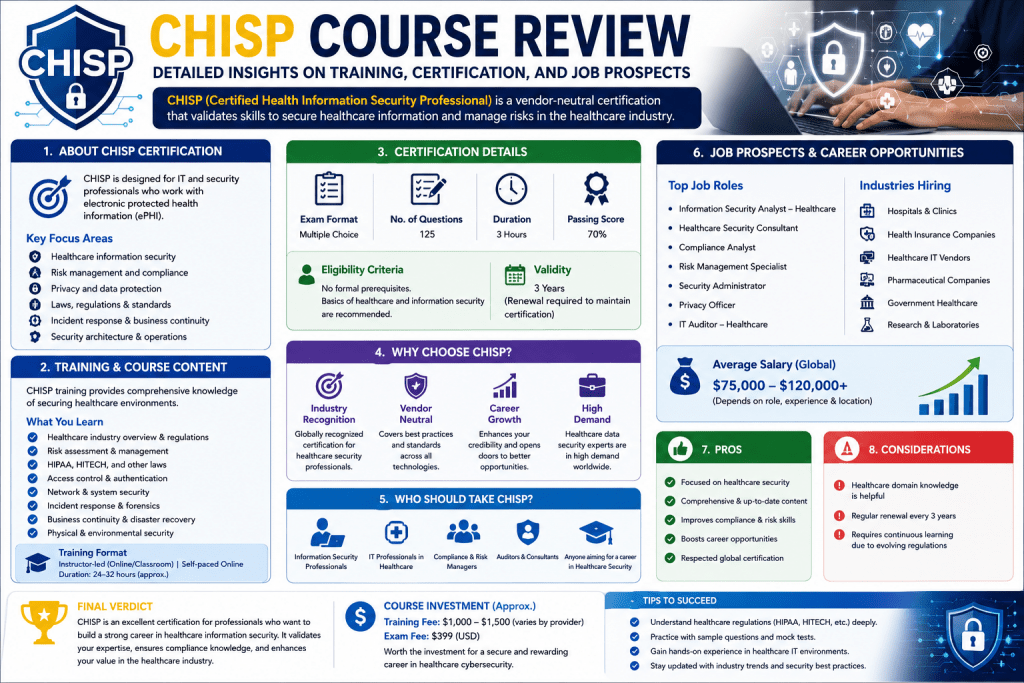
Healthcare information systems have become a central part of modern medical services, connecting clinical practice with digital technologies that manage patient records, diagnostic data, billing processes, and regulatory compliance. A professional certification in healthcare informatics systems is designed to validate an individual’s understanding of both healthcare environments and the technical systems that support them. This type of credential is typically pursued by individuals aiming to work at the intersection of healthcare delivery and information technology, where accuracy, security, and interoperability are essential.
A structured training program in this field generally introduces learners to the foundational principles of healthcare IT while gradually progressing toward more complex topics such as data governance, electronic health record systems, and information security frameworks. The goal is to develop a well-rounded skill set that enables professionals to support healthcare organizations in improving operational efficiency and patient care outcomes through technology.
Rather than focusing solely on exam preparation, this type of learning path also emphasizes practical understanding of real-world healthcare environments. Learners are exposed to the terminology, workflows, and systems commonly used in hospitals, clinics, insurance organizations, and public health institutions. This ensures that technical knowledge is grounded in the realities of healthcare delivery.
Foundational Computing Concepts in Healthcare IT
A strong understanding of basic computing principles is essential for anyone entering healthcare informatics. Healthcare systems rely heavily on computers, networks, and digital infrastructure to store and transmit sensitive information. Foundational topics typically include how data is represented at the most basic level, such as bits, bytes, and hexadecimal systems, which form the basis of all digital communication.
Computer architecture concepts are also important, including how processors handle instructions, how memory is structured, and how data is temporarily and permanently stored. Memory addressing plays a key role in ensuring that applications retrieve and process information accurately, especially when handling large volumes of patient records.
Programming language structures are often introduced to help learners understand how software is built and how instructions are logically organized. While healthcare IT professionals may not always write complex code, understanding the structure of programming logic helps in troubleshooting systems and communicating effectively with software developers.
Networking fundamentals are equally critical. Healthcare environments rely on interconnected systems that transmit data across departments, facilities, and sometimes across geographic regions. Understanding how data moves through networks helps professionals ensure that information is delivered efficiently and securely without disruption to clinical operations.
Data Representation and Medical Data Types
Healthcare data comes in many forms, ranging from structured numerical values to unstructured clinical notes. Understanding how different types of data are categorized and represented is essential for accurate recordkeeping and analysis. Structured data includes measurable values such as heart rate, blood pressure, laboratory results, and medication dosages. Unstructured data includes physician notes, diagnostic descriptions, and narrative reports.
Different data types require different methods of storage and processing. For example, numerical data can be analyzed statistically, while text-based data often requires natural language processing or manual interpretation. Characteristics such as accuracy, consistency, and completeness are especially important in healthcare environments where incorrect data can lead to serious consequences.
Data representation also extends to how information is encoded and stored in digital systems. Healthcare systems must ensure that data remains consistent across multiple platforms and applications, particularly when shared between institutions. Proper understanding of data types helps professionals maintain data integrity and supports better decision-making in clinical and administrative contexts.
Healthcare Terminology and Clinical Language Fundamentals
Healthcare environments use a highly specialized language that combines medical terminology with technical and administrative vocabulary. Understanding this terminology is essential for effective communication between clinicians, administrators, and IT professionals. Medical terms often describe anatomical structures, diseases, treatments, and procedures in precise language that reduces ambiguity.
In addition to clinical terminology, healthcare IT professionals must also understand operational and technical terms used in healthcare systems. This includes terminology related to patient management, diagnostic workflows, and digital recordkeeping systems. Familiarity with both clinical and technical language allows professionals to bridge the gap between healthcare providers and technology systems.
Healthcare terminology also plays a critical role in coding and classification systems used for recordkeeping and billing. Accurate interpretation of terms ensures that patient data is correctly documented and processed. This reduces errors in reporting and improves the overall efficiency of healthcare operations.
Healthcare Systems, Regulations, and Operational Workflows
Healthcare organizations operate within highly regulated environments that require strict adherence to standards and procedures. Operational workflows define how patients move through different stages of care, from initial consultation to diagnosis, treatment, and follow-up. Understanding these workflows is essential for designing and managing information systems that support healthcare delivery.
Regulatory frameworks ensure that healthcare organizations maintain patient privacy, data security, and ethical standards. These regulations influence how information is collected, stored, and shared across systems. Healthcare IT professionals must be aware of these requirements to ensure compliance and avoid data breaches or operational failures.
Operational principles in healthcare also include resource management, scheduling, and coordination between departments. Information systems play a key role in streamlining these processes, reducing delays, and improving communication between healthcare teams. A strong understanding of these systems allows professionals to contribute to more efficient and reliable healthcare operations.
Medical Billing, Insurance, and Administrative Data Flow
Healthcare systems are not only clinical in nature but also involve complex financial and administrative processes. Medical billing systems manage the documentation and processing of healthcare services for reimbursement purposes. This includes translating clinical procedures into standardized codes used by insurance providers and government agencies.
Insurance systems rely on accurate data exchange between healthcare providers and payers. This includes patient eligibility verification, claim submission, and payment processing. Understanding how these systems interact helps professionals ensure that financial transactions are handled accurately and efficiently.
Administrative data flow also includes patient registration, appointment scheduling, and record maintenance. These processes are supported by digital systems that integrate clinical and financial data into a unified structure. Efficient management of this data flow reduces administrative burden and allows healthcare providers to focus more on patient care.
Electronic Health Records and Interoperability Systems
Electronic health record systems are central to modern healthcare IT infrastructure. They store comprehensive patient information, including medical history, test results, treatment plans, and clinical notes. These systems allow healthcare providers to access patient information quickly and make informed decisions based on complete and up-to-date records.
Interoperability is a critical concept in healthcare systems, referring to the ability of different systems to communicate and exchange data effectively. This ensures that patient information can be shared across multiple healthcare providers without loss of accuracy or context. Interoperability also supports coordinated care, especially for patients receiving treatment from multiple specialists.
Healthcare systems must be designed to support data exchange standards that ensure consistency and reliability. This includes structured formats for storing and transmitting clinical data. Understanding these systems is essential for maintaining continuity of care and improving healthcare outcomes.
Data Management, Databases, and Analytics in Healthcare
Healthcare organizations generate large volumes of data that must be stored, managed, and analyzed effectively. Database systems provide the structure needed to organize this information in a way that allows for efficient retrieval and reporting. These systems support both operational needs and long-term strategic planning.
Data warehousing involves collecting data from multiple sources and storing it in a centralized system for analysis. This enables healthcare organizations to identify trends, monitor performance, and improve decision-making processes. Data mining techniques are often used to extract meaningful insights from large datasets, supporting research and quality improvement initiatives.
Analytics in healthcare can be used to improve patient outcomes, optimize resource allocation, and identify potential risks. By analyzing patterns in clinical and operational data, healthcare organizations can make more informed decisions and improve overall efficiency.
Information Security and Privacy in Healthcare IT
Information security is one of the most critical aspects of healthcare technology systems due to the sensitive nature of patient data. Healthcare organizations must implement strong security measures to protect information from unauthorized access, corruption, or loss. This includes both technical safeguards and administrative policies.
Security practices involve controlling access to systems, encrypting data, and monitoring for potential threats. These measures ensure that patient information remains confidential and is only accessible to authorized personnel. Compliance with privacy regulations is also essential to maintain trust and legal integrity.
Healthcare IT professionals must understand how to identify vulnerabilities and respond to security incidents effectively. This includes recognizing potential risks in network systems, software applications, and data storage environments. A strong security foundation helps protect both patients and healthcare organizations from harm.
Conclusion
Healthcare informatics systems represent a critical intersection of medicine and technology, requiring a broad understanding of computing, data management, clinical terminology, and regulatory frameworks. Professionals entering this field must develop both technical and contextual knowledge to effectively support healthcare operations. From foundational computing principles to advanced topics such as interoperability and data security, each component plays a vital role in ensuring that healthcare systems function efficiently and reliably. As healthcare continues to evolve through digital transformation, the demand for skilled professionals who understand these integrated systems will continue to grow, making this area of study both relevant and impactful for long-term career development.