Virtual client computing has evolved from an experimental approach into a critical pillar of enterprise technology. Organizations today depend heavily on digital infrastructure to support their operations, and virtualization has become one of the most effective ways to deliver consistent, secure, and scalable computing environments. Instead of relying on physical devices tied to specific locations, virtualization enables users to access applications and desktops from virtually anywhere.
This transformation has been driven by the need for flexibility in the workplace. As businesses expand globally and remote work becomes more common, traditional computing models have struggled to keep up. Virtualization addresses these challenges by separating the user experience from the underlying hardware. This allows IT teams to centralize resources while still providing seamless access to end users.
Security is another major factor behind the rise of virtual client computing. By hosting applications and data in centralized environments, organizations can implement stronger security controls and reduce the risk of data breaches. Sensitive information remains within controlled systems rather than being distributed across multiple devices. This approach not only enhances protection but also simplifies compliance with regulatory requirements.
Performance and efficiency have also improved significantly with advancements in virtualization technologies. Modern solutions are capable of delivering high-quality user experiences even over remote connections. This has made virtualization a viable option for a wide range of use cases, from small businesses to large enterprises with complex infrastructure needs.
Citrix as a Leader in Virtualization Technology
When discussing virtualization, it is impossible to ignore the influence of Citrix. Over the years, Citrix has established itself as one of the leading providers of virtualization solutions, offering tools that enable organizations to deliver applications and desktops efficiently and securely.
Citrix technologies are designed to provide centralized control over IT environments while maintaining flexibility for users. This balance is crucial in modern workplaces, where employees need access to resources from different locations and devices. By leveraging Citrix solutions, organizations can ensure that users have consistent experiences regardless of how they connect.
One of the key strengths of Citrix is its ability to integrate with existing IT infrastructure. Organizations can incorporate Citrix solutions into their environments without completely overhauling their systems. This makes it easier to adopt virtualization while minimizing disruption to ongoing operations.
Citrix also places a strong emphasis on user experience. Its technologies are optimized to deliver smooth performance, even in challenging network conditions. This ensures that users can work efficiently without being hindered by technical limitations. At the same time, IT teams retain full control over security and system management.
Introduction to the CCE-V Certification
The Citrix Certified Expert – Virtualization represents the highest level of expertise within Citrix’s virtualization certification track. It is designed for experienced professionals who are responsible for designing and implementing advanced virtualization solutions.
Unlike entry-level certifications that focus on basic skills, the CCE-V emphasizes strategic thinking and system design. Candidates are expected to understand how to analyze business requirements and translate them into effective technical solutions. This requires a deep understanding of both the technology and the organizational context in which it is used.
The certification serves as a formal recognition of expert-level knowledge in Citrix virtualization. It demonstrates that a professional has the skills needed to design complex environments that meet performance, security, and scalability requirements. This makes it a valuable credential for individuals who want to advance their careers in IT.
Earning the CCE-V is not an easy task. The certification process is rigorous and requires a significant investment of time and effort. However, for those who succeed, it provides a strong validation of their expertise and opens up new career opportunities.
Understanding the Certification Pathway
The journey to earning the CCE-V certification involves progressing through multiple levels of expertise. Candidates typically start with an associate-level certification, followed by a professional-level credential, before reaching the expert level.
This structured pathway ensures that individuals build a solid foundation before tackling advanced topics. Each stage introduces new concepts and skills, gradually increasing in complexity. By the time candidates reach the expert level, they are expected to have extensive hands-on experience and a deep understanding of virtualization technologies.
The progression also mirrors real-world career development. Entry-level roles often focus on basic configuration and support tasks, while more advanced positions involve planning and design responsibilities. The certification pathway aligns with this progression, making it a practical guide for professional growth.
In addition to technical knowledge, candidates must develop problem-solving skills and the ability to think strategically. These qualities are essential for designing effective virtualization solutions that meet organizational needs.
Core Technologies Behind the CCE-V
At the center of the CCE-V certification is Citrix Virtual Apps and Desktops. This platform enables organizations to deliver applications and desktop environments from centralized servers to end users.
The technology works by hosting applications and desktops in a data center or cloud environment, allowing users to access them remotely. This eliminates the need for local installations and ensures that all users are working with the same configurations. It also simplifies updates and maintenance, as changes can be applied centrally.
Citrix Virtual Apps and Desktops supports a wide range of features that enhance performance and usability. These include load balancing, resource optimization, and user personalization. Such features make it possible to deliver high-quality experiences even in large and complex environments.
Understanding how to design solutions using this platform requires more than technical knowledge. Professionals must consider factors such as network performance, user behavior, and security requirements. The CCE-V certification focuses on these aspects, emphasizing the importance of comprehensive system design.
The Importance of Virtualization Design Skills
Designing virtualization solutions is a complex process that requires careful planning and analysis. It involves evaluating existing infrastructure, identifying requirements, and developing strategies to meet those needs. This process goes beyond simply deploying software and requires a deep understanding of both technology and business objectives.
The CCE-V certification places a strong emphasis on design skills. Candidates are tested on their ability to create solutions that are scalable, secure, and efficient. This includes considerations such as resource allocation, redundancy, and disaster recovery.
Effective design can have a significant impact on organizational performance. Well-designed systems are easier to manage, more reliable, and better able to adapt to changing requirements. They also provide a better user experience, which can improve productivity and satisfaction.
Professionals who excel in design are highly valued in the job market. They are often responsible for making critical decisions that affect the success of IT projects. The CCE-V certification helps demonstrate these capabilities, making it a valuable asset for career advancement.
Specialization vs Generalization in Certifications
One of the key characteristics of the CCE-V certification is its focus on a specific technology ecosystem. Unlike general certifications that cover a broad range of topics, the CCE-V is tailored to Citrix solutions.
This specialization allows for a deeper understanding of the platform and its capabilities. Candidates learn how to use Citrix technologies effectively and how to apply best practices in real-world scenarios. This makes the certification particularly valuable in organizations that rely on Citrix for their virtualization needs.
However, specialization also means that the certification may not be as widely applicable in environments that use different technologies. Professionals must consider their career goals and the technologies used by their organization when deciding whether to pursue the CCE-V.
Despite this limitation, the skills developed through the certification process are transferable. Concepts such as system design, resource management, and security are relevant across various IT domains. This makes the CCE-V a valuable addition to a professional’s skill set.
The Role of Experience in Achieving CCE-V
Experience plays a crucial role in preparing for the CCE-V certification. While theoretical knowledge is important, practical experience is essential for understanding how virtualization technologies work in real-world environments.
Candidates are expected to have several months or even years of hands-on experience with Citrix solutions before attempting the certification. This includes managing and supporting complex environments, as well as troubleshooting issues and optimizing performance.
Experience also helps candidates develop the problem-solving skills needed to succeed in the certification exam. The questions are designed to test not only knowledge but also the ability to apply that knowledge in practical scenarios.
In addition to working with Citrix technologies, candidates should be familiar with related systems such as directory services, databases, and networking tools. This broader knowledge is necessary for designing integrated solutions that function effectively within an organization.
Career Opportunities with CCE-V Certification
Earning the CCE-V certification can open up a range of career opportunities in the IT industry. It is particularly relevant for roles that involve system design, architecture, and consulting.
Professionals with this certification are often responsible for planning and implementing virtualization solutions. They may work as solutions architects, virtualization engineers, or consultants, helping organizations optimize their IT infrastructure.
These roles typically involve high levels of responsibility and require strong technical and analytical skills. Certified professionals are expected to make decisions that impact the performance, security, and scalability of systems.
The demand for such expertise continues to grow as organizations adopt virtualization technologies. This makes the CCE-V certification a valuable credential for individuals who want to advance their careers and take on more strategic roles.
Why Organizations Value Expert-Level Certifications
Organizations rely on skilled professionals to manage their IT infrastructure effectively. Certifications like the CCE-V assure that an individual has the knowledge and expertise needed to handle complex environments.
For employers, hiring certified professionals reduces risk and increases confidence in their capabilities. It ensures that the individual has been tested against industry standards and has demonstrated their ability to perform at a high level.
Certified professionals also bring credibility to their roles. They are often seen as trusted advisors who can guide decision-making and contribute to strategic planning. This can lead to increased responsibilities and opportunities for career growth.
The value of certification extends beyond individual professionals. It contributes to the overall effectiveness of IT teams, enabling organizations to implement and maintain robust virtualization solutions.
Deep Dive into the CCE-V Exam Structure and Objectives
The Citrix Certified Expert – Virtualization is widely recognized for its depth and complexity, and a major reason for that is the structure of its exam. The certification is validated through a single advanced-level exam that evaluates a candidate’s ability to design and optimize enterprise virtualization environments. This is not an entry-level test focused on memorization or basic configuration. Instead, it is built to assess decision-making, architectural thinking, and the ability to handle real-world scenarios.
The exam associated with this certification is known as 1Y0-403. Candidates are given a limited amount of time to answer a set of questions that are carefully designed to test multiple aspects of virtualization design. The questions often present scenarios that require analysis, interpretation, and strategic thinking rather than straightforward answers. This makes preparation more challenging, as candidates must go beyond theoretical knowledge and develop practical problem-solving skills.
The exam is divided into several objectives, each representing a key component of virtualization design. These objectives include methodology and assessment, user layer, access layer, resource layer, control layer, hardware and compute considerations, high availability, and disaster recovery. Each section contributes to the overall evaluation, but some areas carry more weight due to their importance in real-world implementations.
Understanding these objectives is essential for effective preparation. Candidates must be familiar with each domain and how it fits into the broader context of virtualization design. This requires a comprehensive approach to learning, combining study materials with hands-on experience.
Understanding Methodology and Assessment in Virtualization Design
One of the foundational aspects of the exam is methodology and assessment. This section focuses on the processes used to evaluate an organization’s requirements and determine the best approach to virtualization. It involves gathering information, analyzing existing systems, and identifying potential challenges.
Professionals preparing for the certification must understand how to conduct thorough assessments. This includes evaluating user needs, application requirements, and infrastructure capabilities. The goal is to create a clear picture of the current environment and identify areas for improvement.
Assessment is not just about identifying problems. It also involves understanding business objectives and aligning technical solutions with those goals. This requires strong communication skills, as professionals often need to work with stakeholders from different departments.
A well-structured methodology ensures that all relevant factors are considered during the design process. It helps prevent oversights and reduces the risk of implementing ineffective solutions. This is why the exam places significant emphasis on this area.
Exploring the User Layer and Experience Optimization
The user layer is a critical component of virtualization design, as it directly affects the end-user experience. This section of the exam focuses on how users interact with virtualized applications and desktops. It includes considerations such as user profiles, personalization, and performance.
Designing an effective user layer requires an understanding of user behavior and expectations. Different users have different needs, and solutions must be tailored accordingly. For example, some users may require high-performance applications, while others may prioritize accessibility and flexibility.
Personalization is another important factor. Users expect their virtual environments to reflect their preferences and settings. This can be achieved through various technologies that manage user profiles and ensure consistency across sessions.
Performance optimization is also crucial. Slow or unreliable systems can negatively impact productivity and user satisfaction. Professionals must be able to design solutions that deliver consistent performance, even under heavy workloads.
Access Layer and Secure Connectivity Considerations
The access layer is responsible for managing how users connect to virtualized environments. This includes authentication, authorization, and secure communication. It plays a key role in ensuring that only authorized users can access resources.
Security is a major focus in this area. Professionals must understand how to implement secure access methods and protect data from unauthorized access. This involves using encryption, secure gateways, and other security measures.
In addition to security, the access layer must provide a seamless user experience. Users should be able to connect without encountering technical barriers. This requires careful planning and configuration.
The exam tests a candidate’s ability to design access solutions that balance security and usability. This is particularly important in environments where users access systems from different locations and devices.
Resource Layer and Application Management
The resource layer is where applications and desktops are hosted. It includes the infrastructure that supports virtualization, such as servers, storage, and virtualization software. This layer is responsible for delivering resources to users efficiently.
Application management is a key aspect of this layer. Professionals must understand how to deploy, update, and maintain applications within a virtualized environment. This includes managing dependencies and ensuring compatibility.
Resource optimization is another important consideration. Organizations need to make efficient use of their infrastructure to reduce costs and improve performance. This involves techniques such as load balancing and resource allocation.
The exam evaluates a candidate’s ability to design resource layers that are scalable and efficient. This requires a deep understanding of both the technology and the organization’s needs.
Control Layer and Centralized Management
The control layer is responsible for managing and monitoring the virtualization environment. It provides the tools and interfaces that administrators use to control systems and ensure their proper functioning.
Centralized management is one of the key benefits of virtualization. It allows IT teams to oversee multiple systems from a single location, simplifying administration and reducing complexity. This is especially important in large environments with many users and applications.
Monitoring is another critical function of the control layer. Professionals must be able to track system performance, identify issues, and take corrective action. This helps maintain stability and prevent disruptions.
The exam tests a candidate’s ability to design control systems that provide effective management and monitoring capabilities. This includes understanding how different components interact and how to optimize their performance.
Hardware and Compute Layer Considerations
The hardware and compute layer forms the foundation of the virtualization environment. It includes the physical and virtual resources that support the system, such as servers, processors, and memory.
Designing this layer requires careful planning to ensure that resources are sufficient to meet demand. Professionals must consider factors such as workload requirements, scalability, and performance.
Virtualization adds another layer of complexity, as resources must be allocated dynamically. This requires an understanding of how virtualization technologies manage resources and how to optimize their use.
The exam evaluates a candidate’s ability to design hardware and compute solutions that are efficient and reliable. This includes understanding how to balance performance and cost.
High Availability and Multi-Location Environments
High availability is a critical requirement for modern IT systems. Organizations need their systems to be accessible at all times, and downtime can have significant consequences. This section of the exam focuses on designing solutions that ensure continuous availability.
High availability involves implementing redundancy and failover mechanisms. This ensures that if one component fails, another can take its place without disrupting service. Professionals must understand how to design systems that minimize downtime.
Multi-location environments add another layer of complexity. Organizations with multiple sites need to ensure that their systems are consistent and accessible across locations. This requires careful planning and coordination.
The exam tests a candidate’s ability to design solutions that provide high availability and support multi-location environments. This is one of the most important areas, as it directly impacts system reliability.
Disaster Recovery Planning and Implementation
Disaster recovery is another critical aspect of virtualization design. It involves preparing for unexpected events that could disrupt operations, such as hardware failures or natural disasters.
A comprehensive disaster recovery plan includes strategies for data backup, system restoration, and continuity of operations. Professionals must understand how to design and implement these strategies effectively.
Testing is also an important part of disaster recovery. Plans must be regularly tested to ensure that they work as intended. This helps identify potential issues and improve readiness.
The exam evaluates a candidate’s ability to design disaster recovery solutions that protect data and ensure business continuity. This requires a thorough understanding of both technology and risk management.
Cost Breakdown and Financial Considerations
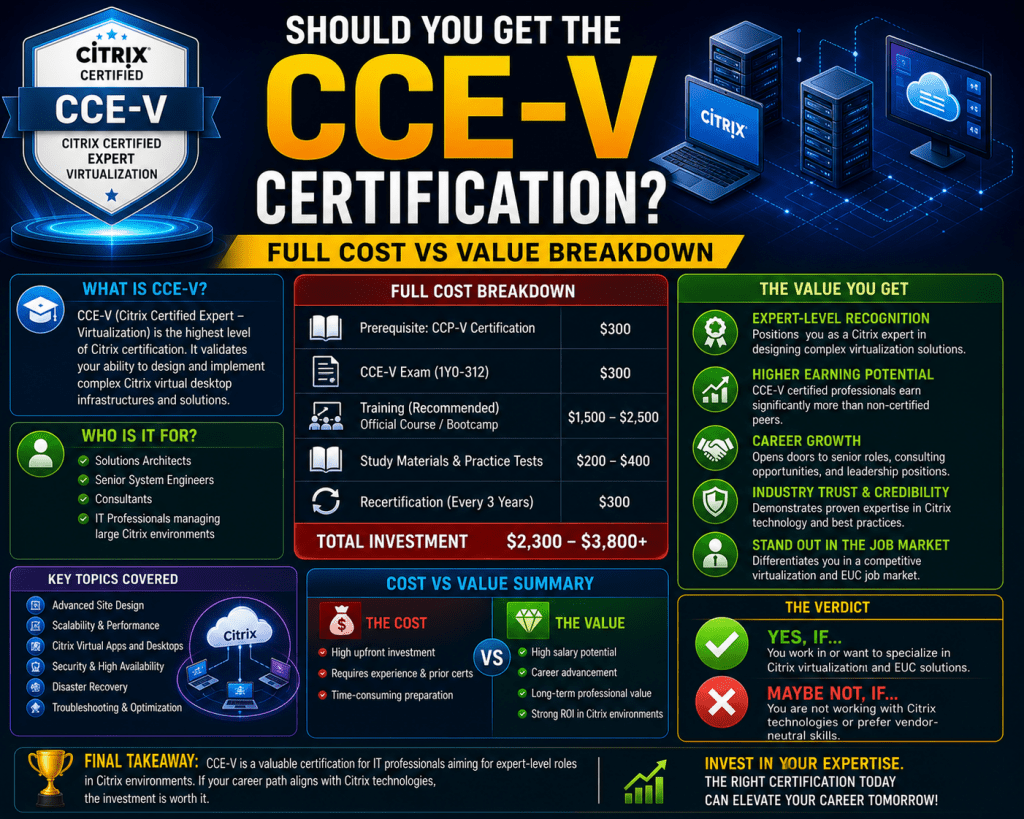
Pursuing the CCE-V certification involves financial investment. The cost of the exam itself is only part of the overall expense. Candidates must also consider the cost of prerequisite certifications and training.
Before attempting the expert-level certification, candidates are required to complete earlier certifications. Each of these comes with its own exam fees, adding to the total cost. In addition, training courses and study materials may be necessary to prepare effectively.
While the cost can be high, it is important to view it as an investment in professional development. The skills and knowledge gained through the certification process can lead to career advancement and increased earning potential.
Professionals must evaluate their career goals and determine whether the investment aligns with their objectives. This requires careful consideration of both the costs and the potential benefits.
Skills Required to Succeed in the CCE-V Exam
Success in the CCE-V exam requires a combination of technical knowledge and practical skills. Candidates must have a deep understanding of virtualization technologies and how they are used in real-world environments.
Problem-solving is one of the most important skills. The exam presents complex scenarios that require analysis and decision-making. Candidates must be able to evaluate different options and choose the best solution.
Communication skills are also important, as professionals often need to explain their designs and justify their decisions. This is particularly relevant in roles that involve working with stakeholders.
Hands-on experience is essential for developing these skills. Candidates should spend time working with virtualization technologies and gaining practical experience. This helps build confidence and improve performance in the exam.
The Importance of Real-World Experience
Real-world experience is a key factor in preparing for the CCE-V certification. While study materials provide valuable information, practical experience is necessary to understand how concepts are applied in real environments.
Working with virtualization technologies allows candidates to develop a deeper understanding of their functionality and limitations. It also helps build problem-solving skills and the ability to handle unexpected challenges.
Experience with related technologies is also important. Virtualization environments often involve multiple systems, including networking, storage, and security. Understanding how these components interact is essential for effective design.
The exam is designed to reflect real-world scenarios, making practical experience a crucial part of preparation. Candidates who have hands-on experience are more likely to succeed and perform well in their roles after certification.
Evaluating the Career Value of the CCE-V Certification
The Citrix Certified Expert – Virtualization represents a significant milestone in the career of an IT professional specializing in virtualization. However, determining whether it is worth pursuing depends largely on individual career goals, current experience, and the technologies used within an organization. Unlike entry-level certifications that provide general exposure, this expert-level credential is designed to validate deep expertise and strategic thinking.
For professionals who are already working within virtualization environments, the certification can serve as a formal acknowledgment of their skills. It demonstrates that they are capable of handling complex design challenges and can contribute to high-level decision-making processes. This can be particularly valuable in competitive job markets where employers seek candidates with proven expertise.
The value of the certification also depends on the relevance of Citrix technologies within a professional’s work environment. In organizations where virtualization is heavily reliant on Citrix solutions, the certification can significantly enhance credibility and career prospects. In contrast, in environments that use different platforms, its impact may be more limited.
Ultimately, the decision to pursue the certification should be based on a careful assessment of career objectives. Professionals should consider whether their roles involve design and architecture responsibilities, as these are the areas where the certification provides the most benefit.
Using the CCE-V to Develop Advanced Skills
One of the most compelling reasons to pursue the CCE-V certification is the opportunity to develop advanced skills in virtualization design. The certification process requires candidates to explore complex topics and gain a deeper understanding of how systems are built and managed.
Preparing for the certification involves studying various aspects of virtualization, including system architecture, resource management, and security. This comprehensive approach ensures that candidates develop a well-rounded skill set that can be applied in real-world scenarios.
The learning process also encourages critical thinking. Candidates must analyze different situations, evaluate possible solutions, and determine the best course of action. This helps build problem-solving skills that are essential for advanced roles in IT.
In addition to technical knowledge, the certification process helps professionals develop a strategic mindset. They learn how to align technical solutions with business objectives, ensuring that their designs meet organizational needs. This combination of technical and strategic skills is highly valued in the industry.
Validating Expertise Through Certification
Certifications play an important role in validating a professional’s skills and experience. The CCE-V certification serves as proof that an individual has achieved a high level of expertise in virtualization design.
For professionals who have gained experience through hands-on work, the certification provides a way to formalize their knowledge. It demonstrates that their skills have been tested and meet industry standards. This can be particularly beneficial when seeking new job opportunities or promotions.
Employers often use certifications as a benchmark when evaluating candidates. An expert-level certification like the CCE-V can help differentiate a candidate from others with similar experience. It signals that the individual has gone beyond basic knowledge and has developed advanced capabilities.
The certification also provides a sense of accomplishment. Achieving an expert-level credential requires dedication and effort, and it reflects a commitment to professional growth. This can boost confidence and motivate individuals to continue developing their skills.
Who Benefits Most from the CCE-V Certification
The CCE-V certification is not equally beneficial for all IT professionals. Its value is highest for individuals who are involved in designing and implementing virtualization solutions. These roles require a deep understanding of system architecture and the ability to make strategic decisions.
Solutions architects are among the primary beneficiaries of this certification. Their responsibilities often include evaluating requirements, designing systems, and ensuring that solutions meet organizational goals. The certification aligns closely with these tasks, making it a valuable asset for career advancement.
Virtualization consultants also benefit significantly from the certification. These professionals are often brought in to assess environments and recommend solutions. The CCE-V demonstrates its ability to handle complex projects and provides credibility when working with clients.
Senior engineers who are transitioning into design roles can also gain value from the certification. It helps bridge the gap between technical implementation and strategic planning, preparing them for more advanced responsibilities.
When the CCE-V May Not Be the Right Choice
While the CCE-V certification offers many benefits, it is not the best choice for everyone. Professionals who focus primarily on day-to-day operational tasks may find that the certification does not align with their responsibilities.
For example, network engineers who spend most of their time troubleshooting issues and maintaining systems may not benefit as much from a design-focused certification. In such cases, other certifications that focus on practical skills and specific technologies may be more relevant.
The certification also requires a significant investment of time and money. Professionals must be prepared to dedicate resources to studying and gaining experience. If the certification does not align with their career goals, this investment may not provide a strong return.
Individuals need to evaluate their roles and responsibilities before deciding to pursue the certification. They should consider whether their work involves design and planning, as these are the areas where the certification provides the most value.
The Role of CCE-V in Career Advancement
The CCE-V certification can play a significant role in career advancement for IT professionals. It demonstrates a high level of expertise and can open doors to more advanced roles and responsibilities.
Professionals with this certification are often considered for leadership positions within IT teams. They may be responsible for overseeing projects, guiding team members, and making strategic decisions. This level of responsibility can lead to increased job satisfaction and career growth.
The certification can also enhance earning potential. Employers are often willing to offer higher salaries to individuals with advanced certifications, as they bring valuable skills to the organization. This makes the certification a worthwhile investment for many professionals.
In addition to financial benefits, the certification can provide greater job security. As organizations continue to rely on virtualization technologies, the demand for skilled professionals is expected to remain strong. Having an expert-level certification can help individuals stay competitive in the job market.
Comparing CCE-V with Other Certification Paths
When considering the CCE-V certification, it is important to compare it with other certification paths. This helps professionals determine whether it is the best fit for their career goals.
The CCE-V is highly specialized, focusing specifically on Citrix technologies. This makes it an excellent choice for professionals working in environments that rely on these solutions. However, it may not be as relevant for those working with other platforms.
General virtualization certifications provide broader coverage and may be more suitable for professionals who work with multiple technologies. These certifications often focus on fundamental concepts that apply across different platforms.
The choice between specialized and general certifications depends on individual circumstances. Professionals should consider the technologies used in their organization and the direction they want their careers to take.
Industry Demand for Virtualization Experts
The demand for virtualization experts continues to grow as organizations adopt digital transformation strategies. Virtualization plays a key role in enabling flexible work environments, improving security, and optimizing resource utilization.
Professionals with expertise in virtualization are needed to design and manage these systems. The CCE-V certification provides a way to demonstrate this expertise and stand out in the job market.
As businesses continue to invest in technology, the need for skilled professionals is expected to increase. This creates opportunities for individuals who have the knowledge and skills required to design and implement virtualization solutions.
The certification also aligns with emerging trends such as cloud computing and remote work. These trends are driving the adoption of virtualization technologies, further increasing the demand for experts in this field.
Practical Applications of CCE-V Knowledge
The knowledge gained through the CCE-V certification can be applied in various real-world scenarios. Professionals can use their skills to design and implement virtualization solutions that meet organizational needs.
One of the key applications is improving system efficiency. By optimizing resource allocation and performance, professionals can help organizations reduce costs and improve productivity. This has a direct impact on business operations.
Another important application is enhancing security. Virtualization allows organizations to centralize data and implement stronger security measures. Professionals with CCE-V certification can design systems that protect sensitive information and reduce the risk of breaches.
The certification also prepares professionals to handle complex projects. They can manage large-scale implementations, coordinate with different teams, and ensure that systems are delivered successfully. This makes them valuable assets to their organizations.
Long-Term Benefits of Achieving CCE-V
Achieving the CCE-V certification offers long-term benefits that extend beyond immediate career gains. It provides a strong foundation for continued professional development and growth.
The skills acquired during the certification process remain relevant as technology evolves. Concepts such as system design, resource management, and security are fundamental to many areas of IT. This makes the certification a valuable investment in the long term.
The certification also encourages continuous learning. Professionals who achieve expert-level credentials are often motivated to stay updated with new technologies and trends. This helps them remain competitive in a rapidly changing industry.
In addition to professional benefits, the certification can provide personal satisfaction. Achieving a challenging goal can boost confidence and inspire individuals to pursue further accomplishments.
Balancing Cost, Effort, and Return on Investment
Pursuing the CCE-V certification requires careful consideration of the costs and benefits. The financial investment includes exam fees, training, and study materials. In addition, candidates must invest time and effort in preparation.
To determine whether the certification is worth it, professionals should evaluate the potential return on investment. This includes factors such as career advancement, earning potential, and job opportunities.
For individuals working in environments that rely on Citrix technologies, the certification can provide significant benefits. It can enhance credibility, improve job prospects, and lead to higher salaries. In such cases, the investment is often justified.
However, for those working in different environments, the benefits may be less pronounced. It is important to consider how the certification aligns with career goals and whether it will provide tangible advantages.
By carefully weighing these factors, professionals can make informed decisions about whether to pursue the CCE-V certification.
Conclusion
The decision to pursue the Citrix Certified Expert – Virtualization ultimately comes down to alignment between professional goals, current experience, and the technological direction of the environments in which an individual works or plans to work. Throughout the exploration of virtualization, certification pathways, exam structure, and career impact, it becomes clear that this credential is not simply another addition to a resume but rather a specialized validation of high-level expertise in designing and managing complex virtualization ecosystems.
Virtualization itself has become a cornerstone of modern IT infrastructure. As organizations continue to prioritize flexibility, scalability, and security, the need for centralized solutions that can deliver consistent user experiences has grown significantly. Technologies developed by Citrix have played a major role in shaping this transformation, allowing businesses to deliver applications and desktops efficiently across distributed environments. In such contexts, professionals who can design, optimize, and maintain these systems are not only valuable but essential.
The CCE-V certification represents the peak of this specialization within the Citrix ecosystem. It is designed for individuals who are not just implementing solutions but are responsible for planning them from the ground up. This distinction is important because it separates operational roles from strategic ones. While many IT professionals focus on maintaining systems and resolving immediate technical issues, the CCE-V is intended for those who operate at a higher level, where decisions impact long-term performance, scalability, and business outcomes.
One of the most significant aspects of this certification is the depth of knowledge it requires. Candidates must understand not only how individual components function but also how they interact within a larger system. This includes considerations such as user experience, network performance, resource allocation, security, and disaster recovery. The ability to integrate all these elements into a cohesive design is what defines an expert in virtualization. Achieving this level of understanding requires both extensive study and practical experience, making the certification a meaningful indicator of capability.
At the same time, the specialization of the CCE-V should not be overlooked. Because it focuses specifically on Citrix technologies, its value is closely tied to environments where those technologies are used. In organizations that rely heavily on Citrix solutions, the certification can significantly enhance a professional’s credibility and effectiveness. It signals to employers and peers that the individual has mastered the tools and methodologies required to design and manage these systems successfully. However, in environments that use different platforms, the direct applicability of the certification may be more limited, even though many of the underlying concepts remain relevant.
Another important consideration is the investment required to achieve the certification. The financial cost includes multiple exams and potentially training resources, while the time commitment involves extensive preparation and hands-on practice. This level of investment means that the decision to pursue the certification should not be taken lightly. It is most beneficial for individuals who are committed to a career path that involves virtualization design and architecture, as they are more likely to see a meaningful return on their investment.
From a career perspective, the CCE-V can open doors to advanced roles that involve greater responsibility and influence. Positions such as solutions architect, virtualization consultant, and senior infrastructure designer often require the kind of expertise that this certification validates. In these roles, professionals are expected to make strategic decisions, guide projects, and ensure that systems align with organizational goals. The certification helps demonstrate readiness for such responsibilities, making it a valuable asset for career progression.
Beyond immediate career benefits, the process of preparing for the certification also contributes to long-term professional growth. It encourages individuals to think critically, approach problems systematically, and develop a deeper understanding of complex systems. These skills are not limited to a single technology or platform but can be applied across various areas of IT. This makes the certification valuable not only as a credential but also as a learning experience that enhances overall competence.
It is also worth noting that certifications like the CCE-V serve as a form of validation in an industry where experience can sometimes be difficult to quantify. While hands-on work is essential, having a recognized credential provides a standardized way to demonstrate expertise. This can be particularly useful when seeking new opportunities or transitioning into more advanced roles. Employers often look for such indicators when evaluating candidates, as they assure a certain level of proficiency.
However, the certification is not a universal solution for all career paths. Professionals who are primarily focused on operational tasks or who work in environments with different technological stacks may find that their efforts are better directed toward other areas of development. In such cases, pursuing certifications that align more closely with daily responsibilities or broader skill sets may provide greater value. This highlights the importance of aligning certification choices with individual goals and circumstances.
The broader context of the IT industry also plays a role in determining the relevance of the CCE-V. As trends such as cloud computing, remote work, and digital transformation continue to evolve, virtualization remains a key enabler of these changes. The ability to deliver secure and efficient computing environments is critical for organizations adapting to new ways of working. Professionals who can design and manage these environments are likely to remain in demand, and certifications that validate these skills will continue to hold significance.
In evaluating whether the CCE-V is worth pursuing, it is helpful to consider not just the immediate benefits but also the long-term implications. The certification represents a commitment to mastering a specialized area of IT and to taking on roles that require strategic thinking and leadership. For those who are prepared to make this commitment, the rewards can be substantial, both in terms of career advancement and personal development.
Ultimately, the value of the certification lies in how well it aligns with an individual’s aspirations and the needs of the organizations they serve. It is neither inherently essential nor unnecessary, but rather a tool that can be highly effective when used in the right context. By carefully considering their goals, experience, and the technologies they work with, professionals can make informed decisions about whether this certification is the right step for their careers.