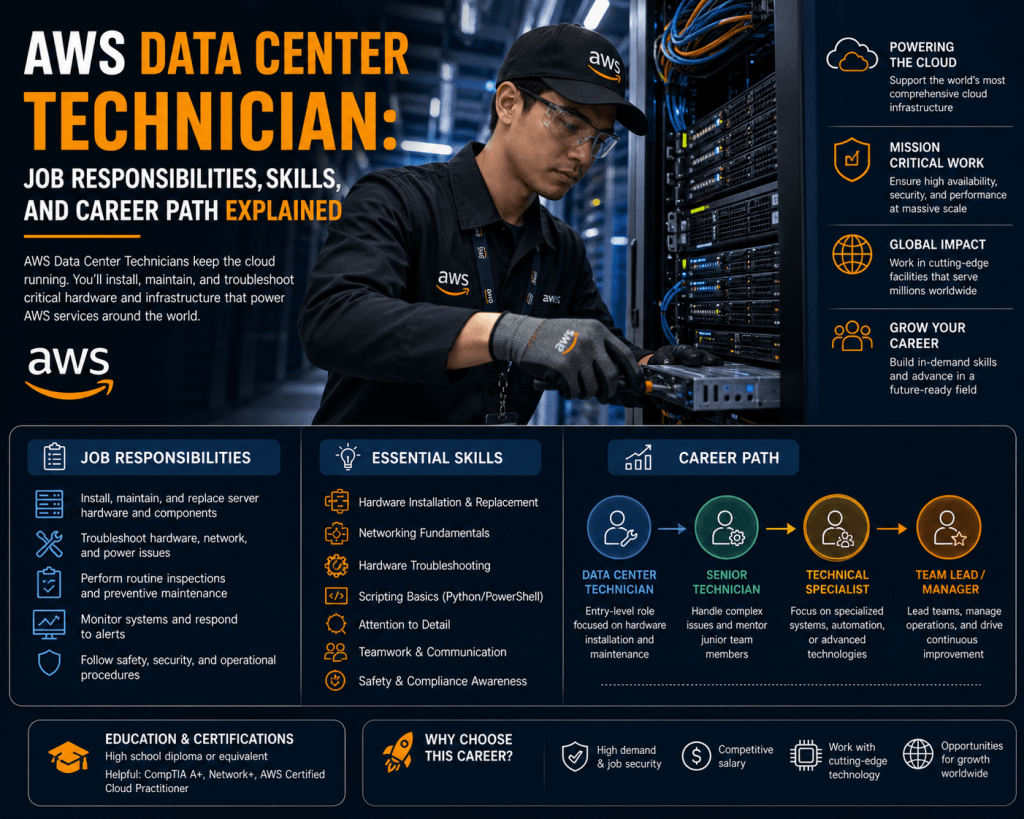
An AWS data center technician operates at the physical foundation of cloud computing systems where large-scale infrastructure is installed, maintained, and continuously monitored. The role is centered on ensuring that servers, networking equipment, storage systems, power delivery units, and cooling systems function reliably to support global cloud workloads. Unlike software-focused roles, this position deals directly with hardware components and the operational environment that supports cloud services. Every action taken by a technician contributes to the availability and stability of digital platforms used by enterprises and applications worldwide. The work environment is highly structured, requiring strict adherence to operational procedures, because even small hardware issues can impact large clusters of interconnected systems. Technicians must understand how physical systems interact with logical services, ensuring that infrastructure remains stable under continuous demand. This combination of hands-on technical work and disciplined operational execution makes the role essential in modern cloud ecosystems.
Core Responsibility: Infrastructure Installation And Hardware Deployment
A major part of the AWS data center technician role involves installing and deploying physical infrastructure within data center environments. This begins with receiving hardware components such as servers, storage devices, networking switches, and related equipment. Each item is inspected, verified, and prepared before being integrated into production systems. Technicians mount servers into racks, connect power systems, and route network cabling according to strict architectural standards. Proper labeling and documentation are required to maintain traceability across large-scale deployments. The installation process is not random or ad hoc; it follows structured procedures designed to ensure consistency, reliability, and scalability. Technicians also confirm that hardware placement supports efficient cooling, balanced power distribution, and optimized network flow. Before systems go live, validation steps are performed to confirm hardware functionality, connectivity, and readiness for production use. This ensures that new infrastructure integrates smoothly into existing cloud environments without causing disruptions.
Incident Response And System Troubleshooting Operations
Incident response is one of the most important responsibilities in this role. When systems fail or performance issues arise, technicians are responsible for identifying and resolving the underlying problem quickly and accurately. Incidents may involve server failures, network interruptions, storage issues, or hardware degradation. The troubleshooting process typically begins with analyzing alerts or tickets that describe system symptoms. Technicians then perform physical inspections, test hardware components, and examine system indicators to isolate the root cause. Because cloud infrastructure is highly interconnected, a single failure may affect multiple services, making an accurate diagnosis critical. Solutions may include replacing faulty hardware, reseating components, or repairing physical connections. If the issue exceeds local resolution capacity, escalation procedures are followed. The goal is always to restore functionality as quickly as possible while minimizing impact on dependent systems.
Physical Network Layer Management And Connectivity Maintenance
The physical network layer is a key responsibility area for AWS data center technicians. This includes managing fiber optic cables, Ethernet connections, switches, routers, and patch panels that enable data movement within and between data centers. Network connectivity issues can result from damaged cables, incorrect routing, or hardware failures. Technicians perform structured inspections to ensure that all cabling is properly installed, labeled, and secured. They also verify link status indicators and run diagnostic checks to confirm connectivity between systems. In large environments, maintaining organized cabling is essential for both performance and troubleshooting efficiency. Technicians must also understand redundancy designs, where multiple network paths ensure continuous operation even if one path fails. When problems are identified, technicians isolate affected segments, replace faulty components, and restore connectivity according to standard network design principles.
Linux System Interaction And Low-Level Server Diagnostics
Although the role is hardware-focused, AWS data center technicians frequently interact with Linux-based systems for diagnostic purposes. This involves accessing system consoles or logs to understand hardware behavior and system status. Technicians may review error logs to identify issues such as disk failures, memory errors, or CPU anomalies. Basic command-line tools are used to verify system health and confirm whether hardware is properly recognized by the operating system. While they do not manage software applications or system configurations at a high level, their ability to interpret system signals is essential for troubleshooting. For example, repeated system errors may indicate failing hardware components, allowing technicians to take corrective action. This integration of physical and system-level understanding helps ensure faster and more accurate problem resolution.
Power Distribution Systems And Electrical Infrastructure Support
Power systems are a critical component of data center operations, and technicians play an active role in maintaining them. This includes monitoring power distribution units, ensuring servers receive stable electrical input, and replacing faulty power supplies when necessary. Data centers are designed with redundant power systems, including backup generators and battery systems, to ensure continuous operation during outages. Technicians must understand how these systems function together to maintain reliability. They also inspect power cables, verify connections, and monitor electrical loads to prevent overload conditions. If irregularities are detected, technicians follow structured procedures to isolate affected systems and restore stability. Because even minor power disruptions can affect large numbers of servers, precision and attention to detail are essential in this area.
Cooling System Management And Environmental Control Operations
Cooling systems are essential for maintaining safe operating conditions within data centers. Servers generate significant heat, and without proper cooling, performance degradation or hardware failure can occur. AWS data center technicians monitor temperature levels, airflow patterns, and environmental sensors to ensure optimal conditions. Cooling infrastructure includes air conditioning systems, airflow containment structures, and ventilation pathways designed to regulate temperature across server racks. Technicians respond to alerts related to overheating or airflow disruptions by inspecting equipment and identifying potential causes such as blocked vents or malfunctioning cooling units. Maintaining proper environmental conditions ensures that hardware operates efficiently and remains reliable over time. This continuous monitoring process is critical for preventing thermal-related system failures.
Hardware Lifecycle Management And Large-Scale Infrastructure Operations
Hardware lifecycle management is a continuous process that involves deploying, maintaining, upgrading, and decommissioning equipment within data centers. Technicians are responsible for ensuring that each stage of this lifecycle is handled correctly and documented accurately. When new hardware is introduced, it is installed, tested, and integrated into production environments. When equipment becomes outdated or fails, it is safely removed and replaced without disrupting ongoing operations. This process requires coordination with logistics and infrastructure teams to maintain accurate inventory tracking and operational consistency. Technicians must also follow strict handling procedures to protect sensitive hardware from damage during installation or removal. In large-scale environments, this lifecycle process operates continuously across thousands of devices, requiring precision and structured execution at every step.
Operational Environment of AWS Data Center Technicians in Large-Scale Facilities
AWS data center technicians operate within highly controlled environments designed to support massive computing workloads that run continuously without interruption. These facilities are built with strict physical security, environmental monitoring systems, redundant power infrastructure, and advanced cooling mechanisms to ensure maximum uptime. The operational environment is structured in a way that every component has a defined purpose, from server racks to cable management systems. Technicians must navigate this environment with precision, following standardized workflows that reduce risk and maintain system stability. The scale of operations is significant, often involving thousands of interconnected systems distributed across multiple rows of equipment. Because these environments support global cloud services, even minor disruptions must be handled quickly and methodically. Technicians work in shifts to ensure 24/7 coverage, responding to incidents, performing maintenance tasks, and supporting infrastructure expansion activities. Every action is documented to maintain operational traceability, which is essential for both auditing and long-term system reliability. The environment itself is engineered for predictability, but technicians must be prepared to respond to unpredictable hardware failures or connectivity issues at any time.
Role Of Monitoring Systems and Alert-Driven Operations
Monitoring systems play a central role in the daily activities of AWS data center technicians. These systems continuously track the health and performance of servers, networking devices, and power infrastructure. When anomalies are detected, alerts are generated and assigned to technicians for investigation. These alerts may indicate hardware degradation, connectivity loss, storage failure, or environmental irregularities such as temperature spikes. Technicians interpret these alerts to determine the severity and urgency of the issue, then initiate appropriate response procedures. The alert-driven nature of the environment ensures that problems are identified proactively rather than reactively, reducing the likelihood of large-scale service disruption. Technicians rely on structured dashboards and diagnostic tools to prioritize incidents based on impact and system dependency. Each alert must be carefully validated, as false positives can occur due to temporary fluctuations or transient conditions. Once validated, technicians follow standardized troubleshooting workflows to isolate and resolve the issue. Monitoring systems are continuously refined to improve accuracy and reduce noise, allowing technicians to focus on meaningful operational tasks.
Structured Troubleshooting Methodologies In Data Center Operations
Troubleshooting in a data center environment follows a structured methodology designed to ensure accuracy, efficiency, and minimal disruption. AWS data center technicians begin by identifying the symptoms of a problem through system alerts or physical inspection. They then gather relevant diagnostic information, including hardware status indicators, system logs, and network connectivity data. The next step involves isolating the problem domain, determining whether the issue is related to power, network, hardware failure, or environmental factors. Once the potential cause is identified, technicians perform targeted tests to confirm the root cause. This may include swapping components, testing alternate connections, or reviewing system responses under controlled conditions. If the issue is confirmed, corrective actions are implemented immediately to restore functionality. The structured nature of troubleshooting ensures that problems are resolved systematically rather than through guesswork. This reduces the risk of introducing additional issues during remediation. In complex cases, escalation procedures are followed to involve specialized engineering teams, ensuring that advanced problems receive appropriate expertise.
Server Hardware Maintenance And Preventive Operational Practices
Server maintenance is a continuous responsibility that ensures the infrastructure remains stable and efficient over time. AWS data center technicians perform both corrective and preventive maintenance tasks on server hardware. Preventive maintenance includes routine inspections, firmware validation, hardware health checks, and replacement of components nearing end-of-life. These activities are designed to prevent unexpected failures and maintain system reliability. Technicians also ensure that servers are properly configured and aligned with operational standards before being placed into production. Corrective maintenance occurs when hardware failures are detected, requiring immediate replacement or repair of components such as memory modules, storage drives, or power supplies. Maintenance activities must be performed with minimal disruption to active workloads, often requiring careful coordination and timing. Technicians follow strict procedural guidelines to ensure that maintenance operations do not compromise system integrity or data availability. This disciplined approach allows large-scale infrastructure to remain operational even while undergoing continuous maintenance cycles.
Networking Infrastructure And Data Flow Optimization
Networking infrastructure forms the backbone of cloud environments, enabling communication between servers, storage systems, and external services. AWS data center technicians are responsible for maintaining the physical components of this network, including switches, routers, fiber optic cables, and patch panels. Proper configuration and maintenance of these components ensure efficient data flow across the infrastructure. Technicians regularly inspect cabling systems to verify correct routing, secure connections, and physical integrity. They also monitor link performance indicators to detect potential issues such as packet loss or degraded signal quality. In high-density environments, even small cabling errors can lead to significant performance issues, making precision essential. Technicians work within predefined network topologies that are designed for redundancy and scalability. This ensures that even if one network path fails, alternate routes can maintain connectivity. Optimization of physical network layout also contributes to improved performance and reduced latency across systems. Every adjustment or repair is carefully documented to maintain network consistency and traceability.
Environmental Stability And Thermal Regulation Systems
Maintaining environmental stability is a critical function in data center operations, as hardware performance is highly sensitive to temperature and airflow conditions. AWS data center technicians monitor environmental control systems that regulate cooling, humidity, and airflow distribution. These systems are designed to maintain optimal operating conditions for large clusters of servers generating continuous heat. Technicians respond to alerts indicating temperature fluctuations or cooling inefficiencies by inspecting equipment and identifying potential causes. This may include blocked airflow pathways, malfunctioning cooling units, or improper rack configurations. Adjustments are made to restore balanced airflow and ensure that heat is effectively dissipated from equipment racks. Environmental monitoring systems provide real-time data that helps technicians maintain consistent conditions across the facility. Proper thermal regulation is essential not only for performance but also for preventing hardware degradation and extending equipment lifespan. The complexity of thermal management increases with scale, requiring continuous observation and proactive maintenance.
Security Protocols And Physical Access Control In Data Centers
Security is an integral aspect of data center operations, and AWS data center technicians operate within strict access control environments. Physical access to infrastructure is tightly regulated to prevent unauthorized entry and protect critical systems. Technicians must follow authentication procedures and security protocols when entering restricted areas or interacting with sensitive equipment. Surveillance systems and monitoring tools track all physical activity within the facility to ensure compliance with operational standards. Security protocols extend beyond physical access and include procedural safeguards that govern how equipment is handled, installed, and modified. Technicians are trained to follow these protocols precisely to maintain system integrity and prevent accidental disruptions. In addition, chain-of-custody procedures are used when handling hardware components to ensure accountability throughout the lifecycle of equipment. Security awareness is embedded into daily operations, making it a fundamental aspect of the technician’s responsibilities.
Collaboration Between Technical And Operational Teams
AWS data center technicians operate within a collaborative environment that involves multiple specialized teams working together to maintain infrastructure stability. Coordination with network engineers, systems architects, logistics personnel, and operations managers is essential for ensuring the smooth execution of tasks. Technicians often act as the physical execution layer for engineering decisions, implementing hardware changes or resolving infrastructure issues identified by other teams. Communication between teams is structured and documentation-driven, ensuring that all changes are recorded and traceable. Collaboration also plays a key role during large-scale deployments or system upgrades, where multiple teams must work in synchronization to avoid service disruption. Logistics teams ensure that hardware is available and properly staged, while technicians handle installation and validation. Engineering teams provide design specifications and troubleshooting guidance when complex issues arise. This multi-layered collaboration ensures that infrastructure operations remain efficient and scalable across global environments.
Inventory Management And Hardware Tracking Systems
Inventory management is an essential operational function in data center environments, ensuring that all hardware components are accurately tracked throughout their lifecycle. AWS data center technicians are responsible for updating inventory records whenever equipment is installed, moved, replaced, or decommissioned. This includes maintaining detailed records of serial numbers, hardware configurations, and physical locations within the facility. Accurate inventory tracking is critical for operational efficiency, troubleshooting, and capacity planning. Technicians use structured systems to log changes in real time, ensuring that data remains consistent across operational platforms. Mismanaged inventory can lead to deployment delays, configuration errors, or difficulty in identifying faulty equipment. Therefore, precision and discipline are required when handling hardware records. Inventory systems also support long-term infrastructure planning by providing visibility into hardware utilization and lifecycle stages. This allows organizations to optimize resource allocation and plan for future expansion effectively.
Operational Discipline And Standardized Execution Frameworks
Operational discipline is a defining characteristic of AWS data center technician roles. Every task is governed by standardized execution frameworks that define how work should be performed, documented, and validated. These frameworks are designed to reduce variability, improve reliability, and ensure consistent outcomes across global infrastructure. Technicians follow detailed procedures for installation, troubleshooting, maintenance, and decommissioning activities. Deviation from established processes is minimized to reduce risk and maintain system stability. Standardization also enables scalability, allowing large teams to operate efficiently across multiple facilities. Each procedure includes verification steps to confirm successful completion of tasks. This structured approach ensures that infrastructure remains predictable even under high operational demand. Technicians are trained to prioritize accuracy over speed, as even small errors can have significant consequences in large-scale environments. The emphasis on discipline ensures that cloud infrastructure remains resilient, reliable, and capable of supporting continuous global operations.
Advanced Infrastructure Operations and Large-Scale System Coordination
AWS data center technicians working in advanced infrastructure environments are responsible for maintaining and coordinating highly complex systems that operate at a global scale. These systems are not isolated machines but interconnected clusters of computing, storage, and networking resources that function as a single distributed platform. In this context, technicians must understand how localized hardware actions can influence broader system behavior across multiple regions and availability zones. Coordination becomes essential when infrastructure changes are introduced, such as hardware upgrades, capacity expansion, or system rebalancing. Technicians execute these changes under strict operational frameworks that ensure consistency and minimize risk. Every action is planned, validated, and recorded to maintain alignment with global infrastructure standards. The complexity of these operations increases significantly as systems scale, requiring technicians to operate with both precision and situational awareness. Even routine maintenance tasks must be executed in a way that does not impact dependent workloads or disrupt service continuity. This level of coordination ensures that cloud infrastructure remains stable while continuously evolving to meet increasing demand.
Data Center Expansion And Capacity Scaling Operations
Capacity scaling is a core function in large cloud environments where infrastructure must continuously grow to support increasing workloads. AWS data center technicians play a direct role in expanding physical infrastructure by installing additional servers, networking equipment, and storage systems. This process begins with capacity planning, where infrastructure requirements are translated into physical deployment tasks. Technicians then prepare racks, install hardware, and integrate new systems into existing network and power architectures. Expansion activities must be carefully coordinated to ensure that new equipment integrates seamlessly without affecting active systems. This often involves staged deployments, where systems are brought online incrementally and validated at each step. Technicians verify connectivity, performance, and system health before full integration. Capacity scaling is not limited to adding new hardware; it also includes optimizing existing infrastructure to improve efficiency and performance. This may involve redistributing workloads, adjusting physical layouts, or upgrading components to higher-performance specifications. The goal is to ensure that infrastructure remains capable of handling future growth while maintaining operational stability.
Failure Analysis And Root Cause Investigation In Infrastructure Systems
Failure analysis is a critical discipline within data center operations, focused on understanding why system failures occur and how they can be prevented in the future. AWS data center technicians participate in structured root cause investigations when hardware or infrastructure failures impact system performance. The process begins with collecting diagnostic data from affected systems, including hardware logs, network traces, and environmental readings. Technicians then analyze this information to identify patterns or anomalies that may indicate the source of failure. Root cause analysis often requires examining multiple layers of infrastructure, as failures can originate from power systems, hardware components, or network connectivity. Once the root cause is identified, corrective actions are implemented to restore system functionality and prevent recurrence. These actions may include replacing defective hardware, updating operational procedures, or adjusting infrastructure configurations. The findings from failure analysis are documented and shared with engineering teams to improve system design and operational resilience. This continuous feedback loop helps reduce future failures and enhances overall infrastructure reliability.
High Availability Architecture And Redundancy Implementation
High availability is a foundational principle in cloud infrastructure design, ensuring that systems remain operational even in the event of hardware or network failures. AWS data center technicians contribute to this architecture by implementing and maintaining redundant systems across all layers of infrastructure. This includes dual power feeds, multiple network paths, and replicated hardware components that provide failover capabilities. Technicians ensure that redundancy systems are correctly configured and fully operational during installation and maintenance activities. They also test failover mechanisms to verify that systems can continue functioning when primary components fail. Redundancy is not limited to individual servers but extends across entire data center regions, where workloads are distributed to prevent single points of failure. Technicians play a key role in maintaining the physical integrity of these redundant systems by ensuring that all components are properly connected and operational. This architecture allows cloud services to maintain continuous availability even under adverse conditions, supporting global users without interruption.
Data Integrity Protection And Hardware Reliability Assurance
Data integrity is a critical concern in large-scale computing environments, and AWS data center technicians contribute to its protection through careful hardware management and maintenance practices. While data itself is managed at higher system layers, physical hardware stability is essential for preventing corruption or loss. Technicians ensure that storage devices, memory modules, and processing units operate within safe parameters. They replace failing components before they can cause data inconsistencies or system errors. Hardware reliability assurance involves continuous monitoring of system health indicators and proactive replacement of aging or degraded components. Technicians also follow strict handling procedures when working with storage systems to prevent accidental damage or data exposure. In environments where thousands of devices operate simultaneously, maintaining hardware reliability is essential for ensuring consistent system performance. Any degradation in physical components can lead to broader system instability, making proactive maintenance a key operational priority.
Operational Scalability And Distributed Infrastructure Management
Scalability is one of the defining characteristics of cloud infrastructure, and AWS data center technicians are essential in supporting this scalability at the physical level. Distributed infrastructure management involves maintaining systems that are spread across multiple physical locations, often spanning different geographic regions. Technicians ensure that each location operates according to standardized procedures and maintains consistent hardware configurations. This uniformity allows workloads to be distributed seamlessly across global infrastructure. Scalability also requires the ability to rapidly deploy new hardware and expand existing systems without disrupting ongoing operations. Technicians execute these expansions by following structured deployment workflows that ensure consistency and reliability. Distributed environments introduce additional complexity, as systems must remain synchronized across multiple locations. Technicians support this synchronization by maintaining accurate documentation and ensuring that all physical infrastructure aligns with global operational standards. This enables cloud platforms to scale dynamically in response to changing demand.
Physical Security Enforcement And Controlled Infrastructure Access
Physical security is an integral part of data center operations, ensuring that only authorized personnel can access critical infrastructure. AWS data center technicians operate within secure environments that enforce strict access controls, surveillance systems, and authentication procedures. Every entry into restricted areas is logged and monitored to maintain accountability. Technicians must adhere to security protocols when handling hardware, including procedures for installation, removal, and modification of equipment. These protocols are designed to prevent unauthorized access, data exposure, or accidental disruption of systems. Physical security also extends to equipment handling, where chain-of-custody procedures ensure that hardware components are tracked throughout their lifecycle. Surveillance systems provide continuous monitoring of all activities within the facility, supporting both security enforcement and operational auditing. Technicians are trained to follow security guidelines precisely, as any deviation could compromise system integrity or operational safety.
Continuous Improvement And Infrastructure Optimization Processes
Continuous improvement is a core principle in data center operations, focusing on enhancing efficiency, reliability, and performance over time. AWS data center technicians contribute to this process by identifying areas where infrastructure can be optimized or streamlined. This may involve improving cable management, refining installation procedures, or enhancing cooling efficiency. Optimization efforts are based on operational data and performance metrics that highlight areas of inefficiency or risk. Technicians implement changes in collaboration with engineering teams to ensure that improvements align with system design requirements. Continuous improvement also involves adopting new technologies and methodologies that enhance infrastructure performance. As systems evolve, technicians must adapt to updated procedures and operational frameworks. This ongoing refinement ensures that data center operations remain efficient and capable of supporting increasing global demand. Optimization is not a one-time effort but a continuous cycle embedded into daily operational activities.
Cross-Functional Coordination In Global Cloud Infrastructure
Global cloud infrastructure requires coordination between multiple teams and operational domains, and AWS data center technicians serve as a critical link in this ecosystem. They collaborate with network engineers, systems architects, logistics teams, and operations managers to execute infrastructure tasks effectively. Each team contributes specialized expertise, and technicians translate these plans into physical implementation. Communication is structured and documentation-driven to ensure clarity and traceability across all operations. During large-scale deployments or maintenance activities, coordination becomes even more important, as multiple tasks must be executed simultaneously across different systems. Technicians ensure that physical infrastructure changes align with engineering designs and operational objectives. This cross-functional coordination enables seamless execution of complex infrastructure operations without disrupting service availability. It also ensures that global systems remain synchronized and consistent across multiple regions.
Career Development And Technical Skill Progression In Data Center Roles
Career progression for AWS data center technicians involves continuous development of technical skills, operational knowledge, and infrastructure expertise. Entry-level responsibilities typically focus on hardware installation, basic troubleshooting, and maintenance tasks. As technicians gain experience, they develop a deeper understanding of networking systems, power infrastructure, and large-scale operational workflows. Advanced roles may involve leading infrastructure deployments, managing complex troubleshooting scenarios, or supporting system design validation. Skill progression also includes increased familiarity with automation tools, monitoring systems, and diagnostic frameworks used in modern data centers. Technicians often expand their expertise into adjacent areas such as network engineering, systems administration, or infrastructure architecture. Continuous learning is essential in this field due to the rapid evolution of cloud technologies and infrastructure design principles. Career growth is supported by hands-on experience in high-scale environments where practical exposure to complex systems enhances technical proficiency.
Evolving Role Of Data Center Technicians In Cloud Ecosystems
The role of AWS data center technicians continues to evolve as cloud ecosystems become more advanced and distributed. Modern infrastructure increasingly integrates automation, intelligent monitoring systems, and predictive maintenance technologies that enhance operational efficiency. Despite these advancements, the need for skilled technicians remains critical because physical infrastructure still requires human oversight and intervention. Technicians are adapting to new tools and technologies that support faster diagnostics, improved monitoring, and more efficient deployment processes. The evolution of cloud computing also introduces new challenges, such as higher-density hardware, increased energy efficiency requirements, and more complex network architectures. Technicians must continuously adapt to these changes while maintaining operational stability. Their role remains essential in bridging the gap between physical infrastructure and digital services, ensuring that cloud systems remain reliable, scalable, and resilient in an increasingly complex technological landscape.
Conclusion
The role of an AWS data center technician sits at the very foundation of modern cloud computing, even though it often remains invisible to the end users who depend on cloud services every day. Across global infrastructure networks, these technicians are responsible for ensuring that the physical systems powering digital platforms remain operational, stable, and capable of handling massive and continuously changing workloads. While cloud services appear seamless from the outside, that reliability is only possible because of disciplined, structured, and highly technical work performed inside data centers, where every server, cable, and power system must function within precise operational boundaries.
At its core, the job is about maintaining physical infrastructure at scale. That includes installing and configuring servers, managing network connectivity, ensuring proper power distribution, and maintaining environmental conditions such as cooling and airflow. Each of these components might seem straightforward in isolation, but in a large-scale cloud environment,t they become deeply interconnected. A single hardware failure can cascade into broader system disruptions if not handled correctly, which is why technicians must operate with precision and strong procedural discipline. The environment does not allow for improvisation; instead, it requires structured execution based on standardized operational frameworks that ensure consistency across thousands of machines.
One of the defining aspects of this role is troubleshooting under pressure. When systems fail, technicians are expected to quickly identify the root cause and restore functionality with minimal disruption. This process is rarely simple because failures often involve multiple layers, including hardware faults, network interruptions, or power inconsistencies. The ability to isolate issues methodically and apply corrective actions efficiently is central to maintaining uptime. In many cases, technicians must work within tight time constraints, ensuring that services return to normal operation before users even notice a disruption. This demands not only technical knowledge but also strong situational awareness and decision-making skills.
Another important dimension of the role is its physical nature. Unlike many IT positions that focus primarily on software or abstract systems, data center technicians engage directly with tangible infrastructure. They handle physical equipment, route cables, replace hardware components, and manage the operational environment of entire server farms. This hands-on responsibility requires attention to detail and adherence to strict safety and handling procedures. Even small mistakes, such as improper cable routing or incorrect hardware installation, can lead to performance degradation or system instability. As a result, discipline and consistency are essential traits in this profession.
Power and cooling systems also play a critical role in data center operations, and technicians are deeply involved in maintaining both. Servers consume significant amounts of electricity and generate substantial heat, which must be carefully managed to prevent system failures. Technicians monitor power distribution systems to ensure stable energy delivery and work with redundant power architectures designed to prevent outages. At the same time, they ensure that cooling systems operate efficiently to maintain optimal temperature levels across all equipment. These environmental factors are not secondary concerns; they are essential components of infrastructure reliability and directly impact system performance and hardware longevity.
Networking infrastructure is another major responsibility area. Data centers rely on complex physical network architectures to move data between systems, regions, and services. Technicians maintain the integrity of this network by managing cables, switches, and connectivity pathways. They ensure that data flows efficiently and that redundancy systems are in place to prevent downtime in the event of failures. Because cloud services depend heavily on uninterrupted communication between systems, maintaining network stability is a critical part of the technician’s role.
Beyond technical execution, the role also involves strong operational discipline. Every action performed within a data center must be documented, verified, and aligned with established procedures. This level of structure ensures that operations remain predictable and scalable even as infrastructure grows. Technicians are not only responsible for completing tasks but also for ensuring that those tasks are performed consistently across different environments and teams. This standardization is what allows global cloud systems to function cohesively across multiple regions and facilities.
Collaboration is another essential aspect of the job. Data center technicians work alongside network engineers, infrastructure architects, logistics teams, and operations managers. Each group contributes specialized knowledge, but technicians serve as the execution layer that brings designs and plans into physical reality. Effective communication and coordination are necessary to ensure that infrastructure changes are implemented correctly and without disrupting existing systems. This collaborative environment reinforces the importance of teamwork in maintaining large-scale cloud operations.
As cloud infrastructure continues to evolve, the role of the data center technician is also changing. Modern systems are becoming more automated, more densely packed, and more energy efficient. However, despite advancements in automation and remote management, physical infrastructure still requires human oversight. Hardware must still be installed, replaced, and maintained. Environmental systems must still be monitored and adjusted. When failures occur, human intervention is still required to diagnose and resolve issues. This ensures that the role remains essential even as technology advances.
Career development in this field often leads to deeper specialization in infrastructure systems, networking, or systems engineering. Many technicians build strong foundational knowledge of how large-scale computing environments operate, which can serve as a stepping stone into more advanced technical roles. The hands-on experience gained in data center environments provides a unique understanding of how digital systems are physically supported, offering valuable insight that is difficult to acquire in purely software-focused positions.
Ultimately, AWS data center technicians are the operational backbone of cloud computing. They ensure that the invisible infrastructure behind digital services remains functional, resilient, and scalable. Without their work, modern applications, platforms, and services would not be able to operate at the level of reliability that users expect today. Their responsibilities extend across hardware maintenance, network integrity, environmental control, and operational discipline, all of which contribute to the seamless functioning of global cloud ecosystems.