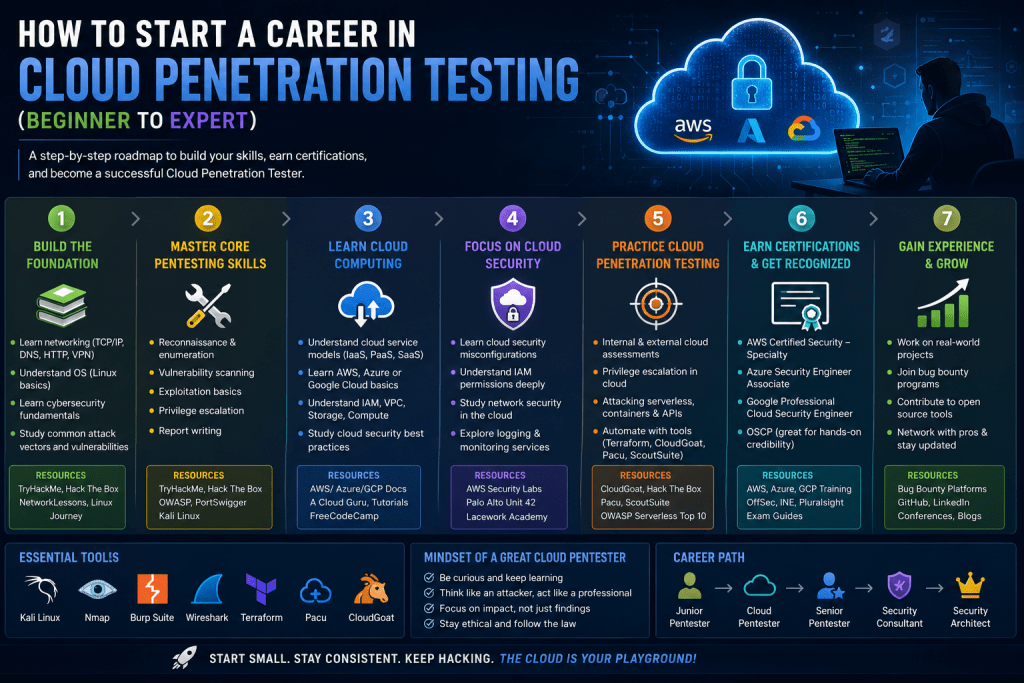
Cloud penetration testing is a specialized area of cybersecurity that focuses on evaluating the security of cloud-based systems by simulating real-world attack techniques. As organizations continue shifting critical infrastructure, applications, and data into cloud environments, the attack surface expands in both size and complexity. This creates a demand for professionals who can think like attackers while operating within authorized boundaries to identify weaknesses before malicious actors exploit them. Unlike traditional security testing, cloud-focused testing must account for distributed architectures, shared responsibility models, dynamic scaling environments, and API-driven services. The role sits at the intersection of cloud engineering and offensive security, requiring both technical depth and strategic awareness. It is not simply about finding vulnerabilities but understanding how those weaknesses interact across interconnected systems. This makes it one of the more technically demanding and intellectually challenging roles in modern cybersecurity. The increasing reliance on remote infrastructure and digital services has elevated the importance of this discipline, positioning it as a critical function in maintaining organizational resilience.
Understanding the Role of a Cloud Security Tester
A cloud security tester operates by assessing cloud environments for weaknesses that could be exploited by attackers. The primary objective is to identify security gaps in infrastructure, applications, and configurations before they can be used maliciously. These professionals simulate attack scenarios such as unauthorized access, data exposure, privilege escalation, and service disruption. They evaluate how well cloud systems can withstand real-world adversarial behavior and determine whether existing controls are sufficient. Unlike general security assessments, cloud-focused testing must consider multi-tenant environments where resources are shared across users, requiring careful attention to isolation boundaries and access controls. Another critical aspect of the role is understanding provider-specific constraints, as different cloud platforms implement security models differently. This means testers must adapt their approach depending on architecture, service type, and deployment model. The role also involves producing detailed findings that explain not only what vulnerabilities exist but also how they could be exploited and what impact they may have on business operations. This combination of technical investigation and risk analysis makes the role both analytical and highly practical in nature.
Core Responsibilities in Cloud Security Assessment
The responsibilities of a cloud security tester extend beyond simply identifying vulnerabilities. One of the most important tasks is mapping the structure of a cloud environment to understand how different components interact. This includes computing resources, storage systems, identity and access management configurations, and application interfaces. Once the environment is understood, the tester evaluates potential weaknesses in each area, including misconfigurations, weak authentication mechanisms, exposed services, and insecure data handling practices. Another key responsibility is analyzing how an attacker might move laterally within a cloud system after gaining initial access. This requires a deep understanding of privilege relationships and trust boundaries. The tester must also prioritize discovered vulnerabilities based on severity and potential business impact, helping organizations focus remediation efforts effectively. Reporting is another essential function, where findings are documented in a structured way that clearly explains risks and recommended mitigation strategies. In many cases, testers also contribute to improving security posture by suggesting best practices for configuration, access control, and monitoring. Their work directly supports long-term resilience by ensuring that cloud environments remain secure as they evolve.
Technical Skills Required for Cloud-Focused Security Testing
A successful cloud security tester must possess a broad and well-developed technical skill set. Strong networking knowledge is essential, as cloud environments rely heavily on interconnected systems and virtual networks. Understanding how data flows across networks, how routing works, and how segmentation is implemented is critical for identifying potential weaknesses. Familiarity with operating systems is equally important, particularly in understanding how permissions, processes, and services operate in both server and containerized environments. Knowledge of scripting and automation is also valuable, as testers often need to analyze large environments efficiently or simulate attack scenarios programmatically. Cloud environments introduce additional complexity through identity management systems, encryption mechanisms, and API-driven architecture, all of which require specialized understanding. Security concepts such as authentication, authorization, encryption, and secure configuration management form the foundation of effective testing. Analytical thinking is also crucial, as testers must interpret system behavior and identify patterns that may indicate vulnerabilities. Communication skills are necessary as well, since findings must be translated into clear, actionable insights for technical and non-technical stakeholders.
Building a Foundation Through Networking and Infrastructure Experience
Most professionals in cloud security testing begin their careers in foundational infrastructure roles. Experience in network administration or system support provides essential exposure to how enterprise environments operate. This includes configuring networks, troubleshooting connectivity issues, managing servers, and ensuring system availability. These responsibilities help build a strong understanding of how systems communicate and how failures can occur. Exposure to virtualization technologies is particularly important, as modern cloud environments are built on virtualized infrastructure. Working with virtual machines, storage systems, and network segmentation tools helps develop the conceptual foundation needed for cloud environments. At this stage, professionals also learn about monitoring systems, performance optimization, and basic security practices. This early experience is critical because it provides real-world context for understanding how systems behave under normal and abnormal conditions. Without this foundation, transitioning into cloud or security-focused roles becomes significantly more difficult. Over time, professionals in these roles develop the problem-solving mindset required for more advanced cybersecurity responsibilities.
Transitioning Into Cloud-Focused Engineering Roles
After gaining experience in traditional infrastructure environments, the next step often involves transitioning into cloud-focused engineering roles. This shift introduces professionals to scalable computing environments where resources are provisioned dynamically and managed through centralized platforms. In these roles, individuals learn how cloud systems are designed, deployed, and maintained. They work with virtual networks, storage systems, and application services that operate across distributed environments. Understanding identity and access management becomes especially important, as cloud systems rely heavily on permission-based control models. Engineers in these roles also become familiar with automation tools that manage infrastructure at scale. This stage of career development is critical because it bridges the gap between traditional IT systems and modern cloud architectures. It also provides exposure to security considerations such as configuration management, encryption, and compliance requirements. As professionals become more comfortable in cloud environments, they develop the technical intuition needed to identify weaknesses and inefficiencies. This experience forms the basis for later specialization in security-focused roles.
Developing Cybersecurity Expertise in Cloud Environments
The next phase in career progression involves moving into cybersecurity-focused roles where the emphasis shifts from system operation to system protection. In these positions, professionals learn how to detect, analyze, and respond to security incidents. They study how attackers exploit vulnerabilities and how defensive mechanisms can be used to prevent or mitigate damage. Exposure to monitoring tools and incident response procedures helps build situational awareness of how threats evolve in real time. Professionals also gain experience analyzing logs, investigating anomalies, and identifying indicators of compromise. Understanding common attack methods such as phishing, malware delivery, and unauthorized access attempts becomes essential. At this stage, individuals begin to develop a security mindset, thinking not only about how systems function but also how they can be broken. Cloud environments introduce additional complexity because security responsibilities are shared between providers and customers. This requires a clear understanding of where responsibilities begin and end. Over time, professionals build the analytical skills needed to anticipate attacker behavior and strengthen system defenses.
Advancing Into Cloud Penetration Testing Roles
Once a strong foundation in both cloud engineering and cybersecurity has been established, professionals can transition into cloud penetration testing roles. In these positions, the focus shifts to actively identifying weaknesses by simulating adversarial behavior. Testers examine cloud configurations, access controls, application interfaces, and data storage mechanisms to uncover vulnerabilities. They analyze how an attacker might gain initial access, escalate privileges, and move within the environment. This requires a deep understanding of both technical systems and attacker methodologies. Cloud penetration testers must also remain aware of the limitations imposed by cloud service providers, as certain actions may be restricted within shared environments. Their work often involves designing controlled test scenarios that replicate real-world attack paths without disrupting operational systems. After testing, they produce detailed assessments that outline vulnerabilities, potential impact, and recommended improvements. This role demands a combination of creativity, technical expertise, and disciplined methodology. It is one of the most advanced security roles due to the complexity of modern cloud infrastructures and the evolving nature of cyber threats.
Conclusion
Cloud penetration testing represents a highly specialized career path that combines deep technical knowledge with strategic security thinking. As organizations continue to expand their reliance on cloud-based systems, the need for professionals who can evaluate and strengthen these environments becomes increasingly important. The role requires a progressive development of skills, beginning with foundational infrastructure experience, advancing through cloud engineering, and culminating in cybersecurity specialization. Each stage builds upon the previous one, gradually shaping the expertise needed to understand complex distributed systems and their associated risks. Professionals in this field must be adaptable, analytical, and continuously learning, as both cloud technologies and attack techniques evolve rapidly. The value of this role lies in its ability to directly contribute to organizational resilience by identifying vulnerabilities before they can be exploited. In a digital landscape where security is a constant concern, cloud security testing stands as a critical discipline that supports the integrity, availability, and confidentiality of modern systems.