Data has become one of the most influential forces shaping the modern global economy. Every digital interaction, business transaction, online service, and connected device generates data that holds potential value. Organizations across industries are now heavily dependent on data to improve performance, understand customer behavior, and make informed strategic decisions. This transformation has shifted data from being a byproduct of operations to becoming a central business asset.
The expansion of digital infrastructure has increased both the volume and complexity of data being generated. Businesses no longer deal only with structured information stored in traditional databases. Instead, they now handle a mixture of structured, semi-structured, and unstructured data coming from applications, sensors, social platforms, and cloud systems. Managing this diversity of data requires specialized knowledge of storage systems, processing methods, and analytical techniques.
In this environment, professionals who understand how data flows through systems have become essential. Data must be collected, stored, processed, and transformed before it can be used effectively. Each step requires technical awareness and the ability to work with modern cloud-based platforms. As a result, foundational knowledge in data management has become a critical requirement for anyone entering the field of technology.
The Evolution of Data-Driven Technologies and Cloud Adoption
The evolution of data technologies has been strongly influenced by the shift toward cloud computing. Traditional on-premises systems are no longer sufficient for handling the scale and speed of modern data generation. Cloud platforms offer scalable infrastructure, flexible storage solutions, and powerful processing capabilities that support large-scale data operations.
Cloud adoption has enabled organizations to process data more efficiently while reducing infrastructure costs. Instead of maintaining physical servers, businesses can now use cloud services that provide on-demand access to computing resources. This shift has made it easier for organizations of all sizes to implement data-driven strategies without significant upfront investment.
As cloud environments continue to evolve, the demand for professionals who understand cloud-based data systems has increased significantly. These professionals must be able to navigate different types of data services, understand storage architectures, and apply analytical tools effectively. This requires a strong foundation in core data concepts before moving into more advanced technical roles.
The transition to cloud-based systems has also changed how data is managed. Instead of relying on a single centralized system, data is often distributed across multiple services and locations. This requires careful coordination to ensure consistency, security, and accessibility. Understanding these challenges is an important part of working in modern data environments.
Foundational Knowledge Required for Data Careers
Before advancing into specialized data roles, it is essential to build a strong understanding of fundamental concepts. These foundational principles form the basis for all data-related work and help professionals understand how different systems interact.
One of the key areas of knowledge is data structure. Data can exist in different formats depending on how it is collected and used. Structured data follows a defined format, often stored in tables with rows and columns. This type of data is commonly used in relational databases. Unstructured data, on the other hand, does not follow a fixed format and includes formats such as images, videos, and text documents. Semi-structured data falls between these two categories and includes formats like JSON or XML.
Another important concept is data processing. Data must be transformed and prepared before it can be analyzed. This involves cleaning, filtering, and organizing raw data into a usable format. Processing can occur in batches or in real time, depending on the requirements of the system. Batch processing is used for large datasets that are processed at scheduled intervals, while real-time processing is used for immediate data analysis.
Data storage is also a fundamental area of knowledge. Different storage systems are designed to handle different types of data and workloads. Relational storage systems are used for structured data, while non-relational systems are designed for flexibility and scalability. Understanding how these systems work helps professionals choose the right solution for specific use cases.
Introduction to Cloud-Based Data Management Systems
Cloud-based data management systems have become a standard in modern IT environments. These systems provide scalable and flexible solutions for storing and processing data. They allow organizations to manage large volumes of information without relying on physical infrastructure.
One of the key advantages of cloud-based systems is scalability. Resources can be adjusted based on demand, allowing organizations to handle varying workloads efficiently. This is particularly important for businesses that experience fluctuating data usage patterns.
Cloud systems also offer a wide range of data services that support different types of workloads. These services include storage solutions, analytics platforms, and data integration tools. Each service is designed to address specific aspects of data management, making it easier for organizations to build comprehensive data solutions.
Security is another critical aspect of cloud-based data systems. Organizations must ensure that data is protected from unauthorized access and potential breaches. This involves implementing access controls, encryption mechanisms, and monitoring systems. Understanding these security principles is essential for anyone working with cloud data environments.
Core Areas of Data Fundamentals Knowledge
A strong understanding of data fundamentals includes several key areas that form the foundation of data-related roles. These areas provide the knowledge required to work with modern data systems and cloud platforms effectively.
One of the most important areas is understanding data workloads. Data workloads refer to the types of operations performed on data, including storage, processing, and analysis. Different workloads require different approaches depending on the nature of the data and the desired outcome.
Relational data management is another core area. This involves working with structured data stored in tables and understanding how relationships between data points are established. Relational systems use queries to retrieve and manipulate data, making them highly efficient for structured environments.
Non-relational data management focuses on flexible data structures that do not require predefined schemas. These systems are designed to handle large volumes of diverse data types and are commonly used in modern applications that require scalability and adaptability.
Analytics is also a key component of data fundamentals. It involves examining data to identify patterns, trends, and insights. Analytical processes can range from simple descriptive analysis to more advanced predictive techniques. Understanding these methods helps professionals extract meaningful information from raw data.
Role of Data Professionals in Modern Organizations
Data professionals play a crucial role in modern organizations by ensuring that data is effectively managed and utilized. Their responsibilities vary depending on their specific role, but they all contribute to the overall data ecosystem.
Data analysts focus on interpreting data and generating insights that support decision-making. They use visualization tools and analytical techniques to present data in a meaningful way. Their work helps organizations understand performance trends and identify opportunities for improvement.
Database administrators are responsible for managing and maintaining data storage systems. They ensure that databases are secure, efficient, and accessible. Their role involves monitoring system performance, optimizing queries, and ensuring data integrity.
Data engineers design and build systems that allow data to flow between different sources and applications. They work with large-scale data pipelines and ensure that data is processed efficiently. Their work is essential for enabling analytics and machine learning applications.
Even professionals outside of traditional data roles are increasingly required to understand data concepts. As organizations become more data-driven, the ability to interpret and work with data has become a valuable skill across many job functions.
The Importance of Entry-Level Data Certifications
Entry-level certifications in data fundamentals provide a structured way to learn essential concepts. They are designed for individuals who are new to the field and want to build a strong foundation before moving into more advanced roles.
These certifications typically focus on core principles rather than advanced technical skills. This makes them accessible to a wide range of learners, including students, career changers, and early-stage professionals. By covering fundamental topics, they help learners develop a clear understanding of how data systems work.
One of the key benefits of foundational certifications is that they provide a structured learning path. Instead of learning concepts in isolation, learners are guided through a sequence of topics that build on each other. This helps reinforce understanding and ensures that key concepts are fully grasped.
Another benefit is career flexibility. By gaining foundational knowledge, individuals can explore different areas of data-related work and determine which path best suits their interests. This could include roles in analysis, engineering, or database management.
Preparing for a Career in Data and Cloud Technologies
Building a career in data and cloud technologies requires both theoretical knowledge and practical experience. Understanding core concepts is the first step, but applying those concepts in real-world scenarios is equally important.
Hands-on practice helps reinforce learning and provides valuable experience with data tools and platforms. Working with sample datasets, experimenting with queries, and exploring cloud services are all effective ways to build confidence.
Continuous learning is also essential in this field. Data technologies are constantly evolving, and professionals must stay updated with new tools and methods. Developing a habit of ongoing learning helps ensure long-term career growth and adaptability.
A strong foundation in data fundamentals provides the starting point for this journey. It enables learners to understand more complex systems and prepares them for advanced roles in the data ecosystem.
Expanding Into Cloud-Based Data Ecosystems and Their Role in Modern Computing
The shift toward cloud-based computing has fundamentally reshaped how data is stored, processed, and analyzed. In modern IT environments, cloud ecosystems provide the backbone for nearly every data-driven operation. Organizations rely on these systems not only for storage but also for advanced analytics, integration, and real-time processing. This transformation has created a strong demand for professionals who understand how cloud platforms handle data at scale.
Cloud ecosystems are designed to provide flexibility, scalability, and efficiency. Instead of relying on fixed physical infrastructure, organizations can dynamically adjust resources based on demand. This means that data workloads can expand or contract depending on usage patterns without requiring manual hardware upgrades. As a result, businesses can respond more quickly to changing conditions while maintaining performance and reliability.
Within these environments, data is no longer confined to a single location. It is distributed across multiple services and regions, allowing for redundancy and improved accessibility. This distributed nature of cloud data systems requires a clear understanding of how data moves between services and how consistency is maintained across different environments.
Understanding Microsoft Azure as a Data Platform
Microsoft Azure is one of the major cloud platforms used globally for data storage, processing, and analytics. It provides a wide range of services that support different types of data workloads, from simple storage solutions to advanced machine learning capabilities. Azure is designed to support both small-scale applications and large enterprise systems, making it a versatile platform for modern data needs.
At its core, Azure offers infrastructure, platform, and software services. These categories define how much control a user has over the underlying systems. Infrastructure services provide virtual machines and storage, platform services offer development environments and tools, and software services deliver ready-to-use applications. Understanding these layers is essential for navigating cloud-based data environments effectively.
Azure’s data services are structured to handle both structured and unstructured data. Structured data is typically stored in relational databases, while unstructured data is managed using flexible storage solutions. This separation allows organizations to choose the most efficient storage method based on the type of data they are working with.
The platform also integrates analytics services that enable users to process and visualize data. These services are designed to work seamlessly with other Azure components, creating a unified environment for data operations. This integration is a key reason why cloud platforms have become central to modern data strategies.
Core Architecture of Cloud Data Systems
Cloud data systems are built on a layered architecture that separates storage, processing, and application logic. This structure allows each layer to function independently while still interacting with others. Understanding this architecture is essential for working effectively with cloud-based data systems.
The storage layer is responsible for holding raw and processed data. It includes different types of storage systems such as object storage, file storage, and database storage. Each type serves a specific purpose and is optimized for different workloads.
The processing layer handles data transformation and analysis. This includes batch processing systems that handle large datasets and stream processing systems that handle real-time data. These processing methods allow organizations to extract insights from data in different ways depending on their needs.
The application layer is where data is consumed by end users or applications. This includes dashboards, reporting tools, and machine learning models. The application layer transforms processed data into usable information that supports decision-making.
This layered structure ensures that cloud data systems remain flexible and scalable. It also allows different teams within an organization to focus on specific parts of the data workflow without interfering with other components.
Relational Data Systems in Cloud Environments
Relational data systems are one of the most widely used methods for storing structured data. These systems organize data into tables, where each table consists of rows and columns. Relationships between tables are defined using keys, allowing data to be connected and queried efficiently.
In cloud environments, relational databases are managed as services rather than standalone systems. This means that users do not need to worry about hardware maintenance or infrastructure management. Instead, they can focus on designing and querying data structures.
Relational systems are highly effective for applications that require consistency and structured relationships. Examples include financial systems, customer databases, and inventory management systems. These systems rely on structured query languages to retrieve and manipulate data.
One of the key advantages of relational systems in the cloud is scalability. Resources can be adjusted dynamically based on workload requirements. This ensures that performance remains consistent even during periods of high demand.
Non-Relational Data Systems and Their Applications
Non-relational data systems, also known as NoSQL systems, are designed to handle flexible and unstructured data. Unlike relational systems, they do not require predefined schemas. This makes them ideal for applications where data formats may vary or evolve.
These systems are commonly used in scenarios involving large-scale data collection, such as social media platforms, sensor networks, and real-time analytics applications. They allow organizations to store and process data without strict structural constraints.
Non-relational systems include several types of data models, such as document-based, key-value, column-based, and graph-based models. Each model is optimized for specific use cases. For example, document databases are often used for storing JSON-like data structures, while graph databases are used for analyzing relationships between entities.
The flexibility of non-relational systems makes them particularly suitable for modern cloud applications. They can scale horizontally, meaning that additional resources can be added easily to handle increased workloads. This scalability is essential for applications that experience unpredictable data growth.
Data Processing Techniques in Cloud Systems
Data processing is a critical component of any data system. It involves transforming raw data into meaningful information that can be analyzed and used for decision-making. In cloud environments, data processing is typically divided into two main categories: batch processing and stream processing.
Batch processing involves collecting data over a period of time and processing it in large groups. This method is efficient for handling large datasets and is commonly used for tasks such as reporting and historical analysis. Batch processing systems are designed to handle high volumes of data but may not provide real-time results.
Stream processing, on the other hand, involves processing data as it is generated. This method is used in scenarios where immediate insights are required. Examples include monitoring systems, fraud detection, and real-time analytics applications. Stream processing systems are designed to handle continuous data flows with minimal delay.
Cloud platforms provide tools that support both processing methods. These tools are designed to integrate with storage systems and analytics services, allowing for seamless data workflows. Understanding when to use each processing method is an important skill for data professionals.
Analytics Workloads and Their Importance in Data Systems
Analytics workloads refer to the processes used to analyze and interpret data. These workloads are essential for transforming raw data into actionable insights. In cloud environments, analytics services are designed to handle large-scale data processing and complex queries.
There are different types of analytics workloads, including descriptive, diagnostic, predictive, and prescriptive analytics. Descriptive analytics focuses on summarizing historical data, while diagnostic analytics aims to identify the causes of past events. Predictive analytics uses statistical models to forecast future outcomes, and prescriptive analytics provides recommendations for actions based on data insights.
Cloud platforms provide tools that support these different types of analytics. These tools allow users to process large datasets, build models, and generate visualizations. The integration of analytics services with storage and processing systems creates a unified environment for data analysis.
Understanding analytics workloads is essential for data professionals because it helps them choose the right approach for solving different types of problems. It also enables organizations to make more informed decisions based on data-driven insights.
Security and Governance in Cloud Data Systems
Security is a fundamental aspect of cloud data systems. As organizations move more data to the cloud, ensuring that this data is protected becomes increasingly important. Cloud platforms provide a range of security features designed to safeguard data from unauthorized access and potential threats.
Access control is one of the primary security mechanisms used in cloud systems. It determines who can access specific data and what actions they can perform. This helps prevent unauthorized access and ensures that sensitive information is only available to authorized users.
Encryption is another important security measure. It involves converting data into a coded format that can only be read by authorized systems. Encryption is used both for data at rest and data in transit, providing multiple layers of protection.
Governance refers to the policies and procedures used to manage data effectively. This includes defining data ownership, ensuring compliance with regulations, and maintaining data quality. Proper governance ensures that data is used responsibly and consistently across an organization.
Role of Data Fundamentals in Professional Development
Understanding data fundamentals is essential for building a successful career in data-related fields. These foundational concepts provide the knowledge required to work with complex systems and technologies. They also serve as a starting point for more advanced learning and specialization.
Professionals who understand data fundamentals are better equipped to adapt to different roles within the data ecosystem. Whether working as analysts, engineers, or administrators, a strong foundation helps individuals perform their tasks more effectively.
In addition, data fundamentals provide a common language for communication between technical and non-technical teams. This improves collaboration and ensures that data is used effectively across the organization.
Building Readiness for Advanced Cloud and Data Roles
Progressing in a data career requires continuous learning and skill development. After mastering foundational concepts, professionals can move on to more advanced topics such as data engineering, machine learning, and cloud architecture.
Practical experience plays a key role in this development process. Working with real-world data scenarios helps reinforce theoretical knowledge and builds problem-solving skills. It also prepares individuals for the challenges they may encounter in professional environments.
As cloud technologies continue to evolve, the demand for skilled data professionals will continue to grow. Building a strong foundation in data fundamentals provides the necessary starting point for long-term career growth in this field.
The Role of Data Fundamentals in Long-Term Career Growth
Building a career in data-related fields requires more than just technical exposure. It requires a structured understanding of how data systems operate, how cloud platforms manage information, and how different tools interact within a larger ecosystem. Data fundamentals serve as the starting point for this journey, helping individuals establish the core knowledge needed for long-term professional growth.
In modern technology environments, data is not confined to a single role or department. It flows across business intelligence, software development, cybersecurity, artificial intelligence, and operations. This means that professionals in almost every technical field benefit from understanding how data is structured, stored, and processed. The ability to interpret and work with data has become a universal skill across the IT industry.
Entry-level data knowledge provides clarity on how systems communicate and how information moves through pipelines. Without this foundation, advanced concepts such as distributed computing, machine learning models, and cloud architecture can become difficult to understand. Data fundamentals act as a bridge between basic computing knowledge and specialized technical expertise.
Understanding the Position of DP-900 in the Certification Path
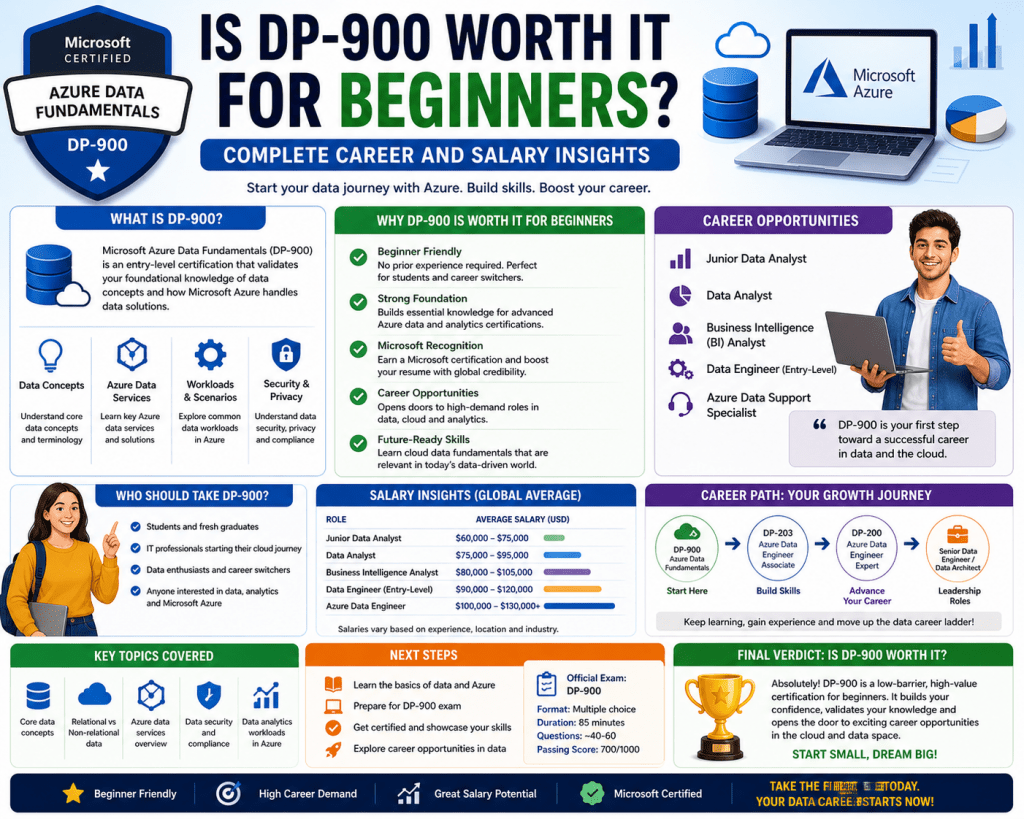
The DP-900 certification is positioned as an introductory milestone in the broader data certification ecosystem. It is designed to validate foundational understanding rather than advanced technical mastery. This makes it an essential starting point for individuals who are new to data roles or cloud platforms.
Unlike specialized certifications that focus on deep technical implementation, DP-900 emphasizes conceptual clarity. It introduces learners to the basic principles of data storage, relational and non-relational systems, and analytics workloads. These concepts form the backbone of more advanced certifications and professional roles in the data domain.
The structure of DP-900 ensures that candidates develop a broad understanding of how data systems function in cloud environments. This includes recognizing how different services interact and how data flows between storage, processing, and analytics layers. The goal is not to create experts in a single technology but to build awareness of the entire data ecosystem.
This foundational positioning makes the certification valuable for beginners as well as professionals transitioning into data-focused roles. It allows learners to explore different career paths before committing to a specialized direction.
Developing Conceptual Clarity Through Data Fundamentals
One of the most important benefits of studying data fundamentals is the development of conceptual clarity. Instead of focusing on specific tools or platforms, learners gain an understanding of underlying principles that apply across technologies.
Conceptual clarity begins with understanding what data represents and how it is categorized. Data can be structured, semi-structured, or unstructured, and each category requires different handling techniques. Structured data follows a defined schema, while unstructured data includes formats such as images, videos, and free-text content.
Understanding these distinctions helps professionals choose appropriate storage and processing methods. It also improves their ability to design efficient systems that align with business requirements. Without this clarity, it becomes difficult to evaluate which tools or services are best suited for a given task.
Another important aspect of conceptual understanding is recognizing how data moves through systems. Data rarely remains static. It is collected, transformed, stored, analyzed, and visualized in continuous cycles. Each stage requires different technologies and approaches, and understanding this lifecycle is essential for working effectively in data environments.
How Cloud Platforms Shape Modern Data Careers
Cloud platforms have fundamentally changed the structure of data careers. Instead of working with isolated systems, professionals now operate within interconnected ecosystems that span multiple services and regions. This shift has created new opportunities as well as new challenges.
In traditional environments, data systems were often limited by physical infrastructure. Scaling required significant investment in hardware and maintenance. Cloud platforms eliminate many of these limitations by offering on-demand resources that can scale dynamically.
This flexibility allows organizations to process larger volumes of data and run more complex analytics workloads. It also enables faster deployment of applications and services. As a result, professionals working in cloud environments must understand not only data concepts but also how cloud infrastructure supports them.
Cloud platforms also encourage specialization. Some professionals focus on storage systems, while others specialize in analytics or data engineering. However, even specialized roles require a foundational understanding of the entire ecosystem. This ensures that different components work together efficiently.
The integration of cloud services has also increased the importance of automation. Many data processes are now automated using pipelines and scripts. This reduces manual effort and improves consistency. Understanding how these automated systems work is becoming an essential skill in modern data careers.
Practical Applications of Data Fundamentals in Real-World Scenarios
Data fundamentals are not limited to theoretical knowledge. They have direct applications in real-world scenarios across industries. Businesses use data to optimize operations, improve customer experiences, and identify new opportunities.
In retail environments, data is used to analyze customer behavior and manage inventory. In healthcare, it supports patient record management and predictive diagnostics. In finance, it is used for risk analysis and fraud detection. Each of these applications relies on foundational data principles.
Understanding how data is structured and processed allows professionals to design systems that meet specific business needs. For example, a system that processes real-time transaction data requires a different architecture compared to one that analyzes historical sales data.
Data fundamentals also play a role in improving system performance. By understanding how data flows through systems, professionals can identify bottlenecks and optimize processing pipelines. This leads to faster and more efficient systems.
The Importance of Relational and Non-Relational Thinking
One of the key distinctions in data systems is between relational and non-relational thinking. Relational systems are based on structured data models with predefined relationships. These systems are highly effective for scenarios where consistency and accuracy are critical.
Non-relational systems, on the other hand, provide flexibility in handling diverse data types. They are designed to scale horizontally and support dynamic data structures. This makes them suitable for modern applications that require adaptability.
Understanding when to use relational versus non-relational systems is a critical skill in data careers. Each approach has strengths and limitations, and choosing the right one depends on the nature of the data and the requirements of the application.
In many modern systems, both approaches are used together. Hybrid architectures combine relational and non-relational systems to achieve a balance between structure and flexibility. This reflects the evolving nature of data systems in cloud environments.
Analytics as a Core Component of Data Understanding
Analytics plays a central role in transforming raw data into meaningful insights. Without analytics, data remains unused and unstructured. Analytics allows organizations to extract value from data and apply it to decision-making processes.
Descriptive analytics focuses on understanding what has already happened. It summarizes historical data and provides insights into past performance. Diagnostic analytics goes a step further by identifying reasons behind observed outcomes.
Predictive analytics uses statistical models and algorithms to forecast future trends. This allows organizations to anticipate changes and plan accordingly. Prescriptive analytics provides recommendations based on data analysis, helping decision-makers choose optimal actions.
Each type of analytics requires a different level of complexity and understanding. However, all of them rely on the same foundational data principles. Without proper data structuring and processing, analytics cannot produce reliable results.
Security Awareness in Data and Cloud Environments
Security is a critical aspect of working with data in any environment. As data becomes more distributed and accessible through cloud platforms, protecting it from unauthorized access becomes increasingly important.
Access management ensures that only authorized users can interact with specific data. This is achieved through identity verification systems and role-based permissions. Proper access control reduces the risk of data breaches and misuse.
Encryption provides an additional layer of protection by converting data into unreadable formats. Even if data is intercepted, it cannot be understood without proper decryption keys. This ensures confidentiality in both storage and transmission.
Monitoring systems help detect unusual activity and potential threats. These systems continuously track data access and usage patterns. Any deviation from normal behavior can trigger alerts for further investigation.
Security awareness is not limited to technical implementation. It also involves understanding best practices for handling sensitive information and ensuring compliance with organizational policies.
Career Pathways Enabled by Data Fundamentals Knowledge
Understanding data fundamentals opens the door to multiple career pathways. These pathways include data analysis, data engineering, database administration, and cloud architecture. Each path builds on the same foundational knowledge but applies it in different ways.
Data analysts focus on interpreting data and generating insights. They use visualization tools and reporting systems to communicate findings. Their work supports decision-making across organizations.
Data engineers design and build systems that manage data flow. They create pipelines that move data between storage, processing, and analytics layers. Their role is essential for maintaining efficient data systems.
Database administrators manage and maintain data storage systems. They ensure that databases are secure, optimized, and reliable. Their responsibilities include performance tuning and data integrity management.
Cloud professionals focus on designing and managing cloud-based systems. They work with infrastructure, storage, and analytics services to build scalable solutions.
The Value of Foundational Certifications in Skill Validation
Foundational certifications provide a structured way to validate knowledge and skills. They demonstrate that an individual understands core concepts and can apply them in practical scenarios. This validation is important for both entry-level professionals and those transitioning into new roles.
Employers often use certifications as indicators of baseline knowledge. While experience remains important, certifications provide proof of structured learning. This can help candidates stand out in competitive job markets.
These certifications also serve as stepping stones for more advanced qualifications. By building a strong foundation, learners can progress to specialized certifications with greater confidence and understanding.
Conclusion
The importance of data fundamentals in today’s technology-driven world cannot be overstated, especially as organizations continue to rely more heavily on digital systems, cloud platforms, and large-scale analytics. The DP-900 certification sits at a unique and strategic entry point within this evolving ecosystem, offering a structured introduction to the principles that govern how data is stored, processed, managed, and used in real-world environments. While it is often viewed as a beginner-level credential, its impact extends far beyond its initial scope because it establishes the conceptual foundation required for almost every modern data-related role.
At its core, the value of DP-900 lies in how it simplifies complex ideas without oversimplifying their importance. Data systems in modern enterprises are no longer isolated or static. They are interconnected, distributed, and constantly evolving. Cloud platforms such as Azure have transformed how data flows across systems, enabling real-time analytics, scalable storage, and flexible processing architectures. Without a strong understanding of these fundamentals, it becomes difficult to navigate even basic cloud-based environments effectively. DP-900 helps bridge that gap by introducing essential concepts in a structured and accessible way.
One of the most significant outcomes of learning data fundamentals is the ability to think in systems rather than isolated tools. Many beginners entering the field of data focus heavily on individual technologies, such as databases or visualization tools, without understanding how these components interact within a larger ecosystem. DP-900 encourages a shift in perspective by emphasizing how data moves through different layers of infrastructure, from ingestion and storage to processing and analysis. This systems-level understanding is what ultimately distinguishes a skilled data professional from someone with only surface-level familiarity.
Another important aspect of foundational knowledge is adaptability. The technology landscape changes rapidly, with new tools, platforms, and methodologies emerging constantly. Professionals who rely only on tool-specific knowledge often struggle to keep up with these changes. However, those who understand core principles such as data modeling, relational and non-relational structures, and workload types are able to adapt more easily. These principles remain consistent even as technologies evolve, making them a stable foundation for long-term career growth.
In practical terms, DP-900 also plays an important role in career positioning. For individuals entering the IT or data field, it provides an early signal of commitment and readiness to learn cloud-based data systems. For professionals already working in related roles, it helps formalize and validate their understanding of essential concepts. This validation is particularly important in competitive job markets where employers are looking for both theoretical knowledge and practical awareness of cloud platforms. While the certification alone does not guarantee expertise, it demonstrates that the individual has taken the time to understand how modern data systems function at a fundamental level.
The certification also indirectly supports career exploration. Data is a broad field that includes analytics, engineering, administration, and architecture. Without exposure to foundational concepts, it can be difficult to determine which direction to pursue. DP-900 introduces learners to multiple areas of the data ecosystem, allowing them to see how different roles interact and where their interests may align. This early exposure helps reduce uncertainty and provides a clearer pathway for further specialization.
Another key benefit of foundational learning is improved communication across technical and non-technical teams. In many organizations, data professionals are required to collaborate with business stakeholders who may not have a technical background. The ability to explain concepts such as data storage, processing models, or analytics workloads in simple terms is a valuable skill. DP-900 contributes to this ability by encouraging clarity of thought and conceptual understanding rather than focusing solely on technical implementation.
As organizations continue to adopt cloud-first strategies, the relevance of data fundamentals becomes even more pronounced. Cloud environments are inherently complex, often involving multiple services working together to deliver end-to-end data solutions. Without a clear understanding of how these services interact, it becomes difficult to design or maintain efficient systems. Foundational knowledge ensures that professionals can navigate these environments with confidence, even as complexity increases.
It is also important to recognize that data fundamentals are not limited to technical professionals alone. Many roles outside traditional IT departments now require some level of data literacy. Business analysts, project managers, and operations specialists increasingly rely on data-driven insights to make decisions. Understanding basic data concepts allows these professionals to interpret information more effectively and contribute to data-informed decision-making processes.
From a long-term perspective, DP-900 and similar foundational learning paths serve as the starting point for deeper specialization. After establishing a base understanding, learners can progress into more advanced areas such as data engineering, cloud architecture, machine learning, or business intelligence. Each of these paths builds upon the same core principles introduced at the foundational level. Without this base, advanced concepts often become more difficult to grasp and apply effectively.
Another important outcome of foundational learning is confidence. Entering the field of data can be overwhelming due to the wide range of tools, technologies, and concepts involved. Having a structured understanding of the basics reduces this complexity and provides learners with a sense of direction. Instead of feeling lost in technical details, they are able to connect new information to established concepts, making the learning process more manageable and sustainable.
In addition, foundational certifications help create consistency in skill expectations across the industry. Employers can rely on them as a baseline indicator of knowledge, ensuring that candidates have at least a minimum understanding of essential data concepts. While experience and practical ability remain critical, certifications provide a standardized way to measure foundational readiness.
The broader significance of data fundamentals also lies in how they shape problem-solving approaches. Data professionals are often required to analyze complex systems, identify inefficiencies, and design solutions that improve performance. A strong understanding of how data is structured and processed enables more effective problem-solving by providing a clear framework for analysis. Instead of approaching problems in isolation, professionals can view them within the context of the entire data ecosystem.
Ultimately, the DP-900 certification represents more than just an entry-level credential. It is a gateway into a much larger and evolving field that underpins modern digital transformation. By focusing on core principles rather than specific tools, it provides learners with a durable foundation that remains relevant even as technologies change. This foundation supports both immediate learning and long-term career development, making it a valuable starting point for anyone interested in data, cloud computing, or analytics.
As the demand for data-driven decision-making continues to grow, the importance of understanding fundamental concepts will only increase. Organizations will continue to rely on professionals who can interpret, manage, and optimize data systems effectively. Those who begin their journey with a strong grasp of data fundamentals are better positioned to adapt, grow, and succeed in this evolving landscape.