Information technology has become one of the most accessible and dynamic career fields, offering multiple entry points for individuals with different educational and professional backgrounds. Unlike many traditional professions that require highly specific qualifications from the outset, the IT sector allows for a broader range of starting positions. This flexibility is one of the reasons the field continues to attract learners from diverse disciplines, including science, business, mathematics, and even non-technical areas.
One of the most structured ways to begin a career in IT is through formal education. A college degree provides a guided learning environment where foundational concepts are introduced in a progressive and organized manner. These academic programs are designed to build both theoretical understanding and practical ability, allowing students to develop essential skills over time. However, it is important to recognize that employers in entry-level IT roles often evaluate candidates based on general technical readiness rather than strict specialization.
In many hiring environments, the emphasis is placed on problem-solving ability, logical reasoning, and familiarity with digital systems rather than mastery of advanced technical concepts. This means that individuals with a wide range of academic backgrounds may qualify for consideration, provided they demonstrate relevant skills. As a result, degrees related to computing, analytics, and even business can serve as effective starting points.
The flexibility of IT career entry is also influenced by the rapid evolution of technology. As systems become more complex and interconnected, organizations increasingly value adaptability and learning capability. This shift has made entry-level positions more accessible while still maintaining a strong focus on foundational knowledge and technical awareness.
The Role of Academic Degrees in IT Career Development
A formal academic degree continues to play an important role in shaping early career opportunities in information technology. While not always mandatory, it often serves as a strong signal of foundational competence and commitment to structured learning. Employers frequently use degrees as a baseline indicator when reviewing candidates for entry-level positions, particularly when technical experience is limited.
Degrees in technology-related fields help individuals develop a structured understanding of how computing systems operate. They introduce essential concepts such as hardware architecture, software interaction, data management, and network communication. These areas form the backbone of most IT environments, regardless of industry or specialization.
Another significant advantage of pursuing a degree is exposure to structured problem-solving approaches. Academic programs are designed to gradually increase complexity, encouraging students to analyze problems from multiple perspectives before arriving at solutions. This method of learning closely mirrors real-world IT environments, where issues often require systematic troubleshooting and layered analysis.
Additionally, degree programs often incorporate practical exercises that simulate workplace scenarios. These experiences help students transition from theoretical understanding to applied knowledge. By working through structured tasks, learners gain familiarity with tools and processes commonly used in professional IT settings.
Even though the industry continues to evolve toward skills-based hiring, academic qualifications remain relevant because they demonstrate persistence, discipline, and the ability to complete long-term learning objectives. These qualities are highly valued in environments where continuous adaptation is required.
Information Systems and Information Technology as Core Foundations
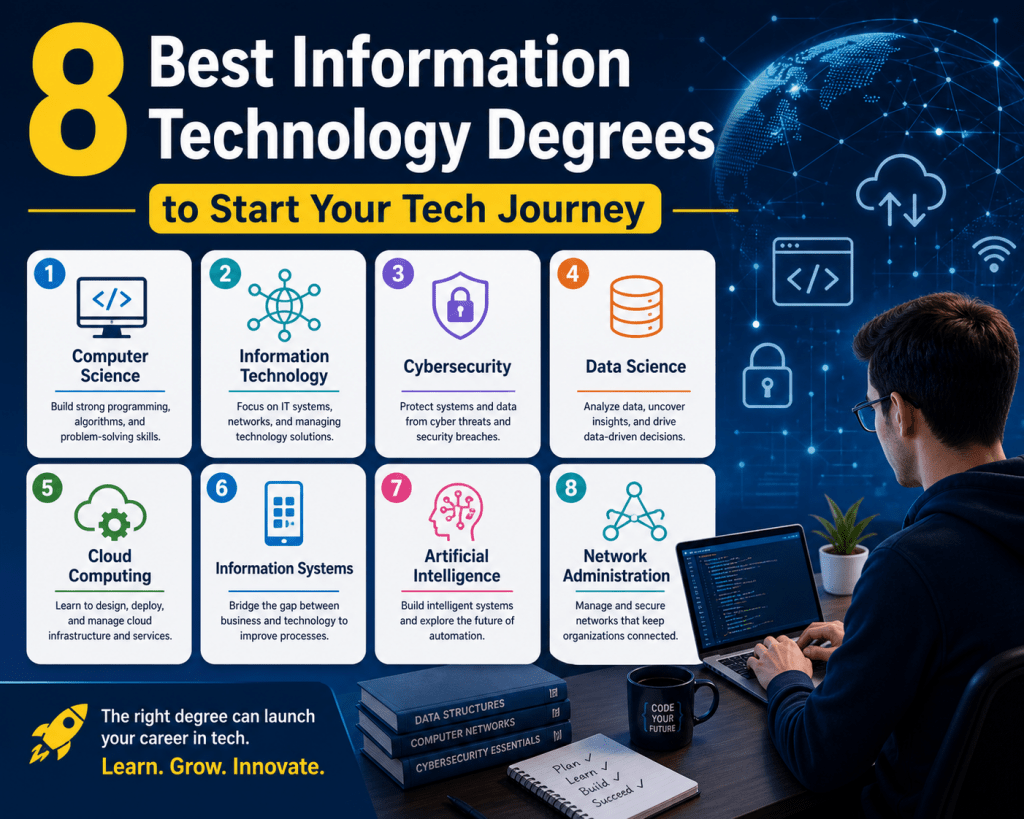
Among the most direct academic pathways into the IT field are degrees in information systems or information technology. These programs are specifically designed to align with the operational needs of modern organizations. They focus on teaching students how to work with existing technologies rather than developing entirely new computing theories.
Students in these programs are introduced to a wide range of topics that form the foundation of IT operations. These include computer hardware fundamentals, software applications, operating system management, and basic networking concepts. The goal is to create professionals who understand how different components of a digital environment interact and support each other.
A key feature of these programs is their emphasis on applied learning. Instead of focusing solely on theoretical concepts, students are often required to complete hands-on tasks that simulate real workplace environments. These exercises may include configuring systems, troubleshooting technical issues, and managing basic network structures.
Information systems education also emphasizes the relationship between technology and business processes. Students learn how digital tools are used to improve efficiency, streamline operations, and support decision-making within organizations. This business-oriented perspective makes graduates particularly valuable in roles that require communication between technical and non-technical teams.
Graduates from these programs are often prepared for entry-level positions such as technical support, IT assistance, and systems coordination roles. These positions serve as stepping stones to more advanced responsibilities, allowing individuals to gradually build experience while continuing to develop their technical skills.
Computer Science as a Theoretical and Analytical Discipline
Computer science represents one of the most comprehensive academic pathways into the broader technology field. Unlike more application-focused programs, computer science emphasizes the theoretical principles that govern computing systems. This includes the study of algorithms, data structures, computational logic, and system design principles.
Students in computer science programs develop a deep understanding of how software and hardware systems function at a fundamental level. They are introduced to programming concepts, but the primary focus is on problem-solving techniques and logical reasoning. The goal is to train individuals to think critically about how computational problems can be modeled and solved efficiently.
A significant portion of computer science education involves working with programming languages. However, the emphasis is not simply on writing code, but on understanding how different programming approaches impact system performance and scalability. Students learn to evaluate multiple solutions to a single problem and determine the most effective approach based on constraints and requirements.
Beyond programming, computer science also explores areas such as operating systems, database management, artificial intelligence concepts, and system architecture. These topics provide a broad understanding of how complex computing environments are structured and maintained.
Graduates from computer science programs often enter the IT field with strong analytical capabilities. This makes them suitable for a variety of roles that require structured thinking and technical problem-solving. While some may focus on software-related positions, others transition into system analysis, infrastructure management, or data-focused roles.
The strength of this academic path lies in its adaptability. Because it emphasizes core computing principles, individuals with this background can adjust to new technologies and evolving industry demands more easily than those with narrower specialization.
Software Engineering and Structured System Development
Software engineering is another important academic pathway that supports entry into the IT sector. This discipline focuses on the systematic design and development of software systems. It combines programming knowledge with structured project management principles to ensure that software is reliable, efficient, and maintainable.
Students in software engineering programs learn how to approach software creation as an organized process rather than an isolated task. This includes understanding requirement gathering, system design, implementation strategies, testing methods, and maintenance planning. Each stage of development is treated as part of a larger lifecycle that ensures long-term system stability.
Collaboration is a central aspect of software engineering education. In real-world environments, software projects are rarely completed by individuals working alone. Instead, they involve teams of professionals working together on different components of a system. Academic programs reflect this reality by incorporating group-based projects and collaborative assignments.
In addition to coding skills, students are introduced to tools and methodologies that support modern software development practices. These include version control systems, debugging techniques, and structured development frameworks. Understanding these tools is essential for managing complex software systems in professional environments.
Software engineering graduates are often prepared for roles involving application development, system design, and software maintenance. However, the skills developed in this discipline also apply to broader IT contexts, particularly in organizations that rely heavily on custom-built digital systems.
As industries continue to adopt digital solutions at scale, the demand for professionals who understand both technical implementation and system design continues to grow. This makes software engineering a strong and relevant academic pathway for individuals entering the technology field.
Introduction to Information Security as a Growing IT Specialization
Information security has become an increasingly important area within the broader IT landscape. As organizations rely more heavily on digital infrastructure, the need to protect systems and data from unauthorized access has grown significantly. Academic programs focused on security provide the foundational knowledge required to address these challenges.
Students in this field are introduced to the principles of system protection, risk identification, and vulnerability management. They learn how digital threats emerge and how systems can be designed or modified to reduce exposure to potential attacks. This includes understanding secure communication methods, authentication systems, and data protection techniques.
A key aspect of security education is the development of analytical thinking skills. Security professionals must be able to evaluate systems from multiple perspectives to identify weaknesses that may not be immediately visible. This requires a deep understanding of how different components within a network interact and where potential risks may arise.
Practical learning is also an important component of this discipline. Students often engage with simulated environments that replicate real-world security challenges. These exercises help develop the ability to respond to incidents, analyze system behavior, and implement corrective measures.
Graduates from information security programs are commonly prepared for entry-level roles in system monitoring, network protection, and cybersecurity support. These positions are essential in maintaining the stability and safety of modern digital environments.
As technology continues to expand into every aspect of business and communication, the importance of security-focused professionals continues to grow. This makes information security a critical and increasingly relevant entry pathway into the IT industry.
Software Engineering and the Expansion of Development-Focused IT Careers
Software engineering has become one of the most influential academic and professional pathways into information technology because it directly connects academic learning with real-world system development. Unlike general computing programs that emphasize broad technical exposure, software engineering focuses on building structured, scalable, and maintainable systems that support modern digital ecosystems. This discipline plays a central role in shaping the applications, platforms, and services that define today’s technology landscape.
Students entering this field are introduced to a systematic approach to software creation. This involves breaking down large development tasks into smaller, manageable components that can be designed, tested, and implemented independently before being integrated into a complete system. This modular approach helps reduce complexity and improve the reliability of software products.
A key aspect of software engineering education is lifecycle thinking. Students learn that software is not a one-time creation but a continuously evolving product that requires planning, design, implementation, testing, deployment, and maintenance. Each stage has its own methodologies and best practices, which are essential for ensuring long-term system stability.
Another important component of this academic path is exposure to collaborative development environments. Modern software systems are rarely built by individuals working alone. Instead, teams of developers, analysts, testers, and system architects work together to achieve shared goals. Academic programs reflect this reality by incorporating group-based assignments that simulate real project environments.
Version control systems, testing frameworks, and development methodologies are also introduced to students as essential tools for managing complex projects. These tools ensure that changes to software systems are tracked, tested, and integrated without disrupting existing functionality. Understanding how to use these tools effectively is a critical skill for entry-level professionals entering IT development roles.
Software engineering graduates often find opportunities in application development, system integration, and technical support roles that require a deeper understanding of how software systems are built and maintained. The structured nature of their training makes them well-suited for environments where precision, reliability, and long-term planning are essential.
As digital transformation continues across industries, software engineering remains a foundational discipline supporting innovation and system modernization. Organizations increasingly rely on software engineers not only to build applications but also to optimize workflows and improve user experiences across platforms.
Information Security as a Specialized and High-Demand IT Entry Path
Information security has evolved into one of the most critical areas within the information technology sector. As organizations expand their digital presence, the need to protect sensitive data and maintain system integrity has become a top priority. Academic programs focused on security provide the foundational knowledge required to address these challenges effectively.
Students studying information security are introduced to concepts such as risk assessment, threat modeling, and vulnerability analysis. These topics help them understand how security breaches occur and what measures can be implemented to prevent or mitigate them. The focus is not only on identifying threats but also on designing systems that are resilient against attacks.
A significant portion of security education is dedicated to understanding network infrastructure and how data flows within digital environments. By learning how systems communicate, students gain insight into potential weak points that could be exploited by malicious actors. This knowledge is essential for designing secure architectures and implementing protective measures.
Encryption plays a major role in information security education. Students learn how data can be transformed into secure formats that prevent unauthorized access. Authentication systems, access control mechanisms, and identity verification methods are also studied in detail, as they form the backbone of secure digital operations.
Hands-on experience is a key part of this discipline. Students often work in simulated environments that replicate real-world security incidents. These exercises help them develop the ability to respond quickly and effectively to potential breaches, system failures, or unauthorized access attempts.
Graduates from information security programs are typically prepared for roles involving system monitoring, security analysis, and network protection. These positions are increasingly important as organizations continue to face growing cybersecurity challenges across industries.
The demand for security professionals continues to rise due to the expansion of cloud computing, remote work environments, and digital communication systems. This makes information security a highly relevant and strategically important entry point into the IT field.
Business Analytics and the Intersection of Data and Technology
Business analytics has emerged as a valuable academic pathway for individuals interested in combining technology with decision-making and data interpretation. This discipline focuses on using data to understand trends, improve operations, and support strategic planning within organizations.
Students in business analytics programs are introduced to data collection methods, statistical analysis techniques, and data visualization tools. These skills allow them to transform raw data into meaningful insights that can be used to guide business decisions.
A strong emphasis is placed on understanding how data is stored, processed, and retrieved within digital systems. This includes learning about databases, query languages, and data management structures. These technical skills are essential for working with large datasets commonly used in modern organizations.
Mathematical reasoning and statistical thinking are central to this discipline. Students learn how to interpret patterns, identify correlations, and evaluate the significance of data trends. These analytical skills are highly valued in IT environments where data-driven decision-making is increasingly important.
Business analytics also introduces students to visualization techniques that help communicate complex information in a clear and accessible format. This is particularly important in organizational settings where technical and non-technical stakeholders must collaborate.
Graduates from this field often find roles that blend IT responsibilities with business strategy. These positions may involve data analysis, reporting, or system optimization, depending on the needs of the organization.
The growing importance of data across industries ensures that business analytics remains a relevant and practical entry point into IT-related careers. Organizations increasingly rely on professionals who can bridge the gap between technical systems and strategic decision-making processes.
Mathematics and Statistics as Foundational Analytical Disciplines for IT Roles
Mathematics and statistics provide a strong analytical foundation for individuals entering the information technology field. While not traditionally viewed as direct IT degrees, these disciplines develop critical thinking and problem-solving skills that are highly applicable to computing environments.
Students in these fields learn how to approach problems logically and systematically. This involves identifying patterns, analyzing relationships, and developing structured solutions based on quantitative data. These skills are essential in IT environments where precision and accuracy are required.
A major focus of mathematical education is logical reasoning. This helps individuals develop the ability to evaluate complex systems and break them down into simpler components. In IT contexts, this skill is particularly valuable for troubleshooting technical issues and optimizing system performance.
Statistics introduces students to data interpretation and probabilistic thinking. These concepts are widely used in areas such as system performance analysis, network monitoring, and predictive modeling. Understanding how to interpret data correctly is essential for making informed decisions in technology-driven environments.
Mathematics and statistics also contribute to algorithmic thinking, which is a fundamental aspect of computing. Algorithms form the basis of software operations, data processing, and system optimization. A strong mathematical background helps individuals understand how these processes function at a deeper level.
Graduates from these disciplines often transition into IT roles that require strong analytical capabilities. These may include data analysis, system evaluation, and performance optimization positions.
The adaptability of mathematical and statistical training makes it a valuable asset in the technology sector. As systems become more data-driven, the ability to interpret and analyze information continues to grow in importance.
Business Administration with Information Technology Integration
A business administration degree combined with information technology exposure offers a unique entry point into the IT sector. This combination allows individuals to understand both organizational operations and technical systems, creating a bridge between business strategy and technology implementation.
Students in this academic path learn how businesses operate at a structural level, including management principles, organizational behavior, and operational planning. When combined with IT-focused learning, this knowledge becomes particularly valuable in technology-driven environments.
Information technology components within business programs often include exposure to system management, digital tools, and basic networking concepts. This allows students to understand how technology supports business functions and improves efficiency.
A key advantage of this combination is the ability to communicate effectively between technical and non-technical teams. Many organizations require professionals who can translate business needs into technical requirements and vice versa.
Students also develop analytical and organizational skills that help them manage projects and workflows. These abilities are essential in IT environments where coordination between multiple systems and teams is required.
Graduates from this path often pursue roles that involve system coordination, IT support, or business analysis. These positions require both technical awareness and an understanding of organizational goals.
The integration of business and IT knowledge continues to be highly relevant as organizations rely more heavily on digital systems to support operations, decision-making, and customer engagement.
Alternative Academic Pathways Into Information Technology Careers
The landscape of information technology careers continues to expand, and with it, the range of academic pathways that can lead into the field. While traditional computing degrees remain common entry points, many professionals begin their journey from disciplines that are not strictly labeled as IT-related. This flexibility reflects the nature of the industry, where practical skills, adaptability, and problem-solving ability often carry as much weight as formal specialization.
In many organizations, entry-level IT roles are designed to evaluate a candidate’s ability to learn and apply technical concepts rather than relying solely on their academic background. As a result, individuals with degrees in unrelated fields can still transition successfully into IT careers when they demonstrate relevant knowledge or hands-on experience.
This broader acceptance has created opportunities for graduates from diverse academic areas such as science, engineering, humanities, and business. These individuals often bring unique perspectives that contribute to innovation and interdisciplinary problem-solving within technical environments.
The key factor that enables this transition is the development of transferable skills. Analytical thinking, logical reasoning, communication ability, and familiarity with digital tools are all valuable in IT roles regardless of academic specialization. When combined with targeted technical training, these skills can form a strong foundation for entry into the technology sector.
The Role of Science-Based Degrees in IT Career Transitions
Degrees in scientific disciplines such as physics, chemistry, and biology may not appear directly related to information technology at first glance, but they often provide strong analytical foundations that are highly applicable in technical environments.
Scientific education emphasizes experimentation, data analysis, and structured problem-solving. These skills closely align with the demands of IT roles, where professionals are required to analyze systems, identify issues, and implement logical solutions.
Students in science programs are trained to work with complex systems and interpret large sets of data. This ability translates well into IT environments where system behavior must be monitored, evaluated, and optimized.
Additionally, scientific disciplines encourage precision and attention to detail. These qualities are essential in technology roles where small errors can lead to significant system disruptions. The disciplined approach developed through scientific study often helps individuals adapt to structured IT workflows.
Graduates from science backgrounds frequently transition into IT roles involving data analysis, system testing, and technical support. Their ability to understand complex processes and apply logical reasoning makes them strong candidates for positions that require analytical depth.
As technology continues to intersect with scientific research, fields such as computational modeling, data science, and automation have created additional opportunities for science graduates to enter IT-related careers.
Engineering Degrees as a Strong Foundation for IT Careers
Engineering disciplines represent one of the most direct non-IT pathways into information technology careers. Fields such as electrical engineering, mechanical engineering, and industrial engineering develop strong technical and analytical skills that are highly transferable to IT environments.
Engineering education emphasizes problem-solving, system design, and process optimization. These core principles align closely with IT operations, where systems must be designed, maintained, and improved continuously.
Students in engineering programs are trained to work with complex systems and understand how different components interact. This systems-thinking approach is essential in IT environments where hardware, software, and networks must function together seamlessly.
A significant aspect of engineering education is mathematical application. Engineers use mathematical models to analyze and predict system behavior, a skill that is directly relevant to IT fields such as network analysis and performance optimization.
Engineering graduates also develop strong troubleshooting abilities. When systems fail or behave unexpectedly, engineers are trained to identify root causes and implement practical solutions. This mindset is highly valuable in IT support and infrastructure roles.
Many engineering professionals transition into IT roles such as systems administration, network engineering, and infrastructure management. Their ability to understand both physical and digital systems allows them to operate effectively in environments where technology integration is critical.
Mathematics and Statistics as Analytical Entry Points Into IT
Mathematics and statistics provide some of the strongest analytical foundations for careers in information technology. While not traditionally categorized as IT degrees, they equip students with essential skills that are widely applicable across technical roles.
Mathematics develops structured thinking and logical reasoning abilities. These skills are fundamental in IT environments where professionals must evaluate problems systematically and design efficient solutions.
Statistics focuses on data interpretation, probability, and pattern recognition. These skills are increasingly important in modern IT roles that rely on data-driven decision-making and system analysis.
Students in these disciplines learn how to work with abstract concepts and translate them into practical applications. This ability is particularly useful in areas such as algorithm design, data processing, and system optimization.
Mathematical training also enhances computational thinking. Many IT systems rely on algorithms and structured logic, which are directly influenced by mathematical principles.
Graduates from mathematics and statistics backgrounds often pursue roles in data analysis, system evaluation, and performance monitoring. Their ability to interpret complex data sets makes them valuable in environments where decision-making relies heavily on quantitative insights.
The Importance of Practical Experience in IT Career Entry
While academic degrees provide a structured foundation for entering information technology, practical experience plays an equally important role in shaping career opportunities. Employers often look for candidates who can demonstrate applied skills in addition to theoretical knowledge.
Practical experience can take many forms, including internships, project work, volunteer activities, and independent learning. These experiences help individuals develop familiarity with real-world systems and workplace expectations.
Working on hands-on projects allows aspiring IT professionals to apply theoretical concepts in practical environments. This helps reinforce learning and builds confidence in technical abilities.
Experience with system configuration, troubleshooting, and software tools is particularly valuable when applying for entry-level roles. Employers often prioritize candidates who can demonstrate familiarity with common IT tasks.
Home-based learning environments and personal projects also contribute significantly to skill development. Individuals who build and manage their own systems gain practical insights into how technology functions in real-world scenarios.
Practical experience also helps develop problem-solving skills under real constraints. Unlike academic exercises, real-world IT challenges often involve time limitations, resource constraints, and unpredictable system behavior.
Certifications and Supplementary Learning as Career Enhancers
In addition to formal education, supplementary learning and certifications play a significant role in strengthening IT career prospects. These credentials help validate technical knowledge and demonstrate commitment to professional development.
Certifications often focus on specific areas of technology, such as networking, system administration, or cybersecurity. This allows individuals to specialize in particular domains based on their career interests.
Supplementary learning also helps bridge gaps between academic knowledge and industry requirements. Many IT roles require familiarity with specific tools, systems, or platforms that may not be fully covered in academic programs.
Structured learning outside traditional education helps individuals stay updated with evolving technologies. The IT industry changes rapidly, and continuous learning is essential for maintaining relevance in the field.
Practical certification preparation often includes hands-on exercises and scenario-based learning. These methods help reinforce theoretical concepts and improve real-world problem-solving abilities.
Employers often view certifications as evidence of initiative and technical commitment. When combined with academic qualifications, they strengthen a candidate’s overall profile for entry-level IT positions.
Building a Sustainable Entry Strategy Into Information Technology Careers
Entering the information technology field requires a combination of academic preparation, practical experience, and continuous learning. There is no single pathway that guarantees success, as the industry values adaptability and skill development over rigid qualification structures.
Individuals interested in IT careers benefit from identifying their strengths and aligning them with suitable academic and practical pathways. Whether through formal degrees, alternative education, or hands-on experience, the goal is to develop a strong foundation in technical thinking and problem-solving.
The most successful entry strategies often combine multiple elements, including academic learning, real-world practice, and supplementary skill development. This integrated approach helps individuals build both confidence and competence in technical environments.
As technology continues to evolve, the demand for adaptable professionals remains strong. Those who can combine theoretical understanding with practical application are well-positioned to succeed in a wide range of IT roles.
Conclusion
The pathway into information technology is rarely linear, and that is one of the defining strengths of the field. Unlike many traditional professions that require a fixed sequence of qualifications, IT allows individuals to enter from multiple directions, grow at different speeds, and specialize based on evolving interests and industry needs. Whether someone begins with a dedicated IT degree, transitions from an unrelated academic background, or builds skills independently through practical experience, the industry consistently rewards capability, adaptability, and continuous learning over rigid academic categorization.
A key takeaway from examining the most common academic routes into IT is that no single degree guarantees success on its own. Information technology is a broad ecosystem that includes systems administration, software development, cybersecurity, data analysis, networking, and many hybrid roles that overlap across disciplines. Because of this diversity, employers tend to prioritize foundational abilities rather than narrow specialization at the entry level. Critical thinking, structured problem-solving, and familiarity with digital systems are often more important than the exact title of a degree.
Information systems and information technology degrees remain among the most direct and practical entry points. These programs are designed to prepare students for real-world environments where systems must be maintained, users must be supported, and technical issues must be resolved efficiently. However, even within these structured programs, success depends heavily on how well students engage with hands-on learning opportunities. Those who actively practice configuration, troubleshooting, and system management tend to transition more smoothly into professional roles.
Computer science and software engineering provide a different kind of advantage. These disciplines emphasize deeper theoretical understanding and structured logic, which becomes especially valuable in roles that require system design, application development, or advanced problem-solving. Graduates from these programs often have a stronger foundation in computational thinking, allowing them to adapt more easily to emerging technologies and complex systems. However, the transition into IT roles still depends on how well they can apply theoretical knowledge in practical environments, since real-world systems often behave differently from academic models.
Security-focused degrees highlight another critical aspect of IT careers: specialization. As digital systems expand, cybersecurity has become a central concern across industries. Professionals entering this area must understand not only how systems operate but also how they can be protected from threats. This requires a combination of technical knowledge, analytical thinking, and constant awareness of evolving risks. The importance of security roles continues to grow, making this one of the most stable and high-demand entry paths within the IT landscape.
At the same time, non-IT degrees such as mathematics, statistics, engineering, and even business-related fields demonstrate that the industry is not limited to traditional computing education. Mathematics and statistics develop strong analytical abilities that are essential in areas such as data analysis, system optimization, and algorithmic thinking. Engineering disciplines contribute structured problem-solving and systems-level understanding, which translate well into infrastructure and network-related roles. Business-oriented degrees, especially when combined with technical exposure, create professionals who can bridge the gap between organizational needs and technical solutions. This ability to translate business requirements into technical execution is increasingly valuable in modern workplaces.
One of the most important insights is that practical experience often matters as much as formal education. Many entry-level IT professionals secure their first roles not solely because of their degrees, but because they can demonstrate hands-on familiarity with systems, tools, or problem-solving scenarios. This experience may come from internships, personal projects, volunteer work, or self-directed learning environments. What matters most is the ability to show that theoretical knowledge can be applied in real situations where systems must function reliably under constraints.
The growing accessibility of learning resources has also reshaped how IT careers begin. Individuals are no longer limited to traditional classroom environments to develop technical skills. Many build their own learning paths by experimenting with systems, configuring environments, and solving real-world problems independently. This self-driven approach reflects one of the core characteristics of the IT field itself: continuous adaptation. Technology evolves quickly, and professionals who remain flexible and curious tend to progress further in their careers.
Certifications and supplementary learning further strengthen entry opportunities. While they are not replacements for academic education, they provide focused validation of specific skills. In many cases, certifications help bridge the gap between theoretical understanding and industry expectations. They also demonstrate initiative, showing that a candidate is willing to invest time in developing relevant competencies beyond formal education. When combined with academic backgrounds, they create a more complete and competitive professional profile.
Another important factor in IT career development is specialization over time. Many professionals begin their careers in general support or entry-level technical roles before moving into more focused areas such as cybersecurity, cloud computing, data engineering, or software development. This gradual progression allows individuals to build experience while discovering which aspects of technology align most closely with their strengths and interests. The flexibility of the IT field supports this kind of career evolution, making long-term growth highly dynamic.
Despite the variety of entry paths, one consistent requirement across all IT careers is the ability to learn continuously. Technology does not remain static, and systems that are relevant today may evolve significantly within a few years. Professionals who succeed in this field are those who remain committed to updating their skills, understanding new tools, and adapting to changing environments. This mindset is often more important than any single qualification.
Communication skills also play a significant role in IT career development. While the field is technical in nature, many roles require interaction with non-technical stakeholders, including business teams, clients, and end users. The ability to explain technical issues in clear and understandable terms is highly valuable and often distinguishes strong professionals from average ones. This combination of technical and communication ability is especially important in hybrid roles that bridge IT and business operations.
Ultimately, the entry into information technology is shaped by a combination of education, experience, adaptability, and continuous learning. There is no universal formula that guarantees success, but there are clear patterns that consistently lead to strong career outcomes. Individuals who combine structured academic learning with practical experience and ongoing skill development tend to build the most resilient and flexible careers.
The IT field continues to expand across industries, creating opportunities in nearly every sector of the modern economy. From healthcare systems to financial platforms, from communication networks to cloud-based infrastructure, technology is now deeply integrated into daily operations. This widespread integration ensures that demand for IT professionals remains strong and continues to evolve.
As a result, entering the IT field is less about choosing a single perfect degree and more about building a foundation that supports growth, learning, and adaptability. Those who understand this dynamic nature of the industry are better positioned to navigate its challenges and take advantage of its opportunities over time.