The CompTIA A+ certification is widely regarded as one of the most important entry-level qualifications for individuals beginning a career in information technology. It serves as a foundational benchmark that validates essential technical knowledge required for IT support roles, system troubleshooting, and basic infrastructure management. The certification is designed to ensure that candidates understand how modern computing environments function, including both hardware and software components, as well as networking and security fundamentals. It is often considered the first major step for individuals aiming to build long-term careers in IT support, technical operations, and help desk services.
The certification is recognized globally and is valued by employers because it demonstrates that a candidate has practical, job-ready skills rather than just theoretical knowledge. In today’s digital-first world, organizations depend heavily on reliable IT systems, and entry-level professionals are often responsible for ensuring that these systems operate efficiently. The A+ certification helps bridge the gap between academic learning and real-world IT demands by focusing on problem-solving, troubleshooting, and system maintenance in practical environments.
Purpose and Structure of the CompTIA A+ Certification
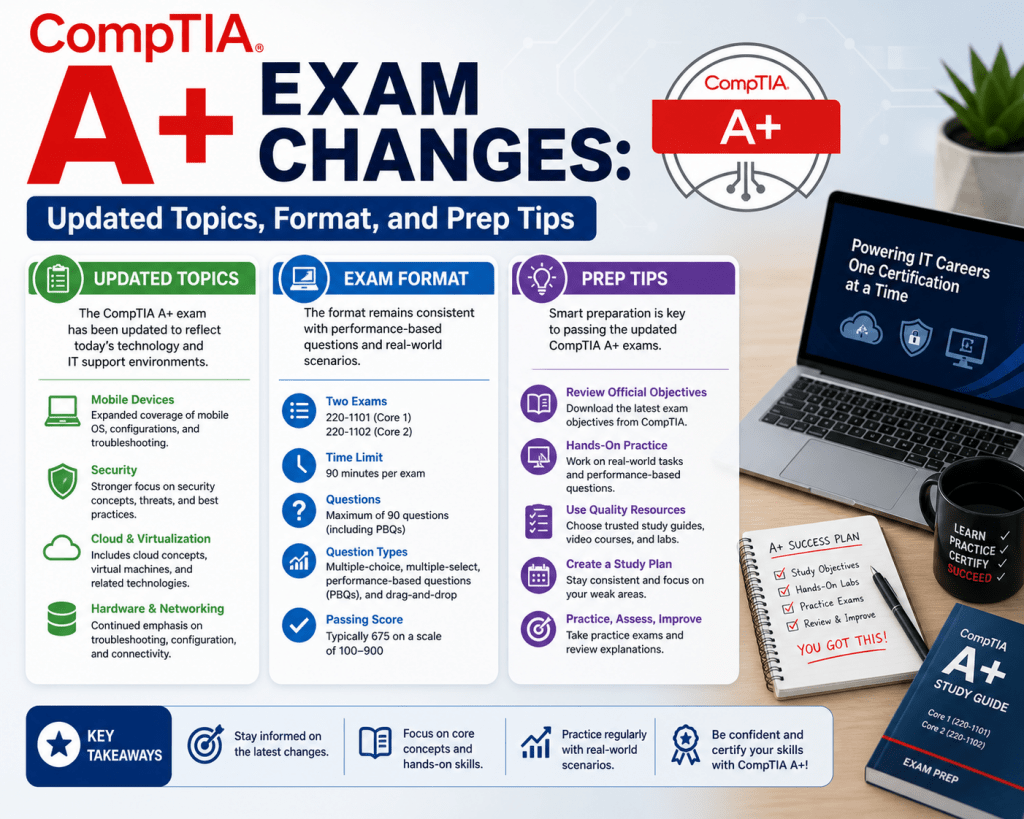
The CompTIA A+ certification is structured to evaluate a candidate’s ability to handle core IT responsibilities across multiple technical domains. It is divided into two separate exams known as Core 1 and Core 2, both of which must be completed to earn the certification. Each exam covers distinct areas of IT knowledge, ensuring a balanced assessment of technical and operational skills.
Core 1 typically focuses on hardware components, networking concepts, mobile devices, virtualization technologies, and cloud fundamentals. Core 2 emphasizes operating systems, security practices, software troubleshooting, and professional operational procedures. Together, these two exams provide a complete foundation for understanding how IT systems function in real-world environments.
The exam format includes multiple-choice questions as well as performance-based scenarios. These scenarios simulate real IT tasks such as diagnosing system issues, configuring devices, and resolving network problems. This approach ensures that candidates are not only tested on memorized knowledge but also on their ability to apply that knowledge in practical situations. The structure is designed to reflect real workplace conditions where IT professionals must quickly analyze issues and implement effective solutions.
Evolution of the CompTIA A+ Certification Over Time
The CompTIA A+ certification has undergone several updates since its introduction, reflecting the continuous evolution of the IT industry. As technology advances, the skills required for IT professionals also change. Early versions of the certification focused heavily on desktop hardware, legacy operating systems, and basic networking principles. At that time, IT environments were primarily localized, with limited cloud integration or remote access systems.
Over time, the rise of cloud computing, virtualization, mobile technologies, and cybersecurity threats has significantly changed how IT systems are designed and managed. In response to these changes, the certification has been updated to include more modern technologies and practices. Current versions of the exam place greater emphasis on hybrid IT environments where on-premises infrastructure works alongside cloud-based services. This reflects the reality of modern workplaces, where employees may work remotely and access systems through secure cloud platforms.
Another important evolution in the certification is the increased focus on security. As cyber threats have become more sophisticated and frequent, IT professionals are now expected to understand security principles at a foundational level. This includes knowledge of malware protection, secure authentication methods, data privacy, and system hardening techniques. These updates ensure that certified individuals are prepared to handle modern IT challenges effectively.
Major Update: Transition to New Exam Versions
A significant update to the CompTIA A+ certification was introduced with the release of new exam versions labeled 220-1201 and 220-1202. These new versions replaced the previous 220-1101 and 220-1102 exams, marking an important shift in the certification’s structure and content focus. The updated exams were officially introduced in March, aligning the certification with current industry standards and emerging technology trends.
The transition to the new exam versions reflects the need to keep IT certifications relevant in a rapidly changing technological landscape. As organizations adopt more advanced systems, IT professionals must be equipped with updated knowledge that reflects real-world environments. The newer exams incorporate expanded coverage of cloud computing, networking advancements, cybersecurity practices, and foundational artificial intelligence awareness.
The older exam versions remain available for a limited period to allow candidates who are already in the preparation process to complete their certification without disruption. However, these older versions are scheduled for retirement, after which only the updated exams will be valid. This structured transition ensures continuity while encouraging learners to adopt updated study materials and knowledge areas.
Core Focus Areas of the CompTIA A+ Certification
The CompTIA A+ certification is designed around several core technical domains that represent essential IT support knowledge. These domains are carefully selected to reflect the skills required in entry-level IT roles across various industries.
One of the primary focus areas is hardware, which includes understanding computer components such as processors, memory, storage devices, and peripheral equipment. Candidates must be able to identify, install, and troubleshoot hardware components in both desktop and laptop systems. This includes knowledge of physical connections, power requirements, and compatibility considerations.
Networking is another critical area, covering fundamental concepts such as IP addressing, network types, wireless technologies, and basic network troubleshooting. IT professionals must understand how devices communicate within a network and how to resolve connectivity issues when they arise.
Operating systems form a major part of the certification, requiring candidates to be familiar with the installation, configuration, and maintenance of different operating systems. This includes understanding system settings, file management, command-line tools, and user account administration.
Security is increasingly important in modern IT environments. Candidates must understand basic security principles such as authentication, encryption, malware protection, and secure system configuration. These skills are essential for protecting systems from unauthorized access and cyber threats.
Finally, troubleshooting is a key skill tested throughout the certification. IT professionals must be able to identify problems, analyze symptoms, and apply logical steps to resolve technical issues efficiently. This requires both technical knowledge and critical thinking ability.
Changes Introduced in the Exam Update
The update to the CompTIA A+ certification introduced several important changes to align the exam with modern IT practices. One of the most significant changes is the increased focus on cloud computing and virtualization. Candidates are now expected to understand how cloud services function and how virtual environments are used in enterprise IT systems.
Networking content has also been expanded to reflect modern connectivity models used in hybrid work environments. This includes a stronger emphasis on wireless networking, remote access technologies, and network security practices. Traditional legacy networking concepts have been reduced to make room for more relevant modern technologies.
Security has received greater emphasis in the updated exams, reflecting the growing importance of cybersecurity in IT operations. Candidates must now demonstrate a deeper understanding of security threats, prevention techniques, and secure system configuration. This includes awareness of data protection principles and user authentication methods.
Another important addition is the introduction of artificial intelligence awareness at a foundational level. While not deeply technical, this section focuses on how AI tools and systems are increasingly being used in IT environments and how they impact workflows, automation, and decision-making processes.
Impact of Domain Weight Adjustments in the Updated Exam
The updated certification also includes adjustments in domain weight distribution, which affects how much emphasis is placed on each topic area. In Core 1, networking and hardware remain significant areas of focus, while mobile device content has been slightly reduced. Virtualization and cloud computing continue to hold an important position in the exam structure.
In Core 2, security has gained increased importance, reflecting its critical role in modern IT environments. Operating systems have seen a slight weight reduction, while software troubleshooting has been adjusted to align with current application environments. Operational procedures continue to focus on professional communication, documentation, and workplace standards, which are essential skills for IT support roles.
These adjustments ensure that the certification remains aligned with industry demands and prepares candidates for real-world IT responsibilities. The balance between technical knowledge and practical skills helps ensure that certified professionals can effectively support modern IT infrastructures.
Relevance of CompTIA A+ in Today’s Job Market
The CompTIA A+ certification continues to play a vital role in entry-level IT career development. It is commonly required or preferred for roles such as IT support specialist, help desk technician, desktop support analyst, and technical support associate. These positions are essential in maintaining the daily operations of IT systems within organizations.
As businesses increasingly rely on digital technologies, the demand for skilled IT support professionals continues to grow. Organizations require individuals who can quickly resolve technical issues, maintain system performance, and support end-users across various platforms. The certification provides employers with confidence that candidates possess the foundational skills needed to perform these tasks effectively.
The growing importance of cloud computing, cybersecurity, and remote work environments has further increased the relevance of the certification. IT professionals are now expected to work in more complex environments where systems are distributed across multiple platforms and locations. The updated certification ensures that candidates are prepared to meet these evolving demands.
Importance of Foundational IT Skills for Career Growth
The CompTIA A+ certification not only helps individuals secure entry-level positions but also serves as a foundation for long-term career growth in IT. The skills learned during certification preparation form the basis for more advanced certifications and specialized career paths in networking, cybersecurity, systems administration, and cloud computing.
Understanding core IT principles such as hardware functionality, networking communication, and system troubleshooting is essential for advancing in technical roles. These foundational skills enable professionals to adapt to new technologies and take on more complex responsibilities over time.
As the IT industry continues to evolve, professionals who build strong foundational knowledge through certifications like A+ are better positioned to succeed in advanced technical roles. The certification acts as a stepping stone toward more specialized areas of expertise and supports continuous professional development in the field of information technology.
Understanding the Transition from 220-1101/1102 to 220-1201/1202
The transition from the 220-1101 and 220-1102 exams to the updated 220-1201 and 220-1202 versions represents a structured modernization of the CompTIA A+ certification. This change is not simply a revision of content but a rebalancing of skills to reflect how IT environments function in contemporary organizations. The older exam versions were heavily grounded in traditional IT support models, where systems were more localized and less dependent on cloud infrastructure. The updated versions introduced reflect the shift toward hybrid IT environments, remote connectivity, cloud-based services, and increased cybersecurity demands.
The newer exams maintain the foundational purpose of the certification, which is to validate entry-level IT skills, but they reframe those skills within modern workplace scenarios. This means candidates are now expected to understand not only how systems operate in isolation but also how they function within interconnected digital ecosystems. The shift ensures that certified professionals are prepared for real-world IT support roles where cloud platforms, remote access tools, and security frameworks are part of everyday operations.
Core 1 (220-1201): Modern Hardware, Networking, and Cloud Integration
The updated Core 1 exam places strong emphasis on hardware fundamentals, but the way these concepts are applied has evolved. Instead of focusing on outdated legacy systems, the exam now emphasizes modern computing devices, integrated components, and compatibility within hybrid environments. Candidates are expected to understand how modern CPUs, memory systems, storage technologies, and peripherals interact within both physical and virtual systems.
Networking has become one of the most important components of the updated Core 1 exam. This reflects the increasing reliance on connected systems in both business and personal computing environments. The exam now focuses more heavily on wireless networking, secure connectivity, and modern network troubleshooting techniques. Candidates are expected to understand how devices communicate across local and wide-area networks, as well as how cloud-based services integrate into network infrastructures.
Cloud computing has also been given a stronger presence in the updated exam. Instead of treating cloud systems as an advanced concept, they are now presented as a standard part of IT environments. Candidates are expected to understand basic cloud models, including shared resources, remote access systems, and virtual service delivery. This shift reflects the reality that many organizations now rely on cloud platforms for storage, communication, and application hosting.
Virtualization concepts have also been modernized. Rather than focusing on isolated virtual desktop environments, the exam now emphasizes virtualization as part of broader cloud infrastructure strategies. This includes understanding how virtual machines operate, how resources are allocated, and how virtual environments support scalability and efficiency in IT systems.
Removed and Reduced Topics in Core 1 (1201)
The updated Core 1 exam has removed or reduced certain legacy topics that are no longer relevant to modern IT environments. Older mobile communication technologies, such as legacy cellular standards, have been removed to make room for more current mobile device concepts. Similarly, outdated networking topics that focused heavily on legacy configurations have been reduced in importance.
Certain hardware-specific legacy technologies have also been minimized. This includes older storage interfaces and obsolete hardware configurations that are rarely encountered in modern systems. The focus has shifted toward universally applicable hardware knowledge that can be used across a wide range of modern devices.
Some virtualization topics that were previously isolated have been restructured to align more closely with cloud computing models. This ensures that candidates understand virtualization not as a standalone concept but as part of a broader cloud ecosystem.
Newly Emphasized Topics in Core 1 (1201)
The updated Core 1 exam introduces several new areas of focus that reflect current industry demands. One of the most important additions is the increased emphasis on cloud-based networking environments. Candidates are expected to understand how cloud services interact with traditional network infrastructures and how data flows between local systems and remote servers.
Another important addition is the integration of modern wireless technologies. With the rise of remote work and mobile computing, wireless networking has become a primary method of connectivity in many organizations. The exam now emphasizes secure wireless configuration, troubleshooting connectivity issues, and understanding wireless performance factors.
Energy efficiency and device optimization concepts have also gained importance. Modern IT environments often require systems that are both powerful and energy-efficient, especially in large-scale deployments. Candidates are expected to understand how hardware and software configurations impact system performance and energy consumption.
Core 2 (220-1202): Modern Operating Systems and Security Evolution
The updated Core 2 exam reflects significant changes in how operating systems and security concepts are applied in modern IT environments. Operating system coverage now focuses on current platforms and tools used in enterprise environments. This includes updated file systems, modern command-line utilities, and improved system management techniques.
Candidates are expected to understand how modern operating systems are installed, configured, and maintained in both standalone and networked environments. This includes familiarity with system updates, user management, and device configuration within secure environments.
Security has become one of the most important components of the updated Core 2 exam. This reflects the growing importance of cybersecurity across all areas of IT. Candidates are now expected to understand advanced security principles, including authentication methods, access control models, encryption techniques, and threat mitigation strategies.
The exam also introduces broader awareness of privacy concerns and data protection principles. IT professionals are expected to understand how sensitive data is handled, stored, and protected within organizational systems. This includes knowledge of secure communication practices and safe system configuration.
Removed and Reduced Topics in Core 2 (1202)
Several outdated topics have been removed from the Core 2 exam to align with modern IT practices. Older command-line utilities that are no longer commonly used have been reduced or eliminated. Legacy file systems and outdated operating system features have also been removed.
Some older security concepts that are no longer widely applicable have been replaced with more modern approaches. This includes shifting away from outdated mobile security models and focusing more on current authentication and encryption standards.
Certain troubleshooting scenarios that focused on obsolete applications or legacy systems have also been removed. This ensures that candidates are tested on relevant and current IT environments rather than outdated technologies.
Newly Added Topics in Core 2 (1202)
The updated Core 2 exam introduces several new topics that reflect modern IT support responsibilities. One of the most important additions is the inclusion of updated operating system features such as modern file systems and system management tools. Candidates are expected to understand how these systems improve performance, security, and reliability.
Security enhancements are also a major focus of the updated exam. This includes understanding modern authentication methods, multi-factor authentication systems, and secure access protocols. Candidates must also understand how to identify and respond to common security threats in modern IT environments.
Operational procedures have been updated to reflect real-world IT workflows. This includes improved documentation practices, communication standards, and professional behavior expectations within IT teams. These skills are essential for maintaining efficiency and consistency in technical support environments.
The exam also introduces awareness of cloud-based application management and remote system administration. This reflects the growing trend of managing IT systems through centralized cloud platforms rather than traditional on-site infrastructure.
Changes in Domain Weight Distribution
The updated certification also includes adjustments in how different knowledge areas are weighted across both Core 1 and Core 2 exams. These changes reflect the evolving priorities of the IT industry.
In Core 1, networking has gained increased importance, reflecting the growing reliance on connected systems. Hardware remains a core component but is now balanced with modern networking and cloud concepts. Mobile device coverage has been slightly reduced as traditional mobile technologies become less relevant in enterprise environments.
In Core 2, security has seen a significant increase in importance. This reflects the rising number of cyber threats and the need for IT professionals who can implement effective security measures. Operating systems have been slightly reduced in weight, while troubleshooting and security practices have become more prominent.
Operational procedures continue to play an important role, ensuring that candidates understand professional communication, documentation, and workflow management within IT teams. These skills are essential for maintaining efficiency and collaboration in technical environments.
Impact of Modern IT Trends on Certification Design
The changes in the CompTIA A+ certification are heavily influenced by broader trends in the IT industry. One of the most significant trends is the widespread adoption of cloud computing. Organizations are increasingly moving their infrastructure and applications to cloud-based platforms, which has changed the role of IT support professionals.
Another major trend is the rise of remote and hybrid work environments. This has increased the importance of secure remote access, cloud collaboration tools, and distributed system management. IT professionals must now support users who are working from multiple locations and devices.
Cybersecurity threats have also become more sophisticated, requiring stronger security knowledge at all levels of IT support. Entry-level professionals are now expected to understand basic security principles and apply them in daily operations.
Automation and artificial intelligence are also beginning to influence IT environments. While not deeply technical at the entry level, awareness of how these technologies impact workflows is becoming increasingly important.
Alignment of Certification with Real-World IT Responsibilities
The updated CompTIA A+ certification is designed to closely align with real-world IT job responsibilities. Entry-level IT professionals are often responsible for troubleshooting hardware and software issues, assisting users with technical problems, and maintaining system performance.
In modern environments, these responsibilities also include supporting cloud-based applications, managing remote devices, and ensuring system security. The updated certification ensures that candidates are prepared for these expanded responsibilities.
By focusing on practical skills and modern technologies, the certification helps bridge the gap between training and workplace expectations. This ensures that individuals entering the IT field are not only knowledgeable but also capable of adapting to dynamic and evolving environments.
Growing Importance of Networking and Security Skills
Networking and security have become central components of the updated certification due to their critical role in modern IT systems. Networks now serve as the backbone of organizational infrastructure, connecting users, devices, and applications across multiple environments.
Security is equally important, as organizations face increasing risks from cyber threats. IT professionals must understand how to protect systems, identify vulnerabilities, and respond to security incidents effectively. The updated certification ensures that candidates are equipped with these essential skills.
The combination of networking and security knowledge provides a strong foundation for advanced IT roles, including system administration, cybersecurity analysis, and cloud engineering.
How the CompTIA A+ Update Shapes Exam Preparation Strategy
The update to the CompTIA A+ certification significantly changes how candidates should approach their study preparation. While the overall structure of Core 1 and Core 2 remains consistent, the updated content requires a more modern and applied learning strategy. Instead of focusing heavily on memorization of legacy systems or outdated configurations, candidates are now expected to develop a practical understanding of how current IT environments operate. This means preparation must focus more on scenario-based learning, problem-solving, and real-world application of technical concepts.
A major shift in preparation strategy involves understanding integrated IT environments where hardware, software, networking, and cloud systems work together. Candidates must be able to see how these components interact rather than studying them as isolated topics. This approach reflects real IT support environments where issues often span multiple domains simultaneously. For example, a connectivity problem may involve networking configuration, operating system settings, and security restrictions all at once. Therefore, preparation must develop analytical thinking rather than simple recall.
Another important aspect of preparation is adapting to the increased focus on security and cloud technologies. These areas now play a much larger role in both Core 1 and Core 2 exams. Candidates should focus on understanding how security principles are applied in everyday IT tasks and how cloud-based systems are managed and supported. This includes understanding authentication methods, data protection principles, and secure communication practices within distributed environments.
Building a Structured Study Approach for Core 1 (220-1201)
A successful preparation strategy for Core 1 requires a structured understanding of hardware, networking, virtualization, and cloud fundamentals. The updated exam emphasizes modern devices and systems, so candidates should focus on current technologies rather than outdated configurations.
Hardware preparation should include understanding modern computing components such as processors, memory systems, storage devices, and peripheral integration. Instead of focusing on older legacy interfaces, candidates should prioritize learning how modern systems are assembled, configured, and maintained. This includes understanding compatibility, performance optimization, and troubleshooting hardware failures in contemporary devices.
Networking preparation should focus heavily on wireless technologies, internet connectivity models, and secure communication practices. Candidates should understand how devices connect within local networks and how those networks interact with cloud-based systems. This includes learning how data flows across networks and how connectivity issues can be diagnosed and resolved using logical troubleshooting steps.
Cloud computing is now a core part of Core 1 preparation. Candidates should understand basic cloud service models and how cloud platforms are used for storage, application hosting, and remote access. The emphasis is not on advanced cloud engineering but on foundational awareness of how cloud systems support modern IT operations.
Virtualization should also be studied in the context of cloud environments rather than standalone systems. Candidates should understand how virtual machines operate, how resources are allocated, and how virtualization supports scalability and flexibility in IT infrastructures.
Building a Structured Study Approach for Core 2 (220-1202)
Core 2 preparation requires a strong focus on operating systems, security, troubleshooting, and operational procedures. The updated exam reflects modern IT environments, so candidates must focus on current tools, systems, and practices.
Operating system preparation should include understanding installation, configuration, and maintenance of modern platforms. Candidates should be familiar with system settings, user account management, and file system structures used in contemporary environments. Command-line tools remain important but are now focused on practical usage rather than outdated commands.
Security preparation is one of the most important areas in Core 2. Candidates should focus on understanding authentication systems, encryption methods, malware prevention, and secure system configuration. Security is no longer treated as a separate domain but is integrated into all aspects of IT support. This means candidates must understand how security applies to networking, operating systems, and user management.
Troubleshooting preparation should focus on logical problem-solving approaches. Candidates must be able to identify symptoms, analyze potential causes, and apply structured steps to resolve issues. This includes both hardware and software troubleshooting scenarios, as well as network-related problems.
Operational procedures preparation should focus on communication skills, documentation practices, and professional behavior in IT environments. These skills are essential for working effectively in teams and supporting end-users in professional settings.
Impact of Security Emphasis in the Updated Certification
One of the most significant changes in the update is the increased emphasis on security across both Core 1 and Core 2 exams. Security is no longer treated as a specialized topic but as a fundamental requirement for all IT professionals.
Candidates are now expected to understand how to protect systems from threats such as malware, unauthorized access, and data breaches. This includes knowledge of authentication methods, access control systems, and secure configuration practices. Security awareness is also extended to user behavior, meaning candidates must understand how human actions can impact system security.
The increased focus on security reflects real-world IT environments where cyber threats are constant and evolving. IT professionals are often the first line of defense in identifying and preventing security incidents. As a result, the certification ensures that entry-level professionals are prepared to contribute to organizational security from the beginning of their careers.
The Growing Role of Cloud and Virtual Technologies
Cloud computing and virtualization have become central components of modern IT infrastructure. The updated certification reflects this shift by integrating cloud concepts throughout both Core 1 and Core 2 exams.
Cloud technologies are now used for a wide range of functions, including data storage, application hosting, and remote system access. IT professionals must understand how these systems operate and how they are used in business environments. While advanced cloud engineering is not required at this level, foundational knowledge is essential.
Virtualization supports cloud computing by allowing multiple virtual systems to operate on a single physical machine. This improves efficiency, scalability, and resource management. Candidates must understand how virtualization works and how it supports modern IT infrastructures.
The integration of these technologies into the certification ensures that candidates are prepared for real-world IT environments where cloud and virtual systems are standard.
Domain Weight Shifts and Their Practical Meaning
The updated exam includes adjustments in domain weight distribution, which reflects changing priorities in IT support roles. These shifts are not dramatic but are meaningful in understanding what areas require more focus during preparation.
In Core 1, networking has gained more importance, reflecting the growing reliance on connected systems. Hardware remains a core area but is now balanced with cloud and networking concepts. Mobile device coverage has been slightly reduced as older technologies become less relevant.
In Core 2, security has seen a noticeable increase in importance. This reflects the growing need for IT professionals who can understand and apply security principles in everyday tasks. Operating systems have slightly reduced emphasis, while troubleshooting and security have become more prominent.
Operational procedures continue to play a steady role, ensuring that candidates understand communication, documentation, and professional behavior in IT environments. These skills remain essential for effective teamwork and user support.
Real-World Application of A+ Skills in IT Jobs
The CompTIA A+ certification is designed to reflect real-world IT job responsibilities. Entry-level IT professionals are often responsible for supporting users, maintaining systems, and resolving technical issues across a variety of environments.
In modern workplaces, these responsibilities extend beyond traditional desktop support. IT professionals must also support remote users, cloud-based applications, and networked systems. This requires a broad understanding of how different technologies interact within an organization.
The updated certification ensures that candidates are prepared for these responsibilities by focusing on practical skills and modern technologies. This includes troubleshooting system issues, configuring devices, managing user accounts, and applying security best practices.
These skills are directly applicable to roles such as IT support technician, help desk analyst, and desktop support specialist. In these positions, professionals must respond quickly to technical issues and ensure minimal disruption to business operations.
Importance of Troubleshooting and Analytical Thinking
Troubleshooting is one of the most important skills tested in the CompTIA A+ certification. It requires candidates to apply logical thinking to identify and resolve technical issues.
Rather than simply memorizing solutions, candidates must understand how to analyze symptoms, identify possible causes, and systematically eliminate potential issues. This approach mirrors real IT environments where problems are often complex and require structured problem-solving.
The updated certification places strong emphasis on analytical thinking, encouraging candidates to understand underlying system behavior rather than surface-level symptoms. This helps develop more effective IT professionals who can adapt to different scenarios.
Troubleshooting skills are essential for all areas of IT support, including hardware, software, networking, and security. The ability to quickly identify and resolve issues is a core requirement in most IT roles.
Career Opportunities After Earning CompTIA A+
The CompTIA A+ certification opens the door to a wide range of entry-level IT career opportunities. These roles are essential for supporting the daily operations of technology systems within organizations.
Common roles include IT support technician, help desk analyst, desktop support specialist, and technical support associate. These positions involve assisting users, resolving technical issues, and maintaining system performance.
As organizations continue to adopt cloud technologies and remote work models, the demand for IT support professionals continues to grow. These roles are critical in ensuring that employees can access systems and complete their work efficiently.
The certification also serves as a foundation for more advanced IT certifications and career paths. Many professionals use it as a stepping stone toward specialized fields such as networking, cybersecurity, and systems administration.
Long-Term Value of CompTIA A+ in IT Career Development
The CompTIA A+ certification provides long-term value by establishing a strong foundation in IT fundamentals. The skills learned during preparation remain relevant throughout a professional’s career, even as technology continues to evolve.
As IT environments become more complex, professionals with strong foundational knowledge are better equipped to adapt to new technologies and responsibilities. The certification encourages continuous learning and professional development.
It also helps individuals build confidence in their technical abilities, making it easier to progress into more advanced roles. The combination of technical knowledge, troubleshooting skills, and security awareness provides a strong base for long-term career growth in the IT industry.
Conclusion
The CompTIA A+ certification continues to serve as one of the most important entry points into the information technology field, and the update reinforces its role as a modern, industry-aligned credential. Rather than remaining tied to older IT environments, the certification has evolved to reflect how real-world technology ecosystems function today. This includes a stronger emphasis on cloud computing, cybersecurity awareness, networking fundamentals, and emerging technologies such as artificial intelligence at a conceptual level. The overall direction of the certification demonstrates a clear effort to ensure that entry-level IT professionals are not only familiar with traditional support tasks but are also prepared for the demands of modern digital workplaces.
One of the most significant outcomes of the update is the alignment of exam content with current job market expectations. IT support roles today are no longer limited to fixing hardware issues or installing software on standalone machines. Instead, professionals are expected to work in environments where systems are interconnected across local networks, remote infrastructures, and cloud-based platforms. This shift means that IT support specialists must understand how data moves between systems, how users interact with remote services, and how security is maintained across distributed environments. The updated certification reflects this reality by integrating these concepts into both Core 1 and Core 2 exams in a balanced and practical way.
Another important aspect of the certification’s evolution is its increased focus on cybersecurity principles. Security is no longer treated as a separate specialization within IT but as a fundamental requirement for all technical roles. Entry-level professionals are now expected to understand basic security threats, prevention techniques, and safe system configuration practices. This includes awareness of authentication methods, secure access control, and data protection principles. The inclusion of these topics at the foundational level ensures that new IT professionals are better prepared to contribute to organizational security from the beginning of their careers. It also reflects the reality that cyber threats are now a constant concern for businesses of all sizes.
The introduction of cloud and virtualization concepts into the updated exam further strengthens its relevance in modern IT environments. Cloud computing has become a standard part of how organizations store data, deploy applications, and manage infrastructure. As a result, IT professionals must understand how cloud services operate and how they integrate with traditional systems. While the certification does not require deep technical expertise in cloud architecture, it ensures that candidates are familiar with the basic principles of cloud-based environments and their role in supporting business operations. This foundational knowledge is essential for working in organizations that rely heavily on remote systems and distributed resources.
Virtualization also plays a key role in modern IT infrastructure, and its inclusion in the updated certification reflects its growing importance. Virtual machines allow organizations to run multiple systems on a single physical device, improving efficiency and scalability. Understanding how virtualization works helps IT professionals manage resources more effectively and support environments where virtual systems are widely used. The certification ensures that candidates have a basic understanding of these concepts so they can work effectively in modern technical environments.
The changes in domain weight distribution across both Core 1 and Core 2 exams also highlight the evolving priorities of the IT industry. Networking and security have gained increased importance, while certain legacy topics have been reduced or removed. This shift reflects the growing complexity of modern IT systems and the need for professionals who can manage interconnected environments. Networking knowledge is essential because nearly all modern systems rely on network connectivity, whether through local networks, wireless systems, or cloud-based platforms. Security knowledge is equally important due to the increasing frequency and sophistication of cyber threats.
At the same time, the reduction of outdated topics ensures that candidates are not spending time on technologies that are no longer relevant in real-world environments. This allows the certification to remain focused on practical skills that can be applied directly in the workplace. By removing legacy content and introducing modern concepts, the certification maintains its value as a current and industry-relevant credential.
From a career perspective, the CompTIA A+ certification continues to provide strong opportunities for individuals entering the IT field. Entry-level roles such as IT support technician, help desk analyst, and desktop support specialist remain in high demand across industries. These roles form the backbone of IT operations, ensuring that users receive technical assistance and that systems remain functional and secure. As organizations continue to expand their digital infrastructure, the demand for skilled IT support professionals is expected to grow steadily.
The certification also serves as a stepping stone for more advanced career paths. Many professionals use it as a foundation before pursuing specialized areas such as cybersecurity, networking, cloud computing, or systems administration. The broad scope of the certification ensures that individuals gain exposure to multiple areas of IT, helping them identify their interests and strengths before moving into more specialized roles. This flexibility makes the certification valuable not only for immediate job opportunities but also for long-term career development.
Another important outcome of the updated certification is its emphasis on practical, real-world skills. Instead of focusing solely on theoretical knowledge, the exam encourages candidates to think critically and apply their understanding to realistic scenarios. This approach is essential in IT environments where problems are often complex and require structured troubleshooting methods. Professionals must be able to analyze symptoms, identify potential causes, and implement effective solutions quickly and efficiently. The certification reinforces these skills, ensuring that candidates are prepared for the demands of actual IT support work.
The inclusion of operational procedures and communication skills further enhances the certification’s practical value. IT professionals must not only understand technical systems but also communicate effectively with users and team members. Proper documentation, clear communication, and professional behavior are essential for maintaining efficient IT operations. These soft skills are often just as important as technical knowledge in real workplace environments.
Overall, the update to the CompTIA A+ certification represents a significant step forward in aligning entry-level IT training with modern industry needs. It reflects the shift toward cloud-based infrastructure, increased cybersecurity requirements, and more complex networking environments. At the same time, it maintains its core purpose of providing foundational IT knowledge for beginners entering the field.
The certification continues to hold strong value as a gateway into the IT industry, offering individuals a structured path toward building technical expertise and professional experience. Its updated content ensures that candidates are not only prepared for today’s job roles but also equipped with the foundational knowledge needed to adapt to future technological changes. As IT environments continue to evolve, the CompTIA A+ certification remains a relevant and reliable starting point for anyone pursuing a career in technology.