
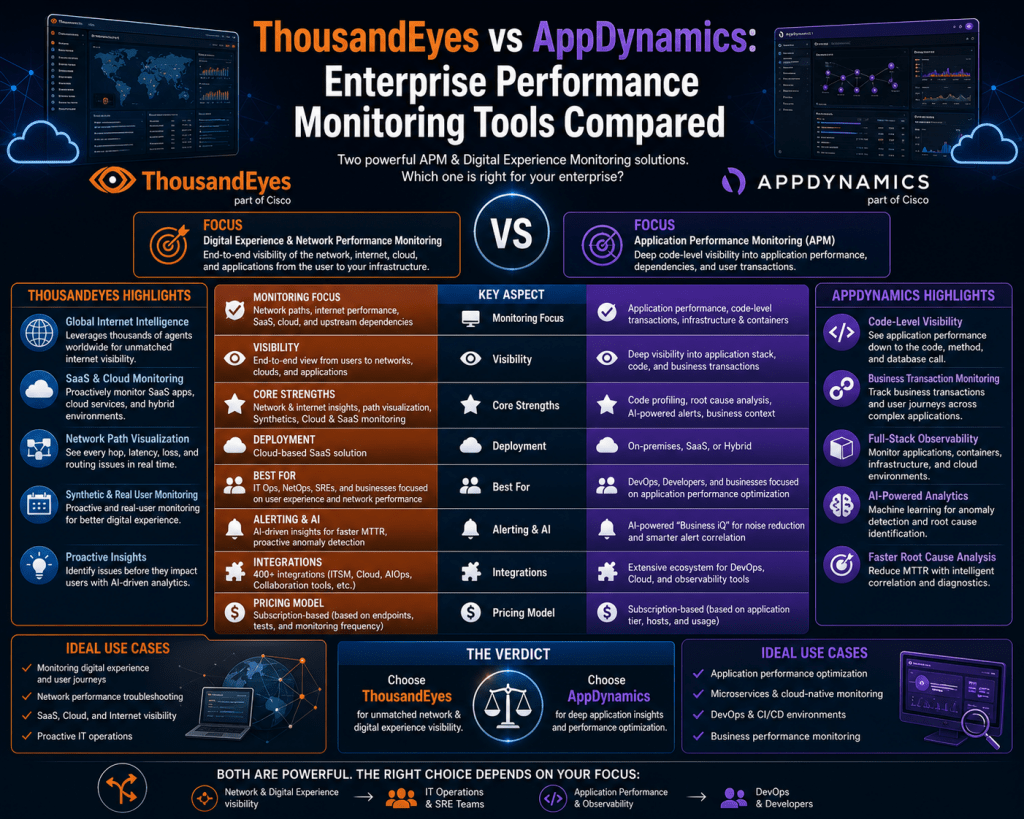
Modern digital systems operate in highly complex environments where applications, networks, cloud services, and user devices interact continuously. Businesses today depend on uninterrupted connectivity and fast application performance to maintain customer satisfaction and operational stability. As infrastructure becomes more distributed, traditional monitoring methods are no longer sufficient to provide full visibility into system behavior. This has led to the adoption of advanced observability platforms designed to unify insights across networks and applications. ThousandEyes and AppDynamics are two widely recognized solutions that address these challenges from different perspectives. Understanding their roles in modern IT ecosystems is essential for organizations seeking to improve reliability, reduce downtime, and enhance digital performance.
The Growing Importance of End-to-End Digital Visibility
End-to-end visibility has become a critical requirement in modern IT operations because applications no longer operate within isolated environments. Instead, they rely on cloud providers, third-party APIs, global internet infrastructure, and hybrid networks. A single user request may traverse multiple systems before reaching its destination. Without proper visibility, diagnosing performance issues becomes extremely difficult. Observability tools help bridge this gap by collecting and analyzing data from multiple layers of the IT stack. ThousandEyes focuses on external network pathways and internet performance, while AppDynamics focuses on internal application behavior and execution flow. Together, they represent two essential dimensions of digital visibility.
Understanding the Core Philosophy of ThousandEyes
ThousandEyes is built around the concept of internet intelligence and network visibility. Its primary goal is to help organizations understand how data travels across complex and often unpredictable network paths. Unlike traditional monitoring tools that focus on internal infrastructure, ThousandEyes extends visibility beyond organizational boundaries into the global internet. This includes tracking how data moves through internet service providers, cloud platforms, and content delivery networks. By analyzing these external dependencies, organizations can identify where network disruptions occur and how they impact application delivery. This philosophy makes ThousandEyes especially valuable for businesses with globally distributed users and cloud-based operations.
Global Network Path Analysis and Its Strategic Value
One of the most powerful capabilities within ThousandEyes is its ability to perform global network path analysis. This feature allows organizations to visualize the complete route that data takes from source to destination. It highlights every hop, routing decision, and network segment involved in data transmission. This level of detail helps identify issues such as latency spikes, packet loss, or routing inefficiencies that may affect performance. In many cases, application slowdowns are not caused by internal systems but by external network conditions. Global path analysis enables IT teams to quickly isolate these issues and determine whether the problem lies within their infrastructure or with external providers.
Internet Intelligence and External Dependency Monitoring
Modern applications depend heavily on external services, including cloud platforms, APIs, and third-party infrastructure. ThousandEyes provides continuous monitoring of these dependencies by analyzing internet health and service provider performance. It evaluates how well different parts of the internet are functioning and identifies disruptions that may affect connectivity. This is particularly important for organizations that operate across multiple regions or rely on distributed cloud environments. By monitoring external dependencies, businesses can proactively respond to outages and minimize the impact on end users. This level of intelligence helps organizations maintain resilience in an unpredictable internet landscape.
Simulated User Experience Through Network Perspective
ThousandEyes also provides simulated user experience monitoring, which helps organizations understand how users interact with applications from different geographical locations. Instead of relying solely on internal metrics, it simulates real-world conditions by testing application performance across various network environments. This approach reveals how latency, routing paths, and external conditions influence user experience. It is especially useful for identifying regional performance disparities where users in different parts of the world may experience varying levels of service quality. By simulating user interactions, organizations can optimize application delivery strategies and improve global performance consistency.
Foundational Overview of AppDynamics and Application Intelligence
AppDynamics is centered around application intelligence and performance monitoring. Its primary focus is on understanding how software applications behave during execution. Unlike network-centric tools, AppDynamics dives deep into application code, infrastructure interactions, and business transactions. It provides detailed insights into how applications process requests, interact with databases, and respond to user actions. This makes it an essential tool for organizations that prioritize software performance, development efficiency, and user experience optimization. Its approach is built on the idea that application performance directly influences business outcomes.
Deep Application Performance Visibility and Code-Level Insights
A defining feature of AppDynamics is its ability to provide code-level visibility into application performance. This means it can track how individual lines of code or specific functions behave during execution. By analyzing application workflows in detail, it identifies slow-performing components, inefficient queries, and system bottlenecks. This granular visibility allows development teams to pinpoint the exact source of performance issues rather than relying on surface-level metrics. As applications become more complex and distributed, this level of insight becomes essential for maintaining performance and stability.
Business Transaction Flow Mapping in Complex Systems
AppDynamics excels at mapping business transactions across distributed application environments. A single user action, such as submitting a form or completing a purchase, often involves multiple backend services. AppDynamics traces this entire journey, showing how data flows through different components of the system. This helps organizations understand how technical performance impacts business operations. For example, a delay in a database query could directly affect checkout completion rates in an e-commerce system. By connecting technical metrics to business outcomes, AppDynamics helps organizations prioritize improvements that have the greatest impact.
Real User Experience Monitoring in Application Environments
User experience monitoring is a core component of AppDynamics. It collects real-time data from actual users interacting with applications. This includes metrics such as page load times, response delays, and error frequencies. By analyzing real user behavior, AppDynamics provides a clear picture of how applications perform under real-world conditions. This is particularly important for identifying issues that may not appear in synthetic testing environments. It also allows organizations to segment user experience data by geography, device type, or network condition, providing deeper insights into performance variability.
Early Structural Comparison of Monitoring Approaches
At a foundational level, ThousandEyes and AppDynamics represent two distinct but complementary approaches to observability. ThousandEyes focuses on external network conditions and internet performance, providing visibility into how data moves across global infrastructures. AppDynamics focuses on internal application behavior, offering deep insights into how software executes and delivers business value. While ThousandEyes helps identify connectivity and routing issues outside the organization’s control, AppDynamics helps optimize application code and internal systems. Together, they form a comprehensive view of digital performance across both external and internal environments.
Expanding the Role of Network Intelligence in Modern Enterprises
Modern enterprises operate in environments where network performance directly influences application reliability, customer experience, and revenue generation. As organizations adopt cloud-first strategies, traditional perimeter-based monitoring becomes less effective. Applications are no longer hosted in a single data center but are distributed across multiple cloud regions, edge locations, and third-party services. In this environment, network intelligence becomes a critical component of observability. ThousandEyes addresses this need by providing deep visibility into how data moves across complex and global network infrastructures. It helps organizations understand not only what is happening within their internal systems but also how external factors shape digital performance outcomes.
ThousandEyes Network Monitoring Architecture Explained
The architecture of ThousandEyes is built around distributed monitoring agents that continuously collect data from multiple geographic locations. These agents simulate user activity and network traffic across different paths to measure performance metrics such as latency, jitter, packet loss, and routing efficiency. The collected data is then aggregated into a centralized intelligence layer, where it is analyzed to identify anomalies and performance degradation. This distributed architecture ensures that organizations can observe network behavior from multiple perspectives rather than relying on a single monitoring point. It also provides redundancy in data collection, improving accuracy and reliability in performance analysis.
End-to-End Internet Path Visibility in Complex Systems
One of the defining strengths of ThousandEyes is its ability to provide end-to-end visibility across internet paths. In modern digital ecosystems, a single user request may traverse multiple autonomous systems, cloud providers, and regional networks. ThousandEyes maps each step of this journey, revealing how data flows across the internet. This visibility helps organizations identify where delays or failures occur, whether in internal infrastructure or external networks. It also helps in understanding the behavior of Internet routing protocols and how they impact application delivery. This level of transparency is essential for diagnosing issues that span beyond organizational boundaries.
Cloud and Multi-Cloud Network Observability
As businesses increasingly adopt multi-cloud strategies, network complexity grows exponentially. Applications may rely on services hosted across multiple cloud platforms, each with its own network structure and performance characteristics. ThousandEyes provides visibility into these multi-cloud environments by monitoring connectivity between cloud regions and external endpoints. It allows organizations to detect performance inconsistencies between different cloud providers and optimize routing strategies accordingly. This capability is especially valuable for enterprises that depend on hybrid architectures combining on-premises systems with public cloud services.
Internet Outage Detection and Root Cause Identification
One of the critical challenges in network operations is identifying whether performance issues are caused by internal systems or external internet outages. ThousandEyes addresses this challenge by continuously monitoring global internet health. It detects outages, routing failures, and service disruptions across ISPs and cloud providers. When an issue occurs, ThousandEyes helps trace the root cause by analyzing network paths and identifying where the failure originated. This reduces mean time to resolution and allows organizations to respond quickly to external disruptions that impact user experience.
Application Delivery Optimization Through Network Insights
While ThousandEyes is primarily a network intelligence platform, it also plays an important role in optimizing application delivery. Analyzing how network conditions affect application performance, it helps organizations fine-tune delivery strategies. For example, if an application experiences slow response times in a specific region, ThousandEyes can determine whether the issue is caused by network latency or routing inefficiencies. This allows IT teams to implement targeted optimizations such as traffic rerouting or edge deployment adjustments. The result is improved application performance without requiring changes to application code.
Deep Dive into AppDynamics Application Performance Architecture
AppDynamics operates on a fundamentally different architecture focused on application performance monitoring. It uses agents deployed within application environments to collect detailed performance data from servers, databases, and application code. These agents track every transaction, method call, and system interaction to build a comprehensive view of application behavior. The collected data is then processed into real-time dashboards that provide insights into performance bottlenecks and system efficiency. This architecture is designed to provide deep visibility into how applications function internally under real-world conditions.
Code-Level Performance Analysis and Diagnostics
One of the most powerful capabilities of AppDynamics is its ability to perform code-level performance analysis. This means it can identify exactly which parts of an application are causing performance degradation. For example, if a web application experiences slow response times, AppDynamics can trace the issue down to a specific function or database query. This level of precision allows developers to quickly fix performance issues without manually analyzing logs or guessing the root cause. It significantly reduces debugging time and improves overall development efficiency.
Distributed Transaction Tracing Across Microservices
Modern applications are often built using microservice architectures where a single user request may involve multiple services communicating with each other. AppDynamics provides distributed transaction tracing that follows each request across all services involved. This allows organizations to visualize the entire execution path of a transaction. If a delay occurs at any point in the process, it becomes immediately visible. This is particularly useful in identifying performance bottlenecks in complex microservices environments where issues may be distributed across multiple components.
Business Transaction Intelligence and Outcome Mapping
AppDynamics goes beyond technical monitoring by connecting application performance to business outcomes. It maps technical transactions to business processes such as purchases, registrations, or service requests. This allows organizations to understand how performance issues impact revenue and customer satisfaction. For example, a slowdown in payment processing may directly result in lost sales. By linking technical metrics with business performance indicators, AppDynamics enables data-driven decision-making at both the IT and executive levels.
Real-Time Application Performance Monitoring at Scale
AppDynamics provides real-time monitoring capabilities that allow organizations to observe application performance as it happens. This includes tracking response times, error rates, throughput, and resource utilization. The system continuously updates performance data, enabling IT teams to detect issues immediately rather than after they escalate. This real-time visibility is critical for maintaining high availability in production environments where even minor delays can impact user experience.
User Experience Analytics and Behavioral Insights
In addition to backend performance monitoring, AppDynamics provides detailed user experience analytics. It captures how users interact with applications, including page load times, navigation paths, and error encounters. This data is used to identify patterns in user behavior and detect areas where performance issues may be affecting engagement. By analyzing real user sessions, organizations can understand how different user segments experience the application, allowing for more targeted optimization strategies.
Comparative Analysis of Monitoring Depth Between Platforms
When comparing ThousandEyes and AppDynamics in terms of monitoring depth, a clear distinction emerges. ThousandEyes provides deep visibility into network infrastructure and external connectivity, focusing on how data moves across the internet. AppDynamics provides deep visibility into application behavior and internal system performance, focusing on how software executes and delivers value. While ThousandEyes excels in diagnosing external network issues, AppDynamics excels in identifying internal application bottlenecks. Together, they provide complementary insights that cover both sides of digital performance.
Scalability and Performance Handling in Large Environments
Both platforms are designed to scale in large enterprise environments, but approach scalability differently. ThousandEyes scales by expanding its distributed monitoring network, allowing it to observe performance from multiple global locations. AppDynamics scales by handling increasing application complexity and transaction volume within enterprise systems. As organizations grow, ThousandEyes adapts to expanding network footprints, while AppDynamics adapts to increasing application workloads and microservices architectures. This makes both platforms suitable for enterprise-scale deployments, but in different domains.
Accuracy and Data Granularity in Observability Systems
Accuracy is a critical factor in observability platforms. ThousandEyes achieves accuracy by collecting data from multiple geographically distributed sources, ensuring that network measurements reflect real-world conditions. AppDynamics achieves accuracy by instrumenting application code directly, capturing precise performance metrics at the execution level. This difference in data collection methods reflects their respective focus areas: external network accuracy versus internal application precision.
Real-Time Monitoring and Incident Detection Capabilities
Both ThousandEyes and AppDynamics offer strong real-time monitoring capabilities, but their focus areas differ. ThousandEyes provides real-time insights into network health and external connectivity issues, allowing organizations to detect outages and routing problems instantly. AppDynamics provides real-time insights into application performance, allowing teams to detect slow transactions, errors, and system bottlenecks as they occur. In both cases, real-time monitoring plays a crucial role in reducing downtime and improving system reliability.
Architectural Differences and Observability Philosophy
The architectural differences between ThousandEyes and AppDynamics reflect their underlying philosophies. ThousandEyes is built around external observability, focusing on internet behavior and network performance outside organizational boundaries. AppDynamics is built around internal observability, focusing on application behavior within controlled environments. This fundamental difference shapes how each platform collects, processes, and interprets data. Understanding these architectural distinctions is essential for selecting the right tool based on organizational needs.
Enterprise Use Cases and Real-World Deployment Scenarios
In modern digital ecosystems, organizations rarely rely on a single monitoring approach. Instead, they deploy observability platforms based on specific operational needs, infrastructure complexity, and business priorities. ThousandEyes and AppDynamics are frequently used in enterprise environments, but they serve different purposes depending on the nature of the system being monitored. ThousandEyes is commonly deployed in organizations that depend heavily on global connectivity, cloud infrastructure, and internet-based services. AppDynamics is widely used in businesses that prioritize application performance, customer experience, and software-driven revenue models. Understanding real-world deployment scenarios helps clarify how each platform fits into enterprise IT strategies.
ThousandEyes in Global Network Monitoring Environments
ThousandEyes is widely used in organizations that operate across multiple regions and depend on consistent global connectivity. Enterprises with distributed offices, remote employees, and cloud-hosted applications use ThousandEyes to monitor how data flows across the internet. It is particularly valuable for organizations that rely on third-party service providers such as cloud platforms, content delivery networks, and SaaS applications. In these environments, network disruptions can originate outside the organization’s control, making external visibility essential. ThousandEyes helps identify whether performance issues stem from internal infrastructure or external internet conditions, enabling faster diagnosis and resolution.
Cloud Dependency Monitoring and Multi-Provider Strategies
Many modern organizations adopt multi-cloud strategies to improve resilience and flexibility. However, this introduces complexity in monitoring performance across different cloud environments. ThousandEyes provides visibility into connectivity between cloud providers, regions, and edge locations. It helps organizations detect inconsistencies in performance between different cloud platforms and optimize routing strategies accordingly. This capability is especially important for businesses that distribute workloads across multiple cloud environments to avoid vendor lock-in and improve redundancy. By monitoring cloud dependencies, organizations can ensure consistent application delivery regardless of underlying infrastructure variations.
Internet Service Provider Performance and Reliability Tracking
A critical use case for ThousandEyes is monitoring internet service provider performance. Since many applications rely on external ISPs for connectivity, any degradation in ISP performance can directly impact application availability. ThousandEyes continuously evaluates ISP behavior by measuring latency, packet loss, and routing efficiency. This allows organizations to identify which providers offer the most reliable performance across different regions. It also helps in negotiating service-level agreements and selecting optimal connectivity partners for global operations.
Digital Experience Assurance for End Users
Organizations increasingly focus on digital experience assurance, ensuring that users receive consistent application performance regardless of location. ThousandEyes supports this by simulating user interactions from multiple global vantage points. It measures how applications perform under real-world internet conditions, helping organizations identify regional performance disparities. This is especially important for global enterprises that serve customers across different continents. By understanding how users experience applications in different regions, businesses can optimize content delivery strategies and improve overall user satisfaction.
AppDynamics in Application-Centric Enterprise Environments
AppDynamics is widely adopted in organizations where application performance directly influences business outcomes. This includes industries such as e-commerce, financial services, healthcare, and digital media. In these environments, even small performance issues can lead to significant revenue loss or customer dissatisfaction. AppDynamics provides deep visibility into application behavior, allowing organizations to monitor every aspect of software execution. It is particularly effective in environments where applications are complex, distributed, and continuously evolving through DevOps practices.
E-Commerce Performance Optimization and Revenue Protection
In e-commerce environments, application performance has a direct impact on conversion rates and revenue generation. AppDynamics is used to monitor user interactions such as product searches, checkout processes, and payment transactions. It identifies bottlenecks that may slow down these critical workflows. For example, a delay in payment processing can lead to abandoned shopping carts. By tracking these transactions in real time, AppDynamics helps organizations optimize performance and reduce revenue loss caused by technical issues.
Financial Systems and High-Availability Application Monitoring
Financial institutions rely heavily on application performance monitoring due to strict availability and compliance requirements. AppDynamics is used to monitor banking applications, trading platforms, and transaction processing systems. It ensures that critical financial operations are executed without delay or failure. By providing detailed insights into application behavior, it helps organizations maintain regulatory compliance and ensure system reliability. In high-frequency environments, even milliseconds of delay can have significant financial consequences, making precise monitoring essential.
DevOps Integration and Continuous Delivery Support
Modern software development practices rely heavily on DevOps and continuous delivery pipelines. AppDynamics integrates into these workflows by providing real-time feedback on application performance during development and deployment stages. This allows development teams to identify performance issues early in the software lifecycle. Instead of discovering problems after deployment, teams can detect and resolve them during testing or staging phases. This improves software quality and reduces the risk of production failures.
Comparing Business Impact Visibility Between Platforms
One of the key differences between ThousandEyes and AppDynamics lies in how they relate technical performance to business outcomes. AppDynamics directly maps application performance to business transactions, allowing organizations to understand how technical issues affect revenue and customer behavior. ThousandEyes, on the other hand, focuses on how network conditions impact digital services but does not directly map these conditions to business processes. While both platforms provide valuable insights, AppDynamics offers a more direct connection between performance metrics and business impact.
Cost Structures and Deployment Considerations
Both ThousandEyes and AppDynamics operate on subscription-based pricing models, but the way costs are structured reflects their fundamentally different monitoring philosophies. ThousandEyes pricing is generally influenced by the number of monitored agents, test locations, endpoints, and network visibility requirements across global environments. Since it focuses heavily on distributed internet intelligence, costs tend to scale with geographic coverage and the complexity of network paths being monitored. Organizations that require extensive global visibility may need a higher number of monitoring nodes, which directly influences overall investment.
AppDynamics, on the other hand, structures its pricing around application-centric metrics such as the number of application nodes, services, runtime environments, and selected feature modules. Because it operates closer to the application layer, costs are more directly tied to software architecture complexity and transaction volume rather than geographic distribution. Additional features such as advanced analytics, business transaction monitoring, or enhanced user experience tracking may further influence pricing tiers.
Scalability in Enterprise-Grade Monitoring Environments
Scalability is one of the most critical requirements in modern observability platforms, especially as organizations transition toward cloud-native and distributed architectures. ThousandEyes achieves scalability by expanding its globally distributed monitoring infrastructure, which allows it to continuously observe network performance across different regions, service providers, and internet backbones. This horizontal scaling model ensures that as an organization’s digital footprint grows, visibility remains consistent across all external dependencies.
This is particularly important in global enterprises where users access services from multiple continents, often through different network providers. ThousandEyes can scale its monitoring coverage to reflect this diversity, ensuring that performance insights remain accurate regardless of user location or traffic routing complexity.
AppDynamics scales differently by focusing on application workloads, transaction volumes, and microservices density within enterprise systems. As organizations adopt microservices architectures, applications become more modular but also more complex to monitor. AppDynamics handles this complexity by scaling vertically within application ecosystems, tracking increasing numbers of services, dependencies, and runtime interactions.
Accuracy and Reliability of Observability Data
Accurate data collection is fundamental to effective observability, as decisions based on incorrect or incomplete information can lead to misdiagnosis and prolonged outages. ThousandEyes achieves high accuracy by collecting data from multiple globally distributed vantage points, ensuring that network measurements reflect real-world internet conditions rather than isolated or artificial environments. This multi-point approach allows organizations to detect inconsistencies in routing, latency fluctuations, and packet loss patterns with a high degree of precision.
By simulating user traffic from different geographic regions, ThousandEyes ensures that network behavior is analyzed under realistic conditions. This is particularly valuable for identifying region-specific performance issues that may not be visible from internal monitoring systems.
Real-Time Alerting and Incident Response Efficiency
Real-time alerting plays a critical role in reducing downtime and improving incident response efficiency in modern IT environments. ThousandEyes provides real-time alerts based on network anomalies such as outages, routing failures, increased latency, or degraded internet performance. These alerts allow IT teams to quickly identify whether disruptions are caused by external providers or internal network configurations.
By detecting issues as they occur across global internet pathways, ThousandEyes significantly reduces the time required to identify the root cause of network-related incidents. This is especially important in environments where external dependencies cannot be directly controlled but must still be continuously monitored.
Strategic Selection Criteria for Enterprise Adoption
Selecting between ThousandEyes and AppDynamics requires a clear understanding of organizational priorities, infrastructure complexity, and long-term digital strategy. Enterprises that rely heavily on global connectivity, cloud services, and distributed networks often prioritize ThousandEyes due to its strong external visibility capabilities. It is particularly valuable for organizations where internet performance and third-party dependencies play a major role in service delivery.
In contrast, organizations that focus on software development, application optimization, and customer experience management tend to prefer AppDynamics. Its deep application-level insights make it ideal for teams that need to optimize code performance, improve system efficiency, and ensure smooth user interactions.
Complementary Use in Full-Stack Observability Strategies
Rather than functioning as competing solutions, ThousandEyes and AppDynamics are often deployed together as complementary components of a full-stack observability framework. ThousandEyes provides the external lens, offering visibility into how internet conditions, routing paths, and service provider performance affect digital experiences. AppDynamics provides the internal lens, delivering deep insights into application execution, code performance, and business transaction flows.
When combined, these platforms create a continuous observability chain that spans from the user’s device, through the internet, into cloud infrastructure, and down to application code. This end-to-end visibility allows organizations to trace issues across multiple layers of complexity without losing context.
Conclusion
In today’s digital-first environment, organizations operate in systems where performance is no longer defined by a single application or a single network. Instead, it emerges from a complex interaction between cloud platforms, internet service providers, microservices, APIs, and end-user devices spread across global regions. This complexity has fundamentally changed how IT teams approach monitoring, troubleshooting, and optimization. ThousandEyes and AppDynamics represent two of the most influential observability solutions designed to address these challenges, each focusing on a different but equally critical layer of the digital ecosystem.
ThousandEyes stands out as a powerful platform for understanding network behavior and internet-dependent performance. Its primary strength lies in its ability to provide visibility beyond organizational boundaries, extending into the global internet. This external perspective is increasingly important because many modern performance issues originate outside the enterprise perimeter. Whether it is an ISP outage, routing inefficiency, cloud region degradation, or latency between continents, ThousandEyes enables organizations to identify and isolate these problems with precision. Its distributed monitoring architecture allows teams to observe real-world network paths and understand how data travels across multiple autonomous systems before reaching end users.
This level of visibility is particularly valuable for organizations that depend on global connectivity. Enterprises with remote workforces, international customers, and multi-cloud environments often face unpredictable performance variations caused by external factors. ThousandEyes helps reduce uncertainty by transforming the internet into a measurable and observable system. It allows teams to move beyond assumptions and gain evidence-based insights into connectivity issues. This makes it especially effective for diagnosing problems that traditional internal monitoring tools cannot detect.
On the other hand, AppDynamics provides a deeply application-centric approach to observability. It focuses on how software behaves internally, from code execution to database queries and business transaction flows. In modern architectures where applications are built using microservices and distributed components, understanding internal performance is essential. AppDynamics delivers this visibility by tracing every transaction from the user interface down to backend systems. It identifies performance bottlenecks, inefficient code paths, and system slowdowns that directly impact user experience.
One of the most important strengths of AppDynamics is its ability to connect technical performance with business outcomes. Rather than simply reporting system metrics, it maps application behavior to real-world business transactions such as purchases, logins, or service requests. This creates a direct link between IT performance and business impact. For organizations operating in competitive industries such as e-commerce, banking, or digital services, this connection is critical. It allows decision-makers to prioritize improvements that have measurable effects on revenue, customer retention, and operational efficiency.
While ThousandEyes and AppDynamics differ in their focus areas, they are not competing tools in a strict sense. Instead, they complement each other by covering different layers of the digital stack. ThousandEyes provides visibility into the external environment, helping organizations understand how networks and internet pathways affect performance. AppDynamics provides visibility into the internal environment, helping organizations understand how applications and code behavior impact user experience. When combined, they create a complete observability framework that spans from infrastructure to application to end user.
This combined approach is increasingly important in modern enterprise environments. As organizations adopt hybrid cloud strategies, microservices architectures, and globally distributed systems, no single tool can provide complete visibility. Network issues may appear as application problems, and application issues may be influenced by network conditions. Without a unified view, IT teams may spend valuable time investigating symptoms rather than identifying root causes. By integrating insights from both ThousandEyes and AppDynamics, organizations can significantly reduce troubleshooting time and improve operational efficiency.
Another important consideration is scalability. Both platforms are designed to operate at enterprise scale, but they scale in different dimensions. ThousandEyes scales horizontally across global networks, expanding its ability to monitor internet paths and external dependencies. AppDynamics scales vertically within application ecosystems, handling increasing transaction volumes and complex service interactions. This makes both tools suitable for large organizations, but their scalability aligns with different operational requirements.
Accuracy and data granularity also play a key role in their effectiveness. ThousandEyes achieves accuracy through distributed measurement points that reflect real-world network conditions. AppDynamics achieves accuracy through deep instrumentation of application code, capturing detailed execution metrics. These different approaches ensure that both platforms provide highly reliable data within their respective domains. When used together, they create a highly accurate and multi-dimensional view of system performance.
From a strategic perspective, the choice between ThousandEyes and AppDynamics depends on organizational priorities. Businesses that prioritize network reliability, internet visibility, and external dependency monitoring will find greater value in ThousandEyes. Organizations that prioritize application performance, user experience optimization, and business transaction monitoring will benefit more from AppDynamics. However, in many modern enterprises, the decision is not binary. Instead, both platforms are often deployed together to create a layered observability strategy.
This layered strategy reflects the reality of modern IT environments. Performance issues are rarely isolated to a single domain. A slow application response may be caused by a network routing issue, and a network delay may be amplified by inefficient application code. Without visibility into both layers, diagnosing these issues becomes time-consuming and complex. By combining external network intelligence with internal application monitoring, organizations gain the ability to trace problems end-to-end, from the internet backbone to the application logic.
Ultimately, the evolution of digital infrastructure demands a shift from isolated monitoring to unified observability. ThousandEyes and AppDynamics represent two essential pillars of this evolution. One focuses on understanding the internet as a dynamic and measurable system, while the other focuses on understanding applications as complex and distributed ecosystems. Together, they enable organizations to build resilient, high-performing digital services capable of meeting the expectations of modern users.
In conclusion, neither ThousandEyes nor AppDynamics can be considered universally superior, as each serves a distinct purpose within the broader observability landscape. Their true value emerges when they are understood not as alternatives, but as complementary components of a comprehensive monitoring strategy. Organizations that successfully integrate both perspectives are better equipped to handle complexity, reduce downtime, and deliver consistent digital experiences in an increasingly interconnected world.