
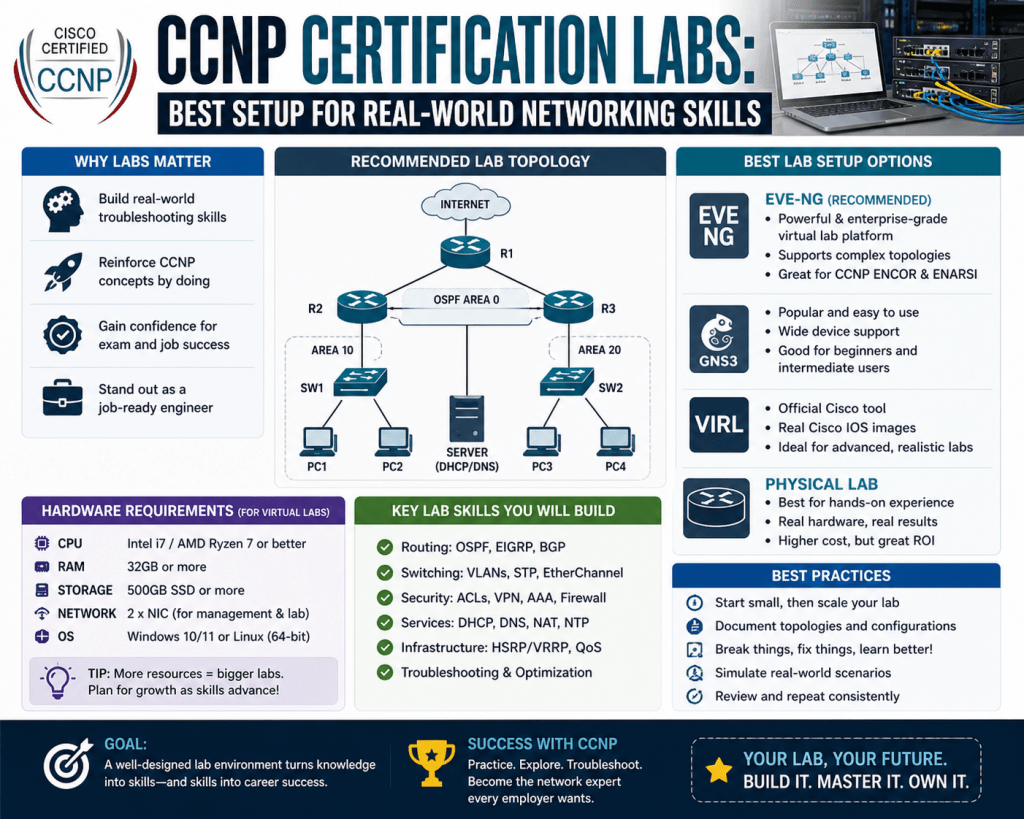
A CCNP-level lab is designed to bridge the gap between theoretical networking knowledge and real operational environments where complex enterprise systems function under continuous load and constant change. At this stage of networking development, simple configuration memorization is no longer sufficient. Instead, emphasis shifts toward understanding how protocols interact, how network layers depend on each other, and how systems respond when failures or unexpected traffic conditions occur. A structured lab environment allows repeated exposure to these conditions, helping develop both technical accuracy and troubleshooting intuition. The goal is to create a controlled but realistic ecosystem where routing decisions, switching behaviors, and service interactions can be observed and modified in real time. This transforms abstract concepts into practical skills that align closely with enterprise network operations.
Skill Expectations At The Professional Certification Level
At the professional networking level, expectations extend beyond basic configuration tasks and move into areas such as network design, scalability planning, redundancy implementation, and performance optimization. Engineers are expected to understand how enterprise networks maintain stability under load, how routing domains interact across multiple sites, and how switching architectures prevent loops while ensuring redundancy. Security awareness also becomes increasingly important, as segmentation, access control, and policy enforcement play a critical role in modern infrastructure design. A lab environment must therefore support experimentation across multiple domains, allowing learners to build, break, and rebuild network systems to observe outcomes. This iterative process strengthens analytical thinking and reinforces real-world decision-making skills required in production environments.
Core Principles Behind Effective Lab Design
An effective lab is not defined by the number of devices available but by how well those devices support structured learning objectives. The foundation of a strong lab design includes scalability, modularity, and realism. Scalability ensures that the environment can grow as learning needs evolve, allowing additional devices or services to be integrated without requiring a complete redesign. Modularity allows individual components, such as switching layers, routing segments, or service modules, to be modified independently. Realism ensures that configurations and behaviors closely resemble enterprise systems, including proper protocol behavior, failover mechanisms, and traffic handling characteristics. A well-designed lab also emphasizes repeatability, allowing scenarios to be recreated multiple times to reinforce understanding of network behavior under consistent conditions.
Physical Lab Architecture And Infrastructure Planning
A physical lab environment requires careful planning of infrastructure elements beyond just networking devices. Physical space becomes an important factor, as equipment must be arranged in a way that allows accessibility, airflow, and structured cabling. Power distribution must also be considered, ensuring that devices receive stable and uninterrupted electricity. In larger setups, power management systems may be required to prevent overloads and maintain uptime during extended study sessions. Cooling is another critical aspect, as networking equipment generates heat during continuous operation. Proper airflow management helps maintain device stability and extends hardware lifespan. In addition to physical infrastructure, attention must be given to noise levels, accessibility of ports, and ease of reconfiguration during experimentation phases.
Switching Infrastructure And Layer 2 Learning Depth
Switching devices form the foundation of most enterprise networks and therefore play a central role in lab environments. Layer 2 technologies such as VLAN segmentation, trunking, spanning tree behavior, and MAC address learning are essential concepts that require hands-on practice to fully understand. A well-structured switching setup allows learners to create segmented network zones, simulate broadcast domains, and analyze traffic flow between different segments. Spanning tree protocols are particularly important because they demonstrate how networks prevent loops while maintaining redundant paths. By modifying link states and observing convergence behavior, learners gain insight into how enterprise networks maintain stability during topology changes.
Switching environments also supports advanced concepts such as link aggregation, port security, and inter-switch communication. These features help simulate real-world enterprise networks where multiple switches operate together to form hierarchical structures. Access, distribution, and core layer concepts can be recreated within a lab to demonstrate how traffic is managed at different levels of a network architecture.
Switch Selection Strategy For Enterprise Simulation
Selecting appropriate switching devices for a lab environment requires balancing capability, compatibility, and availability. Devices should support both basic and advanced Layer 2 and Layer 3 features to ensure comprehensive learning coverage. Enterprise-grade switches typically offer support for dynamic routing protocols, advanced VLAN configurations, and hardware-based forwarding capabilities. While newer devices may offer more modern feature sets, older enterprise models can still provide sufficient functionality for most learning scenarios.
A multi-switch setup is often preferred because it enables the creation of redundant topologies and complex interconnections. This allows learners to simulate network loops, redundancy protocols, and failover scenarios. It also supports segmentation of different network roles, such as separating user traffic, management traffic, and service traffic. The ability to observe how switches interact under different configurations provides valuable insight into real-world enterprise behavior.
Routing Infrastructure And Layer 3 Learning Scenarios
Routing devices introduce the concept of inter-network communication, enabling data transfer between different network segments. At this level, learners explore routing protocols, path selection mechanisms, and policy-based routing strategies. Routing behavior is influenced by multiple factors, including administrative distance, metric calculations, and protocol convergence times. A lab environment must allow experimentation with these variables to understand how routes are selected and adjusted dynamically.
Routing scenarios also introduce WAN simulation concepts, where multiple network sites are connected through logical or physical links. This helps simulate enterprise environments where geographically distributed networks must communicate efficiently and securely. Routing devices also support advanced configuration scenarios such as route redistribution between different protocols, which is essential for complex enterprise infrastructures.
Physical Router Selection And Functional Relevance
Physical routing devices can still provide value in lab environments, particularly for understanding hardware-based processing and interface behavior. However, modern enterprise environments increasingly rely on virtualized routing functions, which replicate routing behavior through software-defined systems. Despite this shift, physical routers remain useful for foundational learning, especially when studying interface configuration, basic routing protocols, and legacy system behavior.
When selecting routing devices, it is important to ensure compatibility with relevant protocol versions and feature sets. Devices should support dynamic routing protocols, multiple interface types, and sufficient processing capability to handle simulated traffic loads. In many cases, a single routing device connected to multiple switching layers is sufficient for creating meaningful learning scenarios.
Physical Connectivity, Cabling, And Network Organization
A structured cabling system is essential for maintaining clarity and functionality within a physical lab environment. Poor cable management can lead to confusion, misconfigurations, and troubleshooting difficulties. Proper labeling, organized routing paths, and consistent connection standards help maintain a clean and manageable setup. Console connections are also important, as they provide direct access to device configuration interfaces during initial setup and recovery scenarios.
Ethernet cabling forms the backbone of most lab connections, but additional cable types may be required depending on device capabilities. Serial connections, power cables, and management interfaces all contribute to the overall structure of the lab. Maintaining consistency in cabling practices helps reduce errors and improve efficiency during configuration changes.
Network Topology Design For Realistic Simulation
Topology design plays a crucial role in determining how effectively a lab environment can simulate real-world conditions. Common designs include hierarchical structures, ring configurations, and mesh-based topologies. Each design serves a specific purpose in demonstrating network behavior. Hierarchical structures help illustrate layered communication models, while mesh configurations highlight redundancy and failover behavior. Ring structures can be used to study loop prevention mechanisms and traffic flow control.
By combining different topology types within a single lab, learners can simulate complex enterprise environments where multiple network segments operate simultaneously. This allows for a deeper understanding of how routing and switching decisions are made across interconnected systems.
Cost Planning And Resource Management Considerations
Building a physical lab requires careful consideration of cost and resource allocation. Networking equipment, power consumption, and physical space all contribute to the overall investment required. Budget planning often involves prioritizing essential devices while gradually expanding the lab over time. Used equipment markets are commonly explored to reduce costs while still obtaining functional enterprise-grade devices.
Resource management also includes planning for future expansion. As learning requirements evolve, additional devices or upgraded hardware may be needed. A flexible design approach helps accommodate these changes without requiring complete reconstruction of the lab environment.
Limitations Of Physical Lab Environments
While physical labs offer strong practical benefits, they also come with inherent limitations. Scalability is restricted by hardware availability and physical space constraints. Maintenance requirements increase as more devices are added, and hardware failures can interrupt learning continuity. Additionally, some modern networking features may not be fully supported on older physical devices, limiting exposure to newer technologies.
Despite these limitations, physical labs remain valuable for foundational skill development and hands-on experience. They provide direct interaction with networking hardware, which helps build confidence and operational familiarity that is difficult to replicate in purely theoretical or simulated environments.
Transition From Physical Labs To Software-Based Networking Environments
As networking technologies evolve, the approach to building CCNP-level lab environments has shifted significantly from purely physical setups to highly flexible software-based systems. This transition is driven by the increasing complexity of enterprise networks, the rise of virtualization technologies, and the need for scalable, cost-efficient learning environments. Software labs allow learners to simulate large-scale infrastructures without requiring extensive physical hardware investments. Instead of being limited by physical devices, learners can build dynamic topologies that include routers, switches, firewalls, and end systems operating within a virtual environment. This approach enables rapid experimentation, quick resets, and the ability to model complex enterprise scenarios that would otherwise be impractical to replicate physically.
Core Concept Of Network Virtualization In Lab Design
Network virtualization refers to the creation of simulated networking environments using software that mimics the behavior of real networking hardware. These environments allow multiple virtual devices to run on a single physical machine while maintaining independent configurations and operational logic. Virtual routers and switches behave similarly to their physical counterparts, supporting routing protocols, VLAN configurations, and interface-level operations. This abstraction allows learners to focus on configuration and design principles rather than hardware limitations. Virtualization also enables the creation of isolated environments where multiple network topologies can coexist without interference, making it ideal for repeated practice and scenario testing.
Advantages Of Software-Based CCNP Lab Environments
One of the most significant advantages of software-based labs is scalability. Users can easily increase the number of simulated devices without worrying about physical space, cabling, or power constraints. This makes it possible to simulate large enterprise networks with multiple sites, redundant paths, and complex routing domains. Another advantage is flexibility, as configurations can be saved, modified, and restored instantly. This allows learners to experiment freely without the risk of damaging physical equipment.
Software environments also support rapid scenario deployment, meaning complex topologies can be built in minutes rather than hours. This accelerates the learning process and allows for more repetition, which is critical for mastering CCNP-level concepts. Additionally, virtualization supports integration with other systems such as virtual servers, enabling full-stack network simulation that includes application traffic, authentication systems, and service dependencies.
Understanding Emulation Versus Simulation In Networking Labs
In software-based networking environments, it is important to distinguish between emulation and simulation. Emulation replicates the actual behavior of networking devices by running real operating system images, allowing configurations to behave exactly as they would on physical hardware. Simulation, on the other hand, approximates network behavior using abstract models without running real firmware. Emulation provides a higher degree of accuracy and is more suitable for CCNP-level preparation because it closely mirrors production environments. Simulation tools are often used for introductory learning, but may lack advanced feature support required for professional certification practice.
Emulation environments are particularly valuable for practicing routing protocols, switching configurations, and enterprise-grade network services. They allow learners to interact with real command-line interfaces and observe authentic device responses. This level of realism is essential for developing the troubleshooting skills required in advanced networking roles.
Virtual Network Platforms And Their Role In CCNP Preparation
Modern virtual networking platforms provide environments where learners can build complex topologies using software-defined devices. These platforms typically support routers, switches, and virtual end systems that can be interconnected to form realistic enterprise networks. Some platforms rely on virtualization technology that runs actual network operating systems, while others use container-based architectures to simulate device behavior.
These platforms allow users to design multi-layer network architectures, including access, distribution, and core layers. They also support advanced features such as dynamic routing protocols, VLAN segmentation, and policy-based routing. The ability to integrate virtual servers enables the simulation of real-world services such as DNS, DHCP, and authentication systems, making the environment more representative of enterprise infrastructure.
Building Scalable Network Topologies In Virtual Environments
One of the most powerful features of software-based labs is the ability to create scalable network topologies. Unlike physical labs, where the number of devices is limited by hardware availability, virtual environments allow for rapid expansion. Learners can build small networks for basic practice or large-scale enterprise simulations involving multiple interconnected sites.
Scalable topologies also allow for hierarchical network design, where different layers of the network serve specific functions. For example, access layers handle end-user connectivity, distribution layers manage routing and policy enforcement, and core layers provide high-speed backbone connectivity. By replicating these structures in a virtual environment, learners gain a deeper understanding of how enterprise networks are designed and maintained.
Routing Protocol Simulation In Virtual Labs
Routing protocols are a core component of CCNP-level knowledge, and virtual environments provide an ideal platform for experimenting with them. Protocols such as OSPF, EIGRP, and BGP can be configured and tested within simulated networks to observe how routing decisions are made. Learners can manipulate metrics, adjust administrative distances, and introduce network changes to see how routes are recalculated.
Virtual labs also allow for the simulation of multi-area routing environments, where different sections of a network operate under separate routing domains. This helps learners understand how large-scale networks manage routing efficiency and scalability. Additionally, route redistribution scenarios can be tested to observe how different routing protocols interact within a single infrastructure.
Switching Behavior And Layer 2 Virtual Simulation
Switching functionality in virtual environments closely mirrors physical behavior, allowing learners to practice VLAN configuration, trunking, and spanning tree protocol operations. Virtual switches support multiple interfaces and can be interconnected to simulate redundant topologies. This enables the study of loop prevention mechanisms and traffic distribution strategies.
Layer 2 simulation also allows for experimentation with MAC address learning, broadcast domain segmentation, and port-based security features. These concepts are critical for understanding how enterprise networks maintain efficiency and security at the data link layer. By adjusting configurations and observing traffic behavior, learners can develop a strong grasp of switching fundamentals.
Integration Of Virtual Servers And Network Services
A key advantage of software-based lab environments is the ability to integrate virtual servers and network services. These servers can simulate real-world applications such as web services, authentication systems, and file sharing platforms. By incorporating these elements into a network topology, learners can observe how network traffic interacts with application-layer services.
This integration also enables testing of service dependencies, such as how DNS resolution impacts application accessibility or how DHCP configurations affect network connectivity. Understanding these interactions is essential for troubleshooting complex enterprise environments where multiple systems rely on coordinated communication.
Automation And Programmability In Virtual Lab Systems
Modern networking increasingly incorporates automation and programmability, and virtual labs provide an ideal environment for exploring these concepts. Automation allows network configurations to be deployed using scripts or templates, reducing manual configuration effort and increasing consistency. Programmability enables dynamic network adjustments based on predefined rules or external inputs.
In a virtual environment, learners can experiment with configuration automation, policy deployment, and network monitoring tools. This helps develop an understanding of how large-scale networks are managed efficiently using software-driven approaches rather than manual configuration alone. These skills are increasingly important in modern enterprise environments where scalability and consistency are critical.
Performance Considerations In Virtual Networking Environments
While virtual labs offer significant flexibility, they also depend heavily on the performance of the underlying hardware. CPU, memory, and storage resources directly impact the number of devices that can be simulated simultaneously. High-performance systems are capable of running large and complex topologies, while lower-end systems may require simplified configurations.
Resource allocation must be carefully managed to ensure stable operation. Overloading a system with too many virtual devices can lead to performance degradation, affecting the accuracy of simulations. Efficient lab design involves balancing complexity with available resources to maintain smooth operation during experimentation.
Limitations Of Software-Based CCNP Lab Systems
Despite their advantages, virtual labs have certain limitations. One of the primary limitations is dependency on the host system’s performance. If the underlying hardware is insufficient, simulation quality may suffer. Additionally, some virtual environments may not perfectly replicate hardware-specific behaviors such as physical interface limitations or hardware acceleration features.
Another limitation is the learning curve associated with setting up and managing virtual environments. Proper configuration of virtual networking platforms requires technical knowledge beyond basic networking concepts. However, once configured, these environments provide highly effective learning platforms that closely mirror real-world enterprise systems.
Hybrid Lab Strategies Combining Physical And Virtual Systems
Many modern learners adopt a hybrid approach that combines physical and virtual lab environments. Physical devices are used for hands-on hardware interaction, while virtual systems are used for scalability and complex scenario simulation. This combination provides a balanced learning experience that covers both hardware familiarity and advanced network design concepts.
Hybrid environments allow learners to connect virtual networks to physical devices, creating mixed infrastructures that closely resemble enterprise setups. This enables testing of real-world scenarios where physical and virtual systems interact, providing deeper insight into modern networking architectures.
Designing A Hybrid CCNP Lab That Combines Physical And Virtual Environments
A hybrid lab approach combines the strengths of physical hardware and software-based virtualization into a single cohesive learning environment. This method is widely regarded as one of the most effective ways to prepare for CCNP-level knowledge because it reflects how modern enterprise networks are actually built. In real-world environments, networks are rarely purely physical or purely virtual. Instead, they are mixed infrastructures where physical switches and routers interact with virtual machines, cloud-based services, and software-defined networking components. A hybrid lab replicates this reality by allowing learners to configure physical devices while simultaneously integrating virtual routers, virtual switches, and simulated services running on a host system.
The main advantage of this approach is flexibility. Physical devices provide hands-on experience with hardware behavior, cabling, interface management, and real-world troubleshooting. Virtual systems provide scalability, rapid deployment, and the ability to simulate large enterprise architectures without requiring additional physical equipment. When combined, these two environments create a powerful learning platform that supports both foundational skill-building and advanced scenario testing. Learners can connect physical switches to virtual routers, simulate branch office connectivity, or integrate virtual servers into a physical network topology to study service interaction.
Advanced Network Topology Design For Enterprise-Level Simulation
At the CCNP level, network topologies become significantly more complex than simple point-to-point or small segmented networks. Enterprise environments often include multi-layer architectures, redundant paths, distributed routing domains, and service segmentation across multiple locations. Designing advanced topologies in a lab environment helps develop a deeper understanding of how large-scale networks operate under real-world conditions.
One common approach is to build hierarchical network structures consisting of access, distribution, and core layers. The access layer handles end-user connectivity, the distribution layer manages policy enforcement and routing decisions, and the core layer provides high-speed transport across the network. By replicating this structure in a lab environment, learners can study how traffic flows between different layers and how design decisions impact performance and reliability.
Another important topology concept is redundancy design. Enterprise networks must remain operational even in the event of link or device failure. This is achieved through multiple pathways, failover mechanisms, and dynamic routing protocols. In a lab environment, redundancy can be tested by intentionally disabling links or devices and observing how the network responds. This helps develop an understanding of convergence behavior, failover timing, and traffic rerouting strategies.
Enterprise Routing Strategy Simulation And Traffic Engineering
Routing is one of the most critical components of CCNP-level knowledge, and advanced lab environments allow for detailed exploration of routing behavior under various conditions. Enterprise routing is not simply about connecting networks; it involves designing efficient paths, optimizing traffic flow, and ensuring stability under changing conditions.
In a lab environment, multiple routing protocols can be deployed simultaneously to simulate real-world enterprise complexity. Internal gateway protocols handle communication within an organization, while external routing protocols manage connectivity between different organizations or service providers. Learners can configure route redistribution scenarios to study how different routing domains exchange information and how routing loops or inefficiencies can be avoided.
Traffic engineering is another important concept that can be explored in advanced labs. This involves controlling the path that network traffic takes based on performance, policy, or cost considerations. By adjusting routing metrics, administrative distances, and policy-based routing rules, learners can observe how traffic flows change dynamically. This provides insight into how enterprise networks maintain performance and reliability under varying conditions.
Advanced Switching Architectures And Layer 2 Optimization Techniques
Switching remains a fundamental component of CCNP-level networking, and advanced lab environments provide opportunities to explore complex Layer 2 architectures. In enterprise networks, switching is not limited to simple VLAN segmentation. It also involves redundancy mechanisms, loop prevention, load balancing, and secure access control.
Spanning tree behavior plays a critical role in ensuring network stability. By configuring redundant switch connections in a lab environment, learners can observe how spanning tree protocols prevent loops while maintaining backup paths. Adjusting bridge priorities, port roles, and link costs allows for detailed experimentation with topology control and failover behavior.
Layer 2 optimization techniques, such as link aggregation, also play an important role in modern networks. These techniques combine multiple physical links into a single logical connection, increasing bandwidth and providing redundancy. In a lab environment, learners can configure and test these mechanisms to understand how traffic distribution and fault tolerance are achieved at the data link layer.
Security Integration In Advanced CCNP Lab Environments
Security is deeply integrated into modern networking and is an essential part of CCNP-level knowledge. Advanced lab environments allow learners to simulate enterprise security architectures, including access control policies, segmentation strategies, and threat mitigation techniques.
Network segmentation is one of the primary security strategies used in enterprise environments. By dividing networks into smaller logical segments, organizations can control traffic flow and reduce the impact of potential security breaches. In a lab environment, VLANs and routing policies can be used to simulate segmentation strategies and study how traffic is controlled between different network zones.
Access control mechanisms can also be implemented to restrict communication between devices or networks. This includes configuring filtering rules, authentication mechanisms, and policy enforcement systems. By testing different configurations, learners can observe how security policies affect network connectivity and performance.
Integration Of Voice, Collaboration, And Real-Time Communication Systems
Modern enterprise networks often support real-time communication services such as voice and video applications. These systems introduce additional requirements such as low latency, minimal jitter, and high reliability. In a CCNP-level lab environment, these requirements can be simulated using specialized configurations and service integrations.
Voice traffic behaves differently from standard data traffic and requires prioritization within the network. Quality of service mechanisms are used to ensure that voice packets are transmitted with minimal delay. In a lab environment, learners can configure traffic prioritization rules and observe how voice communication quality changes under different network conditions.
Collaboration systems also introduce additional complexity by requiring integration with directory services, authentication systems, and centralized communication platforms. These systems can be simulated using virtual servers and network services within a lab environment, allowing learners to study how communication flows are managed across enterprise infrastructures.
Network Automation And Programmability In Modern Lab Environments
Automation has become a key component of modern networking, and CCNP-level preparation increasingly includes exposure to programmable network systems. Automation allows network configurations to be deployed consistently and efficiently across multiple devices without manual intervention. This reduces configuration errors and improves scalability in enterprise environments.
In a lab environment, automation concepts can be explored by simulating configuration deployment, policy enforcement, and system monitoring. Learners can study how automated systems interact with network devices and how changes propagate across the infrastructure. This includes understanding how configuration templates are applied and how network states are maintained dynamically.
Programmability also allows networks to respond to external inputs or system conditions. For example, network behavior can be adjusted based on traffic patterns or performance metrics. In a lab environment, these concepts can be explored through simulated monitoring and control systems that adjust configurations in real time.
Performance Optimization And Resource Management In Complex Labs
As lab environments become more complex, performance optimization becomes increasingly important. Both physical and virtual components consume system resources, and proper management is required to ensure stable operation. In virtual environments, CPU, memory, and storage resources must be allocated efficiently to support multiple simulated devices. In physical environments, power, cooling, and hardware limitations must be considered.
Optimizing lab performance involves balancing complexity with available resources. Large-scale simulations may need to be broken into smaller segments to ensure smooth operation. Efficient topology design also helps reduce unnecessary resource consumption while still providing meaningful learning experiences.
Troubleshooting Methodologies In Advanced Network Labs
Troubleshooting is one of the most valuable skills developed through CCNP-level lab practice. Advanced lab environments allow learners to introduce controlled failures and observe system responses. This includes disabling links, misconfiguring routing protocols, or altering switching behavior to simulate real-world network issues.
Effective troubleshooting requires a structured approach that includes identifying symptoms, isolating the problem, and testing potential solutions. By practicing these steps in a lab environment, learners develop the ability to quickly diagnose and resolve network issues. This skill is essential in enterprise environments where downtime and performance degradation can have significant operational impacts.
Long-Term Skill Development Through Continuous Lab Practice
A CCNP-level lab is not a one-time setup but an evolving learning environment that grows alongside the learner’s skills. Continuous experimentation, scenario building, and configuration testing help reinforce knowledge and build confidence. Over time, learners develop an intuitive understanding of how networks behave under different conditions, which is essential for real-world engineering roles.
By regularly updating lab configurations, introducing new scenarios, and revisiting foundational concepts, learners maintain a strong technical foundation while also adapting to evolving networking technologies. This continuous learning approach ensures long-term skill development and prepares individuals for complex enterprise networking challenges.
Conclusion
A CCNP-level lab environment, whether physical, virtual, or hybrid, represents far more than a simple study setup. It is a structured learning ecosystem designed to transform theoretical networking concepts into practical engineering skills. The central idea remains consistent: real mastery of enterprise networking cannot be achieved through passive reading or memorization alone. It requires repeated exposure to real configurations, controlled experimentation with network behavior, and continuous problem-solving under realistic conditions.
At its core, the purpose of building a CCNP lab is to simulate the complexity of modern enterprise networks in a manageable and repeatable way. Enterprise networks today are no longer simple collections of routers and switches. They are layered, distributed, and heavily integrated systems that combine routing, switching, security, automation, and application services. A well-designed lab reflects this complexity in a controlled environment where mistakes become learning opportunities rather than operational risks. This ability to safely experiment is what makes lab environments essential for professional-level certification preparation.
One of the most important insights from exploring different lab approaches is that there is no single “best” setup. Each method offers distinct advantages depending on learning goals, budget, and available resources. Physical labs provide tactile, real-world experience with hardware behavior, cabling, and device-level troubleshooting. They reinforce discipline and precision because changes are permanent and require careful planning. However, they are limited by cost, space, and scalability.
On the other hand, software-based lab environments introduce flexibility and scale that physical systems cannot match. Virtualized networks allow rapid deployment of complex topologies, instant resets, and near-unlimited expansion. They make it possible to simulate large enterprise infrastructures on a single machine, including routing domains, switching architectures, and integrated services. This makes them especially powerful for iterative learning and scenario-based practice.
The hybrid approach brings both worlds together and, in many ways, represents the most realistic preparation method. By combining physical devices with virtual systems, learners can replicate modern enterprise environments more accurately. Physical switches can handle real Layer 2 behavior, while virtual routers simulate scalable routing domains. Virtual servers can provide application services, while physical infrastructure maintains real-world hardware interaction. This combination mirrors how real enterprise networks are built today, where on-premises infrastructure and virtualized systems coexist and interact continuously.
Another key takeaway is that effective CCNP preparation depends more on how the lab is used than on how advanced the equipment is. A simple lab, when used correctly, can be more effective than a complex one used passively. The value comes from structured practice: building topologies, breaking them intentionally, troubleshooting failures, and rebuilding configurations from scratch. This cycle of construction and deconstruction develops a deep understanding of protocol behavior, system dependencies, and network logic.
Understanding routing and switching at the CCNP level requires moving beyond surface-level configuration knowledge. It involves understanding why protocols behave the way they do, how convergence occurs under different conditions, and how network decisions are influenced by metrics, policies, and topology design. A lab environment provides the only reliable way to observe these behaviors directly. For example, adjusting routing metrics and observing path changes reveals how dynamic routing systems respond to network conditions. Similarly, modifying switching topologies and observing loop prevention mechanisms demonstrates how stability is maintained in Layer 2 environments.
Security and service integration further expand the importance of lab environments. Modern networks are not isolated systems; they support voice, video, cloud services, authentication systems, and security enforcement layers. Each of these components introduces additional complexity that must be understood in context. A lab allows these systems to be integrated and tested together, showing how changes in one layer affect others. For instance, applying access control policies can influence application availability, while routing changes can impact service reachability.
Automation and programmability represent another major shift in networking practice. Traditional manual configuration methods are no longer sufficient for large-scale enterprise environments. Instead, networks are increasingly managed through automated systems and programmable interfaces. A lab environment provides a safe space to explore these concepts without risk. By experimenting with automated configuration deployment or policy-based network adjustments, learners begin to understand how modern infrastructures are managed at scale. This knowledge is becoming increasingly important for professional-level networking roles.
Performance management also plays a critical role in lab design and usage. Whether using physical or virtual systems, resource limitations must be understood and managed effectively. Physical labs require careful attention to power, cooling, and hardware capacity, while virtual labs depend on CPU, memory, and storage allocation. Understanding these constraints helps build realistic expectations of system behavior and ensures stable lab performance during complex simulations.
Troubleshooting remains one of the most valuable skills developed through lab practice. Real-world network issues rarely present themselves in obvious ways. Instead, they often appear as subtle performance degradation, intermittent connectivity problems, or protocol inconsistencies. A lab allows these conditions to be recreated intentionally, providing an opportunity to practice structured diagnosis and resolution techniques. Over time, this builds confidence and speed in identifying root causes, which is essential in professional environments where downtime must be minimized.
Ultimately, the effectiveness of any CCNP lab depends on consistency and engagement. A lab is not a static setup but an evolving learning environment that grows alongside the learner’s knowledge. Regular practice, continuous experimentation, and gradual complexity increases ensure steady skill development. Revisiting foundational concepts while introducing advanced scenarios helps reinforce understanding and prevents knowledge gaps.
The journey toward CCNP-level expertise is not defined by a single tool or setup but by the discipline applied within the learning environment. Whether using physical devices, virtual platforms, or a combination of both, the key is to maintain an active, hands-on approach. Networking is a field built on real systems and real behavior, and only through direct interaction with those systems can true understanding be achieved. A well-constructed lab becomes not just a study tool but a long-term environment for continuous growth, exploration, and professional development.