Virtualization has become one of the most important foundations of modern information technology infrastructure. It enables organizations to run multiple independent computing environments on a single physical machine, improving efficiency, scalability, and resource utilization. In earlier enterprise systems, each application often required dedicated hardware, which led to significant underutilization of server capacity and increased operational costs. Virtualization solved this challenge by introducing abstraction layers that allow computing resources to be shared dynamically across multiple workloads. Over time, this technology has evolved from a cost-saving innovation into a strategic enabler of digital transformation. Today, virtualization supports everything from enterprise applications and databases to cloud-native systems and distributed workloads. Its role continues to expand as organizations move toward more flexible, software-defined infrastructures that prioritize agility and automation over rigid hardware dependencies.
How Virtualization Transformed Data Center Infrastructure
The transformation of data center infrastructure through virtualization has been one of the most significant shifts in enterprise computing. Traditional data centers relied heavily on physical servers, each dedicated to a specific task or application. This approach created inefficiencies, as many servers operated below their full capacity while still consuming power, space, and maintenance resources. Virtualization introduced a new model where multiple virtual machines could operate on a single physical server, each running independently with its own operating system and applications. This innovation dramatically improved hardware utilization and reduced the need for large physical infrastructures. As a result, organizations were able to consolidate their server environments, reduce energy consumption, and streamline IT operations. Over time, data centers evolved into highly optimized virtual environments where computing resources could be allocated dynamically based on demand. This shift also improved disaster recovery capabilities, as virtual machines could be easily replicated, migrated, and restored across different systems without requiring physical hardware changes.
Core Components of Virtualization Technology
Virtualization technology is built upon several essential components that work together to create isolated computing environments. At the core of this system is the hypervisor, which acts as an intermediary layer between physical hardware and virtual machines. The hypervisor is responsible for allocating resources such as CPU, memory, and storage to each virtual environment while ensuring that they operate independently without interference. There are different types of hypervisors, including those that run directly on hardware and those that operate within a host operating system. Each type serves specific use cases depending on performance requirements and infrastructure design. Another critical component is the virtual machine itself, which functions as a fully operational computer system within a virtualized environment. These machines can run different operating systems and applications, making them highly flexible for enterprise use. Additionally, virtual networking and storage systems play a key role in ensuring communication between virtual machines and efficient data management. Together, these components create a unified ecosystem that enables scalable and efficient computing environments.
On-Premise Virtualization Environments and Their Role
Despite the growing adoption of cloud computing, on-premise virtualization environments remain a vital part of enterprise IT infrastructure. Many organizations continue to rely on internal data centers to maintain control over sensitive data, comply with regulatory requirements, and support legacy systems. On-premise virtualization allows businesses to manage their own hardware while still benefiting from the flexibility and efficiency of virtual machines. These environments are typically designed to support critical business applications that require high performance, low latency, and strict security controls. IT teams managing on-premise systems are responsible for configuring virtual machines, allocating resources, monitoring performance, and ensuring system stability. They also implement backup strategies and disaster recovery plans to protect against data loss and system failures. While cloud adoption continues to grow, on-premise virtualization remains essential for industries that require dedicated infrastructure and strict data governance policies. This balance between physical control and virtual efficiency continues to shape enterprise IT strategies.
Shift Toward Hybrid and Cloud-Based Virtualization
The evolution of virtualization has led to the widespread adoption of hybrid and cloud-based environments. Hybrid virtualization combines on-premise infrastructure with cloud resources, allowing organizations to distribute workloads across multiple platforms. This approach provides greater flexibility, as businesses can scale resources up or down depending on demand while maintaining control over critical systems. Cloud-based virtualization extends this concept further by delivering computing resources over the internet, eliminating the need for physical hardware management in many cases. In these environments, virtual machines, storage systems, and networking components are fully managed through software interfaces. This shift has enabled organizations to deploy applications faster, improve global accessibility, and reduce infrastructure overhead. Hybrid models are particularly valuable because they allow businesses to transition gradually from traditional systems to cloud-native architectures. They also support workload mobility, enabling applications to move between environments without disruption. As digital transformation continues, hybrid virtualization is becoming the standard model for enterprise infrastructure design.
Key Skills Required for Virtualization Professionals
Professionals working in virtualization environments must develop a broad set of technical and analytical skills. A strong understanding of operating systems is essential, as virtual machines often run multiple platforms simultaneously. Knowledge of networking is equally important, as virtual environments rely on complex network configurations to enable communication between systems. Storage management skills are also critical, particularly in environments where data is distributed across multiple virtual machines and storage systems. In addition to technical expertise, virtualization professionals must understand system performance optimization, capacity planning, and resource allocation strategies. Security awareness is another key requirement, as virtual environments introduce unique vulnerabilities that must be managed carefully. Automation and scripting skills are increasingly important as organizations adopt software-defined infrastructure models. These skills allow professionals to streamline repetitive tasks, improve system efficiency, and support large-scale deployments. Overall, virtualization roles require a combination of technical depth, problem-solving ability, and adaptability to evolving technologies.
Importance of Structured Certification Pathways
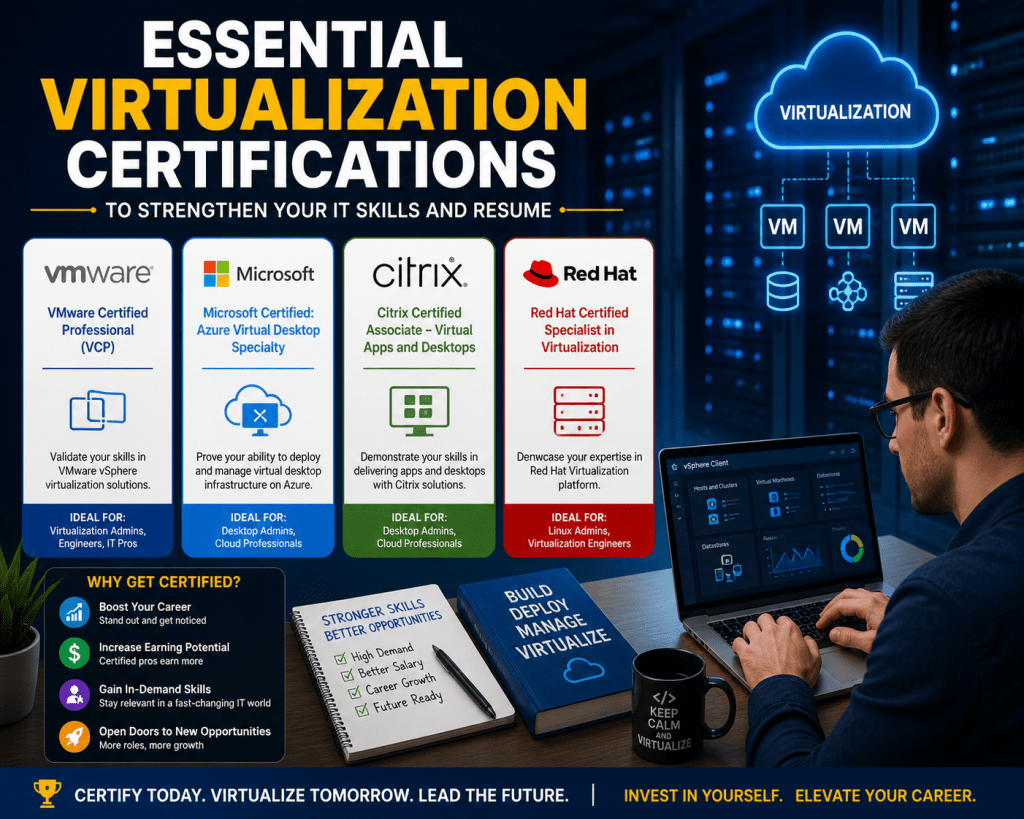
Structured certification pathways play a significant role in helping IT professionals develop and validate virtualization expertise. As virtualization technologies become more complex, certifications provide a standardized way to demonstrate knowledge across different systems and environments. These structured learning paths typically cover foundational concepts such as virtual machine management, networking, storage configuration, and system security. They also extend into advanced topics such as hybrid infrastructure design, automation, and cloud integration. Certification programs help professionals build a progressive skill set, starting from basic virtualization principles and advancing toward specialized roles in infrastructure engineering, system architecture, and cloud operations. For employers, certifications serve as a benchmark for evaluating technical competence and ensuring that candidates possess relevant skills for enterprise environments. For individuals, they provide a clear roadmap for career development in a highly competitive industry. As virtualization continues to evolve, structured learning remains an essential component of professional growth and long-term success in IT infrastructure roles.
Rise of Cloud-Centric Virtualization and Its Enterprise Impact
The evolution of virtualization has accelerated significantly with the rise of cloud computing, fundamentally changing how organizations design, deploy, and manage IT infrastructure. Cloud-centric virtualization extends traditional virtualization principles by delivering computing resources over distributed cloud environments rather than relying solely on local data centers. This shift allows enterprises to access scalable infrastructure on demand while reducing dependency on physical hardware. Cloud platforms use virtualization at their core to create isolated environments for applications, storage, and networking services. These virtualized resources can be provisioned dynamically, enabling organizations to scale operations based on workload requirements. As businesses adopt digital-first strategies, cloud-based virtualization has become essential for supporting global operations, remote accessibility, and continuous service availability. This transformation has also enabled faster innovation cycles, as development and deployment processes are no longer constrained by physical infrastructure limitations.
Understanding Hybrid Virtualization Architectures in Modern IT Systems
Hybrid virtualization represents a strategic approach where organizations combine on-premise infrastructure with cloud-based systems to create a unified computing environment. This model allows businesses to maintain critical workloads locally while leveraging cloud resources for scalability, redundancy, and advanced computing capabilities. Hybrid architectures are designed to ensure seamless integration between different environments, enabling workloads to move efficiently across platforms without disruption. This requires synchronization of identity management systems, consistent network configurations, and unified security policies. One of the key advantages of hybrid virtualization is operational flexibility, as organizations can choose the most efficient environment for each workload based on performance, cost, and compliance requirements. It also enhances disaster recovery capabilities by allowing workloads to be replicated across geographically distributed environments. As enterprise IT systems become more complex, hybrid virtualization has emerged as a preferred model for balancing control, performance, and scalability.
Role of Microsoft Ecosystem in Hybrid Virtualization Environments
Microsoft-based infrastructure plays a major role in shaping hybrid virtualization strategies across enterprise environments. Many organizations rely on Microsoft technologies for identity management, server administration, and cloud integration. In hybrid setups, on-premise systems are often connected with cloud services to extend functionality and improve operational efficiency. This integration enables centralized management of resources while maintaining compatibility across different environments. Virtualization within Microsoft ecosystems involves managing virtual machines, configuring server roles, and ensuring secure communication between local and cloud-based systems. It also includes implementing directory services that synchronize user identities and access controls across platforms. This ensures that users can access applications and data seamlessly, regardless of where the resources are hosted. As organizations continue to adopt hybrid strategies, Microsoft-based virtualization skills remain highly relevant for system administrators, cloud engineers, and infrastructure specialists working in enterprise environments.
Importance of AWS in Virtualized Cloud Infrastructure
Amazon Web Services has established itself as a dominant force in cloud computing, offering a wide range of services built on virtualization technology. AWS provides scalable computing resources that allow organizations to deploy virtual machines, storage systems, and networking components without managing physical hardware. Virtualization in AWS environments is designed to support elasticity, enabling resources to expand or contract based on demand. This is particularly beneficial for businesses with fluctuating workloads or seasonal traffic patterns. AWS virtualization also supports automation, allowing infrastructure to be managed through programmable interfaces and infrastructure-as-code methodologies. This reduces manual configuration efforts and improves deployment consistency. In addition to compute services, AWS offers virtualization-based solutions for databases, analytics, machine learning, and application hosting. The ability to integrate these services into a unified ecosystem makes AWS a powerful platform for enterprise-grade virtualization deployments.
Cloud Operations and Virtual Machine Lifecycle Management in AWS Environments
Managing virtual machines in cloud environments involves a structured lifecycle that includes provisioning, configuration, monitoring, scaling, and decommissioning. In AWS environments, virtual machines are created and managed as instances that can be customized based on performance and storage requirements. These instances operate within virtual networks that define communication pathways, security boundaries, and access controls. Lifecycle management ensures that resources are used efficiently and that unnecessary workloads are terminated when no longer required. Monitoring tools provide real-time insights into system performance, helping administrators identify bottlenecks, optimize resource usage, and maintain operational stability. Automated scaling features allow systems to adjust capacity dynamically based on traffic demands, ensuring consistent performance during peak usage periods. Effective virtual machine management is essential for maintaining cost efficiency and system reliability in large-scale cloud environments.
Networking, Virtualization, and Software-Defined Infrastructure Models
Networking virtualization is a critical component of modern IT infrastructure, enabling organizations to abstract network functions from physical hardware. This approach allows network configurations to be managed through software-defined systems, providing greater flexibility and control. Virtual networks can be created, modified, and scaled independently of physical infrastructure, making it easier to adapt to changing business requirements. Software-defined networking models allow administrators to automate network configuration, improve traffic management, and enhance security enforcement. These systems are particularly useful in cloud and hybrid environments where multiple virtual machines and services must communicate across distributed locations. Networking virtualization also supports segmentation, which isolates different workloads to improve security and performance. As enterprise environments become more complex, software-defined infrastructure models are becoming essential for managing large-scale virtual networks efficiently.
Cisco’s Role in Virtualized Networking and Infrastructure Automation
Cisco has played a significant role in shaping modern networking and virtualization technologies. Its solutions extend beyond traditional networking hardware to include advanced virtualization, automation, and infrastructure management capabilities. Cisco environments often integrate networking devices with virtualized systems, enabling seamless communication between physical and virtual components. This integration supports enterprise-grade scalability and reliability, particularly in large data center environments. Cisco technologies also emphasize network automation, allowing administrators to configure and manage complex systems through programmable interfaces. This reduces manual intervention and improves operational efficiency. Virtualized networking within Cisco ecosystems supports dynamic routing, load balancing, and security enforcement across distributed systems. These capabilities make Cisco-based virtualization highly valuable in enterprise environments where network performance and reliability are critical.
Automation and Orchestration in Virtualized Environments
Automation has become a fundamental aspect of modern virtualization systems, enabling organizations to streamline operations and reduce manual workload. In virtualized environments, automation is used to manage tasks such as provisioning virtual machines, configuring networks, and deploying applications. Orchestration takes automation a step further by coordinating multiple automated processes across different systems and platforms. This ensures that complex workflows are executed efficiently and consistently. Automation also improves scalability by allowing systems to respond dynamically to changing demands without human intervention. In cloud and hybrid environments, automation tools are often used to manage infrastructure as code, enabling version-controlled and repeatable deployments. This approach enhances reliability, reduces configuration errors, and accelerates deployment cycles. As virtualization systems continue to evolve, automation and orchestration are becoming essential components of enterprise IT operations.
Security Considerations in Virtualized Cloud Environments
Security plays a critical role in virtualization, particularly in cloud and hybrid environments where resources are distributed across multiple platforms. Virtualized systems introduce unique security challenges, including isolation vulnerabilities, unauthorized access risks, and configuration inconsistencies. To address these challenges, organizations implement layered security strategies that include identity management, network segmentation, encryption, and continuous monitoring. Virtual machines must be protected both at the hypervisor level and within individual operating systems. Access controls ensure that only authorized users can interact with virtual resources, while monitoring systems detect suspicious activity in real time. Cloud environments also rely heavily on automated security policies that enforce compliance across distributed systems. As virtualization becomes more integrated with cloud infrastructure, security frameworks must evolve to address increasingly complex threat landscapes while maintaining operational efficiency.
Growing Demand for Multi-Platform Virtualization Expertise
The expansion of virtualization across multiple platforms has created a strong demand for professionals who can work across diverse environments. Organizations no longer rely on a single virtualization technology but instead use a combination of on-premise, cloud-based, and hybrid systems. This requires IT professionals to understand multiple platforms, tools, and architectural models. Multi-platform expertise includes knowledge of different hypervisors, cloud services, networking systems, and automation frameworks. Professionals must also be capable of integrating these systems into cohesive infrastructure solutions. This demand has led to increased emphasis on cross-platform certification paths and practical experience in real-world environments. As enterprises continue to adopt complex virtualization strategies, the need for adaptable and multi-skilled professionals will continue to grow across the IT industry.
Cisco-Based Virtualization and Network-Driven Infrastructure Evolution
Modern virtualization environments are no longer limited to server consolidation or cloud computing alone. They now extend deeply into networking, where infrastructure is increasingly defined by software-driven intelligence rather than fixed hardware configurations. Cisco has played a central role in this transformation by integrating virtualization concepts into networking systems, enterprise data centers, and service provider architectures. This shift allows organizations to build highly scalable and automated environments where networking, computing, and storage resources operate as unified systems. In these environments, virtualization is not just about running multiple operating systems on a single server but about enabling entire networks to behave as programmable entities. This approach supports dynamic routing, automated traffic management, and intelligent resource allocation across large-scale enterprise infrastructures. As digital ecosystems grow more complex, Cisco-driven virtualization continues to influence how organizations design resilient and high-performance network architectures.
Software-Defined Networking and Virtualized Network Control
Software-defined networking has become a critical pillar of modern virtualization strategies. It separates the control plane from the data plane, allowing administrators to manage network behavior through centralized software systems rather than individual hardware devices. This abstraction makes it possible to configure, monitor, and optimize network traffic in real time across distributed environments. Virtualized networking environments benefit significantly from this approach, as they can dynamically adjust to changing workloads and application demands. Instead of manually configuring each network device, administrators can deploy policies that automatically govern traffic flow, security rules, and bandwidth allocation. This level of control is essential in large-scale cloud and hybrid environments where thousands of virtual machines may be communicating simultaneously. Software-defined networking also enhances security by enabling micro-segmentation, which isolates workloads and reduces the attack surface within virtual environments. As enterprises continue to expand their digital infrastructure, SDN has become a foundational element of virtualization-based networking strategies.
Automation and Infrastructure as Code in Virtualized Systems
Automation has become deeply embedded in virtualization environments, fundamentally changing how infrastructure is deployed and managed. Instead of manually configuring servers, networks, and storage systems, organizations now rely on automation frameworks that execute predefined instructions across virtual environments. Infrastructure as code is a key concept within this transformation, allowing infrastructure configurations to be written, stored, and executed as machine-readable definitions. This approach ensures consistency, repeatability, and scalability across complex environments. Virtual machines, networks, and storage systems can be provisioned automatically based on predefined templates, significantly reducing deployment time. Automation also plays a crucial role in system maintenance, enabling patch management, scaling operations, and performance optimization without manual intervention. In large enterprise environments, orchestration systems coordinate multiple automated processes to ensure that infrastructure behaves predictably under varying workloads. This level of automation is essential for maintaining efficiency in modern virtualization ecosystems where manual management would be too slow and error-prone.
Cloud Security Architecture in Virtualized Environments
Security remains one of the most critical and continuously evolving aspects of virtualization, particularly as organizations expand their infrastructure across cloud and hybrid environments. Virtualized systems introduce multiple abstraction layers, which increase flexibility but also expand the potential attack surface. Unlike traditional infrastructure, where security boundaries are often physical, virtualization requires security enforcement across software-defined layers that include hypervisors, virtual machines, virtual networks, storage systems, and application interfaces. This multi-layered structure demands a comprehensive and coordinated security architecture that ensures protection at every level of the environment.
Cloud security architecture in virtualized systems is designed around the principle of layered defense, where each component is secured independently while contributing to overall system integrity. Identity and access management play a foundational role by ensuring that only authenticated and authorized users can access virtual resources. This includes role-based access control mechanisms that limit permissions based on job functions, reducing the risk of unauthorized changes or data exposure. In addition, strong authentication systems, including multi-factor authentication, help prevent credential-based attacks that are common in distributed environments.
Encryption is another essential component of virtualization security. Data must be protected both at rest and in transit to prevent interception or unauthorized access. In virtualized environments, data often moves between physical hosts, storage systems, and cloud platforms, making encryption a critical safeguard. Modern systems implement automated encryption protocols that secure data without affecting performance, ensuring that security does not become a bottleneck in system operations.
Network segmentation further strengthens security by dividing virtual environments into isolated zones. This prevents lateral movement, meaning that even if one virtual machine is compromised, the attacker cannot easily access other systems within the same environment. Micro-segmentation, in particular, has become increasingly important in cloud-native architectures, where workloads are highly dynamic and distributed across multiple nodes.
Continuous monitoring and threat detection systems provide real-time visibility into virtual environments. These systems analyze logs, network traffic, and system behavior to identify anomalies that may indicate security threats. Artificial intelligence and machine learning are increasingly being integrated into monitoring tools to improve detection accuracy and reduce response times. As virtualization continues to expand across cloud platforms, security frameworks must constantly evolve to address new vulnerabilities while maintaining operational efficiency and system performance.
Virtualization in Multi-Cloud Ecosystems and Distributed Computing
Multi-cloud environments have emerged as a dominant strategy for organizations seeking resilience, flexibility, and optimized performance across diverse computing platforms. Instead of relying on a single cloud provider, enterprises now distribute workloads across multiple cloud infrastructures to avoid vendor lock-in, improve redundancy, and enhance global service availability. Virtualization is the core technology that enables this approach by abstracting computing resources and making them portable across different environments.
In multi-cloud systems, virtualization allows workloads to operate consistently regardless of the underlying infrastructure. Virtual machines, containers, and application environments can be deployed across different cloud platforms while maintaining uniform functionality. This level of abstraction ensures that applications are not tied to a specific provider’s hardware or architecture. As a result, organizations can optimize workload placement based on performance requirements, cost efficiency, compliance regulations, and geographic proximity to end users.
Distributed computing further enhances multi-cloud virtualization by enabling workloads to be processed across multiple virtual environments simultaneously. This approach improves processing efficiency, reduces latency, and increases system resilience. Large-scale applications can be divided into smaller tasks that are executed across different virtual nodes, allowing for parallel processing and faster execution times. This is particularly beneficial for data-intensive operations such as analytics, machine learning, and real-time transaction processing.
Another important advantage of multi-cloud virtualization is disaster recovery capability. By replicating workloads across geographically distributed cloud environments, organizations can ensure business continuity even in the event of a regional outage or system failure. Virtualization enables rapid workload migration and restoration, minimizing downtime and reducing operational risk.
However, managing multi-cloud environments introduces complexity, particularly in terms of orchestration and interoperability. Advanced management systems are required to coordinate resources across different platforms, ensuring consistent performance and security policies. These systems must also handle differences in architecture, APIs, and service models across cloud providers. Despite these challenges, multi-cloud virtualization continues to grow as organizations prioritize resilience, scalability, and strategic flexibility in their IT infrastructure.
Role of Advanced Virtualization Certifications in IT Career Growth
Virtualization certifications have become a key driver of professional development in the IT industry, offering structured pathways for individuals to build and validate their technical expertise. As virtualization technologies become more sophisticated and widely adopted across cloud, hybrid, and enterprise environments, certification programs play a critical role in bridging the gap between theoretical knowledge and practical implementation.
These certifications typically cover a broad range of technical domains, including system administration, network virtualization, cloud integration, infrastructure automation, and security management. They are designed to equip professionals with the skills needed to manage complex virtual environments that span multiple platforms and technologies. In addition to foundational concepts, advanced certification paths often include real-world scenarios that test problem-solving abilities, system design skills, and troubleshooting expertise.
For employers, virtualization certifications serve as a trusted benchmark for evaluating candidate competency. They assure that professionals possess the necessary skills to manage enterprise-grade infrastructure systems. For individuals, certifications offer a structured roadmap for career advancement, enabling progression from entry-level roles to specialized positions such as cloud architect, infrastructure engineer, or systems consultant.
As the IT landscape continues to evolve, certification programs are increasingly focusing on multi-platform expertise and hybrid infrastructure management. This reflects the growing demand for professionals who can operate seamlessly across on-premise systems, cloud platforms, and distributed environments. In addition, certifications are placing greater emphasis on automation, orchestration, and security, ensuring that professionals are prepared for the demands of modern IT ecosystems.
Enterprise Demand for Hybrid Infrastructure Specialists
The increasing complexity of enterprise IT environments has created a strong and sustained demand for hybrid infrastructure specialists. These professionals are responsible for designing, implementing, and managing systems that integrate on-premise infrastructure with cloud-based platforms. Their role is essential in ensuring that organizations achieve a balance between performance efficiency, cost optimization, security compliance, and operational flexibility.
Hybrid infrastructure specialists must possess a deep understanding of virtualization technologies, networking systems, cloud service architectures, and security frameworks. They are responsible for ensuring that workloads can move seamlessly between environments without disruption. This includes managing workload migration, synchronizing data across platforms, and maintaining consistent performance across distributed systems.
One of the key challenges in hybrid environments is ensuring interoperability between different technologies and platforms. Specialists must design infrastructure that can support diverse operating systems, hypervisors, and cloud services while maintaining a unified operational framework. This requires not only technical expertise but also strategic planning and architectural design skills.
Security is another critical responsibility in hybrid infrastructure management. Specialists must implement policies that protect data across all environments, including encryption, identity management, and network segmentation. They must also ensure compliance with regulatory requirements that may vary across regions and industries.
As organizations continue to adopt hybrid strategies, the demand for skilled professionals in this area is expected to grow significantly. Hybrid infrastructure specialists are becoming essential to digital transformation initiatives, enabling organizations to modernize their IT systems while maintaining stability and control.
Future Direction of Virtualization Technologies in Enterprise IT
Virtualization is expected to continue evolving rapidly alongside advancements in artificial intelligence, edge computing, and automation technologies. Future virtualization systems will be more intelligent, adaptive, and autonomous, capable of managing complex infrastructures with minimal human intervention. Artificial intelligence will play a central role in optimizing resource allocation, predicting system demand, and automating infrastructure operations. This will significantly improve efficiency and reduce operational overhead in large-scale environments.
Edge computing will further extend virtualization closer to data sources, enabling real-time processing and reducing latency for time-sensitive applications. This will be particularly important for industries such as healthcare, autonomous systems, financial trading, and industrial automation, where milliseconds can impact outcomes. Virtualization at the edge will allow organizations to deploy lightweight, distributed computing environments that operate independently while remaining connected to central systems.
Additionally, virtualization is expected to become more tightly integrated with containerization technologies, enabling even greater flexibility in application deployment. This convergence will support microservices architectures, where applications are broken into smaller, independently deployable components. As a result, organizations will be able to innovate faster, scale more efficiently, and improve system resilience.
Long-Term Value of Virtualization Skills in IT Ecosystems
Virtualization skills will continue to hold long-term strategic value in the IT industry due to their foundational role in modern infrastructure design. As organizations adopt increasingly complex digital ecosystems, the ability to manage virtual environments effectively becomes essential for ensuring operational continuity, scalability, and security. These skills are not limited to a single technology or platform but are applicable across cloud computing, networking, cybersecurity, system administration, and enterprise architecture.
Professionals with virtualization expertise are well-positioned to adapt to emerging technologies and evolving industry demands. Their ability to work across multiple platforms and environments makes them highly valuable in organizations undergoing digital transformation. As infrastructure becomes more software-defined and automation-driven, virtualization skills will remain at the core of IT operations.
The continued expansion of hybrid and multi-cloud environments ensures that virtualization will remain relevant for years to come. It is no longer just a technical specialization but a fundamental competency required for managing modern IT ecosystems at scale.
Conclusion
Virtualization has evolved from a niche optimization technology into one of the most foundational pillars of modern information technology systems. What once began as a method to improve server utilization and reduce hardware costs has now grown into a complex ecosystem that supports cloud computing, hybrid infrastructure, enterprise networking, automation, and global digital transformation. Across all industries, virtualization now plays a central role in how organizations design, deploy, and manage their IT environments. The shift from traditional physical infrastructure to virtualized systems has fundamentally changed how businesses operate, enabling greater flexibility, scalability, and resilience in an increasingly digital world.
At its core, virtualization enables abstraction, allowing multiple isolated computing environments to operate on a single physical system. This concept has not only improved resource efficiency but has also introduced new levels of agility in enterprise IT operations. Organizations are no longer constrained by hardware limitations when deploying applications or scaling services. Instead, they can dynamically allocate computing resources based on demand, ensuring optimal performance while minimizing operational costs. This flexibility has become essential in modern business environments where speed, adaptability, and efficiency directly impact competitiveness.
The expansion of virtualization into cloud computing has further accelerated its importance. Cloud platforms rely heavily on virtualization technologies to deliver scalable and on-demand services across global infrastructures. This has enabled businesses of all sizes to access enterprise-grade computing resources without the need for large physical data centers. As a result, startups, mid-sized companies, and large enterprises can all operate on similar technological foundations, leveling the competitive landscape. Cloud-based virtualization has also made it possible to deploy applications globally within minutes, supporting rapid innovation and continuous delivery models that are essential in today’s digital economy.
Hybrid virtualization environments have further expanded the strategic value of this technology. By combining on-premise infrastructure with cloud-based systems, organizations are able to maintain control over critical workloads while still benefiting from the scalability of cloud services. This hybrid approach has become the preferred model for many enterprises, particularly those that must balance regulatory compliance, data security, and operational flexibility. Virtualization serves as the bridge that connects these environments, ensuring seamless workload mobility, consistent performance, and unified management across diverse platforms.
Networking has also undergone a significant transformation through virtualization. Software-defined networking and virtualized network functions have replaced traditional hardware-centric models with more flexible and programmable systems. This shift allows organizations to manage complex networks through centralized software platforms, enabling automation, real-time optimization, and enhanced security. Virtualized networking has become especially important in large-scale cloud environments where thousands of systems must communicate efficiently and securely. The ability to dynamically control network behavior has improved performance, reduced operational complexity, and increased resilience across enterprise infrastructures.
Security considerations have become increasingly important as virtualization expands across distributed environments. Virtual systems introduce new layers of complexity, requiring comprehensive security strategies that protect data, applications, and infrastructure at multiple levels. Organizations now implement advanced identity management systems, encryption protocols, network segmentation, and continuous monitoring tools to safeguard virtual environments. As cyber threats continue to evolve, virtualization security frameworks must adapt to ensure that systems remain protected without compromising performance or usability. This balance between security and efficiency is a defining challenge in modern IT architecture.
Automation and orchestration have further enhanced the value of virtualization by reducing manual intervention and improving operational efficiency. Infrastructure as code and automated deployment systems allow organizations to manage complex environments with precision and consistency. Tasks such as provisioning virtual machines, configuring networks, and scaling resources can now be executed automatically based on predefined policies. This has significantly reduced human error, improved system reliability, and accelerated deployment cycles. In large-scale environments, automation is no longer optional but a necessity for maintaining operational stability and efficiency.
The demand for virtualization expertise continues to grow as organizations adopt more complex IT architectures. Professionals with virtualization skills are increasingly required to understand multiple platforms, including cloud environments, on-premise systems, and hybrid infrastructures. This includes knowledge of hypervisors, network virtualization, storage systems, and automation frameworks. As technology continues to evolve, the ability to integrate and manage diverse systems has become one of the most valuable skill sets in the IT industry. Virtualization professionals play a critical role in ensuring that infrastructure remains scalable, secure, and efficient across all operational environments.
Certification pathways have become an important mechanism for validating virtualization expertise and guiding career development. These structured programs help professionals build foundational knowledge before advancing into specialized areas such as cloud architecture, system engineering, and infrastructure automation. Certifications also provide employers with a reliable measure of technical competence, ensuring that candidates are equipped to handle real-world enterprise challenges. As virtualization technologies continue to evolve, certification programs are increasingly focusing on hybrid systems, multi-cloud environments, and automation-driven infrastructure models.
Looking forward, virtualization is expected to become even more deeply integrated with emerging technologies such as artificial intelligence, edge computing, and advanced automation systems. Artificial intelligence will enhance virtualization by enabling predictive resource allocation, intelligent workload distribution, and autonomous infrastructure management. Edge computing will extend virtualization closer to data sources, enabling faster processing and reduced latency for time-sensitive applications. These developments will further expand the role of virtualization in supporting next-generation digital ecosystems.
Despite these advancements, the core principles of virtualization will remain unchanged. The ability to abstract physical resources, optimize system utilization, and enable scalable computing environments will continue to define its value. As organizations navigate increasing digital complexity, virtualization will remain the foundation upon which modern IT systems are built. Its influence will continue to grow as businesses seek more efficient, flexible, and resilient infrastructure models capable of supporting global operations and evolving technological demands.