
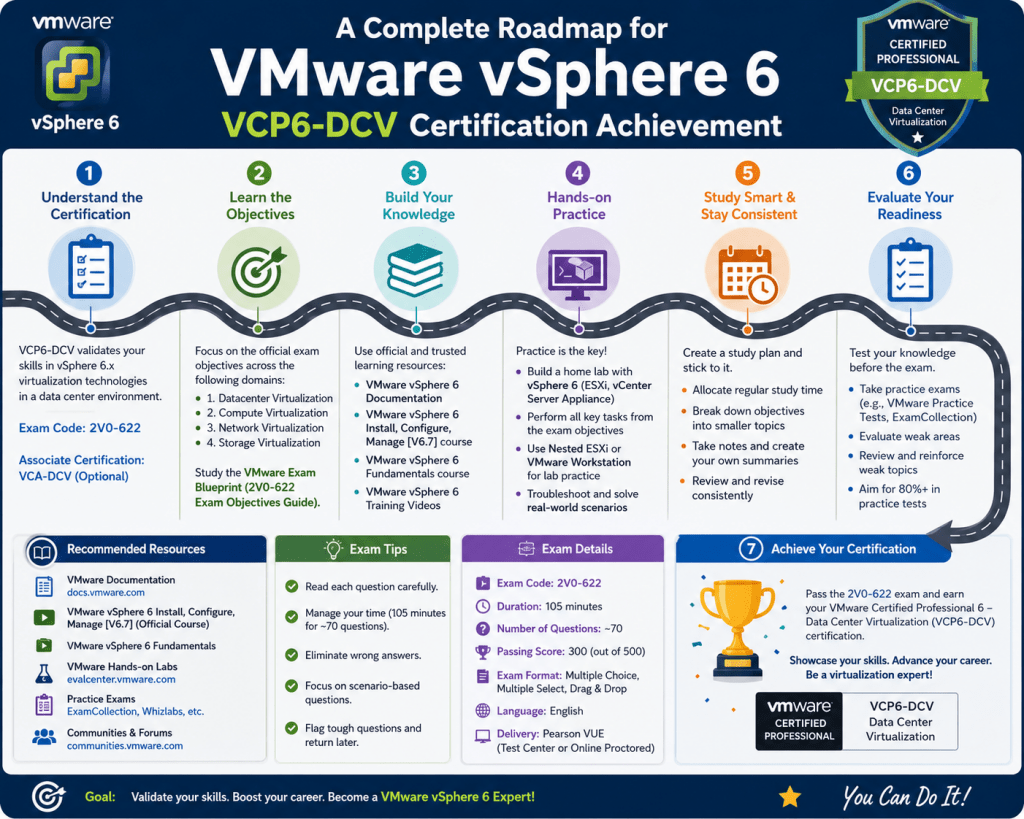
Virtualization has become a foundational element in modern computing environments, enabling organizations to optimize hardware utilization, improve scalability, and reduce operational complexity. At its core, virtualization abstracts physical computing resources and allows multiple virtual machines to operate on a single physical host. This shift has fundamentally changed how data centers are designed and managed, making virtualization expertise a highly valuable skill set for IT professionals. In enterprise environments, virtualization supports workload consolidation, disaster recovery strategies, and efficient resource allocation across distributed systems. Professionals working in this space are expected to understand how compute, storage, and networking layers interact within a virtualized architecture. The ability to manage these environments effectively is a key differentiator in systems administration and infrastructure engineering roles.
Professional Value of VMware vSphere Expertise
Within the virtualization ecosystem, VMware vSphere is widely recognized as a leading platform for enterprise-grade infrastructure management. It provides a suite of tools that enable administrators to deploy, manage, and scale virtual environments with precision and reliability. Mastery of vSphere concepts is often associated with advanced systems administration capabilities, particularly in environments where uptime, performance, and security are critical. Professionals with expertise in this platform are typically involved in managing virtual machines, configuring clusters, optimizing resource allocation, and ensuring high availability of services. This knowledge translates directly into roles that require a deep technical understanding of data center operations and infrastructure lifecycle management. As organizations continue to adopt hybrid and cloud-integrated models, vSphere expertise remains relevant across multiple deployment scenarios.
Purpose and Structure of the Certification Pathway
The VMware VCP6-DCV certification pathway is designed to validate an individual’s ability to work effectively with vSphere-based environments. It focuses on practical skills required to install, configure, manage, and optimize virtualization infrastructure. The certification is structured in a way that ensures candidates develop both foundational knowledge and applied technical capability. Rather than focusing solely on theoretical concepts, the pathway emphasizes real-world operational tasks such as system configuration, performance tuning, and troubleshooting. This structured approach ensures that certified professionals are prepared to handle enterprise-level infrastructure challenges. The certification is typically aligned with intermediate-level experience, making it suitable for professionals who already possess foundational IT and networking knowledge.
Core Knowledge Areas Covered in the Certification Path
The certification framework spans several critical domains of virtualization technology. These include compute virtualization, storage management, networking configuration, and system monitoring. Compute virtualization focuses on managing virtual machines and allocating physical resources efficiently across workloads. Storage management involves understanding datastores, storage policies, and performance optimization techniques. Networking covers virtual switches, distributed networking configurations, and traffic segmentation strategies. Monitoring and optimization focus on ensuring system performance, identifying bottlenecks, and maintaining operational stability. Together, these domains form a comprehensive skill set that enables professionals to manage complex virtual environments effectively. Each area contributes to a broader understanding of how virtual infrastructure operates at scale.
Foundational Requirements and Skill Expectations
Before pursuing this certification pathway, it is generally expected that candidates have a working understanding of IT infrastructure fundamentals. This includes familiarity with operating systems such as Windows Server environments, basic Linux concepts, and networking principles such as IP addressing, routing, and subnetting. In addition, practical exposure to virtualization platforms or management tools is highly beneficial. Candidates are also expected to have experience working in environments where system administration tasks are performed regularly. This includes managing servers, configuring network settings, and supporting enterprise applications. A period of hands-on experience with virtualization environments significantly improves readiness for advanced certification topics, as it allows candidates to contextualize theoretical knowledge within real operational scenarios.
Structure of the Examination Framework
The certification pathway is typically divided into multiple assessments that evaluate different levels of knowledge and competency. One component focuses on foundational understanding of virtualization principles, while another evaluates advanced operational skills in managing vSphere environments. This dual-structure approach ensures that candidates demonstrate both conceptual knowledge and practical ability. The assessments include a combination of multiple-choice questions and scenario-based problem solving, requiring candidates to apply their understanding to real-world situations. The evaluation process is designed to test decision-making skills, technical accuracy, and system troubleshooting capability under defined constraints. Successful completion of all required assessments is necessary to achieve certification status.
Career Opportunities Enabled by Virtualization Certification
Achieving certification in virtualization technologies opens the door to a wide range of career opportunities in IT infrastructure and systems engineering. Professionals in this field often work as systems administrators, responsible for maintaining server environments and ensuring operational continuity. Others may advance into roles such as senior systems engineers, where responsibilities include designing and implementing scalable infrastructure solutions. Additional career paths include infrastructure architects, IT operations managers, and cloud integration specialists. These roles typically require a strong understanding of both physical and virtual infrastructure components, as well as the ability to align technical solutions with business requirements. As organizations continue to modernize their IT environments, demand for virtualization expertise remains consistently strong.
Relevance of Virtualization Skills in Cloud-Oriented Environments
The rise of cloud computing has significantly expanded the relevance of virtualization technologies. Many cloud platforms are built on virtualization principles, making foundational knowledge in this area essential for cloud-related roles. Understanding how virtual machines operate, how resources are allocated dynamically, and how workloads are balanced across environments provides a strong foundation for working with cloud infrastructure. Virtualization also plays a critical role in hybrid environments, where on-premises systems are integrated with cloud services. Professionals with virtualization expertise are better equipped to manage these hybrid architectures, ensuring seamless workload mobility and consistent performance across platforms.
Building a Structured Learning Approach for Certification Success
Preparation for virtualization certification requires a structured and disciplined learning approach. This typically involves a combination of theoretical study, practical lab exercises, and scenario-based problem solving. Candidates benefit from building simulated environments where they can practice configuring virtual machines, managing storage resources, and setting up network components. This hands-on experience reinforces conceptual understanding and improves retention of complex technical topics. A structured learning plan also helps candidates track progress across different knowledge domains, ensuring balanced preparation. Consistent practice in real or simulated environments is essential for developing the confidence required to perform effectively in certification assessments.
Importance of Practical Experience in Virtual Environments
While theoretical knowledge provides a foundation, practical experience is essential for mastering virtualization technologies. Working directly with virtual infrastructure allows candidates to understand how different components interact under operational conditions. This includes observing system behavior during workload changes, identifying performance issues, and applying configuration adjustments. Practical exposure also helps develop troubleshooting skills, which are critical in real-world IT environments. Many certification candidates benefit from building test environments where they can safely experiment with configurations and observe system outcomes. This experiential learning approach significantly enhances technical proficiency and prepares candidates for professional responsibilities in virtualization-focused roles.
Deep Understanding of Enterprise Virtualization Architecture
Modern virtualization environments are built on layered architectures that integrate compute, storage, and networking into a unified operational model. Within enterprise-grade systems, the virtualization layer sits between physical hardware and application workloads, acting as an abstraction layer that enables multiple isolated operating systems to run simultaneously on shared infrastructure. This design significantly improves hardware utilization while maintaining operational isolation between workloads. In advanced environments, virtualization is not treated as a standalone concept but as part of a broader infrastructure strategy that includes automation, orchestration, and resource governance. Understanding this architecture requires familiarity with hypervisor behavior, resource scheduling mechanisms, and the interaction between virtual machines and underlying physical hosts. Each component of the environment must be evaluated not only individually but also in terms of how it contributes to system-wide performance and stability.
Virtual Machine Lifecycle and Operational Management
A core element of virtualization expertise involves managing the complete lifecycle of virtual machines. This lifecycle begins with provisioning, where compute, memory, storage, and network resources are allocated based on workload requirements. Once deployed, virtual machines require continuous monitoring to ensure optimal performance and resource utilization. Operational management includes tasks such as resizing virtual hardware, migrating workloads between hosts, and applying configuration changes without disrupting service availability. Over time, virtual machines may be decommissioned or archived as application needs evolve. Each stage of this lifecycle demands careful attention to resource efficiency and system impact. Effective lifecycle management ensures that virtual environments remain scalable, maintainable, and aligned with organizational requirements.
Compute Resource Allocation and Scheduling Mechanisms
Compute resources in a virtualized environment are managed through sophisticated scheduling systems that determine how CPU and memory resources are distributed across workloads. These mechanisms ensure that no single virtual machine monopolizes physical resources, maintaining balanced performance across the environment. Advanced scheduling strategies consider factors such as workload priority, resource reservations, and dynamic demand fluctuations. Memory management techniques include overcommitment strategies and ballooning mechanisms that optimize usage without compromising stability. CPU scheduling involves allocating processing time slices to virtual machines based on configured policies and real-time demand. Understanding these mechanisms is essential for diagnosing performance issues and ensuring consistent workload responsiveness under varying system loads.
Storage Virtualization and Data Management Principles
Storage plays a critical role in virtualization environments, as all virtual machine data is ultimately stored on shared or distributed storage systems. Storage virtualization abstracts physical disks into logical storage units that can be dynamically allocated to virtual machines. These storage units, often referred to as datastores, provide the foundation for storing operating systems, applications, and data files. Different storage architectures may include block-based storage or network-attached storage systems, each offering distinct performance and scalability characteristics. Efficient storage management involves balancing capacity utilization with input/output performance requirements. Techniques such as thin provisioning, storage tiering, and snapshot management are commonly used to optimize storage efficiency while maintaining data integrity.
Network Virtualization and Traffic Segmentation
Networking within virtual environments is implemented through software-defined constructs that replicate traditional physical networking components. Virtual switches connect virtual machines to external networks, enabling communication across different segments of the infrastructure. Advanced configurations may include distributed switching architectures that centralize network management while maintaining scalability across multiple hosts. Traffic segmentation techniques are used to isolate workloads, improve security, and optimize performance. Network policies define how data flows between virtual machines, physical networks, and external systems. Understanding virtual networking requires knowledge of routing concepts, packet forwarding behavior, and network overlay mechanisms that extend traditional networking capabilities into virtualized environments.
High Availability and Fault Tolerance Strategies
Enterprise virtualization environments are designed to maintain service continuity even in the event of hardware or software failures. High availability mechanisms ensure that virtual machines are automatically restarted on alternate hosts when a failure occurs. Fault tolerance extends this concept by maintaining real-time synchronization between primary and secondary virtual machines, allowing for seamless failover without service interruption. These strategies rely on cluster configurations that monitor host health and resource availability. Resource redundancy is a key principle, ensuring that sufficient capacity exists within the environment to support workload redistribution during failures. Proper configuration of these mechanisms is essential for minimizing downtime and maintaining service reliability in production environments.
Deployment and Configuration of Virtual Infrastructure Components
The deployment of virtualization infrastructure involves the installation and configuration of hypervisor hosts, management servers, and supporting services. Hypervisor installation typically occurs directly on physical hardware, creating a lightweight operating environment that supports virtual machine execution. Management systems provide centralized control over multiple hosts, enabling administrators to configure resources, monitor performance, and manage workloads from a single interface. Initial configuration tasks include setting up networking parameters, configuring storage access, and defining cluster structures. Proper deployment practices ensure that the environment is stable, scalable, and aligned with operational requirements from the outset. Misconfiguration at this stage can lead to performance bottlenecks and operational inefficiencies.
Performance Monitoring and System Optimization Techniques
Continuous monitoring is essential in virtualized environments to ensure optimal performance and early detection of potential issues. Monitoring systems track key metrics such as CPU usage, memory consumption, disk input/output rates, and network throughput. These metrics provide insight into system health and workload behavior. Performance optimization involves analyzing these metrics to identify inefficiencies and implementing corrective measures such as resource reallocation or configuration adjustments. In complex environments, performance issues may arise from resource contention, inefficient workload distribution, or misconfigured policies. Effective troubleshooting requires a structured approach that isolates the root cause and applies targeted solutions without disrupting overall system stability.
Security and Access Control in Virtual Environments
Security in virtualized infrastructures is enforced through layered access control mechanisms that regulate user permissions and system interactions. Administrative roles are typically defined to restrict access based on operational responsibility, ensuring that only authorized personnel can modify critical system configurations. Network segmentation and isolation techniques further enhance security by limiting communication between sensitive workloads. Virtual environments also support logging and auditing features that track administrative actions and system changes. These records are essential for compliance and forensic analysis in the event of security incidents. Maintaining a secure virtual infrastructure requires continuous enforcement of access policies and regular review of configuration integrity.
Troubleshooting Methodologies for Virtual Systems
Troubleshooting in virtualization environments requires a systematic approach that considers the interdependencies between compute, storage, and networking components. Issues may manifest as performance degradation, connectivity failures, or application instability. Effective troubleshooting begins with identifying the scope of the issue and gathering relevant system metrics. From there, administrators analyze logs, monitor resource usage, and isolate potential points of failure. Because virtual environments are highly interconnected, problems in one layer may propagate to others, making root cause analysis more complex. Structured diagnostic procedures are essential for efficiently resolving issues while minimizing impact on production workloads.
Scenario-Based Operational Thinking for Certification Readiness
Advanced virtualization knowledge is often assessed through scenario-based problem solving, where candidates are required to apply theoretical concepts to practical situations. These scenarios may involve optimizing resource allocation, resolving system performance issues, or configuring high availability settings under specific constraints. Success in such assessments depends on the ability to interpret system behavior and make informed operational decisions. Rather than relying on memorized procedures, candidates must understand the underlying principles that govern system functionality. This analytical approach reflects real-world responsibilities, where administrators must adapt to dynamic environments and respond to unpredictable system conditions.
Integration of Virtualization with Broader Infrastructure Systems
Virtualization does not operate in isolation but is integrated into broader IT ecosystems that include storage networks, identity management systems, and cloud platforms. This integration enables organizations to build flexible and scalable infrastructures that support diverse workloads. Virtual environments often serve as the foundation for private and hybrid cloud architectures, where resources are dynamically allocated based on demand. Understanding how virtualization interacts with other infrastructure components is essential for designing efficient systems. This includes knowledge of data flow between systems, dependency mapping, and workload orchestration across distributed environments.
Advanced Operational Mastery in vSphere Environments
At an advanced stage of virtualization expertise, professionals move beyond basic deployment and configuration tasks into full operational mastery of vSphere environments. This level of understanding requires a deep awareness of how all infrastructure components interact under production workloads. Administrators are expected to interpret system behavior under stress conditions, recognize inefficiencies in resource utilization, and apply corrective adjustments without disrupting service continuity. Operational mastery includes managing distributed workloads across clusters, balancing compute and storage demand dynamically, and ensuring that system policies align with organizational performance requirements. It also involves understanding the impact of configuration decisions on long-term system stability. In large-scale environments, small misconfigurations can propagate across multiple layers, making precision in operational execution essential. The ability to anticipate system behavior under different load conditions distinguishes advanced practitioners from intermediate administrators.
Strategic Design Thinking in Virtual Infrastructure Planning
Beyond operational tasks, virtualization professionals are often involved in designing infrastructure architectures that align with business requirements. Strategic design thinking focuses on building environments that are scalable, resilient, and adaptable to future demands. This involves selecting appropriate cluster configurations, determining resource allocation strategies, and planning storage architectures that can accommodate growth. Design decisions must also consider fault tolerance, disaster recovery capabilities, and workload segmentation. A well-designed virtual environment minimizes operational complexity while maximizing performance efficiency. In enterprise settings, design considerations often extend to hybrid integration scenarios where on-premises systems must interoperate with cloud-based infrastructure. Effective design thinking requires a balance between technical constraints and organizational objectives, ensuring that infrastructure remains both functional and sustainable over time.
Performance Engineering and System Optimization Practices
Performance engineering in virtualized environments focuses on maintaining consistent system responsiveness under varying workloads. This discipline involves continuous analysis of resource utilization patterns and proactive adjustment of system configurations. CPU scheduling behavior, memory allocation efficiency, and storage input/output performance are key areas of focus. Optimization techniques may include workload redistribution, resource reservation tuning, and elimination of bottlenecks caused by contention. In complex environments, performance issues may not originate from a single source but from cumulative inefficiencies across multiple layers. Therefore, performance engineering requires a holistic view of system behavior. Professionals must be able to interpret performance metrics in context, distinguishing between normal fluctuations and structural inefficiencies that require remediation.
Automation and Infrastructure Efficiency Models
Automation plays a central role in modern virtualization environments by reducing manual intervention and improving operational consistency. Infrastructure automation involves the use of predefined workflows to handle repetitive administrative tasks such as provisioning, configuration updates, and resource scaling. This approach reduces the likelihood of human error and ensures standardized system behavior across environments. Automation also supports rapid response to changing workload demands, enabling dynamic resource allocation based on predefined policies. Efficiency models in virtualization environments rely on automation to maintain optimal system performance while minimizing administrative overhead. As environments grow in complexity, automation becomes essential for maintaining control and ensuring predictable infrastructure behavior.
High Availability Engineering and Resilient Architecture Design
Resilient architecture design focuses on ensuring continuous service availability even in the presence of hardware or software failures. High availability engineering involves configuring clusters that monitor host health and automatically redistribute workloads when failures occur. This requires careful planning of resource redundancy to ensure that sufficient capacity exists to handle failover scenarios. Fault-tolerant configurations extend this concept further by maintaining synchronized virtual machine states across multiple hosts, allowing for uninterrupted service continuity. Designing resilient systems requires understanding failure domains and ensuring that no single point of failure can compromise overall system stability. Effective implementation of these strategies is critical in environments where uptime requirements are strict and service interruptions are not acceptable.
Storage Architecture Optimization and Data Resilience
Storage architecture in virtualized environments must balance performance, scalability, and data protection. Advanced storage strategies involve tiered storage systems where data is distributed across different performance levels based on usage patterns. Frequently accessed data may reside on high-performance storage, while less frequently used data is stored on cost-efficient systems. Data resilience is achieved through redundancy mechanisms that protect against hardware failure and data corruption. Snapshot technologies allow administrators to capture system states at specific points in time, enabling recovery in case of system failure or misconfiguration. Storage optimization also involves managing capacity allocation efficiently to avoid fragmentation and ensure consistent performance across workloads.
Network Architecture Evolution in Virtualized Systems
Network architecture within virtualized environments has evolved significantly with the introduction of software-defined networking principles. Traditional physical networking constraints are replaced with virtual constructs that provide greater flexibility and control. Virtual switches enable communication between workloads without relying on physical network hardware. Advanced configurations allow for traffic segmentation, policy-based routing, and dynamic bandwidth allocation. Network overlays extend connectivity across distributed environments, enabling seamless communication between geographically separated systems. Understanding network behavior in virtual environments requires knowledge of packet flow, virtual routing mechanisms, and network isolation techniques. Proper network design ensures secure and efficient communication across all layers of the infrastructure.
Security Governance and Access Management Strategies
Security governance in virtual environments involves defining structured access control policies that regulate system interaction. Administrative roles are carefully assigned to ensure that only authorized personnel can perform critical operations. Access management systems enforce these policies across all components of the infrastructure. In addition to role-based access control, network segmentation is used to isolate sensitive workloads from general traffic. Logging and auditing mechanisms provide visibility into system activity, enabling detection of unauthorized changes or suspicious behavior. Security governance is not a one-time configuration but an ongoing process that requires continuous monitoring and policy refinement. Effective governance ensures that virtualization environments remain secure, compliant, and resilient against potential threats.
Troubleshooting Complex Virtualization Scenarios
Advanced troubleshooting in virtual environments requires a structured analytical approach that considers interdependencies across compute, storage, and networking layers. Issues may manifest as performance degradation, connectivity instability, or application failure. Diagnosing these issues involves collecting system metrics, analyzing logs, and isolating variables that contribute to the problem. Because virtual environments are highly interconnected, a single issue may have multiple contributing factors. Troubleshooting, therefore, requires methodical elimination of potential causes. Professionals must be able to interpret system behavior under different conditions and identify patterns that indicate underlying structural problems. Effective troubleshooting is both a technical and analytical skill that improves with experience in real-world environments.
Cloud Integration and Hybrid Infrastructure Alignment
Virtualization serves as a foundational technology for cloud computing and hybrid infrastructure models. Integration between virtual environments and cloud platforms enables organizations to extend their infrastructure beyond physical data centers. Hybrid alignment involves workload mobility, resource synchronization, and unified management across distributed environments. Virtualization plays a key role in enabling this flexibility by abstracting workloads from underlying hardware. This allows systems to be deployed, migrated, and scaled across different environments without significant reconfiguration. Understanding hybrid integration requires knowledge of workload orchestration, data consistency management, and cross-environment communication protocols. These capabilities are essential for organizations that operate across both on-premises and cloud-based infrastructures.
Capacity Planning and Resource Forecasting Models
Capacity planning is a critical aspect of virtualization management that focuses on ensuring sufficient resources are available to meet future demand. This involves analyzing historical usage patterns and forecasting future requirements based on workload growth trends. Resource forecasting models help administrators determine when additional compute, storage, or network capacity will be required. Effective capacity planning prevents system overload and ensures consistent performance as environments scale. It also supports cost optimization by avoiding unnecessary over-provisioning of resources. In enterprise environments, capacity planning is an ongoing process that must be continuously adjusted as workloads evolve and organizational requirements change.
Advanced Certification Progression and Skill Expansion Paths
After establishing foundational and intermediate virtualization expertise, professionals naturally progress toward advanced certification stages that emphasize architectural design, large-scale infrastructure engineering, and enterprise-level system optimization. At this level, the focus shifts from operational execution to strategic infrastructure planning, where decisions influence entire data center ecosystems rather than individual virtual machines or hosts. Advanced certification paths typically require a more mature understanding of distributed systems, resource orchestration, and multi-layer dependency management across compute, storage, and networking domains.
Skill expansion at this stage includes deep engagement with multi-site architectures, where virtualization environments span across geographically distributed data centers. This introduces complexity in latency management, data replication strategies, and synchronized workload mobility. Professionals are expected to understand how virtual machines behave under cross-site failover conditions and how resource replication impacts system performance and consistency. Disaster recovery planning becomes a central competency, requiring the ability to design recovery strategies that minimize downtime while maintaining data integrity across primary and secondary environments.
Another critical aspect of advanced progression involves large-scale deployment strategies. Instead of focusing on isolated systems, professionals must design environments that support thousands of virtual machines with predictable performance characteristics. This requires a strong grasp of resource pooling mechanisms, cluster design principles, and capacity distribution models. Infrastructure must be structured in a way that avoids resource contention while ensuring elasticity under peak demand conditions. At this level, optimization is not just technical but architectural, requiring decisions that balance cost efficiency, scalability, and operational resilience.
Complex system integration scenarios also become a key area of expertise. Virtualized environments rarely exist in isolation; they interact with identity services, storage ecosystems, backup frameworks, and external application platforms. Professionals must understand how these integrations affect system behavior and how dependencies propagate across layers. This requires architectural reasoning that goes beyond configuration knowledge, focusing instead on system-wide behavior analysis and long-term operational sustainability.
This progression ultimately represents a shift from hands-on system administration toward infrastructure governance and design authority. Professionals are expected to make decisions that define how environments evolve, ensuring that systems remain aligned with organizational growth, technological change, and operational demands.
Real-World Operational Decision Making in Virtual Environments
In production environments, operational decision-making becomes a high-stakes process where timing, accuracy, and system awareness are critical. Administrators are frequently required to respond to dynamic conditions where system performance, resource utilization, or service availability may fluctuate unexpectedly. In such scenarios, decision-making must balance immediate technical resolution with broader operational impact.
One of the key responsibilities in these environments involves workload prioritization. When resource contention occurs, administrators must determine which virtual machines or services receive priority access to compute, memory, or storage resources. This requires an understanding of business-critical applications, service-level agreements, and system dependency chains. Decisions are rarely isolated; instead, they influence multiple interconnected services across the infrastructure.
Resource reallocation is another frequent operational requirement. As workloads shift, administrators may need to adjust CPU allocation, memory reservations, or storage access policies to maintain performance stability. These adjustments must be made carefully to avoid introducing new bottlenecks or destabilizing other workloads. In many cases, changes must be applied in real time, requiring both technical precision and situational awareness.
Failover initiation represents a more critical decision point in environments designed for high availability. When system failures or performance degradation occur, administrators must determine whether to trigger automated or manual failover processes. This involves evaluating system health indicators, redundancy availability, and recovery time objectives. Poorly timed failover actions can result in unnecessary service disruption, while delayed responses can lead to extended downtime.
Real-world decision-making is also shaped by organizational constraints and risk tolerance. Some environments prioritize maximum uptime at all costs, while others balance performance with operational efficiency. Professionals must adapt their decision-making strategies accordingly, aligning technical actions with business objectives. Over time, this capability develops through exposure to diverse operational scenarios, where each incident contributes to a deeper understanding of system behavior under pressure.
Long-Term Infrastructure Sustainability and Evolution Considerations
Virtualization environments are inherently dynamic systems that evolve continuously in response to technological advancements, workload changes, and organizational growth. Long-term sustainability requires a forward-looking approach that anticipates future requirements rather than reacting solely to current system demands.
One of the core principles of sustainable infrastructure design is adaptability. Systems must be capable of integrating new technologies without requiring complete architectural redesigns. This includes accommodating emerging compute models, evolving storage technologies, and changes in networking paradigms. A flexible architecture ensures that infrastructure can evolve incrementally while maintaining operational stability.
Scalability is another essential consideration. As organizations grow, their virtualization environments must expand proportionally without degrading performance. This requires careful planning of resource distribution, cluster expansion strategies, and capacity forecasting models. Scalability is not only about adding more resources but also about ensuring that those resources integrate seamlessly into existing structures.
Periodic reassessment of infrastructure configurations is also necessary to maintain long-term efficiency. Over time, workloads evolve, usage patterns shift, and certain configurations may become inefficient or obsolete. Regular evaluation of performance metrics, resource utilization trends, and system bottlenecks allows administrators to refine infrastructure design and eliminate inefficiencies.
Security and compliance requirements also evolve, requiring continuous updates to access control policies, monitoring systems, and audit mechanisms. Sustainable environments must incorporate security as an ongoing design principle rather than a static configuration. This ensures that systems remain resilient against emerging threats and aligned with regulatory expectations.
Ultimately, long-term sustainability in virtualization environments depends on maintaining a balance between stability and adaptability. Systems must remain reliable under current workloads while retaining the flexibility to evolve with future demands. This balance is achieved through thoughtful architecture, continuous optimization, and strategic foresight in infrastructure planning.
Final Perspective on VMware VCP6-DCV and Virtualization Expertise
The VMware VCP6-DCV certification pathway represents more than a technical credential; it reflects a structured approach to understanding and operating complex virtualized infrastructures. Across modern IT environments, virtualization has become the backbone of enterprise computing, enabling organizations to consolidate resources, improve scalability, and maintain operational continuity in highly dynamic conditions. The concepts covered throughout this certification journey—ranging from compute and storage management to networking, performance optimization, and system design—form a unified skill set that directly translates into real-world infrastructure management.
At a professional level, the value of virtualization expertise is rooted in its universality across IT systems. Whether deployed in traditional data centers, hybrid environments, or cloud-integrated infrastructures, virtualization remains a foundational layer that supports nearly every modern application workload. The ability to manage this layer effectively requires both technical precision and architectural awareness. It is not sufficient to simply understand how virtual machines operate; professionals must also understand how those machines interact with underlying hardware resources, network systems, and storage architectures under varying operational demands.
One of the most significant aspects of virtualization proficiency is the transition from operational execution to strategic thinking. Early-stage learning focuses on deployment and configuration tasks, where individuals learn how to create and manage virtual machines, allocate resources, and maintain system availability. However, as expertise develops, the focus shifts toward optimization, design, and long-term sustainability. At this stage, professionals begin to evaluate infrastructure not only in terms of functionality but also in terms of efficiency, resilience, and scalability. This shift in perspective is essential for managing enterprise environments where downtime, performance degradation, or inefficient resource usage can have a significant business impact.
Another important dimension of virtualization expertise is adaptability. Virtual environments are not static systems; they evolve continuously in response to changing workloads, technological advancements, and organizational requirements. Professionals working in this domain must be capable of adjusting configurations, optimizing performance, and integrating new technologies without disrupting existing services. This requires a deep understanding of system dependencies and the ability to anticipate how changes in one layer of the infrastructure may affect others. In practice, this means balancing immediate operational needs with long-term architectural goals.
Security and governance also play a critical role in virtualization environments. As systems become more interconnected and distributed, maintaining control over access, data integrity, and system behavior becomes increasingly complex. Effective professionals must understand how to implement structured access control models, enforce security policies, and monitor system activity for anomalies. Security in virtual environments is not limited to external threats; it also includes internal misconfigurations, unauthorized changes, and resource mismanagement. A well-governed virtualization infrastructure ensures that systems remain stable, compliant, and protected against both intentional and unintentional disruptions.
Performance management is another key pillar of virtualization expertise. In high-density environments where multiple workloads share the same physical resources, performance optimization becomes a continuous process. Professionals must be able to interpret system metrics, identify bottlenecks, and implement corrective actions that improve efficiency without compromising stability. This requires a combination of analytical thinking and practical experience, as performance issues often arise from complex interactions between compute, storage, and network components. The ability to diagnose and resolve these issues is a defining characteristic of advanced virtualization practitioners.
Equally important is the role of infrastructure design in ensuring long-term system effectiveness. Well-designed virtual environments are built with scalability and resilience in mind, allowing them to accommodate growth and adapt to changing requirements. Design decisions must account for resource distribution, workload isolation, and failure recovery mechanisms. A strong architectural foundation reduces operational complexity and improves system reliability, making it easier to manage large-scale environments efficiently. Professionals who develop strong design capabilities are often positioned to take on more strategic roles within IT organizations.
Career development in virtualization is closely tied to the depth of technical and architectural understanding. As professionals gain experience, they often transition into roles that involve infrastructure planning, systems engineering, and cloud integration. These roles require a broader perspective that extends beyond day-to-day system management and into long-term technology strategy. Virtualization expertise also serves as a gateway to related domains such as cloud computing, automation, and enterprise systems architecture. This interconnected skill set increases professional flexibility and opens pathways to advanced technical and leadership positions.
Ultimately, virtualization remains one of the most critical components of modern IT infrastructure. Its influence extends across nearly every aspect of enterprise computing, from application deployment and resource management to security enforcement and system scalability. Mastery of virtualization concepts provides professionals with the ability to manage complex environments with confidence and precision. It also enables them to contribute meaningfully to infrastructure design decisions that shape the efficiency and reliability of organizational systems.
The VCP6-DCV certification journey, when viewed in its entirety, represents a structured pathway toward developing these capabilities. It encourages a progression from foundational understanding to advanced operational and architectural thinking. While the technical landscape continues to evolve, the core principles of virtualization—resource abstraction, efficient allocation, and system resilience—remain constant. Professionals who internalize these principles are well-positioned to adapt to future technologies and continue advancing within the field of IT infrastructure management.