
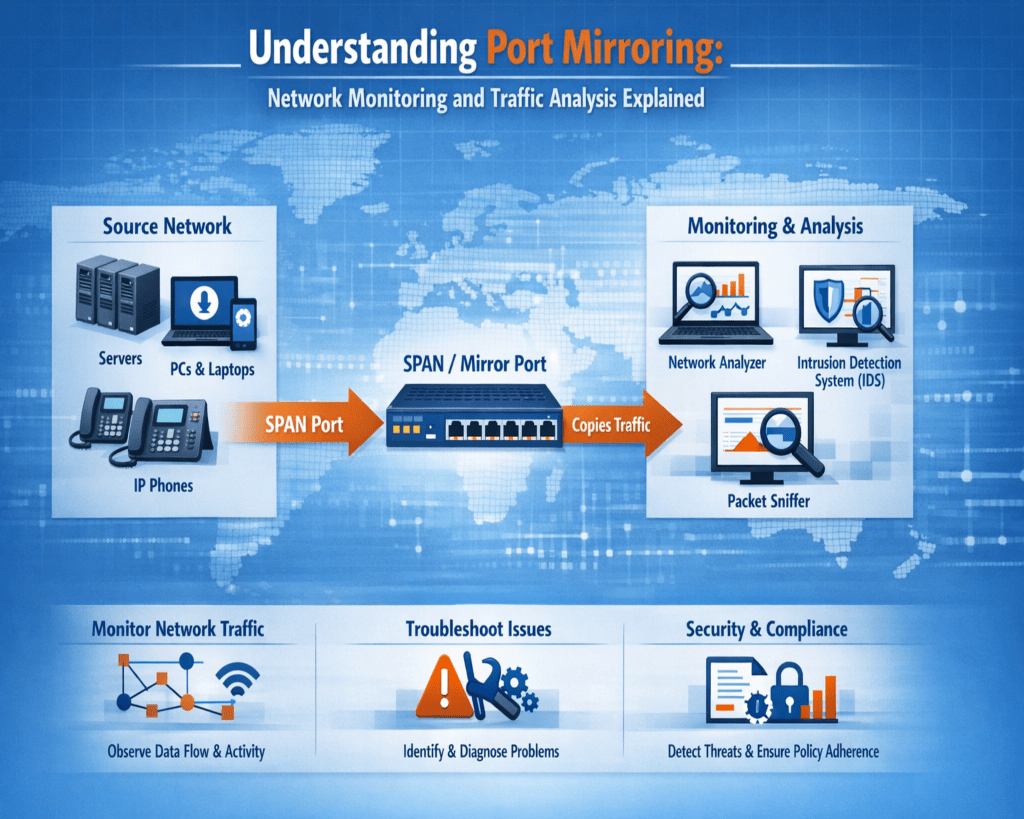
Port mirroring is a network traffic replication technique used in switched environments where packets entering or leaving selected interfaces are copied and forwarded to a dedicated monitoring interface. This mechanism enables passive observation of live traffic without disrupting the original data flow. In practical network architectures, it is commonly implemented at the switch level, where forwarding logic is extended to duplicate frames based on defined source points such as physical ports or VLAN segments.
In addition to its basic operational concept, port mirroring is tightly integrated with the internal switching fabric of modern networking devices. When a packet enters a switch, it is first evaluated against forwarding tables to determine its destination. If port mirroring is enabled for that source interface or VLAN, the switch creates a duplicate of the packet during the forwarding process. One copy follows the standard forwarding path toward the destination device, while the mirrored copy is redirected to a predefined monitoring port. This process occurs at high speed within hardware-assisted switching environments, ensuring that packet duplication does not significantly interfere with normal traffic flow under properly designed conditions.
At its core, port mirroring operates on the principle of selective packet duplication. The original traffic continues its normal forwarding path toward the intended destination, while a parallel copy is delivered to a monitoring endpoint. This endpoint is typically connected to diagnostic tools that inspect packet headers, payload behavior, and transmission patterns. The ability to observe traffic in real time without interference makes this method essential for deep network visibility.
Beyond simple observation, this mechanism provides a foundation for understanding how data moves through complex network infrastructures. By analyzing mirrored packets, network engineers can reconstruct communication sessions, identify latency points, and examine protocol-level interactions in detail. This level of insight is particularly valuable in environments where multiple applications share the same underlying network resources, as it allows for precise isolation of performance issues without affecting production services.
Port mirroring also plays an important role in maintaining operational stability during troubleshooting activities. Instead of actively probing or injecting test traffic into the network, engineers rely on passive observation, which eliminates the risk of introducing additional load or unintended side effects. This passive nature ensures that production systems remain unaffected while still providing complete visibility into live traffic behavior.
Packet Flow Behavior and Traffic Duplication Mechanism
In a switched network, each frame is processed based on MAC address learning tables. When port mirroring is enabled, an additional rule set is applied during the forwarding decision process. Instead of simply forwarding a packet from ingress to egress ports, the switching engine generates a mirrored copy of that packet and directs it toward a preconfigured monitoring interface.
This duplication process occurs at wire speed in modern switching hardware, minimizing performance overhead. However, the effectiveness of this mechanism depends heavily on hardware capabilities and available backplane bandwidth. In environments with heavy traffic loads, the replication process must be carefully managed to prevent congestion at the monitoring port.
The mirrored traffic typically includes all Ethernet frame components, ensuring that both control and data plane activity can be analyzed. This makes it possible to examine protocol behavior, session initiation patterns, and potential anomalies at a granular level.
Role of Switching Architecture in Traffic Replication
Switching infrastructure plays a critical role in how port mirroring is executed. Most enterprise-grade switches include dedicated hardware support for traffic replication, often implemented within application-specific integrated circuits. This allows mirroring to occur without requiring CPU intervention for each packet, ensuring minimal impact on forwarding performance.
The switch maintains internal mappings between source interfaces and the designated monitoring interface. When a packet matches the configured source criteria, the switch fabric duplicates the frame and forwards one copy toward its original destination and another toward the monitoring endpoint. This process is deterministic and operates independently of higher-layer routing decisions.
Source Selection and Traffic Scope Definition
Port mirroring configurations typically begin with defining the traffic scope. This may include individual switch ports, aggregated interfaces, or entire VLAN segments. The selection of source traffic determines the breadth of visibility achieved through the monitoring setup.
When a single port is selected, only traffic entering or leaving that interface is mirrored. In VLAN-based configurations, all traffic associated with the specified VLAN is duplicated, providing a broader observational scope. This flexibility allows network engineers to adjust monitoring granularity based on operational requirements.
The destination for mirrored traffic is always a dedicated monitoring port. This port is isolated from normal forwarding operations and is intended solely for analysis systems. The separation ensures that diagnostic tools receive complete traffic visibility without affecting production traffic paths.
Local Mirroring Within a Single Switching Device
Local port mirroring occurs when both source and destination interfaces exist on the same switching device. This configuration is commonly used for rapid troubleshooting because it minimizes latency and avoids inter-device traversal. Traffic duplication happens entirely within the internal switching fabric, resulting in efficient packet handling.
In this model, the monitoring system is physically connected to the same device, allowing immediate observation of traffic behavior. This setup is particularly useful for identifying interface-level issues, analyzing microbursts, and detecting protocol-level irregularities within a localized segment of the network.
Remote Mirroring Across Multiple Network Devices
Remote port mirroring extends the concept of local duplication by allowing mirrored traffic to be forwarded across different switching devices. In this arrangement, the source switch encapsulates and transmits the mirrored traffic to a remote monitoring switch.
This introduces additional network hops, which may slightly increase latency, but it enables centralized traffic analysis across distributed infrastructures. Remote mirroring is often used in larger network topologies where centralized monitoring systems aggregate data from multiple access layers or regional segments.
Encapsulation methods ensure that mirrored packets maintain integrity during transit across intermediate network paths. This allows analysts to reconstruct original traffic conditions even when observation points are physically distant from the source.
Encapsulated Mirroring and Layered Transmission Techniques
Encapsulated port mirroring introduces a structured method of transporting mirrored traffic through standard network routing paths. Instead of directly forwarding raw frames, the switch encapsulates them into a transport format suitable for layer three delivery.
This approach enables scalability across complex network environments. Multiple source devices can forward mirrored traffic toward a single analysis endpoint, reducing the need for localized monitoring hardware. Encapsulation ensures that packet context is preserved, including metadata about the original source interface and VLAN association.
This model is commonly used in large-scale monitoring infrastructures where centralized analysis systems process traffic from multiple distributed network segments.
Traffic Replication Constraints and Hardware Considerations
Although port mirroring is designed for efficiency, it is constrained by hardware resources such as switching capacity, buffer availability, and forwarding throughput. Each mirrored packet consumes additional processing resources, which can become significant under high traffic loads.
Switch architectures must balance normal forwarding operations with replication tasks. If monitoring configurations are too broad or improperly scoped, the additional load may lead to congestion or packet loss at the monitoring interface. For this reason, precise definition of source traffic is critical for maintaining network stability.
Buffer management also plays a role in ensuring that mirrored traffic does not interfere with production flows. High-performance switching devices use dedicated memory structures to isolate mirrored traffic from standard forwarding queues.
Traffic Visibility and Observational Scope in Network Analysis
The primary objective of port mirroring is to enhance visibility into network behavior. By duplicating live traffic, administrators gain access to unfiltered data streams that reflect actual network conditions. This visibility extends to application performance, protocol negotiation, session timing, and error patterns.
Because mirrored traffic is an exact copy of production data, it provides a reliable foundation for behavioral analysis. This allows network engineers to reconstruct events, identify anomalies, and understand traffic distribution patterns without affecting operational systems.
The scope of visibility is directly influenced by configuration choices. Narrowly defined source selection provides focused insight, while broader configurations offer a holistic view of network activity.
Relationship Between Mirroring and Network Forwarding Logic
Port mirroring operates alongside standard forwarding logic rather than replacing it. The switching engine continues to perform MAC address lookups, VLAN tagging, and forwarding decisions as usual. Mirroring is implemented as an additional parallel process that triggers during packet handling.
This separation ensures that diagnostic functionality does not interfere with production traffic flow. Forwarding decisions remain deterministic, while mirroring acts as an observational overlay.
The integration of both processes within the same switching pipeline highlights the efficiency of modern network hardware design, where multiple operations are executed concurrently at line rate.
Scaling Traffic Visibility in High-Density Network Infrastructures
As network environments grow in size and complexity, the demand for scalable traffic visibility increases significantly. Port mirroring evolves from a simple diagnostic feature into a structured monitoring architecture that supports large-scale observation of distributed systems. In high-density environments, traffic flows across multiple switching layers, requiring mirroring configurations that can aggregate data from various segments without overwhelming analysis points.
To achieve this scalability, modern network designs distribute mirroring responsibilities across multiple devices while maintaining centralized visibility. This involves careful planning of source selection, destination allocation, and bandwidth utilization. The goal is to ensure that traffic duplication does not interfere with production forwarding while still providing comprehensive observational coverage across the entire infrastructure.
SPAN-Style Traffic Replication and Logical Monitoring Groups
A widely used approach to port-based traffic duplication involves the concept of switched port analysis behavior, where monitoring sessions are logically defined rather than physically constrained. In this model, multiple source interfaces are grouped into a monitoring session that forwards replicated traffic to a single destination interface.
This logical grouping allows administrators to dynamically adjust monitored sources without redesigning the physical topology. Traffic from different access layers, uplink ports, or service VLANs can be combined into a unified monitoring stream. The switching system maintains internal session tables that map each source to the same destination, ensuring consistent replication behavior.
This approach is particularly useful in environments where rapid troubleshooting is required across multiple segments simultaneously, as it eliminates the need to configure individual mirroring rules for each interface separately.
Remote Traffic Replication Across Distributed Switching Layers
Remote traffic replication extends monitoring capabilities beyond a single device by enabling mirrored packets to traverse intermediate network infrastructure. In this architecture, traffic originating from a source switch is encapsulated and transmitted across standard routing paths toward a remote analysis node.
The encapsulation process ensures that the original packet structure is preserved while adding metadata that identifies its source origin. This allows centralized monitoring systems to reconstruct traffic behavior across multiple network domains. Remote replication is essential in enterprise-scale architectures where data centers, branch offices, and cloud-connected segments must be observed from a unified analytical platform.
Unlike local duplication, remote replication introduces dependency on network transport reliability. Packet loss, jitter, and congestion in transit can affect the accuracy of observed traffic patterns, making careful bandwidth planning essential.
Encapsulation Methods for Transporting Mirrored Traffic
When traffic is forwarded across network boundaries, it is encapsulated into a transport format that supports identification and reassembly. This encapsulation typically includes source identifiers, session metadata, and original packet headers.
Encapsulation ensures that mirrored traffic remains distinguishable from production traffic during transit. Upon arrival at the monitoring endpoint, the encapsulation layer is removed, restoring the original packet structure for analysis.
This mechanism enables multi-hop visibility across complex topologies without requiring direct physical connectivity between source and monitoring systems. It also allows multiple source devices to send mirrored traffic into a single aggregated monitoring pipeline.
Encapsulation efficiency plays a key role in performance, as excessive overhead can lead to increased bandwidth consumption. Therefore, optimization of encapsulation depth and frequency is critical in high-throughput environments.
VLAN-Level Traffic Replication Strategies
Beyond individual port-based duplication, traffic mirroring can also operate at the VLAN level. In this approach, all traffic associated with a specific VLAN is replicated and sent to a monitoring interface. This provides visibility into segmented network domains without requiring individual port configuration.
VLAN-based replication is particularly useful in environments where logical segmentation is used to separate departments, services, or security zones. By monitoring VLAN traffic, administrators can observe inter-device communication patterns within a defined logical boundary.
This method reduces configuration complexity while increasing observational coverage. However, it also increases the volume of mirrored traffic, which must be carefully managed to avoid overwhelming monitoring infrastructure.
Aggregated Monitoring Sessions and Multi-Source Traffic Consolidation
In complex networks, multiple source interfaces may need to be monitored simultaneously. Aggregated monitoring sessions allow traffic from several ports or VLANs to be combined into a single mirrored output stream.
This consolidation simplifies analysis by providing a unified traffic feed to diagnostic tools. Instead of analyzing multiple isolated streams, engineers can observe combined network behavior in a single view. This is particularly valuable when diagnosing issues that span multiple segments, such as application latency or distributed service failures.
However, aggregation must be carefully controlled to avoid excessive duplication. If too many sources are included, the monitoring interface may become saturated, leading to dropped packets and incomplete analysis.
Performance Considerations in High-Throughput Mirroring Environments
Port mirroring introduces additional processing demands on switching infrastructure. Every mirrored packet requires duplication, which consumes buffer memory, switching fabric resources, and in some cases, CPU cycles.
In high-throughput environments, this can lead to measurable performance impact if not properly managed. The degree of impact depends on traffic volume, number of mirrored sources, and hardware acceleration capabilities. Modern switching devices mitigate this through dedicated hardware pipelines that handle replication independently of general forwarding logic.
Despite these optimizations, careful planning is required to ensure that monitoring configurations do not exceed system capacity. Over-subscription of mirrored traffic can lead to congestion at the monitoring interface, reducing the accuracy of collected data.
Distinguishing Full Replication from Selective Traffic Observation
Traffic duplication systems can operate in full replication mode or selective observation mode. In full replication, all packets from defined sources are mirrored without filtering. This provides complete visibility but generates large volumes of data.
Selective observation introduces filtering criteria that limit which packets are duplicated. This may include specific protocols, IP ranges, or traffic conditions. While this reduces monitoring overhead, it may also omit relevant diagnostic information if filters are too restrictive.
The choice between full and selective replication depends on operational objectives. Security investigations often require full visibility, while performance monitoring may benefit from filtered datasets that focus on specific traffic types.
Security Monitoring Through Passive Traffic Inspection
One of the primary applications of traffic duplication is passive security monitoring. By observing mirrored traffic, security systems can detect abnormal patterns without interacting with production flows.
This includes identifying unusual connection attempts, repeated authentication failures, or unexpected data transfer patterns. Because mirrored traffic is non-intrusive, it allows continuous monitoring without introducing additional latency or risk to production systems.
Security analysis systems rely on the completeness of mirrored data to detect subtle indicators of compromise. Any loss or degradation of mirrored packets can reduce the effectiveness of detection mechanisms.
Behavioral Analysis and Anomaly Detection in Network Streams
Mirrored traffic provides a foundation for behavioral analysis, where normal network activity patterns are established and deviations are identified. This includes baseline traffic volumes, session durations, and protocol distributions.
When traffic deviates from established patterns, it may indicate performance degradation, misconfiguration, or malicious activity. By analyzing mirrored data streams over time, systems can build adaptive models that improve detection accuracy.
This form of analysis requires consistent and reliable traffic replication to ensure that observed patterns accurately reflect real network behavior.
Troubleshooting Distributed Application Performance Issues
In distributed systems, application performance issues often span multiple network segments. Port mirroring enables engineers to trace packet flows across these segments, identifying where delays or losses occur.
By examining mirrored traffic at different points in the network, it becomes possible to isolate latency sources, detect retransmissions, and identify congestion points. This granular visibility is essential for diagnosing complex issues that cannot be observed from a single vantage point.
The ability to correlate traffic behavior across multiple interfaces significantly improves troubleshooting efficiency in large-scale environments.
Compliance Monitoring and Traffic Validation Mechanisms
Regulatory frameworks often require validation of network segmentation, data handling policies, and encryption standards. Mirrored traffic provides a direct method for verifying these requirements.
By observing actual packet flows, administrators can confirm whether sensitive data remains within defined network boundaries or whether encryption is consistently applied during transmission. This validation process is essential for maintaining compliance in regulated industries.
Traffic duplication ensures that compliance verification is based on real operational data rather than configuration assumptions, increasing audit reliability.
Optimization of Mirroring Architectures for Long-Term Stability
Sustainable deployment of traffic duplication systems requires continuous optimization. This includes adjusting source selection, balancing monitoring loads, and ensuring that destination systems can process incoming traffic efficiently.
Over time, network conditions change, requiring adjustments to mirroring configurations. New applications, increased traffic volumes, and infrastructure upgrades can all affect the efficiency of existing monitoring setups.
Maintaining long-term stability involves periodic review of mirrored traffic scope and ensuring that monitoring infrastructure evolves alongside production systems.
Resource Consumption and Hardware Load in Mirroring Systems
Port mirroring introduces additional processing overhead into switching environments because every selected packet must be duplicated and forwarded to a monitoring destination. Although modern hardware offloads much of this workload to dedicated switching ASICs, the cumulative effect of high-volume traffic replication can still impact system resources.
The most significant resource constraint is switch fabric capacity. Each mirrored packet competes with production traffic for internal bandwidth. When replication is extensive, the fabric must handle both original and duplicated flows simultaneously, increasing utilization pressure. This is particularly relevant in environments with high-speed uplinks where traffic aggregation is already dense.
Memory buffers also play a critical role. Mirrored packets must be temporarily stored before being forwarded to the monitoring interface. If buffer utilization exceeds safe thresholds, packet drops may occur, leading to incomplete visibility and unreliable analysis results.
CPU involvement varies depending on hardware architecture. In lower-end or partially hardware-accelerated devices, replication tasks may partially rely on CPU processing, increasing system load during peak traffic periods. In high-performance switching platforms, this dependency is minimized, but not entirely eliminated in complex configurations.
Bandwidth Saturation and Monitoring Port Overload Risks
One of the most common operational issues in port mirroring deployments is saturation of the monitoring interface. Since multiple source streams may be duplicated simultaneously, the aggregated mirrored traffic can exceed the capacity of the destination port.
When this occurs, the monitoring system receives incomplete data, which can distort analysis outcomes. Packet loss at the monitoring interface does not affect production traffic directly, but it significantly reduces diagnostic accuracy.
Bandwidth planning is therefore a critical aspect of deployment. Engineers must estimate peak mirrored traffic volume based on source selection and ensure that the monitoring infrastructure is capable of handling worst-case scenarios. In large environments, dedicated high-speed interfaces are often reserved exclusively for mirrored traffic ingestion.
Oversubscription is particularly problematic in remote or encapsulated mirroring scenarios, where multiple distributed sources converge on a single analysis point. Without careful design, these aggregation points can become bottlenecks.
Latency Implications in Mirrored Traffic Processing
Although port mirroring does not directly alter the forwarding path of original traffic, it can introduce indirect latency effects under heavy load conditions. This occurs when switch resources are shared between production forwarding and replication tasks.
In well-optimized systems, latency impact is negligible. However, in overloaded environments, contention for internal resources such as buffers and fabric bandwidth can increase processing delays. These delays may manifest as slight jitter in packet forwarding or temporary queuing effects.
Remote mirroring architectures are more susceptible to latency variations because mirrored traffic must traverse additional network hops before reaching the monitoring system. Each hop introduces potential queuing delays and propagation latency, which can accumulate in multi-layer designs.
Encapsulated traffic adds additional overhead, which slightly increases packet size and processing time. While typically minimal, this overhead becomes more noticeable in high-frequency monitoring scenarios.
Configuration Complexity and Operational Precision Requirements
Although basic port mirroring configurations are relatively simple, large-scale deployments introduce significant complexity. Administrators must carefully define source interfaces, VLAN scopes, and destination mappings to avoid unintended traffic duplication.
A common operational risk is misconfiguration of source selection, which can result in excessive or insufficient traffic capture. Overly broad configurations may overwhelm monitoring systems, while overly narrow configurations may miss critical diagnostic information.
Consistency across multiple devices is another challenge. In distributed environments, maintaining uniform mirroring policies requires careful configuration management. Differences in vendor implementations and feature sets can further complicate standardization.
To reduce configuration errors, many organizations adopt structured templates or automation-driven deployment models. These approaches ensure that mirroring rules are applied consistently across network devices.
Impact of Mirroring on Network Design Decisions
Port mirroring influences overall network architecture because it introduces additional traffic flows that must be accounted for in capacity planning. Designers must consider both production and mirrored traffic when sizing links and selecting switching hardware.
In some cases, dedicated monitoring networks are deployed to isolate mirrored traffic from production systems. This prevents diagnostic workloads from competing with business-critical applications for bandwidth and processing resources.
Network segmentation strategies may also be adjusted to optimize visibility. VLAN structures, trunk configurations, and uplink paths can all be influenced by the need to support effective traffic duplication.
These design considerations highlight that port mirroring is not an isolated feature but an integrated component of broader network observability architecture.
Security and Data Exposure Considerations in Traffic Replication
Because port mirroring exposes full packet-level data, it introduces potential security considerations. Mirrored traffic may contain sensitive information such as authentication credentials, session tokens, or unencrypted payload data depending on application behavior.
If monitoring systems are not properly secured, this data can become a target for unauthorized access. Therefore, strict access controls and isolation mechanisms are required for systems that receive mirrored traffic.
Encryption of monitoring channels is often implemented when mirrored traffic traverses remote networks. This ensures that sensitive data remains protected during transport between switching devices and analysis platforms.
Additionally, careful control of source selection helps minimize unnecessary exposure. Only relevant traffic segments should be mirrored to reduce the risk of overexposing sensitive data streams.
Troubleshooting Methodologies Using Mirrored Traffic Streams
Mirrored traffic provides a powerful foundation for systematic troubleshooting in complex environments. Engineers typically begin by capturing traffic from suspected problematic segments and analyzing flow behavior over time.
This includes examining retransmission patterns, connection setup delays, and abnormal termination events. By correlating mirrored data from multiple points in the network, it becomes possible to reconstruct end-to-end communication paths.
In distributed applications, issues may only become visible when observing interactions between multiple systems simultaneously. Mirrored traffic enables this multi-point observation without affecting production systems.
Time synchronization between monitoring points is critical in such analyses. Without accurate timing correlation, it becomes difficult to reconstruct event sequences accurately.
Performance Optimization Techniques for Mirroring Deployments
Optimizing port mirroring involves balancing visibility requirements with system performance constraints. One key strategy is limiting the scope of mirrored traffic to only essential sources.
Another approach is implementing time-based monitoring, where mirroring is enabled only during diagnostic windows or suspected incident periods. This reduces continuous load on switching infrastructure.
Hardware optimization also plays a role. Utilizing switches with dedicated replication engines ensures minimal impact on forwarding performance. Upgrading monitoring interfaces to higher bandwidth capacities can further reduce congestion risks.
Load distribution across multiple monitoring systems is another optimization technique. Instead of funneling all mirrored traffic to a single endpoint, traffic can be distributed across multiple analysis nodes.
Role of Mirroring in Modern Observability Architectures
In modern network environments, port mirroring forms part of a broader observability strategy that includes flow analysis, telemetry collection, and packet inspection.
Unlike flow-based monitoring, which aggregates metadata, port mirroring provides full packet-level fidelity. This makes it particularly valuable for deep diagnostics and forensic analysis.
However, it is often used in conjunction with other monitoring methods to provide layered visibility. Flow data provides high-level insights, while mirrored traffic delivers detailed context when deeper investigation is required.
This combination allows organizations to maintain both scalability and precision in network monitoring practices.
Challenges in Large-Scale Distributed Environments
In large-scale distributed systems, maintaining consistent mirroring behavior across multiple network domains becomes increasingly difficult. Differences in hardware capabilities, configuration standards, and traffic patterns can lead to inconsistent visibility.
Synchronization of monitoring policies is essential to ensure that data collected from different regions can be correlated effectively. Without this consistency, analysis results may become fragmented or incomplete.
Another challenge is ensuring that monitoring infrastructure scales alongside network growth. As new segments are added, mirroring configurations must be updated to include relevant traffic sources without overloading existing analysis systems.
Long-Term Operational Maintenance and Monitoring Evolution
Over time, network requirements evolve, and so must mirroring configurations. New applications, security requirements, and infrastructure changes all influence how traffic visibility should be structured.
Regular review of mirrored traffic scope ensures that monitoring remains relevant and efficient. Outdated configurations may capture unnecessary traffic or miss newly introduced systems.
Continuous refinement of monitoring strategies is necessary to maintain accuracy and performance. This includes adjusting source selection, updating destination systems, and refining analysis tools.
As networks continue to scale and become more distributed, port mirroring remains a foundational technique for deep traffic inspection, but its effectiveness depends heavily on careful operational management and ongoing optimization.
Conclusion
Port mirroring remains one of the most fundamental mechanisms for achieving deep network visibility in modern switched environments. Despite the evolution of more advanced telemetry systems and flow-based analytics, packet-level duplication continues to provide unmatched granularity when analyzing real-time network behavior. Its primary value lies in the ability to observe exact traffic conditions without altering the original forwarding path, making it an essential tool for both operational diagnostics and long-term infrastructure assessment.
At a conceptual level, port mirroring transforms a standard switching device into a passive observation platform. By duplicating selected traffic streams and forwarding them to a dedicated analysis endpoint, it enables engineers to examine live packet exchanges as they occur across production systems. This capability is particularly important in environments where distributed applications depend on precise timing, low latency, and reliable data transfer. Even minor deviations in these parameters can lead to performance degradation, and mirrored traffic provides the level of detail required to identify such issues.
From an architectural perspective, the value of port mirroring is closely tied to its simplicity and direct integration within switching hardware. Unlike external probing mechanisms that require inline deployment or traffic interception, mirroring operates entirely within the switching fabric. This allows it to function without introducing significant risk to production traffic paths. The separation between mirrored data and original forwarding behavior ensures that visibility can be achieved without compromising network stability, which is a critical requirement in enterprise-grade environments.
However, this simplicity also introduces important engineering tradeoffs. The act of duplicating traffic inherently increases resource consumption within the switching device. Even when hardware acceleration is available, replication still requires careful management of internal bandwidth, buffer utilization, and interface capacity. As traffic volumes scale, these factors become increasingly significant, particularly in high-density environments where multiple mirrored sessions may operate simultaneously. Without proper design, the monitoring infrastructure can become a bottleneck rather than a source of insight.
Another important consideration is the relationship between visibility and scope. Port mirroring is highly flexible in terms of configuration, allowing engineers to select individual interfaces, aggregated groups, or entire VLAN segments as sources. While this flexibility is powerful, it also requires precision. Overly broad configurations can generate excessive mirrored traffic, overwhelming analysis systems and reducing the effectiveness of monitoring efforts. Conversely, overly narrow configurations may fail to capture relevant diagnostic information, leading to incomplete analysis and misinterpretation of network behavior.
In distributed network architectures, the role of port mirroring becomes even more strategic. Modern infrastructures often span multiple physical locations, cloud environments, and segmented operational domains. In such scenarios, local visibility is insufficient, and centralized analysis becomes necessary. Remote and encapsulated mirroring approaches extend the reach of traffic duplication across network boundaries, enabling consolidated observation of geographically dispersed systems. This capability is essential for organizations that rely on consistent performance across globally distributed services.
Despite these advantages, remote replication introduces additional complexity. Encapsulation overhead, intermediate hop latency, and dependency on transport reliability all influence the quality of mirrored data. These factors must be carefully balanced against the need for centralized visibility. In many cases, hybrid monitoring architectures are employed, combining local and remote mirroring to optimize both performance and coverage. This layered approach allows critical traffic to be analyzed locally while still maintaining broader visibility across the entire infrastructure.
Security considerations also play a significant role in the deployment of port mirroring. Because duplicated traffic can contain sensitive information, including authentication data and application payloads, the monitoring infrastructure must be carefully protected. Unauthorized access to mirrored streams can expose critical system details, making access control and isolation essential components of any monitoring strategy. In environments with strict regulatory requirements, mirrored data often becomes part of compliance verification processes, where it is used to confirm proper segmentation, encryption, and data handling practices.
Operationally, port mirroring is most effective when integrated into a broader observability framework. While it provides detailed packet-level insight, it is typically complemented by higher-level monitoring systems that analyze flow data, system metrics, and application logs. This multi-layered approach allows engineers to correlate high-level trends with low-level packet behavior, improving diagnostic accuracy and reducing mean time to resolution during incident response. In this context, mirroring serves as the foundational layer of visibility, supporting more abstract analytical systems.
Performance optimization remains a continuous concern in environments where port mirroring is actively used. Network conditions evolve over time, and traffic patterns can change significantly as new applications and services are introduced. Monitoring configurations must therefore be regularly reviewed and adjusted to ensure they remain aligned with current operational requirements. This includes refining source selection, adjusting monitoring scope, and ensuring that analysis systems are appropriately scaled to handle incoming traffic volumes.
The long-term sustainability of port mirroring depends on disciplined operational management. Without ongoing oversight, configurations can become outdated, inefficient, or overly broad, leading to unnecessary resource consumption. Regular evaluation ensures that only relevant traffic is captured and that monitoring infrastructure continues to deliver actionable insights. This dynamic approach is essential in environments where network complexity is continuously increasing.
Ultimately, port mirroring serves as a bridge between raw network activity and analytical understanding. It provides the raw visibility required to interpret complex interactions within modern digital systems, enabling engineers to diagnose issues, validate configurations, and maintain operational stability. While newer technologies continue to emerge in the field of network observability, packet-level duplication remains uniquely valuable due to its precision and fidelity.
In conclusion, port mirroring is not merely a diagnostic feature but a foundational component of network engineering practice. Its ability to replicate live traffic streams without disrupting production systems makes it indispensable for troubleshooting, performance analysis, security monitoring, and compliance verification. However, its effectiveness depends entirely on careful design, precise configuration, and ongoing operational governance. When implemented correctly, it provides unmatched insight into network behavior, supporting both immediate problem resolution and long-term infrastructure optimization.