
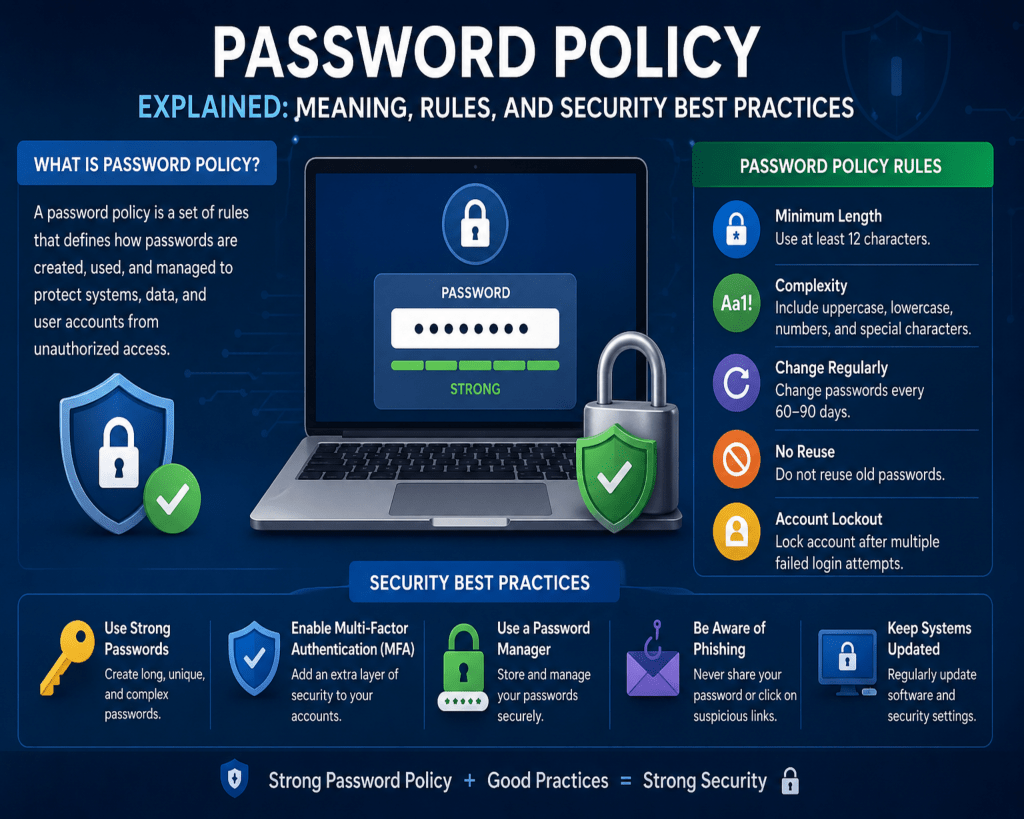
A password policy is a structured set of rules that defines how passwords are created, managed, and maintained within a digital system. It exists to ensure that authentication credentials are strong enough to resist unauthorized access attempts. In modern cybersecurity environments, password policies function as a foundational control layer for protecting sensitive data, user accounts, and organizational systems. These rules generally define minimum password length, character complexity, reuse restrictions, expiration cycles, and authentication behavior. The main purpose is to eliminate weak password choices and reduce predictable patterns that attackers frequently exploit. As digital threats continue to evolve, password policies provide a consistent and enforceable method of reducing risk while maintaining controlled access across systems and applications.
The Role of Password Policies in Strengthening Digital Security Systems
Password policies are essential in improving the overall resilience of digital security systems. They establish uniform standards for authentication, ensuring that weak or easily guessable passwords are not accepted. Without such controls, users may choose simple or repetitive passwords that significantly increase security risks. By enforcing structured requirements, password policies reduce the effectiveness of brute-force attacks, credential stuffing, and dictionary-based hacking techniques. These policies are widely used in enterprise networks and cloud-based infrastructures to maintain consistent protection standards. They also allow administrators to monitor authentication behavior more effectively, improving visibility and reducing the likelihood of unauthorized access.
Core Principles Behind Password Policy Design
The foundation of password policy design is built on several key security principles. One of the most important is unpredictability, which ensures that passwords cannot be easily guessed using personal information or common patterns. Another principle is complexity, which requires a combination of different character types to increase security strength. Length is also critical, as longer passwords significantly improve resistance against automated attacks. Uniqueness is equally important, preventing users from reusing passwords across multiple accounts. These principles work together to create a layered defense system that strengthens authentication and reduces exposure to cyber threats.
Password Complexity Requirements and Their Security Impact
Complexity requirements define the structural rules that passwords must follow. These typically include a mix of uppercase letters, lowercase letters, numbers, and special symbols. The goal is to eliminate predictable password patterns that attackers commonly exploit. Simple passwords based on dictionary words or personal details are highly vulnerable to automated cracking tools. By increasing complexity, password policies expand the number of possible combinations, making unauthorized access significantly more difficult. This requirement encourages users to move away from weak credentials and adopt stronger authentication practices that enhance overall system security.
Importance of Password Length in Security Enforcement
Password length plays a major role in determining overall password strength. Longer passwords increase the number of possible combinations exponentially, making them harder to crack through brute-force methods. Most password policies enforce a minimum length requirement to ensure baseline protection. Short passwords, even if complex, can still be vulnerable due to limited variation. Longer passphrases that combine unrelated words or characters provide stronger protection while remaining easier to remember. This approach improves security without placing excessive cognitive burden on users.
Password Expiration and Rotation Mechanisms in Security Systems
Password expiration policies require users to update their credentials after a specific time period. This reduces the risk of long-term exposure if a password is compromised. Regular rotation ensures that even if unauthorized access occurs, it cannot persist indefinitely. However, overly frequent changes can lead to predictable patterns, which may weaken security. Modern approaches often balance expiration policies with behavioral monitoring to detect suspicious activity. This helps maintain security while reducing unnecessary disruption for users.
Account Lockout Mechanisms as a Protective Barrier
Account lockout policies prevent repeated unauthorized login attempts. When a set number of incorrect password entries is reached, the account is temporarily locked. This mechanism is highly effective against brute-force attacks that rely on automated guessing. Lockout systems may include time delays or escalating restrictions after multiple failed attempts. These controls significantly reduce the success rate of unauthorized access attempts and strengthen overall authentication security.
Multi-Factor Authentication as an Extension of Password Policies
Multi-factor authentication adds an additional layer of security beyond passwords. It requires users to verify their identity using multiple factors such as a mobile device, biometric data, or authentication codes. This ensures that even if a password is compromised, unauthorized access is still prevented. Password policies that incorporate multi-factor authentication create a stronger security framework by combining knowledge-based and possession-based verification methods. This layered approach is widely recognized as highly effective in modern cybersecurity systems.
Password Storage and Encryption Standards in Secure Systems
Secure password storage is a critical component of any password policy. Instead of storing passwords in plain text, systems use hashing and encryption techniques to protect credentials. Hashing converts passwords into irreversible values, making it extremely difficult for attackers to retrieve original data. Additional methods like salting further strengthen protection by adding unique data before hashing. These practices ensure that even if a database is compromised, user passwords remain secure and unreadable.
User Behavior and Its Influence on Password Security
User behavior significantly impacts the effectiveness of password policies. Weak practices such as password reuse, predictable patterns, or sharing credentials can undermine even the strongest security systems. Password policies aim to guide users toward safer practices by enforcing structured rules. However, long-term effectiveness depends on user awareness and discipline. Encouraging secure habits helps reduce risks and strengthens overall authentication security across digital environments.
Balancing Security Requirements with User Usability
A key challenge in password policy design is balancing security with usability. Extremely strict rules can frustrate users and lead to insecure workarounds, while overly relaxed policies increase vulnerability. Effective password policies aim to maintain strong security standards while remaining practical for users. This includes optimizing length requirements, allowing passphrase-based authentication, and supporting user-friendly security practices. A balanced approach ensures both protection and compliance without negatively affecting user experience.
Organizational Importance of Standardized Password Policies
Standardized password policies are essential in organizational environments. They ensure consistent authentication practices across all users and systems. This reduces security gaps caused by inconsistent password behavior. Standardization also improves administrative control, allowing better monitoring and enforcement of security rules. In large-scale infrastructures, password policies contribute to centralized identity management, improving both efficiency and protection across digital systems.
Evolution of Password Policies in Modern Cybersecurity Frameworks
Password policies have evolved significantly over time due to increasing cyber threats. Early systems relied on simple password structures with minimal restrictions, making them highly vulnerable. Modern frameworks now include advanced security techniques such as adaptive authentication, behavioral analysis, and risk-based access control. These improvements reflect the growing complexity of digital environments and the need for stronger protection mechanisms. As cyber threats continue to evolve, password policies are expected to become more intelligent and adaptive in securing authentication systems.
Enterprise Implementation of Password Policies in Modern Systems
In enterprise environments, password policy implementation is a structured process that goes beyond simple rule creation. Organizations deploy password policies across centralized identity systems to ensure uniform enforcement across all users, devices, and applications. These policies are typically integrated into directory services and authentication frameworks that manage user identities at scale. The implementation process involves defining security parameters, aligning them with organizational risk levels, and enforcing them through automated identity management systems. This ensures that every authentication attempt is evaluated against consistent security standards. Enterprise implementation also focuses on scalability, allowing policies to adapt as organizations grow, add new systems, or migrate to cloud-based infrastructures. The objective is to maintain a unified security posture while minimizing administrative overhead and reducing the risk of inconsistent password practices across departments.
Role of Centralized Identity Systems in Password Policy Enforcement
Centralized identity systems play a critical role in enforcing password policies across large-scale environments. These systems act as a single source of truth for authentication and access management, ensuring that all users adhere to defined security rules. By centralizing identity control, organizations eliminate inconsistencies that may arise when different systems enforce different password standards. Centralized enforcement also allows administrators to apply updates globally, ensuring that security improvements are implemented uniformly. These systems support features such as password synchronization, policy enforcement, and real-time authentication validation. As a result, organizations gain better control over access management while improving security visibility across all connected resources.
Fine-Grained Password Policies and Role-Based Security Control
Fine-grained password policies allow organizations to apply different password rules based on user roles, departments, or security levels. This approach recognizes that not all users require the same level of security restrictions. High-privilege accounts, such as system administrators or security personnel, often require stronger password requirements, shorter expiration cycles, and additional authentication factors. Standard users may follow slightly less restrictive policies while still maintaining strong security standards. This role-based approach improves flexibility without compromising overall security. Fine-grained policies are particularly useful in large organizations where different teams have varying access needs. By customizing password rules based on risk exposure, organizations achieve a more balanced and efficient security model.
Common Password Attacks and Their Operational Mechanisms
Password attacks are among the most common methods used by cybercriminals to gain unauthorized access to systems. One of the most widely known methods is brute-force attack, where attackers attempt every possible combination until the correct password is found. Another method is dictionary attack, which uses precompiled lists of commonly used passwords and phrases. Credential stuffing is also prevalent, where attackers use previously leaked credentials to access multiple accounts due to password reuse. These attacks exploit human behavior and weak authentication practices rather than system vulnerabilities. Password policies are designed specifically to mitigate these risks by enforcing complexity, uniqueness, and account protection mechanisms. By increasing password strength and reducing predictability, organizations significantly reduce the success rate of these attack methods.
Brute Force Resistance Through Password Policy Design
Brute force resistance is directly influenced by password structure and complexity. Password policies increase resistance by enforcing longer passwords and requiring a combination of multiple character types. The larger the password space, the more computational power is required to attempt all possible combinations. Modern systems also introduce rate-limiting and account lockout mechanisms to slow down repeated login attempts. These measures significantly reduce the feasibility of brute-force attacks by making them time-consuming and resource-intensive. Additionally, advanced systems may incorporate detection mechanisms that identify abnormal login behavior and block suspicious activity in real time. This layered approach ensures that brute-force attempts are effectively neutralized before they can succeed.
Credential Stuffing and the Risk of Password Reuse
Credential stuffing attacks rely on the reuse of passwords across multiple platforms. When users reuse the same password across different systems, a single data breach can compromise multiple accounts. Attackers use automated tools to test leaked credentials on various platforms, exploiting this common behavior pattern. Password policies address this risk by encouraging or enforcing password uniqueness across systems. Some advanced security frameworks also monitor for known compromised passwords and prevent their reuse. By discouraging password repetition, organizations reduce the impact of external data breaches and limit the spread of unauthorized access across systems.
Password Storage Techniques and Cryptographic Protection
Secure password storage is a fundamental requirement in any authentication system. Instead of storing actual passwords, systems use cryptographic techniques to protect user credentials. Hashing is the primary method used, where passwords are transformed into fixed-length values that cannot be reversed. This ensures that even if data is exposed, original passwords remain hidden. Modern systems enhance hashing by using algorithms designed specifically for password protection, which are intentionally slow to reduce attack efficiency. These methods ensure that large-scale password cracking becomes computationally impractical. Proper storage techniques are essential for maintaining trust and preventing large-scale credential exposure.
Salting and Advanced Hash Protection Methods
Salting is an additional security measure used in password hashing. It involves adding random data to each password before hashing, ensuring that identical passwords produce different hash values. This prevents attackers from using precomputed tables to crack passwords efficiently. Salting significantly increases the complexity of password attacks by eliminating predictable hash patterns. In combination with strong hashing algorithms, salting provides a highly effective defense against offline password cracking attempts. This method is widely used in modern authentication systems to enhance data protection and reduce vulnerability exposure.
Passphrases as a Modern Alternative to Traditional Passwords
Passphrases have become increasingly popular as a secure alternative to traditional passwords. Instead of relying on short, complex strings, passphrases use longer combinations of words or phrases. This approach improves both security and memorability. Longer passphrases increase entropy, making them more resistant to brute-force attacks while remaining easier for users to remember. Password policies that support passphrases encourage users to create more secure credentials without increasing cognitive difficulty. This balance between usability and security makes passphrases an effective solution for modern authentication challenges.
Password Policy Enforcement in Cloud-Based Environments
Cloud-based systems introduce additional complexity to password policy enforcement due to distributed infrastructure and remote access requirements. Password policies in these environments must be consistently applied across multiple services and access points. Identity synchronization ensures that policy changes are reflected across all connected systems in real time. Cloud environments also benefit from adaptive security mechanisms that evaluate login behavior and adjust authentication requirements based on risk levels. This dynamic approach enhances security while maintaining accessibility for legitimate users. As cloud adoption continues to grow, password policy enforcement plays an increasingly important role in maintaining secure access control.
Security Monitoring and Anomaly Detection in Authentication Systems
Modern password policies are often supported by continuous monitoring systems that analyze authentication behavior. These systems detect unusual login patterns, such as multiple failed attempts, access from unfamiliar locations, or irregular login times. When anomalies are detected, additional security measures may be triggered, such as account verification or temporary access restrictions. This proactive approach allows organizations to identify potential security threats before they escalate. Behavioral monitoring enhances traditional password policies by adding an intelligent layer of protection that adapts to real-time risk conditions.
Password Policy Compliance and Organizational Security Standards
Compliance with password policies is essential for maintaining organizational security standards. Many industries require strict adherence to authentication guidelines to protect sensitive data and meet regulatory requirements. Compliance ensures that all users follow consistent security practices, reducing the likelihood of internal vulnerabilities. Organizations often implement auditing systems to verify adherence to password rules and identify potential weaknesses. Regular compliance checks help maintain security integrity and ensure that authentication systems remain aligned with evolving cybersecurity standards.
Common Misconfigurations in Password Policy Implementation
Misconfigurations in password policies can significantly weaken system security. One common issue is setting overly simple requirements that fail to provide adequate protection. Another issue is excessive complexity that leads users to adopt insecure behaviors such as writing down passwords or reusing them across systems. Improper expiration settings can also create predictable password patterns. Inconsistent enforcement across systems further increases vulnerability. Identifying and correcting these misconfigurations is essential for maintaining a strong security posture. Proper policy design requires balancing security requirements with practical usability considerations.
Human Factors in Password Security Failures
Human behavior remains one of the most significant factors affecting password security. Users often prioritize convenience over security, leading to weak password choices or reuse across multiple accounts. Social engineering attacks further exploit human tendencies by tricking users into revealing credentials. Password policies aim to reduce these risks by enforcing structured rules, but long-term success depends on user awareness and adherence. Addressing human factors requires combining technical controls with behavioral guidance to ensure that users understand the importance of secure authentication practices.
Adaptive Password Policies in Modern Cybersecurity Systems
Adaptive password policies represent an advanced approach to authentication security. Instead of applying static rules, these systems adjust requirements based on contextual risk factors. For example, login attempts from unfamiliar locations or devices may trigger additional authentication requirements. This dynamic approach improves security while minimizing unnecessary restrictions for trusted users. Adaptive systems enhance traditional password policies by introducing flexibility and intelligence into authentication processes. As cyber threats become more sophisticated, adaptive policies provide a more responsive and effective security framework.
Advanced Threat Landscape in Password-Based Authentication Systems
Modern password-based authentication systems operate in an environment shaped by continuously evolving cyber threats. Attackers no longer rely on simple guessing techniques; instead, they use automated frameworks, distributed computing power, and intelligence-driven methods to bypass authentication controls. These threats include large-scale credential harvesting campaigns, automated login bots, and AI-assisted password prediction systems that analyze human behavior patterns. Password policies are designed to counter these evolving risks by increasing the complexity, uniqueness, and unpredictability of authentication credentials. However, as attack sophistication increases, password policies must also evolve into adaptive and intelligence-driven security mechanisms. This shift reflects the broader transformation of cybersecurity from static rule enforcement to dynamic threat mitigation.
Automated Password Cracking Techniques and Defense Mechanisms
Automated password cracking tools have become significantly more advanced, leveraging high-performance computing systems and optimized algorithms to test billions of combinations per second. These tools often use hybrid methods that combine dictionary attacks with pattern-based mutations, increasing their effectiveness against weak passwords. Attackers also utilize GPU acceleration to drastically reduce the time required for brute-force attacks. Password policies counter these techniques by enforcing long passphrases, complexity requirements, and rate-limiting mechanisms. Additionally, modern systems incorporate detection layers that identify abnormal authentication patterns and block automated requests. This combination of structural password strength and behavioral monitoring significantly reduces the success rate of automated cracking attempts.
Behavioral Authentication and Its Integration with Password Systems
Behavioral authentication introduces an additional dimension to password security by analyzing user interaction patterns. These patterns may include typing rhythm, mouse movement, login timing, and device usage behavior. When combined with traditional password policies, behavioral authentication provides a continuous verification layer that operates beyond initial login credentials. This means that even if a password is compromised, unauthorized users may still be detected based on behavioral inconsistencies. This approach enhances security by shifting authentication from a single static event to an ongoing validation process. It also reduces reliance on frequent password changes while maintaining strong protection against unauthorized access.
Zero Trust Architecture and Password Policy Evolution
Zero Trust architecture represents a modern security model where no user or system is automatically trusted, even if they are within the network perimeter. In this model, password policies are only one component of a broader authentication framework. Every access request is continuously verified based on identity, device health, location, and behavioral signals. Passwords alone are no longer sufficient for granting access to sensitive systems. Instead, they function as an initial authentication layer within a multi-step verification process. This approach significantly reduces the risk of lateral movement within networks and ensures that compromised credentials cannot be easily exploited.
Risk-Based Authentication and Dynamic Password Enforcement
Risk-based authentication adjusts security requirements based on the perceived risk of a login attempt. If a login attempt appears normal, standard password authentication may be sufficient. However, if unusual behavior is detected, additional verification steps are triggered. These may include multi-factor authentication, device verification, or temporary access restrictions. Password policies in this context become dynamic rather than static, adapting to real-time threat conditions. This approach improves both security and user experience by applying stronger controls only when necessary. It represents a shift from rigid password enforcement to intelligent, context-aware security systems.
Enterprise Identity Governance and Password Lifecycle Management
Identity governance plays a critical role in managing the entire lifecycle of passwords within enterprise environments. This includes password creation, usage, modification, and eventual expiration or reset. Governance systems ensure that password policies are consistently applied across all users and systems. They also provide auditing capabilities that track authentication events and identify policy violations. Lifecycle management helps organizations maintain control over credentials even as employees join, leave, or change roles. By enforcing structured governance, organizations reduce the risk of orphaned accounts and unauthorized access caused by outdated credentials.
Privileged Access Management and High-Security Password Controls
Privileged accounts represent the highest level of risk in any digital environment because they have elevated access to critical systems and data. Password policies for these accounts are significantly stricter than those for standard users. They often require longer passwords, more frequent rotation, and mandatory multi-factor authentication. Privileged access management systems also monitor and control how these accounts are used, ensuring that access is granted only when necessary. These controls reduce the risk of internal misuse and external compromise. By isolating high-risk accounts and enforcing strict password policies, organizations strengthen their overall security posture.
Password Policy Auditing and Continuous Compliance Monitoring
Auditing is a crucial component of maintaining effective password policies. It involves continuously reviewing authentication logs, password compliance levels, and system configuration settings. Automated auditing systems can detect weak passwords, policy violations, and unusual authentication patterns. Continuous monitoring ensures that security standards are consistently enforced across all systems. It also helps organizations identify emerging risks before they escalate into security incidents. Regular audits support compliance with industry standards and regulatory requirements, ensuring that password policies remain effective and up to date.
Common Human Psychology Exploited in Password Attacks
Attackers often exploit predictable human behavior to compromise passwords. Many users tend to choose passwords based on personal information, such as names, dates, or familiar phrases. Others prefer convenience over security, leading to password reuse across multiple platforms. Social engineering techniques further manipulate users into revealing credentials through deception or psychological pressure. Password policies aim to counter these behaviors by enforcing structured rules that eliminate predictability. However, long-term effectiveness depends on user awareness and behavioral change. Understanding psychological patterns is essential for designing policies that are both secure and user-friendly.
Password Fatigue and Its Impact on Security Behavior
Password fatigue occurs when users are overwhelmed by the need to manage multiple complex passwords across different systems. This often leads to insecure practices such as password reuse, simplification, or writing passwords down. While password policies aim to increase security, overly strict requirements can unintentionally contribute to fatigue. This creates a paradox where stronger rules may lead to weaker real-world behavior. To address this issue, modern security systems incorporate password management tools, single sign-on solutions, and adaptive authentication methods. These approaches reduce cognitive burden while maintaining strong security standards.
Single Sign-On Systems and Centralized Authentication Models
Single sign-on systems allow users to access multiple applications using a single set of credentials. This reduces the need to manage multiple passwords and improves overall user experience. However, it also increases the importance of strong password policies because a single compromised credential can grant access to multiple systems. Centralized authentication models rely heavily on robust password enforcement combined with additional security layers such as multi-factor authentication. This approach simplifies user management while maintaining strong security controls across interconnected systems.
Cloud Identity Security and Distributed Authentication Challenges
Cloud environments introduce unique challenges for password policy enforcement due to their distributed nature. Users may access systems from multiple devices, locations, and networks, increasing the attack surface. Password policies in cloud systems must be synchronized across all services to ensure consistent enforcement. Identity federation allows users to authenticate across multiple platforms using centralized credentials. However, this also increases dependency on strong password security. Cloud identity systems often incorporate adaptive authentication, behavioral analysis, and continuous risk assessment to enhance protection in distributed environments.
Artificial Intelligence in Password Security and Threat Detection
Artificial intelligence is increasingly being used to enhance password security and detect threats. AI systems can analyze login patterns, detect anomalies, and identify potential credential misuse in real time. Machine learning models are capable of recognizing subtle deviations in user behavior that may indicate compromised accounts. AI is also used by attackers to generate more sophisticated password guessing techniques, creating an ongoing cycle of defense and adaptation. Password policies must therefore evolve to incorporate AI-driven monitoring and predictive security mechanisms. This integration improves both detection speed and accuracy in identifying potential threats.
Encryption Evolution and Modern Cryptographic Standards
Encryption standards used in password protection have evolved significantly over time. Early systems relied on basic hashing methods, which are now considered insufficient against modern attacks. Contemporary systems use advanced cryptographic algorithms designed specifically for password storage and protection. These algorithms are intentionally computationally expensive to slow down brute-force attempts. Combined with salting and iterative hashing techniques, modern encryption ensures that even large-scale data breaches do not easily expose actual passwords. Continuous improvements in cryptographic standards are essential for maintaining long-term password security.
Future of Password Policies in Post-Password Security Models
The future of password policies is closely linked to the evolution of passwordless authentication systems. Emerging technologies such as biometrics, hardware-based authentication, and cryptographic identity systems are gradually reducing reliance on traditional passwords. However, passwords are still widely used and are expected to remain part of authentication systems for the foreseeable future. Future password policies will likely become more adaptive, intelligent, and integrated with behavioral and contextual security models. The focus will shift from static password enforcement to continuous identity verification and risk-based access control.
Long-Term Security Strategy and Continuous Policy Optimization
Effective password security is not a one-time implementation but an ongoing process that requires continuous optimization. Threat landscapes change over time, and password policies must evolve accordingly. Organizations must regularly review authentication practices, update security standards, and adopt new technologies to stay ahead of attackers. Continuous improvement ensures that password policies remain effective in protecting digital assets. Long-term security strategies focus on combining human awareness, technological enforcement, and adaptive intelligence to create a resilient authentication ecosystem capable of responding to future cyber threats.
Final Overview of Password Policy in Modern Cybersecurity
A password policy represents one of the most fundamental elements of digital security architecture. It is the structured framework that governs how authentication credentials are created, managed, stored, and protected across systems. In an environment where data breaches, identity theft, and unauthorized access attempts are increasingly sophisticated, password policies serve as the first line of defense for protecting digital identities and sensitive information. Their importance extends beyond technical enforcement; they shape user behavior, organizational security culture, and the overall resilience of digital infrastructures.
At its core, a password policy is designed to eliminate weak authentication practices. Weak passwords remain one of the most exploited vulnerabilities in cybersecurity. Attackers often rely on predictable patterns, reused credentials, and human behavior to gain unauthorized access. A well-designed password policy directly addresses these risks by enforcing complexity, length, uniqueness, and structured lifecycle management. These requirements ensure that passwords cannot be easily guessed, reused, or cracked through automated methods.
One of the most significant strengths of password policies lies in their ability to increase computational difficulty for attackers. When passwords are long, complex, and unpredictable, the number of possible combinations increases exponentially. This makes brute-force attacks impractical and time-consuming. Even with modern computing power, properly enforced password rules significantly slow down unauthorized attempts, often rendering them ineffective before success can be achieved. This computational barrier remains one of the simplest yet most effective forms of cybersecurity defense.
However, password security is not only a mathematical problem. It is also deeply connected to human behavior. Users often prioritize convenience over security, leading to predictable choices such as simple words, repeated patterns, or personal information. This behavioral tendency is one of the biggest challenges in authentication security. Password policies attempt to correct this by enforcing structured constraints, but their effectiveness depends heavily on user understanding and compliance. When users do not fully understand the importance of strong credentials, they may adopt insecure workarounds that weaken the entire system.
To address this issue, modern security frameworks increasingly emphasize user awareness alongside technical enforcement. Educating users about secure password creation, the risks of reuse, and the dangers of predictable patterns plays a crucial role in strengthening overall security. When users understand why certain rules exist, they are more likely to follow them consistently. This alignment between policy and behavior is essential for long-term effectiveness.
Another critical aspect of password security is the integration of multi-layered authentication systems. Passwords alone are no longer sufficient in high-risk environments. Multi-factor authentication introduces additional verification layers, such as temporary codes, biometric checks, or device-based authentication. This ensures that even if a password is compromised, unauthorized access is still prevented. The combination of something known (password) and something possessed or inherent (device or biometric data) creates a significantly stronger security barrier.
In addition to authentication layers, secure storage practices are equally important. Passwords must never be stored in plain text. Instead, cryptographic hashing techniques are used to transform passwords into irreversible representations. Even if a system is breached, attackers cannot easily reconstruct original credentials. Salting further strengthens this process by adding unique random data to each password before hashing. These techniques ensure that large-scale data leaks do not directly translate into usable credentials.
Modern cybersecurity environments also rely heavily on continuous monitoring and adaptive security mechanisms. Instead of relying solely on static password rules, systems now analyze behavior, login patterns, and contextual signals. Unusual login attempts, such as access from unfamiliar locations or devices, can trigger additional verification steps. This dynamic approach significantly improves security by detecting threats in real time rather than relying only on predefined rules.
Despite these advancements, password fatigue remains a persistent challenge. As users are required to manage multiple accounts across different systems, they often struggle to maintain strong and unique credentials for each one. This leads to risky behaviors such as password reuse or simplification. To mitigate this, organizations increasingly adopt centralized authentication systems and secure password management solutions. These tools reduce cognitive load while maintaining strong security standards across multiple platforms.
Another evolving aspect of authentication security is the gradual shift toward passwordless systems. While traditional passwords are still widely used, newer technologies such as biometric authentication and hardware-based security keys are becoming more common. These methods reduce reliance on memorized credentials and significantly decrease the risk of phishing and credential theft. However, even in passwordless environments, foundational principles of identity verification remain essential.
The importance of password policies also extends into regulatory and compliance frameworks. Many industries require strict adherence to authentication standards to protect sensitive data and ensure privacy. These requirements are not optional; they are legally and operationally necessary. Strong password policies help organizations meet these obligations while also reducing exposure to financial and reputational risks associated with data breaches.
From an organizational perspective, password policies contribute to overall security governance. They provide structure, consistency, and accountability in how access is managed across systems. Without standardized policies, security becomes fragmented, increasing the likelihood of vulnerabilities. Consistency ensures that all users, regardless of role or department, follow the same baseline security principles, reducing weak points within the system.
Looking at the broader cybersecurity landscape, password policies continue to evolve in response to increasingly advanced threats. Attackers are constantly developing new methods, including artificial intelligence-driven password guessing and large-scale credential analysis. In response, security systems are becoming more intelligent, adaptive, and behavior-driven. The future of password security will likely involve deeper integration with artificial intelligence, real-time risk analysis, and continuous identity verification.
Ultimately, password policies represent a balance between security enforcement and practical usability. If policies are too weak, systems become vulnerable. If they are too strict, users may find ways to bypass them. The most effective approach lies in achieving equilibrium—creating systems that are secure, intuitive, and adaptive to real-world usage patterns.
In a digital world where identity is the primary target of cyberattacks, password policies remain a critical safeguard. They are not just technical rules but foundational elements of trust, security, and digital integrity. Their role will continue to evolve, but their core purpose will remain the same: to protect access, preserve confidentiality, and ensure that only authorized users can enter secure digital environments.