Modern IT environments no longer operate on the assumption that beginners will start with narrowly defined responsibilities. Entry-level professionals are increasingly expected to interact with interconnected systems that span devices, networks, cloud services, and security layers. This shift has been driven by the integration of digital infrastructure into almost every business function, where even basic support roles require awareness of system-wide behavior rather than isolated technical tasks.
The expectation today is not limited to performing scripted troubleshooting steps. Instead, individuals are required to interpret system behavior, identify patterns across multiple technologies, and respond to unpredictable operational scenarios. This evolution has changed how foundational IT capability is measured. It is no longer sufficient to know definitions or memorize procedures; professionals must demonstrate an ability to reason through technical environments where multiple variables interact simultaneously.
This environment places strong emphasis on adaptability. Systems are frequently updated, workflows change, and organizations adopt hybrid infrastructures combining legacy systems with modern cloud-based services. Entry-level professionals must therefore be capable of transitioning between different contexts without losing clarity of reasoning or operational accuracy.
How Foundational Certification Maps to Workplace Reality
Foundational IT certification is designed to reflect this complexity by simulating real-world operational expectations. Rather than focusing on theoretical knowledge alone, it evaluates how individuals respond to layered technical situations. These situations often combine hardware issues, software misbehavior, and network inconsistencies within a single scenario, requiring structured analysis to resolve effectively.
The workplace reality in IT support roles involves constant interaction with unpredictable systems. Devices may behave inconsistently depending on load, configuration, or environmental conditions. Applications may fail due to dependency conflicts or misconfigured services. Networks may exhibit latency or connectivity issues that require careful isolation of contributing factors. Foundational certification aligns with these conditions by emphasizing structured reasoning over rote memorization.
This alignment ensures that individuals entering IT environments are not surprised by the complexity of real-world operations. Instead, they are trained to approach problems systematically, using logical frameworks that can be applied consistently across different situations. This reduces error rates and improves efficiency in live environments where time and accuracy are critical.
Structural Composition of Foundational IT Certification
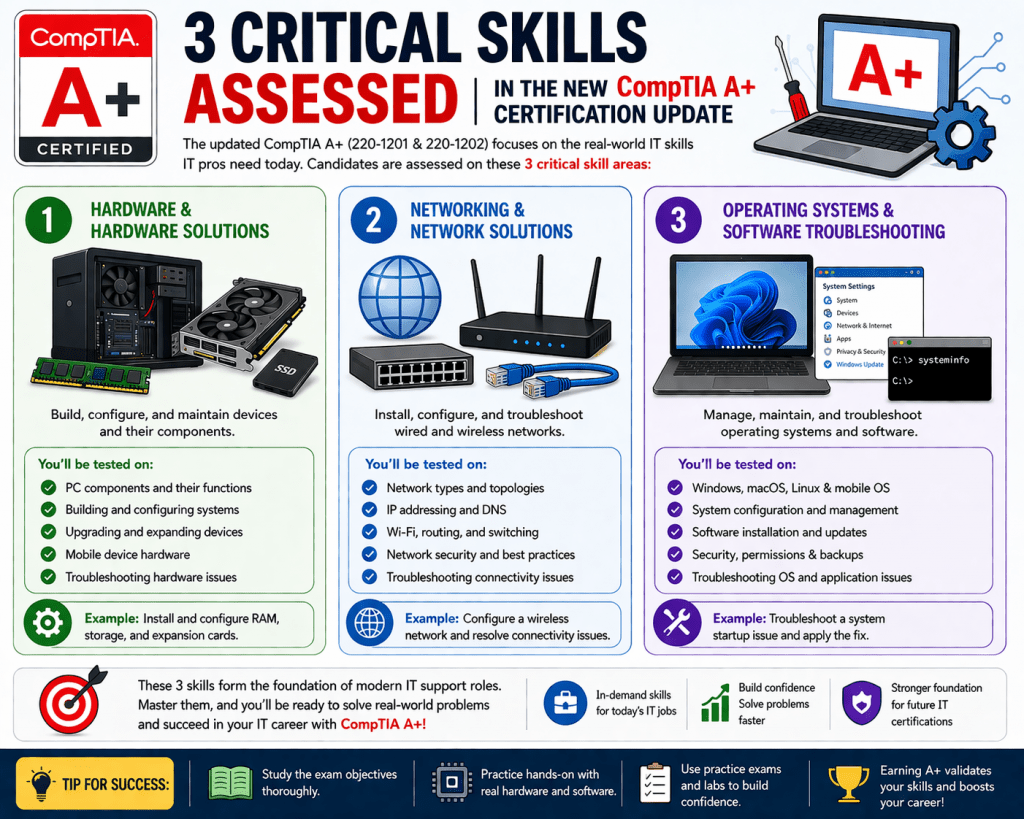
The architecture of entry-level IT certification is intentionally divided into multiple domains that reflect the layered nature of technology systems. These domains typically include device support, network fundamentals, operating system behavior, security principles, and operational procedures. Each domain represents a distinct but interconnected aspect of IT environments.
Device support focuses on understanding how physical components function and interact. This includes processing units, memory systems, storage technologies, and peripheral devices. Network fundamentals address how systems communicate, how data is transmitted, and how connectivity is maintained across different infrastructures. Operating system behavior introduces concepts related to system management, process control, and user interaction layers.
Security principles are integrated across all domains rather than isolated as a separate topic. This reflects the reality that security considerations exist at every level of IT operations. Operational procedures complete the structure by ensuring that technical actions are aligned with organizational processes, communication standards, and documentation requirements.
This multi-domain structure ensures that candidates develop a balanced understanding of IT environments rather than focusing on a single specialized area. It reflects the interdisciplinary nature of modern technology roles where multiple systems must be understood simultaneously.
Cognitive Skills Beyond Technical Memorization
One of the most important aspects of foundational IT certification is its emphasis on cognitive skill development. This includes analytical reasoning, pattern recognition, and structured decision-making. These cognitive abilities are essential because IT environments rarely present problems in clearly defined formats.
Technical issues often manifest through indirect symptoms. A system slowdown may not immediately indicate whether the cause is hardware degradation, software conflict, or network congestion. Identifying the root cause requires the ability to analyze multiple signals and eliminate improbable causes through logical deduction.
This type of thinking goes beyond memorized procedures. It requires professionals to construct mental models of system behavior and adjust those models based on observed outcomes. Over time, this develops a more intuitive understanding of how systems interact, allowing for faster and more accurate problem resolution.
Cognitive flexibility is also critical. IT professionals must be able to shift between different layers of abstraction, moving from high-level system behavior to low-level technical diagnostics as needed. This ability to navigate between conceptual and operational thinking is a core outcome of foundational certification frameworks.
Systems Thinking in Complex IT Environments
Modern IT infrastructure is not composed of isolated components but rather interconnected systems that depend on each other for functionality. Systems thinking refers to the ability to understand how different elements interact within this broader structure.
For example, a user-facing application may depend on database performance, network latency, authentication services, and hardware resources simultaneously. A failure in any one of these areas can produce similar symptoms at the user level. Without systems thinking, troubleshooting becomes inefficient and often misdirected.
Developing systems thinking allows IT professionals to map relationships between components and identify indirect dependencies. This improves diagnostic accuracy and reduces the time required to isolate issues. It also enhances preventative maintenance, as professionals can anticipate how changes in one part of the system may affect others.
This approach is especially important in environments that use hybrid infrastructure, where cloud services, local servers, and distributed systems operate together. Understanding these relationships is essential for maintaining stability and ensuring consistent performance across all operational layers.
Hardware Diagnostics and Physical System Interpretation
Hardware remains a foundational element of IT systems despite the increasing dominance of virtualized environments. Physical components still influence performance, reliability, and system behavior in significant ways. Understanding hardware diagnostics is therefore a critical skill in entry-level IT roles.
Hardware issues often present themselves through indirect symptoms such as system instability, unexpected shutdowns, or performance degradation. Diagnosing these issues requires an understanding of how components such as memory modules, storage devices, and processors interact under different workloads.
Physical system interpretation also involves recognizing environmental factors such as overheating, power fluctuations, and hardware aging. These factors can significantly impact system performance and must be considered during troubleshooting processes.
The ability to differentiate between hardware and software-related issues is particularly important. Misidentifying the source of a problem can lead to ineffective solutions and prolonged system downtime. Structured diagnostic reasoning helps prevent such errors by encouraging systematic elimination of potential causes.
Interpreting Network Behavior in Integrated Systems
Networking is a foundational layer that connects all digital systems within an organization. Even in roles that are not explicitly network-focused, understanding basic network behavior is essential for diagnosing connectivity issues and system communication failures.
Network-related problems often appear as application errors or system delays rather than direct network alerts. This makes it necessary for IT professionals to interpret indirect indicators such as latency, packet loss, or authentication failures.
Understanding how data flows through network layers allows professionals to identify where breakdowns occur. This includes recognizing whether issues originate at the device level, within local infrastructure, or across external connections.
In complex environments, multiple network paths may exist simultaneously, adding further complexity to diagnostics. Structured reasoning is required to isolate variables and determine whether issues are systemic or localized. This analytical approach is essential for maintaining stable and reliable connectivity across organizational systems.
Operating System Behavior and Internal System Logic
Operating systems form the core interface between hardware and software applications. Understanding how operating systems manage resources, execute processes, and handle user interactions is essential for diagnosing system-level issues.
System behavior can be influenced by background processes, resource allocation conflicts, or configuration inconsistencies. Recognizing these factors requires familiarity with how operating systems prioritize tasks and manage system resources.
Different operating systems may behave differently under similar conditions, requiring professionals to adapt their understanding based on the environment. This adaptability is particularly important in organizations that use multiple operating systems simultaneously.
Analyzing system behavior also involves understanding logs, performance metrics, and system alerts. These indicators provide insight into internal processes and help identify irregularities that may not be immediately visible through user-facing symptoms.
Security Awareness Embedded in Technical Operations
Security is not a separate function in modern IT environments but an integrated aspect of all technical operations. Every system interaction has potential security implications, whether related to data access, network communication, or system configuration.
Security awareness involves recognizing potential vulnerabilities and understanding how system behavior can be exploited. This includes awareness of unauthorized access attempts, misconfigurations, and insecure communication channels.
Entry-level IT professionals are expected to apply security principles during routine operations. This includes following access control protocols, verifying system integrity, and ensuring that changes do not introduce unnecessary risk.
Security-conscious thinking also involves understanding the broader impact of technical decisions. A configuration change that improves performance may inadvertently reduce security, while strict security controls may impact usability. Balancing these factors is a key aspect of operational decision-making.
Relevance of Foundational Certification in Automated Environments
As automation becomes increasingly prevalent in IT environments, some assume that foundational technical skills may become less relevant. However, automation systems still rely on underlying infrastructure that must be understood and maintained by human operators.
Automated systems can execute predefined tasks efficiently, but they cannot fully replace human reasoning when unexpected issues arise. When automation fails or produces unintended results, professionals must intervene using foundational technical knowledge to diagnose and resolve the issue.
Understanding how automated processes interact with underlying systems is therefore essential. Without this understanding, it becomes difficult to troubleshoot automation failures or optimize system performance effectively.
Foundational certification remains relevant because it builds the conceptual framework required to understand both manual and automated systems. It ensures that professionals are capable of working in environments where automation supports but does not replace human decision-making.
Expanding Technical Competence Beyond Foundational Knowledge
As IT environments grow more interconnected, entry-level professionals are expected to move beyond basic familiarity and develop applied technical competence. This means not only recognizing system components but also understanding how those components behave under real operational conditions. In modern workplaces, systems rarely function in isolation, and most issues arise from interactions between multiple layers such as hardware performance, operating system behavior, network communication, and application dependencies.
Technical competence in this context refers to the ability to interpret system signals and translate them into actionable insights. For example, a slowdown in application response time may not originate from the application itself. It could be caused by insufficient memory allocation, background process contention, network latency, or storage bottlenecks. Identifying the true source requires structured evaluation rather than surface-level observation.
This depth of understanding is what differentiates routine task execution from professional-level IT support capability. Entry-level certification frameworks emphasize this transition by exposing learners to scenarios where multiple systems intersect, forcing them to think in terms of interconnected infrastructure rather than isolated tools or commands.
Advanced Troubleshooting as a Structured Analytical Process
Troubleshooting in IT environments is not a random attempt to fix problems but a disciplined analytical process. This process begins with accurate identification of symptoms, followed by hypothesis formation, controlled testing, and verification of resolution. Each step is designed to reduce uncertainty and eliminate incorrect assumptions.
In practical environments, troubleshooting often involves incomplete information. Systems may fail intermittently, logs may be unclear, and symptoms may appear inconsistent. In such cases, professionals must rely on structured reasoning rather than guesswork. This includes isolating variables, reproducing issues under controlled conditions, and systematically eliminating potential causes.
A key aspect of advanced troubleshooting is prioritization. Not all system issues carry the same level of urgency or impact. Professionals must assess which problems affect critical services and which can be addressed later. This requires both technical understanding and situational awareness of organizational priorities.
Another important dimension is validation. After applying a fix, it is not enough to assume the issue is resolved. Systems must be tested under expected operating conditions to confirm stability. This ensures that solutions are durable and do not introduce secondary issues.
Device Lifecycle Awareness and Hardware Stability Factors
Modern IT environments rely heavily on a wide range of devices, each with its own lifecycle and performance characteristics. Understanding how hardware ages and degrades over time is essential for maintaining system stability. Components such as storage drives, memory modules, and power supplies do not fail abruptly in most cases; instead, they exhibit gradual performance degradation before complete failure.
Device lifecycle awareness involves recognizing early warning signs such as increased error rates, performance inconsistencies, or unusual system behavior. These indicators often precede more serious failures and can be used to proactively address issues before they impact operations.
Environmental factors also play a significant role in hardware stability. Temperature fluctuations, dust accumulation, and power instability can all contribute to reduced hardware lifespan. IT professionals must therefore consider both internal system behavior and external environmental conditions when diagnosing hardware-related issues.
Understanding hardware lifecycle management also includes knowledge of replacement planning and maintenance scheduling. Organizations often rely on predictive maintenance strategies to reduce downtime and ensure continuity of operations.
Network Behavior Interpretation in Real Operational Scenarios
Network systems form the communication backbone of modern IT infrastructure. However, network-related issues are often among the most difficult to diagnose because they may manifest indirectly at the application or system level. For example, a user may experience slow application performance without realizing that the underlying issue is network congestion or routing inefficiency.
Interpreting network behavior requires an understanding of how data moves through different layers of infrastructure. This includes local device communication, internal routing paths, and external connectivity to cloud services or remote systems. Each layer introduces potential points of failure that must be considered during diagnostics.
Latency, packet loss, and bandwidth limitations are key indicators of network health. However, interpreting these metrics requires context. A small amount of latency may be acceptable in one environment but problematic in another depending on application requirements.
Network troubleshooting also involves distinguishing between local and external issues. For example, if multiple users experience connectivity problems, the issue is likely network-wide rather than device-specific. Conversely, isolated issues may indicate individual device misconfiguration or hardware faults.
Operating System Internal Mechanics and Process Management
Operating systems manage the interaction between hardware resources and software applications. Understanding how this management occurs internally is essential for diagnosing performance issues and system instability.
At a fundamental level, operating systems allocate resources such as CPU time, memory space, and storage access to running processes. When resource allocation becomes inefficient or conflicts arise between processes, system performance can degrade significantly.
Process management includes prioritization, scheduling, and termination of tasks. Some processes operate in the background and may consume resources without immediate visibility to the user. Identifying these processes is critical when diagnosing performance-related issues.
Operating systems also maintain logs and system records that provide insight into internal behavior. These logs can reveal errors, warnings, and operational patterns that help diagnose underlying problems. Interpreting these logs requires familiarity with system structure and event categorization.
Different operating systems implement process management differently, meaning professionals must adapt their diagnostic approach depending on the environment. This adaptability is essential in organizations that use multiple operating systems simultaneously.
Security Principles Embedded in Operational Decision-Making
Security considerations are deeply integrated into every aspect of IT operations. Rather than being treated as a separate discipline, security is embedded into system configuration, user management, network design, and operational procedures.
One of the key aspects of security awareness is understanding access control. This includes determining who has permission to access specific resources and ensuring that permissions are aligned with organizational policies. Misconfigured access controls are among the most common sources of security vulnerabilities.
Another important aspect is system hardening, which involves configuring systems to reduce their exposure to potential threats. This may include disabling unnecessary services, enforcing authentication requirements, and monitoring system activity for unusual behavior.
Security also extends to data handling practices. IT professionals must understand how sensitive information is stored, transmitted, and accessed. Even routine tasks such as file sharing or system updates can introduce security risks if not managed properly.
A strong security mindset requires continuous evaluation of potential risks during all technical operations. Every configuration change, system update, or network adjustment must be assessed for its security implications.
Operational Efficiency Through Structured IT Processes
Operational efficiency in IT environments depends heavily on structured processes that guide how tasks are performed and documented. These processes ensure consistency, reduce errors, and improve collaboration between team members.
Documentation plays a critical role in operational efficiency. Accurate records of system configurations, changes, and incidents allow teams to track system behavior over time and identify recurring issues. Without proper documentation, troubleshooting becomes significantly more difficult.
Change management is another essential process. It ensures that modifications to systems are reviewed, tested, and approved before implementation. This reduces the risk of unintended consequences and helps maintain system stability.
Incident management processes define how technical issues are reported, escalated, and resolved. Clear escalation paths ensure that problems are addressed by appropriately skilled personnel and that critical issues receive timely attention.
Operational efficiency is also influenced by communication practices. Clear and structured communication between technical teams and non-technical stakeholders ensures that expectations are aligned and misunderstandings are minimized.
Performance-Based Problem Solving in Dynamic Environments
In real-world IT environments, problem-solving often occurs under time constraints and incomplete information. Performance-based problem solving evaluates the ability to apply technical knowledge in dynamic scenarios where conditions may change during analysis.
These scenarios require simultaneous consideration of multiple factors. For example, a system issue may involve hardware limitations, software conflicts, and network delays all occurring at the same time. Effective resolution requires prioritizing which factors to investigate first.
Decision-making under pressure is an important aspect of this skill. IT professionals must balance speed with accuracy, ensuring that solutions are both effective and stable. Rushed decisions may temporarily resolve issues but create long-term instability.
Performance-based environments also test adaptability. As new information becomes available, professionals must adjust their approach without losing focus on the overall objective. This flexibility is essential in environments where system behavior is unpredictable.
Interconnected System Dependencies and Risk Awareness
Modern IT systems are highly interdependent, meaning that changes in one area can have unintended effects elsewhere. Understanding these dependencies is critical for maintaining system stability and reducing operational risk.
For example, updating a software component may affect compatibility with other applications. Similarly, modifying network configurations may impact system communication across multiple services. Without awareness of these dependencies, changes can introduce widespread issues.
Risk awareness involves evaluating potential consequences before implementing changes. This includes considering both immediate and long-term effects on system performance, security, and usability.
IT professionals must also be aware of cascading failures, where a single issue triggers multiple downstream problems. Identifying these risks requires systems thinking and a deep understanding of infrastructure relationships.
Adaptation to Hybrid and Distributed IT Environments
Modern IT infrastructure is increasingly distributed across on-premises systems, cloud platforms, and hybrid environments. This distribution introduces additional complexity in system management and troubleshooting.
In hybrid environments, data and applications may move between different platforms depending on performance, cost, or scalability requirements. IT professionals must understand how these systems interact and how data flows between environments.
Distributed systems also introduce challenges related to synchronization, latency, and consistency. Diagnosing issues in such environments requires a broader perspective that considers multiple infrastructure layers simultaneously.
Adaptation to these environments requires continuous learning and flexibility. As technologies evolve, professionals must update their understanding of how systems operate across different platforms and architectures.
Building Analytical Confidence in Technical Decision-Making
Confidence in technical decision-making comes from repeated exposure to structured problem-solving scenarios. Over time, professionals develop the ability to recognize patterns, anticipate system behavior, and make informed decisions based on incomplete information.
This analytical confidence is essential in IT roles where hesitation can lead to prolonged downtime or unresolved issues. However, confidence must be balanced with caution to avoid incorrect assumptions.
Developing this balance requires experience, structured learning, and consistent application of troubleshooting methodologies. As professionals gain exposure to increasingly complex systems, their ability to make accurate decisions improves significantly.
Analytical confidence also enhances communication with stakeholders, allowing IT professionals to explain technical issues in clear and structured terms that can be understood by non-technical audiences.
The Expanding Role of Entry-Level IT Professionals in Modern Infrastructure
Entry-level IT roles have evolved significantly due to the increasing complexity of digital infrastructure. Organizations no longer operate in environments where systems are isolated or predictable. Instead, they rely on interconnected ecosystems that combine cloud platforms, on-premises servers, mobile devices, virtual environments, and distributed applications. Within this structure, even foundational IT professionals are expected to understand how these systems interact at a basic operational level.
This shift has changed the expectations placed on individuals entering the field. Rather than focusing solely on task execution, professionals are now expected to interpret system behavior, recognize anomalies, and contribute to problem resolution in real time. The modern IT environment rewards individuals who can think beyond individual tools and instead understand how entire systems behave as unified structures.
Entry-level certification frameworks reflect this reality by evaluating not only technical knowledge but also analytical reasoning and operational awareness. These competencies are essential because IT environments rarely present problems in isolation. A single user issue may involve multiple systems working together, and resolving it requires a holistic understanding of infrastructure behavior.
How IT Systems Operate as Interconnected Ecosystems
Modern IT systems function as interconnected ecosystems where each component influences others. Hardware, software, networking, and cloud services all interact continuously, creating dependencies that must be understood for effective troubleshooting and management.
For example, a simple application request may pass through multiple layers before reaching its destination. It may begin on a client device, travel through a local network, pass through routing infrastructure, interact with a server-side application, and retrieve data from a database. Each step introduces potential points of failure or delay.
Understanding these interactions is essential for diagnosing issues accurately. Without a systems-level perspective, IT professionals may focus on the wrong layer, leading to ineffective solutions. Systems thinking allows professionals to trace problems across multiple layers and identify where breakdowns occur.
This ecosystem-based approach also highlights the importance of coordination between different IT domains. Networking teams, system administrators, security analysts, and support technicians must work together to maintain system stability. Entry-level professionals are often the first point of contact in this chain and must be capable of recognizing when issues extend beyond their immediate scope.
Deepening Diagnostic Accuracy Through Layered Analysis
Diagnostic accuracy in IT environments depends on the ability to analyze systems in layers. Each layer represents a different aspect of system functionality, such as physical hardware, operating systems, network communication, and application behavior.
Layered analysis begins with identifying visible symptoms and then gradually narrowing down potential causes. For example, a system slowdown may initially appear to be a software issue, but further analysis may reveal underlying hardware limitations or network congestion.
This approach requires structured reasoning and disciplined elimination of possibilities. Instead of making assumptions, professionals must gather evidence from multiple sources such as system logs, performance metrics, and user reports.
Layered analysis also helps prevent misdiagnosis. In complex environments, multiple issues may occur simultaneously, and focusing on only one layer can lead to incomplete solutions. By examining each layer systematically, IT professionals can ensure that all contributing factors are considered.
This method is particularly important in environments where downtime has significant operational impact. Accurate diagnosis reduces resolution time and minimizes disruption to business processes.
Operational Intelligence in Real-Time IT Environments
Operational intelligence refers to the ability to interpret system behavior in real time and respond effectively to changing conditions. In modern IT environments, systems generate continuous streams of data related to performance, security, and user activity. Interpreting this data requires both technical knowledge and contextual understanding.
Real-time environments are dynamic, meaning system conditions can change rapidly. A network that is stable at one moment may experience congestion seconds later due to increased traffic. Similarly, system performance may fluctuate based on workload distribution or background processes.
IT professionals must be able to interpret these changes and determine whether they indicate normal variation or underlying issues. This requires familiarity with baseline system behavior and awareness of acceptable performance thresholds.
Operational intelligence also involves prioritization. Not all alerts or system changes require immediate intervention. Professionals must assess severity and determine appropriate responses based on impact and urgency.
This ability to operate in real time is essential in environments such as cloud infrastructure, enterprise networks, and service-based architectures where continuous availability is expected.
The Importance of Communication in Technical Environments
Communication is a critical but often underestimated component of IT operations. Technical professionals must be able to convey complex information in a way that is understandable to both technical and non-technical audiences.
Effective communication begins with clarity. IT professionals must be able to describe system issues, potential causes, and resolution steps in structured language that avoids ambiguity. This ensures that stakeholders understand the situation and can make informed decisions.
Documentation is another key aspect of communication. Accurate records of system changes, incidents, and resolutions help maintain continuity across teams. Without proper documentation, knowledge becomes fragmented, leading to repeated issues and inefficiencies.
Communication also plays a role in collaboration. IT environments often require coordination between multiple teams, each with different areas of expertise. Clear communication ensures that responsibilities are understood and that tasks are completed efficiently.
In addition, communication helps bridge the gap between technical and business perspectives. IT professionals must be able to explain how technical issues impact business operations, enabling decision-makers to prioritize resources effectively.
Security Integration Across All Layers of IT Infrastructure
Security is no longer a separate function within IT environments; it is integrated into every layer of infrastructure. From hardware configuration to application deployment, security considerations influence every technical decision.
At the hardware level, security involves protecting physical devices and ensuring secure boot processes. At the network level, it includes monitoring traffic, controlling access, and detecting anomalies. At the software level, it involves secure coding practices, authentication mechanisms, and access controls.
This layered integration means that security awareness must be present in all IT roles, including entry-level positions. Professionals must understand how their actions can affect system security and take appropriate precautions when performing technical tasks.
Security integration also involves understanding risk. Every system modification carries potential security implications, and professionals must evaluate these risks before implementing changes. This includes considering how configurations may expose systems to unauthorized access or data leakage.
The goal of integrated security is to create a consistent defense model that protects systems at all levels rather than relying on isolated security tools.
Cloud and Virtualization Awareness in Modern IT Systems
Cloud computing and virtualization have become fundamental components of modern IT infrastructure. These technologies allow organizations to scale resources dynamically, improve efficiency, and reduce physical infrastructure dependency.
Understanding cloud environments requires familiarity with service models that define how resources are delivered. These models determine the level of control, responsibility, and abstraction involved in system management.
Virtualization introduces additional complexity by allowing multiple virtual systems to operate on a single physical machine. This requires understanding resource allocation, performance management, and isolation principles.
IT professionals must also understand how cloud and virtual environments interact with traditional systems. Many organizations operate hybrid infrastructures where local and cloud-based systems coexist and communicate continuously.
This integration requires awareness of data flow, latency considerations, and security implications across distributed environments. Without this understanding, professionals may struggle to diagnose issues that span multiple infrastructure layers.
The Role of Standardized Procedures in System Stability
Standardized procedures are essential for maintaining consistency and reliability in IT environments. These procedures define how tasks are performed, documented, and reviewed, ensuring that operations follow predictable patterns.
Standardization reduces the likelihood of errors by providing clear guidelines for technical actions. It also ensures that different team members perform tasks in a consistent manner, reducing variability in system behavior.
Procedures also support accountability. When actions are documented and standardized, it becomes easier to track changes and identify the source of issues. This is particularly important in environments with multiple administrators or support teams.
In addition, standardized procedures improve scalability. As organizations grow, consistent processes ensure that new team members can integrate quickly and operate effectively within established frameworks.
Developing Professional Judgment in Technical Decision-Making
Professional judgment refers to the ability to make informed decisions based on technical knowledge, experience, and contextual understanding. In IT environments, this involves evaluating multiple options and selecting the most appropriate course of action.
Decision-making often requires balancing competing factors such as performance, security, cost, and usability. For example, a configuration change may improve system performance but introduce security risks. Professionals must evaluate these trade-offs carefully.
Developing judgment requires experience and exposure to different scenarios. Over time, professionals learn to recognize patterns and anticipate outcomes based on previous situations.
This ability is particularly important in environments where rapid decision-making is required. Delays in response can lead to system downtime or service disruption, making confident and informed judgment essential.
Adaptability as a Core Requirement in IT Careers
Adaptability is one of the most important qualities in modern IT careers. Technology evolves rapidly, and professionals must continuously update their knowledge and skills to remain effective.
Adaptability involves learning new technologies, adjusting to changing environments, and applying existing knowledge in new contexts. It also requires openness to change and willingness to revise established approaches when necessary.
In practical terms, adaptability means being able to transition between different systems, tools, and platforms without losing effectiveness. It also means being able to respond to unexpected challenges with flexibility and composure.
Organizations value adaptability because it ensures long-term resilience. Professionals who can adjust to changing conditions contribute to organizational stability and innovation.
Long-Term Value of Foundational IT Skill Development
Foundational IT skills provide long-term value because they remain relevant regardless of technological changes. While specific tools and platforms may evolve, core principles such as system interaction, troubleshooting logic, and operational awareness remain constant.
These foundational skills serve as the basis for advanced specialization. Whether moving into cybersecurity, network engineering, cloud architecture, or systems administration, professionals rely on these core competencies to understand more complex systems.
Long-term career growth in IT is built on continuous learning and skill expansion. Foundational knowledge provides the stability needed to support this progression, ensuring that professionals can adapt to new technologies without losing their core understanding of system behavior.
In this way, foundational IT competencies act as a permanent framework for professional development in an industry defined by constant change.
Conclusion
The IT industry continues to evolve at a rapid pace, driven by constant advancements in cloud computing, cybersecurity frameworks, automation systems, and distributed digital infrastructure. Despite this ongoing transformation, the core skills required to function effectively in technical environments remain remarkably consistent. Foundational IT competencies such as troubleshooting, systems thinking, operational discipline, and structured problem-solving continue to serve as the backbone of professional capability across all levels of technical roles.
Even as new technologies emerge, they are ultimately built upon the same underlying principles of computing and system interaction. Devices still rely on hardware resources, software still depends on operating system management, and networks still govern the movement of data between systems. This continuity ensures that foundational IT knowledge remains relevant regardless of how advanced or automated the industry becomes.
Entry-level IT certification frameworks reflect this stability by focusing on enduring principles rather than temporary technologies. The goal is not to train individuals on specific tools that may become obsolete, but to develop transferable skills that can be applied across different environments. This includes the ability to analyze system behavior, identify root causes of technical issues, and apply structured reasoning to complex operational scenarios.
One of the most valuable outcomes of foundational IT training is the development of structured problem-solving ability. In real-world environments, technical issues rarely present themselves in clearly defined formats. Instead, they appear as combinations of symptoms that must be interpreted, analyzed, and resolved through logical reasoning.
Structured problem-solving provides a consistent framework for approaching these challenges. It encourages professionals to break down complex issues into smaller components, evaluate each component independently, and then reconstruct the problem to identify its root cause. This method reduces uncertainty and improves accuracy in diagnosis.
Over time, this approach becomes second nature. IT professionals begin to recognize patterns in system behavior and apply previously learned solutions to new situations. This ability to transfer knowledge across different contexts is one of the most important advantages of foundational training.
Structured problem-solving also reduces dependency on guesswork. In technical environments, incorrect assumptions can lead to ineffective solutions or even system instability. By relying on systematic analysis, professionals minimize the risk of introducing new issues while attempting to resolve existing ones.
Operational awareness refers to understanding how IT systems function within the context of organizational processes. It extends beyond technical knowledge to include awareness of workflows, communication structures, and procedural requirements.
In real-world environments, IT systems are not isolated entities. They support business operations, user interactions, and critical organizational functions. As a result, technical decisions must always be made with consideration of operational impact.
Foundational IT training emphasizes this awareness by introducing concepts such as documentation, escalation procedures, and change management. These processes ensure that technical actions are not only effective but also aligned with organizational standards.
Operational awareness also involves understanding responsibility boundaries. IT professionals must recognize when issues fall within their scope and when escalation is required. This ensures that problems are addressed efficiently and by appropriately skilled personnel.
As professionals advance in their careers, operational awareness becomes increasingly important. Higher-level roles require coordination across teams, departments, and systems, making structured operational understanding essential for success.
Adaptability is one of the most critical skills in the modern IT landscape. As technologies evolve, professionals must continuously adjust their knowledge, tools, and methods to remain effective. This includes learning new systems, understanding updated workflows, and integrating emerging technologies into existing environments.
Adaptability is not simply about learning new tools; it is about understanding how to apply foundational principles in changing contexts. A professional who understands core networking concepts, for example, can apply that knowledge across traditional networks, cloud environments, and hybrid infrastructures.
This ability to transfer knowledge is what allows IT professionals to remain relevant despite technological shifts. Without adaptability, skills quickly become outdated, limiting career progression and reducing effectiveness in dynamic environments.
Organizations highly value adaptable professionals because they contribute to long-term stability. When systems change, adaptable individuals are able to transition smoothly without requiring extensive retraining. This reduces operational disruption and increases overall efficiency.
Adaptability also supports innovation. Professionals who are comfortable with change are more likely to explore new approaches, experiment with solutions, and contribute to process improvement within technical environments.
Troubleshooting remains one of the most essential skills in IT regardless of technological advancement. Systems will always experience failures, inconsistencies, and performance issues. The ability to diagnose and resolve these problems efficiently is a fundamental requirement for maintaining operational continuity.
Effective troubleshooting relies on observation, analysis, and validation. Professionals must be able to identify symptoms, form hypotheses, test potential causes, and confirm resolution. This structured approach ensures that problems are resolved accurately rather than temporarily masked.
As systems become more complex, troubleshooting becomes even more important. Modern environments often involve multiple interconnected systems, making it difficult to isolate the source of issues without a systematic approach.
Troubleshooting expertise also improves decision-making under pressure. In critical environments, such as enterprise networks or cloud infrastructure, downtime can have significant consequences. Professionals who can respond quickly and accurately play a vital role in maintaining system reliability.
Over time, troubleshooting becomes a refined skill that combines technical knowledge with experience-based intuition. This combination allows professionals to resolve issues more efficiently as they gain exposure to different system behaviors.
Foundational IT skills serve as the starting point for long-term career development in the technology sector. While specialization is often required for advanced roles, all specialized fields rely on a shared base of core competencies.
For example, cybersecurity professionals must understand system behavior, network communication, and operational procedures. Network engineers must understand device interaction, data flow, and troubleshooting logic. Cloud specialists must understand virtualization, system architecture, and infrastructure dependencies.
Without a strong foundation, it becomes difficult to progress into these specialized areas. Foundational skills provide the conceptual framework needed to understand advanced topics and apply them effectively in real environments.
Career progression in IT is typically cumulative rather than linear. Professionals build on existing knowledge, gradually expanding their expertise into more complex domains. This makes foundational training a critical early investment in long-term career success.
Although technology continues to evolve, the underlying principles of IT remain consistent. Systems still require input processing, data storage, communication protocols, and resource management. These core principles form the basis of all modern computing environments.
This consistency ensures that foundational knowledge retains its relevance over time. While specific tools and platforms may change, the principles that govern their operation remain stable.
Understanding these principles allows professionals to adapt more easily to new technologies. Instead of learning each system from scratch, they can apply existing knowledge to understand how new tools function within established frameworks.
This principle-based understanding is what enables long-term success in IT careers. It ensures that professionals are not dependent on specific technologies but are instead capable of adapting to any system that follows fundamental computing logic.
Foundational IT development represents more than just an entry point into the technology industry. It is a long-term framework that supports continuous learning, adaptability, and professional growth. The skills developed at this stage remain relevant throughout an IT career, regardless of specialization or technological change.
The combination of structured problem-solving, operational awareness, adaptability, and troubleshooting expertise creates a strong professional base. This base supports progression into advanced technical roles and ensures long-term resilience in a rapidly evolving industry.
As technology continues to advance, the importance of these foundational skills becomes even more pronounced. They provide stability in a dynamic environment and ensure that professionals are equipped to handle both current and future challenges in the IT landscape.