
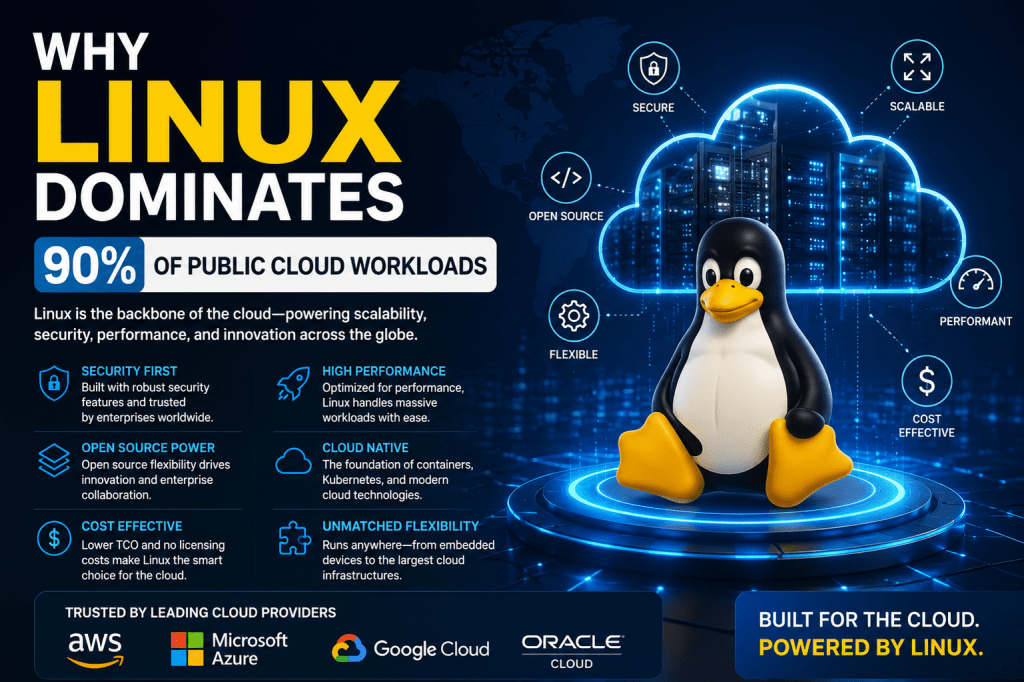
Cloud computing has transformed the way organizations operate modern technology environments. Instead of purchasing expensive hardware and maintaining massive on-site server rooms, businesses can now access computing power, storage, networking, and applications whenever needed. This flexible approach reduces operational burdens and allows companies to scale faster without large upfront investments. Behind most of these cloud environments, however, one operating system quietly powers the majority of the infrastructure: Linux.
Linux has become the foundation of modern cloud computing because of its reliability, scalability, flexibility, and open-source development model. Nearly every major cloud provider depends heavily on Linux to deliver stable and efficient services across millions of servers worldwide. From small startups to multinational corporations, organizations rely on Linux-powered systems every day without even realizing it.
Linux Became the Backbone of the Cloud
The rise of Linux in cloud computing did not happen overnight. Its growth was the result of decades of collaboration between developers, technology companies, engineers, and open-source communities around the world. Linux started as a flexible operating system designed to give users more control over their computing environments. Over time, its adaptability made it ideal for handling large-scale workloads in data centers and distributed systems.
Public cloud providers needed an operating system capable of supporting enormous numbers of users while maintaining performance and uptime. Linux delivered exactly that. Its lightweight architecture allowed cloud companies to maximize hardware efficiency while minimizing unnecessary resource consumption. Because cloud platforms often run thousands or even millions of virtual machines simultaneously, efficiency became one of the most important factors in infrastructure design.
Linux offered a solution that was both powerful and customizable. Providers could optimize the operating system specifically for their infrastructure requirements instead of depending on rigid proprietary systems. This freedom allowed companies to improve performance, automate deployment processes, and create highly scalable environments that could grow rapidly alongside customer demand.
Open Source Development Accelerated Innovation
One of Linux’s greatest advantages is its open-source nature. Unlike proprietary operating systems controlled by a single company, Linux is developed collaboratively by contributors across the globe. Developers can inspect, modify, improve, and distribute the source code openly. This collaborative model has allowed Linux to evolve at an extraordinary pace.
Thousands of developers continuously work on improving security, performance, hardware compatibility, networking capabilities, and system stability. Large technology companies also contribute heavily because their businesses depend on Linux infrastructure functioning efficiently. Cloud providers, software vendors, hardware manufacturers, and enterprise organizations all invest resources into improving the ecosystem.
This collaborative development model creates rapid innovation. Problems are identified quickly, patches are released frequently, and new technologies are integrated faster than in many proprietary systems. As cloud computing expanded, Linux evolved alongside it, adapting to support containers, virtualization, distributed storage, orchestration platforms, and advanced networking systems.
Because so many companies rely on Linux, there is constant motivation to strengthen the operating system. Every improvement benefits the entire ecosystem, creating a cycle where collaboration drives further adoption, and broader adoption drives even more collaboration.
Scalability Made Linux Perfect for Cloud Environments
Scalability is one of the defining characteristics of cloud computing. Businesses need systems capable of handling sudden traffic spikes, growing databases, expanding applications, and global workloads without downtime. Linux excels in scalable environments because it can efficiently run on everything from tiny embedded devices to enormous supercomputers.
Cloud providers require operating systems capable of adapting to rapidly changing workloads. Linux can scale vertically by utilizing increasingly powerful hardware and horizontally by supporting distributed systems spread across thousands of servers. This flexibility is essential in modern cloud infrastructure where workloads constantly fluctuate.
Linux also performs exceptionally well in virtualized environments. Virtual machines and containers rely on efficient resource management to maximize server utilization. Linux supports advanced process scheduling, memory management, networking, and filesystem optimization that allow cloud providers to operate infrastructure at massive scale while maintaining high performance.
This scalability enables cloud companies to deploy workloads dynamically based on customer needs. Whether a company requires a single virtual server or thousands of computing instances worldwide, Linux can support those requirements efficiently.
Reliability Drives Enterprise Confidence
Reliability is critical in cloud computing. Businesses depend on cloud platforms for applications, customer services, financial systems, databases, and communications. Even short periods of downtime can result in lost revenue, damaged reputations, and operational disruption.
Linux earned a strong reputation for stability long before cloud computing became mainstream. Many enterprise organizations adopted Linux for mission-critical workloads because of its consistent performance under heavy demand. This reputation naturally extended into the cloud era.
Linux systems are known for running continuously for extended periods without requiring frequent reboots or maintenance interruptions. Its modular architecture allows administrators to update or modify components without destabilizing entire systems. This capability is particularly important in cloud environments where availability expectations are extremely high.
Cloud providers prioritize infrastructure resilience, and Linux supports that objective exceptionally well. Its robust networking stack, process management capabilities, and fault-tolerant design help organizations maintain reliable services even during periods of intense demand.
Cost Efficiency Increased Adoption
Another major reason Linux dominates public cloud workloads is cost efficiency. The Linux kernel itself is free to use, which significantly reduces licensing expenses compared to proprietary operating systems. For cloud providers operating millions of servers, licensing costs can become enormous.
Using Linux allows cloud companies to allocate more resources toward infrastructure expansion, security improvements, performance optimization, and customer services instead of paying massive software licensing fees. These savings also help providers offer competitive pricing to customers.
Organizations adopting cloud infrastructure benefit from this efficiency as well. Businesses can deploy Linux-based servers without worrying about expensive operating system licensing for every instance they launch. This flexibility encourages experimentation, rapid scaling, and broader cloud adoption.
The affordability of Linux also helped startups compete with larger organizations. Smaller companies could build scalable infrastructure without massive software expenses, accelerating innovation across the technology industry.
Linux Supports Nearly Every Cloud Technology
Modern cloud computing relies on many interconnected technologies, including virtualization, containers, orchestration systems, software-defined networking, distributed storage, and automation platforms. Linux supports all of these technologies exceptionally well.
Containerization became especially important in cloud environments, and Linux played a central role in its success. Technologies like Docker and Kubernetes were built around Linux capabilities such as namespaces and control groups. These features allow containers to isolate applications efficiently while sharing system resources securely.
Cloud-native development practices also rely heavily on Linux. Microservices architectures, DevOps workflows, continuous integration pipelines, and infrastructure automation tools often function best within Linux-based environments. Developers appreciate Linux because it provides powerful command-line tools, scripting capabilities, package managers, and development utilities that simplify application deployment and management.
Because Linux integrates smoothly with so many modern technologies, organizations can build highly flexible cloud ecosystems without unnecessary compatibility barriers.
Major Cloud Providers Depend on Linux
The world’s largest cloud providers all rely heavily on Linux infrastructure. Companies offering public cloud services need operating systems capable of supporting massive global platforms while maintaining speed, efficiency, and security. Linux consistently meets those requirements.
Many cloud providers offer numerous Linux distributions to customers because demand for Linux-based environments remains extremely high. Businesses using cloud services often choose Linux servers for web hosting, application development, data analytics, artificial intelligence workloads, and enterprise software deployment.
Even companies historically associated with proprietary operating systems have embraced Linux within their cloud ecosystems. The demand from enterprise customers and developers made Linux support essential for remaining competitive in the cloud market.
Linux’s widespread adoption among cloud providers further strengthened its dominance. As more companies built applications specifically for Linux-based infrastructure, compatibility and optimization improved even further, reinforcing its position as the preferred cloud operating system.
Security Strengthened Linux’s Position
Security is one of the most important concerns in public cloud computing. Organizations trust cloud providers with sensitive customer information, financial data, business applications, and intellectual property. Operating systems powering these environments must offer strong protection against threats and vulnerabilities.
Linux benefits from extensive security scrutiny because its source code is publicly accessible. Developers and security researchers worldwide continuously analyze the operating system for vulnerabilities, bugs, and weaknesses. This transparency allows issues to be identified and addressed quickly.
Linux also includes powerful security features such as user permission controls, process isolation, firewall tools, encryption support, and mandatory access control systems. Administrators can customize security configurations extensively to match specific organizational requirements.
The modular nature of Linux helps reduce attack surfaces by allowing administrators to install only necessary components. Minimal installations reduce unnecessary services and lower exposure to potential vulnerabilities.
Cloud providers further enhance Linux security using custom hardening techniques, monitoring systems, automated patch management, and advanced threat detection solutions.
Linux Encourages Automation and Efficiency
Automation is central to cloud computing operations. Modern cloud environments involve enormous numbers of servers, applications, databases, and networking components that would be impossible to manage manually.
Linux excels in automated environments because it offers extensive scripting and command-line capabilities. Administrators can automate deployment, monitoring, scaling, backups, updates, and security management efficiently using shell scripting and configuration management tools.
This automation capability reduces operational complexity and improves consistency across large infrastructure environments. Cloud providers depend heavily on automation to maintain reliable services at global scale, and Linux provides the flexibility needed to support these operations.
Infrastructure-as-code practices also align naturally with Linux environments. Organizations can define entire server environments programmatically, enabling rapid deployment and consistent configuration across distributed cloud systems.
Developer Communities Continue Strengthening Linux
The strength of Linux extends beyond the operating system itself. One of its greatest advantages is the enormous global community supporting it. Developers, engineers, system administrators, and technology companies continuously contribute tutorials, documentation, software tools, security patches, and performance improvements.
This community-driven ecosystem creates a rich environment for innovation and learning. Organizations adopting Linux benefit from access to extensive knowledge bases, open-source software repositories, development frameworks, and troubleshooting resources.
The availability of skilled Linux professionals also contributes to its dominance in cloud computing. Because Linux is widely taught and used across the technology industry, companies can find administrators, developers, and engineers familiar with Linux systems more easily than specialists for some proprietary platforms.
As cloud computing continues evolving, Linux remains deeply integrated into nearly every major advancement in infrastructure technology. Its flexibility, collaborative development model, scalability, reliability, and efficiency continue making it the preferred foundation for public cloud environments worldwide.
Linux Powers Modern Internet Infrastructure
The internet depends heavily on infrastructure capable of handling billions of requests, transactions, and communications every single day. Behind websites, streaming platforms, financial systems, mobile applications, and enterprise services lies a massive network of servers working continuously to keep digital experiences running smoothly. Linux became the operating system of choice for much of this infrastructure because of its performance, adaptability, and ability to operate reliably under constant pressure.
Large cloud environments require operating systems that can manage huge amounts of simultaneous activity without sacrificing speed or stability. Linux handles these challenges exceptionally well. Its lightweight design allows systems to allocate more hardware resources directly to workloads instead of consuming unnecessary memory or processing power for the operating system itself.
This efficiency matters enormously in cloud computing. Even small performance improvements can save providers millions of dollars across thousands of servers. Linux allows organizations to maximize server utilization while maintaining responsiveness and scalability. As cloud adoption expanded globally, Linux naturally became the foundation supporting modern internet services.
Data Centers Depend on Linux Stability
Modern cloud services operate inside enormous data centers filled with servers, networking equipment, and storage systems. These facilities must function continuously with minimal downtime because businesses around the world rely on them every second of the day.
Linux gained strong adoption in data centers because of its proven stability in demanding environments. System administrators trust Linux for critical operations because it consistently performs well under heavy workloads and long operating periods. Many Linux servers run continuously for months without interruptions, making them highly attractive for enterprise infrastructure.
Cloud providers prioritize operational consistency. They need operating systems capable of supporting millions of users while remaining dependable during software updates, traffic spikes, and infrastructure maintenance. Linux’s modular architecture makes this easier because administrators can adjust system components independently without disrupting entire environments.
The operating system also supports advanced monitoring tools that help administrators track performance, detect issues early, and optimize infrastructure efficiency. This visibility is essential in large cloud environments where even minor problems can affect thousands of customers.
Linux Thrives in Virtualization Environments
Virtualization changed the technology industry by allowing multiple virtual systems to run on a single physical server. Instead of dedicating one machine to one application, virtualization enables providers to maximize hardware efficiency by hosting many isolated workloads simultaneously.
Linux became highly successful in virtualized infrastructure because it supports hypervisors and virtualization technologies extremely well. Cloud providers can create, scale, and manage virtual machines efficiently using Linux-based systems. This flexibility helps businesses launch cloud resources rapidly without requiring physical hardware deployment for every workload.
Virtualization also improves resource allocation. Linux allows providers to distribute processing power, memory, and storage dynamically based on demand. When workloads increase, additional resources can be assigned quickly. When demand decreases, resources can be reallocated elsewhere to maintain efficiency.
This adaptability is one of the core reasons Linux became central to public cloud computing. Businesses need infrastructure capable of responding instantly to changing traffic patterns, application growth, and customer demand. Linux supports this level of flexibility better than many alternatives.
Containers Expanded Linux Dominance
The rise of containers accelerated Linux adoption even further. Containers allow applications to run in isolated environments while sharing the same operating system kernel. This approach reduces overhead compared to traditional virtual machines and improves deployment speed significantly.
Linux provides the core technologies that make containers possible. Features such as namespaces and control groups allow applications to operate independently while maintaining efficient resource management. Container platforms rely heavily on these Linux capabilities to create scalable cloud-native environments.
Containerization transformed software development and deployment practices. Developers can package applications with all necessary dependencies and deploy them consistently across different environments. This consistency reduces compatibility issues and simplifies cloud operations.
Because Linux powers most container infrastructure, organizations building modern applications often choose Linux-based environments by default. Container orchestration platforms also depend heavily on Linux systems to automate deployment, scaling, and workload management across distributed cloud infrastructure.
As container adoption increased across the industry, Linux became even more deeply embedded in cloud operations worldwide.
Linux Supports Massive Scalability
Cloud providers must handle unpredictable demand patterns. A small application might suddenly experience global popularity overnight, requiring rapid scaling to support millions of new users. Linux provides the flexibility needed to scale infrastructure quickly and efficiently.
One of Linux’s greatest strengths is its ability to support distributed computing environments. Workloads can be spread across multiple servers, regions, and networks while maintaining coordinated operation. This architecture allows cloud providers to build resilient systems capable of handling enormous traffic volumes.
Scalability also extends to hardware compatibility. Linux runs on many different processor architectures and hardware configurations, giving cloud providers freedom to optimize infrastructure based on performance and cost requirements. Providers can customize systems for specific workloads without being restricted to narrow hardware ecosystems.
This flexibility encourages innovation. Companies can experiment with new hardware designs, energy-efficient processors, and optimized server configurations while continuing to rely on Linux as the core operating system layer.
Developers Prefer Linux Environments
Developers play a major role in determining which technologies dominate cloud computing. Linux became extremely popular among software developers because it offers powerful tools, flexibility, and extensive customization capabilities.
Many programming languages, frameworks, and development platforms function exceptionally well on Linux systems. Developers appreciate the command-line environment, scripting support, package management systems, and automation capabilities available within Linux distributions.
Cloud-native software development practices also align closely with Linux infrastructure. Continuous integration, continuous deployment, infrastructure automation, and microservices architectures often operate most efficiently in Linux environments. As modern development workflows evolved, Linux naturally became the preferred platform for building scalable cloud applications.
Open-source software ecosystems further strengthened Linux adoption among developers. Many popular databases, web servers, analytics tools, and artificial intelligence frameworks were designed primarily for Linux compatibility. This extensive software availability makes Linux an attractive choice for organizations building cloud-based services.
The more developers adopted Linux, the more software vendors optimized products for Linux systems, creating another cycle of increasing adoption and ecosystem growth.
Linux Reduces Vendor Lock-In
Many organizations choose Linux because it provides greater flexibility and independence compared to proprietary operating systems. Vendor lock-in occurs when companies become heavily dependent on a single provider’s technology ecosystem, making migration difficult and expensive.
Linux helps reduce this risk because it is open source and widely supported across the technology industry. Businesses can deploy Linux workloads across multiple cloud providers, on-premise infrastructure, or hybrid environments without being tied to one vendor’s platform.
This portability is especially important in cloud computing. Organizations want the ability to move workloads based on pricing, performance, regulatory requirements, or operational needs. Linux-based applications are often easier to migrate between environments because of standardized tools and broad compatibility.
Cloud providers also benefit from Linux’s flexibility. They can customize operating systems internally, optimize infrastructure for specific workloads, and integrate new technologies without waiting for permission from a proprietary software vendor.
This independence encourages innovation and allows organizations to maintain greater control over their technology strategies.
Community Collaboration Improves Security
Cybersecurity remains one of the biggest concerns in public cloud environments. Cloud providers face constant threats from malicious actors attempting to exploit vulnerabilities, disrupt services, or steal sensitive data.
Linux benefits from a massive global security community that continuously analyzes, tests, and improves the operating system. Because the source code is publicly available, vulnerabilities can be identified and fixed quickly by contributors worldwide.
This transparency creates a strong security culture around Linux development. Instead of relying solely on internal teams, the broader community participates in strengthening the operating system. Security patches, hardening techniques, monitoring tools, and defensive technologies evolve rapidly because so many organizations depend on Linux infrastructure.
Cloud providers further strengthen Linux security using additional protective layers, automated threat detection systems, access controls, and encryption technologies. Many enterprise organizations trust Linux precisely because of its strong security reputation and extensive auditing capabilities.
Linux also supports fine-grained permission systems that help administrators control access to files, processes, and network resources carefully. These capabilities are critical in multi-tenant cloud environments where infrastructure resources are shared among many customers.
Linux Handles Diverse Workloads Efficiently
Public cloud infrastructure supports an enormous variety of workloads. Some customers run simple websites, while others operate artificial intelligence systems, financial applications, streaming services, scientific simulations, or enterprise databases.
Linux performs well across this wide range of use cases because of its adaptable architecture. Administrators can optimize systems for different workload types without requiring entirely separate operating environments.
For example, Linux can support lightweight web servers, high-performance computing clusters, machine learning frameworks, containerized applications, and distributed databases simultaneously. This versatility allows cloud providers to standardize infrastructure while serving diverse customer requirements.
Artificial intelligence and machine learning workloads particularly benefited Linux adoption. Many popular AI frameworks were initially developed and optimized for Linux systems. Research institutions, universities, and technology companies commonly use Linux for data science and high-performance computing tasks because of its flexibility and processing efficiency.
As emerging technologies continued expanding, Linux consistently adapted to support new computing models and workload requirements.
Cloud Providers Continuously Optimize Linux
Major cloud providers invest heavily in improving Linux performance because their businesses depend on efficient infrastructure. Many providers develop custom Linux optimizations specifically designed for large-scale cloud environments.
These optimizations include improvements to networking performance, storage management, virtualization efficiency, energy consumption, and security hardening. Providers fine-tune Linux systems to maximize reliability and reduce operational costs across global infrastructure networks.
Some companies even develop custom Linux distributions tailored specifically for their cloud services. These specialized versions help providers achieve better scalability, faster deployment times, and stronger integration with internal management systems.
Because Linux allows deep customization, providers can innovate rapidly without waiting for external software vendors to release updates or approve modifications. This flexibility gives cloud companies significant operational advantages.
Continuous optimization ensures Linux remains highly competitive as cloud infrastructure evolves. New hardware technologies, networking architectures, and workload demands can be integrated quickly into Linux-based environments.
Linux Became the Standard for Cloud Innovation
As cloud computing matured, Linux increasingly became the standard operating environment for innovation. Many of the technologies driving modern infrastructure were developed first within Linux ecosystems before spreading more broadly across the industry.
Open-source collaboration accelerated experimentation in areas such as orchestration, automation, distributed computing, observability, and software deployment. Linux served as the foundation enabling these advancements because developers could modify and extend the operating system freely.
This innovation culture helped Linux maintain momentum while competitors struggled to match its adaptability. Organizations adopting cloud technologies often discovered that Linux provided the broadest compatibility, strongest community support, and most mature tooling for modern infrastructure development.
The combination of scalability, efficiency, reliability, flexibility, and collaborative development positioned Linux as the dominant force behind public cloud computing. As businesses continue shifting toward cloud-first strategies, Linux remains deeply integrated into the infrastructure powering the digital world.
Linux Supports the Future of Cloud Computing
Cloud computing continues evolving at an extraordinary pace as businesses move more applications, services, and infrastructure into digital environments. Organizations now depend on cloud platforms not only for storage and hosting but also for artificial intelligence, analytics, cybersecurity, communication systems, and large-scale enterprise operations. Linux remains at the center of this transformation because it consistently adapts to changing technological demands while maintaining the reliability companies require.
One of the biggest reasons Linux continues dominating public cloud infrastructure is its ability to evolve without losing stability. Technology trends shift rapidly, but Linux has repeatedly demonstrated that it can support emerging innovations without abandoning the core strengths that made it successful in the first place. This balance between innovation and reliability gives organizations confidence when building long-term cloud strategies around Linux-based systems.
Cloud providers value this adaptability because they constantly need to support new hardware architectures, software frameworks, networking technologies, and customer requirements. Linux provides the flexibility necessary to integrate these advancements while continuing to operate efficiently at massive scale.
Enterprise Businesses Trust Linux Infrastructure
Large enterprises operate highly complex technology ecosystems involving databases, internal applications, customer platforms, communication systems, and global networks. These organizations require infrastructure capable of supporting enormous workloads with minimal interruptions.
Linux earned enterprise trust through years of dependable performance in mission-critical environments. Financial institutions, healthcare providers, research organizations, telecommunications companies, and global retailers all rely heavily on Linux systems because of their stability and scalability.
Cloud adoption among enterprises accelerated because Linux already had a strong reputation within corporate data centers. Many organizations simply extended their existing Linux environments into the cloud instead of rebuilding infrastructure around unfamiliar operating systems.
This transition became even easier because cloud providers offered extensive Linux support. Businesses could migrate applications, automate deployments, and scale operations while maintaining compatibility with existing Linux-based tools and workflows.
Enterprise confidence in Linux also comes from the availability of commercial support options. Although Linux itself is open source, many companies provide professional services, security updates, consulting, and enterprise-grade distributions tailored for corporate environments. This combination of open-source flexibility and commercial support gives businesses both freedom and operational assurance.
Linux Excels in Automation and DevOps
Modern cloud infrastructure depends heavily on automation. Managing thousands of servers manually would be impractical, especially in environments where applications scale dynamically based on demand.
Linux became the preferred platform for automation because of its powerful scripting capabilities and command-line tools. Administrators can automate system provisioning, software deployment, updates, backups, monitoring, and security management using scripts and infrastructure management platforms.
This automation culture naturally aligned with the rise of DevOps practices. DevOps focuses on improving collaboration between development and operations teams while accelerating software delivery through automation and continuous integration processes.
Linux supports these workflows exceptionally well. Developers can create automated pipelines that test, deploy, and monitor applications efficiently across cloud infrastructure. Continuous deployment systems often rely heavily on Linux-based environments because they provide the flexibility and control necessary for advanced automation.
Cloud-native technologies also integrate closely with Linux. Orchestration platforms, monitoring systems, and configuration management tools frequently operate most effectively within Linux ecosystems. As organizations adopted DevOps practices more broadly, Linux strengthened its position as the operating system powering modern cloud operations.
Microservices Increased Linux Adoption
Traditional software applications were often built as large, monolithic systems where all components operated together as a single application. Modern cloud environments increasingly use microservices architectures instead, where applications are divided into smaller independent services that communicate with each other.
Linux became highly important in microservices environments because it supports lightweight containers and distributed application deployment efficiently. Organizations can deploy individual services independently, scale them separately, and update them without affecting entire applications.
This flexibility improves reliability and development speed. Teams can work on different services simultaneously, deploy updates faster, and respond more quickly to changing business needs.
Containers running on Linux systems became one of the most popular ways to manage microservices infrastructure. These environments allow applications to remain portable across development, testing, and production systems while maintaining consistent behavior.
Cloud providers embraced this model because it improves infrastructure efficiency and scalability. Linux provides the underlying technologies that make containerized microservices practical at large scale.
Linux Dominates High-Performance Computing
High-performance computing environments require operating systems capable of handling extremely demanding workloads involving scientific simulations, artificial intelligence, engineering analysis, and large-scale data processing.
Linux dominates these environments because of its efficiency, scalability, and customization capabilities. Research institutions, universities, and technology companies rely on Linux-powered supercomputers and computing clusters for complex computational tasks.
Many cloud providers now offer high-performance computing services that allow organizations to access enormous processing power on demand. Linux serves as the foundation for much of this infrastructure because it can efficiently coordinate workloads across thousands of processors and distributed systems.
Artificial intelligence workloads particularly accelerated Linux adoption. Machine learning frameworks, data science tools, and GPU computing platforms frequently operate best on Linux systems. Researchers and developers often prefer Linux because it provides strong compatibility with open-source AI ecosystems and advanced computational libraries.
As artificial intelligence becomes increasingly important in cloud computing, Linux continues strengthening its role as the operating system powering advanced computational infrastructure.
The Open-Source Ecosystem Strengthens Linux
Linux’s dominance in public cloud environments extends beyond the operating system itself. Its success is closely tied to the broader open-source ecosystem surrounding it.
Many of the most important cloud technologies are open source. Databases, orchestration platforms, monitoring systems, web servers, automation frameworks, and development tools often integrate naturally with Linux environments. This interconnected ecosystem creates enormous advantages for organizations building cloud infrastructure.
Open-source collaboration accelerates innovation because developers worldwide contribute improvements, identify bugs, and share solutions openly. Companies adopting Linux-based cloud environments gain access to vast libraries of software, documentation, and community expertise.
The availability of open-source tools also reduces barriers to entry for startups and smaller businesses. Organizations can build sophisticated cloud infrastructure without paying massive licensing costs for every component of their technology stack.
This accessibility encourages experimentation and innovation across the industry. New cloud technologies often emerge first within Linux and open-source communities before becoming mainstream enterprise solutions.
Linux Helps Cloud Providers Improve Efficiency
Operating global cloud infrastructure requires enormous amounts of electricity, cooling, networking capacity, and physical hardware. Even small improvements in efficiency can save providers substantial operational costs.
Linux helps optimize resource usage because it can operate with minimal overhead compared to heavier operating systems. Cloud providers can dedicate more server resources directly to customer workloads instead of consuming those resources internally.
The operating system’s modular design also allows providers to customize installations for specific purposes. Instead of deploying unnecessary services and components, administrators can create streamlined environments optimized for particular workloads.
This efficiency improves server density and reduces operational expenses across large data centers. Providers can support more customers using the same infrastructure while lowering power consumption and hardware requirements.
Linux also supports advanced scheduling and resource management technologies that help distribute workloads intelligently across infrastructure environments. These capabilities are essential for maintaining performance and reliability in modern cloud systems.
Hybrid and Multi-Cloud Strategies Favor Linux
Many organizations no longer rely on a single cloud provider. Instead, they adopt hybrid and multi-cloud strategies that combine on-premise infrastructure with services from multiple cloud platforms.
Linux plays a major role in these environments because of its portability and compatibility. Applications running on Linux can often move between different cloud providers with relatively few modifications.
This flexibility helps organizations avoid becoming overly dependent on a single vendor. Businesses can distribute workloads strategically, improve redundancy, and negotiate better pricing while maintaining operational consistency.
Hybrid cloud strategies also benefit from Linux compatibility. Organizations can integrate existing on-premise Linux infrastructure with public cloud services more easily than if they depended entirely on proprietary operating systems.
Because Linux operates consistently across different environments, administrators can standardize management practices, automation workflows, and deployment pipelines regardless of where workloads are hosted.
This portability continues making Linux highly attractive as businesses seek greater flexibility in their cloud strategies.
Linux Supports Edge Computing Growth
Edge computing is becoming increasingly important as organizations process data closer to users and devices instead of relying entirely on centralized cloud infrastructure.
Linux is highly effective in edge environments because it can run efficiently on many types of hardware, including small devices with limited resources. Its lightweight nature and modular architecture make it ideal for distributed computing environments.
Edge computing supports applications such as smart cities, industrial automation, autonomous systems, Internet of Things devices, and real-time analytics. Many of these systems require fast local processing combined with cloud connectivity.
Linux provides the consistency needed to manage these distributed environments effectively. Organizations can deploy Linux-based systems at the edge while integrating them seamlessly with centralized cloud infrastructure.
As edge computing expands globally, Linux continues extending its influence beyond traditional data centers into highly distributed computing networks.
The Linux Community Encourages Continuous Improvement
One of Linux’s greatest strengths is the ongoing commitment of its global development community. Thousands of contributors continuously improve the operating system by enhancing performance, fixing bugs, strengthening security, and supporting emerging technologies.
This collaborative approach creates a development cycle that evolves rapidly while maintaining strong stability standards. Organizations benefit from constant innovation without depending entirely on the priorities of a single software vendor.
Major technology companies actively contribute to Linux development because their infrastructure depends on it. Cloud providers, semiconductor manufacturers, networking companies, and enterprise software vendors all participate in improving Linux capabilities.
This cooperation benefits the entire industry. Improvements developed for one organization often strengthen the ecosystem for everyone else as well. Cloud computing especially benefits from this collaborative model because providers share many common infrastructure challenges.
The Linux community also produces extensive educational resources, technical documentation, and training materials. This accessibility helps organizations build skilled teams capable of managing complex cloud environments efficiently.
Linux Continues Expanding Across Industries
Linux’s influence extends far beyond traditional cloud hosting. Industries such as finance, healthcare, education, manufacturing, telecommunications, entertainment, and scientific research all rely heavily on Linux-powered cloud systems.
Streaming services use Linux infrastructure to deliver video content globally. Financial institutions process transactions using Linux-based servers. Research organizations run scientific simulations on Linux supercomputers. Telecommunications companies operate networking infrastructure using Linux environments.
This widespread adoption creates strong momentum that reinforces Linux’s position in public cloud computing. As more industries build services around Linux infrastructure, software compatibility improves, community expertise expands, and cloud ecosystems become even more mature.
The operating system’s ability to adapt to many different use cases ensures its continued relevance as technology evolves. Whether supporting artificial intelligence, edge computing, distributed databases, or cloud-native applications, Linux remains deeply integrated into the infrastructure powering the digital economy.
Linux Continues Leading the Future of Public Cloud Computing
Linux remains the dominant operating system in public cloud infrastructure because it consistently delivers the qualities modern organizations need most. Businesses demand scalability, flexibility, reliability, efficiency, and security from their cloud environments, and Linux provides all of these advantages while continuing to evolve alongside changing technology trends.
As cloud computing expands across industries, Linux continues strengthening its position as the operating system powering the digital economy. From startups building online platforms to multinational enterprises running global services, organizations trust Linux-based infrastructure because it performs reliably under demanding conditions.
One of the biggest reasons for Linux’s success is its adaptability. Technology changes rapidly, but Linux consistently supports emerging innovations without sacrificing stability. Cloud providers need operating systems capable of handling virtualization, containers, artificial intelligence workloads, distributed computing, automation systems, and modern networking technologies simultaneously. Linux supports all of these requirements while remaining efficient and customizable.
This flexibility allows cloud providers to optimize infrastructure for different workloads and customer demands. Whether supporting streaming platforms, enterprise applications, machine learning systems, or global communication services, Linux can adapt to the environment efficiently.
Linux Supports Cloud Scalability Better Than Most Alternatives
Scalability is one of the defining features of cloud computing. Businesses expect infrastructure to expand instantly when traffic increases or workloads grow unexpectedly. Linux excels in scalable environments because it can efficiently operate across thousands of interconnected servers while maintaining performance and stability.
Cloud providers rely on Linux to distribute workloads dynamically across global infrastructure networks. Applications running on Linux systems can scale horizontally by adding more servers or vertically by increasing hardware resources without major disruptions.
This scalability is especially important for modern internet services. Streaming platforms, social networks, financial systems, and e-commerce websites often experience sudden traffic spikes that require immediate resource expansion. Linux helps providers respond quickly to these situations while maintaining service reliability.
Its lightweight architecture also improves scalability because servers can dedicate more resources directly to customer workloads instead of consuming unnecessary processing power internally. This efficiency allows providers to maximize hardware utilization across massive data center environments.
Linux Encourages Open Innovation
Another major reason Linux dominates public cloud infrastructure is its open-source development model. Unlike proprietary operating systems controlled entirely by one company, Linux evolves through collaboration between developers, engineers, enterprises, and technology organizations worldwide.
This open development process accelerates innovation because improvements happen continuously. Security patches, performance enhancements, hardware support updates, and new cloud technologies are integrated rapidly by contributors across the global Linux community.
Cloud providers benefit enormously from this collaborative ecosystem. They can customize Linux internally, optimize infrastructure for specific workloads, and contribute improvements back to the broader community. This shared innovation model helps Linux evolve faster than many closed systems.
The open-source ecosystem surrounding Linux also provides businesses with access to extensive software libraries, development frameworks, automation tools, and cloud-native technologies. Organizations can build sophisticated cloud infrastructure without being restricted by expensive licensing barriers or vendor limitations.
This freedom encourages experimentation and technological advancement across the entire cloud industry.
Linux Reduced the Cost of Cloud Computing
Cost efficiency played a major role in Linux becoming the preferred operating system for public cloud providers. The Linux kernel itself is free to use, which reduces software licensing expenses significantly compared to proprietary operating systems.
For cloud providers operating millions of servers globally, licensing costs can become extremely expensive. Linux allows companies to allocate more resources toward infrastructure expansion, performance optimization, and customer services instead of paying large software fees.
These savings benefit customers as well. Businesses using cloud services can deploy Linux-based servers at lower costs, making cloud computing more accessible for startups, small companies, and enterprise organizations alike.
Linux also reduces operational expenses because of its efficiency and automation capabilities. Administrators can manage large environments using scripting, orchestration tools, and automated workflows that simplify infrastructure operations.
This combination of low licensing costs, efficient resource utilization, and strong automation support helped accelerate global cloud adoption.
Linux Became the Foundation of Cloud-Native Technology
Modern cloud computing depends heavily on cloud-native technologies such as containers, orchestration platforms, microservices, and automated deployment systems. Linux plays a central role in all of these environments.
Containerization transformed application deployment because it allows software to run consistently across different environments while using fewer resources than traditional virtual machines. Linux provides the core technologies that make containers possible, including namespaces and control groups.
As container adoption increased, Linux became even more deeply integrated into public cloud infrastructure. Orchestration systems that manage containers at scale also rely heavily on Linux environments for performance and compatibility.
Cloud-native application development further strengthened Linux adoption. Developers building scalable applications often prefer Linux because of its command-line tools, scripting capabilities, package managers, and strong compatibility with modern development frameworks.
Many popular cloud technologies were originally designed specifically for Linux environments, making Linux the natural choice for organizations adopting cloud-native architectures.
Enterprise Organizations Trust Linux Reliability
Reliability remains one of Linux’s strongest advantages in cloud computing. Businesses depend on cloud infrastructure for critical applications, databases, communication systems, and customer services. Downtime can result in financial losses, operational disruptions, and reputational damage.
Linux earned a strong reputation for stability long before cloud computing became mainstream. Enterprises trusted Linux systems for mission-critical workloads because they consistently performed well under heavy demand.
Cloud providers rely on this reliability to maintain global services operating continuously. Linux systems can run for long periods without requiring frequent restarts or maintenance interruptions, which is essential in large-scale cloud environments.
Its modular architecture also improves reliability by allowing administrators to update or modify specific components without destabilizing entire systems. This flexibility helps cloud providers maintain high availability while performing infrastructure upgrades and security updates.
Because Linux has demonstrated dependable performance for decades, organizations feel confident building large-scale cloud strategies around Linux-based infrastructure.
Linux Powers Emerging Technologies
Linux continues expanding beyond traditional cloud hosting into many emerging technology fields. Artificial intelligence, machine learning, edge computing, high-performance computing, and Internet of Things infrastructure all rely heavily on Linux environments.
Artificial intelligence systems especially benefit from Linux because many AI frameworks and computational tools were developed primarily for Linux compatibility. Research organizations, universities, and technology companies often choose Linux for machine learning workloads because of its flexibility and performance efficiency.
Edge computing also increases Linux adoption. Many edge devices require lightweight operating systems capable of operating efficiently with limited resources. Linux fits these environments perfectly while maintaining compatibility with centralized cloud infrastructure.
As emerging technologies continue evolving, Linux remains adaptable enough to support new computing models without losing the qualities that made it successful originally.
Conclusion
Linux powers the majority of public cloud workloads because it delivers the performance, scalability, flexibility, reliability, and efficiency modern cloud computing requires. Its open-source development model encourages constant innovation, while its lightweight architecture helps cloud providers maximize infrastructure performance and reduce operational costs.
The operating system’s ability to support virtualization, containers, automation, artificial intelligence, and distributed computing made it the ideal foundation for modern cloud infrastructure. Businesses across nearly every industry depend on Linux-powered systems to run applications, process data, support communication, and deliver online services globally.
Linux also benefits from one of the strongest technology communities in the world. Developers, enterprises, cloud providers, and engineers continuously improve the ecosystem, ensuring it remains adaptable as technology evolves.
As cloud computing continues expanding into artificial intelligence, edge computing, and highly distributed digital environments, Linux is likely to remain at the center of that transformation. Its combination of open innovation, operational efficiency, scalability, and reliability ensures that Linux will continue powering the infrastructure behind the modern internet for years to come.