
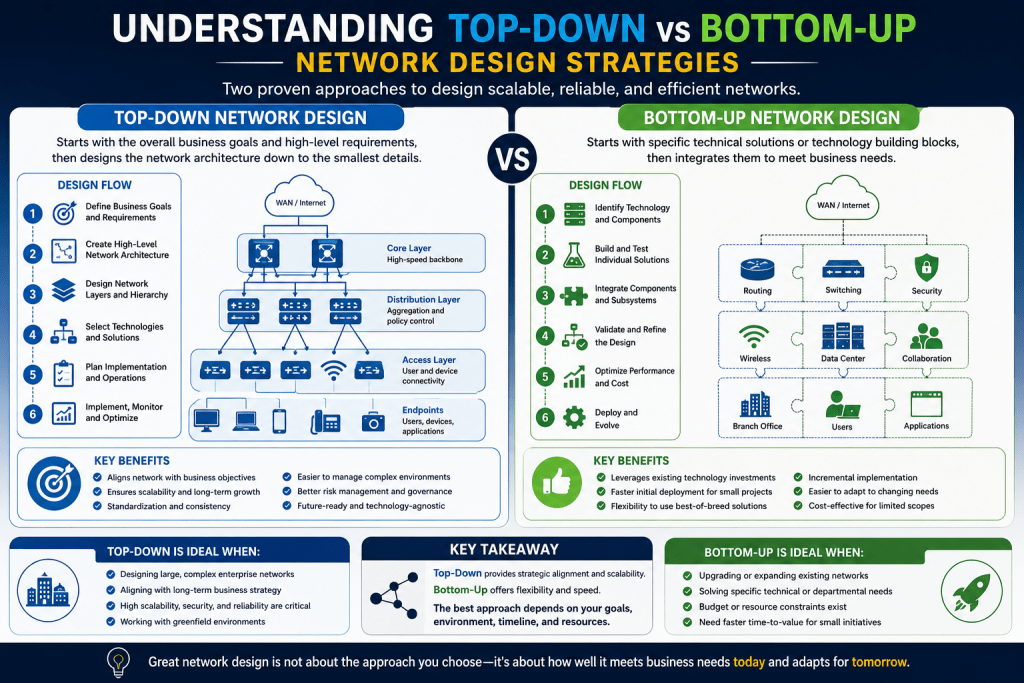
Network design is a complex discipline that requires careful coordination between technology, business needs, and future scalability. Even for professionals with a solid understanding of networking fundamentals, designing a new infrastructure from the ground up can be a demanding task. It is not just about connecting devices; it involves aligning hardware choices, anticipating growth, ensuring security, and balancing financial constraints. Every decision made at the beginning of a project has a cascading effect on later stages, influencing performance, reliability, and long-term maintainability. Among the most important early decisions is the selection of a design philosophy. Two widely recognized approaches exist in this context: bottom-up design and top-down design. Each follows a different logic, starting point, and planning methodology, ultimately shaping how the entire network evolves.
Understanding the Bottom-Up Network Design Approach
The bottom-up approach begins at the foundation of network architecture, starting with the physical and data link layers of the conceptual networking model. In this method, the focus is first placed on the tangible infrastructure, such as cabling, switches, routers, and other hardware components. The idea is to establish a functional and operational network core before considering higher-level requirements like applications or user services. Rather than beginning with abstract business needs, designers prioritize building a stable and capable technical foundation that can support a wide range of potential future requirements. This approach is often used when there is an urgency to deploy a working system quickly or when the future use cases are not fully defined. It allows engineers to create a robust infrastructure that can be adapted over time as requirements become clearer. However, this flexibility comes with a tendency to generalize early decisions, since detailed application-level planning is not initially available.
Key Characteristics of Bottom-Up Design
A bottom-up strategy emphasizes rapid deployment and technical readiness. Engineers focus on ensuring that core connectivity, bandwidth availability, and hardware redundancy are sufficient to support unknown future demands. The system is often designed with extra capacity, allowing for expansion without major structural changes. This method assumes that future requirements will evolve and that the infrastructure should be prepared to accommodate them without requiring a complete redesign. As a result, scalability is built into the network from the outset, even if it is not precisely calculated based on current needs. This makes the approach particularly useful in environments where flexibility is more important than precision in initial planning.
Advantages of the Bottom-Up Approach
One of the main strengths of the bottom-up approach is its speed of implementation. Since the design begins with infrastructure rather than analysis, teams can quickly build a working network and bring services online. This can be especially valuable in environments where time constraints are critical. Another advantage is adaptability. Because the network is often over-provisioned, it can accommodate unexpected growth or changing requirements without requiring immediate redesign. This approach also simplifies early decision-making, as engineers do not need to fully understand every business requirement before starting implementation. Instead, they can focus on ensuring that the physical and technical foundation is strong enough to support future evolution.
Practical Considerations in Bottom-Up Design
While the bottom-up approach allows for rapid deployment, it still requires careful technical judgment. Hardware selection remains a critical step, as underestimating baseline performance requirements can lead to inefficiencies or bottlenecks. Even though precise forecasting is not always possible, engineers must still consider expected traffic loads, redundancy needs, and compatibility between devices. Security also plays an important role, as foundational infrastructure must be capable of supporting protective mechanisms such as traffic filtering, monitoring, and intrusion prevention. Another important consideration is lifecycle planning. Hardware chosen in the early stages must remain viable over time, meaning supportability, firmware updates, and interoperability must be evaluated carefully. Without this foresight, initial speed gains may be offset by long-term maintenance challenges.
Limitations of the Bottom-Up Approach
Despite its flexibility, the bottom-up method has notable drawbacks. One of the primary concerns is the lack of alignment with business objectives during early design phases. Since the focus is on infrastructure rather than requirements, there is a risk of building a network that is technically sound but not optimized for actual organizational needs. This can lead to inefficiencies, unnecessary costs, or over-engineering. Additionally, the assumption of future growth can sometimes result in excessive spending on hardware and capacity that may never be fully utilized. Another limitation is the potential for architectural inconsistency, as decisions made without a unified strategic framework can lead to fragmented design choices that are difficult to optimize later.
Understanding the Top-Down Network Design Approach
The top-down approach takes the opposite perspective by starting with business objectives and application requirements before considering technical implementation. In this model, the design process begins at the highest conceptual level, focusing on organizational goals, user expectations, and service requirements. Once these elements are clearly defined, the design gradually moves downward through the layers of network architecture, eventually reaching hardware selection and physical infrastructure. This method ensures that the network is built specifically to support defined outcomes rather than general assumptions. It is a structured and analytical approach that prioritizes alignment between technology and business strategy.
Key Characteristics of Top-Down Design
Top-down design is characterized by detailed planning and structured analysis. It requires a deep understanding of how the organization operates, what services it needs, and how users interact with systems. Designers must evaluate application behavior, traffic patterns, and performance expectations before making technical decisions. This approach often involves collaboration across multiple teams to gather accurate requirements. Because of its structured nature, it tends to produce highly tailored network architectures that closely match operational needs. However, this precision comes at the cost of increased planning time and effort.
Advantages of the Top-Down Approach
One of the strongest advantages of the top-down approach is alignment with organizational goals. Since design decisions are driven by business requirements, the resulting network is more likely to support actual operational needs efficiently. This reduces the likelihood of unnecessary infrastructure or wasted resources. Another advantage is improved long-term planning. By understanding requirements upfront, designers can create architectures that scale in a controlled and predictable manner. This often results in better cost efficiency over time, as investments are made based on real needs rather than assumptions. Additionally, the structured nature of this approach helps reduce ambiguity, making it easier to justify design decisions and maintain consistency across the network.
Practical Considerations in Top-Down Design
Implementing a top-down strategy requires extensive collaboration and analysis. Gathering accurate business requirements is a critical first step, as any misunderstanding at this stage can impact the entire design. Service expectations, performance benchmarks, and operational workflows must be clearly defined. Designers must also consider how different applications interact and what level of network performance they require. Once requirements are established, appropriate technologies can be selected to meet those needs. This often leads to more precise hardware selection and more efficient use of resources. However, the process requires time and coordination, which can delay deployment compared to more infrastructure-first approaches.
Limitations of the Top-Down Approach
Although highly structured, the top-down approach is not without challenges. One of the main limitations is the extended planning phase, which can slow down project initiation. In environments where rapid deployment is required, this delay can be a disadvantage. Another challenge is the reliance on accurate requirement gathering. If business needs are misunderstood or incomplete, the resulting design may not fully meet operational demands. Additionally, because the design is based on predefined requirements, it may be less flexible when unexpected changes occur. Adjustments after deployment can require significant redesign effort, especially if initial assumptions were too rigid.
Choosing Between Bottom-Up and Top-Down Design
Selecting between bottom-up and top-down approaches depends largely on project context, organizational priorities, and available information. A bottom-up strategy is often suitable when speed and flexibility are more important than precise alignment with current business requirements. It works well in environments where infrastructure must be established quickly or where future needs are uncertain. In contrast, the top-down approach is better suited for environments where long-term stability, cost efficiency, and alignment with business goals are critical. It provides a more structured foundation that reduces the likelihood of misaligned investments. In many real-world scenarios, organizations may even adopt a hybrid approach, combining elements of both methods to balance speed and precision.
Conclusion
Network design is a foundational process that significantly influences the performance, scalability, and efficiency of any IT infrastructure. Both bottom-up and top-down approaches offer distinct advantages and challenges, and neither is universally superior. The bottom-up method prioritizes rapid deployment and technical flexibility, while the top-down approach emphasizes structured planning and alignment with business objectives. The most effective choice depends on the specific needs, constraints, and goals of the organization. A well-considered decision at the beginning of the design process can lead to a stable, efficient, and scalable network, while a poorly chosen approach can create long-term challenges that are difficult to resolve.