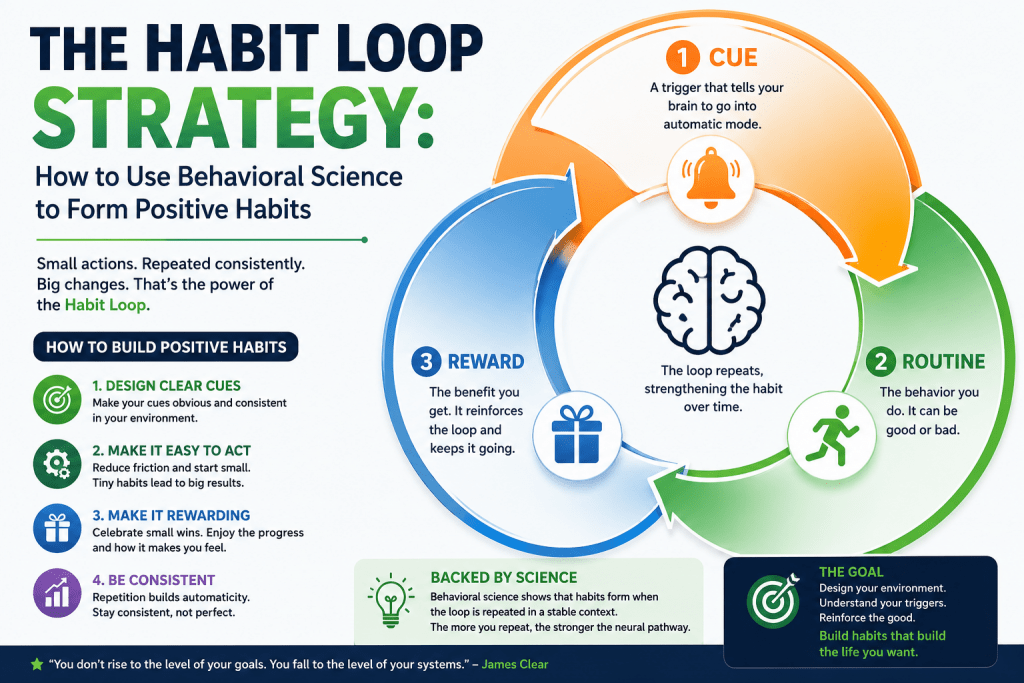
“Nothing is stronger than habit,” a sentiment often attributed to classical thinkers, captures a fundamental truth about human behavior. Much of what people do each day is not the result of active decision-making but of learned patterns that operate automatically. These patterns, known as habits, shape productivity, learning, health, and skill development. Understanding how habits function provides a structured way to influence behavior deliberately rather than leaving it to chance or motivation alone. The concept of the habit loop explains why behaviors repeat and how they can be modified over time.
Origins in Neuroscience and Behavioral Research
The habit loop concept emerged from behavioral and neurological research that examined how the brain conserves energy by automating repeated actions. Researchers observed that the brain develops shortcuts for recurring behaviors, allowing individuals to perform complex tasks with minimal conscious effort. Over time, repeated actions become encoded into neural pathways, forming efficient circuits that activate in response to specific triggers. This process explains why habits can feel automatic and why they persist even when conscious intention changes. The loop itself consists of three core components: cue, routine, and reward.
Cue: The Trigger Mechanism Behind Behavior
The cue is the starting point of every habitual action. It functions as a signal that tells the brain to initiate a behavior without requiring deliberate thought. Cues can come from external or internal sources. External cues include environmental signals such as sounds, locations, time of day, or the presence of other people. Internal cues arise from emotional states, physical sensations, or preceding actions. Once the brain associates a cue with a specific behavior, the response becomes increasingly automatic. For example, a notification sound can prompt an immediate response to check a device, while a specific time of day may trigger a routine activity such as eating or taking a break. The cue essentially acts as a switch that activates the behavioral sequence.
Routine: The Behavioral Pattern Itself
The routine represents the actual behavior that follows the cue. It can be physical, mental, or emotional in nature. This is the stage where the action occurs, whether it is productive, neutral, or counterproductive. Routines can range from simple actions like checking messages to more complex sequences like studying, exercising, or problem-solving. Over time, repetition strengthens the connection between the cue and the routine, making the behavior more automatic. The routine is the most visible part of the habit loop, but it is only one component of a larger system that reinforces itself through repetition and feedback.
Reward: The Reinforcement System
The reward is the outcome that follows the routine and determines whether the behavior is likely to be repeated. Rewards provide the brain with a sense of satisfaction or relief, reinforcing the connection between cue and routine. This reinforcement is rooted in neurochemical responses, particularly involving dopamine, which signals pleasure or achievement. Rewards do not always need to be physical; they can be emotional or psychological, such as a sense of progress, relief from stress, or completion of a task. When a reward consistently follows a routine, the brain strengthens the habit loop, increasing the likelihood that the behavior will occur again in response to the same cue.
How the Loop Becomes Automatic Over Time
As the habit loop repeats, the brain begins to reduce its active involvement in decision-making. Neural pathways associated with the behavior become more efficient, allowing the action to occur with less conscious effort. This automation is a key reason habits are powerful. Instead of evaluating choices repeatedly, the brain relies on established patterns. Over time, the cue triggers the routine almost instantly, followed by the expected reward. This cycle creates stability in behavior but also makes habits resistant to change once they are established.
Why Habits Reduce Cognitive Load
One of the primary advantages of habits is that they conserve mental energy. Decision-making requires cognitive resources, and constant deliberation can lead to fatigue. By automating repetitive behaviors, the brain frees up capacity for more complex tasks that require creativity, analysis, or problem-solving. This efficiency explains why many daily activities operate on autopilot. However, this same mechanism can also maintain unproductive behaviors if the habit loop is not consciously directed. Understanding this trade-off is essential for intentional behavior design.
Applying the Habit Loop to Skill Development and Learning
Skill acquisition benefits significantly from structured habit formation. Consistent repetition of learning behaviors leads to gradual improvement and long-term retention. When applied to structured learning or professional development, the habit loop can transform irregular effort into sustained practice. Establishing a consistent pattern of engagement with learning material helps reduce reliance on motivation, which can fluctuate. Instead, behavior becomes anchored in routine, making progress more stable and predictable. The key lies in designing cues, routines, and rewards that align with learning objectives.
Designing Effective Cues for Consistency
Effective cues are specific, stable, and easy to recognize. Consistency is more important than complexity when establishing triggers for behavior. Time-based cues are particularly effective because they create predictable anchors in the daily schedule. Environmental cues, such as a dedicated workspace or specific location, can also reinforce behavior. Combining multiple cues, such as time and context, strengthens the trigger effect. The goal is to reduce ambiguity so that the brain automatically associates the cue with the intended action. Over time, this reduces resistance and increases consistency.
Structuring Routines for Sustainable Practice
The routine should be simple enough to execute consistently but meaningful enough to provide progress. Overly complex routines increase the likelihood of failure because they require more cognitive effort. Gradual progression is more effective than attempting large behavioral shifts at once. Once a routine becomes stable, it can be expanded incrementally. The focus should remain on repetition rather than intensity in the early stages. Consistency builds the foundation for long-term improvement, while complexity can be introduced later as the habit strengthens.
Creating Meaningful Rewards for Reinforcement
Rewards must be relevant enough to reinforce the behavior but not so excessive that they become distractions. Internal rewards, such as satisfaction, progress tracking, or a sense of achievement, are often more sustainable than external incentives. However, external rewards can be useful in the early stages of habit formation to strengthen the association between cue and routine. Over time, the brain begins to derive intrinsic satisfaction from the behavior itself, reducing dependence on external reinforcement. The effectiveness of a reward lies in its consistency and its ability to signal completion.
Repetition and the Role of Neural Adaptation
Repetition is the mechanism that solidifies the habit loop. Each cycle strengthens neural pathways associated with the behavior, making future execution easier. This process, known as neural adaptation, explains why habits become more automatic over time. The frequency of repetition is more important than perfection. Even imperfect execution contributes to strengthening the loop. Eventually, the behavior requires minimal conscious effort, allowing it to operate as an automatic response to the cue. This transition from effortful action to automatic behavior is the core of habit formation.
Common Obstacles in Habit Formation
Several factors can interfere with habit development. Inconsistent cues weaken the trigger-response association, while unclear rewards reduce reinforcement strength. Overly ambitious routines can lead to burnout, and environmental distractions can disrupt consistency. Emotional variability also plays a role, as stress or fatigue can interrupt established patterns. Recognizing these obstacles allows for better design of habit systems that account for real-world variability. Adjustments to cues, routines, or rewards may be necessary to maintain stability over time.
Environmental Design and Habit Control
Environment plays a significant role in shaping behavior. By structuring surroundings to support desired actions, it becomes easier to maintain consistency. Reducing friction for positive behaviors and increasing friction for negative ones can influence habit formation without requiring constant willpower. For example, placing necessary tools in visible and accessible locations encourages use, while removing distractions reduces the likelihood of unwanted behavior. Environmental alignment reinforces the habit loop by making cues more noticeable and routines easier to perform.
Conclusion
The habit loop provides a structured explanation of how behavior is formed, reinforced, and sustained over time. By understanding the interaction between cue, routine, and reward, it becomes possible to intentionally design behaviors that support long-term goals. Habits reduce cognitive load, increase efficiency, and create stability in daily actions. When applied consistently, this framework transforms repeated effort into automatic behavior, allowing individuals to focus mental energy on higher-level thinking and decision-making. Over time, small repeated actions accumulate into significant behavioral change, demonstrating the long-term impact of structured habit formation.