
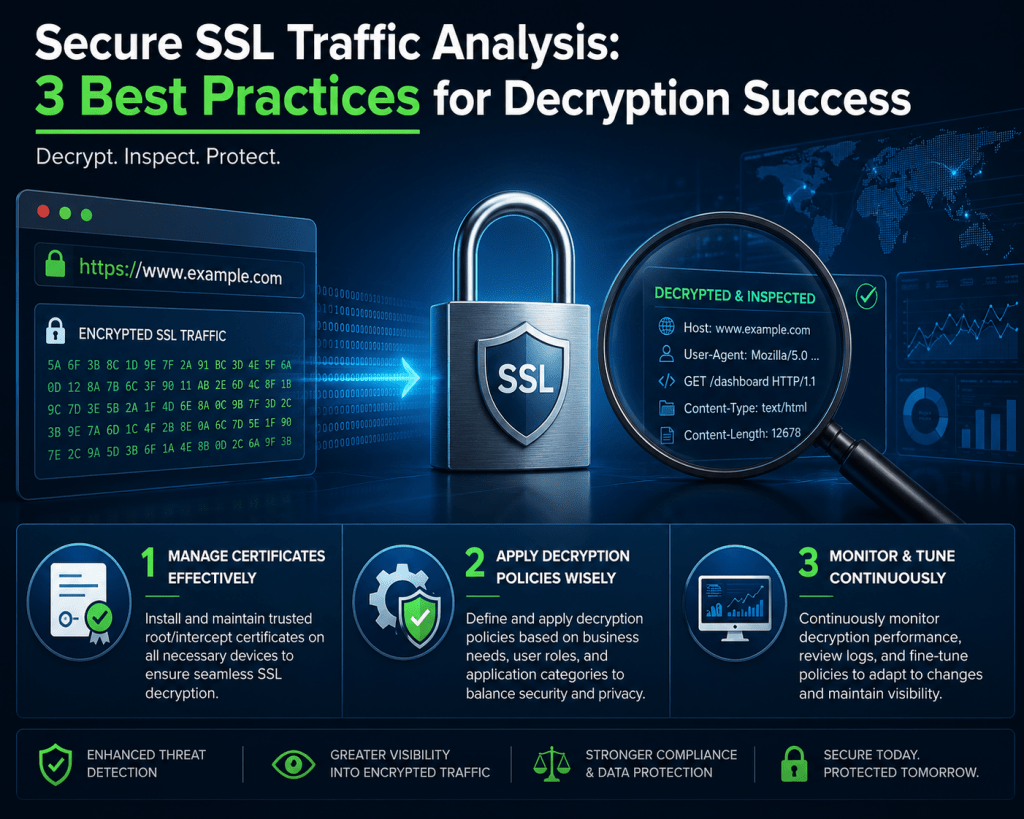
Encrypted communication has become the default mechanism for nearly all modern digital systems, spanning web applications, cloud services, enterprise platforms, and mobile ecosystems. The widespread adoption of SSL/TLS protocols ensures that data in transit remains protected from interception and tampering, creating a secure communication layer between endpoints. This encryption standard has fundamentally improved confidentiality across networks, reducing the effectiveness of passive eavesdropping and man-in-the-middle attacks. However, the same protective mechanism that secures legitimate communication also conceals malicious activity. Attackers increasingly embed harmful payloads, command-and-control instructions, and data exfiltration attempts within encrypted sessions, knowing that traditional security tools cannot inspect payload contents without breaking encryption boundaries. As a result, organizations face a dual challenge: maintaining strong encryption for privacy and security while also ensuring visibility into potentially harmful traffic. This tension has driven the evolution of inspection-based security models that introduce controlled decryption capabilities within defined trust boundaries. These systems are designed to temporarily expose traffic content for analysis while preserving encryption integrity during transmission.
Why Encryption Creates Security Visibility Challenges
While encryption protects data confidentiality, it also introduces significant blind spots within security monitoring infrastructures. Traditional network security tools rely heavily on packet inspection techniques that analyze payload content to identify anomalies, malicious signatures, or policy violations. When traffic is encrypted, these tools lose direct visibility into the data being transmitted, limiting their ability to detect sophisticated threats. Only metadata such as source, destination, packet size, and timing remains visible, which is often insufficient for accurate threat identification. This limitation is increasingly exploited by cyber attackers who use encrypted channels to bypass perimeter defenses. Malware distribution campaigns frequently hide payloads within HTTPS traffic, while data theft operations conceal sensitive transfers using secure tunnels. The result is an environment where encrypted traffic can appear legitimate even when it carries malicious intent. Security teams must therefore adopt advanced inspection methodologies capable of safely analyzing encrypted data without undermining the trust model established by encryption protocols.
Security Requirements for Controlled Traffic Inspection
Introducing visibility into encrypted traffic requires a carefully controlled inspection framework that balances security effectiveness with privacy protection. The inspection process must ensure that decrypted data is handled within secure, isolated environments to prevent unauthorized access. This involves establishing controlled interception points where encrypted sessions are temporarily decrypted, analyzed, and then re-encrypted before forwarding. These inspection points must operate under strict access controls, ensuring that only authorized security systems and personnel can interact with sensitive data. Additionally, inspection processes must be designed to minimize exposure duration, ensuring that decrypted content exists only long enough for analysis before being securely discarded. Performance considerations are equally important, as encryption and decryption processes introduce computational overhead. Proper system design ensures that inspection does not degrade network performance or disrupt application functionality. The goal is to achieve visibility into traffic behavior without compromising the integrity, confidentiality, or availability of network communications.
Governance and Authorization Structures
Effective traffic inspection requires a strong governance framework that defines operational boundaries, responsibilities, and accountability. Since decrypted traffic may contain sensitive personal or organizational data, access must be tightly controlled through formal authorization processes. Governance structures typically define who can enable inspection, what types of traffic can be analyzed, and under what conditions decryption is permitted. Role-based access control ensures that only trained security personnel can interact with inspection systems, reducing the risk of misuse or accidental exposure. Documentation plays a critical role in governance, capturing inspection policies, operational procedures, and escalation workflows for security incidents. Audit mechanisms must record all inspection activities, including access attempts, analysis outcomes, and system modifications. This ensures traceability and supports compliance verification during internal and external audits. Governance frameworks also establish oversight mechanisms to review inspection effectiveness, adjust policies based on evolving threats, and ensure alignment with organizational risk tolerance.
Legal and Compliance Constraints in Traffic Decryption
The process of decrypting network traffic introduces complex legal and regulatory obligations that vary depending on jurisdiction and industry. Organizations must ensure that inspection activities comply with applicable data protection laws, privacy regulations, and industry-specific standards. These frameworks often require explicit justification for monitoring activities, along with clear documentation of how decrypted data is handled. Data minimization principles mandate that only necessary traffic is inspected and that no excessive collection or retention of sensitive information occurs. Retention policies must define strict time limits for storing decrypted data, ensuring that information is not preserved longer than operationally required. In regulated environments such as financial services, healthcare, and enterprise systems handling personal data, inspection processes must adhere to stringent security and auditing requirements. Failure to comply with these obligations can result in significant penalties, legal consequences, and reputational damage. Therefore, legal alignment is not optional but an integral part of designing any traffic inspection framework.
Policy Design for Inspection Boundaries
Defining clear inspection boundaries is essential to ensure that SSL/TLS decryption is applied appropriately and responsibly. Not all encrypted traffic should be subject to inspection, and policies must distinguish between high-risk and sensitive communication channels. High-risk traffic typically includes external web browsing, unknown application traffic, and data transfers to untrusted endpoints. These categories are often prioritized for inspection due to their higher likelihood of containing malicious content. Conversely, certain communication types must remain exempt from decryption due to privacy or operational requirements. These include financial transactions, healthcare-related communications, personal messaging, and legally privileged data exchanges. Policy design must also account for trusted applications that have been validated through security assessments and can be safely excluded from inspection. This selective approach helps reduce system load while maintaining effective security coverage. Policy frameworks must remain flexible to adapt to evolving application behaviors, emerging threats, and changing organizational needs.
Trust, Transparency, and User Awareness
Maintaining transparency in inspection practices is essential for building trust between users and security systems. Individuals within an organization should be informed that certain network traffic may be analyzed for security purposes. Transparency ensures that inspection is understood as a protective measure rather than intrusive monitoring. Clear communication through acceptable use policies and internal security documentation helps establish awareness of how traffic analysis is conducted and why it is necessary. While user consent models may vary depending on organizational context, the principle of informed awareness remains important. In some cases, limited exemptions may be provided for specific traffic types where privacy considerations outweigh security needs, but such exceptions must be carefully controlled to prevent exploitation. Transparency also helps reduce resistance to security controls and promotes cooperation between users and security teams, strengthening overall organizational resilience.
Threat Evolution Driving Inspection Needs
The increasing sophistication of cyber threats has significantly contributed to the need for encrypted traffic inspection. Attackers now routinely use encryption to conceal malicious activity, making it difficult for traditional security tools to detect threats based solely on visible traffic attributes. Malware campaigns often embed payloads within encrypted sessions, while command-and-control infrastructure uses secure channels to maintain communication with compromised systems. Data exfiltration techniques similarly rely on encryption to avoid detection during transmission. This evolution has shifted the security focus from perimeter-based defenses to deep traffic analysis techniques capable of identifying hidden behaviors. Without inspection capabilities, organizations risk operating with incomplete visibility into their network environments, allowing advanced threats to persist undetected for extended periods. The ability to analyze encrypted traffic has therefore become a critical requirement in modern cybersecurity architectures.
Risks of Misuse and Operational Exposure
Although SSL/TLS inspection provides significant security advantages, it also introduces operational risks if not properly managed. Decrypted traffic contains sensitive information that, if exposed, could lead to serious privacy violations or security breaches. Unauthorized access to inspection systems can result in exposure of credentials, confidential communications, and proprietary data. Misconfiguration of inspection policies can also create unintended vulnerabilities, such as bypassing critical security controls or disrupting legitimate application traffic. Additionally, inspection systems themselves may become high-value targets for attackers seeking access to decrypted data streams. To mitigate these risks, strong security controls must be implemented, including strict access management, system segmentation, encrypted storage of logs, and continuous monitoring of inspection infrastructure. Operational discipline is essential to ensure that the benefits of traffic inspection are not undermined by weaknesses in system protection or policy enforcement.
SSL/TLS Inspection Architecture in Enterprise Network Security
Modern enterprise environments rely heavily on encrypted communication to protect data in transit, but this creates a significant visibility gap for security monitoring systems. To address this challenge, organizations implement SSL/TLS inspection architectures that are strategically positioned within network traffic flows. These architectures are designed to intercept encrypted sessions, temporarily decrypt them for analysis, and then re-encrypt the traffic before forwarding it to its destination. The design of such systems must ensure that security inspection occurs without disrupting application performance or user experience. Typically, inspection points are deployed at network gateways, data center ingress and egress points, or cloud security layers where traffic aggregation naturally occurs. These interception points act as controlled inspection zones where encrypted traffic is analyzed in real time. The architecture must support high-throughput environments, often processing millions of concurrent sessions, which requires careful engineering of scalability, redundancy, and failover mechanisms. Without a properly structured architecture, inspection systems can quickly become bottlenecks that degrade network performance and introduce latency across critical business applications.
Traffic Interception Flow and Session Lifecycle Handling
The SSL/TLS inspection process follows a structured lifecycle that ensures encrypted traffic is handled securely and efficiently. When a user initiates a connection to an external service, the encrypted session is intercepted at the inspection point before reaching its destination. The system establishes a trusted proxy relationship where it decrypts the session using controlled certificate mechanisms. Once decrypted, the traffic is analyzed by security engines that evaluate payload content, behavioral patterns, and threat intelligence indicators. After inspection, the traffic is re-encrypted using a separate secure session before being forwarded to its intended endpoint. This process occurs in real time and must be optimized to prevent noticeable delays in communication. The lifecycle also includes session tracking, where each connection is monitored for anomalies such as unexpected data transfers, protocol deviations, or unauthorized access attempts. This structured flow ensures that encrypted communication is analyzed without compromising the integrity of the original session or disrupting application continuity.
Hardware Requirements for High-Performance Decryption Systems
SSL/TLS inspection is computationally intensive because it requires continuous encryption and decryption of large volumes of data. As a result, hardware selection plays a critical role in system performance. Inspection appliances typically rely on high-performance multi-core processors capable of handling parallel cryptographic operations. Dedicated cryptographic acceleration hardware is often used to offload intensive encryption tasks from the main CPU, significantly improving throughput. Memory capacity is equally important, as inspection systems must maintain active session states for potentially thousands of concurrent connections. Fast storage systems are required to support logging, caching, and temporary data buffering during analysis. Network interface cards with high bandwidth capabilities ensure that traffic can flow through inspection points without congestion. Redundant hardware configurations are commonly deployed to eliminate single points of failure, ensuring continuous operation even during component outages. Proper hardware design ensures that security inspection scales effectively with increasing network traffic demands.
Performance Optimization and Latency Management Strategies
One of the primary challenges in SSL/TLS inspection is maintaining acceptable network performance while performing deep packet analysis. Encryption and decryption processes inherently introduce latency, which can impact user experience if not properly managed. To mitigate this, organizations implement performance optimization strategies such as selective inspection, where only high-risk or unknown traffic is decrypted while trusted traffic is allowed to bypass inspection. Application-aware policies further enhance efficiency by identifying known safe services and excluding them from unnecessary processing. Load-balancing techniques distribute traffic across multiple inspection nodes to prevent system overload. Additionally, caching mechanisms can reduce repetitive decryption operations for frequently accessed sessions. Continuous performance monitoring is essential to identify bottlenecks and adjust system configurations dynamically. The goal of these optimization techniques is to ensure that security inspection does not interfere with application responsiveness while maintaining comprehensive threat visibility.
Selective Decryption Policies and Traffic Classification Models
Not all encrypted traffic requires inspection, and selective decryption policies are used to determine which sessions should be analyzed. Traffic classification models categorize network flows based on risk level, application type, and destination reputation. High-risk categories such as unknown external websites, file transfer services, and untrusted application traffic are typically prioritized for inspection. Conversely, trusted enterprise applications that have been validated through security assessments may be excluded from decryption to improve performance efficiency. Classification systems often rely on threat intelligence feeds, behavioral analysis, and machine learning models to continuously refine traffic categorization. These systems adapt dynamically to evolving network environments, ensuring that inspection policies remain effective against emerging threats. However, exclusion policies must be carefully managed to prevent attackers from exploiting trusted channels as hidden communication pathways. Continuous validation ensures that classification accuracy remains high and that security coverage is not compromised by overly permissive exclusions.
Integration with Enterprise Security Ecosystems
SSL/TLS inspection does not function as an isolated capability but rather as part of a broader security ecosystem. Decrypted traffic data is integrated with intrusion detection systems, endpoint protection platforms, security information and event management systems, and threat intelligence platforms. This integration enables correlation of network-level activity with endpoint behavior, providing a more comprehensive view of potential security incidents. For example, suspicious network activity identified through decrypted traffic analysis can be correlated with endpoint alerts to confirm malicious behavior. Security orchestration systems use this combined intelligence to automate response actions such as blocking traffic, isolating devices, or triggering incident workflows. Integration ensures that decrypted traffic insights are not siloed but contribute to a unified security posture across the organization. This interconnected approach enhances detection accuracy and reduces response times during security incidents.
Scalability Challenges in Large-Scale Network Environments
As organizations expand, network traffic volumes increase exponentially, creating scalability challenges for SSL/TLS inspection systems. Large enterprises often operate across multiple geographic locations, cloud environments, and hybrid infrastructures, all of which generate encrypted traffic that must be analyzed. Scaling inspection systems requires both horizontal and vertical expansion strategies. Horizontal scaling involves adding additional inspection nodes to distribute traffic load, while vertical scaling focuses on enhancing the processing power of existing systems. Cloud-based environments introduce additional complexity, requiring inspection systems that can dynamically adapt to elastic infrastructure changes. Policy management must also scale effectively, ensuring that inspection rules remain consistent across distributed environments. Without proper scalability planning, inspection systems may become overwhelmed, resulting in performance degradation and reduced security visibility.
Monitoring and Logging of Decrypted Traffic Activities
Comprehensive monitoring is essential in SSL/TLS inspection environments to ensure operational transparency and security accountability. Every inspection event is logged, including session details, analysis results, policy decisions, and system interactions. These logs provide valuable insights for both real-time monitoring and historical analysis. Security teams use this information to detect anomalies, investigate incidents, and validate compliance with organizational policies. Logging systems must be designed to handle large volumes of data while maintaining performance efficiency. Advanced monitoring tools analyze decrypted traffic patterns to identify unusual behaviors such as abnormal data transfers, unexpected protocol usage, or suspicious external connections. Continuous monitoring ensures that security teams maintain visibility into network activity even as traffic volumes and complexity increase. Proper log management also supports forensic investigations by preserving detailed records of security-relevant events.
Incident Response and Forensic Analysis Using Decryption Data
When a security incident occurs, decrypted traffic data plays a critical role in forensic analysis and incident response. Security analysts can reconstruct communication flows to understand how an attack unfolded, identify compromised systems, and trace data movement within the network. This level of visibility is essential for determining the scope and impact of security breaches. Incident response procedures rely on decrypted traffic insights to guide containment strategies, such as isolating affected systems or blocking malicious communication channels. Forensic analysis also helps identify the root cause of incidents, enabling organizations to strengthen defenses and prevent recurrence. Detailed examination of decrypted sessions can reveal attacker techniques, persistence mechanisms, and lateral movement patterns. This intelligence is invaluable for improving long-term security resilience and refining detection capabilities.
Security Hardening of Inspection Infrastructure
Given the sensitive nature of decrypted traffic, inspection systems themselves must be strongly secured against unauthorized access and compromise. Security hardening measures include strict authentication controls, network segmentation, and system isolation to prevent external access to decrypted data. Administrative access must be restricted to authorized personnel using multi-factor authentication and role-based access control. Inspection systems should operate within isolated network zones that are separated from general user traffic to reduce exposure risk. Encryption must be applied to stored logs and temporary data caches to protect information at rest. Regular security assessments and vulnerability testing are necessary to ensure that inspection infrastructure remains resistant to exploitation attempts. Continuous monitoring of system integrity helps detect unauthorized changes or abnormal behavior within the inspection environment. Hardening these systems is essential because they represent high-value targets for attackers seeking access to sensitive, decrypted data.
Cloud Integration and Distributed Inspection Models
The shift toward cloud computing has introduced new challenges for SSL/TLS inspection due to the distributed nature of modern applications. Cloud environments generate encrypted traffic across multiple services, regions, and platforms, requiring flexible inspection architectures. Distributed inspection models are used to extend visibility across hybrid infrastructures, ensuring consistent security enforcement regardless of traffic origin. Cloud-native inspection tools integrate directly with virtual networks and service meshes to analyze encrypted traffic within cloud workloads. These systems must be capable of scaling dynamically based on workload demands while maintaining centralized policy control. Hybrid environments require coordination between on-premises inspection systems and cloud-based security services to ensure unified visibility. This distributed approach ensures that encryption does not create blind spots in complex, multi-cloud architectures where traditional perimeter-based security models are no longer sufficient.
Certificate Management and Trust Architecture in SSL/TLS Inspection Systems
SSL/TLS inspection relies heavily on a trusted certificate infrastructure that enables secure interception and re-encryption of encrypted traffic. At the core of this mechanism is a controlled trust model where inspection systems act as authorized intermediaries between clients and external services. To achieve this, organizations deploy internal certificate authorities that generate and manage digital certificates used during interception processes. These certificates are trusted within the organizational network, allowing inspection systems to decrypt traffic without triggering security warnings on client devices. The integrity of this trust chain is critical because any compromise in certificate management can undermine the entire inspection architecture. Certificate lifecycle management includes generation, distribution, renewal, and revocation processes that must be tightly controlled to prevent misuse. Expired or improperly configured certificates can lead to service disruptions or a complete loss of inspection visibility. Proper certificate governance ensures that encryption inspection remains transparent to end users while maintaining strong cryptographic security standards.
Lifecycle Control and Renewal Strategies for Inspection Certificates
Managing certificates in an SSL/TLS inspection environment requires continuous lifecycle oversight. Certificates have defined validity periods and must be renewed before expiration to ensure uninterrupted inspection capability. Renewal processes must be automated where possible to reduce the risk of human error and service disruption. Each certificate must be securely stored using protected key storage mechanisms that prevent unauthorized extraction or duplication. Hardware-based secure modules are commonly used to safeguard private keys associated with inspection certificates. These modules provide tamper-resistant environments where cryptographic operations can be performed without exposing sensitive key material. Lifecycle control also includes revocation procedures in cases where certificates are compromised or no longer needed. A robust renewal strategy ensures that inspection systems remain operational while maintaining strong security assurance across all encrypted communication channels.
Secure Storage and Isolation of Decrypted Data Streams
Once encrypted traffic is decrypted for inspection, it becomes highly sensitive and must be handled with strict security controls. Decrypted data should never be stored in unsecured environments or left accessible beyond the inspection process. Instead, it must be processed within isolated system zones designed specifically for security analysis tasks. These zones are separated from the general network infrastructure to prevent unauthorized access or lateral movement. Data at rest, even temporarily stored inspection content, must be encrypted using strong cryptographic algorithms to ensure confidentiality. Access to decrypted data must be restricted to authorized security systems and personnel only, enforced through strict identity verification mechanisms. Temporary storage systems should include automatic deletion policies that remove decrypted content immediately after analysis is completed. This reduces the risk of data exposure and ensures compliance with privacy and security requirements. Proper isolation strategies are essential to maintain trust in inspection systems while preventing accidental or malicious leakage of sensitive information.
Logging Mechanisms and Security Event Tracking
Comprehensive logging is a fundamental requirement in SSL/TLS inspection environments because it provides visibility into system behavior and security events. Every interaction with decrypted traffic must be recorded, including session initiation, inspection outcomes, policy decisions, and administrative actions. These logs serve as an essential resource for security monitoring, compliance audits, and forensic investigations. Logging systems must be designed to handle high volumes of data generated by continuous traffic inspection without impacting system performance. Security event tracking enables organizations to detect anomalies such as unauthorized access attempts, unusual traffic patterns, or deviations from expected behavior. Advanced log analysis techniques can identify subtle indicators of compromise that may not be visible through direct traffic inspection alone. Logs must also be protected using encryption and access controls to prevent unauthorized viewing or tampering. Retention policies define how long logs are stored, ensuring that historical data is available for investigation while minimizing unnecessary data accumulation.
Behavioral Analysis and Threat Detection in Decrypted Traffic
One of the most powerful benefits of SSL/TLS inspection is the ability to perform behavioral analysis on decrypted traffic. Unlike traditional signature-based detection methods, behavioral analysis focuses on identifying abnormal patterns of activity rather than known threat signatures. This approach is particularly effective against advanced persistent threats that use encryption to evade detection. By analyzing decrypted traffic, security systems can observe communication patterns, data transfer behaviors, and protocol usage in real time. Deviations from normal behavior, such as unusual outbound connections or irregular data volumes, may indicate malicious activity. Machine learning models can enhance behavioral analysis by continuously learning from network traffic patterns and improving detection accuracy over time. This allows security systems to adapt to evolving threats and identify previously unknown attack techniques. Behavioral analysis is especially important in modern environments where attackers frequently modify their methods to avoid detection by conventional security tools.
Incident Response Integration with Decryption Intelligence
SSL/TLS inspection plays a critical role in incident response by providing detailed visibility into network activity during security events. When a potential threat is detected, decrypted traffic data allows security teams to reconstruct the sequence of events leading up to the incident. This includes identifying the source of the attack, the affected systems, and the methods used by attackers to infiltrate the network. Incident response teams rely on this information to contain threats, remove malicious components, and restore normal operations. Decrypted traffic insights also support root cause analysis, helping organizations understand how vulnerabilities were exploited and how similar incidents can be prevented in the future. Integration between inspection systems and incident response platforms enables automated workflows that accelerate response times. For example, suspicious traffic identified through decryption analysis can trigger automatic isolation of affected devices or blocking of malicious connections. This tight integration enhances the overall effectiveness of security operations.
Risk Exposure and Operational Challenges in Inspection Systems
Despite its advantages, SSL/TLS inspection introduces operational risks that must be carefully managed. One of the primary risks is the potential exposure of sensitive data during the decryption process. If inspection systems are not properly secured, attackers may gain access to decrypted traffic, resulting in data breaches or credential theft. Another challenge is the performance impact of large-scale encryption processing, which can strain system resources and affect network performance. Misconfigured inspection policies can also lead to unintended consequences, such as blocking legitimate traffic or exposing sensitive communications unnecessarily. Additionally, inspection systems themselves may become targets for cyberattacks due to the valuable data they process. Operational resilience requires continuous monitoring, system hardening, and regular security updates to mitigate these risks. Organizations must also ensure that inspection processes are aligned with internal policies and external regulatory requirements to avoid compliance violations.
Remote Work Expansion and Encryption Visibility Challenges
The rise of remote work has significantly increased the complexity of SSL/TLS inspection because network traffic now originates from diverse and often unmanaged environments. Employees connect to organizational systems from home networks, public networks, and mobile devices, all of which generate encrypted traffic that must be analyzed. This distributed environment reduces the effectiveness of traditional perimeter-based inspection models. Security systems must now extend visibility beyond centralized network boundaries to maintain consistent protection. Virtual inspection gateways and cloud-based security services are commonly used to address this challenge, enabling traffic analysis regardless of user location. However, remote work environments also introduce additional risks, such as insecure endpoints and untrusted network conditions. Inspection systems must therefore balance visibility with privacy while ensuring that remote users maintain secure access to organizational resources. The complexity of remote environments makes SSL/TLS inspection even more critical for maintaining comprehensive security coverage.
Cloud-Based Traffic Complexity and Distributed Security Models
Cloud computing has transformed how applications generate and transmit encrypted traffic, creating new challenges for inspection systems. Modern applications often rely on microservice architectures, where communication occurs between distributed components across multiple cloud environments. Each of these communications is typically encrypted, making visibility difficult without specialized inspection capabilities. Distributed security models are used to address this challenge by embedding inspection capabilities directly within cloud infrastructure. These models enable traffic analysis at multiple points within the application lifecycle, rather than relying solely on perimeter-based inspection. Cloud-native inspection systems must be highly scalable, flexible, and capable of integrating with dynamic workloads that change frequently. Centralized policy management ensures consistent inspection rules across different cloud environments. This approach allows organizations to maintain visibility into encrypted traffic even in highly complex and distributed cloud ecosystems.
Advanced Threat Evasion Techniques and Encryption Abuse
Cyber attackers continuously evolve their techniques to evade detection, and encryption has become one of their most commonly exploited tools. Malicious actors often use encrypted communication channels to hide command-and-control infrastructure, making it difficult for traditional security systems to detect compromised devices. Encryption is also used to conceal data exfiltration activities, allowing attackers to transfer sensitive information without detection. Some advanced threats use legitimate encrypted services as cover for malicious communication, blending in with normal network traffic. SSL/TLS inspection is essential for identifying these hidden activities by exposing the underlying content of encrypted sessions. Without inspection capabilities, organizations may remain unaware of ongoing breaches until significant damage has already occurred. Advanced threat detection relies on combining decrypted traffic analysis with behavioral monitoring and threat intelligence to identify suspicious patterns that indicate malicious intent.
Security Hardening and Defense-in-Depth Strategies for Inspection Environments
Given the sensitive nature of decrypted traffic, inspection systems must be protected using a defense-in-depth security strategy. This includes multiple layers of protection such as network segmentation, strict access controls, encrypted storage, and continuous monitoring. Administrative access must be limited to authorized personnel using strong authentication mechanisms to prevent unauthorized system changes. Inspection environments should be isolated from general network traffic to reduce exposure risk. Regular vulnerability assessments and penetration testing help identify weaknesses in the inspection infrastructure before they can be exploited. Security updates and patches must be applied consistently to maintain system integrity. Monitoring tools should continuously analyze system behavior to detect anomalies or unauthorized activities. A strong security posture ensures that inspection systems remain resilient against both internal and external threats while maintaining reliable traffic visibility.
Conclusion
The increasing dominance of encrypted traffic across modern digital ecosystems has fundamentally changed how network security must operate. What was once a relatively transparent environment, where packet inspection could easily reveal malicious payloads, has evolved into a landscape where encryption is the default state of communication. While this shift has significantly improved privacy, confidentiality, and data integrity, it has also created a critical visibility gap that cyber attackers actively exploit. SSL/TLS decryption exists as a controlled mechanism to close this gap, enabling security teams to inspect encrypted traffic in a structured and governed manner without undermining the foundational principles of secure communication. Its role is not to weaken encryption but to introduce selective transparency where security necessity outweighs privacy constraints within organizational boundaries.
At its core, SSL/TLS inspection represents a balance between two competing priorities: maintaining strong cryptographic protection for data in transit and ensuring that malicious activity cannot hide behind that protection. Organizations today operate in environments where threats are increasingly sophisticated, adaptive, and concealed within encrypted channels. Malware distribution, command-and-control communication, phishing payload delivery, and data exfiltration attempts frequently rely on encrypted tunnels to avoid detection. Without decryption capabilities, security systems are limited to analyzing metadata alone, which is insufficient for identifying complex attack patterns. Decryption enables deeper visibility into actual payload content, making it possible to detect behavioral anomalies, unauthorized data transfers, and malicious instructions that would otherwise remain hidden.
However, the implementation of SSL/TLS decryption is not purely a technical exercise; it is a multidimensional discipline that spans governance, compliance, infrastructure design, performance engineering, and ethical responsibility. A properly designed inspection system must incorporate strict authorization frameworks that define who can access decrypted data and under what conditions. Without these controls, the risk of misuse or accidental exposure increases significantly. Equally important is the establishment of clear policy boundaries that determine which traffic is eligible for inspection and which must remain encrypted due to privacy, legal, or operational sensitivity. Financial transactions, healthcare data, personal communications, and legally protected exchanges typically require exclusion from inspection, reinforcing the need for nuanced policy design rather than blanket decryption approaches.
Regulatory compliance further complicates the deployment of SSL/TLS inspection systems. Organizations must operate within the constraints of data protection laws, industry standards, and regional privacy regulations. These frameworks demand transparency, data minimization, controlled retention, and secure handling of sensitive information. Decrypted traffic, even when analyzed for security purposes, falls under strict governance requirements that mandate secure storage, limited access, and timely deletion. Failure to adhere to these obligations can result in severe financial penalties, legal consequences, and reputational damage. Therefore, compliance is not an optional layer but an embedded requirement that shapes how inspection systems are designed and operated.
From an architectural perspective, SSL/TLS inspection introduces significant engineering challenges. The process of decrypting and re-encrypting traffic at scale requires high-performance hardware, optimized software systems, and carefully balanced load distribution mechanisms. Inspection points must be capable of handling large volumes of concurrent encrypted sessions without introducing unacceptable latency or degrading application performance. This requires investment in computational resources, cryptographic acceleration technologies, and scalable infrastructure designs. Performance optimization strategies such as selective inspection, application-aware filtering, and traffic prioritization are essential to ensure that security does not come at the cost of usability.
Another critical dimension is the secure handling of decrypted data. Once encryption is removed, even temporarily, the resulting data becomes highly sensitive and must be protected with strict isolation and access control mechanisms. Secure zones, encrypted storage, and time-limited retention policies help reduce exposure risk. Additionally, audit logging and monitoring systems must track all interactions with decrypted traffic to ensure accountability and traceability. These controls are necessary to prevent insider misuse, accidental leakage, or external exploitation of inspection systems.
The integration of SSL/TLS inspection into broader security ecosystems significantly enhances its effectiveness. When combined with endpoint protection, intrusion detection systems, behavioral analytics, and threat intelligence platforms, decrypted traffic analysis becomes a powerful component of a unified defense strategy. This integrated approach enables correlation of network-level activity with endpoint behavior, improving detection accuracy and reducing response times. Security operations teams benefit from consolidated visibility that allows them to understand not just isolated events but complete attack chains across the environment.
The rise of cloud computing and remote work has further increased the importance of encrypted traffic inspection. Traditional perimeter-based security models are no longer sufficient in environments where users connect from distributed locations and applications operate across multiple cloud platforms. Encrypted traffic now flows through highly dynamic and decentralized infrastructures, requiring inspection systems that can adapt to hybrid and cloud-native architectures. This shift demands scalable, flexible, and continuously evolving inspection strategies capable of maintaining visibility regardless of where data originates or resides.
Despite its advantages, SSL/TLS decryption must always be approached with caution. It introduces inherent risks, including potential exposure of sensitive information, system misuse, and performance degradation if improperly implemented. These risks highlight the importance of strong security hardening practices, including system isolation, strict authentication, continuous monitoring, and regular security assessments. Without these safeguards, inspection systems themselves can become high-value targets for attackers seeking access to decrypted data.
Ultimately, SSL/TLS decryption represents a critical capability in modern cybersecurity architecture, but it is not a standalone solution. Its effectiveness depends on disciplined implementation, robust governance, and continuous adaptation to evolving threat landscapes. Organizations that implement it successfully are those that treat it as part of a broader security strategy rather than a singular control mechanism. When properly designed and managed, it enables security teams to regain visibility into encrypted environments, detect advanced threats more effectively, and maintain a stronger defensive posture in an increasingly encrypted digital world.