
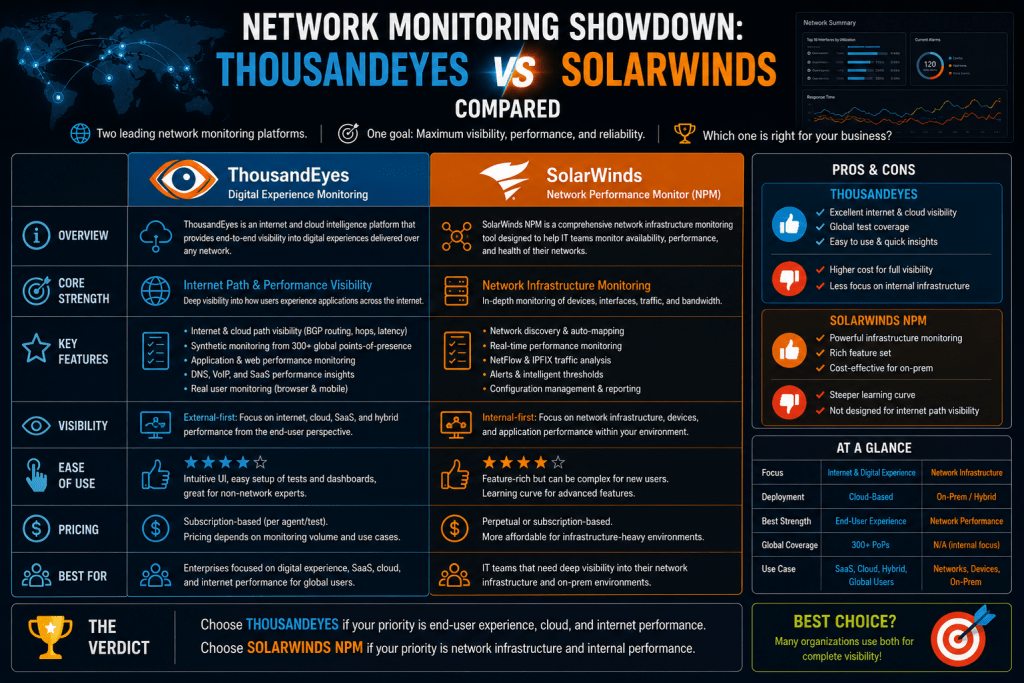
In modern IT environments, network and application performance monitoring has become essential due to the increasing reliance on distributed systems, cloud platforms, and hybrid infrastructures. Organizations need visibility not only inside their own data centers but also across the broader internet ecosystem that supports their services. Two widely recognized solutions in this space are ThousandEyes and SolarWinds. While both aim to improve observability and performance management, they approach the problem from different angles and serve slightly different operational priorities. Understanding how they differ helps organizations align tooling with their infrastructure needs, operational maturity, and long-term strategy.
ThousandEyes overview
ThousandEyes is primarily designed to provide deep visibility into how networks behave across the internet and within cloud-connected environments. It focuses on mapping and analyzing the entire delivery path between users and applications, regardless of where those applications are hosted. This makes it particularly relevant in scenarios where services depend heavily on third-party networks, internet service providers, and cloud platforms. The platform emphasizes external network intelligence, enabling organizations to understand how traffic flows beyond their direct control.
Core capabilities of ThousandEyes
One of the strongest aspects of ThousandEyes is its ability to provide end-to-end visibility across complex network paths. It continuously monitors performance between endpoints, cloud services, and enterprise infrastructure, helping identify where delays or failures originate. It also offers internet health monitoring, which tracks the performance of global routing infrastructure and identifies disruptions affecting connectivity. Another important capability is application delivery visibility, which allows teams to see how applications perform from the end-user perspective rather than just from internal systems. Integration with collaboration and incident management tools also helps teams respond more efficiently when issues are detected.
SolarWinds overview
SolarWinds is a broader IT management platform that extends beyond network monitoring into system administration, infrastructure management, and security visibility. It is designed to provide centralized oversight of multiple IT layers, including servers, applications, databases, and network devices. Unlike tools that focus only on external connectivity, SolarWinds is often deployed to manage internal IT ecosystems and ensure the stability of enterprise infrastructure. Its strength lies in offering a consolidated view of operational health across different components of an organization’s technology stack.
Core capabilities of SolarWinds
SolarWinds provides detailed network performance monitoring, including traffic analysis, device status tracking, and bandwidth usage insights. It also extends into server and application monitoring, enabling administrators to track system performance across physical and virtual environments. In addition, it includes features related to security event visibility and log management, helping organizations detect unusual activity and maintain compliance standards. This multi-layered approach makes it suitable for IT teams that want to centralize infrastructure monitoring under a single platform rather than using multiple specialized tools.
Architecture and deployment differences
The architectural philosophy behind these tools differs significantly. ThousandEyes is built with a distributed monitoring model that places emphasis on synthetic agents deployed across various global locations. These agents simulate user activity and network traffic to evaluate performance from multiple geographic perspectives. This allows organizations to observe how services behave under real-world internet conditions.
SolarWinds, on the other hand, is typically deployed within the enterprise environment and focuses on collecting telemetry from internal systems. It relies heavily on agents, SNMP polling, and log collection to gather performance data from servers, network devices, and applications. This makes it highly effective for internal infrastructure visibility but less focused on external internet path analysis.
Monitoring depth and visibility comparison
ThousandEyes provides deep visibility into external dependencies, which is critical for understanding issues that originate outside an organization’s direct infrastructure. It can identify whether a performance issue is caused by a cloud provider, ISP, or intermediate routing problem. This external perspective is especially valuable for businesses that rely heavily on SaaS platforms or global user bases.
SolarWinds provides deeper visibility within the internal IT environment. It excels at identifying issues such as server overload, hardware failures, application bottlenecks, or misconfigured network devices. While it may not fully map internet-level routing issues, it offers strong insights into infrastructure health and resource utilization within controlled environments.
Real-time monitoring capabilities
Both platforms offer real-time monitoring, but they differ in scope and granularity. ThousandEyes delivers near real-time insights into internet performance and application delivery paths, allowing teams to quickly detect disruptions affecting external connectivity. This is particularly useful for identifying transient internet issues that may not be visible in internal monitoring tools.
SolarWinds provides real-time dashboards and alerts focused on internal systems. It can quickly notify administrators about device failures, performance degradation, or unusual traffic patterns within the network. Its alerting system is designed for operational IT teams managing enterprise infrastructure stability.
Scalability and enterprise use
ThousandEyes scales effectively in globally distributed environments because its architecture is designed to monitor multiple regions and networks simultaneously. It is often used by organizations with a large international user base or complex cloud dependencies. As the number of monitoring points increases, it maintains consistent visibility across regions.
SolarWinds scales well within enterprise IT environments, particularly those with large internal networks and multiple data centers. It is capable of managing thousands of nodes, making it suitable for organizations with extensive on-premises infrastructure or hybrid environments. However, its scalability is more focused on internal systems rather than global internet paths.
Accuracy and telemetry approach
ThousandEyes relies heavily on active synthetic testing combined with real-time network path analysis. This allows it to generate precise insights into packet loss, latency, and routing changes across the internet. Its telemetry is designed to reflect real user experience as traffic traverses external networks.
SolarWinds primarily depends on passive monitoring techniques, including device polling and log analysis. This approach is highly effective for infrastructure health tracking but may not capture external network conditions with the same level of detail as synthetic internet monitoring tools.
Use case scenarios and operational fit
ThousandEyes is best suited for organizations that depend on cloud-based services, SaaS applications, or globally distributed systems. It is especially useful when user experience is impacted by external network conditions that are beyond direct administrative control. Companies with international operations often benefit from its ability to pinpoint geographic or ISP-related performance issues.
SolarWinds is better suited for organizations that require centralized management of internal IT infrastructure. This includes environments with complex server architectures, virtualization layers, and internal network dependencies. It is often chosen by IT teams that prioritize infrastructure stability, resource optimization, and internal system visibility.
Operational complexity and learning curve
ThousandEyes generally requires a shift in thinking toward internet-centric observability. Understanding external routing paths, ISP behavior, and cloud network dependencies is important for effectively using the platform. Once understood, it provides highly actionable insights into distributed performance issues.
SolarWinds has a broader feature set, which can make it more complex to configure initially. However, it is structured around traditional IT monitoring concepts, making it familiar to system administrators and network engineers. Its learning curve depends on the number of modules deployed within the environment.
Cost and licensing considerations
ThousandEyes typically follows a subscription-based model, with pricing influenced by the number of monitored endpoints, test frequency, and types of monitoring configured. Costs can increase as monitoring scope expands, especially in large distributed environments.
SolarWinds uses a more modular pricing approach, where different components are licensed separately. Organizations can start with core network monitoring and expand into additional capabilities such as server monitoring or security analytics as needed. This flexibility allows gradual scaling but can increase complexity in budgeting.
Strengths and limitations of each platform
ThousandEyes excels in external visibility, internet performance analysis, and cloud dependency tracking. Its primary limitation is that it is not designed to replace full internal infrastructure monitoring systems. It complements rather than replaces broader IT management tools.
SolarWinds excels in internal infrastructure monitoring, system management, and operational visibility across enterprise environments. Its limitation lies in reduced visibility into external internet paths and ISP-level performance issues, which may require additional tools for complete end-to-end observability.
Decision factors for selection
Choosing between the two depends on organizational priorities. If the main challenge involves understanding user experience across the internet and cloud services, ThousandEyes provides stronger capabilities. If the goal is to manage and monitor internal IT infrastructure comprehensively, SolarWinds offers a more complete operational suite. Many organizations also use both tools together to achieve full-stack visibility from internal systems to external delivery paths.
Conclusion
ThousandEyes and SolarWinds serve different but complementary roles in network and infrastructure monitoring. ThousandEyes focuses on external visibility, internet health, and end-user experience across distributed environments. SolarWinds concentrates on internal infrastructure management, system performance, and centralized IT operations. The decision between them depends on whether an organization prioritizes external network intelligence or internal system control. In many modern IT environments, combining both approaches provides the most complete understanding of performance across the entire digital delivery chain.