Container technology has become one of the most important building blocks in modern IT infrastructure. It allows applications to run in isolated environments while sharing the same operating system kernel, which makes them lightweight and efficient compared to traditional virtual machines. This approach has changed how organizations design, build, and deploy applications across development, testing, and production environments. Instead of worrying about compatibility issues between systems, developers and system administrators can package applications with all required dependencies and ensure consistent behavior everywhere.
In enterprise environments, containers are widely used to support microservices architectures, where large applications are broken down into smaller, independent services. Each service can be developed, deployed, and scaled separately, which improves flexibility and reduces downtime during updates. This shift has created a strong demand for professionals who understand how container systems work and how to manage them effectively in real-world environments.
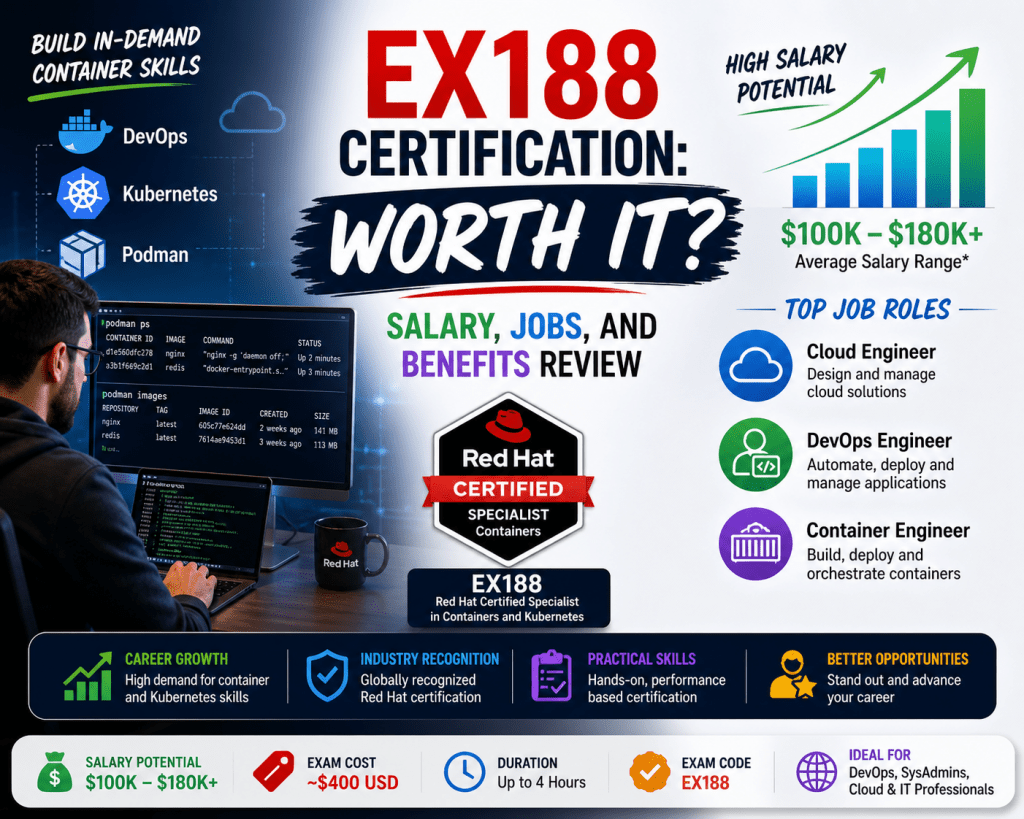
Introduction to the Red Hat Certified Specialist in Containers (EX188)
The Red Hat Certified Specialist in Containers (EX188) is a performance-based certification designed to evaluate practical skills in container management within a Linux enterprise environment. Unlike theoretical exams that rely on multiple-choice questions, this certification focuses entirely on hands-on tasks performed in a live system. Candidates are required to demonstrate their ability to create, manage, and troubleshoot containers using enterprise-grade tools.
The purpose of this certification is to validate real operational skills rather than memorized knowledge. This makes it particularly valuable in environments where professionals are expected to work directly with containerized applications in production systems. The exam is structured to reflect real-world scenarios, ensuring that certified individuals can handle tasks that are commonly encountered in IT operations.
Why Hands-On Certification Matters in Modern IT Careers
In today’s IT industry, practical experience is often more valuable than theoretical understanding alone. Employers look for professionals who can demonstrate the ability to solve real problems in live systems. The EX188 certification is designed with this expectation in mind, as it requires candidates to perform actual tasks rather than answer questions about them.
This hands-on approach ensures that certified individuals have a deeper understanding of container workflows. It also builds confidence in working with complex systems where errors can impact production environments. By focusing on execution rather than theory, the certification helps bridge the gap between learning and real-world application.
Core Purpose of Container Skills in Enterprise Environments
Container skills are essential in modern IT environments because they support scalability, portability, and automation. Organizations use containers to deploy applications faster and more reliably across different infrastructure environments. Whether running on physical servers, virtual machines, or cloud platforms, containers ensure consistent behavior and reduce deployment risks.
In enterprise systems, containers are often part of larger automation pipelines that include continuous integration and continuous deployment workflows. This allows organizations to update applications frequently without disrupting services. Professionals who understand container operations play a key role in maintaining these systems and ensuring smooth deployment cycles.
Overview of the Tools Used in EX188 Certification
The EX188 certification focuses on a set of enterprise container tools that are commonly used in Red Hat-based environments. These tools include Podman, Buildah, and Skopeo, each serving a specific purpose in the container lifecycle.
Podman is used for running and managing containers in a secure and efficient way. It does not require a central daemon, which improves system security and simplifies container management. Buildah is used for creating container images step by step, allowing precise control over how images are constructed. Skopeo is used for managing container images across different registries without needing to download them locally.
Together, these tools form a complete ecosystem for working with containers in enterprise environments. Understanding how they interact is essential for managing container workflows effectively.
Podman and Its Importance in Container Execution
Podman is a key tool in modern container management because it provides a secure and flexible way to run containers. Unlike traditional container engines that rely on background services, Podman operates without a daemon process. This reduces complexity and improves security by eliminating a single point of failure.
One of the major advantages of Podman is its support for rootless container execution. This means containers can be run without requiring administrative privileges, which reduces security risks in multi-user environments. Podman also supports familiar command structures, making it easier for users transitioning from other container systems.
In enterprise environments, Podman is often used for running individual containers, managing container lifecycles, and organizing containers into groups called pods. This allows multiple containers to work together as part of a single application system.
Buildah and the Process of Creating Container Images
Buildah is a specialized tool designed for creating container images in a controlled and flexible manner. Unlike automated image-building systems, Buildah allows users to construct images step by step. This gives full control over each layer of the image, which is important for security and optimization purposes.
With Buildah, users can start from a base image, install required packages, configure system settings, and commit changes as needed. This process ensures that container images are built with precision and transparency. It also allows organizations to create optimized images tailored to specific application requirements.
In enterprise environments, Buildah is often used to create production-ready images that are secure, efficient, and consistent across different deployment systems. This makes it an essential tool for teams that require strict control over their container environments.
Skopeo and Image Management Across Systems
Skopeo plays a critical role in managing container images across different registries and environments. It allows users to inspect, copy, and synchronize images without needing to download them locally. This makes it a highly efficient tool for managing large-scale container deployments.
One of the key benefits of Skopeo is its ability to verify image integrity before deployment. This ensures that only trusted and validated images are used in production environments. It also supports transferring images between development, testing, and production systems without unnecessary duplication.
In enterprise workflows, Skopeo is often used to maintain consistency across multiple environments. It helps ensure that the same container images are deployed everywhere, reducing the risk of configuration differences and system errors.
Importance of Linux Environment in Container Certification
The EX188 certification is built around a Linux-based environment, which reflects the reality of most enterprise container deployments. Linux provides the foundation for container technologies, making it the preferred operating system for running containerized applications.
Understanding Linux command-line operations is essential for working with containers effectively. Tasks such as file management, process control, and system configuration are all part of container management workflows. The certification expects candidates to be comfortable working in a Linux environment and performing operations without graphical interfaces.
This focus on Linux ensures that certified professionals are prepared for real-world systems where container operations are typically managed through command-line tools and scripts.
Real-World Relevance of Container Skills
Container skills are highly relevant in today’s IT industry because they are widely used across cloud computing, DevOps practices, and enterprise application deployment. Organizations rely on containers to improve efficiency, reduce infrastructure costs, and increase deployment speed.
Professionals who understand container workflows are better equipped to work in environments where automation and scalability are critical. These skills are applicable across multiple industries, including software development, cloud engineering, and system administration.
The ability to manage containers effectively also supports modern software delivery practices, where applications are frequently updated and deployed in distributed systems.
Foundation for Advanced Container Learning
The EX188 certification serves as a foundation for more advanced container and orchestration technologies. By mastering basic container operations, professionals can move on to more complex systems such as multi-container orchestration and cloud-native application management.
This foundational knowledge includes understanding how containers interact with networking systems, how storage is managed, and how security is maintained in containerized environments. These concepts are essential for working with large-scale distributed systems.
As container technology continues to evolve, professionals with strong foundational skills will be better positioned to adapt to new tools and workflows in the IT industry.
Deep Dive Into the EX188 Exam Structure and Expectations
The EX188 certification is structured as a hands-on performance exam that evaluates how effectively a candidate can work in a live Linux-based container environment. Unlike theoretical certifications that rely on memorization, this exam focuses entirely on execution. Candidates are placed in a controlled system where they must complete operational tasks using enterprise container tools. These tasks are designed to simulate real production scenarios, requiring both technical accuracy and efficient time management.
The exam is typically time-bound, which adds pressure similar to real workplace environments where systems must be managed under deadlines. Candidates are expected to navigate a Linux system, execute container commands, troubleshoot issues, and ensure that all tasks are completed correctly before time expires. There is no room for guesswork because each task is evaluated based on precise outcomes. This structure ensures that certified individuals have demonstrated practical competence rather than theoretical familiarity.
Core Philosophy Behind the EX188 Assessment Model
The underlying philosophy of this certification is based on real-world job readiness. In enterprise IT environments, professionals are rarely asked to explain concepts in isolation. Instead, they are expected to perform tasks such as deploying services, resolving system failures, and managing infrastructure components directly. The EX188 exam mirrors this reality by eliminating theoretical questioning and focusing entirely on task completion.
This approach ensures that candidates are evaluated on their ability to work under realistic conditions. It also reinforces the importance of hands-on experience, as success in the exam depends on familiarity with Linux systems and container workflows. The certification is designed to reflect the expectations of employers who need professionals capable of working in production environments from day one.
Working With Podman in Operational Environments
Podman is one of the central tools evaluated in the EX188 certification. It is used to manage the lifecycle of containers, including creation, execution, inspection, and termination. Unlike traditional container engines, Podman operates without requiring a background daemon, which improves system stability and reduces security risks.
In practical scenarios, Podman is used to run containerized applications that mimic production services. Candidates must understand how to pull container images, run containers with specific configurations, and manage container states. This includes starting and stopping containers, inspecting logs, and ensuring that services are running correctly.
Podman also supports the concept of pods, which are groups of containers that share resources such as networking and storage. This is particularly useful in multi-service applications where different components must communicate efficiently. Understanding how to configure and manage pods is an important part of container operations in enterprise systems.
Building Container Images With Buildah
Buildah is a powerful tool used for constructing container images in a controlled and flexible manner. In the EX188 context, candidates are expected to demonstrate their ability to create images from scratch or modify existing ones. This process involves defining a base image, installing required software packages, configuring system settings, and committing changes to create a final image.
Unlike automated build systems, Buildah provides step-by-step control over the image creation process. This allows users to customize each layer of the image, ensuring that only necessary components are included. This level of control is important in enterprise environments where security and performance are critical considerations.
Candidates must understand how to manage image layers, optimize build processes, and ensure that images are consistent across different environments. This includes verifying that applications run correctly inside the container after the image is built.
Managing Container Images With Skopeo
Skopeo plays a key role in managing container images across different systems and registries. It allows users to inspect, copy, and transfer images without requiring local downloads. This makes it highly efficient for working with large-scale container environments where bandwidth and storage optimization are important.
In practical terms, Skopeo is used to verify image contents before deployment. Candidates may be required to inspect image metadata, confirm version details, or copy images between development and production registries. This ensures that only validated and trusted images are used in operational environments.
Skopeo also supports synchronization of images across multiple environments, which is essential for maintaining consistency in distributed systems. This prevents issues caused by mismatched versions or unverified changes.
Container Networking in Enterprise Scenarios
Networking is one of the most critical components of containerized systems. Containers must be able to communicate with each other and with external systems in a secure and efficient manner. The EX188 exam evaluates a candidate’s ability to configure and manage container networking in realistic scenarios.
This includes setting up network interfaces, assigning ports, and ensuring that containers can access required services. In multi-container applications, networking configuration ensures that services can communicate internally without exposing unnecessary endpoints externally.
Candidates must also understand how to troubleshoot networking issues, such as connection failures or misconfigured ports. In enterprise environments, networking problems can significantly impact application availability, making this a critical skill area.
Persistent Storage and Data Management in Containers
Containers are designed to be ephemeral, meaning they can be created and destroyed quickly. However, many applications require persistent data storage. The EX188 certification evaluates a candidate’s ability to configure and manage persistent storage solutions for containerized applications.
This involves mounting external storage volumes to containers so that data remains intact even if the container is removed or restarted. Candidates must understand how to configure storage paths, manage permissions, and ensure data consistency.
Persistent storage is especially important for applications such as databases, logging systems, and file management services. Without proper storage configuration, data loss can occur during container lifecycle changes.
Security Practices in Containerized Environments
Security is a critical aspect of container management in enterprise systems. Containers must be configured in a way that minimizes vulnerabilities and restricts unauthorized access. The EX188 certification evaluates understanding of secure container practices, including user permissions, process isolation, and image integrity.
One key security concept is running containers with limited privileges. This reduces the potential impact of compromised containers on the host system. Another important aspect is ensuring that only trusted container images are used in deployments.
Security also extends to networking configurations, where unnecessary exposure of services must be avoided. Proper configuration ensures that only required communication paths are open, reducing the risk of external attacks.
Troubleshooting Container Issues in Live Systems
Troubleshooting is a major component of real-world container management. In the EX188 exam, candidates may encounter scenarios where containers fail to start, services are unreachable, or configurations are incorrect. The ability to diagnose and resolve these issues is essential.
Troubleshooting typically involves checking container logs, verifying configurations, and testing network connectivity. Candidates must be able to identify root causes quickly and apply appropriate fixes without disrupting system operations.
This skill reflects real production environments where downtime must be minimized, and issues must be resolved efficiently. Strong troubleshooting abilities are often what distinguish experienced professionals from beginners.
Time Management and Task Prioritization
Time management is an important factor in the EX188 certification because candidates must complete all tasks within a limited time frame. This requires not only technical knowledge but also the ability to prioritize tasks effectively.
Candidates must decide which tasks can be completed quickly and which require more attention. Efficient workflow management is essential to ensure that all objectives are met before the exam time expires.
In real-world environments, similar time constraints exist when managing production systems, responding to incidents, or deploying updates. The exam reflects these conditions to evaluate readiness for professional responsibilities.
Integration of Container Skills in DevOps Workflows
Container skills are closely aligned with DevOps practices, which focus on continuous integration and continuous deployment. In these workflows, containers are used to package applications and ensure consistent deployment across environments.
Professionals who understand container operations can contribute to building automated pipelines that streamline software delivery. This includes integrating container builds into development workflows, managing image repositories, and deploying applications across multiple environments.
The EX188 certification reinforces these skills by focusing on practical container operations that align with DevOps principles.
Cloud Compatibility and Container Portability
One of the key advantages of containers is their portability across different cloud platforms. Applications packaged in containers can be deployed in various environments without modification. This makes container skills highly valuable in cloud computing roles.
The EX188 certification supports this concept by focusing on tools and workflows that are compatible with multiple environments. Candidates learn how to manage containers in a way that is independent of underlying infrastructure.
This portability allows organizations to move workloads between cloud providers or hybrid environments without significant changes, improving flexibility and reducing vendor dependency.
Preparing for Advanced Container Responsibilities
The skills evaluated in the EX188 certification form the foundation for more advanced container management roles. Once basic container operations are mastered, professionals can move on to orchestration platforms, automation systems, and large-scale infrastructure management.
This progression involves understanding how containers interact in distributed systems, how to manage scaling, and how to optimize performance in production environments. These advanced responsibilities require a strong understanding of foundational container principles.
The EX188 certification acts as a stepping stone toward these advanced roles by ensuring that candidates have a solid grasp of essential container operations.
Real-World Impact of Container Certification Skills
Container certification skills are highly relevant in modern IT careers because they directly apply to production environments. Organizations rely on containerized systems to deliver applications efficiently and maintain system reliability.
Professionals with container expertise are often involved in system deployment, infrastructure management, and application support roles. These responsibilities require a combination of technical knowledge and practical experience.
The EX188 certification demonstrates that an individual is capable of working in these environments, making it a valuable credential for career development in IT and cloud-based industries.
How EX188 Fits Into Modern IT Career Paths
The EX188 certification sits at the intersection of system administration, DevOps engineering, and cloud infrastructure roles. It is not limited to one specific job title but instead supports a wide range of career paths that involve Linux systems and containerized environments. As organizations continue to modernize their infrastructure, professionals with container expertise are increasingly needed to manage scalable, distributed applications.
In many IT roles, container knowledge is no longer optional. System administrators are expected to support containerized workloads, DevOps engineers rely on containers for continuous deployment pipelines, and cloud engineers use containers to deploy portable applications across multiple platforms. The EX188 certification provides validation that a professional can perform these responsibilities in real environments.
This makes it particularly relevant for individuals aiming to transition into cloud computing or DevOps-focused roles. It also supports experienced professionals who want to formalize their existing skills with a recognized performance-based credential.
Industry Demand for Container Expertise
The demand for container skills has grown significantly as organizations adopt cloud-native architectures. Businesses are shifting away from traditional monolithic applications toward microservices-based systems that rely heavily on containerization. This shift has created a strong need for professionals who can design, deploy, and manage containerized workloads.
Containers are now widely used in production systems across industries such as finance, healthcare, telecommunications, and software development. These environments require stability, scalability, and automation, all of which are supported by container technology. As a result, professionals with container experience are often prioritized in hiring processes.
The EX188 certification aligns with these industry needs by focusing on practical skills that directly apply to enterprise environments. Employers value candidates who can demonstrate real-world competence rather than theoretical understanding alone.
Why Hands-On Skills Matter More Than Theory
One of the defining characteristics of the EX188 certification is its focus on hands-on execution. In real IT environments, professionals are expected to solve problems directly within systems rather than explain concepts abstractly. This makes practical experience far more valuable than theoretical knowledge.
The exam structure reflects this reality by requiring candidates to perform actual container operations. This includes managing images, configuring networking, and troubleshooting system issues. These tasks mirror what professionals encounter in production environments, where quick and accurate decision-making is essential.
Hands-on skills also reduce the gap between learning and employment readiness. Professionals who pass performance-based exams are typically better prepared for job responsibilities because they have already demonstrated their ability to work in real systems.
EX188 as a Foundation for DevOps Engineering
DevOps practices rely heavily on automation, continuous integration, and continuous delivery pipelines. Containers play a central role in these workflows by providing consistent environments for building, testing, and deploying applications.
The EX188 certification helps build foundational skills required for DevOps roles. It teaches how to create container images, manage container lifecycles, and deploy applications in controlled environments. These skills are essential for building automated deployment pipelines.
In DevOps environments, containers are often used to standardize application deployment across different stages of development. This reduces inconsistencies between development and production systems and improves deployment reliability. Professionals with EX188-level knowledge are better equipped to contribute to these workflows.
Relevance of EX188 for Cloud Engineering Roles
Cloud computing platforms rely heavily on containerization to support scalable and flexible application deployment. Containers allow applications to run consistently across different cloud environments without requiring modifications.
Cloud engineers use container technologies to deploy services, manage workloads, and optimize resource usage. The EX188 certification supports these responsibilities by focusing on container tools and workflows that are widely used in enterprise cloud environments.
Understanding how containers operate in Linux-based systems is particularly valuable in hybrid and multi-cloud architectures. These environments require portability and consistency, both of which are supported by container technologies. Professionals with EX188-level skills are well-positioned to work in such environments.
Containerization and Microservices Architecture
Modern application design increasingly relies on microservices architecture, where applications are broken into smaller, independent services. Each service is deployed as a separate container, allowing for independent scaling and management.
This architecture improves flexibility and resilience, as individual services can be updated or replaced without affecting the entire application. However, it also increases complexity in terms of deployment and management.
The EX188 certification helps professionals understand how containers support microservice systems. This includes managing multiple containers, configuring communication between services, and ensuring that applications run reliably in distributed environments.
Importance of Linux Skills in Container Environments
Linux is the foundation of most containerized environments. Container tools are built to operate within Linux systems, making Linux knowledge essential for container management.
The EX188 certification assumes familiarity with Linux command-line operations. This includes file management, process control, system monitoring, and networking configuration. These skills are necessary for working effectively with container tools.
In enterprise environments, container management is often performed entirely through command-line interfaces. This makes Linux proficiency a critical requirement for professionals working in this field.
Real-World Applications of Container Skills
Container skills are applied in a wide range of real-world scenarios. These include deploying web applications, managing backend services, supporting database systems, and automating infrastructure workflows.
Organizations use containers to improve deployment speed and reduce operational complexity. This allows development teams to release updates more frequently and with fewer risks.
Professionals with container expertise are often involved in managing these systems, ensuring that applications remain stable and scalable. The EX188 certification demonstrates that an individual has the ability to contribute to these responsibilities.
Security and Compliance in Containerized Systems
Security is a critical concern in container environments. Since containers share the underlying operating system kernel, proper configuration is necessary to prevent vulnerabilities.
Security practices include limiting container privileges, controlling access to system resources, and ensuring that only trusted images are used in deployments. These practices reduce the risk of unauthorized access and system compromise.
Compliance requirements in enterprise environments also require strict control over container configurations. This includes maintaining audit trails, managing image versions, and enforcing security policies.
The EX188 certification reinforces these concepts by requiring candidates to understand secure container operations in practical scenarios.
Troubleshooting and Operational Reliability
Troubleshooting is a key skill in container management because issues can arise in deployment, networking, or configuration. Professionals must be able to quickly identify and resolve problems to maintain system reliability.
Common troubleshooting tasks include analyzing container logs, verifying service availability, and checking network connectivity. These tasks require a strong understanding of how containers interact with the underlying system.
Operational reliability depends on the ability to maintain stable container environments. This includes monitoring system performance, ensuring consistent deployments, and resolving issues before they impact users.
Performance Optimization in Container Environments
Performance optimization is an important aspect of container management. Containers must be configured efficiently to ensure that system resources are used effectively.
This includes optimizing image sizes, managing resource allocation, and reducing unnecessary processes inside containers. Efficient container design improves application performance and reduces infrastructure costs.
Professionals working with containers must also understand how to balance performance with security and scalability requirements. This requires careful planning and system monitoring.
Career Advancement Through Container Expertise
Container expertise can significantly enhance career opportunities in IT. Professionals with container skills are often considered for roles in system administration, DevOps engineering, cloud architecture, and infrastructure management.
As organizations continue to adopt container-based systems, demand for skilled professionals continues to grow. Certifications such as EX188 provide validation of these skills, which can improve job prospects and career mobility.
In many cases, container knowledge serves as a stepping stone toward more advanced roles involving orchestration systems, automation platforms, and large-scale distributed infrastructure.
Long-Term Value of Container Certification Skills
The long-term value of container skills lies in their broad applicability across multiple technologies and industries. Containers are not limited to a single platform or vendor, making the skills transferable across different environments.
As technology continues to evolve, containerization is expected to remain a core component of modern infrastructure design. This ensures that skills learned through certifications like EX188 will continue to be relevant in the future.
Professionals who invest in container knowledge are likely to benefit from long-term career stability and growth opportunities in IT and cloud computing fields.
Integration of Containers in Automation and Infrastructure
Automation plays a major role in modern IT systems, and containers are a key component of automated workflows. They enable consistent deployment across different environments and support scalable infrastructure management.
Containers are often integrated into automation pipelines that handle testing, deployment, and scaling of applications. This reduces manual effort and improves system efficiency.
Understanding how containers fit into these automated systems is essential for professionals working in DevOps and cloud engineering roles.
Evolution of Container Technologies
Container technologies continue to evolve as new tools and practices are introduced. While the core principles remain consistent, improvements in security, performance, and orchestration continue to shape the industry.
Enterprise tools such as Podman, Buildah, and Skopeo reflect this evolution by offering specialized functionality for modern container workflows. These tools are designed to meet the needs of production environments where reliability and security are critical.
Professionals who stay updated with these developments are better prepared to adapt to changes in the industry and maintain their technical relevance.
Sustaining Skills in a Changing Technology Landscape
The IT industry is constantly evolving, and container technologies are no exception. Maintaining skills in this area requires continuous learning and practical experience.
Professionals must regularly work with container systems to stay familiar with updates and best practices. This includes exploring new tools, refining workflows, and adapting to changing infrastructure requirements.
The EX188 certification provides a strong foundation, but long-term expertise depends on ongoing engagement with container technologies in real-world environments.
Conclusion
The Red Hat Certified Specialist in Containers (EX188) holds strong relevance in today’s IT landscape because it focuses on practical, hands-on container skills rather than theoretical knowledge. In modern technology environments, employers are far more interested in what professionals can actually do inside real systems than what they can explain on paper. This certification reflects that reality by placing candidates in live Linux environments where they must complete real operational tasks using container tools. As a result, it serves as a direct measure of job readiness in areas where containerization is widely used.
One of the most important aspects of EX188 is that it aligns closely with how modern infrastructure works. Organizations today are rapidly moving toward container-based systems because they offer flexibility, scalability, and consistency across different environments. Applications are no longer deployed as single, large systems but are instead broken into smaller services that can be managed independently. This approach requires professionals who understand how containers behave in real systems, how they are deployed, and how they interact with networking and storage. EX188 supports this need by focusing on those exact operational skills.
The certification is also valuable because it validates real-world capability. In many IT roles, having theoretical knowledge is not enough. Employers want assurance that candidates can handle production environments where mistakes can impact services. EX188 demonstrates that a professional can work confidently with container tools in a Linux-based system, manage workloads, troubleshoot issues, and maintain stability. This kind of validation carries weight in hiring decisions because it reduces uncertainty about a candidate’s practical ability.
Career growth is another major benefit associated with this certification. Container skills are now used across multiple job roles, including system administration, DevOps engineering, cloud engineering, and infrastructure management. Professionals who understand containers are often better positioned to move into roles that involve automation, deployment pipelines, and scalable application systems. EX188 provides a structured way to enter or strengthen this career path by proving that an individual can handle essential container operations.
The importance of hands-on experience cannot be overstated when discussing this certification. Unlike traditional exams that rely on memorization, EX188 requires candidates to perform tasks directly in a working environment. This approach builds a deeper understanding because it forces individuals to apply knowledge rather than simply recall it. In real IT environments, professionals must solve problems directly within systems, often under time pressure. The certification reflects this reality and helps prepare candidates for those conditions.
Container technology itself is now a core part of cloud computing and modern software delivery systems. Applications need to run consistently across different environments, whether on local servers, private infrastructure, or public cloud platforms. Containers make this possible by packaging applications with all required dependencies. EX188 ensures that professionals understand how to manage these systems in a way that supports portability and consistency, which is essential in hybrid and multi-cloud environments.
Another important aspect of the certification is its focus on operational discipline. Working with containers requires careful attention to configuration, system behavior, and resource management. Small mistakes can lead to service failures or security vulnerabilities. EX188 encourages a structured approach to system management where each task must be completed accurately and efficiently. This builds habits that are directly applicable in production environments where reliability is critical.
Security also plays a key role in container environments, and this is reflected in the skills evaluated through EX188. Containers must be configured in a way that limits risk, controls access, and ensures that only trusted images are used. Professionals need to understand how to manage permissions, isolate processes, and maintain secure configurations. These practices are essential in enterprise systems where data protection and system integrity are top priorities.
Another long-term benefit of container skills is their stability in the IT industry. While tools and platforms continue to evolve, the core concept of containerization remains central to modern infrastructure. Organizations are increasingly adopting microservices, automation, and cloud-native architectures, all of which depend heavily on containers. This means that the skills validated by EX188 are not limited to a single technology but are instead part of a broader and long-lasting shift in how software systems are built and managed.
The certification also supports professional development by bridging the gap between learning and real-world application. Many individuals understand theoretical concepts but struggle when applying them in live systems. EX188 helps close this gap by requiring direct interaction with container tools and environments. This experience is valuable because it builds confidence and prepares individuals for the challenges they will face in actual job roles.
In addition to technical skills, the certification also develops problem-solving ability. Working in a timed, task-based environment requires candidates to think logically, prioritize effectively, and troubleshoot issues quickly. These skills are essential in IT operations where downtime must be minimized, and systems must remain stable. The ability to remain focused under pressure is a key trait that employers look for in technical professionals.
As container adoption continues to grow, the demand for skilled professionals is expected to increase. Organizations rely on containerized systems to improve deployment speed, reduce infrastructure complexity, and enhance scalability. This creates ongoing opportunities for individuals who understand how to work with these systems effectively. EX188 provides a foundation that supports entry into these opportunities and helps professionals remain competitive in the job market.
Ultimately, the value of EX188 lies in its focus on real-world capability. It is not just a certification that measures knowledge, but one that demonstrates practical ability in a system that mirrors actual enterprise environments. It helps professionals build confidence, validate their skills, and prepare for roles that require direct interaction with containerized infrastructure. In a technology landscape that increasingly depends on automation and distributed systems, these abilities are becoming essential rather than optional.