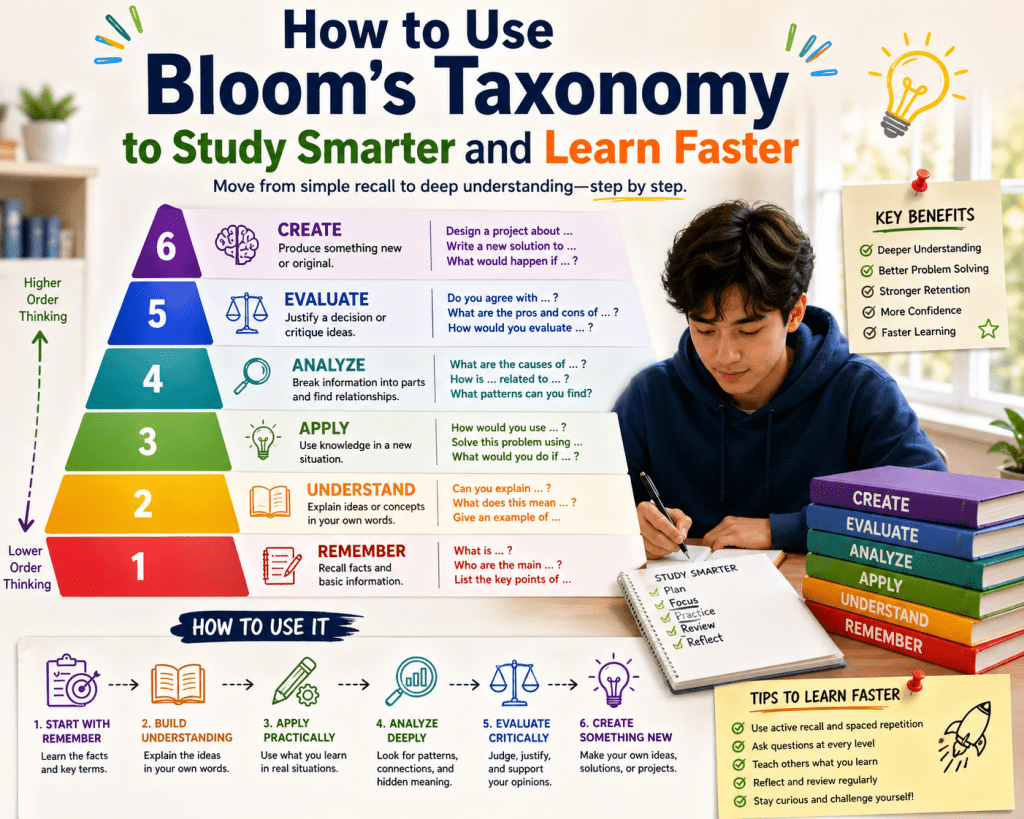
Bloom’s Taxonomy is a structured model used in educational psychology to describe how human cognition develops during learning. It explains how individuals move from simple information recall to complex reasoning and knowledge creation. The framework is widely applied in academic learning environments, professional development, and skill-based training because it provides a systematic approach to understanding how learning progresses over time. Instead of treating learning as a single act of memorization, this model organizes it into stages that reflect increasing cognitive complexity. Each stage represents a deeper level of mental engagement, where learners gradually shift from basic awareness of information to the ability to analyze, evaluate, and produce new ideas based on what they have learned.
At its core, this framework is designed to improve the quality of learning by encouraging structured thinking. It helps learners identify where they are in the learning process and what steps are required to move forward. This makes studying more intentional and less dependent on random memorization. The result is a more efficient learning process where knowledge is not only acquired but also retained and applied effectively.
Historical Foundation and Psychological Basis of the Framework
The origin of Bloom’s Taxonomy lies in mid-20th-century educational research focused on understanding how students process information. The model was developed to categorize intellectual behaviors that contribute to learning outcomes. It was designed to help educators structure curriculum and assessments in a way that aligns with cognitive development. Over time, it became a foundational concept in educational psychology because it addressed a key issue: learners often memorize information without truly understanding or applying it.
The psychological basis of this framework is grounded in cognitive development theory. It assumes that learning is a progressive process where each stage builds upon previous mental structures. When learners acquire new information, it is not stored in isolation. Instead, it interacts with existing knowledge, gradually forming more complex mental networks. This progression is essential for deep learning because it ensures that knowledge is not fragmented but interconnected.
The framework also aligns with how memory functions. Information that is actively processed at multiple cognitive levels is more likely to be stored in long-term memory. This is because deeper processing requires greater mental effort, which strengthens neural connections. As a result, learners who engage with material beyond simple memorization tend to retain it for longer periods and apply it more effectively in different contexts.
Structure of Cognitive Levels and Their Progressive Nature
The structure of Bloom’s Taxonomy is typically represented as a hierarchical system of cognitive levels. Each level reflects a different type of mental activity and increases in complexity as learners move upward. The progression begins with basic recognition of information and advances toward the ability to generate original ideas.
The lowest level involves recognizing and recalling information. This stage is essential for building foundational knowledge, as it allows learners to store basic facts and definitions. Without this stage, higher levels of thinking cannot occur because there would be no information to process further.
The next level focuses on comprehension, where learners begin to interpret meaning. At this stage, individuals do not simply remember information but start to understand it. They can explain ideas in their own words and identify relationships between concepts. This transition from memorization to understanding marks an important shift in cognitive engagement.
As learners progress, they reach the application stage, where knowledge is used in practical situations. This is where theoretical understanding is transformed into action. Learners begin solving problems, using formulas, and applying concepts in real-world scenarios. This stage is critical because it demonstrates whether knowledge has been truly understood or simply memorized.
Higher levels introduce analytical thinking, where information is broken down into components. Learners examine structures, identify patterns, and evaluate relationships between different elements. This level of thinking requires deeper cognitive effort because it involves interpreting complex information rather than simply absorbing it.
Further progression leads to evaluative thinking, where learners make judgments based on evidence. This involves comparing ideas, assessing validity, and forming reasoned opinions. It requires not only understanding information but also critically engaging with it.
The highest cognitive level focuses on creation, where learners produce original ideas or solutions. This stage represents the highest form of intellectual engagement because it requires synthesis of all previous levels. Learners are no longer just the consumers of information but contributors to knowledge development.
The Role of Memory and Information Retention in Learning
Memory plays a crucial role in the learning process described by this framework. Without effective memory retention, progression through cognitive levels becomes difficult. However, memory in this context is not limited to simple repetition. It involves encoding information in a way that allows it to be retrieved and applied later.
Information is more effectively retained when it is processed deeply rather than superficially. Shallow processing, such as rote memorization, often leads to short-term retention that fades quickly. In contrast, deeper cognitive engagement strengthens memory pathways and improves long-term recall.
The process of moving from remembering to understanding is particularly important for memory consolidation. When learners actively interpret information, they create meaningful associations that make recall easier. These associations form the foundation for higher-level thinking, where information is used in more complex ways.
Another important aspect of memory in learning is retrieval practice. Recalling information repeatedly strengthens neural connections and improves accessibility. This aligns with the lower levels of the taxonomy but also supports progression to higher cognitive stages by reinforcing foundational knowledge.
Transition from Basic Recall to Conceptual Understanding
The shift from remembering to understanding represents a significant cognitive transition. At the recall stage, learners focus on storing information. At the understanding stage, they begin to process meaning. This shift is essential because it transforms passive knowledge into active comprehension.
Understanding requires learners to interpret information rather than simply recognize it. This involves explaining concepts, summarizing ideas, and identifying key relationships. It also requires the ability to reframe information in different ways, which strengthens cognitive flexibility.
This stage is critical for academic success because it ensures that learners are not just memorizing isolated facts. Instead, they are developing a structured understanding of how information is connected. This structured knowledge becomes the foundation for all higher-level cognitive processes.
Application as a Bridge Between Theory and Practice
Application represents the point where theoretical knowledge meets. This stage is essential for transforming abstract concepts into usable skills. Without application, knowledge remains theoretical and lacks practical relevance.
At this level, learners begin solving problems, completing tasks, and applying rules in structured environments. This process reinforces understanding by requiring learners to actively use what they have learned. It also helps identify gaps in knowledge, as application often reveals areas that require further study.
The application is particularly important in skill-based learning environments where knowledge must be demonstrated through action. It ensures that learning is not limited to theoretical understanding but extends to practical execution.
Active and Passive Engagement in Learning Processes
Learning can be broadly categorized into active and passive engagement. Passive learning involves receiving information without significant interaction, such as listening or reading. While this method is useful for initial exposure, it does not deeply engage cognitive processes.
Active learning requires participation and mental engagement. It involves problem-solving, discussion, and practical application. This type of learning aligns more closely with higher cognitive levels because it requires learners to process and manipulate information.
Both forms of learning are important, but their effectiveness depends on how they are used. Passive learning is useful for building foundational knowledge, while active learning is essential for deeper understanding and retention. A balanced approach that integrates both methods leads to more effective learning outcomes.
Building Study Strategies Around Cognitive Progression
Effective study strategies can be developed by aligning learning activities with cognitive levels. At the beginning stages, focus is placed on building memory through repetition and review. As understanding develops, learners shift toward summarization and explanation of concepts.
As learning progresses, practice-based methods become more important. These include problem-solving exercises and real-world application tasks. At advanced stages, learners engage in analysis and evaluation, which requires critical thinking and reflection.
The final stage of learning involves creative expression, where knowledge is used to generate new ideas or solutions. This progression ensures that learning is comprehensive and structured rather than fragmented or surface-level.
Cognitive Load and Its Impact on Learning Efficiency
Cognitive load refers to the amount of mental effort required to process information. When cognitive load is too high, learning becomes inefficient because the brain struggles to process and store information effectively.
Bloom’s framework helps manage cognitive load by organizing learning into progressive stages. By starting with basic knowledge and gradually increasing complexity, learners avoid overwhelming their cognitive capacity. This structured approach ensures that information is processed efficiently and retained more effectively over time.
Understanding cognitive load also helps learners design better study sessions. Short, focused learning periods are often more effective than long, continuous sessions because they reduce mental fatigue and improve concentration.
Early Development of Analytical Thinking Skills
Analytical thinking begins to develop when learners start breaking down information into components. This involves examining relationships, identifying patterns, and understanding how different elements interact.
At this stage, learners move beyond surface-level understanding and begin engaging with deeper structural aspects of knowledge. This cognitive shift is essential for developing critical thinking skills that are required in advanced learning and problem-solving environments.
Advancing Through Bloom’s Taxonomy Toward Higher-Order Thinking
As learners move beyond the foundational stages of Bloom’s Taxonomy, the cognitive demand increases significantly. The early stages focus on recognition, comprehension, and basic application, but the middle and upper levels require deeper mental processing, abstraction, and structured reasoning. This progression is not automatic; it requires deliberate engagement with learning material in a way that challenges assumptions and encourages active manipulation of knowledge.
Higher-order thinking begins when learners stop relying solely on memorized information and start questioning, interpreting, and restructuring what they know. This shift is essential for developing intellectual independence. Instead of simply absorbing content, learners begin interacting with it, testing its boundaries, and evaluating its reliability in different contexts. This stage marks a transition from passive knowledge accumulation to active cognitive construction.
The importance of this progression lies in its impact on long-term intellectual development. Learners who operate primarily at lower cognitive levels often struggle with unfamiliar problems because they rely on repetition rather than reasoning. In contrast, those who consistently engage in higher-order thinking are better equipped to adapt their knowledge to new and complex situations.
Analyzing Information Through Structural Decomposition
Analysis represents a critical stage in cognitive development where learners begin breaking down complex information into smaller, more manageable components. This process allows individuals to understand how ideas are structured and how different parts of a concept interact with one another.
At this level, learning becomes less about absorbing information and more about examining relationships. Learners identify patterns, compare elements, and explore underlying structures that govern how information is organized. This approach helps transform abstract knowledge into structured understanding, which is essential for problem-solving and critical reasoning.
Analytical thinking also requires learners to distinguish between relevant and irrelevant information. This skill is particularly important in environments where large volumes of information must be processed efficiently. By filtering and organizing data, learners improve both accuracy and decision-making ability.
Another key aspect of analysis is identifying inconsistencies or contradictions within information. This encourages deeper engagement with content, as learners must evaluate the reliability and coherence of what they are studying. Over time, this strengthens cognitive flexibility and improves the ability to approach problems from multiple perspectives.
Evaluative Thinking and the Development of Judgment Skills
Evaluation represents a significant advancement in cognitive processing because it requires learners to make judgments based on evidence, criteria, and logical reasoning. At this stage, learners are no longer just interpreting information but actively assessing its value, credibility, and effectiveness.
This level of thinking is essential in environments where decisions must be made based on incomplete or competing information. Learners must compare different viewpoints, weigh evidence, and justify their conclusions using structured reasoning. This process strengthens analytical rigor and reduces reliance on assumptions or bias.
Evaluative thinking also involves the ability to construct arguments. Learners must not only form opinions but also support them with logical explanations and relevant evidence. This develops communication skills as well as intellectual discipline, as arguments must be coherent, structured, and defensible.
An important aspect of evaluation is recognizing the criteria used to judge information. Different contexts require different standards, and understanding these standards is essential for making appropriate judgments. This awareness enhances adaptability and improves decision-making across various domains.
Creative Thinking and Knowledge Synthesis
Creation is the highest level of cognitive development within the taxonomy and represents the point where learners generate new ideas, solutions, or interpretations. This stage involves synthesizing knowledge from multiple sources and restructuring it into original outputs.
Creative thinking is not limited to artistic expression; it includes problem-solving, innovation, and conceptual development. Learners at this level combine existing knowledge in novel ways to produce outcomes that did not previously exist. This requires both deep understanding and flexible thinking.
Synthesis plays a central role in this process. Learners must integrate different concepts, identify connections between seemingly unrelated ideas, and reorganize information into new frameworks. This ability is essential for innovation and advanced problem-solving.
Creative thinking also involves experimentation. Learners test ideas, revise approaches, and refine their outputs based on feedback and evaluation. This iterative process strengthens cognitive resilience and encourages continuous improvement.
The Interconnection Between Cognitive Levels
Although Bloom’s Taxonomy is often presented as a linear hierarchy, the cognitive levels are deeply interconnected. Learning does not always progress in a strict upward sequence; instead, learners often move back and forth between levels depending on the complexity of the material and the learning context.
For example, analysis may require revisiting basic knowledge to clarify understanding. Similarly, evaluation often depends on strong analytical skills, and creation relies on both analysis and evaluation. This interconnectedness highlights the dynamic nature of learning and emphasizes that cognitive development is not rigid but flexible.
Understanding these interconnections helps learners approach studying more strategically. Instead of treating each level as separate, they can recognize how different cognitive processes support one another. This leads to more integrated and effective learning strategies.
The Role of Metacognitive Awareness in Learning Progression
Metacognition refers to awareness and control of one’s own thinking processes. Within Bloom’s framework, metacognitive awareness plays a crucial role in guiding learners through different cognitive levels.
Learners who are metacognitively aware can monitor their understanding, identify gaps in knowledge, and adjust their study strategies accordingly. This self-regulation improves learning efficiency and ensures that cognitive effort is directed appropriately.
Metacognitive skills also include planning, monitoring, and evaluating one’s own learning. These skills allow learners to make informed decisions about how to approach study tasks, how much time to allocate, and which strategies to use for different types of content.
This level of awareness transforms learning from a passive process into an active, self-directed activity. It empowers learners to take control of their educational development and adapt to different learning challenges more effectively.
Deep Learning Versus Surface Learning Approaches
A key distinction in educational psychology is between deep learning and surface learning. Surface learning is characterized by memorization and minimal engagement with content, while deep learning involves meaningful understanding and cognitive integration.
Bloom’s Taxonomy strongly aligns with deep learning principles because it encourages progression through multiple cognitive levels. Instead of focusing only on recall, learners are encouraged to engage with material in increasingly complex ways.
Deep learning leads to better retention, stronger comprehension, and improved problem-solving ability. It also enhances the ability to transfer knowledge across different contexts, which is essential in real-world applications.
Surface learning, on the other hand, often results in short-term retention and limited understanding. While it may be useful for initial exposure to new material, it is insufficient for mastery or advanced application.
Cognitive Engagement in Structured Learning Environments
Structured learning environments benefit significantly from the application of Bloom’s Taxonomy because they provide a clear framework for organizing educational activities. Each cognitive level can be supported through specific learning tasks that guide learners through progressive stages of understanding.
In such environments, learners are encouraged to move beyond passive reception of information and engage in activities that require interpretation, application, and critical thinking. This structured progression ensures that learning is not fragmented but systematically developed.
Cognitive engagement is further enhanced when learners are challenged to explain, justify, and apply their knowledge in different scenarios. These activities strengthen mental connections and reinforce understanding at multiple levels.
Application of Cognitive Progression in Problem Solving
Problem-solving is one of the most important practical applications of Bloom’s Taxonomy. Effective problem-solving requires movement through multiple cognitive stages, beginning with understanding the problem and progressing toward analysis, evaluation, and solution creation.
At the initial stage, learners must understand the problem clearly by identifying relevant information and defining key concepts. Without this foundation, further steps cannot be effectively executed.
Next, analysis allows learners to break down the problem into smaller components and identify relationships between variables. This step is essential for understanding the structure of the problem.
Evaluation then enables learners to assess possible solutions and determine their effectiveness based on logical reasoning. Finally, creation involves developing a solution that integrates all previous cognitive processes.
This structured approach ensures that problem-solving is systematic rather than random, leading to more accurate and effective outcomes.
The Importance of Cognitive Flexibility in Learning
Cognitive flexibility refers to the ability to adapt thinking strategies based on changing conditions or new information. Within Bloom’s framework, cognitive flexibility becomes increasingly important at higher levels of learning.
Learners must be able to shift between different types of thinking, such as moving from analysis to evaluation or from understanding to application. This adaptability enhances problem-solving ability and improves learning efficiency.
Cognitive flexibility also allows learners to approach problems from multiple perspectives. This reduces rigid thinking patterns and encourages more innovative and effective solutions.
Integration of Knowledge Across Cognitive Levels
Effective learning requires integration across all cognitive levels rather than isolated engagement with individual stages. Knowledge becomes most powerful when it is connected, structured, and applied across different contexts.
This integration ensures that learners do not simply accumulate information but develop a coherent understanding of the subject. It also improves the ability to retrieve and use knowledge in practical situations.
As learners progress, they begin to see how different cognitive levels support one another. This awareness strengthens overall learning outcomes and promotes long-term intellectual development.
Integrating Bloom’s Taxonomy Into Long-Term Learning Strategies
Long-term learning effectiveness depends on how well cognitive processes are structured and sustained over time. Bloom’s Taxonomy provides a framework for organizing study behavior into a progressive system that supports continuous intellectual growth. Rather than treating learning as isolated sessions of information intake, this approach encourages learners to view knowledge development as an evolving process that unfolds across multiple cognitive layers.
At the core of long-term learning is consistency. Cognitive development does not occur in a single stage or through a single method. Instead, it requires repeated engagement with material at increasing levels of complexity. When learners revisit information through different cognitive lenses, they strengthen neural pathways and deepen conceptual understanding. This repeated engagement ensures that knowledge is not only stored but also reinforced and expanded.
A structured learning strategy built around cognitive progression helps prevent stagnation. Many learners remain stuck at surface-level understanding because they repeatedly focus on memorization without advancing toward application or analysis. By intentionally moving through cognitive levels, learners create a dynamic learning system that continuously evolves and adapts to new challenges.
The Role of Structured Repetition in Cognitive Reinforcement
Repetition plays a critical role in reinforcing memory and supporting progression through cognitive stages. However, repetition alone is not sufficient unless it is structured in a way that aligns with deeper cognitive engagement. Simply repeating information without variation leads to shallow learning, while structured repetition strengthens both memory and understanding.
When learners revisit material at different cognitive levels, they reinforce previous knowledge while simultaneously expanding its depth. For example, initial repetition may focus on recall, but subsequent repetition can involve explanation, application, or analysis. This layered approach ensures that each encounter with the material contributes to cognitive growth rather than simple memorization.
Structured repetition also enhances retention by activating multiple areas of the brain. When information is processed in different ways, it becomes more deeply embedded in memory networks. This makes recall easier and improves the ability to apply knowledge in unfamiliar situations.
Cognitive Progression in Complex Problem Environments
Complex problem environments require the integration of multiple cognitive skills. In such situations, learners must move fluidly between understanding, analysis, evaluation, and creation. Bloom’s Taxonomy provides a clear framework for managing this complexity by breaking down cognitive demands into manageable stages.
In real-world problem-solving scenarios, the first requirement is often comprehension of the problem itself. Without clear understanding, subsequent steps cannot be effectively executed. Once the problem is understood, learners must analyze its structure, identify relevant variables, and determine relationships between components.
Evaluation becomes essential when multiple possible solutions exist. Learners must assess each option based on evidence, feasibility, and logical consistency. This stage requires critical judgment and the ability to weigh competing factors.
Finally, creative thinking allows learners to develop innovative solutions that may not be immediately obvious. This stage often involves combining existing knowledge in new ways or generating entirely new approaches to the problem.
The ability to move through these stages efficiently is what distinguishes novice learners from advanced thinkers. Cognitive flexibility and structured reasoning are essential for navigating complex environments effectively.
The Development of Critical Thinking Through Cognitive Structuring
Critical thinking is one of the most important outcomes of progressing through Bloom’s Taxonomy. It involves the ability to analyze information objectively, evaluate arguments, and make reasoned decisions based on evidence rather than assumptions.
At lower cognitive levels, thinking is often descriptive and factual. As learners progress, they begin to question assumptions, identify biases, and assess the validity of information. This transition is essential for developing independent thinking skills.
Critical thinking also involves recognizing patterns of reasoning and identifying logical inconsistencies. Learners must be able to distinguish between strong and weak arguments, as well as between relevant and irrelevant information. This skill is particularly important in environments where information is abundant and not always reliable.
As learners reach higher cognitive levels, they begin to construct their own arguments and justify their reasoning. This requires not only understanding information but also organizing it coherently and persuasively. The ability to articulate reasoning clearly is a key component of advanced cognitive development.
Knowledge Transfer Across Different Contexts
One of the most powerful aspects of advanced learning is the ability to transfer knowledge across different contexts. This means applying what has been learned in one situation to entirely new and unfamiliar scenarios.
Knowledge transfer occurs when learners move beyond memorization and develop a deep understanding of underlying principles. Instead of remembering isolated facts, they understand how concepts function and how they can be adapted to different situations.
This ability is particularly important in dynamic environments where problems are not predictable. Learners who can transfer knowledge effectively are more adaptable and better equipped to handle uncertainty.
Cognitive flexibility plays a key role in knowledge transfer. Learners must be able to reinterpret information based on context and adjust their thinking accordingly. This requires a high level of mental adaptability and conceptual understanding.
The Relationship Between Cognitive Depth and Retention
Cognitive depth refers to the level of mental processing involved in learning. The deeper the cognitive engagement, the stronger the retention of information. This relationship is a fundamental principle of effective learning.
Shallow processing, such as simple repetition, often leads to weak retention. Information is stored temporarily but is easily forgotten because it is not meaningfully connected to other knowledge structures. In contrast, deep processing involves interpretation, analysis, and application, which strengthens memory consolidation.
When learners engage with material at multiple cognitive levels, they create multiple pathways for retrieval. This makes it easier to recall information and apply it in different contexts. Cognitive depth, therefore, directly influences both memory strength and learning effectiveness.
Advanced Analytical Thinking in Structured Learning
At advanced stages of cognitive development, analytical thinking becomes more sophisticated. Learners are no longer just identifying relationships but are evaluating complex systems and interpreting multi-layered information.
This level of analysis requires breaking down abstract concepts into structured components and examining how they interact. It also involves identifying hidden assumptions and evaluating the reliability of information sources.
Advanced analytical thinking is essential for solving complex problems that do not have straightforward solutions. It allows learners to approach challenges systematically and develop well-reasoned conclusions.
Evaluation as a Foundation for Decision-Making
Evaluation is a critical cognitive process that directly supports decision-making. It involves assessing information based on criteria such as accuracy, relevance, and effectiveness. This stage requires learners to go beyond understanding and analysis and engage in judgment-based reasoning.
Effective evaluation depends on the ability to compare alternatives and weigh evidence objectively. It also requires awareness of potential biases and the ability to separate subjective opinion from objective analysis.
In decision-making contexts, evaluation ensures that choices are made based on logical reasoning rather than impulse or incomplete information. This leads to more reliable and consistent outcomes.
Creative Cognition and the Generation of Original Thought
Creative cognition represents the highest level of cognitive engagement. It involves generating new ideas, combining existing knowledge in innovative ways, and developing original solutions to problems.
Creativity is not limited to artistic expression; it is a fundamental cognitive process that plays a role in all areas of learning. It requires flexibility, imagination, and the ability to think beyond established patterns.
At this stage, learners synthesize information from multiple sources and restructure it into new forms. This process often involves experimentation, revision, and refinement.
Creative thinking is essential for innovation and advanced problem-solving. It allows learners to move beyond existing knowledge frameworks and contribute new insights.
The Continuous Cycle of Cognitive Development
Cognitive development is not a linear process but a continuous cycle of learning, application, reflection, and refinement. Bloom’s Taxonomy provides a structured way to understand this cycle by organizing cognitive processes into progressive stages.
Learners often move back and forth between levels as they encounter new information or challenges. This dynamic movement ensures that learning remains flexible and adaptable.
Continuous engagement with all cognitive levels leads to sustained intellectual growth. It also ensures that knowledge remains active and usable rather than static or forgotten.
Building Intellectual Independence Through Structured Learning
One of the ultimate goals of cognitive development is intellectual independence. This refers to the ability to learn, analyze, and create without relying heavily on external guidance.
Structured learning frameworks support this independence by teaching learners how to organize their thinking processes. By progressing through cognitive levels, learners develop the ability to manage their own learning effectively.
Intellectual independence also involves confidence in reasoning and decision-making. Learners who reach higher cognitive levels are more capable of evaluating information critically and forming their own conclusions.
Sustaining Cognitive Growth Beyond Formal Learning
Cognitive development does not end with formal education. It continues throughout life as individuals encounter new experiences and challenges. Bloom’s Taxonomy provides a lifelong framework for maintaining cognitive growth.
By consistently engaging in higher-order thinking, individuals can continue to expand their intellectual abilities. This includes analyzing new information, evaluating different perspectives, and generating innovative ideas.
Sustained cognitive engagement ensures that learning remains active and relevant. It also supports adaptability in rapidly changing environments where continuous learning is essential.
Final Stage of Cognitive Integration Across Lifelong Learning
At the highest level of cognitive development, learners achieve full integration of knowledge across all stages of thinking. This means they can seamlessly move between remembering, understanding, applying, analyzing, evaluating, and creating based on context and need.
This integrated cognitive ability represents mastery of learning processes. It allows individuals to approach problems holistically, combining different types of thinking to produce effective outcomes.
Cognitive integration is not a fixed achievement but an ongoing process. As new knowledge is acquired, it is continuously incorporated into existing cognitive structures, ensuring that learning remains dynamic and evolving.
Conclusion
Bloom’s Taxonomy ultimately functions as a structured cognitive roadmap that explains how human learning develops from simple information recognition to advanced levels of intellectual creation. When viewed as a complete system, it is not just an academic classification but a practical guide for improving how knowledge is absorbed, processed, and applied. The real value of this framework emerges when learners begin to understand that learning is not a single activity but a layered progression of thinking skills that build upon each other over time.
At the most basic level, learning begins with exposure to information. This stage is where individuals encounter facts, definitions, and foundational concepts. While this stage is often underestimated, it is essential because it establishes the raw material that higher cognitive processes depend on. Without a stable base of factual understanding, more advanced thinking becomes fragmented and inconsistent. However, the limitation of this stage is that it does not guarantee comprehension or usability. Memorized information alone is not sufficient for meaningful learning outcomes.
As learners progress into deeper cognitive stages, understanding becomes the central focus. This is where information is no longer treated as isolated data points but is instead interpreted, explained, and connected. Comprehension transforms raw information into structured meaning. At this stage, learners begin to see relationships between ideas and can express concepts in their own language. This transition is critical because it marks the shift from passive reception to active cognitive processing.
Beyond understanding, application introduces the practical dimension of learning. Knowledge becomes functional when it is used to solve problems or complete tasks. This stage bridges theory and practice, ensuring that learning is not limited to abstract concepts. Application reinforces understanding because it requires learners to actively use what they know in structured or real-world contexts. Without this stage, learning remains theoretical and disconnected from actual performance.
As cognitive complexity increases, analysis becomes essential for deeper learning. At this level, learners begin to break down information into components and examine how those parts interact. This process encourages critical observation and structured reasoning. Instead of accepting information at face value, learners investigate underlying patterns, structures, and relationships. Analytical thinking strengthens intellectual clarity and prepares learners for more complex cognitive tasks by teaching them how to deconstruct and reorganize knowledge.
Evaluation introduces a higher level of judgment and decision-making. At this stage, learners assess information based on logic, evidence, and structured criteria. This is where critical thinking becomes more pronounced, as individuals must compare ideas, identify strengths and weaknesses, and justify their conclusions. Evaluation is essential in developing intellectual independence because it requires learners to form reasoned opinions rather than relying on external authority or memorized answers. It also strengthens the ability to engage in structured argumentation and evidence-based reasoning.
At the highest cognitive level, creation represents the culmination of all previous stages. This is where learners synthesize knowledge and produce original ideas, solutions, or interpretations. Creation is not simply about artistic expression; it includes innovation, problem-solving, and conceptual development across all fields of knowledge. At this stage, learners demonstrate mastery by combining understanding, analysis, and evaluation into new intellectual outputs. This level reflects true cognitive independence, where knowledge is not only consumed but transformed into something new.
One of the most important insights from Bloom’s Taxonomy is that learning is not linear in practice, even though it is structured hierarchically. Learners often move between levels depending on context, difficulty, and familiarity with content. For example, while analyzing a concept, a learner may return to basic understanding to clarify meaning or revisit factual knowledge to strengthen reasoning. This dynamic movement highlights that effective learning is flexible and iterative rather than rigid.
Another key takeaway is the importance of cognitive depth in retention and mastery. Information that is processed at deeper cognitive levels tends to be retained longer and applied more effectively. This is because deeper processing creates stronger mental connections between ideas. Instead of storing isolated facts, the brain organizes information into interconnected structures that are easier to retrieve and use. This explains why learners who engage in analysis, evaluation, and creation tend to perform better in long-term understanding and problem-solving.
The framework also emphasizes the role of active engagement in learning. Passive exposure to information, such as reading or listening without interaction, is insufficient for deep cognitive development. Active learning requires participation, reflection, and application. When learners actively engage with material, they process it more deeply, which improves comprehension and retention. This engagement also encourages curiosity and critical thinking, which are essential for long-term intellectual growth.
Metacognitive awareness further enhances the effectiveness of Bloom’s framework. When learners understand how they learn, they can adjust their strategies to improve outcomes. This includes recognizing strengths and weaknesses, selecting appropriate study methods, and monitoring progress. Metacognition transforms learning into a self-regulated process, where individuals take control of their cognitive development rather than relying solely on external instruction.
The framework also highlights the importance of structured progression in learning environments. When cognitive stages are intentionally incorporated into study routines, learners can move more efficiently from basic knowledge acquisition to advanced reasoning. This structured progression prevents cognitive overload by ensuring that each stage is mastered before moving to the next. It also creates a balanced learning experience that combines memorization, understanding, application, and creativity.
In practical terms, applying Bloom’s Taxonomy to study strategies leads to more effective learning outcomes. Learners who consciously engage with different cognitive levels develop stronger problem-solving skills, improved analytical ability, and greater intellectual flexibility. They are better equipped to handle unfamiliar challenges because they are trained to think at multiple levels rather than relying on surface-level understanding.
Ultimately, the strength of Bloom’s Taxonomy lies in its ability to connect cognitive theory with practical learning behavior. It provides a clear structure for understanding how knowledge is developed and how intellectual skills evolve over time. By recognizing that learning is a progressive and ongoing process, learners can approach education more strategically and effectively.
When applied consistently, this framework supports not only academic success but also lifelong learning. It encourages continuous intellectual development, adaptability, and creativity. Over time, learners who engage with all levels of cognition develop a more complete and flexible understanding of knowledge, allowing them to navigate complex situations with confidence and clarity.