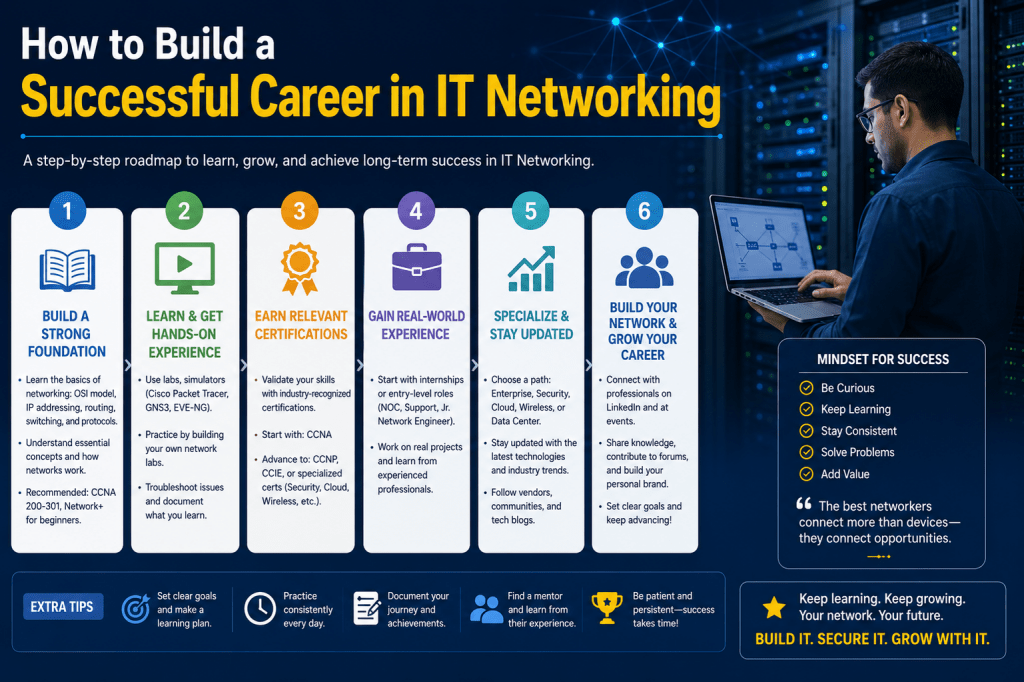
A career in IT networking is best understood as a structured yet flexible journey where each stage builds on the previous one. Rather than being a random collection of skills, it follows a progressive development from foundational knowledge to advanced technical mastery and eventually to specialization or leadership roles. This pathway is designed to help individuals move from basic IT support responsibilities into complex network engineering environments where they manage, design, and optimize large-scale systems. The goal of this structured progression is to reduce confusion, eliminate unnecessary detours, and create a clear learning direction that strengthens both technical ability and professional confidence over time.
Building Strong Foundations in Information Technology
The first stage of an IT networking career begins with establishing a strong understanding of general information technology concepts. At this level, learners focus on understanding how computers function, how operating systems interact with hardware, and how software applications communicate with system resources. This foundation is essential because networking is deeply connected to all aspects of computing. Without this base, advanced networking concepts become difficult to grasp. Entry-level learners typically study topics such as computer components, storage systems, memory types, installation processes, and basic system configuration. These early skills prepare individuals to troubleshoot simple technical problems and develop confidence in handling real-world IT environments.
Understanding Computer Hardware and Operating Systems
A crucial part of early IT learning involves becoming familiar with computer hardware and operating systems. Hardware knowledge includes identifying and understanding components such as processors, motherboards, RAM, storage drives, power supplies, and peripheral devices. Operating system knowledge involves learning how software manages hardware resources and provides an interface for users. This includes tasks like installing operating systems, managing files, configuring system settings, and understanding system performance. These skills form the backbone of IT support roles and prepare learners for more advanced networking tasks where hardware and software interaction becomes more complex and critical for system stability.
Introduction to Core Networking Principles
Once foundational IT knowledge is established, the next step is understanding basic networking principles. Networking focuses on how devices communicate with each other through wired and wireless connections. Learners begin by understanding concepts such as IP addressing, subnetting, DNS, DHCP, and the OSI model. These principles explain how data travels across networks and how systems identify and connect with one another. At this stage, learners also explore different types of networks such as LAN, WAN, and MAN, as well as common networking devices like routers, switches, and access points. This foundational knowledge is essential for building a career in networking because it explains the structure behind all digital communication.
Developing Practical Networking Skills Through Entry Certifications
To formalize foundational knowledge, many learners pursue entry-level certifications such as CompTIA A+ and CompTIA Network+. These certifications validate understanding of basic IT systems and networking fundamentals. CompTIA A+ focuses on hardware, software, troubleshooting, and operational procedures, while CompTIA Network+ expands into deeper networking concepts such as network design, protocols, security basics, and infrastructure management. These certifications are widely recognized and help learners transition from theoretical understanding to practical IT roles. They also serve as a stepping stone toward more advanced networking certifications and help build confidence in real-world technical environments.
Building Hands-On Experience Through Practice Environments
Practical experience is one of the most important elements of developing IT networking skills. Learners are encouraged to build small home labs or practice environments where they can experiment with configurations, troubleshoot issues, and simulate real network scenarios. This hands-on approach allows individuals to apply theoretical knowledge in practical situations, making learning more effective and memorable. Activities may include setting up virtual machines, configuring routers and switches, testing network connections, and simulating troubleshooting scenarios. The goal is to develop problem-solving skills and gain familiarity with real-world networking tools and systems.
Strengthening Troubleshooting and Analytical Thinking
As learners progress, troubleshooting becomes a critical skill in IT networking. Troubleshooting involves identifying, diagnosing, and resolving technical issues within systems and networks. This requires logical thinking, attention to detail, and the ability to follow structured problem-solving methods. Common issues may include connectivity failures, IP conflicts, hardware malfunctions, or configuration errors. Developing strong troubleshooting skills helps IT professionals respond quickly to technical problems and minimize system downtime. Over time, these skills become essential for managing complex network environments where multiple systems interact simultaneously.
Transitioning Toward Networking Specialization
After building foundational IT and networking knowledge, learners begin transitioning into specialized networking roles. This stage focuses on deeper technical understanding of how enterprise networks are designed and maintained. Learners explore advanced topics such as routing, switching, network security, and infrastructure optimization. At this level, individuals start to understand how large-scale networks operate in business environments and how different systems are integrated to ensure performance and reliability. This transition marks the shift from general IT support to more focused networking responsibilities.
Advancing with Professional Networking Certifications
To progress further in an IT networking career, learners pursue more advanced certifications such as Cisco CCNA and similar networking qualifications. These certifications focus on routing, switching, network configuration, and infrastructure management at a professional level. They provide in-depth knowledge of how networks are built, secured, and maintained in enterprise environments. Learners gain practical skills in configuring network devices, managing IP routing protocols, and implementing network security measures. This stage is critical for individuals aiming to become network engineers or systems specialists, as it significantly enhances technical expertise and job readiness.
Developing a Problem-Solving and Continuous Learning Mindset
Success in IT networking requires more than technical knowledge; it requires a mindset focused on continuous learning and adaptability. Technology evolves rapidly, and professionals must stay updated with new tools, protocols, and systems. Developing a habit of ongoing learning helps individuals remain relevant in the industry. This includes studying new technologies, practicing regularly, and staying engaged with real-world IT challenges. A strong problem-solving mindset also helps professionals approach complex issues with confidence and efficiency, ensuring long-term career growth and adaptability in changing environments.
Preparing for Advanced Networking Roles and Future Growth
As individuals gain experience and certifications, they gradually move toward advanced networking roles that involve designing, managing, and optimizing large-scale IT infrastructures. These roles require a combination of technical expertise, analytical thinking, and practical experience. Professionals at this stage may work on enterprise network architecture, cloud integration, cybersecurity implementation, and system performance optimization. The focus shifts from learning basic concepts to applying advanced strategies that support organizational goals. This stage represents the continuous evolution of an IT networking career, where growth is driven by experience, specialization, and consistent skill development.
Transitioning from Core Networking Knowledge to Advanced Concepts
As an IT networking professional moves beyond the foundational stage, the focus gradually shifts toward deeper and more complex networking concepts that form the backbone of modern enterprise systems. At this stage, understanding how individual devices communicate is no longer sufficient; instead, the emphasis is placed on how entire networks are designed, optimized, and secured to support business operations. Learners begin to explore how routing decisions are made across multiple networks, how switching impacts data flow efficiency, and how large-scale infrastructures maintain reliability under heavy traffic loads. This transition marks the beginning of a more strategic approach to networking, where theoretical knowledge is combined with practical system design thinking.
Strengthening Understanding of Routing and Switching Technologies
Routing and switching represent the core functions of any network infrastructure, and mastering these concepts is essential for career progression in IT networking. Routing focuses on how data packets are directed between different networks, while switching deals with communication within a single network. At this stage, professionals learn how routers determine the best path for data transmission using routing protocols, and how switches efficiently forward data within local networks using MAC addresses. These mechanisms ensure that information reaches its destination quickly and accurately. Developing a strong understanding of these technologies enables IT professionals to design more efficient networks and troubleshoot complex connectivity issues with greater precision.
Exploring Network Addressing and Subnetting in Depth
One of the most critical areas in advanced networking is IP addressing and subnetting. While basic concepts are introduced early in a career, deeper mastery is required for real-world network design. Subnetting involves dividing a large network into smaller, manageable segments to improve performance and security. Professionals learn how to calculate subnet masks, determine usable IP ranges, and design hierarchical network structures that reduce congestion and improve scalability. Understanding IPv4 and IPv6 addressing schemes also becomes essential, especially as modern networks transition toward larger and more complex address spaces. This knowledge allows professionals to allocate resources efficiently and prevent address conflicts in enterprise environments.
Developing Expertise in Network Protocols and Communication Standards
As networking knowledge expands, professionals must also become familiar with the wide range of protocols that govern communication between devices. These protocols define how data is transmitted, formatted, and received across networks. Common examples include TCP/IP, HTTP, HTTPS, FTP, and DNS. Each protocol serves a specific purpose and operates at different layers of the networking model. Understanding how these protocols interact helps professionals diagnose communication issues and optimize network performance. At this stage, learners also begin to explore advanced protocols used in enterprise environments, gaining insight into how large organizations maintain secure and efficient communication systems.
Enhancing Skills in Network Security Fundamentals
Security becomes increasingly important as networks grow in size and complexity. Advanced networking professionals must understand how to protect systems from unauthorized access, data breaches, and cyber threats. This includes learning about firewalls, intrusion detection systems, encryption methods, and access control mechanisms. Network security also involves implementing secure configurations for routers and switches, managing user permissions, and monitoring network traffic for suspicious activity. A strong understanding of security fundamentals ensures that professionals can design networks that are not only efficient but also resilient against evolving cyber threats. This knowledge becomes even more critical as organizations increasingly rely on digital infrastructure for their operations.
Introduction to Enterprise Networking Environments
At this stage of career development, professionals begin working with enterprise-level network environments that are significantly more complex than small-scale systems. These environments often include multiple interconnected networks, data centers, remote sites, and cloud-based resources. Understanding how these components interact is essential for maintaining system stability and performance. Professionals learn how to manage large-scale network architectures, implement redundancy systems, and ensure high availability for critical applications. This experience prepares them for roles that involve managing mission-critical infrastructure where downtime can have significant business impacts.
Working with Virtualization and Cloud Networking Concepts
Modern IT networking increasingly involves virtualization and cloud-based technologies. Virtualization allows multiple virtual machines to run on a single physical server, improving resource efficiency and scalability. Cloud networking extends this concept by enabling organizations to manage infrastructure over the internet rather than relying solely on physical hardware. Professionals at this stage learn how virtual networks are configured, how cloud environments are structured, and how resources are distributed across global data centers. Understanding these technologies is essential for working in modern IT environments where cloud adoption continues to grow rapidly and traditional networking boundaries are expanding.
Improving Network Performance and Optimization Techniques
Network performance optimization becomes a key responsibility for advanced IT professionals. This involves analyzing network traffic, identifying bottlenecks, and implementing solutions to improve speed and reliability. Techniques such as load balancing, traffic shaping, and bandwidth management are commonly used to ensure optimal performance. Professionals also monitor network health using specialized tools that provide insights into latency, packet loss, and throughput. By continuously optimizing network performance, IT specialists help organizations maintain smooth operations and prevent disruptions that could affect productivity and user experience.
Developing Problem-Solving Strategies for Complex Network Issues
As networks become more complex, troubleshooting also becomes more challenging. Advanced professionals must develop structured problem-solving strategies that allow them to quickly identify and resolve issues across interconnected systems. This often involves analyzing logs, testing connectivity, isolating faulty components, and verifying configurations. The ability to think systematically and logically is crucial in these situations. Instead of relying on trial and error, experienced professionals follow a methodical approach that helps them pinpoint root causes efficiently. This skill is highly valued in enterprise environments where downtime must be minimized.
Building Confidence Through Real-World Network Exposure
Practical exposure to real-world networking environments plays a vital role in professional development. Working with live systems allows professionals to understand how theoretical concepts apply in actual business scenarios. This includes managing network configurations, responding to outages, and implementing infrastructure changes under real operational constraints. Over time, this experience builds confidence and enhances decision-making abilities. Professionals also learn how to handle pressure, prioritize tasks, and communicate effectively with team members during critical situations. These soft skills are just as important as technical knowledge in advanced networking roles.
Expanding Knowledge Through Continuous Technical Learning
The field of IT networking is constantly evolving, making continuous learning essential for long-term success. Professionals must stay updated with emerging technologies, new protocols, and evolving security threats. This involves regularly studying updated materials, experimenting with new tools, and staying engaged with industry developments. Continuous learning ensures that professionals remain competitive and capable of adapting to technological changes. It also encourages curiosity and innovation, allowing individuals to explore new areas such as automation, software-defined networking, and artificial intelligence integration in network systems.
Understanding the Importance of Network Documentation and Planning
Effective network management requires clear documentation and careful planning. Professionals must maintain detailed records of network configurations, changes, and troubleshooting procedures. This documentation helps ensure consistency, simplifies problem resolution, and supports future upgrades or expansions. Planning also plays a critical role in designing scalable and efficient network architectures. By anticipating future needs and potential challenges, professionals can create networks that are flexible and capable of supporting long-term growth. Proper documentation and planning are essential skills for anyone working in advanced IT networking roles.
Deepening Expertise in Enterprise Network Design
As an IT networking professional progresses further, the focus shifts from operating and maintaining networks to designing them at an enterprise scale. At this stage, understanding how different network components integrate into a cohesive architecture becomes essential. Enterprise network design involves planning how routers, switches, servers, and security systems interact to support business operations efficiently. Professionals begin to evaluate requirements such as scalability, redundancy, fault tolerance, and performance optimization. The goal is to build networks that can handle increasing demand while maintaining stability and security across multiple locations and user environments.
Mastering Advanced Routing Concepts and Protocols
Routing at an advanced level goes far beyond basic path selection between networks. Professionals begin working with dynamic routing protocols that automatically adapt to changes in network topology. These protocols ensure that data finds the most efficient path even when network conditions change due to failures or congestion. Understanding how routing decisions are influenced by metrics such as hop count, bandwidth, and delay becomes critical. At this stage, professionals also learn how to manipulate routing behavior to improve performance and reliability in enterprise environments, ensuring that data flow remains consistent and optimized under all conditions.
Enhancing Switching Technologies for High-Performance Networks
Switching technologies evolve significantly in advanced networking environments. Professionals begin working with features such as VLANs, trunking, and advanced switching architectures that segment and optimize network traffic. VLANs allow logical separation of networks within the same physical infrastructure, improving security and performance. Trunking enables multiple VLANs to communicate efficiently across switches. Understanding how to design and configure these systems helps professionals reduce network congestion and improve overall efficiency. At this level, switching is no longer just about forwarding data but about strategically controlling traffic flow across complex environments.
Implementing Scalable Network Architectures
Scalability is a key concern in enterprise networking. As organizations grow, their networks must expand without compromising performance or reliability. Professionals learn how to design scalable architectures that can accommodate increasing users, devices, and applications. This involves implementing hierarchical network models, optimizing routing paths, and ensuring that infrastructure components can be easily upgraded or expanded. Scalability also includes planning for future technologies such as cloud integration and remote access systems. A well-designed scalable network allows organizations to grow seamlessly without requiring major structural changes.
Strengthening Network Security at the Infrastructure Level
At the advanced stage, network security becomes deeply integrated into the infrastructure itself. Professionals are responsible for designing secure networks that protect data at every level of communication. This includes implementing firewalls, intrusion prevention systems, secure access controls, and encryption mechanisms. Security is no longer treated as an additional layer but as a core part of network design. Professionals must also consider threats such as unauthorized access, malware propagation, and distributed attacks. By embedding security into the architecture, networks become more resilient and capable of defending against increasingly sophisticated cyber threats.
Working with Redundancy and High Availability Systems
Enterprise networks must remain operational even in the event of hardware failures or unexpected outages. To achieve this, professionals implement redundancy and high availability systems. Redundancy ensures that backup systems are available when primary systems fail, while high availability focuses on minimizing downtime and maintaining continuous service. This involves configuring backup routes, duplicate hardware systems, and failover mechanisms. Understanding how to design and manage these systems is critical for ensuring business continuity. In modern IT environments, even a few minutes of downtime can have significant financial and operational impacts.
Exploring Network Automation and Efficiency Tools
Automation plays an increasingly important role in advanced networking. Professionals begin using tools and scripts to automate repetitive tasks such as configuration management, monitoring, and updates. This reduces the risk of human error and increases operational efficiency. Automation also allows networks to respond dynamically to changes, such as adjusting traffic loads or reconfiguring routes automatically. Learning how to integrate automation into network operations is essential for managing large-scale environments effectively. It also frees up time for professionals to focus on strategic planning and system optimization.
Understanding Network Monitoring and Performance Analysis
Monitoring network performance is a critical responsibility at this stage of a networking career. Professionals use specialized tools to track network health, analyze traffic patterns, and identify potential issues before they become critical problems. Metrics such as latency, bandwidth usage, packet loss, and error rates are continuously monitored to ensure optimal performance. Performance analysis helps professionals understand how networks behave under different conditions and where improvements are needed. This proactive approach ensures that networks remain stable, efficient, and capable of supporting organizational demands.
Developing Skills in Troubleshooting Large-Scale Systems
Troubleshooting in enterprise environments is significantly more complex than in small networks. Issues may span multiple systems, locations, and technologies, making diagnosis more challenging. Professionals must develop advanced troubleshooting methodologies that allow them to isolate problems quickly and efficiently. This often involves analyzing logs from multiple devices, testing different network segments, and collaborating with other IT teams. A structured and systematic approach is essential for identifying root causes and implementing effective solutions without disrupting overall network operations.
Integrating Cloud and Hybrid Networking Environments
Modern enterprise networks increasingly rely on cloud and hybrid architectures. Professionals must understand how on-premises infrastructure integrates with cloud services to create flexible and scalable systems. Hybrid networks combine traditional data centers with cloud platforms, allowing organizations to optimize resources and improve accessibility. Understanding how data flows between these environments is essential for maintaining performance and security. Professionals also learn how to manage cloud-based networking services, ensuring seamless communication between distributed systems across global infrastructures.
Advancing Professional Growth Through Specialization
At this stage of career development, professionals often begin specializing in specific areas of networking. This could include network security, cloud networking, infrastructure design, or automation. Specialization allows individuals to develop deeper expertise in a particular domain, making them more valuable in the job market. It also enables them to take on more complex and strategic responsibilities within organizations. Choosing a specialization often depends on personal interest, industry demand, and long-term career goals. This step marks a transition from general networking roles to highly focused technical positions.
Expanding into Advanced Network Security Operations
At this stage of an IT networking career, security becomes a continuous operational responsibility rather than a separate function. Professionals work with advanced security operations that involve monitoring, detecting, and responding to threats in real time. This includes analyzing traffic patterns for unusual behavior, identifying potential intrusion attempts, and enforcing strict access control policies across enterprise systems. Security operations also require understanding how attackers exploit vulnerabilities and how defensive mechanisms can be designed to prevent such incidents. The focus shifts toward building proactive defense systems that reduce risk before it impacts business operations.
Working with Intrusion Detection and Prevention Systems
Intrusion detection and prevention systems play a major role in modern network security environments. These systems are designed to monitor network traffic and identify suspicious activities that may indicate cyberattacks. Professionals learn how to configure these systems to detect anomalies, trigger alerts, and automatically block harmful traffic. Understanding how to fine-tune detection rules is important to avoid false positives while ensuring real threats are identified accurately. These systems act as a critical layer of defense, protecting enterprise networks from both external and internal threats.
Strengthening Identity and Access Management in Networks
Identity and access management becomes increasingly important as networks grow in size and complexity. Professionals are responsible for ensuring that only authorized users can access specific systems and data. This involves implementing authentication mechanisms, role-based access controls, and secure login protocols. Proper access management reduces the risk of unauthorized entry and data breaches. It also ensures compliance with organizational policies and regulatory requirements. At this level, managing user identities across multiple systems becomes a key responsibility in maintaining overall network security.
Implementing Advanced Encryption Techniques
Encryption is a fundamental component of secure networking. Advanced professionals work with encryption methods to protect data both in transit and at rest. This ensures that sensitive information remains secure even if intercepted by unauthorized parties. Understanding encryption algorithms, secure key management, and secure communication protocols is essential. Professionals also implement secure tunnels for data transmission, ensuring that communication between systems remains private and protected. Encryption strengthens trust in network systems by ensuring confidentiality and integrity of data.
Managing Large-Scale Network Infrastructure
Enterprise environments often involve managing large-scale network infrastructures that span multiple locations and data centers. Professionals are responsible for ensuring that all components work together seamlessly. This includes coordinating routers, switches, servers, and cloud resources to maintain consistent performance. Large-scale management also involves monitoring system health, optimizing traffic flow, and ensuring redundancy across critical network paths. The complexity of these environments requires strong organizational skills and a deep understanding of how different systems interact within a unified architecture.
Optimizing Network Traffic Flow Across Distributed Systems
As networks expand, optimizing traffic flow becomes essential for maintaining performance. Professionals analyze how data moves across different segments of the network and identify areas of congestion or inefficiency. Techniques such as traffic prioritization, load balancing, and routing optimization are used to improve speed and reliability. This ensures that critical applications receive the necessary bandwidth while maintaining overall system efficiency. Optimizing traffic flow is especially important in environments where multiple services and applications operate simultaneously across distributed systems.
Integrating Wireless and Mobile Networking Technologies
Modern enterprise networks are no longer limited to wired connections. Wireless and mobile networking technologies play a significant role in providing flexible connectivity options. Professionals learn how to design and manage wireless networks that support large numbers of devices without compromising performance or security. This includes configuring access points, managing signal coverage, and ensuring secure wireless authentication. Mobile networking also introduces challenges such as device mobility, roaming, and network consistency, all of which must be carefully managed to maintain seamless connectivity.
Understanding Software-Defined Networking Concepts
Software-defined networking introduces a new approach to managing network infrastructure by separating control functions from physical hardware. This allows for centralized management and greater flexibility in network configuration. Professionals learn how software-defined systems enable dynamic control of network behavior through software applications. This makes it easier to adjust network policies, allocate resources, and respond to changing demands. Understanding this concept is essential for working in modern environments where automation and virtualization are becoming standard practices.
Enhancing Collaboration Across IT Teams
At advanced stages of a networking career, collaboration becomes a key component of daily work. Professionals often work closely with security teams, system administrators, cloud engineers, and developers. Effective communication ensures that network changes align with broader organizational goals. Collaboration also helps in resolving complex issues that require input from multiple technical domains. Strong interpersonal skills become just as important as technical expertise, enabling professionals to coordinate effectively and deliver integrated solutions across IT environments.
Building Resilience Through Disaster Recovery Planning
Disaster recovery planning is essential for maintaining business continuity in the event of system failures or cyber incidents. Professionals design strategies that ensure networks can recover quickly from disruptions. This includes creating backup systems, defining recovery procedures, and testing failover mechanisms. The goal is to minimize downtime and data loss during unexpected events. A well-designed disaster recovery plan ensures that organizations can continue operations even under adverse conditions, making it a critical aspect of enterprise network management.
Developing Advanced Analytical and Strategic Thinking Skills
As professionals move deeper into their networking careers, analytical and strategic thinking become increasingly important. Rather than simply reacting to technical issues, they begin to anticipate potential challenges and design proactive solutions. This involves analyzing system performance trends, predicting future requirements, and making informed decisions about infrastructure improvements. Strategic thinking allows professionals to align network design with long-term business objectives, ensuring that technology supports organizational growth effectively.
Preparing for Leadership and Architectural Responsibilities
At higher levels of experience, IT networking professionals often transition into roles that involve leadership or architectural responsibilities. This includes designing entire network systems, setting technical standards, and guiding implementation strategies. Leadership roles require not only technical expertise but also the ability to manage teams, coordinate projects, and make high-level decisions. Architectural responsibilities involve creating scalable, secure, and efficient network designs that support long-term organizational needs. This stage represents a shift from hands-on technical work to strategic oversight and system design thinking.
Transitioning Toward Senior-Level Networking Responsibilities
At the most advanced stage of an IT networking career, professionals begin operating in senior-level roles where the focus shifts from implementation to strategy, governance, and long-term infrastructure planning. Instead of working only on configurations and troubleshooting, the responsibility expands to designing entire network ecosystems that support business growth, security, and scalability. These roles require a deep understanding of how all networking components interact, along with the ability to align technical decisions with organizational objectives. At this level, professionals are expected to anticipate future needs and design systems that remain effective even as technology and business demands evolve.
Architecting Enterprise Network Infrastructures
Network architecture becomes a central responsibility at this stage. Professionals are tasked with designing complex infrastructures that integrate multiple technologies, including on-premises systems, cloud platforms, wireless networks, and hybrid environments. The goal is to create a unified architecture that ensures seamless communication between all components while maintaining performance and security. This requires careful planning of network topology, redundancy strategies, segmentation models, and scalability frameworks. Every design decision must consider both current operational requirements and future expansion possibilities, ensuring long-term sustainability of the network environment.
Leading Network Strategy and Infrastructure Planning
Senior professionals play a key role in shaping the overall network strategy of an organization. This involves evaluating business needs, understanding technological trends, and translating them into actionable infrastructure plans. Strategic planning includes decisions about network upgrades, technology adoption, cost optimization, and risk management. Professionals must balance innovation with stability, ensuring that new technologies enhance performance without disrupting existing systems. This level of responsibility requires strong analytical thinking and the ability to make decisions that impact the entire organization’s IT ecosystem.
Driving Innovation Through Emerging Networking Technologies
At this stage, professionals actively explore and implement emerging technologies that redefine how networks operate. This includes advancements in automation, artificial intelligence-driven network management, edge computing, and next-generation connectivity solutions. These innovations help organizations improve efficiency, reduce operational costs, and enhance performance. Professionals must continuously evaluate new technologies to determine their relevance and potential impact. The ability to integrate innovative solutions into existing infrastructures is a key skill that distinguishes senior networking experts from mid-level professionals.
Managing Global and Distributed Network Systems
Many organizations operate across multiple regions, requiring professionals to manage global and distributed network systems. These environments involve connecting data centers, branch offices, and cloud services across different geographic locations. Managing such systems requires ensuring consistent performance, security, and reliability regardless of location. Professionals must account for latency, bandwidth limitations, regional regulations, and infrastructure differences. Coordinating these complex systems demands a high level of expertise and the ability to design networks that function efficiently on a global scale.
Ensuring Compliance and Governance in Network Operations
Compliance and governance become increasingly important in senior networking roles. Organizations must adhere to industry standards, regulatory requirements, and internal policies related to data security and network operations. Professionals are responsible for ensuring that network designs and configurations meet these requirements. This includes implementing audit controls, maintaining documentation, and enforcing security policies across all systems. Governance also involves establishing best practices for network management, ensuring consistency and accountability across the organization’s IT infrastructure.
Optimizing Cost Efficiency in Network Design
Cost management is a critical aspect of enterprise networking at the senior level. Professionals must design and manage networks in a way that maximizes performance while minimizing unnecessary expenses. This involves selecting appropriate technologies, optimizing resource usage, and eliminating inefficiencies in infrastructure design. Cloud adoption, virtualization, and automation often play a role in reducing operational costs. Effective cost optimization ensures that organizations achieve high performance without overspending on infrastructure or maintenance.
Mentoring and Developing Future IT Networking Professionals
Senior professionals often take on mentoring roles, guiding junior and mid-level IT staff in their career development. This includes sharing technical knowledge, providing guidance on certifications, and helping others develop practical skills. Mentorship plays a key role in building strong technical teams and ensuring knowledge transfer within organizations. By training and supporting new professionals, senior experts contribute to the overall growth and stability of the IT workforce. This responsibility also helps reinforce their own understanding and leadership capabilities.
Aligning Network Architecture with Business Objectives
At the highest level of networking careers, technical decisions must align closely with business goals. Professionals work to ensure that network infrastructure supports organizational priorities such as scalability, digital transformation, customer experience, and operational efficiency. This requires close collaboration with business leaders and stakeholders to understand long-term objectives. Network architecture is no longer just a technical concern but a strategic asset that directly influences business success. Professionals must ensure that every design decision contributes to achieving broader organizational outcomes.
Evaluating Risk and Strengthening Infrastructure Resilience
Risk management becomes a key responsibility in advanced networking roles. Professionals must identify potential risks to network infrastructure and develop strategies to mitigate them. This includes preparing for cyber threats, system failures, natural disasters, and operational disruptions. Building resilience into network design ensures that systems can recover quickly from unexpected events. This involves redundancy planning, backup systems, disaster recovery strategies, and continuous monitoring. A resilient infrastructure minimizes downtime and protects critical business operations.
Adapting to Continuous Technological Evolution in Networking
The IT networking field continues to evolve rapidly, requiring professionals to remain adaptable throughout their careers. New technologies, protocols, and methodologies constantly reshape how networks are designed and managed. Senior professionals must stay informed about industry trends and continuously update their skills to remain effective. Adaptability ensures long-term career relevance and allows professionals to lead organizations through technological transitions. The ability to embrace change while maintaining stability is one of the most important qualities at this stage of a networking career.
Evolving Into Network Leadership and Decision-Making Roles
At the highest level of an IT networking career, professionals gradually move into leadership positions where technical expertise is combined with decision-making authority. The focus is no longer limited to configuring systems or troubleshooting networks but extends to guiding entire infrastructure directions. Leaders in networking are responsible for evaluating organizational needs, defining technical roadmaps, and ensuring that every network decision supports long-term stability and growth. This stage requires a balanced mindset where technical depth meets business awareness, allowing professionals to influence both engineering outcomes and strategic direction.
Overseeing Large-Scale Digital Transformation Initiatives
Modern organizations constantly evolve through digital transformation, and networking professionals play a critical role in this process. At this level, they contribute to planning and executing transformations that integrate cloud computing, automation, and advanced connectivity solutions into existing infrastructures. This involves migrating legacy systems, redesigning network architectures, and ensuring uninterrupted business operations during transitions. Professionals must carefully evaluate risks and benefits while coordinating with multiple departments. Their decisions directly influence how efficiently an organization adapts to new technologies and maintains competitiveness in a rapidly changing digital environment.
Designing Future-Ready Network Ecosystems
A key responsibility at senior levels is designing networks that are not only functional today but also adaptable for future technologies. This requires anticipating industry trends such as increased cloud dependency, expansion of edge computing, and integration of AI-driven network management. Future-ready network ecosystems are built with flexibility in mind, allowing seamless upgrades and integration of new tools without major disruptions. Professionals must ensure that architecture choices support scalability, automation, and long-term sustainability while maintaining high levels of performance and security.
Managing Cross-Functional IT Collaboration at Scale
Networking leaders often work across multiple IT domains, coordinating efforts between cybersecurity teams, cloud engineers, system administrators, and software developers. This cross-functional collaboration ensures that network infrastructure aligns with broader technology initiatives. Effective communication becomes essential, as technical decisions must be clearly understood by stakeholders from different backgrounds. Professionals at this stage act as bridges between teams, ensuring that network strategies are properly implemented and aligned with organizational goals. Strong leadership and coordination skills are essential for maintaining efficiency across complex IT ecosystems.
Strengthening Organizational Cybersecurity Posture
At advanced levels, networking professionals contribute significantly to an organization’s cybersecurity strategy. Instead of focusing only on network-level protections, they help design integrated security frameworks that span across all systems and services. This includes enforcing zero-trust principles, implementing advanced threat detection systems, and ensuring compliance with security standards. Professionals also work closely with security analysts to identify vulnerabilities and strengthen defenses. Their role becomes increasingly strategic, ensuring that security is embedded into every layer of network design and operation.
Driving Efficiency Through Automation and Intelligent Networking
Automation becomes a central theme in modern network management at senior levels. Professionals oversee the implementation of automated systems that manage configurations, monitor performance, and respond to network events in real time. Intelligent networking solutions use data analysis and machine learning to optimize performance and detect anomalies. By reducing manual intervention, automation improves accuracy, efficiency, and scalability. Leaders in networking must understand how to integrate these technologies effectively while ensuring that automated systems remain reliable and secure.
Balancing Innovation with Operational Stability
One of the key challenges at this stage is balancing innovation with operational stability. While new technologies offer improved performance and capabilities, they also introduce potential risks and complexities. Networking professionals must carefully evaluate when and how to adopt emerging solutions without disrupting existing systems. This requires strong judgment and experience in assessing technical maturity, compatibility, and organizational readiness. Maintaining stable operations while continuously innovating is a defining characteristic of senior-level networking roles.
Establishing Best Practices and Technical Standards
Senior professionals are often responsible for defining technical standards and best practices within an organization. These guidelines ensure consistency in network design, configuration, and maintenance across all systems. Establishing standards helps reduce errors, improve efficiency, and simplify troubleshooting processes. It also ensures that all teams follow a unified approach when implementing network solutions. By setting clear expectations and documentation practices, professionals create a structured environment that supports long-term operational success.
Evaluating and Adopting Emerging Industry Trends
The networking field evolves rapidly, and staying updated with emerging trends is essential for continued success. At this stage, professionals actively evaluate new developments such as software-defined wide area networking, cloud-native infrastructure, and advanced virtualization techniques. They assess how these innovations can be applied within their organization and whether they provide measurable benefits. This requires continuous learning and strategic evaluation to ensure that adopted technologies align with business goals and technical requirements.
Building Long-Term Career Legacy in IT Networking
At the peak of a networking career, professionals begin focusing on the long-term impact of their work. This includes mentoring future leaders, contributing to organizational growth, and shaping the evolution of IT infrastructure within their industry. Their experience allows them to influence not only technical systems but also the direction of entire teams and projects. Building a career legacy involves sharing knowledge, improving organizational capabilities, and ensuring that systems remain sustainable and adaptable for future generations of IT professionals.
Sustaining Continuous Growth in a Rapidly Changing Field
Even at the most advanced level, learning and adaptation remain essential. The IT networking field continues to evolve with new technologies, security challenges, and architectural models. Professionals must remain engaged with ongoing developments to maintain their expertise and effectiveness. Continuous growth ensures that they remain relevant and capable of guiding organizations through future technological shifts. The journey in IT networking does not end at a senior level; instead, it evolves into a continuous cycle of learning, innovation, and leadership.
Final Conclusion
The IT networking career pathway is a structured yet continuously evolving journey that transforms a beginner into a highly skilled professional capable of designing, managing, and securing complex enterprise systems. It begins with fundamental IT knowledge, where learners build an understanding of hardware, operating systems, and basic troubleshooting skills. From there, it progresses into core networking principles, where concepts such as IP addressing, routing, switching, and communication protocols form the foundation of all future learning.
As professionals advance, they move into specialized networking domains that require deeper technical expertise and hands-on experience. This stage focuses on real-world network configuration, enterprise infrastructure management, and the development of strong problem-solving abilities. Certifications and practical lab environments play an important role in strengthening both confidence and competence during this phase, ensuring that theoretical knowledge is effectively applied in practical scenarios.
At higher levels, the career pathway shifts toward enterprise architecture, advanced security operations, automation, and cloud-integrated networking environments. Professionals begin to work with large-scale infrastructures, optimize performance across distributed systems, and implement security frameworks that protect critical organizational data. The focus expands from simply maintaining networks to strategically designing systems that support long-term business growth, resilience, and efficiency.
In the most advanced stages, IT networking professionals transition into leadership and architectural roles where decision-making, strategy, and innovation become central responsibilities. They guide digital transformation initiatives, define technical standards, mentor future professionals, and ensure that network infrastructures remain scalable, secure, and future-ready. Their work directly influences organizational success and technological advancement.
Ultimately, success in IT networking is not defined by a single certification or milestone, but by continuous learning, adaptability, and practical experience. The field demands a mindset of lifelong growth, where professionals constantly evolve alongside emerging technologies. Those who remain committed to learning, hands-on practice, and strategic thinking are able to build rewarding, impactful, and future-proof careers in the ever-expanding world of IT networking.