Desktop support engineering has shifted from a reactive, device-focused support function into a structured technical discipline that directly influences enterprise stability. In earlier IT models, support teams primarily handled individual user incidents such as software installation issues or hardware malfunctions. In modern environments, however, desktop support engineers operate at the intersection of endpoint computing, identity systems, network connectivity, and cloud-managed infrastructure. This expanded scope reflects the complexity of today’s enterprise ecosystems where every workstation is part of a larger interconnected system rather than an isolated machine.
In practical terms, this means engineers are no longer just “fixers” of broken devices. They are responsible for ensuring that entire fleets of endpoints function consistently across different departments, locations, and sometimes even global offices. The role now demands an understanding of how system-wide policies affect individual devices, how authentication flows interact with directory services, and how application behavior changes under different network conditions. This transformation has elevated the role from basic technical support into a specialized operational engineering function.
The increasing reliance on cloud services and hybrid work environments has further expanded this responsibility. Desktop support engineers now frequently manage endpoints that connect to both on-premises systems and cloud platforms simultaneously. This dual-environment complexity introduces challenges such as synchronization issues, conditional access policies, and device compliance enforcement across distributed networks. As a result, engineers must think beyond individual incidents and instead evaluate how systemic configurations influence user experience at scale.
Positioning Within IT Support Structures and Escalation Frameworks
Desktop support engineers occupy a critical middle layer within IT support hierarchies. At the lowest tier, service desk analysts handle high-volume, low-complexity issues using predefined troubleshooting procedures. These include password resets, basic software guidance, and routine hardware checks. When incidents exceed the scope of these procedures, they are escalated to desktop support engineers who possess deeper technical knowledge and authority to implement more advanced corrective actions.
Above this level, system administrators and infrastructure engineers manage servers, networks, virtualization layers, and core enterprise systems. Desktop support engineers act as the interface between end-user environments and these backend systems. They translate user-facing problems into technical diagnoses that often require coordination with multiple IT domains. For example, a login issue may involve identity services, endpoint configuration, and network authentication policies simultaneously.
This structured escalation model ensures efficiency while maintaining system integrity. Desktop support engineers reduce the workload on higher-level engineering teams by resolving complex but non-core infrastructure issues. Their position requires them to understand when to escalate problems further and when to resolve them independently, which is a critical decision-making skill in enterprise IT environments.
Core Responsibilities Across Enterprise Endpoint Environments
The responsibilities of desktop support engineers extend across a wide range of technical and operational domains. One of their primary functions is managing endpoint stability across organizational devices. This includes maintaining operating system health, ensuring software compatibility, and resolving system-level conflicts that disrupt user productivity. Unlike basic support roles that address isolated incidents, engineers often deal with recurring or systemic issues that require deeper analysis.
Another major responsibility involves system diagnostics and root cause analysis. Engineers frequently investigate operating system crashes, application failures, and performance degradation issues that cannot be resolved through standard troubleshooting scripts. This requires the ability to interpret system logs, analyze error patterns, and correlate multiple data points to identify underlying causes.
In addition to diagnostics, desktop support engineers are heavily involved in endpoint lifecycle management. This includes device provisioning, configuration standardization, software deployment, patch management, and eventual device retirement. Each stage of this lifecycle requires careful coordination to ensure compliance with organizational standards and security requirements.
Engineers also play a key role in user access management. They often troubleshoot authentication issues, permission inconsistencies, and profile synchronization problems that arise in directory-based environments. These tasks require a strong understanding of identity systems and how they interact with endpoint configurations.
Enterprise Endpoint Management and System Control Models
Modern IT environments rely heavily on centralized endpoint management systems that allow organizations to control large numbers of devices from a unified platform. Desktop support engineers work extensively within these systems to enforce configuration policies, deploy applications, and monitor device compliance.
These platforms enable organizations to maintain consistency across thousands of endpoints by applying standardized configurations automatically. Engineers are responsible for ensuring that these configurations are correctly applied and that deviations are quickly identified and corrected. When devices fall out of compliance, engineers must investigate the cause, which may involve software conflicts, user modifications, or synchronization issues.
Endpoint management also includes monitoring system health indicators such as disk usage, memory performance, update status, and security compliance levels. Engineers analyze these metrics to proactively identify potential issues before they escalate into user-impacting incidents. This proactive approach is increasingly important in large-scale environments where reactive troubleshooting alone is insufficient to maintain operational efficiency.
Additionally, engineers are often involved in large-scale deployment projects such as operating system upgrades or enterprise-wide application rollouts. These projects require careful planning to minimize downtime and ensure compatibility across diverse hardware and software configurations.
Technical Complexity and Multi-Domain Knowledge Requirements
Desktop support engineering requires a broad and interconnected technical skill set. Unlike specialized IT roles that focus on a single domain, engineers must understand multiple layers of technology and how they interact. This includes operating systems, networking fundamentals, identity management systems, and application behavior.
Operating system knowledge is essential because engineers must understand how system processes, drivers, services, and registry structures interact. Many technical issues originate from conflicts within these components, requiring engineers to analyze system behavior at a granular level.
Networking knowledge is equally important, as many endpoint issues are related to connectivity, DNS resolution, authentication routing, or latency inconsistencies. Engineers must be able to interpret network behavior and determine whether an issue originates from the device itself or from external infrastructure.
Identity systems also play a significant role in modern environments. Engineers must understand how authentication flows operate, how user permissions are assigned, and how group policies influence system behavior. Misconfigurations in these systems can lead to widespread access issues affecting entire departments.
This multi-domain knowledge requirement is what differentiates desktop support engineers from entry-level technicians. It allows them to diagnose complex issues that span multiple systems rather than focusing on isolated symptoms.
Automation, Scripting, and Operational Efficiency
Automation has become an essential part of desktop support engineering. Engineers frequently use scripting techniques to streamline repetitive tasks such as software deployment, system configuration, and log analysis. This not only improves efficiency but also reduces the likelihood of human error in large-scale operations.
Automated deployment processes allow engineers to configure new devices quickly and consistently, ensuring that all endpoints adhere to organizational standards. This is particularly important in environments with frequent onboarding or device refresh cycles.
Scripting also plays a role in troubleshooting. Engineers may use automated scripts to collect system data, analyze performance metrics, or reset configurations across multiple devices simultaneously. This reduces resolution time and improves overall support efficiency.
As organizations scale, automation becomes increasingly important in maintaining system stability. Engineers who can design and implement automated workflows are often more valuable because they reduce operational overhead and improve consistency across IT environments.
Security, Compliance, and Endpoint Protection Responsibilities
Security is a fundamental aspect of desktop support engineering. Engineers are responsible for ensuring that endpoints comply with organizational security policies and industry standards. This includes managing software updates, enforcing encryption protocols, and monitoring for vulnerabilities.
Endpoint security also involves responding to potential threats such as malware infections, unauthorized access attempts, and configuration breaches. Engineers must act quickly to isolate affected systems and prevent further compromise.
Compliance management is another critical responsibility. Organizations often have strict policies governing how devices must be configured and maintained. Engineers ensure that these policies are consistently applied across all endpoints and that any deviations are corrected promptly.
This security-focused aspect of the role has become increasingly important as cyber threats continue to evolve. Desktop support engineers now play a frontline role in protecting organizational systems from endpoint-level vulnerabilities.
Communication, Problem Solving, and Operational Decision-Making
Beyond technical skills, desktop support engineers must possess strong communication and problem-solving abilities. They frequently interact with non-technical users who require clear explanations and structured guidance. The ability to translate complex technical issues into understandable terms is essential for effective support delivery.
Problem-solving in this role involves more than resolving immediate issues. Engineers must evaluate patterns, identify root causes, and implement long-term solutions that prevent recurrence. This requires analytical thinking and the ability to prioritize issues based on business impact.
Decision-making is also a key component of the role. Engineers must determine whether an issue should be resolved immediately, escalated to another team, or addressed through systemic changes. These decisions often have direct implications for business continuity and operational efficiency.
Operational Impact on Enterprise Productivity and System Stability
Desktop support engineers contribute directly to organizational productivity by ensuring that employees can perform their tasks without technical interruptions. Even minor endpoint issues can lead to productivity losses across teams, making rapid resolution critical.
In large organizations, system downtime can have significant operational and financial consequences. Engineers help mitigate these risks by maintaining stable endpoint environments and addressing issues before they escalate.
Their work also reduces pressure on higher-level IT teams by handling complex endpoint issues independently. This allows system administrators and infrastructure engineers to focus on core systems rather than user-level troubleshooting.
Through their combined technical, analytical, and operational responsibilities, desktop support engineers play a foundational role in maintaining the stability and efficiency of modern IT environments.
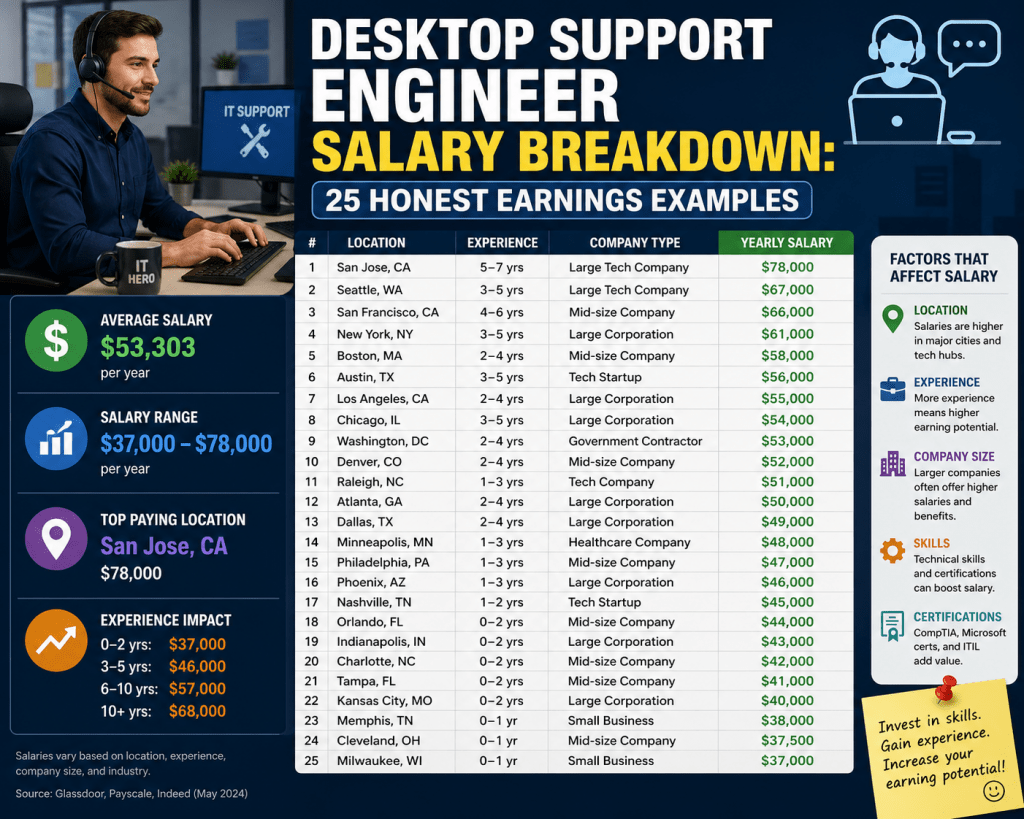
Understanding Desktop Support Engineer Salary Architecture in Modern IT Markets
Desktop support engineer compensation is shaped by a combination of technical responsibility, organizational scale, industry demand, and geographic economic conditions. Unlike standardized roles with fixed pay bands, this position exists within a wide salary spectrum because its responsibilities vary significantly across organizations. In some environments, a desktop support engineer may function closer to a systems administrator, while in others, the role remains tightly focused on advanced endpoint troubleshooting and escalation support. This variability directly impacts compensation models and makes salary prediction more complex than many entry-level IT roles.
At a structural level, compensation is typically divided into three broad tiers: entry-level support engineers transitioning from technician roles, mid-level engineers handling enterprise-scale endpoint environments, and senior engineers who manage complex infrastructure-facing support operations. Each tier reflects not only experience but also the depth of technical responsibility and decision-making authority. As engineers move upward, their exposure to system-wide issues increases, and so does their influence over organizational IT stability.
National Salary Ranges and Economic Baseline Benchmarks
Across large IT labor markets, desktop support engineer salaries tend to cluster within a predictable national range, though exact figures fluctuate based on demand and cost-of-living conditions. On average, compensation reflects the role’s hybrid nature—more advanced than help desk positions but not as specialized as infrastructure engineering roles.
At a national baseline, entry-level desktop support engineers often fall into lower compensation brackets due to limited experience with enterprise systems. These professionals typically handle escalated incidents, endpoint configuration tasks, and structured troubleshooting workflows under supervision. Mid-tier engineers, who possess broader system knowledge and independent problem-solving capabilities, tend to earn significantly higher salaries due to their ability to manage complex technical incidents without escalation.
At the upper end of the spectrum, senior desktop support engineers often approach compensation levels associated with junior systems administrators, particularly in large enterprises or regulated industries. These professionals frequently manage endpoint ecosystems at scale, contribute to infrastructure projects, and participate in strategic IT planning initiatives.
Geographic Salary Variation and Regional IT Demand Dynamics
Location is one of the most influential factors in determining desktop support engineer salaries. Regional differences in technology demand, cost of living, and industry concentration create significant variations in compensation structures across cities and states.
High-density technology hubs typically offer higher salaries due to increased competition for skilled IT professionals and greater reliance on advanced digital infrastructure. In these environments, organizations must offer competitive compensation to attract engineers capable of managing complex endpoint ecosystems. These regions also tend to have higher expectations for technical proficiency, including scripting skills, cloud integration knowledge, and enterprise endpoint management expertise.
Conversely, regions with lower concentrations of technology companies or smaller enterprise infrastructures tend to offer more modest salary ranges. However, even within these regions, senior engineers with specialized skills can still command competitive compensation, particularly if they demonstrate expertise in automation, security enforcement, or large-scale deployment management.
The disparity between regions also reflects differences in organizational maturity. Companies operating in advanced IT environments require engineers who can handle distributed systems, hybrid cloud configurations, and multi-platform endpoint ecosystems, all of which justify higher pay structures.
Cost of Living Influence on Compensation Structures
Cost of living plays a direct role in shaping desktop support engineer salaries. In metropolitan areas with higher housing, transportation, and general living expenses, employers typically adjust compensation upward to remain competitive in the labor market. This adjustment is not purely inflationary; it also reflects the increased operational complexity of IT environments in densely populated business regions.
In contrast, regions with lower living costs often have reduced salary bands, but the purchasing power of those salaries may remain competitive relative to local economic conditions. This creates a dynamic where nominal salary figures alone do not fully represent compensation value.
For desktop support engineers considering relocation, this relationship between salary and cost of living becomes a strategic factor in career planning. A higher salary in a major metropolitan area may not always translate to higher disposable income when compared to moderate salaries in lower-cost regions. However, high-cost regions often provide greater long-term career growth opportunities due to exposure to advanced IT systems and enterprise-scale infrastructure environments.
Industry-Specific Compensation Variations
Different industries place varying levels of importance on desktop support engineering, which directly influences salary expectations. In sectors where system uptime, data integrity, and operational continuity are critical, compensation tends to be significantly higher.
Financial services organizations, for example, rely heavily on secure and stable IT environments. Desktop support engineers in these environments often work with highly regulated systems and must adhere to strict compliance standards. This increases both responsibility and compensation levels.
Healthcare organizations also require robust IT support due to the critical nature of their systems. Engineers in these environments may manage devices connected to clinical systems, administrative platforms, and secure patient data environments, all of which require precision and reliability.
Technology-driven companies, particularly those operating cloud-based or SaaS platforms, often demand engineers who can adapt quickly to evolving systems. These organizations typically offer competitive compensation to attract talent capable of supporting dynamic, fast-changing environments.
Managed service providers also represent a significant employment sector for desktop support engineers. These organizations support multiple clients simultaneously, requiring engineers to operate across diverse systems and configurations. This variety often results in strong skill development opportunities and competitive salary structures.
Experience-Based Salary Progression and Career Maturity Models
Experience plays a central role in determining desktop support engineer compensation. Entry-level professionals transitioning from help desk roles typically start at lower salary ranges due to limited exposure to enterprise systems. However, as they accumulate experience across different operating systems, network environments, and support scenarios, their earning potential increases substantially.
Mid-level engineers with several years of experience often demonstrate proficiency in independent troubleshooting, system automation, and endpoint management at scale. This level of competence allows them to handle complex incidents without escalation, which increases their value within organizations.
Senior engineers often operate at a level where they influence system design decisions, contribute to infrastructure planning, and manage large-scale endpoint deployments. Their experience enables them to anticipate system issues before they occur, making them critical assets in maintaining operational stability.
Career progression is not strictly time-based; it is heavily influenced by skill acquisition, certification attainment, and exposure to enterprise environments. Engineers who actively develop automation skills, scripting proficiency, and security knowledge tend to progress faster than those who remain in reactive support roles.
Skill-Based Compensation Differentiation
Beyond experience and geography, specific technical skills have a direct impact on salary levels. Engineers who possess advanced troubleshooting capabilities, automation expertise, and deep system knowledge tend to command higher compensation.
Operating system mastery is one of the foundational skills influencing salary progression. Engineers who can manage complex system configurations, resolve advanced OS-level issues, and optimize performance across diverse environments are highly valued.
Networking knowledge also significantly impacts earning potential. While desktop support engineers are not network engineers, a strong understanding of network behavior allows them to diagnose connectivity issues more effectively and collaborate with infrastructure teams.
Automation and scripting capabilities represent one of the most significant salary differentiators. Engineers who can develop scripts to automate repetitive tasks, deploy systems at scale, or analyze logs programmatically are often positioned for higher compensation due to increased efficiency and reduced operational overhead.
Security awareness is another critical factor. As endpoint security becomes a primary concern for organizations, engineers who understand compliance frameworks, threat detection, and endpoint protection strategies are increasingly valuable.
Organizational Scale and Enterprise Complexity Factors
The size and complexity of an organization significantly influence desktop support engineer salaries. Large enterprises with thousands of endpoints require engineers who can manage complex systems, coordinate large-scale deployments, and maintain consistent performance across distributed environments.
In smaller organizations, desktop support engineers may handle a broader range of responsibilities but within a less complex infrastructure. While this can provide diverse experience, compensation levels are often lower due to reduced system complexity and narrower operational scope.
Enterprise environments also tend to require more formalized processes, including change management procedures, incident tracking systems, and structured escalation protocols. Engineers operating in these environments must adhere to strict operational standards, which increases both responsibility and compensation.
Remote Work Models and Global Salary Competition
The rise of remote work has introduced new dynamics into desktop support engineer compensation structures. Engineers are no longer restricted to local job markets, allowing organizations to hire talent across regions with varying salary expectations.
This globalization of IT labor markets has created both opportunities and challenges. Engineers in lower-cost regions may access higher-paying remote roles, while organizations gain access to a broader talent pool. However, this also increases competition, as candidates are now evaluated against a global benchmark rather than a local one.
Remote environments also require engineers to be more self-sufficient, as physical access to systems is limited. This increases the importance of remote troubleshooting skills, communication abilities, and independent problem-solving capacity.
Long-Term Compensation Growth Trajectories in Desktop Support Engineering
Over time, desktop support engineers can experience significant salary growth depending on skill development and career direction. Those who remain within endpoint support often progress into senior engineering roles with higher compensation and expanded responsibilities.
Others transition into adjacent fields such as systems administration, cloud engineering, cybersecurity, or IT operations management. These transitions often result in substantial salary increases due to broader system ownership and increased technical complexity.
Long-term compensation growth is closely tied to continuous learning and adaptation. Engineers who consistently upgrade their technical skills, stay current with evolving technologies, and expand their operational scope tend to experience the strongest salary progression over time.
Advanced Skill Development as the Core Driver of Salary Growth
The long-term earning potential of a desktop support engineer is fundamentally determined by skill depth rather than job title alone. While entry into the role often begins with foundational IT knowledge, sustained salary growth depends on continuous expansion into advanced technical domains. Employers increasingly evaluate engineers based on their ability to handle complex, cross-domain issues rather than their tenure alone. This means that engineers who actively develop systems thinking, automation capability, and enterprise-level troubleshooting expertise tend to progress into higher compensation brackets much faster than those who remain within reactive support functions.
A critical shift occurs when an engineer moves from resolving individual incidents to understanding systemic patterns. Instead of simply fixing a malfunctioning workstation, advanced engineers identify underlying infrastructure issues that affect multiple endpoints simultaneously. This includes diagnosing recurring authentication failures, application deployment inconsistencies, and configuration drift across managed devices. This transition from reactive problem-solving to proactive system stabilization is one of the most important factors in salary escalation within IT support engineering careers.
Operating System Mastery and Deep System Architecture Understanding
One of the strongest technical differentiators in desktop support engineering is advanced knowledge of operating system architecture. Engineers who understand how system processes, memory management, file structures, and service dependencies interact are significantly more effective in troubleshooting complex issues.
In enterprise environments, operating system issues rarely exist in isolation. A single failure may be linked to driver conflicts, registry misconfigurations, group policy misalignment, or corrupted system components. Engineers who can analyze these relationships are able to resolve issues more efficiently and with fewer escalations.
This level of OS expertise also enables engineers to participate in system optimization tasks, such as improving boot performance, reducing application load times, and standardizing system configurations across large fleets. These contributions directly impact organizational efficiency and are often reflected in higher compensation levels due to their operational value.
Networking Knowledge as a Salary Multiplier
Although desktop support engineers are not primarily network engineers, a strong understanding of networking principles significantly increases earning potential. Many endpoint issues are ultimately network-related, even if they initially appear to be device-specific.
Engineers who understand DNS resolution, IP routing, authentication flows, and latency behavior can diagnose problems more accurately and reduce resolution time. This capability is particularly valuable in large organizations where network dependencies are complex and distributed across multiple environments.
In addition, familiarity with network security principles enhances an engineer’s ability to support secure environments. Understanding how firewalls, VPNs, and access control systems interact with endpoints allows engineers to troubleshoot connectivity issues without compromising security policies.
As organizations increasingly adopt hybrid and cloud-based infrastructures, networking knowledge has become a critical salary differentiator for desktop support engineers.
Automation, Scripting, and Efficiency Engineering
Automation capability is one of the most influential factors in modern IT compensation structures. Engineers who can automate repetitive tasks are considered force multipliers within IT teams, as they reduce manual workload and increase operational efficiency.
Scripting languages are commonly used to automate tasks such as software deployment, system configuration, log collection, and user account management. Engineers who can design and maintain these automation workflows are often entrusted with larger responsibilities and more complex environments.
Beyond scripting, automation also includes the ability to design repeatable processes for endpoint provisioning, patch management, and system compliance enforcement. These capabilities allow organizations to scale IT operations without proportionally increasing support staff, which significantly increases the value of engineers who possess these skills.
In many cases, engineers who specialize in automation transition into roles that overlap with systems engineering or infrastructure automation, both of which offer higher salary ceilings.
Security Expertise and Endpoint Protection Responsibility
Security has become a central component of desktop support engineering, particularly as organizations face increasing cyber threats targeting endpoint devices. Engineers are now responsible for ensuring that all devices comply with security policies and are protected against vulnerabilities.
This includes managing endpoint protection systems, enforcing encryption standards, monitoring device compliance, and responding to potential security incidents. Engineers must also ensure that operating systems and applications are regularly updated to mitigate known vulnerabilities.
In more advanced environments, desktop support engineers may participate in incident response activities, assisting security teams in isolating compromised devices and analyzing potential breach vectors. This integration of support and security responsibilities increases the strategic importance of the role and contributes to higher compensation levels.
Security-focused engineers are often among the highest-paid professionals within desktop support because they operate at the intersection of user support and organizational risk management.
Certifications as Structured Career Acceleration Tools
Certifications play a structured role in validating technical expertise and accelerating salary growth in desktop support engineering. While experience remains critical, certifications provide formal recognition of skill sets and often serve as benchmarks for promotion eligibility.
Foundational certifications typically validate core IT knowledge, including hardware support, operating system management, and basic networking concepts. These certifications are often required for entry into structured IT environments and serve as baseline qualifications for desktop support roles.
Intermediate certifications focus on enterprise-level support skills, including system administration principles, endpoint management platforms, and advanced troubleshooting methodologies. Engineers who obtain these credentials are often positioned for higher-responsibility roles and improved compensation packages.
Specialized certifications, particularly those focused on security, cloud environments, or vendor-specific technologies, can further enhance earning potential. These certifications demonstrate expertise in niche areas that are highly valued in modern IT infrastructures.
The impact of certifications on salary is not uniform; it depends on organizational needs, technology stacks, and role requirements. However, engineers with multiple relevant certifications generally have stronger negotiation power and access to higher-paying opportunities.
Experience Depth Versus Experience Duration
In desktop support engineering, salary growth is more closely tied to experience depth than to years of service alone. Depth refers to the complexity and variety of technical challenges an engineer has resolved over time.
An engineer who has worked on diverse environments, including enterprise deployments, hybrid cloud systems, and multi-platform infrastructures, typically commands higher compensation than someone with longer tenure in a limited environment.
Exposure to large-scale incidents, system migrations, and infrastructure transitions significantly enhances an engineer’s problem-solving capability. These experiences develop decision-making skills that are highly valued in advanced IT roles.
Organizations often prioritize engineers who can demonstrate adaptability across different systems and technologies, as this indicates readiness for complex operational environments.
Communication Skills and Cross-Functional Collaboration Impact
While technical expertise is essential, communication skills significantly influence career progression and salary levels in desktop support engineering. Engineers frequently interact with non-technical users, management teams, and specialized IT departments.
The ability to clearly explain technical issues, provide structured guidance, and document solutions effectively is critical for operational efficiency. Engineers who communicate well reduce misunderstandings, accelerate issue resolution, and improve user satisfaction.
In cross-functional environments, desktop support engineers often collaborate with network engineers, system administrators, and security teams. Effective communication ensures that technical information is accurately shared across these domains, reducing the risk of misconfiguration or incomplete troubleshooting.
Engineers who excel in communication are often considered for leadership roles, escalation management positions, or project coordination responsibilities, all of which are associated with higher compensation levels.
Industry Selection and Strategic Career Positioning
The industry in which a desktop support engineer works has a significant impact on salary potential. Some industries inherently require higher levels of IT reliability, security, and system uptime, which translates into greater compensation for support engineers.
Highly regulated industries typically demand stricter compliance standards and more advanced technical oversight. Engineers in these environments are expected to manage sensitive systems, ensure regulatory compliance, and maintain high availability.
Technology-driven industries often provide more dynamic environments where engineers work with rapidly evolving systems and tools. These environments tend to reward adaptability and technical versatility.
Managed service environments expose engineers to multiple client systems, providing broad experience across different technologies and configurations. This diversity can accelerate skill development and improve long-term career prospects.
Remote Work Expansion and Global Compensation Dynamics
Remote work has significantly altered compensation structures in desktop support engineering. Engineers are no longer restricted to local job markets, allowing access to global employment opportunities.
This shift has increased competition but also expanded earning potential for skilled professionals. Engineers who can operate independently in remote environments and manage distributed systems effectively are highly valued.
Remote roles require strong self-management, communication discipline, and technical autonomy. Engineers must be capable of diagnosing and resolving issues without physical access to systems, which increases the importance of advanced troubleshooting skills.
Organizations benefit from remote hiring by accessing broader talent pools, while engineers benefit from increased job mobility and access to higher-paying markets.
Long-Term Career Pathways and Salary Ceiling Expansion
Desktop support engineering serves as a foundational role that can lead to multiple advanced IT career paths. Engineers often transition into systems administration, cloud engineering, cybersecurity, or IT operations management.
Each of these pathways offers higher salary ceilings due to increased responsibility, system ownership, and technical complexity. Transition success depends on skill development, specialization, and exposure to enterprise systems.
Engineers who remain within desktop support can still achieve senior-level compensation by specializing in automation, security, or large-scale endpoint management. However, the highest salary growth typically occurs when engineers expand beyond endpoint support into infrastructure or cloud domains.
Continuous learning, technical diversification, and strategic career planning are essential for maximizing long-term earnings in this field.
Conclusion
Desktop support engineering sits at an interesting intersection in the IT profession where technical depth, operational responsibility, and user-facing communication all converge into a single role. It is not purely a troubleshooting job, nor is it fully aligned with infrastructure engineering, but instead functions as a stabilizing layer that ensures end-user environments remain reliable, secure, and productive. One consistent pattern emerges: salary and career progression in this field are not determined by job title alone but by how effectively an engineer expands their technical scope beyond basic endpoint support.
One of the strongest drivers of long-term earning potential is the ability to move from reactive problem-solving to structured system thinking. Entry-level support work often revolves around isolated incidents such as application failures, login issues, or hardware malfunctions. However, higher-level desktop support engineers begin to recognize patterns across multiple incidents and trace those patterns back to deeper systemic causes. This shift in mindset is what separates routine technicians from engineers who are trusted with enterprise-level responsibility. When an individual can identify recurring issues that originate from policy misconfigurations, network dependencies, or endpoint management inconsistencies, they become significantly more valuable to an organization.
Another critical factor influencing salary growth is technical versatility. Desktop support engineers who confine their skills to a narrow set of troubleshooting tasks often reach a plateau relatively quickly. In contrast, those who actively develop competencies across operating systems, networking fundamentals, identity management systems, and automation tools tend to move into higher compensation brackets. This is because modern IT environments are not isolated systems; they are interconnected ecosystems where endpoints, servers, cloud services, and security frameworks all interact continuously. Engineers who understand these interactions can resolve issues faster and with greater accuracy, which directly reduces operational downtime for organizations.
Automation capability is particularly important in shaping salary trajectories. Engineers who rely solely on manual processes often find themselves limited to repetitive operational work. However, those who can build scripts, automate deployments, and streamline repetitive tasks effectively increase their value to IT departments. Automation reduces workload across teams and introduces consistency into system management processes. As organizations scale, this ability becomes even more critical because manual intervention cannot sustain large enterprise environments. Engineers who contribute to automation initiatives often transition into hybrid roles that overlap with systems engineering or infrastructure operations, both of which carry higher compensation ceilings.
Security awareness is another increasingly important dimension of desktop support engineering. Endpoint devices are often the first point of contact for cyber threats, making engineers responsible for maintaining strong security hygiene across all systems. This includes ensuring systems are patched, configurations comply with security policies, and unauthorized access attempts are identified and mitigated. Engineers who develop strong security skills often become integral to incident response processes and compliance enforcement activities. As cybersecurity continues to grow in importance across industries, professionals with endpoint security expertise are seeing stronger salary growth compared to those focused only on general support tasks.
Geographic and industry factors also play a significant role in shaping compensation. High-demand technology regions tend to offer higher salaries due to increased competition for skilled professionals and more complex IT environments. However, cost of living must always be considered alongside salary figures, as higher nominal income does not always translate to higher real purchasing power. Similarly, industries such as finance, healthcare, and large-scale technology services often pay more due to their reliance on high availability systems and strict compliance requirements. In these environments, downtime or system failure carries significant operational risk, which increases the value of skilled support engineers.
Experience progression in desktop support engineering is not simply a matter of time spent in the role but rather the diversity and complexity of problems handled. Engineers who have been exposed to enterprise deployments, large-scale migrations, hybrid environments, and multi-platform systems typically progress faster than those who remain in repetitive support cycles. Depth of experience matters more than duration because it reflects adaptability and problem-solving capability across different technical scenarios. Employers place high value on engineers who can operate independently in complex environments without requiring constant escalation.
Communication skills also play a surprisingly important role in salary growth. While technical expertise is the foundation of the role, the ability to clearly communicate technical issues to non-technical users and collaborate effectively with other IT teams enhances overall performance. Engineers who can document solutions clearly, explain issues in understandable terms, and maintain professional interactions across departments are often seen as more reliable and capable. This perception frequently leads to increased responsibility, leadership opportunities, and ultimately higher compensation.
Certifications provide a structured way to validate skills and accelerate career progression. While they are not the sole determinant of salary, they act as benchmarks that employers use to evaluate technical competence. Foundational certifications demonstrate baseline capability, while more advanced or specialized certifications indicate readiness for higher responsibility roles. However, certifications are most effective when combined with practical experience. Employers tend to value engineers who can demonstrate real-world application of certified knowledge rather than theoretical understanding alone.
Remote work has also reshaped the desktop support engineering landscape. Engineers are no longer limited to local job markets, which has expanded both opportunity and competition. Remote roles require higher levels of independence, self-discipline, and technical confidence because physical access to systems is not available. This has increased the demand for engineers who can troubleshoot effectively in distributed environments and manage endpoints without direct on-site intervention. At the same time, organizations benefit from broader talent access, which has created a more dynamic and competitive compensation environment.
Ultimately, desktop support engineering should be viewed as a foundational but highly strategic IT role. It serves as an entry point into deeper technical disciplines while also offering opportunities for specialization in automation, security, and enterprise systems management. Salary growth in this field is not linear; it is driven by a combination of technical expansion, problem-solving maturity, industry selection, and the ability to adapt to evolving IT infrastructures. Engineers who continuously develop their skills and move beyond reactive support into proactive system management consistently position themselves for higher compensation and stronger long-term career stability.