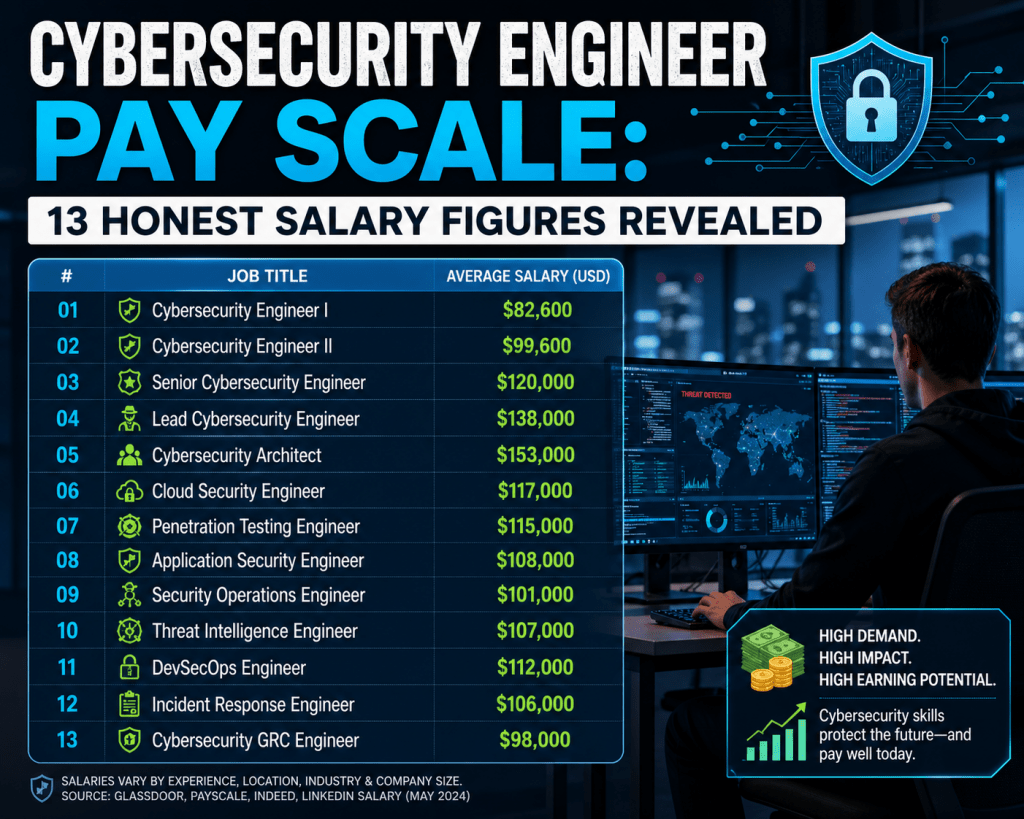
Cybersecurity engineer salary data often appears inconsistent when viewed casually because it is usually aggregated from multiple sources without proper segmentation. The result is a broad numerical spread that can be misleading if interpreted as a single fixed earning benchmark. In reality, cybersecurity engineering compensation is structured around multiple interdependent variables such as technical expertise, organizational complexity, geographic economics, and industry risk exposure. Each of these factors contributes differently to final compensation outcomes, which is why salary figures rarely converge into a narrow range.
At its core, a cybersecurity engineer is responsible for designing and maintaining secure digital environments that protect organizational infrastructure from internal and external threats. This includes implementing security architectures, configuring defensive systems, analyzing vulnerabilities, and ensuring continuous protection of critical data assets. Because these responsibilities directly influence organizational risk levels, compensation is typically aligned with the level of impact an engineer has on operational security and business continuity.
The variation in salary data is not an error but a reflection of how dynamic the cybersecurity labor market has become. As organizations adopt cloud computing, distributed systems, and automated workflows, the demand for security engineers who can manage complex environments continues to increase. This demand is not evenly distributed across regions or industries, which naturally leads to salary disparities that appear wide when aggregated at a national level.
Why Salary Ranges Appear Extremely Wide Across the Industry
One of the most common misconceptions about cybersecurity engineer compensation is the expectation of a uniform national average. In practice, salary ranges are significantly influenced by geographic location, cost of living, and regional demand for technical talent. For example, engineers working in major technology hubs or financial centers typically earn more than those in smaller cities or regions with lower concentrations of enterprise organizations. This difference is primarily driven by competition among employers and the need to attract highly skilled professionals in saturated job markets.
Cost-of-living adjustments also play a major role in shaping compensation. In high-expense urban environments, salaries are adjusted upward to match housing, transportation, and general living costs. Conversely, in regions where operational costs are lower, salaries may appear reduced even though purchasing power remains relatively balanced. This creates the illusion of inconsistency when comparing salary data across multiple locations without considering economic context.
Another contributing factor is organizational maturity. Large enterprises with established cybersecurity frameworks often operate with layered security systems, regulatory compliance obligations, and complex infrastructure environments. These conditions require advanced engineering expertise, which is reflected in higher compensation structures. Smaller organizations may still require cybersecurity engineers, but their operational environments are typically less complex, which influences salary levels accordingly.
The Role of Experience in Determining Earning Potential
Experience is one of the most significant determinants of cybersecurity engineer compensation. Entry-level professionals who transition into security engineering roles typically begin with foundational responsibilities such as system monitoring, basic vulnerability assessments, and assisting in security configuration tasks. At this stage, compensation reflects both limited hands-on experience and the learning curve associated with complex security environments.
As engineers gain experience, their responsibilities expand to include designing security controls, implementing infrastructure protection mechanisms, and managing incident response processes. This mid-level stage is where salary growth becomes more noticeable, as professionals begin to demonstrate measurable impact on system security and operational resilience. Employers place increasing value on engineers who can independently identify vulnerabilities and implement effective mitigation strategies without constant supervision.
Senior-level cybersecurity engineers operate at a much broader scope, often influencing organizational security strategy and architecture design. Their responsibilities extend beyond technical execution into system-wide security planning, risk evaluation, and cross-departmental coordination. At this level, compensation reflects not only technical expertise but also leadership capability and strategic decision-making influence.
How Industry Type Shapes Compensation Structures
The industry in which a cybersecurity engineer works significantly impacts salary expectations due to varying levels of data sensitivity, regulatory pressure, and threat exposure. Industries that handle large volumes of sensitive information or financial transactions tend to invest more heavily in cybersecurity engineering talent because the consequences of security breaches are substantially higher.
Financial institutions, healthcare systems, and cloud-based technology providers typically offer higher compensation due to the critical nature of their digital infrastructure. These environments require continuous monitoring, advanced threat detection systems, and strict compliance with security regulations, all of which increase the demand for skilled engineers.
Other industries, such as manufacturing, retail, and education,n also employ cybersecurity engineers, but their compensation structures may vary depending on the complexity of their digital ecosystems. Organizations undergoing digital transformation often increase cybersecurity investment as their reliance on interconnected systems grows, which can gradually elevate salary ranges within these sectors.
Organizational Scale and Its Influence on Salary Levels
The size of an organization plays a crucial role in determining cybersecurity engineer compensation. Large enterprises typically maintain dedicated security departments with specialized roles, structured hierarchies, and clearly defined technical responsibilities. These environments often require engineers to manage complex systems spanning multiple regions, cloud platforms, and operational layers. As a result, compensation is generally higher to reflect both responsibility and technical complexity.
Mid-sized organizations may offer competitive salaries but often expect cybersecurity engineers to operate across multiple domains simultaneously. Instead of focusing on a single specialization, engineers in these environments may handle network security, endpoint protection, identity management, and system monitoring collectively. While this broad exposure can accelerate skill development, compensation may not always match large enterprise levels.
Smaller organizations or startups often operate with limited security resources, requiring engineers to take on highly versatile roles. Although base salaries may be lower in some cases, these positions can offer rapid skill development due to the wide range of responsibilities involved. In many instances, compensation is supplemented through flexibility, equity structures, or accelerated career progression opportunities.
Geographic Economic Factors and Salary Distribution
Geography remains one of the most influential variables in cybersecurity engineer compensation. Regions with dense concentrations of technology companies, financial institutions, and enterprise infrastructure tend to offer higher salaries due to increased competition for skilled professionals. In these environments, organizations must offer competitive compensation to attract and retain qualified engineers.
In contrast, regions with fewer large-scale enterprises may exhibit lower salary ranges, although this does not necessarily reflect reduced job complexity. Instead, it reflects differences in regional economic conditions and labor market dynamics. The same role may carry different compensation levels depending on where it is performed, even if the technical responsibilities remain identical.
Remote work has begun to influence geographic salary structures by allowing engineers to access opportunities beyond their immediate location. While this has increased access to higher-paying roles for some professionals, many organizations still adjust compensation based on regional benchmarks to maintain internal equity across distributed teams.
Core Technical Expectations That Influence Salary
Cybersecurity engineers are expected to possess a deep understanding of system architecture, network protocols, and security frameworks. Their ability to implement protective measures across infrastructure layers is a key factor in determining compensation levels. Engineers who can design scalable security systems and integrate them into existing infrastructure are particularly valuable in modern IT environments.
Technical expertise in areas such as threat detection, encryption methods, vulnerability management, and access control systems directly influences earning potential. Additionally, engineers who can automate security processes and reduce manual intervention are often rewarded with higher compensation due to increased operational efficiency.
The ability to respond effectively to security incidents is another critical skill. Organizations place significant value on engineers who can quickly analyze breaches, contain threats, and restore system integrity with minimal disruption. This incident response capability is closely tied to both experience and technical depth.
Market Demand and Its Effect on Salary Stability
The demand for cybersecurity engineers continues to rise as organizations expand their digital infrastructure and adopt cloud-based technologies. This increased reliance on interconnected systems has elevated the importance of security engineering across virtually all industries.
As cyber threats become more sophisticated, organizations are prioritizing investment in skilled professionals who can proactively defend systems against evolving attack vectors. This sustained demand contributes to relatively stable salary growth, even during periods of broader economic uncertainty.
Cybersecurity engineering remains a resilient career path due to the essential nature of digital protection in modern business operations. The growing complexity of technology ecosystems ensures that demand for skilled engineers will continue to influence compensation trends over time.
How Job Scope Expands Beyond Basic Security Responsibilities
Cybersecurity engineering is often misunderstood as a purely technical function focused on protecting systems from external attacks. In reality, the role extends far beyond perimeter defense and includes a wide range of responsibilities tied to system architecture, operational continuity, and enterprise risk management. This expanded scope is one of the primary reasons salary levels vary so widely across professionals with the same job title.
A cybersecurity engineer is typically expected to design and implement security controls across multiple layers of an organization’s infrastructure. This includes network security, endpoint protection, identity and access management, application security, and cloud environment configuration. Each of these domains requires specialized knowledge, and engineers who can operate across multiple domains simultaneously tend to command higher compensation due to their broader impact.
In addition, cybersecurity engineers are frequently involved in long-term planning related to security posture improvement. This includes assessing current system weaknesses, designing mitigation strategies, and aligning technical implementations with organizational risk tolerance. The ability to translate abstract security requirements into functional system designs significantly increases an engineer’s value in the job market.
The Relationship Between Technical Depth and Compensation
Technical depth is one of the strongest predictors of cybersecurity engineer salary progression. Engineers who possess only surface-level knowledge of security tools and frameworks typically remain in lower compensation brackets, while those who develop deep expertise in system behavior, threat modeling, and infrastructure design move into higher earning ranges.
At a fundamental level, cybersecurity engineering requires understanding how systems behave under both normal and adversarial conditions. Engineers must be able to anticipate attack vectors, simulate potential breach scenarios, and implement safeguards that reduce system vulnerability. This requires a combination of theoretical knowledge and hands-on experience, both of which contribute directly to salary growth.
As engineers gain deeper technical proficiency, they begin to work on more complex environments such as hybrid cloud systems, distributed microservices architectures, and automated security orchestration platforms. These environments require advanced problem-solving skills and the ability to manage interdependent systems at scale, which increases the perceived and actual value of the engineer.
Specialization as a Salary Multiplier in Cybersecurity Engineering
Specialization plays a major role in determining compensation levels within cybersecurity engineering. While generalist engineers are valuable for their versatility, specialists often command higher salaries due to their ability to solve highly specific and complex problems.
Cloud security specialization is one of the most in-demand areas due to the widespread adoption of cloud infrastructure. Engineers who understand secure cloud architecture design, identity federation, and workload protection are often highly compensated because cloud environments introduce unique security challenges that differ significantly from traditional on-premises systems.
Network security specialization remains a foundational area of expertise, particularly in organizations with large-scale internal infrastructure. Engineers who can design secure network topologies, implement segmentation strategies, and manage intrusion detection systems are critical to maintaining organizational defense layers.
Application security specialists focus on securing software development pipelines, identifying vulnerabilities in code, and implementing secure development practices. Their work is especially valuable in organizations that rely heavily on software delivery, as application-level vulnerabilities are among the most common attack vectors.
Each specialization adds incremental value to an engineer’s profile, and professionals who combine multiple areas of expertise tend to achieve the highest compensation levels.
The Impact of Organizational Security Complexity
The complexity of an organization’s security environment directly influences cybersecurity engineer salaries. Organizations with simple IT infrastructures require fewer advanced security controls, while those with complex, distributed systems require sophisticated engineering approaches.
Large enterprises often operate across multiple geographic regions, cloud providers, and internal systems. This creates a highly complex security environment that requires advanced engineering capabilities to manage effectively. Engineers in these environments must ensure consistency in security policies across diverse systems while maintaining scalability and performance.
Highly regulated industries introduce additional layers of complexity. Organizations operating in sectors such as finance, healthcare, and critical infrastructure must comply with strict regulatory frameworks that govern data protection, access control, and incident reporting. Cybersecurity engineers in these environments are responsible not only for technical security but also for ensuring compliance with external standards.
This combination of technical and regulatory complexity significantly increases the value of cybersecurity engineers, which is reflected in higher compensation levels.
How Incident Response Responsibility Influences Pay
Incident response is a critical component of cybersecurity engineering and has a direct impact on salary structures. Engineers who are responsible for detecting, analyzing, and responding to security incidents must operate under high-pressure conditions where rapid decision-making is essential.
The ability to contain breaches, minimize system downtime, and prevent data loss requires both technical expertise and situational awareness. Organizations place a high value on engineers who can respond effectively to incidents because the financial and reputational costs of security breaches can be substantial.
Engineers with strong incident response capabilities are often involved in designing response protocols, improving detection systems, and refining escalation procedures. This proactive involvement in organizational defense strategies increases their overall compensation potential.
Automation Skills as a Modern Salary Driver
Automation has become an increasingly important factor in cybersecurity engineering. As organizations scale their infrastructure, manual security processes become less efficient and more error-prone. Engineers who can automate security tasks significantly enhance operational efficiency and reduce response times.
Automation skills often include scripting, orchestration of security tools, and integration of monitoring systems. Engineers who can build automated workflows for threat detection, vulnerability scanning, and incident response are highly valued because they reduce the burden on security teams while improving system responsiveness.
The ability to design automated security systems is especially important in cloud environments where infrastructure is dynamic and constantly changing. Engineers who can implement automated security controls in these environments often command higher salaries due to the complexity of the work involved.
Communication Skills and Cross-Functional Influence
Although cybersecurity engineering is highly technical, communication skills play a crucial role in determining career progression and compensation. Engineers are frequently required to explain complex security concepts to non-technical stakeholders, including management teams, compliance officers, and business leaders.
The ability to translate technical risks into business impact is particularly valuable. Organizations rely on cybersecurity engineers to articulate the consequences of security vulnerabilities in terms of operational disruption, financial loss, and reputational damage.
Engineers who can effectively communicate across departments are often involved in strategic decision-making processes. This cross-functional influence increases their visibility within the organization and contributes to higher compensation over time.
Experience With Security Frameworks and Standards
Familiarity with established security frameworks and industry standards is another factor that influences cybersecurity engineer salaries. These frameworks provide structured approaches to managing security risks and are widely used across industries to ensure consistency and compliance.
Engineers who understand how to implement security controls based on recognized frameworks are better equipped to design robust security architectures. This knowledge is particularly valuable in regulated industries where compliance requirements must be strictly followed.
Experience with security frameworks also enables engineers to participate in audits, risk assessments, and compliance reporting processes. These additional responsibilities increase their overall contribution to organizational security and can positively influence compensation.
The Role of Continuous Learning in Salary Growth
Cybersecurity is a rapidly evolving field, and continuous learning is essential for maintaining relevance and advancing in compensation. New threats, technologies, and security methodologies emerge regularly, requiring engineers to adapt quickly.
Professionals who actively update their skills and stay current with industry developments are more likely to progress into higher-paying roles. This includes learning about emerging technologies such as zero trust architecture, cloud-native security models, and artificial intelligence-driven threat detection systems.
Continuous learning not only enhances technical capability but also demonstrates commitment to professional growth, which is often considered during compensation evaluations.
How Market Competition Affects Salary Structures
The cybersecurity labor market is highly competitive due to a global shortage of skilled professionals. This shortage creates upward pressure on salaries, particularly for engineers with advanced technical expertise.
Organizations often compete for a limited pool of qualified candidates, which leads to increased compensation packages and additional benefits. Engineers with specialized skills or experience in high-demand areas are particularly well-positioned to benefit from this competitive environment.
As demand continues to grow and the supply of experienced professionals remains limited, salary structures are expected to remain strong across most regions and industries.
How Long-Term Demand Shapes Cybersecurity Engineer Salaries
Cybersecurity engineering remains one of the most structurally in-demand roles in modern technology environments, and this demand is not cyclical in the traditional sense. It is driven by permanent changes in how organizations operate digitally. As businesses continue shifting toward cloud infrastructure, distributed systems, and remote-first operations, the attack surface expands continuously. This expansion directly increases the need for engineers capable of designing resilient security systems.
Unlike some IT roles that fluctuate with specific technology waves, cybersecurity engineering demand is sustained by necessity rather than trend. Every new application, integration, or digital workflow introduces potential vulnerabilities. As long as digital systems exist and evolve, cybersecurity engineers remain essential. This structural demand is one of the strongest factors supporting long-term salary stability and gradual compensation growth across experience levels.
Organizations are also increasingly aware that cybersecurity failures are not isolated technical incidents but business-level risks. A single breach can result in financial loss, regulatory penalties, operational disruption, and reputational damage. This elevates cybersecurity engineering from a support function to a core business safeguard, reinforcing long-term investment in skilled professionals.
The Expansion of Cybersecurity Engineering Responsibilities Over Time
Over the past decade, the role of cybersecurity engineers has expanded significantly beyond traditional infrastructure protection. Earlier expectations were centered around firewall configuration, antivirus management, and basic intrusion detection. Modern responsibilities now include cloud security architecture, identity federation design, DevSecOps integration, and automated threat response systems.
This expansion of responsibility directly impacts long-term earning potential. As engineers take on broader and more complex systems, their value increases proportionally. Organizations increasingly rely on cybersecurity engineers not just to react to threats but to proactively design systems that minimize vulnerability from the outset.
In advanced environments, cybersecurity engineers are involved in system design discussions from the earliest stages of development. This shift-left approach integrates security into architecture planning rather than treating it as a post-deployment layer. Engineers who operate at this level often experience accelerated salary growth because their decisions influence entire system lifecycles.
How Cloud Computing Has Reshaped Salary Expectations
Cloud adoption has fundamentally changed cybersecurity engineering requirements. Traditional perimeter-based security models are no longer sufficient in environments where infrastructure is distributed across multiple providers, regions, and virtualized systems.
Cybersecurity engineers must now understand cloud-native architectures, identity and access management frameworks, container security, and automated scaling environments. These systems introduce dynamic security challenges that require continuous monitoring and adaptive defense mechanisms.
Engineers who specialize in cloud security environments often command higher compensation because of the complexity involved in securing distributed systems. Unlike static infrastructure, cloud environments change constantly, requiring engineers to design flexible and automated security controls.
This shift has also created demand for hybrid expertise. Engineers who understand both traditional network security and modern cloud architecture are particularly valuable, as they can bridge legacy systems with modern infrastructure models.
The Growing Importance of DevSecOps in Salary Growth
DevSecOps integration has become a key factor in cybersecurity engineering compensation trends. This approach embeds security practices directly into software development and deployment pipelines, ensuring that security is not an afterthought but an ongoing process.
Cybersecurity engineers involved in DevSecOps environments are responsible for automating security testing, integrating vulnerability scanning into CI/CD pipelines, and ensuring that code deployments meet security standards before reaching production systems.
This role requires both development and security expertise, which significantly increases its value in the job market. Engineers who can operate effectively within DevSecOps frameworks are often compensated at higher levels due to their ability to reduce vulnerabilities early in the development lifecycle.
As organizations accelerate software delivery cycles, the demand for engineers who can balance speed and security continues to rise. This trend contributes to long-term salary growth for professionals with DevSecOps expertise.
Artificial Intelligence and Automation in Cybersecurity Engineering
Artificial intelligence is increasingly being integrated into cybersecurity systems for threat detection, anomaly analysis, and predictive risk modeling. While AI tools enhance security capabilities, they also change the nature of cybersecurity engineering work.
Rather than manually monitoring logs or responding to alerts, engineers are now responsible for designing and managing intelligent security systems that can detect and respond to threats autonomously. This shift requires a deeper understanding of both security principles and machine-driven decision systems.
Engineers who can work with AI-enhanced security platforms or develop automated detection systems are becoming more valuable in the labor market. These capabilities require advanced technical knowledge, which is often reflected in higher compensation levels.
Automation also plays a dual role in cybersecurity engineering. While it reduces repetitive tasks, it increases the importance of engineers who can design and maintain automated systems effectively. This shift increases demand for high-skill professionals rather than reducing job opportunities.
Globalization and Remote Work Influence on Earnings
Cybersecurity engineering has become a globally distributed profession due to the rise of remote work infrastructure. Organizations are no longer limited to hiring within geographic boundaries, which has significantly expanded the talent pool and competitive landscape.
For engineers, this globalization creates access to a wider range of opportunities, including roles in higher-paying markets without requiring relocation. However, it also increases competition, as employers can source talent from multiple regions.
Despite this global accessibility, compensation structures often remain influenced by regional benchmarks. Some organizations adjust salaries based on cost-of-living models, while others offer standardized global pay scales for specialized roles.
Over time, the increasing normalization of remote cybersecurity work is expected to reduce geographic salary disparities for highly skilled engineers, particularly those in specialized or senior roles.
Career Progression Paths That Influence Salary Growth
Cybersecurity engineering offers a well-defined career progression structure that directly influences long-term earnings. Professionals typically begin in foundational IT or security support roles before transitioning into engineering-focused responsibilities.
As engineers gain experience, they move into roles that involve system design, security architecture, and infrastructure protection strategy. These mid-level roles mark a significant increase in compensation as engineers begin to influence broader system security decisions.
At senior levels, cybersecurity engineers often transition into architecture or leadership positions. These roles involve designing enterprise-wide security frameworks, overseeing large-scale infrastructure protection strategies, and guiding organizational security direction.
Some professionals eventually move into advisory or executive-level positions, where they influence business strategy and risk management at the organizational level. These transitions represent the highest earning potential within cybersecurity engineering careers.
Industry Evolution and Long-Term Salary Stability
The cybersecurity industry continues to evolve in response to increasing digital dependency across all sectors. As organizations expand their digital ecosystems, the complexity and frequency of cyber threats also increase.
This ongoing evolution ensures that cybersecurity engineering remains a stable and high-demand profession. Unlike some technical roles that become obsolete due to automation or technological shifts, cybersecurity engineering continues to adapt and expand in scope.
New technologies such as edge computing, Internet of Things ecosystems, and advanced cloud architectures introduce additional security challenges, further reinforcing the need for skilled engineers.
This constant evolution contributes to long-term salary stability, as demand for expertise consistently aligns with technological growth.
Advanced Skill Sets That Elevate Compensation
Certain advanced skill sets significantly enhance a cybersecurity engineer’s earning potential. These include expertise in secure system architecture design, advanced cryptographic implementation, threat intelligence analysis, and large-scale incident response coordination.
Engineers who develop proficiency in multiple areas of cybersecurity tend to achieve higher compensation due to their versatility and ability to operate across complex environments. Cross-domain expertise is particularly valuable in organizations that require integrated security approaches.
Additionally, engineers who can work effectively with cross-functional teams, including development, operations, and compliance units, often see improved career progression due to their broader organizational impact.
The Future Outlook for Cybersecurity Engineer Salaries
The long-term outlook for cybersecurity engineer compensation remains strong due to persistent global demand for digital security expertise. As organizations continue to expand their reliance on interconnected systems, the need for engineers capable of securing these environments will remain critical.
Salary growth is expected to remain steady, particularly for professionals who continue to adapt to emerging technologies and expand their technical capabilities. Engineers who invest in continuous learning and specialization are likely to experience stronger long-term compensation growth.
The combination of increasing system complexity, evolving threat landscapes, and global digital transformation ensures that cybersecurity engineering will remain one of the most strategically important and financially rewarding technical career paths over time.
Conclusion
Cybersecurity engineer compensation is best understood as a dynamic outcome of multiple overlapping forces rather than a fixed or universally applicable number. Any attempt to reduce it to a single “average salary” obscures the real structure of how pay is determined in this field. The profession exists at the intersection of infrastructure engineering, risk management, and security operations, which means compensation is influenced by both technical depth and organizational dependence on secure systems.
One of the most consistent findings across salary patterns is that cybersecurity engineering is fundamentally a value-driven role. Organizations do not pay engineers based solely on job titles, but on the measurable risk reduction and operational stability those engineers provide. When a cybersecurity engineer successfully prevents breaches, strengthens system architecture, or reduces incident response time, the financial impact on the organization can be substantial. This direct connection between technical output and business protection is one of the strongest drivers of six-figure compensation ranges in the field.
At the same time, salary variation should not be mistaken for inconsistency or randomness. It is the natural outcome of structural differences in geography, industry, and system complexity. In high-density technology ecosystems, cybersecurity engineers are competing in environments where demand significantly exceeds supply. This competition pushes compensation upward, especially for professionals with advanced technical capabilities or specialized expertise. In contrast, regions with lower demand density or smaller enterprise presence naturally reflect more moderate compensation structures, even when the underlying role remains technically similar.
Experience also plays a defining role in shaping long-term earnings. Entry-level engineers typically focus on operational tasks such as monitoring systems, assisting with vulnerability identification, and supporting security configurations. While these responsibilities are essential, they do not yet reflect the full strategic value of cybersecurity engineering. As professionals progress, their responsibilities shift toward designing secure systems, implementing architecture-level controls, and responding to complex incidents. This transition marks a significant inflection point in compensation growth, as engineers begin to influence system design rather than simply maintain existing structures.
At more advanced stages, cybersecurity engineers operate at a level where they directly impact organizational security strategy. They contribute to architectural decisions, evaluate systemic risks, and ensure alignment between technical implementations and regulatory requirements. In these roles, compensation reflects not just technical execution but also strategic responsibility. Engineers at this level are often viewed as critical contributors to business continuity, which significantly elevates their earning potential.
Industry context further amplifies these differences. Sectors that handle sensitive or high-value data naturally require stronger security postures, which increases the demand for skilled engineering talent. Financial systems, healthcare infrastructure, and cloud-based service providers operate under constant security pressure, making cybersecurity engineers essential to operational integrity. In these environments, compensation reflects the high stakes associated with system failure or data compromise. Even within the same industry, organizations with more advanced digital infrastructure tend to offer higher compensation due to increased system complexity and exposure to threat vectors.
Another important dimension shaping salary outcomes is technological evolution. As organizations adopt cloud-native architectures, distributed computing models, and automated infrastructure systems, cybersecurity engineering responsibilities become more complex. Engineers are no longer working within static environments but instead managing constantly evolving systems that require adaptive security strategies. This shift increases demand for professionals who can design flexible security frameworks capable of functioning across hybrid environments.
The rise of automation and artificial intelligence in security operations has also changed the nature of the role. Rather than replacing cybersecurity engineers, these technologies have shifted their responsibilities toward higher-level design and oversight functions. Engineers are increasingly required to build and manage systems that use automated detection, predictive analysis, and intelligent response mechanisms. This transition increases the importance of engineers who can operate at the intersection of security logic and system automation, which in turn supports higher compensation structures.
DevSecOps integration has further expanded the scope of cybersecurity engineering. Security is no longer treated as a separate function but is embedded directly into development and deployment pipelines. Engineers who can integrate security into continuous delivery workflows, automate testing processes, and ensure compliance during rapid development cycles are particularly valuable. This integration of development and security expertise creates a hybrid skill set that is increasingly rewarded in the job market.
Geographic influence on salary continues to exist, but its role is gradually evolving. While traditional compensation models were heavily location-dependent, remote work has introduced greater flexibility into the labor market. Engineers can now access opportunities across different regions without being physically constrained by geography. However, many organizations still apply regional compensation adjustments based on cost of living and internal equity structures. Over time, this balance between global accessibility and regional adjustment is expected to stabilize into more standardized compensation frameworks for highly specialized roles.
Long-term career progression in cybersecurity engineering follows a structured upward trajectory. Professionals typically move from operational support roles into engineering, then into architectural design, and eventually into strategic or leadership positions. Each stage of this progression reflects increasing responsibility, broader system influence, and higher compensation potential. Engineers who continue developing technical depth while expanding their strategic understanding tend to experience the most consistent long-term salary growth.
Skill development remains one of the most important factors influencing long-term earnings. Cybersecurity is a field defined by constant change, requiring professionals to continuously adapt to new threats, technologies, and system architectures. Engineers who maintain up-to-date knowledge of emerging security models, cloud environments, and automated defense systems are better positioned for sustained career advancement. This continuous learning cycle is not optional in cybersecurity engineering; it is a structural requirement for long-term relevance.
Another key factor shaping compensation is cross-functional communication ability. Cybersecurity engineers do not operate in isolation. They interact with development teams, infrastructure teams, compliance units, and executive leadership. The ability to translate technical risks into business impact is increasingly important in determining career progression. Engineers who can communicate effectively across disciplines often gain greater organizational influence, which indirectly contributes to higher compensation levels.
Looking forward, the cybersecurity engineering field is expected to remain structurally strong due to the expanding digital footprint of modern organizations. Every new system, integration, or digital workflow introduces additional security considerations. As long as digital transformation continues across industries, the need for engineers capable of designing secure and resilient systems will persist.
This sustained demand, combined with increasing system complexity and evolving threat landscapes, ensures that cybersecurity engineering will continue to be a high-value technical profession. Compensation is likely to remain competitive, particularly for professionals who specialize, adapt to emerging technologies, and develop the ability to manage security at both technical and strategic levels.