
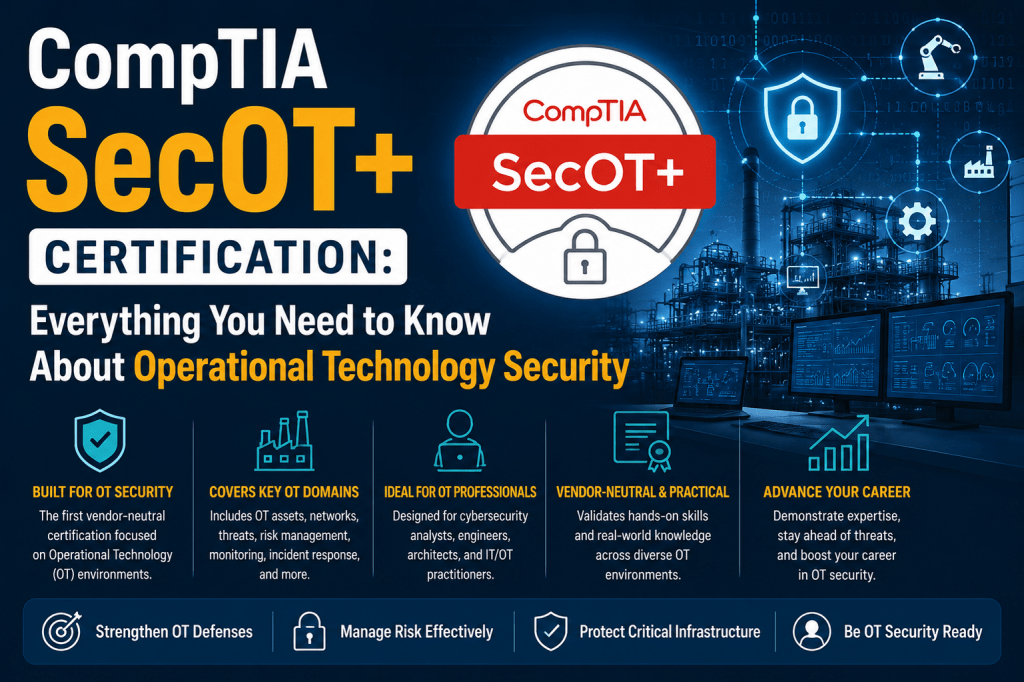
Operational technology environments have become one of the most important targets in modern cybersecurity. Industries that rely on manufacturing systems, power generation, transportation infrastructure, and industrial automation are now under constant pressure from sophisticated cyber threats. To address these challenges, CompTIA introduced SecOT+, a certification designed specifically for operational technology security. Unlike traditional cybersecurity certifications that mainly focus on office networks and business systems, this certification is tailored for industrial environments where cyber incidents can impact physical operations, employee safety, and critical infrastructure.
Operational technology systems were traditionally isolated from the internet and external networks. Many facilities relied on air-gapped systems, proprietary protocols, and legacy devices that rarely communicated with outside systems. Over time, industries began connecting operational systems to business networks to improve efficiency, automate monitoring, and support remote operations. While this digital transformation improved productivity, it also introduced new vulnerabilities that attackers could exploit. CompTIA SecOT+ was created to prepare professionals for these evolving risks and to strengthen the collaboration between IT and OT teams.
The certification reflects a major shift in cybersecurity priorities. Companies no longer view operational technology security as a specialized niche that only applies to industrial engineers. Instead, it is becoming a core requirement for organizations that depend on automation, industrial control systems, and connected infrastructure. The growing dependence on smart factories, industrial internet technologies, and remote management systems has made OT security one of the most critical areas in cybersecurity today.
Why Operational Technology Security Has Become Essential
Operational technology controls physical processes in industries such as manufacturing, energy production, transportation, healthcare, water treatment, and logistics. These systems manage machinery, sensors, robotics, programmable logic controllers, and industrial networks that keep facilities operating efficiently. A disruption to these systems can lead to production downtime, damaged equipment, environmental hazards, and safety risks for workers and the public.
Traditional cybersecurity strategies often focused on protecting sensitive business data like financial records, customer information, and intellectual property. In operational technology environments, the stakes are very different. A successful cyberattack against a factory or power grid can halt production lines, disrupt public services, or even create dangerous physical consequences. This distinction is one of the key reasons why operational technology security requires a different approach from standard IT security practices.
Operational systems prioritize availability and safety above all else. In many industrial facilities, shutting down equipment for routine updates or maintenance is not always practical. Some systems operate continuously for months or years without interruption. As a result, many organizations still use outdated operating systems and legacy hardware that lack modern security features. CompTIA SecOT+ addresses these realities by teaching professionals how to secure industrial environments without compromising operational continuity.
The Expanding Threat Landscape in Industrial Environments
Cybercriminals and nation-state attackers increasingly target operational technology because these environments control critical services and infrastructure. Attackers recognize that disruptions to industrial systems can create financial losses, public panic, and operational chaos. This makes OT systems attractive targets for ransomware groups, espionage campaigns, and politically motivated attacks.
Industrial organizations have experienced a sharp increase in cyber incidents in recent years. Manufacturing facilities, energy providers, transportation networks, and water utilities have all reported attacks targeting operational systems. These incidents demonstrate that industrial infrastructure is no longer isolated from the broader cybersecurity threat landscape. Attackers are using ransomware, phishing campaigns, supply chain compromises, and remote access vulnerabilities to infiltrate OT networks.
One of the biggest challenges is that many operational technology environments were never designed with cybersecurity in mind. Industrial systems were built primarily for reliability and long-term functionality. Security controls such as multi-factor authentication, encryption, network segmentation, and continuous monitoring were not always part of the original design. As organizations modernize their operations, they must integrate security measures into environments that were not originally intended to withstand modern cyber threats.
CompTIA SecOT+ prepares professionals to recognize these vulnerabilities and implement security strategies that align with industrial operational requirements. The certification emphasizes practical skills that can help organizations identify threats, reduce attack surfaces, and respond effectively to security incidents.
The Difference Between IT Security and OT Security
Information technology security and operational technology security share some similarities, but they also differ in significant ways. IT environments focus on protecting data confidentiality, network integrity, and business continuity. OT environments focus heavily on operational reliability, equipment safety, and continuous uptime.
In a traditional office environment, security teams can often patch systems quickly, reboot devices, or isolate compromised endpoints with minimal disruption. In operational technology environments, even a brief interruption can halt manufacturing operations, damage equipment, or create safety hazards. This means security professionals must carefully balance protection measures with operational stability.
Another major difference involves system lifecycles. IT systems are typically replaced every few years, allowing organizations to adopt newer technologies and updated security features. OT systems often remain in service for decades because replacing industrial equipment is expensive and time-consuming. As a result, many industrial facilities rely on legacy devices that are difficult to secure using conventional methods.
Communication protocols also differ between IT and OT environments. Industrial systems frequently use specialized protocols designed for machine communication rather than cybersecurity. These protocols may lack authentication, encryption, or secure communication mechanisms. CompTIA SecOT+ helps professionals understand how to secure these unique technologies while maintaining operational functionality.
The certification also highlights the importance of collaboration between IT and OT teams. Historically, these departments operated separately with different priorities and expertise. IT teams focused on cybersecurity and networking, while OT teams concentrated on engineering, automation, and production efficiency. Modern industrial security requires these groups to work together using a unified security strategy.
The Role of SecOT+ in Bridging IT and OT Teams
One of the most valuable aspects of CompTIA SecOT+ is its emphasis on cross-functional collaboration. Industrial cybersecurity cannot succeed if IT and OT professionals operate independently. Cyber threats now move across interconnected systems, making coordination essential for effective defense.
IT professionals often bring expertise in network security, threat detection, vulnerability management, and incident response. OT professionals understand industrial equipment, process control systems, operational workflows, and safety requirements. SecOT+ creates a shared foundation that allows both groups to communicate more effectively and work toward common security goals.
The certification encourages professionals to understand both operational processes and cybersecurity principles. This balanced approach helps organizations reduce communication gaps and improve their ability to manage risks. Instead of treating OT security as a completely separate discipline, SecOT+ promotes integration between cybersecurity practices and industrial operations.
Organizations increasingly recognize that industrial cybersecurity requires professionals who can understand both technical security controls and operational realities. This demand has created new career opportunities for individuals with expertise in OT security. SecOT+ helps validate these specialized skills and demonstrates readiness for modern industrial cybersecurity roles.
Key Security Concepts Covered in SecOT+
Although the final certification objectives continue to evolve, CompTIA has outlined several major areas that SecOT+ will address. These domains reflect the real-world challenges faced by industrial organizations and security professionals.
Risk management is expected to be a central focus of the certification. Operational technology environments must assess risks differently from traditional business networks because the consequences of downtime and system failure can be severe. Professionals need to evaluate operational risks, prioritize critical assets, and implement security measures that minimize disruptions.
Compliance and regulatory frameworks are also important components of OT security. Many industries operate under strict regulations related to safety, reliability, and infrastructure protection. Organizations must comply with industry standards while maintaining secure operational environments. SecOT+ helps professionals understand how these frameworks apply to industrial systems.
Hardening and secure configuration practices represent another critical area. Industrial devices often require specialized security configurations to reduce vulnerabilities. This includes network segmentation, secure remote access, device monitoring, access controls, and secure communication practices. The certification emphasizes practical methods for strengthening industrial environments against cyber threats.
Supply chain security is becoming increasingly important because industrial organizations rely on third-party vendors, contractors, and connected technologies. Attackers often exploit supplier relationships to gain access to critical systems. SecOT+ teaches professionals how to evaluate supply chain risks and implement security measures that reduce exposure.
Legacy system protection is another major topic. Many operational environments depend on aging technologies that cannot easily support modern security solutions. Professionals must develop strategies to secure these systems without interrupting operations. This requires creative approaches such as network isolation, compensating controls, continuous monitoring, and layered defense strategies.
The Importance of Hands-On Operational Security Skills
CompTIA certifications are widely known for emphasizing practical knowledge rather than purely theoretical concepts. SecOT+ continues this approach by focusing on real-world operational security scenarios. Industrial cybersecurity professionals must be able to apply their knowledge in environments where mistakes can have serious consequences.
Hands-on experience is especially important in OT security because industrial systems behave differently from standard business networks. Professionals must understand how industrial controllers communicate, how operational processes function, and how security controls can affect production systems. Practical training helps learners develop confidence in managing these environments safely and effectively.
Scenario-based learning allows professionals to practice responding to industrial cyber incidents, configuring secure systems, analyzing vulnerabilities, and implementing protective measures. These exercises help bridge the gap between classroom learning and real-world operational challenges.
The certification also promotes an understanding of industrial incident response. Responding to a cyberattack in an operational environment requires coordination between engineers, security analysts, management teams, and external stakeholders. Professionals must know how to contain threats while maintaining safety and minimizing operational disruptions.
Career Opportunities Created by Operational Technology Security
The increasing importance of industrial cybersecurity has created strong demand for professionals with operational security expertise. Organizations across multiple industries are actively searching for individuals who understand both cybersecurity principles and industrial operations.
Manufacturing companies require specialists who can protect automated production systems and industrial control networks. Energy providers need professionals who can secure power generation facilities and distribution infrastructure. Transportation organizations depend on cybersecurity experts to protect logistics systems, signaling equipment, and connected transportation networks. Healthcare facilities also rely on operational technology to support medical equipment and critical infrastructure.
As industrial organizations continue adopting smart technologies and connected systems, the demand for OT security professionals is expected to grow even further. Companies recognize that operational disruptions can create massive financial losses and reputational damage. This has increased investment in cybersecurity programs designed specifically for industrial environments.
CompTIA SecOT+ provides a pathway for professionals who want to enter this expanding field. IT professionals can use the certification to demonstrate their ability to work with industrial systems, while engineers and operational staff can strengthen their cybersecurity knowledge. This flexibility makes SecOT+ valuable for individuals from diverse technical backgrounds.
How Digital Transformation Is Driving OT Security Demand
Industrial sectors are rapidly adopting digital transformation technologies to improve efficiency, automate operations, and collect real-time operational data. Smart factories, connected sensors, cloud-based monitoring platforms, and industrial internet technologies are becoming increasingly common across many industries.
While these technologies provide major operational benefits, they also increase cybersecurity complexity. Every connected device represents a potential entry point for attackers. Organizations must secure not only traditional networks but also industrial devices, wireless sensors, remote monitoring systems, and cloud integrations.
Remote access capabilities have also expanded significantly. Engineers and technicians often need to monitor equipment from offsite locations, especially in large industrial environments. Remote connectivity improves operational flexibility but also introduces additional security challenges. Attackers frequently target remote access systems because they can provide direct entry into operational networks.
CompTIA SecOT+ addresses these evolving challenges by preparing professionals to secure modern industrial ecosystems. The certification recognizes that operational technology is no longer isolated from digital transformation trends. Security professionals must understand how to manage risks in highly connected industrial environments while maintaining reliability and operational efficiency.
The Growing Importance of Cybersecurity in Industrial Operations
Operational technology environments are no longer isolated systems hidden behind factory walls or restricted industrial facilities. Modern industries rely heavily on connected infrastructure, cloud-based monitoring tools, industrial automation, and smart technologies that continuously exchange information across networks. This transformation has improved productivity and operational efficiency, but it has also expanded the attack surface for cybercriminals. CompTIA SecOT+ was introduced to help organizations and professionals respond to this new reality by focusing specifically on operational technology security.
Industrial environments once depended on physical isolation as their primary defense mechanism. Facilities used dedicated systems that rarely communicated with external networks. In many cases, equipment manufacturers believed these systems would remain secure simply because they were inaccessible from the internet. However, digital transformation changed the entire operational landscape. Remote monitoring, predictive maintenance, centralized management systems, and interconnected industrial devices became standard practices in many industries.
As connectivity increased, so did the risks. Cyberattacks targeting operational technology began appearing more frequently across manufacturing, transportation, healthcare, utilities, logistics, and energy sectors. Attackers recognized that disrupting industrial operations could generate significant financial pressure, making these organizations attractive targets for ransomware campaigns and other forms of cybercrime. CompTIA SecOT+ was designed to address this growing problem by helping professionals understand the specialized security requirements of industrial systems.
Why Operational Technology Requires Specialized Security Training
Operational technology differs significantly from traditional information technology environments. While both involve networks, systems, and digital communication, the priorities are not the same. Information technology focuses heavily on data protection, communication systems, and business applications. Operational technology focuses on controlling physical processes, industrial machinery, and automated systems that directly affect real-world operations.
In industrial environments, cybersecurity decisions can have physical consequences. An improperly configured security update, unexpected system restart, or accidental shutdown may halt production lines, damage machinery, interrupt transportation systems, or create dangerous safety situations. Because of this, operational technology professionals must approach security differently from traditional IT administrators.
CompTIA SecOT+ was created to teach professionals how to apply cybersecurity practices within environments where uptime, reliability, and safety are essential. The certification acknowledges that industrial systems cannot always follow the same patching schedules or security policies used in office networks. Instead, OT security requires carefully planned controls that protect systems without interrupting operations.
Many operational environments also depend on specialized hardware and proprietary technologies that traditional cybersecurity professionals may never encounter in standard office environments. Industrial control systems, programmable logic controllers, distributed control systems, and supervisory control platforms all operate differently from standard enterprise servers and workstations. SecOT+ helps bridge this knowledge gap by introducing professionals to the technologies commonly found in industrial environments.
How Cyber Threats Are Evolving in OT Environments
Cyber threats targeting operational technology are becoming more sophisticated every year. Attackers no longer focus solely on stealing information. Many cybercriminal groups now target industrial systems directly because operational disruptions can force organizations to pay large ransom demands or suffer costly downtime.
One of the most dangerous aspects of OT attacks is their ability to affect physical infrastructure. A successful attack against industrial systems can stop manufacturing operations, disrupt transportation networks, interfere with healthcare services, or interrupt utility operations. These consequences extend beyond financial losses and may impact public safety and essential services.
Ransomware remains one of the most common threats facing industrial organizations. Attackers frequently target operational systems because downtime creates immediate pressure on organizations to restore services quickly. Manufacturing facilities, for example, may lose substantial revenue for every hour production lines remain offline. This urgency often makes industrial organizations prime ransomware targets.
Supply chain attacks are also becoming increasingly dangerous. Many industrial environments rely on third-party vendors, contractors, and remote support providers. Attackers often compromise supplier systems to gain indirect access to operational networks. Once inside, they can move laterally through connected environments and target critical infrastructure.
Insider threats present another major concern. Employees, contractors, or third-party technicians with access to operational systems may intentionally or accidentally create security vulnerabilities. In some cases, inadequate access controls or poor security awareness can allow unauthorized activities to go undetected for long periods.
CompTIA SecOT+ prepares professionals to identify and manage these evolving threats by teaching practical defensive strategies tailored to operational environments. The certification emphasizes real-world threat scenarios and risk mitigation approaches that align with industrial operations.
The Challenge of Securing Legacy Industrial Systems
One of the most complex challenges in operational technology security involves legacy systems. Many industrial organizations continue using equipment that was installed decades ago. These systems were designed for long-term operational reliability rather than cybersecurity protection.
Unlike standard business computers that may be replaced every few years, industrial machinery often remains in service for decades because replacement costs are extremely high. Production systems are carefully integrated into operational workflows, and replacing them may require expensive downtime, engineering modifications, and employee retraining.
Many legacy industrial systems run outdated operating systems that no longer receive security updates. Some devices may not support modern encryption methods, advanced authentication systems, or endpoint protection software. In some situations, manufacturers no longer provide technical support for older equipment, leaving organizations responsible for maintaining aging infrastructure.
CompTIA SecOT+ focuses heavily on helping professionals secure these environments using practical methods that minimize operational disruptions. Instead of relying entirely on software updates, OT security often depends on layered defensive strategies. Network segmentation, restricted access controls, continuous monitoring, intrusion detection systems, and physical security measures become critical protective tools.
Industrial organizations also use compensating controls to reduce risks associated with unsupported systems. These controls may include isolating vulnerable devices from external networks, limiting remote access capabilities, monitoring communication traffic, and enforcing strict authentication policies. SecOT+ helps professionals understand how to apply these techniques effectively in real-world operational environments.
The Importance of Network Segmentation in OT Security
Network segmentation is one of the most critical security practices in operational technology environments. Industrial networks often contain a mixture of business systems, operational equipment, monitoring platforms, and remote access tools. Without proper segmentation, attackers who compromise one system may gain unrestricted access to critical infrastructure.
Segmentation involves dividing networks into smaller, controlled sections that restrict communication between systems. In operational environments, this strategy helps isolate critical devices from external threats and limits the spread of malware or unauthorized access.
For example, industrial control systems should not have direct unrestricted connectivity to office networks or internet-facing services. Instead, organizations create security zones that separate operational systems from business applications. Firewalls, secure gateways, and access control policies help regulate communication between these zones.
CompTIA SecOT+ teaches professionals how to design and manage segmented operational networks that balance security with operational efficiency. Proper segmentation reduces attack surfaces and improves incident containment capabilities. Even if attackers gain access to one portion of the network, segmentation can prevent them from reaching critical operational systems.
Remote access management is another major component of network security in industrial environments. Many organizations allow engineers, vendors, and technicians to access systems remotely for maintenance and troubleshooting. However, poorly secured remote access solutions can create major vulnerabilities. SecOT+ addresses secure remote access strategies, including multi-factor authentication, encrypted communication, session monitoring, and restricted permissions.
Understanding Risk Management in Operational Technology
Risk management plays a central role in operational technology security because industrial environments face unique operational and safety concerns. In traditional IT environments, risk assessments often focus on protecting sensitive data and preventing business disruptions. In operational technology, risk assessments must also consider physical safety, environmental impacts, equipment reliability, and service continuity.
A security incident in a factory or utility facility may affect thousands of people and create widespread operational disruptions. Because of this, organizations must carefully evaluate the potential impact of cyber threats on both digital systems and physical operations.
CompTIA SecOT+ teaches professionals how to perform risk assessments tailored specifically for operational environments. This includes identifying critical assets, evaluating vulnerabilities, analyzing potential attack scenarios, and prioritizing security measures based on operational impact.
Industrial organizations often use risk-based security strategies because it is not always practical to apply every possible security control. Some operational systems cannot tolerate frequent changes or software updates. Professionals must therefore determine which protections provide the greatest risk reduction while maintaining system reliability.
Risk management also involves incident preparedness. Organizations need detailed response plans that outline how to detect, contain, and recover from cyber incidents affecting operational systems. These plans often require coordination between cybersecurity teams, engineers, facility operators, management personnel, and external agencies.
The Role of Compliance and Industry Standards
Operational technology security is heavily influenced by industry regulations and compliance requirements. Critical infrastructure sectors such as energy, transportation, healthcare, and utilities must follow strict operational and security standards designed to protect public services and ensure safety.
Compliance frameworks help organizations establish consistent security practices and reduce vulnerabilities within operational environments. These standards may cover areas such as access control, incident response, network security, equipment management, and risk assessment procedures.
CompTIA SecOT+ introduces professionals to the regulatory concepts commonly associated with industrial cybersecurity. Understanding compliance requirements is essential because many organizations face legal and financial consequences if they fail to secure critical infrastructure properly.
However, compliance alone does not guarantee security. Organizations must go beyond minimum regulatory requirements and develop comprehensive security strategies that address evolving cyber threats. SecOT+ emphasizes the importance of proactive defense measures rather than relying solely on compliance checklists.
Security professionals working in OT environments must also understand how to document security processes, conduct audits, maintain operational records, and demonstrate adherence to industry standards. These administrative responsibilities play a significant role in modern industrial cybersecurity programs.
How Industrial Automation Is Changing Cybersecurity Needs
Industrial automation continues transforming operational environments across nearly every major industry. Automated systems now manage manufacturing processes, warehouse logistics, energy distribution, transportation systems, and infrastructure monitoring with minimal human intervention.
Automation improves efficiency and reduces operational costs, but it also increases cybersecurity complexity. Connected robots, smart sensors, machine learning platforms, and automated controllers all rely on digital communication systems that may become targets for cyberattacks.
As industrial facilities adopt more connected technologies, operational technology security becomes increasingly important. Every connected device introduces potential vulnerabilities that attackers may attempt to exploit. Insecure devices, poorly configured networks, and weak authentication mechanisms can all create entry points into operational systems.
CompTIA SecOT+ prepares professionals to secure these highly automated environments by teaching modern cybersecurity practices tailored for industrial operations. The certification recognizes that future operational environments will continue becoming more connected, data-driven, and dependent on advanced digital technologies.
Automation also increases the need for continuous monitoring and threat detection. Industrial organizations must identify suspicious activities quickly before attacks can disrupt operations. OT security professionals often use specialized monitoring systems designed to analyze industrial network traffic and detect abnormal behavior patterns.
These technologies help organizations identify threats earlier and improve response capabilities. However, security professionals must understand how to configure and manage these systems without interfering with operational performance. SecOT+ helps develop these practical operational security skills.
The Expanding Demand for OT Security Professionals
Organizations around the world are investing heavily in operational technology security because cyber threats against industrial environments continue increasing. This has created strong demand for professionals who understand both cybersecurity and industrial operations.
Companies are searching for individuals who can secure industrial control systems, manage operational risks, implement secure network architectures, and respond to cyber incidents affecting critical infrastructure. These roles require specialized knowledge that combines technical security expertise with operational awareness.
CompTIA SecOT+ helps validate these skills and provides professionals with a recognized credential focused specifically on operational technology security. The certification supports both IT professionals transitioning into industrial cybersecurity and OT professionals seeking to strengthen their security knowledge.
As industries continue modernizing their operations, the need for qualified OT security professionals is expected to grow substantially. Manufacturing facilities, energy providers, transportation companies, healthcare organizations, and utility operators all require cybersecurity specialists capable of protecting operational systems from increasingly sophisticated threats.
The certification also helps organizations build stronger internal security teams by encouraging collaboration between engineers, operators, and cybersecurity professionals. This integrated approach is becoming essential as operational environments become more digitally connected and technologically advanced.
The Role of Industrial Control Systems in Modern Operations
Industrial control systems form the backbone of operational technology environments. These systems are responsible for monitoring and controlling industrial processes across sectors such as manufacturing, energy production, transportation, water treatment, mining, logistics, and healthcare infrastructure. Without industrial control systems, many modern industries would struggle to maintain productivity, automation, and operational efficiency.
Industrial environments rely on multiple interconnected technologies that work together to manage physical operations. These include programmable logic controllers, supervisory control and data acquisition systems, distributed control systems, sensors, actuators, and human-machine interfaces. Each component plays a critical role in controlling machinery, monitoring conditions, and ensuring operational stability.
CompTIA SecOT+ focuses heavily on helping professionals understand how these systems operate and why they require specialized cybersecurity protections. Traditional IT security approaches are often insufficient for industrial control environments because operational systems must prioritize safety, reliability, and continuous uptime.
Industrial control systems often operate in harsh environments where equipment must remain functional for many years without interruption. As a result, many organizations continue using older technologies that were not designed with modern cybersecurity principles in mind. This creates significant security challenges for operational technology teams trying to defend critical infrastructure against evolving cyber threats.
The increasing connectivity of industrial systems has further complicated the security landscape. Many operational environments now integrate cloud platforms, remote monitoring solutions, and internet-connected devices to improve visibility and efficiency. While these technologies provide operational benefits, they also introduce new attack vectors that malicious actors can exploit.
Understanding Supervisory Control and Data Acquisition Systems
Supervisory control and data acquisition systems, commonly known as SCADA systems, are among the most important technologies in operational environments. These systems collect information from industrial equipment, monitor operational conditions, and allow operators to control processes remotely.
SCADA systems are widely used in power generation, water treatment facilities, oil and gas operations, transportation systems, and manufacturing plants. Operators rely on these platforms to monitor equipment performance, identify operational issues, and maintain system stability.
Because SCADA systems control critical infrastructure, they have become attractive targets for cybercriminals and nation-state attackers. A successful attack against a SCADA environment could disrupt electricity distribution, interrupt water supplies, halt transportation systems, or damage industrial equipment.
CompTIA SecOT+ teaches professionals how to secure SCADA environments using layered security strategies. These strategies include network segmentation, access controls, continuous monitoring, secure communication channels, and incident response planning.
One major challenge with SCADA security involves balancing protection with operational functionality. Industrial operators require real-time access to system information, and excessive security restrictions may interfere with operational efficiency. OT security professionals must therefore design security controls that protect systems without disrupting industrial processes.
Remote access management is another critical area for SCADA security. Many industrial organizations allow engineers and vendors to connect remotely for maintenance and troubleshooting. If remote access systems are not properly secured, attackers may exploit them to gain entry into operational networks. SecOT+ emphasizes secure remote access practices, including authentication controls, encrypted communication, and session monitoring.
The Importance of Programmable Logic Controllers in OT Security
Programmable logic controllers are specialized industrial computers designed to automate machinery and industrial processes. These devices control everything from assembly lines and conveyor systems to robotic equipment and industrial machinery.
Programmable logic controllers are essential for industrial automation because they allow organizations to manage complex operational processes with high precision and reliability. However, many older controllers were designed primarily for functionality rather than cybersecurity. Some devices lack modern security features such as encryption, authentication, and secure firmware validation.
Attackers targeting operational technology environments often focus on programmable logic controllers because compromising these devices can directly affect physical operations. A malicious actor who gains control of industrial controllers may alter operational settings, disrupt machinery, damage equipment, or create unsafe conditions.
CompTIA SecOT+ helps professionals understand how to secure programmable logic controllers using practical defensive techniques. This includes restricting network access, implementing secure configurations, monitoring controller communications, and protecting engineering workstations used to manage industrial devices.
Another challenge involves firmware management. Updating industrial controller firmware is not always simple because downtime may interrupt production processes. Organizations must carefully test updates and schedule maintenance windows to avoid operational disruptions. OT security professionals need strong planning and coordination skills to manage these processes safely.
Industrial organizations also use physical security controls to protect critical controllers from unauthorized access. Many operational environments restrict access to equipment rooms, control cabinets, and engineering stations to reduce insider threats and accidental tampering.
How Human-Machine Interfaces Affect Operational Security
Human-machine interfaces allow operators to interact with industrial systems and monitor operational conditions in real time. These interfaces display information such as equipment status, temperature readings, pressure levels, production metrics, and alarm notifications.
Operators rely heavily on these systems to maintain safe and efficient industrial operations. However, human-machine interfaces can also become security vulnerabilities if not properly protected. Attackers who gain access to these systems may manipulate operational data, disable alarms, or issue unauthorized commands to industrial equipment.
CompTIA SecOT+ emphasizes the importance of securing operator interfaces through strong authentication mechanisms, role-based access controls, and secure communication practices. Limiting user privileges helps reduce the risk of unauthorized actions within operational environments.
Security awareness training is also important because operators and technicians may not always recognize cybersecurity threats. Phishing attacks, social engineering attempts, and credential theft campaigns frequently target industrial personnel. Organizations must educate employees about security risks and encourage safe operational practices.
Another important consideration involves interface availability. Industrial operators require constant visibility into operational systems, especially during emergencies or abnormal conditions. Security controls must therefore maintain system accessibility while protecting against cyber threats. OT security professionals must carefully balance usability, safety, and protection.
The Growing Risk of Ransomware in Industrial Environments
Ransomware attacks have become one of the most serious threats facing operational technology environments. Cybercriminal groups increasingly target industrial organizations because operational downtime creates intense pressure to restore systems quickly.
Manufacturing facilities, logistics providers, healthcare organizations, and utility operators are especially vulnerable because interruptions can create massive financial losses. Attackers understand that operational disruptions may force organizations to pay ransom demands to resume production and restore critical services.
Unlike traditional data-focused attacks, ransomware incidents affecting operational technology may directly disrupt physical processes. Production lines may stop functioning, transportation systems may become unavailable, and industrial equipment may become inaccessible. In some cases, organizations must shut down operations entirely to contain threats and prevent further damage.
CompTIA SecOT+ prepares professionals to defend against ransomware by teaching layered security strategies tailored for industrial environments. These strategies include network segmentation, backup management, endpoint protection, access controls, continuous monitoring, and incident response planning.
Backup systems play a crucial role in ransomware recovery. Industrial organizations must maintain secure offline backups of critical operational configurations, engineering files, and production data. However, restoring industrial systems can be more complex than restoring traditional office networks because operational equipment may require extensive testing before returning to service.
Incident response coordination is equally important. OT security teams must work closely with engineers, operators, executives, legal advisors, and external agencies during ransomware incidents. Effective communication and predefined response procedures help organizations minimize disruptions and recover more efficiently.
Why Supply Chain Security Matters in OT Environments
Operational technology environments depend heavily on suppliers, vendors, contractors, and third-party service providers. Industrial organizations often purchase specialized hardware, software, remote support services, and maintenance solutions from external companies.
While these partnerships support operational efficiency, they also introduce cybersecurity risks. Attackers frequently target suppliers because compromising a trusted vendor may provide indirect access to industrial networks. Supply chain attacks have become increasingly common across multiple industries.
Third-party vendors often require remote access to operational systems for maintenance, diagnostics, and troubleshooting. If vendor accounts are poorly secured, attackers may exploit them to infiltrate critical infrastructure environments. Organizations must therefore carefully manage vendor access privileges and continuously monitor third-party activities.
CompTIA SecOT+ teaches professionals how to evaluate supplier risks and implement security measures that reduce exposure. Vendor management practices may include access restrictions, multi-factor authentication, contractual security requirements, activity monitoring, and regular security assessments.
Organizations must also evaluate the integrity of hardware and software components before deploying them within operational environments. Compromised devices or malicious software updates can introduce hidden vulnerabilities into critical systems.
Supply chain security extends beyond technology providers. Industrial organizations must also assess cybersecurity risks associated with contractors, logistics partners, cloud service providers, and managed service companies. A comprehensive OT security strategy requires visibility across the entire operational ecosystem.
The Importance of Continuous Monitoring and Threat Detection
Operational technology environments require continuous monitoring because cyber threats can spread rapidly through interconnected industrial systems. Early threat detection is essential for minimizing operational disruptions and preventing damage to critical infrastructure.
Traditional IT monitoring tools may not always function effectively within industrial environments because operational systems use specialized protocols and communication methods. OT security teams often deploy industrial-specific monitoring solutions capable of analyzing operational network traffic and detecting abnormal behaviors.
CompTIA SecOT+ introduces professionals to monitoring strategies designed specifically for industrial systems. These strategies include anomaly detection, traffic analysis, log monitoring, asset visibility, and behavioral analysis.
Anomaly detection is particularly important because many industrial environments follow predictable operational patterns. Unexpected communication activity, unusual device behavior, or unauthorized configuration changes may indicate potential cyber threats.
Continuous monitoring also supports incident investigation and forensic analysis. Security teams need detailed visibility into operational activities to understand how attacks occurred, identify compromised systems, and develop recovery strategies.
Another critical aspect involves monitoring physical processes alongside digital systems. OT security professionals must understand how cyber incidents may affect machinery, production lines, and industrial equipment. This requires close collaboration between cybersecurity personnel and operational engineers.
The Human Factor in Operational Technology Security
Technology alone cannot fully protect operational environments from cyber threats. Human behavior remains one of the most important factors influencing industrial cybersecurity. Employees, contractors, engineers, and operators all play essential roles in maintaining secure operational environments.
Many cyberattacks begin with phishing emails, credential theft, social engineering, or human error. Attackers frequently target industrial personnel because compromising user accounts may provide access to critical operational systems.
CompTIA SecOT+ emphasizes the importance of security awareness and operational training. Employees working within industrial environments must understand how cyber threats can affect physical operations and why security procedures matter.
Operational technology personnel often come from engineering or technical backgrounds rather than cybersecurity disciplines. As a result, organizations must provide training that explains cybersecurity concepts in practical operational terms. Employees need to recognize suspicious activities, follow secure access procedures, and report potential security incidents promptly.
Strong communication between IT and OT teams is equally important. Historically, these departments operated separately with different priorities and technical expertise. Modern industrial security requires close collaboration between cybersecurity specialists and operational personnel.
Organizations that encourage cross-functional teamwork often develop stronger security cultures and improve their ability to respond to cyber threats effectively. CompTIA SecOT+ supports this collaborative approach by helping professionals understand both operational processes and cybersecurity principles.
How Operational Resilience Supports Industrial Security
Operational resilience refers to an organization’s ability to maintain essential functions during disruptions, cyber incidents, equipment failures, or emergency situations. In industrial environments, resilience is critical because downtime can create significant financial losses and operational challenges.
CompTIA SecOT+ teaches professionals how to build resilient operational environments capable of withstanding cyber threats and recovering efficiently from disruptions. This includes implementing backup systems, redundancy strategies, disaster recovery plans, and incident response procedures.
Resilience planning involves identifying critical operational assets and determining how to maintain services during emergencies. Some industrial facilities deploy redundant systems to ensure operations continue even if certain components fail or become compromised.
Disaster recovery planning is especially important for operational technology environments because restoring industrial systems often requires more than simply reinstalling software. Organizations may need to recalibrate equipment, verify operational safety, and test machinery before resuming production.
Cyber resilience also involves continuous improvement. Organizations must regularly review security practices, conduct risk assessments, perform incident simulations, and update response plans to address evolving threats.
CompTIA SecOT+ highlights the importance of proactive security strategies rather than reactive approaches. By improving resilience, organizations can reduce operational disruptions, protect critical infrastructure, and maintain safer industrial environments in the face of increasing cyber threats.
Conclusion
CompTIA SecOT+ represents an important step forward in the evolution of operational technology cybersecurity. As industries continue adopting connected systems, industrial automation, and smart infrastructure, the need for professionals who understand both cybersecurity and operational processes has become more critical than ever. Traditional IT security approaches alone are no longer enough to protect environments where physical operations, public safety, and industrial reliability are at stake.
The certification addresses the growing gap between IT and OT teams by creating a shared understanding of security principles, operational risks, and industrial technologies. From securing industrial control systems and programmable logic controllers to managing ransomware threats, supply chain risks, and legacy infrastructure challenges, SecOT+ focuses on the real-world skills organizations need to defend critical operations.
Operational technology environments are becoming increasingly attractive targets for cybercriminals because disruptions can create major financial and operational consequences. Manufacturing plants, transportation systems, energy providers, healthcare facilities, and utility networks all require stronger cybersecurity defenses to protect their operations from evolving threats. CompTIA SecOT+ helps prepare professionals to secure these environments while maintaining the safety, stability, and reliability that industrial systems depend on every day.
As demand for OT cybersecurity expertise continues growing, SecOT+ offers valuable opportunities for both IT professionals and operational personnel looking to expand their careers. The certification not only validates technical knowledge but also promotes collaboration, resilience, and practical security strategies that align with the realities of modern industrial operations. In an era where digital connectivity and industrial infrastructure are deeply connected, operational technology security will remain one of the most essential areas of cybersecurity for the future.