
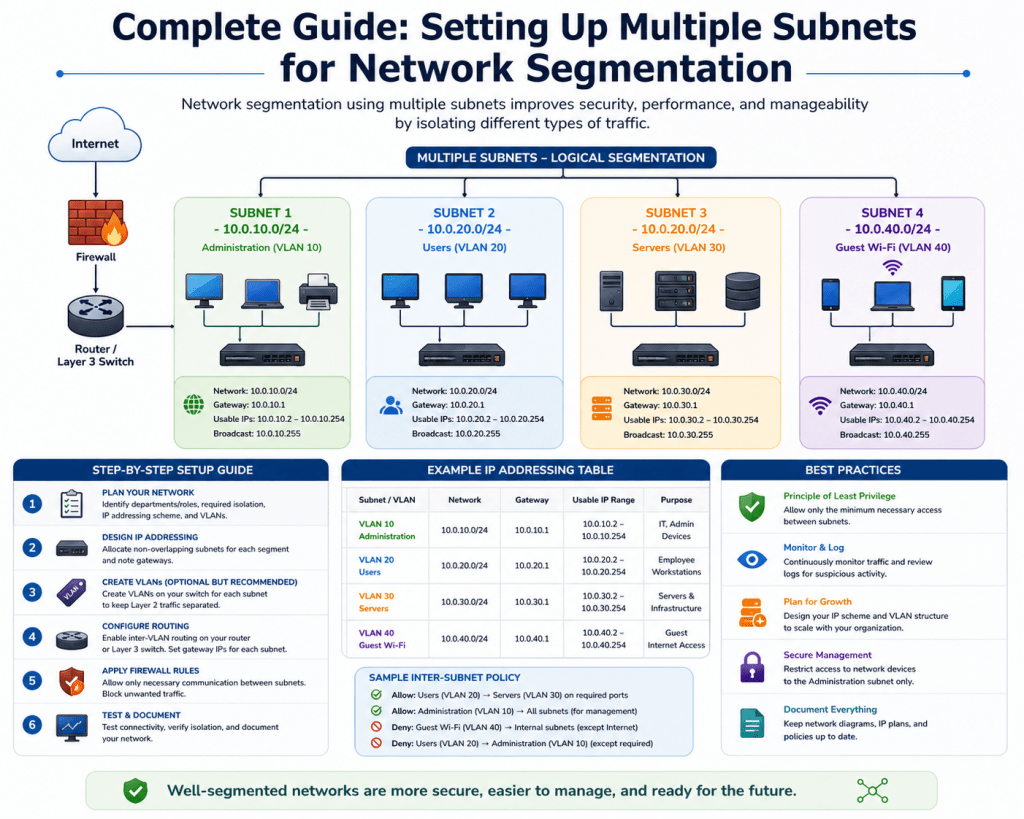
A subnet is a logically defined subdivision of an IP network that allows a larger network to be broken into smaller, more efficient segments. Each subnet functions as an independent network segment within a larger infrastructure, enabling devices to communicate locally while still being part of a broader system. In practical networking environments, a subnet helps organize devices into structured groups, improving communication flow and reducing unnecessary data transmission across the entire network. Instead of treating all connected devices as part of a single broadcast domain, subnetting creates boundaries that define how traffic moves between devices. This segmentation allows networks to operate in a more controlled and scalable manner, especially when dealing with growing numbers of connected systems.
Subnetting is a fundamental concept in modern networking because it directly affects performance, security, and manageability. Without subnetting, every device in a network would receive all broadcast traffic, leading to congestion and inefficiency. By dividing a network into subnets, communication is localized, meaning only relevant devices process specific data transmissions. This structure is essential for maintaining stability in both small-scale home networks and large enterprise infrastructures.
Core Purpose of Subnetting in Network Design
The primary purpose of subnetting is to improve the efficiency and organization of IP networks. As networks expand, managing a single flat structure becomes increasingly difficult. Subnetting solves this problem by introducing logical separation between groups of devices. Each subnet can be assigned to a specific department, location, or function, allowing better control over network resources.
Another important purpose of subnetting is to reduce broadcast traffic. In a flat network, broadcast messages are sent to every device, regardless of relevance. This creates unnecessary load on network resources. Subnetting limits the scope of broadcast traffic to individual segments, ensuring that only devices within the same subnet receive these messages. This improves overall network performance and reduces latency.
Subnetting also enhances network security by isolating groups of devices. If one subnet is compromised or experiences abnormal traffic, the issue is less likely to spread across the entire network. This isolation provides an additional layer of protection by limiting exposure between different network segments.
Understanding IP Address Structure in Networking
To understand subnetting, it is essential to understand how IP addresses are structured. An IP address in IPv4 is a 32-bit numerical identifier assigned to each device on a network. It is typically represented in decimal format as four separated numbers, known as octets. Each octet contains 8 bits and can represent values from 0 to 255.
An IP address is divided into two main components: the network portion and the host portion. The network portion identifies the subnet to which the device belongs, while the host portion identifies the specific device within that subnet.
The flexibility of this structure allows networks to be designed according to specific requirements. A large network may allocate more bits to the network portion to create multiple subnets, while a smaller network may allocate more bits to the host portion to support a larger number of devices within a single subnet.
Role of Subnet Masks in Network Segmentation
A subnet mask is a numerical value used to define which portion of an IP address belongs to the network and which portion belongs to the host. It works in conjunction with the IP address to determine network boundaries. The subnet mask does not change the IP address itself but provides a way for devices to interpret it correctly.
When a device sends data to another device, it uses the subnet mask to determine whether the destination is within the same subnet. If both devices share the same network portion, communication occurs directly without the need for routing. If they are on different subnets, the data must be forwarded through a router.
Subnet masks are essential for maintaining organized communication within networks. They ensure that devices can accurately determine whether to send data locally or through a routing path. This decision-making process is fundamental to efficient network operation.
How Subnetting Divides Large Networks into Smaller Segments
Subnetting works by borrowing bits from the host portion of an IP address and using them to create additional network identifiers. This process increases the number of available networks while reducing the number of hosts per network. Each time a bit is borrowed, the number of possible subnets doubles, while the number of available host addresses per subnet decreases.
For example, a network with a default structure may support a large number of hosts but only one network segment. By applying subnetting, that single network can be divided into multiple smaller networks, each with its own range of IP addresses. This allows network administrators to allocate resources more efficiently and organize devices into logical groups.
The balance between subnet quantity and host capacity is a critical design decision. Networks that require many separate segments may use smaller subnets, while networks that require a large number of devices in a single segment may use fewer subnets with larger host capacities.
Classful and Classless Addressing in Subnetting
IP addressing originally followed a classful system, where networks were divided into predefined classes such as Class A, Class B, and Class C. Each class had a fixed range of network and host allocations. However, this system was inefficient because it often led to wasted IP addresses.
Modern networking uses classless addressing, which is more flexible and efficient. In classless addressing, subnetting is not restricted by predefined classes. Instead, variable-length subnet masks are used to define network boundaries more precisely. This allows networks to be tailored to specific requirements without wasting address space.
Classless addressing is now the standard in most networking environments because it supports better scalability and efficient IP allocation. It allows networks to be designed based on actual needs rather than fixed structural limitations.
CIDR Notation and Its Role in Subnet Definition
Classless Inter-Domain Routing (CIDR) is a method used to represent IP addresses and their associated subnet masks in a simplified format. Instead of using traditional dotted decimal notation for subnet masks, CIDR uses a slash followed by a number. This number represents the number of bits used for the network portion of the address.
CIDR notation provides a more compact and flexible way to represent subnet information. It allows network designers to quickly understand the size of a network and the number of available host addresses. CIDR also supports efficient routing by enabling aggregation of multiple networks into a single routing entry, reducing complexity in routing tables.
This approach has become a standard in modern networking due to its simplicity and scalability. It allows networks to be divided and summarized in a way that improves both performance and manageability.
Broadcast Domains and Their Relationship to Subnets
A broadcast domain is a logical division of a network where all devices receive broadcast messages sent by any device within that domain. Subnets directly define broadcast domains by limiting the scope of broadcast traffic. Each subnet represents a separate broadcast domain, meaning that broadcast messages are contained within that subnet and do not extend to others.
This separation is important because excessive broadcast traffic can slow down network performance. By dividing a network into multiple broadcast domains through subnetting, the amount of unnecessary traffic is significantly reduced. This results in more efficient communication and improved overall network performance.
Broadcast domain segmentation also enhances security by limiting the reach of broadcast-based attacks or misconfigurations. Each subnet operates independently in terms of broadcast communication, which helps contain potential issues.
Routing Between Subnets in Network Communication
When devices need to communicate across different subnets, routing is required. A router is responsible for directing traffic between subnets by analyzing destination IP addresses and forwarding data accordingly. This process ensures that data reaches the correct destination even when it is outside the local subnet.
Routing between subnets allows large networks to function as interconnected systems of smaller segments. Each subnet operates independently, but routers provide controlled communication between them. This structure enables scalable network design where different segments can communicate without interfering with each other’s local traffic.
The routing process also allows network administrators to implement security policies and traffic controls between subnets. This adds another layer of management and control over how data flows within a network.
Private and Public IP Address Ranges in Subnetting
IP addresses are categorized into private and public ranges. Private IP addresses are used within internal networks and are not directly accessible from the internet. Public IP addresses are used for external communication and are globally unique.
Subnetting is commonly applied within private IP ranges to organize internal network structures. These private ranges allow organizations and home networks to create multiple subnets without consuming public IP addresses. This approach improves internal network efficiency while maintaining separation from external networks.
Private IP addressing combined with subnetting provides a flexible framework for building scalable internal networks. It allows multiple devices and systems to operate efficiently without requiring direct internet exposure.
Importance of Logical Network Segmentation
Logical segmentation through subnetting is a key principle in network architecture. It allows networks to be designed in a structured and scalable manner, supporting both current and future growth. By dividing networks into logical segments, administrators can better control traffic flow, improve security, and optimize performance.
Logical segmentation also simplifies network management by allowing administrators to apply configurations, policies, and monitoring tools to specific subnets rather than the entire network. This targeted approach reduces complexity and improves operational efficiency across the network infrastructure.
How Subnetting Works in Practical Network Environments
Subnetting works by taking a single IP network and dividing it into multiple smaller, logically separated networks. Each of these smaller networks is called a subnet, and each subnet has its own range of usable IP addresses. The process is based on manipulating the binary structure of IP addresses, specifically by extending the network portion and reducing the host portion.
In real-world networking environments, subnetting is used to organize devices into structured groups. Instead of having all devices communicate within a single flat network, subnetting allows separation based on departments, physical locations, security requirements, or functional roles. This logical separation improves control and reduces unnecessary communication between unrelated systems.
Subnetting also plays a key role in improving scalability. As networks grow, adding more devices to a single network becomes inefficient. Subnetting allows network designers to expand infrastructure without disrupting existing configurations. Each subnet can operate independently while still being part of a larger network architecture.
Binary Foundation of Subnetting Explained
At the core of subnetting is binary mathematics. IP addresses are represented in binary form when processed by networking devices. Each IPv4 address contains 32 bits, divided into four octets. Subnetting involves manipulating these bits to create new network boundaries.
When subnetting occurs, bits from the host portion of the IP address are borrowed to create additional network identifiers. Each borrowed bit increases the number of available subnets exponentially. At the same time, the number of usable host addresses decreases within each subnet.
For example, borrowing one bit doubles the number of subnets. Borrowing two bits quadruples the number of subnets. This relationship is fundamental in subnet design and helps determine how networks should be structured based on requirements.
Understanding binary conversion is essential because subnet masks are ultimately interpreted in binary form. Network devices perform logical operations using binary values to determine whether an IP address belongs to the same subnet or a different one.
Subnet Masks and Their Role in Network Division
A subnet mask is a 32-bit number that defines how an IP address is split between network and host portions. It is used to determine which part of the IP address identifies the subnet and which part identifies the device.
Subnet masks work by applying a logical AND operation between the IP address and the mask itself. This process extracts the network portion of the address. If two devices produce the same network result after this operation, they belong to the same subnet.
Subnet masks are critical for routing decisions. They help devices determine whether a destination is local or remote. If the destination is local, communication occurs directly. If not, the data is sent to a router for further processing.
The structure of a subnet mask directly impacts network design. A more restrictive mask creates more subnets with fewer hosts, while a less restrictive mask creates fewer subnets with more hosts.
CIDR Notation and Flexible Network Design
Classless Inter-Domain Routing (CIDR) is a modern method used to define IP networks and subnet masks in a simplified format. Instead of writing a full subnet mask, CIDR uses a slash followed by a number that represents how many bits are used for the network portion.
For example, a notation like /24 means that 24 bits are used for the network portion, leaving 8 bits for host addresses. This structure allows for quick interpretation of network size and capacity.
CIDR enables flexible network design by eliminating the rigid structure of older class-based addressing systems. It allows networks to be sized precisely according to actual requirements rather than fixed categories.
CIDR also supports route aggregation, where multiple networks can be combined into a single routing entry. This reduces the size of routing tables and improves overall network efficiency.
Subnet Calculation Process in Network Planning
Subnet calculation is a structured process used to determine how many subnets and hosts can be created from a given IP range. The first step involves identifying the original network class or CIDR block. The next step is determining how many bits are needed for subnetting based on network requirements.
Once the number of borrowed bits is defined, calculations are performed to determine the number of possible subnets and the number of usable hosts per subnet. The number of subnets is calculated using powers of two, based on the number of bits borrowed from the host portion.
The number of usable hosts is calculated by subtracting two addresses from the total number of possible host addresses. These reserved addresses are used for the network identifier and broadcast address.
This calculation process ensures that network designers allocate IP addresses efficiently without wasting address space or creating overly large subnets that are difficult to manage.
Designing Subnets for Organizational Structure
Subnet design is often based on organizational requirements. Large organizations typically divide networks according to departments such as finance, human resources, operations, and IT. Each department may be assigned its own subnet to improve traffic management and security.
This structure allows each department to operate independently while still being part of the same overall network. It also simplifies troubleshooting because network issues can be isolated to specific subnets rather than affecting the entire system.
Subnet design may also be based on physical location. In multi-building environments, each building or floor may have its own subnet. This reduces traffic congestion and improves communication efficiency within each location.
Functional segmentation is another common approach, where devices are grouped based on their role, such as servers, workstations, or IoT devices. This type of segmentation improves security by isolating sensitive systems from general user devices.
Variable-Length Subnet Masking in Advanced Networks
Variable-Length Subnet Masking (VLSM) allows different subnets within the same network to use different subnet masks. This provides greater flexibility in IP address allocation and reduces waste.
Instead of dividing a network into equal-sized subnets, VLSM allows subnet sizes to be customized based on actual requirements. Larger subnets can be assigned to segments with more devices, while smaller subnets can be used for segments with fewer devices.
This approach is particularly useful in large-scale networks where different departments or locations have varying numbers of devices. VLSM ensures efficient use of IP address space while maintaining structured network segmentation.
VLSM requires careful planning because subnets must be allocated in a way that avoids overlap and ensures proper routing. It is widely used in enterprise-level network design due to its flexibility and efficiency.
Subnetting and Network Traffic Management
Subnetting plays a significant role in managing network traffic. By dividing a network into smaller segments, traffic is contained within specific areas, reducing congestion and improving performance.
Broadcast traffic, which is sent to all devices in a network segment, is limited to individual subnets. This reduces unnecessary load on devices that do not need to process that traffic.
Subnetting also improves routing efficiency. Routers only need to manage traffic between subnets rather than handling all communication within a single large network. This reduces processing overhead and improves response times.
Efficient traffic management is essential in environments with high data flow, such as corporate networks, data centers, and cloud-based infrastructures.
Subnet Allocation Strategies in Network Engineering
Subnet allocation involves distributing IP address ranges in a way that aligns with network requirements. One common strategy is hierarchical allocation, where larger subnets are divided into smaller ones as needed.
Another strategy is sequential allocation, where subnets are assigned in a continuous range to simplify management and reduce complexity.
Network engineers must also consider future expansion when allocating subnets. Leaving unused address space allows for network growth without requiring major redesigns.
Proper subnet allocation ensures that IP addresses are used efficiently and that the network remains scalable over time.
Routing Between Multiple Subnets in Large Networks
In networks with multiple subnets, routing is required to enable communication between different segments. Routers analyze destination IP addresses and determine the best path for data transmission.
Each subnet typically connects to a router interface, which acts as a gateway for external communication. When a device sends data to another subnet, the router forwards the traffic based on routing tables.
Routing between subnets allows complex network structures to function efficiently. It enables segmentation without sacrificing connectivity.
Routing protocols may also be used to dynamically manage paths between subnets, ensuring optimal performance and reliability in large-scale environments.
Network Segmentation for Security Enhancement
Subnetting is widely used as a security mechanism in network design. By isolating different groups of devices, subnetting limits the spread of potential security threats.
Sensitive systems can be placed in separate subnets with restricted access controls. This prevents unauthorized access from other parts of the network.
Network segmentation also supports monitoring and intrusion detection by limiting traffic visibility to relevant segments. Security policies can be applied at the subnet level, providing granular control over network access.
This structured approach reduces risk and improves overall network resilience.
Scalability Considerations in Subnet Planning
Scalability is a key factor in subnet design. Networks must be designed not only for current requirements but also for future expansion.
Subnetting allows networks to grow without requiring complete restructuring. Additional subnets can be created as needed, provided that IP address space is available.
Proper planning ensures that networks remain flexible and adaptable. This is particularly important in environments where device counts or user demands may change over time.
Subnetting provides a foundation for scalable network architecture that can evolve alongside organizational needs.
Advanced Subnetting Concepts in Modern Networks
Advanced subnetting extends beyond basic network division and focuses on optimizing how IP address space is structured, allocated, and managed across complex environments. In modern networks, subnetting is not only about splitting a network into smaller parts but also about ensuring efficiency, scalability, and performance across distributed systems. As organizations grow, networks must support increasing numbers of devices, applications, and services, which requires more refined subnetting strategies.
Advanced subnetting often involves hierarchical network design, where large networks are divided into regional, departmental, and functional layers. Each layer is further subdivided into smaller subnets based on operational needs. This structured approach ensures that traffic is organized logically, reducing congestion and improving communication efficiency across the entire infrastructure.
Another aspect of advanced subnetting is optimization of IP address utilization. Instead of allocating large blocks of IP addresses without planning, advanced subnetting ensures that each subnet is sized according to actual requirements. This prevents wastage and allows networks to scale without running out of address space prematurely.
Hierarchical Network Design Using Subnets
Hierarchical design is a structured approach where networks are built in layers, typically divided into core, distribution, and access levels. Subnetting plays a critical role in this architecture by defining boundaries between each layer and ensuring efficient traffic flow.
At the access layer, devices such as computers, printers, and IoT systems are grouped into subnets based on location or function. These subnets connect to the distribution layer, which aggregates traffic and applies routing policies. The core layer handles high-speed data transfer between different parts of the network.
This layered approach improves scalability and simplifies management. Each layer can be designed and modified independently, allowing network administrators to implement changes without disrupting the entire system. Subnets act as the building blocks that support this hierarchical structure.
CIDR Optimization in Large-Scale Networks
Classless Inter-Domain Routing (CIDR) is essential in large-scale network optimization. It allows networks to be summarized and grouped efficiently, reducing the size of routing tables and improving performance. Instead of maintaining individual routes for every subnet, CIDR enables aggregation of multiple networks into a single route entry.
This aggregation is especially useful in enterprise environments and internet service provider infrastructures, where thousands of subnets may exist. By summarizing routes, routers can process data more efficiently, reducing CPU load and improving response times.
CIDR also supports flexible subnet sizing, allowing networks to be tailored precisely to organizational needs. This eliminates the inefficiencies of older class-based systems and provides a scalable foundation for modern networking.
Variable-Length Subnet Masking in Complex Environments
Variable-Length Subnet Masking (VLSM) allows different subnet sizes within the same network, making it one of the most powerful tools in advanced subnet design. Instead of dividing a network into equal parts, VLSM enables customized allocation based on specific requirements.
For example, a network segment with many devices may use a larger subnet, while a segment with fewer devices may use a smaller subnet. This ensures that IP addresses are not wasted and that each subnet is appropriately sized for its purpose.
VLSM requires careful planning because subnets must be allocated without overlap. Network designers must calculate address ranges precisely to ensure efficient utilization. This technique is widely used in enterprise networks, data centers, and cloud environments where flexibility is essential.
Subnetting in Enterprise Network Architecture
In enterprise environments, subnetting is used to create structured and secure network systems. Large organizations often have multiple departments, locations, and operational units that require isolated network segments.
Subnetting allows each department to operate within its own network segment while still being connected to the overall infrastructure. This separation improves performance by reducing broadcast traffic and enhances security by limiting access between departments.
Enterprise subnetting also supports centralized management. Network administrators can apply policies, monitor traffic, and troubleshoot issues more effectively when networks are segmented logically. This improves operational efficiency and reduces downtime.
Routing Architecture Between Multiple Subnets
Routing is the mechanism that enables communication between different subnets. When a device needs to send data to another subnet, the data is forwarded through a router, which determines the best path based on routing tables.
Each subnet typically connects to a router interface that serves as its gateway. The router examines the destination IP address and forwards the packet accordingly. This process ensures that data reaches the correct subnet even when it is outside the local network segment.
In complex networks, multiple routers may be involved in the communication process. Routing protocols help these routers exchange information about network paths, ensuring efficient data delivery across large infrastructures.
Static and Dynamic Routing in Subnet Communication
Static routing involves manually configuring routes between subnets. It is simple and predictable, but can become difficult to manage in large networks. Static routes are typically used in smaller or more stable environments.
Dynamic routing, on the other hand, allows routers to automatically discover and update routes using routing protocols. This makes it more suitable for large and complex networks where changes occur frequently.
Dynamic routing ensures that subnet communication remains efficient even when network conditions change. It provides redundancy and adaptability, which are essential in enterprise environments.
Subnetting for Security Segmentation and Isolation
Subnetting is widely used as a security strategy in modern networks. By dividing a network into isolated segments, organizations can control access and limit the spread of potential threats.
Sensitive systems such as financial databases, authentication servers, and administrative tools can be placed in dedicated subnets with restricted access. This reduces the risk of unauthorized access and lateral movement within the network.
Security policies can also be applied at the subnet level, allowing administrators to define which devices or users can communicate across segments. This granular control enhances overall network security.
Subnet isolation also helps contain security incidents. If one subnet is compromised, the impact is limited to that segment, preventing widespread disruption.
Performance Optimization Through Network Segmentation
Subnetting significantly improves network performance by reducing unnecessary traffic. In a flat network, all devices share the same broadcast domain, which can lead to congestion and slow communication.
By dividing the network into subnets, broadcast traffic is contained within smaller segments. This reduces the load on network devices and improves response times.
Subnetting also reduces the workload on routers and switches by limiting the scope of traffic they must process. This leads to faster routing decisions and improved overall network efficiency.
Performance optimization through subnetting is especially important in environments with high traffic volumes, such as corporate networks, educational institutions, and cloud infrastructures.
IP Address Management in Subnetted Networks
Effective IP address management is essential in subnetted networks. Each subnet must be carefully planned to ensure efficient allocation of address space.
Network administrators must consider the number of devices in each segment, potential future growth, and the overall structure of the network when assigning IP ranges.
Proper IP management prevents address conflicts and ensures that all devices can communicate correctly within their assigned subnets. It also simplifies troubleshooting and network maintenance.
In large environments, IP address management systems are often used to track and organize subnet allocations, ensuring consistency and accuracy.
Scalability and Expansion in Subnet-Based Networks
One of the key advantages of subnetting is scalability. Networks can grow incrementally by adding new subnets without disrupting existing infrastructure.
Each new subnet can be designed to meet specific requirements, allowing organizations to expand their networks in a controlled and structured manner.
Scalability is particularly important in environments where device counts increase over time. Subnetting ensures that networks remain organized even as they expand significantly.
Proper planning allows networks to accommodate future growth without requiring major redesigns or restructuring.
Troubleshooting Subnet-Based Network Issues
Subnetting also simplifies troubleshooting by isolating network problems to specific segments. When an issue occurs, administrators can focus on the affected subnet rather than analyzing the entire network.
Common issues such as IP conflicts, routing errors, or connectivity problems can be quickly identified and resolved within the relevant subnet.
Network monitoring tools often use subnet boundaries to organize diagnostic information, making it easier to detect and resolve issues efficiently.
This structured approach reduces downtime and improves network reliability.
Real-World Applications of Subnetting in Modern Infrastructure
Subnetting is used across a wide range of real-world environments, including corporate networks, cloud systems, data centers, and educational institutions.
In corporate environments, subnetting is used to separate departments and control access to sensitive data. In cloud environments, subnetting helps organize virtual networks and manage resource allocation.
Data centers use subnetting to segment server clusters and optimize traffic flow between systems. Educational institutions use subnetting to separate administrative systems from student networks.
These real-world applications demonstrate the versatility and importance of subnetting in modern networking.
Final Network Design Considerations Using Subnets
Effective network design requires careful planning of subnet structure, IP allocation, routing architecture, and security segmentation. Subnetting provides the foundation for building scalable, efficient, and secure networks.
Designers must consider current requirements as well as future expansion when creating subnet structures. Proper planning ensures that networks remain flexible, efficient, and easy to manage over time.
Subnetting is not just a technical process but a fundamental design strategy that supports the entire structure of modern IP-based networks.
Conclusion
Subnetting is one of the foundational concepts in modern networking, and understanding it is essential for anyone working with IP-based systems. Across all types of environments, from small home networks to large enterprise infrastructures, subnetting plays a critical role in organizing communication, improving performance, and ensuring efficient use of IP address space. While at first it may seem like a purely mathematical or theoretical topic, in practice, it directly influences how networks function, scale, and remain secure over time.
At its core, subnetting is about structure. Without subnetting, a network operates as a single flat space where every device shares the same broadcast domain. In such a setup, every broadcast message reaches every device, regardless of relevance. This leads to unnecessary traffic, wasted processing power, and reduced efficiency. As networks grow, these inefficiencies become more pronounced, eventually creating congestion and slowing down communication. Subnetting solves this problem by dividing the network into smaller, logically separated segments. Each segment operates independently, handling its own traffic and reducing the load on the overall system.
Another major benefit of subnetting is improved control over IP address allocation. IP addresses are finite resources, especially within private network ranges. Without proper planning, large blocks of addresses can be wasted on networks that do not require them. Subnetting allows administrators to allocate IP addresses more precisely based on actual needs. This ensures that address space is used efficiently and can support long-term network growth. By carefully designing subnets, networks can be scaled without requiring constant restructuring or reallocation of IP ranges.
Subnetting also introduces a higher level of organization into network design. Instead of treating all devices equally within one large network, subnetting allows grouping based on logical criteria. These groups can be formed based on departments, physical locations, device types, or functional roles. For example, a network may separate administrative systems, user workstations, servers, and IoT devices into different subnets. This separation makes it easier to manage traffic flow, apply policies, and monitor activity within each segment. It also simplifies troubleshooting, since issues can often be isolated to a specific subnet rather than affecting the entire network.
Security is another area where subnetting provides significant advantages. By dividing a network into smaller segments, it becomes possible to restrict communication between different groups of devices. Sensitive systems can be placed in isolated subnets with strict access controls, reducing the risk of unauthorized access. Even if one part of the network is compromised, subnetting helps contain the issue within that segment, preventing it from spreading across the entire infrastructure. This layered approach to network design enhances overall resilience and reduces exposure to potential threats.
The relationship between subnetting and routing is also fundamental. Once a network is divided into subnets, communication between those subnets requires routing. Routers act as intermediaries that direct traffic based on destination IP addresses and routing rules. This creates a structured communication system where local traffic stays within its subnet, while external traffic is carefully directed through defined paths. This separation improves efficiency and allows administrators to control how data flows between different parts of the network. It also enables the implementation of policies that govern inter-subnet communication, adding another layer of control.
Subnet masks and CIDR notation provide the technical foundation for how subnetting is implemented. Subnet masks define which portion of an IP address belongs to the network and which belongs to the host. CIDR notation simplifies this representation, making it easier to design and understand network structures. These tools allow precise control over how networks are divided and ensure that each subnet is correctly defined. While the underlying process involves binary calculations, modern systems handle most of this automatically, allowing network designers to focus on structure and planning rather than manual computation.
In larger environments, subnetting becomes even more important due to complexity and scale. Enterprise networks, data centers, and cloud infrastructures rely heavily on subnetting to maintain order and efficiency. Without it, managing thousands or even millions of connected devices would be nearly impossible. Subnetting allows these environments to remain organized, scalable, and manageable. It supports hierarchical design models where networks are built in layers, each serving a specific role within the overall architecture.
Subnetting also plays a critical role in performance optimization. By reducing broadcast domains and limiting unnecessary traffic, subnetting ensures that network resources are used efficiently. Devices spend less time processing irrelevant data, and network equipment such as routers and switches operate more effectively. This leads to faster communication, lower latency, and improved overall user experience. In high-traffic environments, these performance gains are essential for maintaining stability and reliability.
Another important aspect of subnetting is its role in scalability. Networks are rarely static; they grow and evolve as new devices, users, and applications are added. Subnetting provides a flexible framework that allows networks to expand without major redesign. New subnets can be created as needed, and existing structures can be adjusted to accommodate changing requirements. This adaptability is one of the key reasons subnetting remains a core principle in network engineering.
Troubleshooting is also significantly improved through subnetting. When networks are segmented, identifying the source of an issue becomes much easier. Instead of searching through an entire network, administrators can focus on specific subnets where the problem is occurring. This reduces diagnostic time and allows for faster resolution. Network monitoring tools also benefit from subnetting by organizing data based on network segments, making analysis more efficient.
Ultimately, subnetting represents a balance between efficiency, control, and scalability. It transforms complex network environments into structured systems that are easier to manage and optimize. Whether used in small-scale home setups or large enterprise infrastructures, the principles remain the same. Subnetting allows networks to function more intelligently by dividing them into manageable components, each serving a specific purpose within the broader system.
Understanding subnetting is not just about memorizing calculations or technical rules. It is about understanding how modern networks are designed and why they function the way they do. It provides the foundation for advanced networking concepts such as routing, security segmentation, and network optimization. As technology continues to evolve and networks become more complex, the importance of subnetting only increases.
In practical terms, subnetting is what makes large-scale digital communication possible. It ensures that networks remain organized, efficient, and secure, even as they expand to support millions of devices and users. It is a fundamental building block of modern networking architecture and remains one of the most important skills for anyone working in IT infrastructure, system administration, or network engineering.