
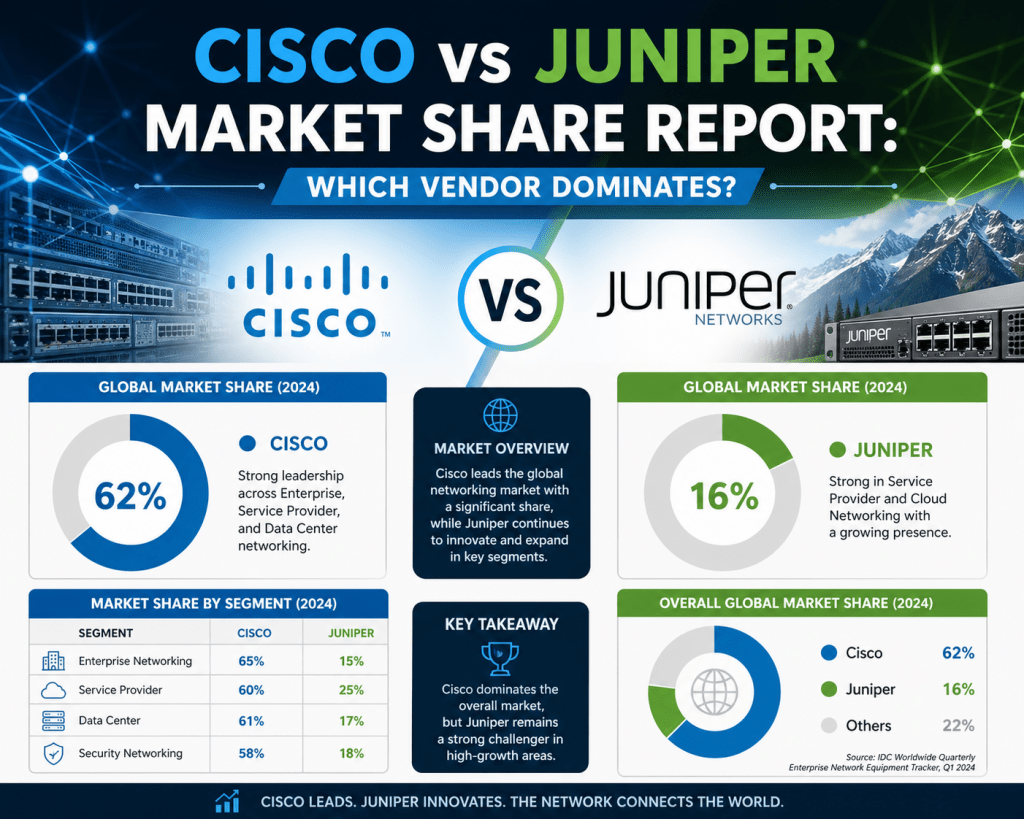
In the enterprise networking ecosystem of 2026, Cisco and Juniper remain two of the most influential vendors shaping how modern infrastructure is designed and deployed. Organizations evaluating networking platforms often compare these two based on performance, scalability, ecosystem maturity, and long-term operational reliability. Market share is frequently used as a high-level indicator of vendor strength, reflecting adoption scale across enterprise, service provider, and cloud environments. Cisco continues to dominate global networking deployments with the largest installed base, while Juniper maintains a focused but strategically strong position in performance-driven and automation-centric network architectures. Understanding their relative positioning requires looking beyond percentages and into the structural factors driving enterprise adoption trends.
Cisco Market Share Position and Global Networking Dominance
Cisco maintains a leading position in the global networking market due to its extensive portfolio and long-established presence across enterprise infrastructure. Its dominance spans routing, switching, security, collaboration systems, and cloud-managed networking solutions. This broad coverage allows organizations to build standardized infrastructures using a single vendor ecosystem, reducing integration complexity and improving operational consistency across environments.
A major contributor to Cisco’s market leadership is its deeply embedded enterprise adoption. Many organizations have built multi-layered network architectures around Cisco technologies over several decades. This creates a strong installed base effect, where existing infrastructure naturally drives continued investment in the same ecosystem due to compatibility, familiarity, and reduced migration risk.
Cisco’s influence extends across multiple segments including campus networks, branch connectivity, and large-scale data center environments. Its solutions are widely used in environments where stability, interoperability, and lifecycle support are critical. This broad applicability ensures consistent demand across industries such as finance, healthcare, education, and government sectors.
Enterprise Ecosystem Expansion and Adoption Drivers
Cisco’s ecosystem advantage plays a significant role in sustaining its market share leadership. The company integrates hardware, software, security frameworks, and cloud-based management platforms into a unified operational model. This integration allows enterprises to centralize control and streamline network operations across distributed environments.
Organizations often choose Cisco not only for technical performance but also for ecosystem consistency. Standardized configuration models, unified dashboards, and consistent policy enforcement reduce operational overhead and training complexity. This becomes particularly important for large enterprises managing geographically distributed infrastructure.
Another key factor supporting Cisco adoption is global enterprise support coverage. Large organizations require predictable vendor responsiveness and standardized technical assistance across regions. Cisco’s established support infrastructure contributes to its reputation as a low-risk, enterprise-grade networking provider, reinforcing its dominance in mission-critical deployments.
Market Distribution Across Networking Segments
Cisco maintains strong penetration across multiple networking segments, although its dominance varies by category. In enterprise switching and routing, Cisco continues to lead due to its mature product lifecycle and compatibility across legacy and modern environments. These characteristics are essential for organizations with long-term infrastructure investments.
In data center networking, Cisco remains highly competitive, especially in enterprises that prioritize integrated management and unified control planes. While alternative vendors compete strongly in hyperscale environments, Cisco continues to maintain relevance through continuous evolution of its architecture and cloud-integrated networking models.
In WAN and branch networking, Cisco has strengthened its position through software-defined networking solutions that support hybrid cloud connectivity. These advancements align traditional networking frameworks with modern application delivery requirements, further expanding its market footprint.
Workforce Ecosystem and Certification Influence on Market Share
Cisco’s market share strength is reinforced by its global certification ecosystem, which shapes the availability of skilled networking professionals. Industry-recognized certifications aligned with Cisco technologies have become widely adopted as standard career pathways in networking and infrastructure engineering.
This widespread skill alignment creates a strong talent ecosystem, making it easier for organizations to hire and train professionals already familiar with Cisco-based environments. As a result, enterprises often prefer Cisco technologies to reduce operational risk associated with skill shortages or retraining requirements.
The availability of a large certified workforce also ensures continuity in infrastructure management. Organizations benefit from easier onboarding of new engineers, reduced dependency on niche expertise, and improved long-term operational stability across complex network environments.
Juniper Market Share Position and Strategic Focus in 2026
Juniper Networks holds a smaller overall share of the global networking market but maintains strong influence in specific high-performance and service provider segments. Its strategy focuses on efficiency, automation, and scalable architecture rather than broad ecosystem dominance.
Juniper is widely recognized in environments where performance optimization and operational simplicity are key priorities. This includes service provider backbones, cloud infrastructure networks, and high-throughput enterprise environments. Its solutions are often selected for their ability to handle large-scale traffic with minimal operational complexity.
Unlike Cisco’s broad portfolio strategy, Juniper concentrates on engineering efficiency and network automation. This targeted approach allows it to compete effectively in specialized segments where performance consistency and cost efficiency outweigh ecosystem breadth considerations.
Architectural Approach and Competitive Positioning
Juniper’s networking architecture emphasizes automation-driven operations and simplified network management. Its systems are designed to reduce manual configuration overhead and improve consistency across distributed infrastructure environments.
A key component of Juniper’s strategy is its focus on intelligent traffic management and adaptive networking models. These systems support dynamic routing decisions based on real-time network conditions, improving performance efficiency in complex environments.
Juniper’s operational model is particularly effective in cloud-centric and service provider networks where scalability and automation are essential. This design philosophy differentiates it from broader ecosystem-based competitors and positions it as a specialized solution provider for high-performance networking scenarios.
Market Share Relevance in Vendor Selection Strategy
Market share is often used as an indirect measure of vendor maturity, ecosystem strength, and long-term sustainability. Higher market share typically indicates wider adoption, stronger community support, and greater availability of technical resources.
In enterprise decision-making, market share helps organizations assess vendor risk and ecosystem stability. A widely adopted platform usually offers better interoperability, larger knowledge bases, and more readily available technical expertise.
However, market share alone is not a complete evaluation metric. Organizations must also consider architectural fit, performance requirements, scalability demands, and operational complexity when selecting networking infrastructure. Many enterprise environments adopt hybrid strategies to balance broad ecosystem support with specialized performance capabilities.
Industry Trends and Competitive Evolution
The competitive landscape between Cisco and Juniper continues to evolve alongside major shifts in networking architecture, including cloud migration, software-defined infrastructure, and AI-driven automation. These trends are reshaping traditional networking models and influencing vendor strategies.
Cisco continues to expand its ecosystem-driven approach by integrating emerging technologies into its existing infrastructure portfolio. Juniper, meanwhile, focuses on strengthening its automation capabilities and performance efficiency in targeted network environments.
As enterprise networks become more distributed and cloud-centric, both vendors are adapting their architectures to align with modern operational requirements. Market share in this evolving context reflects not only current adoption but also adaptability to future networking paradigms.
Cisco vs Juniper Market Share in 2026: Competitive Evolution in Enterprise Networking
The enterprise networking landscape in 2026 is shaped by rapid shifts toward cloud-native architectures, AI-assisted network management, and software-defined infrastructure. Within this evolving environment, Cisco and Juniper continue to represent two distinct but influential approaches to network design and operational strategy. Cisco’s dominance is rooted in ecosystem scale and widespread enterprise adoption, while Juniper’s strength lies in architectural efficiency, automation, and performance-oriented networking. Market share dynamics between the two vendors are not static figures but reflections of long-term adoption patterns, technological alignment, and enterprise decision-making behavior across global IT environments.
Cisco continues to maintain a dominant position across multiple networking categories due to its deeply embedded presence in enterprise infrastructure. However, Juniper’s steady expansion in high-performance and service provider segments highlights a competitive balance that is increasingly shaped by specialized use cases rather than purely broad adoption metrics. Understanding this competition requires analyzing not only infrastructure deployment trends but also operational models, architectural philosophies, and evolving enterprise requirements.
Cisco Enterprise Adoption Patterns and Infrastructure Depth
Cisco’s market share leadership is strongly influenced by its deep integration into enterprise IT environments that span decades of infrastructure evolution. Many organizations have built multi-layered networks using Cisco technologies, resulting in highly standardized operational environments. This long-term deployment history creates a strong dependency cycle where existing infrastructure naturally encourages continued investment in the same ecosystem.
Enterprise adoption of Cisco solutions is often driven by risk minimization strategies. Large organizations prioritize stability, compatibility, and predictable lifecycle management when selecting networking vendors. Cisco’s extensive product portfolio allows enterprises to standardize across routing, switching, security, wireless connectivity, and network management systems under a unified operational framework. This reduces fragmentation across IT environments and improves consistency in configuration and policy enforcement.
In large-scale enterprise deployments, Cisco’s ability to support hybrid environments is a significant factor in maintaining its market position. Organizations operating across on-premises data centers, branch offices, and cloud environments benefit from consistent networking models that can be extended across multiple infrastructure layers without requiring complete redesigns.
Network Standardization and Operational Consistency at Scale
One of the key reasons Cisco maintains high market share is its role in enabling network standardization across complex enterprise environments. Standardization reduces operational variability, allowing IT teams to implement consistent configurations, security policies, and performance monitoring systems across distributed networks.
This consistency is particularly important in industries with strict compliance requirements, such as financial services, healthcare systems, and government institutions. In these environments, predictable network behavior and centralized control mechanisms are critical for regulatory compliance and operational reliability.
Cisco’s architecture supports centralized management frameworks that allow administrators to control large-scale networks from unified interfaces. This reduces operational complexity and minimizes configuration errors across geographically distributed environments. As enterprise networks continue to grow in scale and complexity, the value of standardized operational models becomes increasingly significant in vendor selection decisions.
Cloud Integration and Hybrid Networking Expansion
As enterprises transition toward hybrid and multi-cloud environments, Cisco has adapted its market strategy to align with these architectural shifts. Modern enterprise networks are no longer confined to traditional on-premises infrastructure but instead span across cloud providers, edge environments, and remote user locations.
Cisco’s approach to cloud integration focuses on extending its existing networking models into cloud-managed environments. This allows organizations to maintain operational consistency while transitioning workloads between different infrastructure platforms. The ability to unify policy enforcement across hybrid environments contributes to Cisco’s continued relevance in evolving enterprise architectures.
Hybrid networking also introduces challenges related to visibility, security, and performance monitoring. Cisco addresses these challenges through integrated platforms that combine networking, analytics, and security capabilities. This integrated approach helps enterprises manage complexity while maintaining control over distributed systems.
Security Integration as a Market Share Driver
Security has become a core component of enterprise networking architecture, and Cisco’s integration of security capabilities into its networking portfolio plays a significant role in maintaining its market share. Modern networks require built-in protection mechanisms that operate seamlessly across all layers of infrastructure.
Cisco’s security integration strategy aligns networking infrastructure with threat detection, access control, and policy enforcement systems. This reduces reliance on separate security vendors and enables more unified operational management. As cybersecurity threats continue to evolve, enterprises increasingly prioritize vendors that offer integrated security frameworks within their networking solutions.
The convergence of networking and security has reshaped procurement strategies across enterprises. Organizations now evaluate networking vendors not only on performance and scalability but also on their ability to provide comprehensive security coverage within a unified architecture.
Juniper Market Positioning in High-Performance Environments
Juniper Networks occupies a distinct position in the networking market, focusing primarily on performance efficiency, automation, and service provider infrastructure. While its overall market share is smaller than Cisco’s, Juniper maintains strong influence in environments where scalability and high-throughput performance are critical.
Service providers and large-scale cloud operators often prefer Juniper solutions due to their optimized routing architectures and efficient handling of large traffic volumes. These environments require systems capable of processing massive data flows with minimal latency and operational overhead.
Juniper’s market strategy is centered on simplifying network operations while improving performance efficiency. This includes reducing manual configuration requirements and enabling automated decision-making processes within network management systems. These capabilities are particularly valuable in environments where network complexity grows rapidly with scale.
Automation-Driven Networking and AI Integration
A defining characteristic of Juniper’s competitive strategy is its emphasis on automation and artificial intelligence integration within networking operations. Modern enterprise and service provider networks generate vast amounts of operational data, requiring intelligent systems to manage traffic, detect anomalies, and optimize performance.
Juniper’s automation frameworks are designed to reduce manual intervention in network configuration and troubleshooting processes. This improves operational efficiency and reduces the likelihood of human error in complex environments. AI-driven networking capabilities also enable predictive analysis of network behavior, allowing systems to adjust dynamically based on real-time conditions.
These capabilities are particularly relevant in cloud-native environments where workloads are constantly shifting. Automated network optimization allows organizations to maintain consistent performance without requiring constant manual adjustments.
Service Provider Market Influence and Infrastructure Scale
Juniper’s strongest market presence is often observed in service provider networks, where infrastructure scale and performance efficiency are primary requirements. These networks handle massive volumes of data traffic across global infrastructure backbones, requiring highly reliable and scalable routing systems.
In such environments, operational simplicity and predictable performance are more important than broad ecosystem integration. Juniper’s architecture is designed to meet these requirements by focusing on streamlined operations and high-performance routing capabilities.
The service provider segment plays a critical role in Juniper’s overall market share distribution. While enterprise adoption may be smaller in comparison to Cisco, Juniper’s influence in backbone and carrier-grade networks ensures continued relevance in global infrastructure ecosystems.
Enterprise Decision-Making and Vendor Selection Criteria
Organizations evaluating Cisco and Juniper often consider a combination of technical, operational, and strategic factors. Market share serves as an initial indicator of vendor adoption but is not the sole determinant in procurement decisions.
Technical evaluation typically includes performance benchmarks, scalability requirements, integration capabilities, and operational complexity. Cisco often excels in environments requiring broad ecosystem integration and standardized enterprise operations, while Juniper is frequently selected for high-performance and automation-centric deployments.
Operational considerations include workforce availability, support infrastructure, and training requirements. Vendors with larger market share tend to have more extensive support ecosystems and a broader pool of skilled professionals, which can influence long-term operational sustainability.
Strategic considerations include future scalability, cloud integration readiness, and alignment with digital transformation initiatives. Organizations increasingly prioritize vendors that can support long-term architectural evolution rather than static infrastructure models.
Global Networking Trends and Market Share Implications
The global networking industry is undergoing significant transformation driven by cloud adoption, edge computing expansion, and AI integration. These trends are reshaping traditional vendor dominance structures and creating new competitive dynamics.
Cisco continues to benefit from its broad enterprise footprint, allowing it to adapt across multiple infrastructure paradigms. Juniper, on the other hand, is gaining traction in environments where automation and performance optimization are central requirements.
Market share trends in 2026 reflect this divergence, with Cisco maintaining broad leadership across enterprise segments while Juniper strengthens its position in specialized and high-performance environments. The evolving nature of networking architecture suggests that future market share distribution will be increasingly influenced by workload specialization and infrastructure complexity.
Ecosystem Maturity and Long-Term Vendor Sustainability
Ecosystem maturity plays a significant role in long-term vendor sustainability. Cisco’s extensive ecosystem includes hardware, software, certification programs, and global support infrastructure. This maturity contributes to its continued dominance in enterprise networking environments.
Juniper’s ecosystem, while smaller, is highly focused on performance-driven innovation and automation capabilities. Its strategic positioning allows it to compete effectively in specialized markets, particularly where operational efficiency and scalability are prioritized.
Long-term sustainability in networking markets is influenced by a vendor’s ability to adapt to emerging technologies. Both Cisco and Juniper continue to evolve their architectures to align with cloud-native systems, AI-driven operations, and distributed infrastructure models.
Technology Convergence and Competitive Realignment
As networking technologies continue to converge with cloud computing, cybersecurity, and artificial intelligence, the distinction between traditional infrastructure categories is becoming less rigid. This convergence is influencing how market share is distributed and evaluated.
Cisco’s broad integration strategy positions it well in converged infrastructure environments where multiple IT functions are unified under a single operational framework. Juniper’s specialized approach aligns with environments that prioritize performance efficiency and automation over ecosystem breadth.
This divergence creates a competitive landscape where both vendors maintain strong but distinct roles within global networking infrastructure. Market share in this context reflects not only adoption levels but also alignment with specific technological paradigms shaping enterprise IT in 2026.
Cisco vs Juniper Market Share in 2026: Cloud-Native Transformation and Networking Evolution
The networking industry in 2026 is undergoing a structural transformation driven by cloud-native computing, distributed systems, edge workloads, and AI-assisted network orchestration. Within this shifting landscape, Cisco and Juniper continue to define two major strategic directions in enterprise networking evolution. Cisco’s market leadership is reinforced by its broad ecosystem integration and enterprise adoption base, while Juniper strengthens its position through automation-centric design and high-performance network architectures. The competitive balance between the two is increasingly influenced by how well each vendor adapts to modern infrastructure paradigms rather than traditional hardware-centric deployments.
Market share in this environment is no longer a static measure of dominance but a reflection of architectural adaptability, cloud alignment, and operational intelligence. Enterprises are no longer selecting networking solutions based solely on hardware performance; instead, they are evaluating how effectively vendors support distributed computing, automated operations, and integrated security frameworks across hybrid environments.
Cloud-Native Networking and Infrastructure Decoupling Trends
One of the most significant shifts in modern networking is the move toward cloud-native architectures. Traditional networking models were built around fixed infrastructure and static routing designs. In contrast, cloud-native networking decouples control planes from physical infrastructure, enabling more flexible and dynamic resource allocation.
Cisco has adapted to this transition by extending its ecosystem into cloud-managed networking platforms. This allows organizations to maintain centralized visibility and policy control while operating across multiple cloud environments. The integration of traditional enterprise networking with cloud orchestration tools ensures continuity for organizations transitioning from legacy systems.
Juniper approaches cloud-native transformation from an automation-first perspective. Its architecture is designed to minimize manual intervention and support dynamic scaling across distributed environments. This aligns well with cloud-native principles, where infrastructure must respond automatically to workload changes without requiring constant administrative oversight.
The adoption of cloud-native networking has significant implications for market share distribution. Vendors that can effectively support hybrid cloud environments gain increased relevance, as enterprises prioritize flexibility and scalability over rigid infrastructure models.
Edge Computing Expansion and Distributed Network Design
Edge computing has become a major driver of networking evolution, pushing data processing closer to end users and devices. This shift introduces new requirements for low-latency communication, distributed security enforcement, and decentralized network management.
Cisco’s approach to edge computing focuses on extending its enterprise ecosystem to distributed environments. This includes integrating edge devices into centralized management systems, allowing consistent policy enforcement across cloud, data center, and edge locations. This unified approach helps enterprises maintain operational consistency even as infrastructure becomes more geographically dispersed.
Juniper’s strategy emphasizes efficiency and automation at the edge. Its systems are designed to operate with minimal manual configuration, making them suitable for environments where infrastructure is widely distributed and dynamically changing. Automated routing and intelligent traffic optimization play a central role in Juniper’s edge networking model.
The rise of edge computing is reshaping market share dynamics by increasing demand for scalable, distributed networking solutions. Vendors that can efficiently manage decentralized environments are gaining stronger positions in emerging infrastructure deployments.
AI-Driven Networking and Intelligent Infrastructure Management
Artificial intelligence has become a foundational component of modern networking systems. AI-driven networking enables predictive analysis, automated fault detection, and dynamic optimization of traffic flows across complex environments.
Cisco integrates AI capabilities into its broader networking ecosystem, focusing on improving visibility, security, and operational efficiency. AI-powered analytics tools help organizations identify anomalies, predict performance issues, and optimize resource allocation across hybrid environments.
Juniper’s AI approach is deeply embedded in its architecture, particularly through intent-based networking models. These systems allow networks to interpret operational goals and automatically adjust configurations to achieve desired outcomes. This reduces the need for manual intervention and improves overall system responsiveness.
AI-driven networking significantly influences market share trends by shifting enterprise expectations. Organizations increasingly prefer vendors that can reduce operational complexity through intelligent automation rather than manual configuration processes.
Security-First Networking and Integrated Defense Models
Modern networking environments require integrated security frameworks due to increasing cyber threats and regulatory requirements. Security is no longer treated as a separate layer but as a core component of network architecture.
Cisco integrates security directly into its networking ecosystem, enabling unified policy enforcement across all infrastructure layers. This includes access control, threat detection, and encrypted communication mechanisms embedded within networking operations. This integration reduces fragmentation and improves overall security posture.
Juniper also incorporates security into its architecture but emphasizes automation and policy-driven enforcement. Its systems are designed to apply security policies dynamically based on network conditions and operational requirements. This approach supports scalable security management in large distributed environments.
The convergence of networking and security has become a major factor influencing enterprise vendor selection. Market share advantages increasingly depend on the ability to provide integrated, end-to-end security within networking infrastructure.
Multi-Cloud Networking and Hybrid Infrastructure Strategies
Enterprises in 2026 operate across multiple cloud environments, including private cloud, public cloud, and hybrid architectures. This complexity requires networking solutions capable of maintaining consistent performance and policy enforcement across distributed systems.
Cisco’s multi-cloud strategy focuses on extending its networking control frameworks into cloud environments. This enables organizations to maintain centralized visibility and governance across different infrastructure providers. The ability to unify network operations across cloud platforms contributes to Cisco’s continued relevance in hybrid environments.
Juniper approaches multi-cloud networking through abstraction and automation. Its systems are designed to operate independently of underlying infrastructure, allowing seamless integration across different cloud providers. This reduces dependency on specific environments and increases operational flexibility.
Multi-cloud adoption is a major factor influencing market share distribution, as enterprises prioritize interoperability and flexibility in infrastructure design. Vendors that can support heterogeneous environments gain stronger competitive positioning.
Network Automation and Operational Efficiency Models
Automation has become a central requirement in modern networking environments. As infrastructure scales, manual configuration becomes increasingly inefficient and prone to errors.
Cisco incorporates automation through centralized orchestration platforms that allow administrators to manage large-scale networks with standardized policies. This reduces operational overhead and improves consistency across distributed systems.
Juniper places a stronger emphasis on automation as a core architectural principle. Its systems are designed to operate with minimal manual input, using intent-based models and machine learning to optimize network behavior. This approach significantly reduces operational complexity in large-scale deployments.
Automation-driven networking is reshaping enterprise expectations, making operational efficiency a key factor in vendor selection and market share evolution.
Workforce Evolution and Skills Alignment in Networking Ecosystems
The availability of skilled professionals plays a critical role in shaping vendor adoption patterns. Cisco benefits from a large global workforce trained in its technologies, which simplifies hiring and operational continuity for enterprises.
Juniper, while having a smaller workforce ecosystem, is increasingly supported by professionals specializing in automation and high-performance networking. As network architectures evolve, demand for automation-focused skills is increasing, improving Juniper’s relevance in modern infrastructure environments.
Workforce alignment influences market share indirectly by affecting operational feasibility. Vendors with broader skill availability tend to experience stronger adoption in large enterprise environments.
Infrastructure Scalability and Performance Optimization Trends
Scalability is a key factor in enterprise networking decisions. Cisco’s architecture supports large-scale deployments across diverse environments, making it suitable for organizations requiring standardized global infrastructure.
Juniper’s architecture is optimized for performance efficiency, particularly in environments where high throughput and low latency are critical. This includes service provider backbones and large-scale cloud networks.
Performance optimization trends are driving increased specialization in vendor selection, where enterprises choose solutions based on workload characteristics rather than general-purpose deployment models.
Digital Transformation and Network Modernization Strategies
Digital transformation initiatives are accelerating the modernization of enterprise networks. Organizations are replacing legacy infrastructure with cloud-integrated, software-defined systems that support agility and scalability.
Cisco supports digital transformation through integrated platforms that combine networking, security, and cloud management capabilities. This allows enterprises to modernize infrastructure while maintaining operational continuity.
Juniper supports digital transformation through automation and simplified network architecture. Its systems are designed to reduce complexity and enable faster deployment of modern networking environments.
Digital transformation is a key driver of market share evolution, as enterprises prioritize vendors that can support long-term modernization strategies.
Global Networking Competition and Future Market Direction
The competitive landscape between Cisco and Juniper is expected to continue evolving as networking requirements become more complex and distributed. Cisco’s broad ecosystem ensures continued dominance across enterprise environments, while Juniper’s specialized approach strengthens its position in performance-driven and automated infrastructure segments.
Market share in 2026 reflects not only historical adoption patterns but also future readiness in areas such as cloud computing, AI integration, and edge networking. As enterprises continue to modernize infrastructure, vendor selection will increasingly depend on architectural flexibility, automation capabilities, and ecosystem integration.
The evolution of networking technologies suggests a future where market share is influenced more by workload specialization and operational intelligence than by traditional hardware dominance alone.
Conclusion
The comparison between Cisco and Juniper in 2026 reflects more than just a traditional vendor rivalry; it represents two fundamentally different approaches to how modern networks are built, operated, and evolved in an era defined by cloud computing, automation, and distributed infrastructure. Cisco’s position is anchored in decades of enterprise adoption, ecosystem expansion, and deeply integrated networking architectures that span routing, switching, security, collaboration, and cloud management. Juniper, on the other hand, has carved out a strong identity in performance-focused networking, automation-driven operations, and service provider-scale deployments where efficiency and scalability matter more than ecosystem breadth.
Cisco’s dominance in market share continues to be reinforced by its entrenched presence in global enterprise environments. Many organizations rely on Cisco infrastructure not just because of technical capability, but because of operational familiarity, workforce availability, and long-term stability. Once Cisco systems are deployed at scale, they often become deeply embedded within the organization’s architecture, influencing everything from security policies to network design standards. This creates a self-reinforcing cycle where existing deployments drive continued adoption, and continued adoption strengthens ecosystem maturity.
Another important factor behind Cisco’s sustained market strength is its ability to evolve across multiple technology waves without losing enterprise trust. As networking shifted from hardware-centric deployments to software-defined and cloud-managed environments, Cisco adapted its portfolio to include cloud orchestration, SD-WAN, and integrated security platforms. This allowed organizations to transition toward modern architectures without abandoning established infrastructure models. The ability to bridge legacy systems with modern cloud environments has been a critical factor in maintaining Cisco’s leadership position.
Juniper’s market role, while smaller in overall share, is strategically significant in areas where performance, automation, and operational efficiency are prioritized. Its focus on simplifying network operations through intelligent automation and intent-based networking models has made it particularly attractive in service provider environments and large-scale cloud infrastructures. In these environments, networks must handle massive traffic volumes with minimal latency while maintaining operational simplicity across distributed systems.
Unlike Cisco’s ecosystem-driven strategy, Juniper’s approach is more focused and architectural. It emphasizes reducing complexity through automation and enabling networks to self-adjust based on real-time conditions. This philosophy aligns strongly with modern cloud-native principles, where infrastructure is expected to be dynamic, programmable, and highly scalable. As enterprises increasingly move toward distributed cloud environments, Juniper’s automation-first design continues to gain relevance.
Market share in this context should not be interpreted as a simple measure of superiority but rather as an indicator of different strengths across different segments of the networking industry. Cisco’s large share reflects its dominance in enterprise environments where standardization, integration, and support ecosystems are critical. Juniper’s smaller but focused share reflects its strength in environments where performance optimization and automation efficiency are more important than broad ecosystem integration.
One of the key underlying factors influencing vendor choice is operational risk. Enterprises often prefer solutions with larger market share because they are associated with lower risk in terms of support availability, talent accessibility, and long-term viability. Cisco benefits significantly from this perception, as its widespread adoption ensures that skilled professionals are readily available in the global job market. This reduces dependency risks for organizations and simplifies long-term operational planning.
Juniper, however, is increasingly benefiting from industry shifts toward automation and AI-driven networking. As networks become more complex, the demand for systems that reduce manual intervention is growing. Juniper’s emphasis on intelligent automation aligns well with this trend, particularly in environments where scalability and efficiency are more important than traditional configuration models. Over time, this could gradually shift market dynamics in specific segments, even if overall market share remains lower compared to Cisco.
Another important dimension of this comparison is ecosystem maturity. Cisco’s ecosystem spans not only networking hardware but also software platforms, security solutions, collaboration tools, and cloud integration services. This creates a unified operational environment where multiple aspects of IT infrastructure can be managed under a consistent framework. For large enterprises, this level of integration simplifies governance, reduces complexity, and improves overall operational visibility.
Juniper’s ecosystem, while smaller, is highly specialized and optimized for specific use cases. It focuses heavily on networking efficiency, automation frameworks, and performance optimization tools. Rather than competing across all segments, Juniper concentrates on delivering deep capabilities in selected areas where it can outperform broader but more generalized platforms. This specialization allows it to maintain strong relevance in environments where performance and scalability are the primary concerns.
The evolution of networking technology is also reshaping how market share should be interpreted. In earlier eras, market share was closely tied to hardware deployment and physical infrastructure dominance. In 2026, however, networking is increasingly defined by software, cloud integration, and AI-driven orchestration. This means that vendor success is no longer solely dependent on physical device shipments but also on software adoption, platform integration, and automation capabilities.
Cisco’s transition toward software-defined networking and subscription-based models reflects this shift. By expanding into cloud-managed services and integrated software platforms, Cisco has ensured that its relevance extends beyond traditional hardware markets. This diversification strengthens its market position by aligning with modern IT consumption models.
Juniper’s alignment with cloud-native and automation-centric architectures positions it well for future growth in specific domains. Its focus on reducing operational complexity and enabling intelligent network behavior reflects the direction in which modern infrastructure is evolving. As enterprises continue to adopt distributed systems, demand for automation-first networking solutions is likely to increase.
Ultimately, the Cisco versus Juniper landscape in 2026 is not a simple competition of market percentages but a reflection of how different architectural philosophies serve different segments of the global networking ecosystem. Cisco represents scale, integration, and enterprise-wide standardization, while Juniper represents precision, automation, and performance efficiency. Both continue to play essential roles in shaping modern networking infrastructure, and their relative positions are likely to evolve as technology continues to advance toward more autonomous, cloud-native, and distributed operational models.