
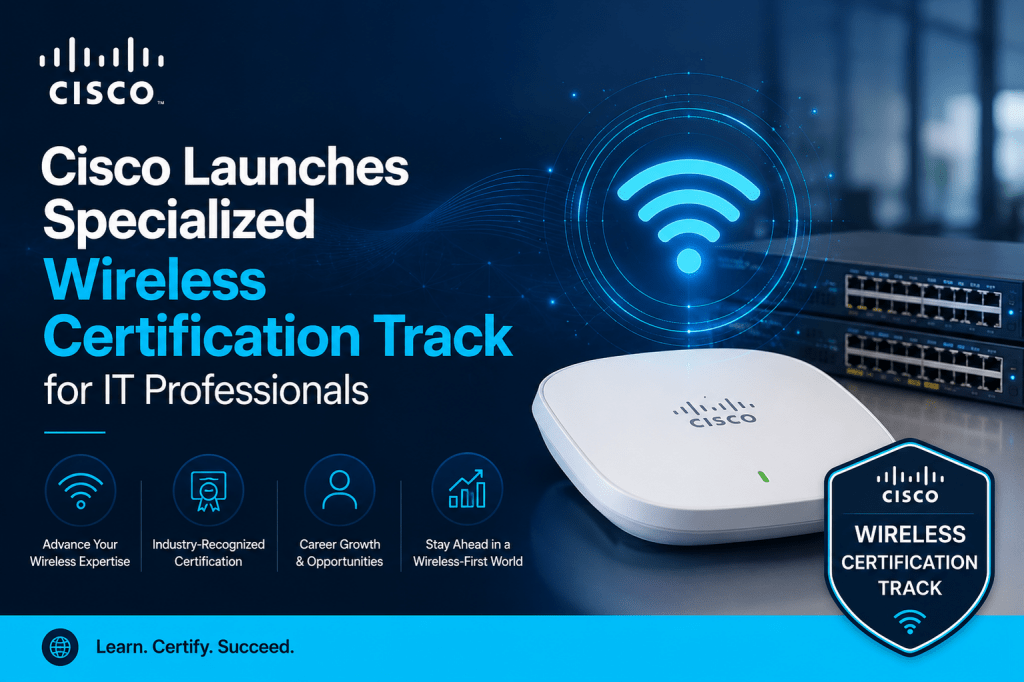
Cisco is giving wireless networking a stronger identity by launching a dedicated certification path focused entirely on enterprise Wi-Fi technologies. For many years, wireless skills were included as a smaller component inside broader enterprise certifications, but the networking landscape has evolved dramatically. Wireless connectivity is now one of the most critical parts of modern infrastructure, and Cisco’s updated direction reflects that shift. Professionals who specialize in wireless networking can now follow a more focused learning path designed specifically for advanced Wi-Fi deployment, optimization, security, and automation.
The introduction of CCNP Wireless and CCIE Wireless creates a clearer route for engineers who want to build careers around enterprise wireless technologies. Instead of studying wireless topics as one section among many, candidates will now be able to dive deeply into technologies that organizations rely on every day. This change highlights the growing demand for wireless expertise across industries where connectivity, mobility, and cloud-managed networking have become essential.
The Growing Importance of Wireless Networking
Wireless networking has transformed from a convenience feature into a business necessity. Organizations of all sizes now depend heavily on Wi-Fi to support daily operations, communication systems, cloud applications, and mobile workforces. Employees expect seamless connectivity whether they are working from offices, homes, warehouses, campuses, or public environments. Businesses also rely on wireless technologies for smart devices, sensors, surveillance systems, inventory tracking, and countless IoT deployments.
As enterprises continue expanding digital operations, wireless infrastructure must handle higher performance demands, stronger security requirements, and larger device volumes. Traditional network management approaches are no longer enough to support these environments efficiently. Engineers must understand advanced RF planning, wireless troubleshooting, automation workflows, cloud management tools, and modern security strategies.
Cisco’s decision to separate wireless certifications from the broader enterprise track acknowledges that wireless networking has become its own specialized field. Companies increasingly seek professionals who can focus entirely on wireless architecture and optimization rather than treating Wi-Fi as a secondary networking skill.
Why Wireless Deserves Its Own Certification Track
For a long time, enterprise networking certifications combined routing, switching, SD-WAN, wireless technologies, and automation into a single learning path. While that structure provided a broad networking foundation, it often limited how deeply wireless topics could be explored. As wireless technologies became more advanced, many engineers felt the need for a more focused certification approach.
Modern Wi-Fi environments involve far more than connecting laptops and smartphones. Engineers now manage complex wireless ecosystems that include high-density deployments, real-time collaboration tools, industrial IoT devices, smart building systems, and cloud-managed infrastructure. Each environment requires careful planning, optimization, and ongoing monitoring.
Wireless networking also introduces challenges that differ significantly from traditional wired infrastructure. RF interference, signal coverage, roaming behavior, channel management, and client density require specialized knowledge. Troubleshooting wireless problems often demands a combination of technical expertise, analytical thinking, and practical experience.
By creating a dedicated wireless certification path, Cisco is making it easier for professionals to develop those advanced skills. Instead of dividing attention across multiple networking disciplines, candidates can focus specifically on enterprise wireless technologies and gain deeper expertise.
A Major Shift in Cisco Certification Strategy
Cisco certifications have long been recognized as industry standards for networking professionals. Over time, the company has adjusted its certification programs to match changes in technology and enterprise demands. The introduction of a dedicated wireless track represents another major evolution in Cisco’s certification strategy.
The new wireless path creates a stronger alignment between certification objectives and real-world job responsibilities. Organizations are increasingly hiring specialists for wireless engineering roles, and these certifications are designed to prepare professionals for those positions.
This move also reflects how modern enterprises are redesigning network infrastructure around mobility and cloud integration. Traditional wired networks still matter, but wireless technologies now support many mission-critical operations. Reliable Wi-Fi performance directly affects productivity, collaboration, customer experiences, and operational efficiency.
By offering specialized wireless certifications, Cisco is positioning networking professionals to meet the growing demand for wireless expertise across healthcare, education, retail, manufacturing, logistics, hospitality, and enterprise environments.
Understanding the New CCNP Wireless Certification
The CCNP Wireless certification is designed for professionals who want to develop advanced enterprise wireless skills. It focuses on the technologies, deployment methods, and troubleshooting practices required to manage modern wireless environments effectively.
At the center of the certification path is the 350-101 WLCOR exam, which serves as the core exam for wireless specialization. This exam is expected to play a role similar to the ENCOR exam in the enterprise track, but with a dedicated focus on wireless networking technologies.
Candidates preparing for the certification will study wireless infrastructure design, controller-based networking, security implementation, RF management, performance optimization, and automation. The certification aims to validate the ability to deploy and maintain large-scale enterprise wireless networks while addressing real-world operational challenges.
The CCNP Wireless track also reflects the increasing importance of cloud-managed networking platforms. Engineers will need to understand how wireless infrastructure integrates with cloud management systems and how centralized platforms simplify administration, monitoring, and troubleshooting.
Wireless Design and RF Expertise
One of the most important aspects of enterprise wireless networking is RF design. Unlike wired infrastructure, wireless communication depends heavily on environmental conditions, physical obstacles, device density, and signal behavior. Engineers must understand how radio frequencies interact within different environments to create stable and reliable wireless coverage.
The CCNP Wireless path places significant emphasis on RF fundamentals and design principles. Candidates are expected to understand channel allocation, antenna behavior, interference management, power levels, roaming optimization, and spectrum analysis.
Large environments such as hospitals, campuses, stadiums, and manufacturing facilities often present unique wireless challenges. Poor RF planning can lead to dead zones, unstable connections, interference problems, and performance degradation. Skilled wireless engineers must analyze these environments carefully and implement designs that maximize reliability and coverage.
Understanding RF behavior is essential because even small configuration changes can impact overall network performance. Wireless professionals must continuously evaluate network conditions and adjust deployments to meet evolving user demands.
Enterprise Wi-Fi Deployment and Management
Modern enterprise Wi-Fi deployments are more complex than ever before. Organizations require scalable wireless infrastructure capable of supporting thousands of devices simultaneously while maintaining strong performance and security.
Wireless engineers must know how to deploy controllers, configure access points, manage wireless policies, optimize roaming behavior, and ensure consistent connectivity across large environments. They also need to understand how different wireless standards impact throughput, latency, coverage, and client compatibility.
The CCNP Wireless certification is expected to focus heavily on deployment strategies and operational management. Candidates will likely work with scenarios involving centralized architectures, distributed deployments, cloud-managed solutions, and hybrid networking models.
Effective wireless management also involves monitoring network health, analyzing client performance, identifying bottlenecks, and resolving connectivity issues quickly. Businesses cannot afford prolonged wireless outages because many operations depend entirely on uninterrupted connectivity.
Security in Wireless Environments
Wireless security remains one of the biggest concerns for enterprise organizations. Unlike wired connections, wireless networks broadcast signals through the air, creating additional risks that must be carefully managed.
Modern wireless engineers must understand authentication methods, encryption protocols, secure access policies, guest networking, segmentation strategies, and threat detection techniques. They also need to protect enterprise environments against rogue access points, unauthorized clients, spoofing attacks, and other wireless threats.
The new wireless certification track is expected to place greater attention on securing enterprise Wi-Fi deployments. As businesses continue expanding remote work and IoT adoption, maintaining secure wireless access becomes even more important.
Organizations increasingly rely on wireless infrastructure for sensitive applications, including financial transactions, healthcare systems, operational technology, and cloud services. Strong security practices help protect data integrity, maintain compliance standards, and reduce operational risks.
Wireless engineers who understand both networking and security principles will remain highly valuable as enterprise environments continue growing more complex.
The Rise of Automation in Wireless Networking
One of the biggest changes in modern networking is the growing role of automation. Enterprise IT teams are increasingly adopting automation tools to simplify deployments, reduce manual configuration tasks, and improve operational efficiency.
Cisco’s updated wireless certification path highlights this trend by including automation concepts alongside traditional wireless technologies. Engineers are now expected to understand scripting, infrastructure automation, and configuration management tools as part of their skill set.
Technologies such as Python, Ansible, and Terraform are becoming increasingly relevant in enterprise networking environments. These tools allow engineers to automate repetitive tasks, manage large-scale configurations, deploy consistent policies, and reduce human error.
Automation is especially valuable in wireless environments where organizations may need to manage hundreds or thousands of access points across multiple locations. Manual administration becomes inefficient at scale, making automation a practical necessity.
Wireless engineers who develop automation skills can improve network consistency, speed up deployments, and simplify troubleshooting processes. As enterprise networks continue growing larger and more distributed, automation expertise will become even more important.
Cloud-Managed Wireless Networking
Cloud networking platforms are changing how organizations manage enterprise infrastructure. Instead of relying entirely on traditional on-premises controllers, many businesses now use cloud-managed solutions to simplify administration and improve visibility.
Cloud-based management platforms provide centralized control over wireless infrastructure, allowing IT teams to configure devices, monitor performance, apply policies, and troubleshoot issues remotely. This approach is particularly useful for organizations with multiple locations or distributed workforces.
The dedicated wireless certification track reflects the growing importance of cloud networking technologies. Candidates are expected to understand how cloud-managed wireless systems operate and how they integrate with enterprise infrastructure.
Cloud networking also supports faster scalability and improved operational flexibility. Organizations can deploy new wireless environments more efficiently while maintaining centralized oversight and policy control.
As more businesses transition toward hybrid cloud models, wireless professionals must understand how cloud platforms influence deployment strategies, security policies, and ongoing management practices.
Preparing for Advanced Wireless Careers
The launch of dedicated wireless certifications creates new opportunities for networking professionals who want to specialize in enterprise Wi-Fi technologies. Engineers with strong wireless expertise are increasingly valuable because organizations depend so heavily on stable and secure wireless connectivity.
Preparing for advanced wireless roles requires both technical study and practical experience. Professionals should build strong foundations in RF concepts, wireless security, enterprise deployment methods, and automation technologies. Hands-on labs and real-world troubleshooting experience are especially important because wireless networking often involves unpredictable environmental factors.
Candidates pursuing wireless certifications should also stay informed about emerging technologies such as Wi-Fi 6, Wi-Fi 7, cloud-managed networking, and advanced analytics platforms. Enterprise wireless environments continue evolving rapidly, and engineers must adapt to changing infrastructure demands.
Strong wireless professionals often develop a combination of networking knowledge, analytical thinking, troubleshooting ability, and automation skills. These capabilities help engineers design scalable environments, optimize performance, and maintain reliable connectivity across complex enterprise networks.
The Evolution of Enterprise Wireless Infrastructure
Enterprise wireless infrastructure has evolved dramatically over the last decade. What once served primarily as a convenient method for connecting laptops and mobile phones has transformed into the central communication layer for modern organizations. Businesses now depend on wireless connectivity for collaboration platforms, cloud applications, remote access, smart office systems, and operational technologies that support daily workflows. Because of this transformation, companies require engineers with highly specialized wireless expertise who can design, deploy, secure, and optimize these increasingly complex environments.
Cisco’s dedicated wireless certification path reflects the reality that enterprise Wi-Fi has become far more advanced than traditional networking add-ons. Wireless engineers are now responsible for maintaining performance across large campuses, warehouses, healthcare facilities, retail environments, manufacturing plants, and distributed branch networks. Every environment introduces unique challenges involving coverage, interference, device density, and roaming behavior. These demands require far deeper knowledge than what could typically be covered within a general enterprise certification.
As wireless networks continue expanding, organizations expect engineers to understand not only connectivity fundamentals but also advanced analytics, automation workflows, cloud integration, and security frameworks. The dedicated certification track helps align professional training with these evolving business requirements.
How Wireless Networking Changed Modern Business Operations
The modern workplace depends heavily on mobility. Employees expect uninterrupted access to applications, communication systems, and cloud services regardless of where they are located. Hybrid work environments have accelerated the need for reliable wireless infrastructure capable of supporting both in-office and remote operations seamlessly.
In many organizations, wireless connectivity directly affects productivity. Video conferencing platforms, collaboration applications, real-time messaging systems, and cloud-hosted services all rely on stable network performance. A poorly designed wireless environment can cause disruptions that impact meetings, customer interactions, and operational efficiency.
Beyond employee connectivity, wireless networking now supports an enormous range of smart technologies. IoT sensors monitor environmental conditions, automate lighting systems, track inventory, manage energy usage, and collect operational data. Retail stores rely on wireless payment systems and customer engagement platforms. Healthcare organizations use wireless medical devices and patient monitoring systems. Manufacturing facilities depend on connected equipment and industrial automation tools.
These technologies require wireless infrastructure that delivers strong performance, consistent reliability, and secure connectivity. As businesses continue digitizing operations, the importance of skilled wireless engineers continues to grow.
The Increasing Complexity of Wireless Environments
Managing enterprise wireless infrastructure is no longer a simple task. Modern deployments often involve hundreds or thousands of access points operating across multiple locations. Engineers must balance performance, security, scalability, and coverage while minimizing interference and maintaining consistent user experiences.
Wireless environments are affected by many variables that do not exist in traditional wired networks. Physical obstacles such as walls, metal surfaces, glass partitions, machinery, and building layouts can impact signal behavior significantly. Device density also creates challenges because crowded wireless environments require careful channel planning and power management.
Large public venues, office campuses, hospitals, and educational institutions often support thousands of simultaneous wireless clients. These environments demand advanced design strategies to prevent congestion and ensure reliable connectivity.
Wireless professionals must constantly evaluate network performance, monitor client behavior, identify interference sources, and optimize RF conditions. Troubleshooting often involves analyzing roaming events, signal strength patterns, retransmissions, authentication failures, and application performance metrics.
The dedicated wireless certification path acknowledges that these responsibilities require highly specialized technical skills and ongoing education.
The Role of Wi-Fi 6 and Wi-Fi 7 in Enterprise Networking
Modern wireless standards have significantly improved enterprise network capabilities. Wi-Fi 6 introduced major advancements in efficiency, capacity, and performance, especially in high-density environments where many devices compete for bandwidth simultaneously.
Features such as OFDMA, MU-MIMO, and improved power management allow networks to support more devices with greater efficiency. These technologies reduce congestion, improve responsiveness, and enhance overall user experiences.
Wi-Fi 7 pushes these capabilities even further by increasing throughput, reducing latency, and improving spectrum utilization. As organizations adopt bandwidth-intensive applications like real-time collaboration tools, augmented reality systems, and cloud-hosted workloads, newer wireless standards become increasingly important.
Cisco’s wireless certification path places strong emphasis on these technologies because engineers must understand how modern wireless standards operate in real-world enterprise environments. Professionals need to know how to optimize deployments, configure advanced features, and troubleshoot performance issues related to newer wireless technologies.
As organizations continue upgrading infrastructure, engineers with expertise in modern wireless standards will remain in high demand.
Understanding Wireless Controllers and Centralized Management
Wireless controllers play a major role in enterprise Wi-Fi deployments. These platforms centralize management functions, allowing organizations to maintain consistent configurations, security policies, and operational controls across large wireless environments.
Controllers simplify many administrative tasks by enabling centralized provisioning, monitoring, firmware management, and troubleshooting. Instead of configuring each access point individually, engineers can apply policies across entire networks from a single management interface.
Centralized management also improves visibility into wireless performance. Administrators can monitor client activity, analyze application usage, identify interference sources, and detect connectivity problems more efficiently.
The dedicated wireless certification track focuses heavily on controller-based architectures because they remain common in enterprise environments. Engineers must understand controller deployment models, redundancy strategies, failover mechanisms, roaming optimization, and policy enforcement techniques.
As enterprise wireless infrastructure grows larger and more distributed, centralized management becomes increasingly important for maintaining operational consistency and reducing administrative complexity.
Hybrid Cloud Networking and Wireless Integration
Many organizations are adopting hybrid cloud networking models that combine on-premises infrastructure with cloud-managed services. This approach offers greater flexibility, scalability, and centralized visibility while allowing businesses to maintain control over critical operations.
Hybrid cloud networking is particularly valuable for organizations operating across multiple locations. Centralized cloud management enables IT teams to monitor and manage wireless infrastructure remotely without requiring dedicated on-site administration at every location.
Wireless engineers working in modern environments must understand how cloud management platforms integrate with enterprise infrastructure. They need to know how policies synchronize across distributed networks, how cloud analytics improve visibility, and how hybrid architectures affect security and performance.
Cloud-managed networking also supports rapid scalability. Businesses can deploy new locations more efficiently while maintaining consistent operational standards. This flexibility becomes especially important for retail chains, healthcare organizations, educational institutions, and distributed enterprise environments.
The wireless certification path recognizes the growing importance of hybrid networking by incorporating cloud integration concepts into professional training objectives.
Advanced Wireless Troubleshooting Skills
Troubleshooting is one of the most valuable skills for wireless professionals. Unlike wired networks, wireless environments are influenced by constantly changing conditions that can affect performance unpredictably.
Engineers must diagnose issues related to interference, signal degradation, authentication failures, roaming instability, latency spikes, bandwidth congestion, and device compatibility problems. Effective troubleshooting requires a deep understanding of RF behavior, protocol analysis, and client interactions.
Wireless troubleshooting often involves interpreting logs, analyzing packet captures, reviewing spectrum data, and monitoring client roaming events. Engineers must determine whether issues originate from infrastructure configurations, environmental interference, client devices, or application behavior.
Large-scale enterprise environments make troubleshooting even more challenging because problems can affect many users simultaneously across multiple locations. Rapid problem resolution is critical because wireless disruptions can impact productivity, communication systems, and customer experiences.
Cisco’s specialized wireless certifications are expected to place significant emphasis on troubleshooting methodologies because organizations depend heavily on engineers who can resolve complex wireless problems efficiently.
The Expanding Role of Network Automation
Automation continues reshaping enterprise networking operations. As wireless infrastructure grows larger and more sophisticated, manual management becomes increasingly inefficient. Organizations are adopting automation tools to streamline administration, improve consistency, and reduce operational overhead.
Wireless engineers are now expected to understand scripting languages and automation frameworks alongside traditional networking technologies. Tools such as Python and Ansible help automate repetitive tasks including device provisioning, configuration updates, policy deployment, and network validation.
Automation improves operational efficiency by reducing human error and ensuring consistent configuration standards across large environments. Engineers can deploy changes faster while minimizing the risks associated with manual administration.
Infrastructure-as-code principles are also becoming more common in enterprise networking. These approaches allow organizations to manage configurations programmatically, track changes systematically, and deploy infrastructure using standardized workflows.
Cisco’s wireless certification path reflects this shift by incorporating automation concepts directly into the curriculum. Engineers who develop automation skills alongside wireless expertise will have strong advantages in modern enterprise environments.
Security Challenges in Wireless Networks
Wireless security remains a critical concern for enterprise organizations because wireless networks create unique exposure risks. Unlike wired infrastructure, wireless signals extend beyond physical office boundaries, making them more accessible to unauthorized users and potential attackers.
Organizations must implement strong authentication methods, encryption standards, access controls, and segmentation policies to protect sensitive data and maintain secure operations. Wireless engineers play a key role in designing secure environments that balance accessibility with protection.
Modern enterprises often support guest access networks, employee devices, IoT systems, and contractor connectivity within the same environment. Proper segmentation helps isolate traffic and reduce security risks.
Wireless engineers must also identify and mitigate threats such as rogue access points, spoofing attacks, unauthorized clients, denial-of-service attempts, and malicious interference. Security monitoring tools help organizations detect unusual behavior and respond quickly to potential incidents.
As businesses continue expanding connected environments, wireless security expertise becomes increasingly important. Professionals who understand both wireless infrastructure and cybersecurity principles will remain highly valuable.
Why Wireless Certifications Matter for Career Growth
Dedicated wireless certifications provide networking professionals with clearer career specialization opportunities. Organizations increasingly seek engineers who possess focused expertise in enterprise wireless technologies rather than only broad networking knowledge.
Wireless specialists often work in roles involving infrastructure design, deployment engineering, performance optimization, cloud networking, security management, and wireless architecture consulting. These positions require strong technical foundations combined with hands-on experience and advanced troubleshooting skills.
Certification paths help professionals demonstrate technical competence and commitment to specialized learning. Employers frequently use certifications to identify candidates with validated knowledge of enterprise networking technologies.
As wireless infrastructure continues evolving, professionals who stay current with modern standards, automation tools, and cloud networking practices will remain competitive in the job market. Cisco’s dedicated wireless track helps create a structured learning path aligned with real-world enterprise demands.
The growing reliance on wireless technologies across industries means skilled wireless engineers will continue playing essential roles in supporting digital transformation initiatives, operational scalability, and business continuity.
The Future Direction of Wireless Networking Careers
Wireless networking careers are entering a new phase as organizations continue shifting toward mobile-first operations and cloud-driven infrastructure. Enterprise environments no longer treat wireless connectivity as a secondary convenience layered on top of traditional networking. Instead, Wi-Fi has become one of the most important technologies supporting communication, productivity, automation, and business continuity. Cisco’s decision to launch a dedicated wireless certification track reflects this industry-wide transformation and signals a growing demand for professionals who specialize specifically in enterprise wireless systems.
The modern workforce expects seamless wireless access across offices, campuses, remote locations, and public environments. Businesses now depend on stable wireless connectivity for everything from collaboration platforms and customer engagement systems to operational technology and smart building automation. Because wireless infrastructure affects nearly every part of business operations, organizations require engineers capable of managing complex deployments with confidence and precision.
As the industry evolves, wireless engineers are becoming strategic technology specialists rather than simply network administrators. Their responsibilities now include architecture planning, security implementation, cloud integration, automation development, and performance optimization across increasingly sophisticated enterprise environments.
How Remote Work Increased Wireless Demands
The rise of remote and hybrid work environments dramatically increased the importance of wireless networking. Employees now rely heavily on wireless connectivity to access cloud applications, participate in video meetings, transfer files, and collaborate with distributed teams. Even when employees return to physical offices, flexible work models continue shaping infrastructure requirements.
Organizations must provide wireless environments capable of supporting high-density collaboration spaces, mobile users, and bandwidth-intensive applications simultaneously. Video conferencing platforms, virtual desktops, and real-time communication systems require reliable low-latency connectivity to function effectively.
Poor wireless performance can directly impact employee productivity and user experiences. Frequent disconnections, unstable roaming behavior, and bandwidth congestion create operational frustration and reduce efficiency. As a result, companies increasingly invest in advanced wireless infrastructure and skilled engineers who can optimize network performance.
Wireless professionals must understand how to design environments that support dynamic work patterns while maintaining consistent connectivity and security standards. This includes balancing capacity planning, coverage optimization, and application performance monitoring across evolving workplace models.
The Expanding Influence of IoT on Wireless Networks
The rapid growth of IoT technologies has significantly increased the complexity of enterprise wireless environments. Businesses now deploy thousands of connected devices including sensors, cameras, inventory trackers, environmental monitors, medical equipment, and industrial systems.
Unlike traditional client devices, many IoT systems operate continuously and generate constant network traffic. These devices may require low latency, uninterrupted connectivity, or specialized communication protocols depending on their operational purpose.
Manufacturing facilities use wireless-connected machinery and monitoring systems to improve operational efficiency and predictive maintenance. Healthcare organizations rely on wireless patient monitoring devices and smart medical equipment. Retail environments use connected systems for inventory management, customer analytics, and payment processing.
These deployments create unique networking challenges because IoT environments often include diverse device types with varying bandwidth, security, and mobility requirements. Wireless engineers must design infrastructure capable of supporting large numbers of simultaneous connections without compromising reliability or performance.
The dedicated wireless certification path recognizes the importance of IoT integration by emphasizing scalable design strategies, advanced troubleshooting, and secure connectivity practices.
Wireless Infrastructure in Large-Scale Enterprise Environments
Large enterprise environments present some of the most demanding wireless networking challenges. Stadiums, airports, universities, hospitals, convention centers, and corporate campuses may support tens of thousands of devices simultaneously.
High-density environments require precise RF planning and continuous optimization to prevent congestion and maintain stable performance. Engineers must carefully manage channel allocation, transmission power levels, antenna placement, and roaming behavior to deliver reliable coverage.
In venues with heavy user concentrations, even small configuration mistakes can create major connectivity problems. Interference from neighboring devices, overlapping signals, and fluctuating client demand all affect performance. Wireless professionals must constantly analyze network behavior and adapt configurations to changing conditions.
Hospitals introduce additional challenges because medical equipment often relies on uninterrupted wireless communication. Manufacturing facilities may contain machinery and structural materials that interfere with RF signals. Educational campuses require consistent roaming performance as users move between classrooms, dormitories, and public spaces.
These complex deployments demonstrate why enterprise wireless networking has become its own specialized field requiring advanced technical expertise.
The Importance of Real-Time Network Visibility
Modern enterprise networking increasingly depends on real-time visibility and analytics. Wireless engineers need detailed insight into network performance, client behavior, and application usage to maintain stable operations.
Advanced monitoring platforms allow organizations to analyze metrics such as signal strength, latency, roaming efficiency, packet loss, bandwidth consumption, and authentication performance. These insights help engineers identify issues before they significantly impact users.
Real-time analytics also improve troubleshooting efficiency. Instead of relying solely on manual testing, engineers can use performance dashboards and intelligent monitoring tools to isolate connectivity problems quickly.
Cloud-managed networking platforms often include AI-driven analytics capable of detecting anomalies, recommending optimizations, and automating corrective actions. These capabilities help reduce downtime and improve overall user experiences.
As enterprise networks become larger and more distributed, visibility tools become increasingly important for maintaining operational reliability. Wireless professionals who understand advanced analytics and monitoring systems will play valuable roles in supporting modern infrastructure environments.
The Relationship Between Wireless and Cybersecurity
Wireless networking and cybersecurity are becoming more closely connected as organizations expand digital operations. Wireless infrastructure provides access to sensitive systems, cloud applications, operational technologies, and business-critical data. Securing these environments is essential for protecting organizational assets and maintaining compliance requirements.
Wireless engineers must understand authentication frameworks, encryption protocols, network segmentation, and access control policies. They also need to recognize potential attack vectors specific to wireless environments, including rogue access points, spoofing attempts, unauthorized clients, and denial-of-service attacks.
Modern enterprises often implement zero-trust security models that require continuous verification and granular access controls. Wireless infrastructure plays a major role in enforcing these security policies.
Guest networks, employee devices, IoT systems, and contractor access must all be managed carefully to prevent unauthorized lateral movement across networks. Proper segmentation and identity-based access control help reduce risk while maintaining operational flexibility.
Cisco’s dedicated wireless certification track reflects the growing overlap between networking and security by emphasizing secure deployment practices and wireless threat mitigation strategies.
Cloud-Based Wireless Management Continues Growing
Cloud-managed networking platforms continue gaining popularity because they simplify infrastructure administration and improve operational scalability. Organizations with multiple locations especially benefit from centralized management capabilities that allow administrators to monitor and control wireless environments remotely.
Cloud-based management platforms enable rapid deployment, centralized policy enforcement, automated updates, and detailed performance visibility. IT teams can configure devices, troubleshoot problems, and apply security policies across distributed environments from a single interface.
This management model also supports improved scalability because organizations can expand infrastructure without significantly increasing administrative overhead. Businesses opening new branch locations or expanding operations can deploy wireless environments more efficiently using cloud-based workflows.
Wireless engineers must understand how cloud platforms integrate with enterprise networking architectures, authentication systems, and security frameworks. Hybrid environments combining on-premises infrastructure with cloud-managed services are becoming increasingly common.
As businesses continue adopting cloud-first strategies, expertise in cloud-managed wireless networking will become even more valuable.
How Automation Improves Enterprise Networking
Automation is transforming how enterprise networks are deployed and managed. Traditional manual configuration methods are increasingly impractical for large-scale environments containing hundreds or thousands of devices.
Automation frameworks allow engineers to deploy consistent configurations, validate infrastructure changes, monitor network health, and respond to operational events more efficiently. Scripting tools such as Python and automation platforms such as Ansible help reduce repetitive administrative tasks while improving consistency.
Infrastructure automation also accelerates troubleshooting and change management processes. Engineers can quickly deploy updates across multiple locations while minimizing configuration drift and reducing human error.
Modern enterprise environments increasingly rely on programmable infrastructure and API-driven management systems. Wireless professionals who understand automation principles can integrate networking operations into broader IT workflows and DevOps practices.
Cisco’s wireless certification track highlights automation because modern wireless engineering requires more than traditional device configuration knowledge. Engineers must understand how to manage infrastructure programmatically and support scalable operational models.
The Value of Specialized Wireless Expertise
As enterprise wireless environments become more advanced, organizations increasingly seek specialists with focused technical expertise. General networking knowledge remains important, but businesses often need engineers who understand the unique challenges associated with wireless infrastructure.
Wireless specialists contribute to network architecture planning, RF optimization, cloud integration, troubleshooting, security implementation, and operational automation. Their expertise helps organizations maintain stable connectivity while supporting growing business demands.
Dedicated wireless certifications help professionals demonstrate advanced knowledge and practical capability in these areas. Employers often value certifications because they provide evidence of structured learning and technical competency.
Specialized wireless expertise can also create opportunities for career advancement in consulting, enterprise architecture, network operations, cloud networking, and infrastructure engineering roles. As organizations continue investing heavily in wireless infrastructure, demand for qualified professionals is expected to remain strong.
Preparing for Modern Wireless Engineering Roles
Professionals preparing for wireless engineering careers must develop a combination of technical knowledge, practical experience, and problem-solving ability. Understanding wireless standards alone is not enough. Engineers must also learn RF analysis, security frameworks, automation tools, cloud networking concepts, and advanced troubleshooting methodologies.
Hands-on experience remains one of the most important aspects of wireless training. Real-world environments introduce unpredictable challenges involving interference, client behavior, environmental conditions, and application performance. Engineers who practice deployment and troubleshooting scenarios gain valuable operational insight that cannot be learned through theory alone.
Continuous learning is also essential because wireless technologies evolve rapidly. New standards, cloud platforms, automation tools, and security frameworks regularly reshape enterprise networking practices. Professionals who stay current with industry developments remain more competitive and adaptable.
Cisco’s dedicated wireless certification path provides a structured learning roadmap for individuals pursuing specialized enterprise wireless careers. The program reflects how modern networking continues shifting toward mobility, cloud integration, automation, and intelligent infrastructure management.
As businesses increasingly depend on reliable wireless connectivity to support digital transformation, skilled wireless engineers will continue playing critical roles in designing, securing, and optimizing the networks that power modern enterprise operations.
The Long-Term Impact of Dedicated Wireless Certifications
The launch of a dedicated wireless certification path represents more than a simple update to Cisco’s training structure. It reflects a broader transformation happening throughout the networking industry. Wireless technologies are no longer viewed as optional enhancements added to enterprise environments after core infrastructure is built. They now serve as the foundation for communication, productivity, automation, and digital operations across nearly every industry.
Organizations depend on uninterrupted wireless connectivity to support employees, customers, cloud applications, IoT systems, and smart technologies. As enterprise environments continue becoming more mobile and distributed, the need for specialized wireless professionals will only continue increasing. Cisco’s wireless certification path acknowledges this shift and creates a clearer route for engineers who want to focus entirely on advanced enterprise Wi-Fi technologies.
The dedicated track also highlights how networking careers are evolving. Companies increasingly value professionals who possess deep technical expertise in specific infrastructure areas rather than only broad networking knowledge. Wireless engineering has matured into its own discipline with specialized tools, troubleshooting methods, deployment strategies, and operational challenges.
Why Businesses Are Investing More in Wireless Infrastructure
Modern businesses rely on wireless infrastructure for far more than internet access. Enterprise Wi-Fi now supports communication systems, customer experiences, operational technology, inventory management, collaboration platforms, and cloud-based workflows. Even industries that once depended almost entirely on wired environments are now shifting toward wireless-first operations.
Retail organizations use wireless systems for mobile payments, customer analytics, and smart inventory tracking. Healthcare facilities rely on wireless communication between medical devices, patient monitoring systems, and operational platforms. Educational institutions support thousands of connected devices across classrooms, dormitories, and remote learning systems. Manufacturing environments increasingly depend on wireless sensors and automation tools to improve operational efficiency.
Because wireless infrastructure directly affects productivity and business continuity, organizations cannot afford unreliable connectivity. Poor network performance can interrupt operations, reduce employee efficiency, disrupt customer experiences, and create security concerns. This growing dependence on wireless networking is one of the main reasons companies are investing more heavily in specialized wireless expertise.
Engineers who understand enterprise Wi-Fi architecture, optimization, security, and automation are becoming essential contributors to long-term business success.
How Wireless Certifications Can Shape Career Opportunities
Dedicated wireless certifications provide professionals with opportunities to specialize in one of the fastest-growing areas of enterprise networking. As organizations continue modernizing infrastructure, demand for engineers with advanced wireless knowledge is expected to remain strong.
Professionals with wireless expertise may pursue careers involving infrastructure deployment, wireless architecture, network consulting, cloud networking, automation engineering, and security operations. Many organizations also seek specialists capable of managing large-scale wireless environments across multiple locations.
Certification paths help candidates build structured technical knowledge while validating their skills for employers. Organizations often prefer certified professionals because certifications demonstrate commitment to learning and familiarity with industry technologies.
The dedicated wireless track also creates clearer professional identity for engineers who focus primarily on enterprise Wi-Fi technologies. Instead of being grouped within broader networking roles, wireless specialists can now follow a learning path specifically aligned with their expertise and career goals.
As enterprise environments continue evolving, wireless certifications may become increasingly valuable for professionals seeking advancement in networking and infrastructure management roles.
The Growing Demand for Wireless Troubleshooting Experts
One of the most valuable skills in enterprise wireless networking is advanced troubleshooting. Wireless environments are dynamic and constantly affected by environmental conditions, device behavior, interference sources, and application demands. Identifying the root cause of connectivity problems often requires deep technical expertise and analytical thinking.
Businesses rely heavily on wireless performance to support daily operations. When users experience poor connectivity, unstable roaming, slow application performance, or authentication failures, organizations expect rapid problem resolution. Wireless engineers must diagnose issues efficiently while minimizing operational disruption.
Troubleshooting enterprise Wi-Fi environments involves far more than basic connectivity testing. Engineers often analyze RF interference patterns, roaming behavior, packet captures, authentication workflows, and network analytics to identify performance bottlenecks.
Large environments such as hospitals, stadiums, airports, and corporate campuses present especially difficult troubleshooting challenges because thousands of devices may compete for wireless resources simultaneously. Small configuration issues can create widespread operational problems if not addressed quickly.
Professionals who develop strong troubleshooting skills alongside wireless certification training will remain highly valuable in enterprise networking environments.
The Expanding Role of AI and Analytics in Wireless Networking
Artificial intelligence and advanced analytics are becoming increasingly important in enterprise networking. Modern wireless platforms now use AI-driven tools to monitor network performance, identify anomalies, recommend optimizations, and automate operational tasks.
AI-based analytics systems can detect unusual client behavior, predict congestion issues, identify interference sources, and highlight performance trends before they become major problems. These tools help administrators improve reliability while reducing the time required for troubleshooting and maintenance.
Cloud-managed networking platforms often include intelligent dashboards that provide real-time visibility into wireless environments. Engineers can analyze application performance, client experiences, roaming patterns, and infrastructure health through centralized monitoring systems.
As enterprise networks become more complex, AI-driven analytics help organizations manage infrastructure more efficiently. Wireless professionals who understand how to interpret and apply these analytics will have significant advantages in modern networking roles.
Cisco’s focus on automation and advanced wireless management reflects the industry’s movement toward more intelligent infrastructure operations supported by analytics and machine learning technologies.
Why Automation Skills Are Becoming Essential
Enterprise networking is increasingly shifting toward automation-driven operations. Large organizations often manage thousands of devices across multiple locations, making manual administration inefficient and difficult to scale.
Automation tools allow engineers to deploy configurations, validate policies, monitor infrastructure, and manage changes programmatically. This approach improves consistency, reduces human error, and accelerates operational workflows.
Wireless engineers now need skills beyond traditional networking concepts. Scripting languages, APIs, and automation frameworks are becoming important parts of enterprise infrastructure management. Engineers who understand automation can improve operational efficiency while supporting large-scale deployments more effectively.
Infrastructure-as-code practices are also becoming more common in networking environments. Organizations use programmable workflows to standardize deployments and maintain consistent configurations across distributed infrastructure.
Cisco’s wireless certification path includes automation concepts because modern enterprise networking increasingly depends on these operational models. Engineers who combine wireless expertise with automation knowledge will be better prepared for future enterprise networking demands.
The Importance of Continuous Learning in Networking
Networking technologies evolve rapidly, especially in wireless infrastructure environments. New standards, security requirements, cloud management platforms, and automation frameworks continuously reshape enterprise networking practices.
Professionals who stop learning risk falling behind as organizations adopt newer technologies and operational models. Continuous education is essential for maintaining technical relevance and adapting to changing business needs.
Wireless engineers must stay informed about advancements in Wi-Fi standards, cloud-managed networking, AI-driven analytics, security frameworks, and automation practices. Emerging technologies often introduce new deployment methods, performance considerations, and operational challenges.
Hands-on experience also remains extremely important. Real-world environments expose engineers to challenges that cannot always be replicated in training materials alone. Practical troubleshooting, deployment planning, and RF analysis help professionals build deeper operational understanding.
Dedicated wireless certifications provide structured learning paths that help professionals organize their training and focus on industry-relevant skills. However, long-term success in networking still depends heavily on ongoing learning and practical experience.
How Wireless Networking Supports Digital Transformation
Many organizations are actively pursuing digital transformation initiatives designed to improve operational efficiency, customer experiences, and business scalability. Wireless infrastructure plays a major role in enabling these transformations.
Cloud applications, mobile workforces, smart technologies, and IoT systems all rely heavily on stable wireless connectivity. Businesses cannot fully modernize operations without reliable enterprise Wi-Fi capable of supporting evolving technology demands.
Wireless networking also enables greater operational flexibility. Employees can work from multiple locations, businesses can deploy smart systems more efficiently, and organizations can scale operations without depending entirely on physical wired infrastructure.
Industries such as healthcare, education, logistics, manufacturing, and retail increasingly rely on wireless connectivity to support innovation and operational growth. Skilled wireless engineers help organizations build the infrastructure needed to support these long-term strategic goals.
Cisco’s dedicated wireless track aligns with these industry trends by preparing professionals to manage the advanced wireless environments driving modern digital transformation efforts.
The Future of Enterprise Wireless Engineering
Enterprise wireless engineering is expected to remain one of the most important areas within modern networking. As organizations continue expanding cloud operations, remote work capabilities, smart technologies, and connected environments, wireless infrastructure will become even more critical.
Future wireless environments will likely support higher device densities, faster data speeds, lower latency requirements, and more advanced automation systems. Engineers will need stronger expertise in cloud networking, AI-driven management platforms, security integration, and large-scale infrastructure optimization.
The networking industry is also becoming more software-driven. Wireless professionals increasingly interact with APIs, automation tools, and analytics platforms alongside traditional networking hardware. This shift creates opportunities for engineers who combine infrastructure expertise with programming and automation skills.
Dedicated certification programs help prepare professionals for these evolving responsibilities by focusing specifically on enterprise wireless technologies and operational practices.
Conclusion
Cisco’s decision to introduce a dedicated wireless certification path represents a major milestone in the evolution of enterprise networking. Wireless infrastructure has become central to business operations, cloud connectivity, remote collaboration, IoT deployments, and digital transformation initiatives across industries.
The new CCNP Wireless and CCIE Wireless certifications provide professionals with a focused learning path designed specifically for advanced enterprise Wi-Fi technologies. These certifications recognize that wireless networking is no longer a secondary networking topic but a specialized discipline requiring deep technical expertise.
Modern wireless engineers must understand RF design, security frameworks, cloud-managed networking, automation, troubleshooting, and large-scale infrastructure management. As enterprise environments continue becoming more connected and mobile, organizations will increasingly depend on professionals capable of maintaining reliable, secure, and scalable wireless operations.
The growing importance of enterprise Wi-Fi ensures that wireless networking will remain one of the most valuable and rapidly evolving areas within the technology industry. Professionals who invest in wireless expertise today position themselves for strong career opportunities in the future of enterprise networking.