
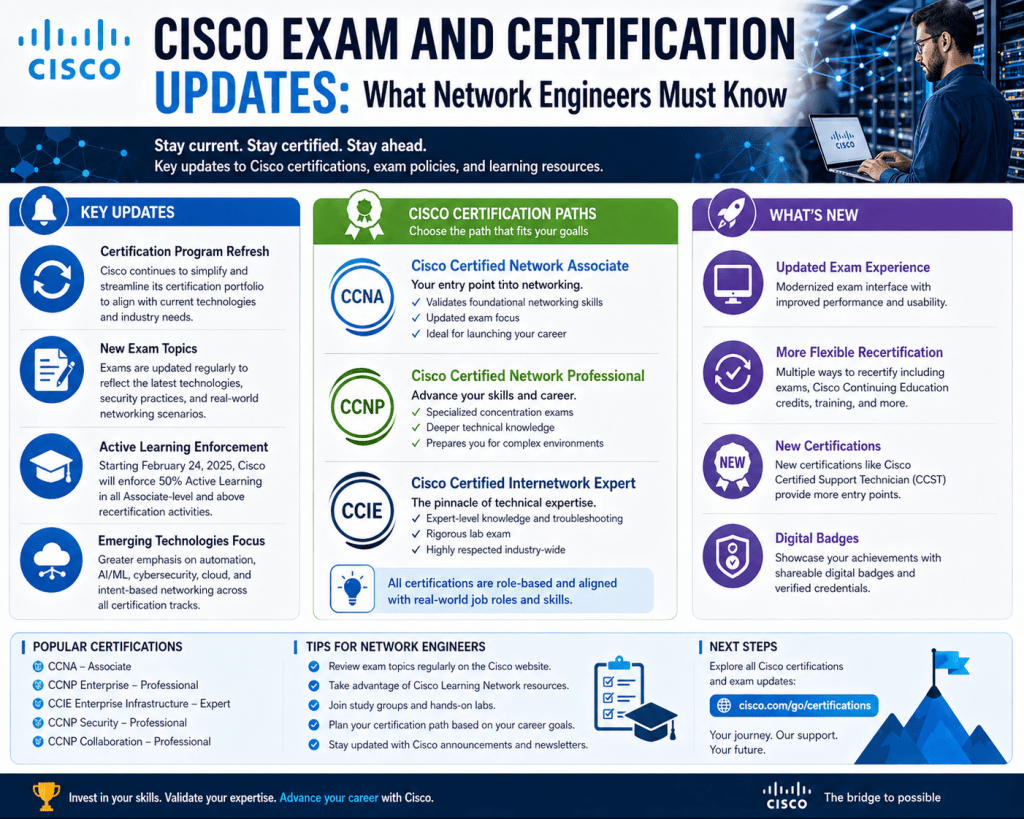
The world of information technology rarely remains static, and professional certifications are no exception. As enterprise environments evolve to accommodate new architectures, distributed systems, and intelligent automation, certification frameworks must adapt to reflect those shifts. Cisco certifications have long served as a benchmark for networking and infrastructure expertise, but recent developments signal a broader transformation that extends far beyond traditional networking.
The transition that began with updates to foundational certifications introduced new domains such as artificial intelligence, cloud-based network management, and machine learning concepts. These additions were not incremental updates but rather strategic changes designed to align certification pathways with modern enterprise requirements. Networking professionals are no longer expected to operate solely within hardware-defined environments. Instead, they must navigate hybrid infrastructures, software-defined systems, and increasingly intelligent automation layers.
This evolution reflects a deeper industry trend. Organizations are integrating predictive analytics, automated orchestration, and scalable cloud platforms into their core operations. As a result, the skill set required of network engineers now overlaps with areas that were once considered separate disciplines, including data science fundamentals, cloud engineering, and security analytics. Cisco’s certification updates represent a response to this convergence, ensuring that certified professionals remain relevant in a rapidly shifting technological landscape.
How Foundational Certification Updates Set the Stage
The restructuring of entry-level certifications laid the groundwork for more advanced changes. By incorporating topics such as artificial intelligence awareness and cloud networking fundamentals, Cisco established a baseline expectation for all candidates entering the certification ecosystem. These updates ensured that even those at the beginning of their careers would develop an understanding of how modern systems operate in interconnected and automated environments.
This foundational shift is particularly significant because it redefines what “entry-level” means in networking. Previously, the focus was heavily centered on routing protocols, switching mechanisms, and basic troubleshooting. While these remain essential, they are now complemented by knowledge of automation tools, cloud service models, and intelligent systems that influence network behavior.
The introduction of machine learning concepts at the foundational level also signals a long-term vision. Rather than treating artificial intelligence as a niche specialization, it is being positioned as a core competency. This approach prepares learners for advanced certifications where these topics are explored in greater depth, particularly in areas such as data center design and security operations.
Transformation of the CCNP Certification Track
The professional-level certification tier has undergone one of the most significant transformations. These updates reflect the increasing complexity of enterprise networks and the growing importance of specialized knowledge within broader domains. The restructuring of this certification tier introduces refined focus areas, updated exam objectives, and a stronger emphasis on real-world applications.
One of the defining characteristics of the updated structure is the modular approach to certification. Candidates are required to pass a core exam that validates broad knowledge within a domain, followed by a concentration exam that allows for specialization. This design enables professionals to tailor their certification paths based on their career goals while maintaining a strong foundational understanding.
The modular system also aligns with industry demands for specialization. Modern IT environments often require deep expertise in specific areas such as automation, security, or cloud integration. By allowing candidates to choose concentration exams, the certification framework supports the development of targeted skill sets that are directly applicable to job roles.
Advancements in the Data Center Certification Path
The data center certification track has been significantly updated to reflect the realities of modern infrastructure. Traditional data center environments, which were once dominated by physical servers and static configurations, have evolved into dynamic ecosystems that support virtualization, containerization, and high-performance workloads.
One of the most notable changes is the integration of artificial intelligence and machine learning concepts into the exam objectives. These topics are not treated as theoretical concepts but are embedded within practical scenarios that reflect real-world applications. For example, candidates are expected to understand how AI-driven workloads influence network design and resource allocation within a data center.
Another important update involves the consolidation of exam content. Certain legacy exams have been retired, with their topics integrated into revised versions of existing exams. This approach streamlines the certification process while ensuring that candidates are tested on the most relevant and up-to-date technologies. It also reduces redundancy, allowing learners to focus on acquiring comprehensive knowledge rather than navigating overlapping content.
The emphasis on high-performance networking is another critical aspect of the updated data center track. As organizations deploy applications that require low latency and high throughput, network engineers must design infrastructures capable of meeting these demands. The updated certification objectives reflect this requirement by incorporating advanced networking concepts and performance optimization techniques.
The Growing Role of Automation in Data Center Environments
Automation has become a central theme across all certification updates, particularly within the data center track. Modern infrastructures rely heavily on automated processes to manage resources, deploy applications, and maintain operational efficiency. As a result, professionals must be proficient in automation tools and programming concepts.
The inclusion of automation-focused exams within the certification track highlights this shift. Candidates are expected to demonstrate an understanding of how to automate network configurations, integrate orchestration platforms, and develop scripts that streamline operations. These skills are essential for managing large-scale environments where manual intervention is no longer practical.
Automation also plays a critical role in supporting artificial intelligence workloads. By automating routine tasks, organizations can allocate resources more efficiently and ensure that systems operate at optimal performance levels. This integration of automation and AI represents a key trend that is reflected throughout the updated certification framework.
Expanding Scope of Design and Troubleshooting Skills
In addition to technical knowledge, the updated certifications place a strong emphasis on design and troubleshooting capabilities. Network professionals are expected to go beyond implementation and demonstrate the ability to design scalable, resilient infrastructures. This requires a deep understanding of system architecture, performance considerations, and potential failure points.
The updated exam objectives include scenarios that test a candidate’s ability to analyze complex environments and develop effective solutions. These scenarios often involve multiple variables, such as resource constraints, security requirements, and performance goals. By focusing on real-world challenges, the certification framework ensures that candidates are prepared to handle the complexities of modern IT environments.
Troubleshooting skills have also been expanded to include advanced diagnostic techniques and tools. As networks become more complex, identifying and resolving issues requires a systematic approach that leverages both traditional methods and modern analytics. The updated certifications reflect this need by incorporating scenarios that require candidates to interpret data, identify root causes, and implement corrective actions.
Integration of Cloud Concepts into Professional Certifications
Cloud computing has become a fundamental component of modern IT infrastructure, and its influence is evident throughout the updated certification paths. The integration of cloud concepts into professional-level certifications reflects the growing importance of hybrid and multi-cloud environments.
Candidates are expected to understand how cloud services interact with on-premises infrastructure, as well as how to design networks that support seamless integration. This includes knowledge of cloud architectures, service models, and deployment strategies. By incorporating these topics into the certification framework, Cisco ensures that professionals are equipped to manage environments that span multiple platforms.
The emphasis on cloud orchestration is particularly noteworthy. As organizations adopt cloud-based solutions, the ability to automate and manage resources across different environments becomes critical. The updated certifications address this need by including topics related to orchestration tools and processes, enabling candidates to develop skills that are directly applicable to modern IT operations.
The Shift Toward AI-Driven Networking
Artificial intelligence is no longer a peripheral concept in networking. It is becoming an integral part of how networks are designed, managed, and optimized. The updated certification framework reflects this shift by incorporating AI-related topics across multiple domains.
Candidates are introduced to concepts such as machine learning models, data analysis, and predictive analytics. These topics are presented in the context of networking, highlighting how AI can be used to improve performance, enhance security, and streamline operations. By integrating these concepts into the certification process, Cisco is preparing professionals for a future where intelligent systems play a central role in network management.
The inclusion of AI also reflects broader industry trends. Organizations are increasingly leveraging data-driven insights to make informed decisions and optimize their operations. Network engineers who understand these concepts are better positioned to contribute to strategic initiatives and drive innovation within their organizations.
Evolving Expectations for Network Professionals
The changes to Cisco certifications highlight a broader shift in expectations for network professionals. The role of a network engineer is no longer limited to configuring devices and maintaining connectivity. Instead, it encompasses a wide range of responsibilities that include automation, security, cloud integration, and data analysis.
This evolution requires a continuous learning mindset. Professionals must stay updated on emerging technologies and adapt their skills to meet changing demands. Certifications play a critical role in this process by providing a structured framework for learning and validation.
The updated certification paths are designed to support this ongoing development. By incorporating new topics and refining existing ones, they ensure that candidates acquire skills that are relevant to current and future industry needs. This approach not only benefits individual professionals but also helps organizations build teams that are capable of navigating complex technological landscapes.
The Expansion of Cisco Security Certifications in a Threat-Driven Era
The cybersecurity landscape has become increasingly complex as organizations expand their digital footprints across hybrid, cloud, and edge environments. This expansion has forced security frameworks to evolve rapidly in response to more sophisticated attack vectors, automated threat systems, and adversaries leveraging artificial intelligence. Within this context, Cisco’s security certification ecosystem has undergone significant restructuring to align with modern defensive requirements.
Security certifications are no longer focused solely on perimeter defense or isolated network protection. Instead, they emphasize a holistic approach that integrates identity management, endpoint security, cloud protection, and automated threat response. This shift reflects the reality that modern infrastructures no longer have a single perimeter. Every device, application, and user interaction represents a potential entry point that must be continuously monitored and secured.
The updated certification structure emphasizes layered defense strategies, also known as defense-in-depth, where multiple overlapping security controls work together to mitigate risk. Candidates are expected to understand not only individual technologies but also how they interact within broader security architectures. This systems-level thinking is essential in environments where threats can propagate across multiple domains in seconds.
Redefining Professional Security Expertise Through CCNP Security Updates
The professional security certification track has been redesigned to reflect the evolving nature of enterprise defense strategies. Instead of focusing on isolated technical competencies, the updated structure emphasizes integrated security operations that span network infrastructure, cloud environments, and endpoint ecosystems.
At the core of this certification track is a foundational exam that evaluates a candidate’s understanding of core security technologies. This includes topics such as secure access control, threat mitigation strategies, encryption methods, and security architecture principles. However, this foundational layer is only the beginning of the certification journey.
Candidates are required to select a specialization exam that aligns with their professional focus. These specialization areas cover a wide range of security domains, including firewall configuration, identity services, secure web access, and automation-driven security operations. This modular approach ensures that professionals can develop deep expertise in specific areas while maintaining a strong foundational understanding of enterprise security principles.
The restructuring of these exams reflects a broader industry shift toward specialization. Security roles are becoming increasingly segmented, with dedicated teams focusing on cloud security, threat intelligence, and incident response. The certification framework mirrors this segmentation, allowing professionals to align their credentials with specific career paths.
Integration of Automation and Artificial Intelligence in Security Operations
One of the most significant changes in the security certification landscape is the integration of automation and artificial intelligence concepts. Modern security operations centers rely heavily on automated systems to detect, analyze, and respond to threats in real time. This reduces response times and allows human analysts to focus on more complex investigations.
Automation within security environments involves the use of scripts, orchestration tools, and machine learning models to streamline repetitive tasks. These tasks include log analysis, alert correlation, and incident response workflows. By automating these processes, organizations can significantly improve their ability to respond to threats at scale.
Artificial intelligence further enhances these capabilities by enabling predictive analysis and behavioral detection. Instead of relying solely on predefined rules, AI-driven systems can identify anomalies based on patterns and historical data. This allows for more proactive threat detection and reduces the likelihood of false positives.
The updated certification framework incorporates these concepts into both foundational and advanced levels. Candidates are expected to understand how automation and AI integrate with traditional security tools and how they contribute to overall security posture improvements.
Expansion of Security Specialization Domains
The security certification track now includes a broader range of specialization domains, each designed to address specific areas of enterprise security. These domains reflect the complexity of modern IT environments and the need for highly specialized expertise.
Firewall security remains a core specialization, focusing on advanced configuration, policy management, and threat prevention techniques. However, this area has expanded to include next-generation firewall capabilities, such as application-layer inspection and cloud-based security enforcement.
Identity services have also become a critical focus area. As organizations adopt zero trust architectures, identity verification has become the primary security boundary. Professionals must understand authentication protocols, identity lifecycle management, and access control mechanisms across distributed systems.
Secure web and email communications represent another important domain. These areas focus on protecting users from phishing attacks, malware distribution, and malicious web traffic. The increasing sophistication of these threats has made web and email security essential components of enterprise defense strategies.
Automation-focused security operations have also emerged as a distinct specialization. This area emphasizes the use of programmable interfaces, scripting languages, and orchestration platforms to manage security infrastructure. Professionals in this domain are expected to design and implement automated workflows that enhance efficiency and reduce operational overhead.
The Rise of Offensive Security Learning Pathways
In addition to defensive certifications, new learning pathways have been introduced to provide exposure to offensive security concepts. These programs focus on ethical hacking techniques, vulnerability assessment, and penetration testing methodologies. Unlike traditional certifications, these pathways are often structured as hands-on learning experiences rather than exam-based credentials.
Participants engage in simulated environments where they are tasked with identifying and exploiting vulnerabilities within controlled systems. This approach provides practical experience in understanding how attackers operate and how security systems can be bypassed. By gaining insight into offensive techniques, security professionals are better equipped to defend against real-world threats.
These learning pathways emphasize experiential learning through scenario-based challenges. Participants may encounter simulated networks, applications, and infrastructure components that require analysis and exploitation. This hands-on approach helps bridge the gap between theoretical knowledge and practical application.
While these programs do not replace formal certifications, they serve as valuable complementary learning tools. They are particularly useful for professionals transitioning into security roles or those seeking to deepen their understanding of adversarial techniques.
Emergence of Skill-Based Credentials and Micro-Learning Badges
Alongside traditional certifications, new skill-based credentials have been introduced to support continuous learning. These credentials are often structured as digital badges that represent mastery of specific technical domains.
Unlike full certifications, which require comprehensive examinations, these badges are awarded upon completion of focused learning modules. These modules typically include interactive labs, scenario-based exercises, and knowledge assessments. The goal is to provide targeted learning experiences that address specific skill gaps.
One of the key advantages of this approach is flexibility. Professionals can acquire new skills incrementally without committing to full certification pathways. This allows for more adaptive learning, particularly in fast-changing technological environments.
Skill-based badges also serve as indicators of emerging expertise. As organizations increasingly adopt new technologies, there is a growing demand for professionals who can quickly adapt and demonstrate competency in specific areas. These credentials provide a mechanism for validating those capabilities.
Advanced Design Specializations in Enterprise Architectures
Design-focused certifications have become increasingly important as enterprise environments grow in complexity. These certifications emphasize the ability to create scalable, resilient, and secure architectures that support modern workloads.
Design professionals are expected to consider a wide range of factors when developing infrastructure solutions. These include performance requirements, security constraints, scalability needs, and integration challenges. The goal is to create systems that not only meet current demands but are also capable of adapting to future changes.
Advanced design certifications also incorporate elements of cross-domain integration. This includes the ability to design systems that span multiple environments, such as on-premises data centers, cloud platforms, and edge computing nodes. Professionals must understand how these environments interact and how to ensure seamless connectivity and security across them.
The inclusion of artificial intelligence considerations in design certifications further expands their scope. Architects are now expected to design infrastructures that support AI workloads, including data processing pipelines, model training environments, and inference systems.
Cloud-Centric Evolution of Collaboration Technologies
Collaboration technologies have undergone a significant transformation as organizations shift toward cloud-based communication platforms. Traditional on-premises systems are being replaced or augmented by hybrid and cloud-native solutions that support distributed workforces.
This transition has led to updates in collaboration-focused certifications, with an emphasis on cloud integration, user experience optimization, and hybrid deployment models. Professionals are now expected to manage systems that support real-time communication across geographically dispersed teams.
The focus on user experience has become particularly important. Collaboration systems are no longer evaluated solely on technical performance but also on usability, reliability, and accessibility. This shift reflects the growing importance of seamless communication in modern organizations.
Hybrid environments present additional challenges, as they require integration between legacy systems and modern cloud platforms. Professionals must understand how to design and manage these environments to ensure consistent performance and security across all communication channels.
Rebranding and Structural Alignment of Cybersecurity Certifications
Cybersecurity certifications have undergone a structural rebranding to align with broader certification hierarchies. This reorganization is designed to create a more intuitive progression path for learners and employers alike.
The updated structure categorizes certifications into clearly defined levels, making it easier to understand the relationship between foundational, professional, and advanced credentials. This hierarchical approach simplifies career planning and helps individuals identify appropriate learning pathways.
Despite the rebranding, the core technical content of these certifications remains focused on modern security challenges. Topics such as zero trust architecture, AI-driven threat detection, and automated incident response continue to play a central role in the curriculum.
The restructuring also reflects the increasing importance of cybersecurity across all areas of IT. Rather than being treated as a separate discipline, security is now integrated into networking, cloud computing, and automation domains.
Automation as a Core Pillar of Modern Networking Careers
Automation has become one of the most important skill areas in modern networking and infrastructure management. As networks grow in size and complexity, manual configuration and management are no longer sustainable approaches.
Automation allows organizations to standardize configurations, reduce human error, and improve operational efficiency. It also enables rapid scaling of infrastructure to meet changing business demands. These benefits have made automation a core competency for network professionals.
Certification updates reflect this shift by incorporating automation concepts across multiple domains. Professionals are expected to understand scripting, orchestration, and programmable network interfaces. These skills are essential for managing modern environments that rely heavily on dynamic configuration and real-time adjustments.
The integration of automation into certification pathways also reflects the convergence of networking and software development. Network engineers are increasingly required to think like developers, using code-based approaches to manage infrastructure.
The Shift Toward Expert-Level Specialization in Cisco Certification Pathways
The highest tier of Cisco certifications represents a significant shift in how advanced technical expertise is defined and validated. At this level, certifications are no longer focused on foundational knowledge or even professional-level implementation skills. Instead, they emphasize architectural thinking, large-scale system design, and the ability to solve complex, multi-domain infrastructure challenges.
Expert-level certifications are structured to simulate real-world enterprise scenarios where multiple technologies converge. These environments often involve large-scale routing and switching infrastructures, cloud integrations, security overlays, and automation frameworks operating simultaneously. Candidates at this level are expected to demonstrate not only technical proficiency but also strategic decision-making capabilities.
A defining characteristic of this tier is the emphasis on problem-solving under constraints. These constraints may include limited resources, conflicting business requirements, or rapidly evolving system conditions. The ability to navigate such complexity is what distinguishes expert-level professionals from those at earlier stages of certification.
Redesign of Expert Infrastructure and Automation Domains
One of the most significant developments in the expert certification landscape is the increasing focus on infrastructure automation. Traditional expert-level roles were heavily centered on manual design and configuration of large-scale networks. However, modern enterprise environments demand automation-first architectures where infrastructure is defined, deployed, and managed through programmable systems.
Automation at this level goes beyond basic scripting. It involves designing full lifecycle management systems that can provision, monitor, and adjust infrastructure dynamically. This includes integration with APIs, orchestration platforms, and event-driven systems that respond to changes in real time.
Expert candidates are expected to understand how automation frameworks interact with underlying network architectures. This includes knowledge of data models, configuration templates, and policy-driven management systems. The goal is to create environments that are not only scalable but also self-optimizing and resilient.
Artificial intelligence also plays a growing role in expert-level automation. Predictive analytics are used to forecast network behavior, identify potential failures, and optimize resource allocation. Professionals must understand how these systems interpret data and how to align automation strategies with AI-driven insights.
Transformation of Enterprise Collaboration Architectures
Collaboration systems at the enterprise level have undergone a major transformation driven by cloud adoption and distributed workforce models. Traditional voice and video systems have evolved into integrated communication platforms that span multiple devices, locations, and network environments.
Expert-level certifications in this domain now emphasize hybrid collaboration architectures. These architectures combine on-premises infrastructure with cloud-based services, creating a unified communication experience across different environments. Professionals must understand how to design systems that maintain performance, reliability, and security across these hybrid models.
A critical aspect of modern collaboration design is user experience optimization. Systems must be designed not only for technical efficiency but also for usability and accessibility. This includes minimizing latency, ensuring consistent audio and video quality, and enabling seamless transitions between devices and platforms.
Another important consideration is scalability. Modern collaboration systems must support large-scale deployments that can accommodate thousands or even millions of users simultaneously. This requires careful planning of bandwidth allocation, load balancing, and failover mechanisms.
Reclassification of Cybersecurity Career Progression Models
Cybersecurity career pathways have been restructured to reflect the increasing complexity and integration of security across all IT domains. Instead of being treated as an isolated specialization, cybersecurity is now embedded within networking, cloud computing, and automation disciplines.
At the foundational level, professionals are expected to understand basic security principles such as authentication, encryption, and access control. However, as they progress to higher certification levels, the focus shifts toward integrated security architecture design and threat intelligence analysis.
One of the key changes in this restructuring is the emphasis on continuous threat adaptation. Cybersecurity is no longer a static discipline where fixed defenses are sufficient. Instead, professionals must design systems that can adapt dynamically to emerging threats.
This includes the use of behavioral analytics, anomaly detection systems, and automated response mechanisms. These technologies allow security systems to identify and respond to threats in real time without requiring manual intervention.
The reclassification also introduces clearer progression pathways. Professionals can now move from foundational security knowledge to advanced operational roles and eventually into architectural and strategic positions within enterprise security teams.
Advanced Threat Intelligence and Defensive Architecture Design
Threat intelligence has become a central component of modern cybersecurity strategies. Rather than reacting to incidents after they occur, organizations are increasingly focused on predicting and preventing attacks before they materialize.
Advanced threat intelligence involves the collection, analysis, and interpretation of data from multiple sources. This data may include network logs, user behavior patterns, external threat feeds, and historical incident data. By analyzing these inputs, security systems can identify patterns that indicate potential threats.
Defensive architecture design incorporates these insights into the structure of the network itself. This includes segmenting networks to limit lateral movement, implementing zero trust principles, and deploying adaptive security controls that respond to changing conditions.
Professionals at this level are expected to design systems that are resilient to both known and unknown threats. This requires a deep understanding of attack vectors, system vulnerabilities, and defensive countermeasures.
Integration of Zero Trust Principles Across Certification Domains
Zero trust architecture has become a foundational principle in modern security design. Unlike traditional models that assume trust within internal networks, zero trust operates on the principle that no entity should be trusted by default, regardless of its location.
This approach requires continuous verification of user identities, device integrity, and access permissions. Every request for access is evaluated based on multiple contextual factors, including user behavior, device posture, and network conditions.
Certification frameworks now incorporate zero trust principles across multiple domains. This includes network design, identity management, and application security. Professionals must understand how to implement zero trust models in both cloud and on-premises environments.
The implementation of zero trust also requires advanced policy management systems. These systems define granular access controls that determine how users and devices interact with resources. Automation plays a key role in enforcing these policies consistently across large-scale environments.
Expansion of Cloud-Native Infrastructure Expertise
Cloud-native technologies have become a dominant force in modern IT infrastructure design. These technologies emphasize scalability, flexibility, and resilience through the use of containerization, microservices, and distributed computing models.
Expert-level certifications now require a deep understanding of cloud-native architectures. This includes knowledge of container orchestration platforms, service mesh architectures, and distributed storage systems.
Professionals must also understand how to design applications that can operate efficiently in cloud-native environments. This involves breaking down monolithic applications into smaller, independent components that can be deployed and scaled independently.
Security in cloud-native environments introduces additional complexity. Traditional perimeter-based security models are no longer sufficient, requiring the implementation of identity-based access controls and micro-segmentation strategies.
Role of Data-Driven Decision Making in Network Engineering
Data has become a critical asset in modern network engineering. The ability to collect, analyze, and act on data is essential for optimizing network performance and ensuring system reliability.
Advanced certifications emphasize the use of telemetry data to monitor network health and performance. This data is used to identify bottlenecks, predict failures, and optimize resource allocation.
Machine learning models are increasingly used to analyze this data and generate actionable insights. These models can detect anomalies, forecast traffic patterns, and recommend configuration changes.
Network engineers must understand how to interpret these insights and integrate them into operational decision-making processes. This requires a combination of technical expertise and analytical thinking.
Long-Term Evolution of Network Automation Ecosystems
Network automation is evolving into a fully integrated ecosystem that spans infrastructure provisioning, configuration management, and performance optimization. This ecosystem is driven by a combination of programmable interfaces, orchestration tools, and intelligent analytics systems.
At the expert level, professionals are expected to design automation frameworks that operate across multiple domains. This includes integrating network devices, cloud services, and security systems into a unified automation strategy.
Event-driven automation is becoming increasingly important. In this model, systems respond automatically to specific triggers, such as performance thresholds or security alerts. This enables real-time adaptation to changing conditions.
The long-term vision for network automation involves fully autonomous systems that can self-configure, self-heal, and self-optimize with minimal human intervention. While this vision is still evolving, current certification pathways are laying the groundwork for its implementation.
Convergence of Networking, Security, and Software Development
One of the most significant trends in modern IT is the convergence of networking, security, and software development. These disciplines, which were once distinct, are now deeply interconnected.
Network engineers are increasingly required to understand programming concepts, while software developers must consider network and security constraints in their designs. Security professionals must integrate their strategies into both network and application layers.
This convergence is reflected in certification structures that emphasize cross-domain knowledge. Professionals are expected to understand how different systems interact and how changes in one domain can impact others.
Infrastructure as code has become a key concept in this convergence. It allows infrastructure to be defined and managed using software development practices, enabling greater consistency and scalability.
Future-Oriented Skill Development and Continuous Adaptation
The final layer of expert-level certification evolution focuses on continuous skill development. In a rapidly changing technological environment, static knowledge quickly becomes obsolete. Professionals must engage in ongoing learning to remain effective.
Certification frameworks are increasingly designed to support this continuous development. Rather than representing a final achievement, certifications are becoming part of a broader learning ecosystem that evolves over time.
This includes updates to exam content, introduction of new specialization areas, and integration of emerging technologies. Professionals are encouraged to regularly update their skills to stay aligned with industry developments.
Conclusion
The evolution of Cisco certifications reflects a broader transformation occurring across the global information technology landscape. What was once a relatively stable framework centered on routing, switching, and infrastructure fundamentals has now become a dynamic ecosystem shaped by automation, artificial intelligence, cloud computing, and advanced cybersecurity practices. This shift is not simply an update to exam content; it represents a fundamental redefinition of what it means to be a network and security professional in modern enterprise environments.
As organizations continue to adopt distributed architectures, hybrid cloud models, and software-defined infrastructure, the expectations placed on IT professionals have expanded significantly. Certifications are now designed to measure not only technical knowledge but also adaptability, analytical thinking, and the ability to integrate multiple technologies into cohesive operational systems. This reflects the reality that modern networks are no longer isolated systems but interconnected ecosystems that must operate seamlessly across diverse environments.
One of the most important aspects of this evolution is the increasing integration of intelligence-driven technologies into core certification domains. Artificial intelligence and machine learning are no longer niche topics reserved for specialized roles. Instead, they are embedded across networking, security, and automation tracks. This integration highlights a shift toward predictive and adaptive systems where infrastructure is no longer managed reactively but proactively optimized based on data-driven insights.
In parallel, automation has become a defining pillar of modern IT operations. The move toward programmable infrastructure and infrastructure-as-code methodologies has changed how networks are designed, deployed, and maintained. Certifications now reflect this shift by emphasizing scripting, orchestration, and API-driven management. This ensures that professionals are not only capable of configuring systems manually but are also proficient in building scalable and repeatable automation frameworks that reduce operational complexity.
Security has also undergone a profound transformation within the certification ecosystem. Traditional perimeter-based models have been replaced by zero trust architectures that assume no inherent trust within or outside the network boundary. This approach requires continuous verification, granular access control, and real-time threat analysis. Certifications now emphasize these principles, ensuring that professionals understand how to build resilient systems capable of withstanding increasingly sophisticated cyber threats.
Another key dimension of this evolution is the convergence of previously separate disciplines. Networking, security, cloud computing, and software development are no longer isolated career paths. Instead, they intersect in complex ways that require professionals to develop cross-domain expertise. This convergence is reflected in certification structures that encourage learners to build a broad foundational understanding before specializing in advanced domains. It also mirrors the real-world demands of enterprise environments where multiple technologies must operate in harmony.
The shift toward cloud-centric architectures has further accelerated this convergence. As organizations migrate workloads to hybrid and multi-cloud environments, the need for professionals who understand both traditional infrastructure and cloud-native systems has increased dramatically. Certifications now incorporate cloud design principles, distributed system architecture, and workload optimization strategies. This ensures that professionals are equipped to manage environments that span on-premises data centers, public cloud platforms, and edge computing nodes.
At the same time, collaboration technologies have evolved into cloud-first communication platforms that support global, distributed workforces. The expectations for these systems go beyond basic functionality. They must deliver seamless user experiences, maintain high availability, and integrate securely with enterprise infrastructure. Certification updates in this area reflect these demands by focusing on hybrid deployment models, user experience optimization, and integration strategies that span multiple environments.
Expert-level certifications represent the highest level of this evolving ecosystem. At this stage, professionals are expected to demonstrate architectural thinking and the ability to design large-scale, resilient systems. These certifications emphasize problem-solving in complex environments where multiple constraints must be balanced simultaneously. This includes performance optimization, security enforcement, scalability planning, and automation integration. The goal is not only to validate technical expertise but also to assess strategic decision-making capabilities.
A defining characteristic of expert-level progression is the emphasis on system-wide thinking. Rather than focusing on individual technologies in isolation, professionals must understand how different components interact within a broader infrastructure ecosystem. This includes recognizing dependencies between networking layers, security controls, automation systems, and cloud services. Such holistic understanding is essential for designing infrastructures that are both efficient and resilient.
Another important trend is the growing role of data-driven decision-making in infrastructure management. Modern IT environments generate vast amounts of telemetry data that can be analyzed to improve performance, detect anomalies, and predict potential failures. Certifications increasingly incorporate these concepts, requiring professionals to understand how to interpret data and apply insights to real-world scenarios. This shift reflects the broader industry movement toward observability and proactive system management.
Skill-based learning models have also become more prominent within the certification ecosystem. Instead of relying solely on traditional exam-based validation, professionals now have access to modular learning pathways that focus on specific competencies. These pathways allow for continuous skill development and provide flexibility in how knowledge is acquired and applied. This approach aligns with the fast-paced nature of technology, where new tools and methodologies emerge frequently.
The introduction of specialized learning credentials and badges further reinforces this shift toward continuous education. These credentials allow professionals to demonstrate proficiency in targeted areas without committing to full certification tracks. This modular approach supports lifelong learning and enables individuals to adapt quickly to changing industry demands. It also provides organizations with more granular insight into the capabilities of their workforce.
As automation continues to advance, the concept of self-managing infrastructure is becoming more realistic. Future systems are expected to incorporate self-healing, self-optimizing, and self-configuring capabilities. While these concepts are still evolving, current certification pathways are laying the foundation for their implementation. Professionals are being trained to design systems that can respond dynamically to changing conditions with minimal human intervention.
The integration of software development practices into networking and infrastructure management is another significant development. Infrastructure as code has become a standard approach for managing complex environments, enabling consistency, scalability, and version control. Certifications now reflect this shift by incorporating programming concepts and development methodologies into their frameworks. This convergence is redefining the skill set required for modern IT professionals.
Looking at the broader picture, the evolution of Cisco certifications represents a microcosm of the larger transformation occurring within the technology industry. The boundaries between disciplines are dissolving, replaced by interconnected systems that require multidisciplinary expertise. Professionals are no longer expected to specialize narrowly but rather to develop adaptable skill sets that span multiple domains.
Ultimately, the certification ecosystem is evolving to reflect the realities of modern IT environments. It is no longer sufficient to understand isolated technologies. Instead, professionals must be capable of designing, implementing, and managing complex systems that integrate networking, security, automation, cloud computing, and artificial intelligence. This holistic approach ensures that certified individuals remain relevant in an industry defined by constant change.