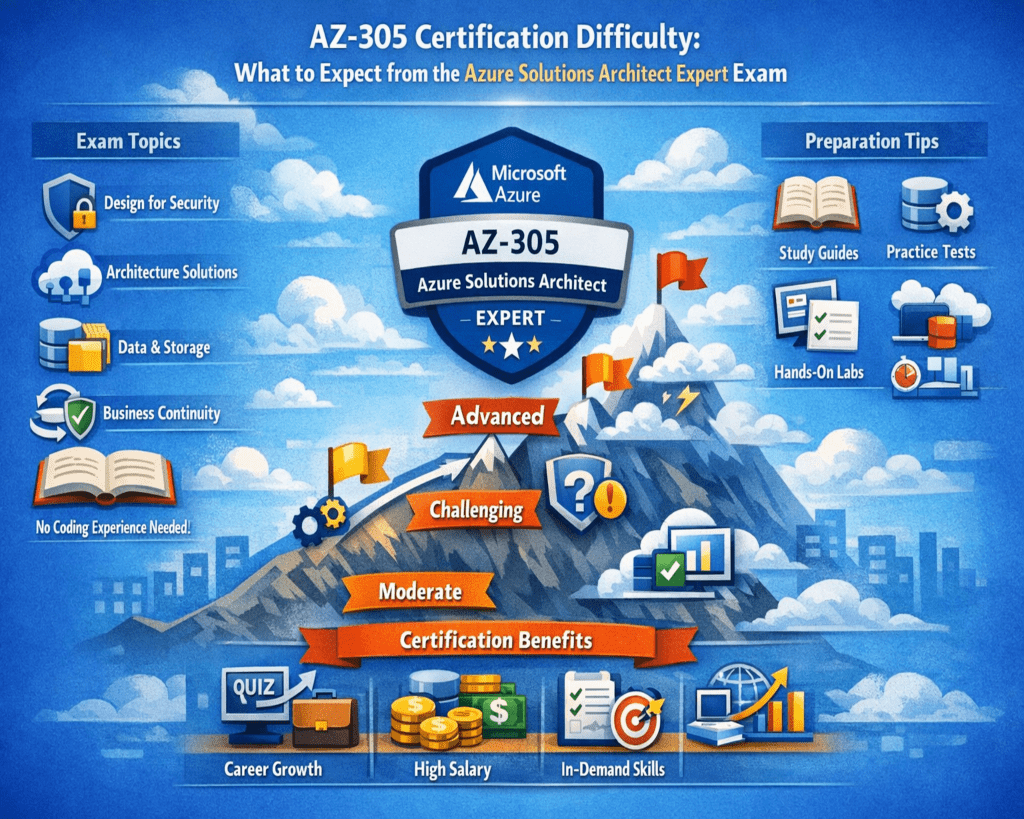
The AZ-305 exam is a high-level certification assessment designed to validate the skills required to design enterprise-grade cloud solutions on Microsoft Azure. It represents a shift from operational cloud administration toward architectural design thinking, where the focus is not on how to configure individual services but on how to combine multiple services into scalable, secure, and cost-efficient systems. This exam is widely recognized in enterprise IT environments because it demonstrates the ability to design systems that meet business, technical, and compliance requirements simultaneously. Unlike entry-level certifications that emphasize task execution, this exam evaluates strategic decision-making and solution design under complex constraints. Candidates are expected to think like cloud architects, where every decision affects performance, security posture, scalability, and long-term maintainability of systems deployed in production environments.
Role of AZ-305 in the Microsoft Azure Certification Pathway
Within the Microsoft certification ecosystem, AZ-305 represents the final step toward achieving the Azure Solutions Architect Expert credential. Before reaching this level, candidates typically progress through associate-level certifications that focus on foundational cloud operations and administration. These earlier stages help build familiarity with Azure services, including compute, storage, networking, identity management, and monitoring tools. However, AZ-305 elevates expectations significantly by requiring candidates to design complete solutions rather than implement isolated components. This transition is critical because it reflects real-world enterprise requirements where cloud professionals must integrate multiple systems into unified architectures. The certification path is intentionally structured to ensure that candidates develop a gradual understanding of Azure before attempting advanced architectural challenges. This ensures that individuals reaching the AZ-305 level have already developed a baseline technical competency.
Architectural Thinking Required for AZ-305 Success
Success in the AZ-305 exam depends heavily on the ability to think in architectural terms rather than focusing on individual services. Architectural thinking involves understanding how different components interact within a system and how design decisions impact overall performance and resilience. Candidates must be able to evaluate trade-offs between different architectural approaches, such as choosing between different types of storage solutions, networking configurations, or identity models. Each decision must be evaluated in the context of business requirements, technical constraints, and operational complexity. For example, a solution optimized for cost efficiency may not provide the same level of performance or redundancy as a more expensive alternative. The exam evaluates whether candidates can identify the most appropriate balance based on scenario requirements. This level of reasoning requires both theoretical knowledge and practical exposure to real-world cloud environments.
Core Skill Areas Evaluated in the AZ-305 Exam
The AZ-305 exam covers several interconnected domains that collectively define cloud architecture design competence. One of the most important areas is identity and access management design, where candidates must demonstrate the ability to implement secure authentication and authorization strategies. This includes understanding role-based access control, identity federation, and secure access to cloud resources across distributed environments. Another critical domain is data storage architecture, which involves selecting appropriate storage solutions based on performance, scalability, and data structure requirements. Candidates must also understand how to design networking architectures that support hybrid connectivity, secure communication, and high availability across regions. In addition, the exam evaluates monitoring and governance design, requiring candidates to ensure visibility, compliance, and control over deployed resources. Application architecture design is another major area, focusing on how applications are structured, deployed, and scaled in cloud environments. These domains are not tested in isolation but are combined in scenario-based questions that require integrated decision-making.
Complexity of Scenario-Based Questioning in AZ-305
One of the defining characteristics of the AZ-305 exam is its use of scenario-based questions that simulate real-world architectural challenges. These scenarios present candidates with detailed business requirements and technical constraints that must be translated into cloud architecture designs. Unlike traditional multiple-choice exams that test factual knowledge, AZ-305 requires analytical reasoning and problem-solving skills. Candidates must carefully evaluate each requirement and determine which Azure services and design patterns best meet the needs of the scenario. Often, there are multiple technically correct answers, but only one solution aligns best with all constraints, including cost, scalability, and security. This makes the exam particularly challenging because it tests judgment rather than memorization. The complexity of these scenarios reflects real enterprise environments where cloud architects must make decisions without clear-cut answers.
Importance of Practical Experience in Azure Environments
Practical experience plays a significant role in determining success in the AZ-305 exam. Candidates who have worked with Azure services in real-world environments tend to perform better because they understand how services behave under production conditions. This experience allows them to interpret scenarios more effectively and evaluate trade-offs based on actual operational constraints. For example, understanding how network latency impacts application performance or how storage redundancy affects cost and reliability can only be fully appreciated through hands-on experience. Similarly, familiarity with identity management systems and security policies helps candidates design more secure architectures. While theoretical study can provide foundational knowledge, it is often insufficient for mastering the level of complexity required in the exam. Practical exposure bridges the gap between knowledge and application, enabling candidates to approach scenario-based questions with greater confidence and accuracy.
Breadth of Knowledge Required for AZ-305 Preparation
The AZ-305 exam requires a broad understanding of multiple Azure service categories, making preparation more complex than many other certifications. Candidates must be familiar with compute services, storage options, networking configurations, identity management systems, monitoring tools, and governance frameworks. Each of these areas contains multiple subcomponents, each with its own configuration options and use cases. The challenge lies not only in understanding each service individually but also in understanding how they interact within integrated architectures. For example, selecting a particular compute service may influence networking requirements, which in turn affects security design. Similarly, storage choices can impact application performance and scalability. This interconnected nature of cloud architecture requires candidates to develop a holistic understanding of the Azure ecosystem rather than focusing on isolated components.
Cognitive Load and Decision-Making Pressure in the Exam
The AZ-305 exam places a significant cognitive load on candidates due to the complexity and length of scenario-based questions. Each question often contains multiple paragraphs of business requirements, technical constraints, and operational considerations. Candidates must process this information quickly while identifying key requirements that influence architectural decisions. This requires strong analytical skills and the ability to filter relevant information from large amounts of data. In addition, candidates must compare multiple solution options and evaluate their trade-offs under time pressure. The decision-making process involves balancing competing priorities such as cost optimization, performance efficiency, security requirements, and operational simplicity. This multi-dimensional evaluation increases the difficulty of the exam and requires candidates to develop structured problem-solving approaches.
Enterprise-Level Expectations of Azure Solutions Architects
The AZ-305 exam reflects the expectations placed on cloud architects in enterprise environments. Organizations rely on solutions architects to design systems that support business continuity, scalability, and digital transformation initiatives. This requires not only technical expertise but also the ability to understand business requirements and translate them into technical solutions. Architects must collaborate with stakeholders, including developers, administrators, and business leaders, to ensure that proposed solutions align with organizational goals. They must also anticipate future growth and design systems that can scale efficiently without requiring complete redesigns. The exam evaluates these capabilities by presenting scenarios that require both technical and strategic thinking, reflecting real-world responsibilities of cloud architects.
Evolution of Cloud Architecture Roles in Modern IT Environments
The role of cloud architects has evolved significantly as organizations have transitioned from traditional infrastructure to cloud-based systems. In earlier stages of cloud adoption, professionals primarily focused on migrating existing workloads to cloud platforms. However, as cloud technologies have matured, the focus has shifted toward designing cloud-native applications and scalable architectures. This evolution has increased the demand for professionals who can design complex systems that integrate multiple services and support dynamic workloads. The AZ-305 exam reflects this evolution by emphasizing design thinking and architectural decision-making rather than operational tasks. Cloud architects are now expected to play a strategic role in technology planning, ensuring that systems are not only functional but also optimized for long-term business success.
Conceptual Challenges in Cloud System Design
Cloud system design introduces several conceptual challenges that contribute to the difficulty of the AZ-305 exam. One of the primary challenges is understanding how different architectural components interact within distributed systems. For example, changes in networking design can impact application performance, while storage decisions can affect data availability and access speed. Another challenge is designing for scalability and resilience, which requires anticipating future growth and potential system failures. Candidates must also consider security at every layer of the architecture, ensuring that systems are protected against unauthorized access and data breaches. These challenges require a deep understanding of system design principles and the ability to apply them in cloud environments.
Strategic Importance of Azure Architecture Skills in Industry
Azure architecture skills have become increasingly important in modern IT environments due to the widespread adoption of cloud technologies. Organizations across industries rely on cloud platforms to support critical business operations, making cloud architects essential for ensuring system reliability and efficiency. The ability to design scalable and secure cloud solutions directly impacts organizational performance and competitiveness. As a result, professionals with Azure architecture expertise are often involved in high-level decision-making processes that influence technology strategy. The AZ-305 certification serves as a validation of these skills, demonstrating that individuals possess the knowledge required to design enterprise-grade cloud solutions.
Increasing Depth of Architectural Responsibility in AZ-305 Exam Scope
The AZ-305 exam increases in complexity because it expects candidates to operate at a level where they are no longer making isolated technical decisions, but instead designing entire cloud ecosystems. At this stage, the focus shifts from understanding individual Azure services to understanding how those services behave when combined into enterprise-scale architectures. The exam evaluates whether candidates can reason through interconnected systems where changes in one component influence multiple others. This reflects real-world cloud environments where architecture decisions must account for scalability, availability, security, governance, and operational sustainability at the same time. The difficulty arises from the fact that there is rarely a single “correct” answer; instead, candidates must evaluate multiple valid options and determine which one best satisfies a set of competing requirements. This requires a structured decision-making process and a strong understanding of cloud design principles.
Integration of Multiple Azure Service Domains in Exam Scenarios
A defining feature of the AZ-305 exam is the integration of multiple Azure service domains within a single scenario. Unlike earlier certifications that may focus on one service area at a time, this exam requires candidates to combine identity, networking, storage, monitoring, and application design into unified solutions. For example, a single scenario may require designing a secure application architecture that spans multiple regions, integrates with on-premises systems, and supports dynamic scaling based on demand. To solve such scenarios, candidates must understand how identity services interact with network security configurations, how storage choices affect application performance, and how monitoring systems provide visibility across distributed components. This level of integration significantly increases cognitive complexity because each decision must be evaluated in terms of its impact on the entire architecture rather than a single component.
Business Requirement Translation as a Core Skill Area
One of the most challenging aspects of the AZ-305 exam is the requirement to translate business needs into technical architectures. Scenarios are often presented in business language rather than technical specifications, requiring candidates to interpret abstract requirements such as scalability, cost efficiency, compliance, and user experience. These requirements must then be mapped to specific Azure services and architectural patterns. This translation process is not straightforward because business requirements are often broad or ambiguous. Candidates must infer technical implications from these requirements and design solutions that align with both current and future organizational needs. This skill is critical in real-world cloud architecture roles, where architects frequently act as intermediaries between business stakeholders and technical teams. The exam evaluates this ability by presenting scenarios that require interpretation rather than direct technical implementation.
Complex Trade-Off Analysis in Cloud Architecture Design
Trade-off analysis is a central component of the AZ-305 exam and significantly contributes to its difficulty level. Every architectural decision involves balancing competing factors such as cost, performance, security, scalability, and maintainability. For example, a highly redundant architecture may improve availability but increase operational costs. Similarly, a low-cost solution may not meet performance or security requirements. Candidates must evaluate these trade-offs in the context of scenario constraints and select the most appropriate solution. This requires not only technical knowledge but also strategic thinking. The exam is designed to test whether candidates can prioritize requirements effectively and make decisions that align with organizational goals. This level of analysis is often what distinguishes experienced cloud professionals from those with only theoretical knowledge.
Hybrid Cloud Architecture Complexity in AZ-305 Exam Design
Hybrid cloud architecture is a significant focus area within the AZ-305 exam and introduces additional complexity. Many real-world organizations operate in hybrid environments where on-premises infrastructure is integrated with cloud services. Designing solutions for such environments requires understanding connectivity options, identity synchronization, and data integration strategies. Candidates must be able to design secure and reliable communication between cloud and on-premises systems while maintaining performance and compliance standards. This often involves configuring VPNs, express connectivity solutions, or hybrid identity models. The complexity increases because hybrid environments introduce additional variables such as legacy systems, network latency, and security boundaries. The exam tests whether candidates can design architectures that seamlessly integrate both environments without compromising system integrity.
Security-Centric Architecture Requirements in Enterprise Scenarios
Security is a foundational element of the AZ-305 exam and is embedded into nearly every scenario. Candidates are expected to design architectures that enforce strong identity controls, data protection mechanisms, and secure communication channels. This includes implementing role-based access control, managing privileged identities, and ensuring secure data storage and transmission. Security design also extends to network architecture, where candidates must ensure that resources are protected from unauthorized access through segmentation and firewall configurations. The exam evaluates whether candidates can integrate security principles into every layer of an architecture rather than treating it as a separate component. This reflects real-world expectations where security is a core design principle rather than an afterthought. The difficulty arises from the need to balance security with usability, performance, and cost constraints.
Scalability and Performance Engineering in Cloud Design
Scalability and performance are critical considerations in AZ-305 exam scenarios, particularly for applications expected to handle variable workloads. Candidates must design systems that can scale horizontally or vertically based on demand while maintaining consistent performance levels. This involves selecting appropriate compute resources, configuring load balancing strategies, and optimizing data storage access patterns. Performance engineering also includes designing for low latency, high throughput, and efficient resource utilization. The challenge lies in anticipating future growth and ensuring that architectures can adapt without requiring significant redesign. Candidates must also consider how different services interact under load conditions and how bottlenecks can be identified and mitigated. This requires a deep understanding of system behavior under varying workloads.
Data Architecture Design Complexity Across Multiple Models
Data architecture is one of the most technically demanding areas of the AZ-305 exam. Candidates must understand the differences between relational, non-relational, structured, and unstructured data models and how each fits into different architectural scenarios. Selecting the appropriate storage solution requires evaluating factors such as data consistency, access patterns, scalability, and cost. In addition, candidates must design solutions for data redundancy, replication, and backup strategies to ensure data durability and availability. Many scenarios also require integration of multiple data storage types within a single architecture. This increases complexity because data flows must be carefully designed to ensure consistency and efficiency across distributed systems. The exam evaluates whether candidates can make informed decisions about data placement and access strategies in complex environments.
Monitoring, Governance, and Operational Visibility Requirements
Another key area in the AZ-305 exam is the design of monitoring and governance frameworks that provide operational visibility across cloud environments. Candidates must design solutions that allow organizations to track resource usage, monitor performance metrics, and enforce compliance policies. This includes implementing centralized logging, alerting systems, and automated governance controls. The challenge lies in designing monitoring systems that scale with the architecture and provide meaningful insights without generating excessive noise. Governance design also involves ensuring that resources are deployed consistently and comply with organizational standards. This requires an understanding of policy enforcement mechanisms and resource organization strategies. The exam evaluates whether candidates can design systems that maintain operational control while supporting flexibility and scalability.
Application Architecture Design Challenges in Distributed Systems
Application architecture design in the AZ-305 exam involves creating scalable and resilient application structures that operate efficiently in cloud environments. Candidates must understand how applications are deployed across multiple regions, how they handle failover scenarios, and how they scale based on demand. This often involves designing microservices-based architectures or distributed application models that can operate independently while maintaining overall system coherence. The complexity arises from the need to ensure that applications remain responsive and reliable under varying conditions. Candidates must also consider integration with other system components such as databases, identity services, and networking layers. This requires a holistic understanding of application behavior within distributed environments.
Time Pressure and Cognitive Load Management in Exam Environment
The AZ-305 exam introduces a significant cognitive load due to the complexity and length of scenario-based questions. Candidates must process large volumes of information within limited time frames while maintaining accuracy in decision-making. Each question typically includes multiple requirements that must be analyzed and prioritized before selecting an answer. This requires strong reading comprehension skills and the ability to quickly identify key architectural constraints. Time pressure adds another layer of difficulty because candidates must balance thorough analysis with efficient decision-making. The exam is designed to evaluate not only technical knowledge but also cognitive endurance and problem-solving efficiency under pressure.
Enterprise Decision-Making Simulation in Exam Structure
The structure of the AZ-305 exam closely mirrors enterprise decision-making processes. In real-world organizations, cloud architects are often required to evaluate multiple solution options, present recommendations, and justify architectural decisions to stakeholders. The exam replicates this environment by presenting scenarios that require justification of design choices based on technical and business constraints. Candidates must demonstrate the ability to think strategically and make decisions that align with organizational objectives. This simulation of enterprise decision-making adds to the difficulty of the exam because it requires a mindset shift from technical execution to strategic planning.
Advanced Networking Architecture Considerations in AZ-305 Scenarios
Networking design is a critical component of the AZ-305 exam and involves complex considerations such as hybrid connectivity, traffic routing, and network segmentation. Candidates must design architectures that ensure secure and efficient communication between distributed resources. This includes selecting appropriate connectivity options for on-premises integration and configuring network security mechanisms to protect resources. The complexity increases when designing multi-region architectures where latency, redundancy, and failover strategies must be considered. Networking decisions also impact application performance and security posture, making it a highly interdependent domain within cloud architecture design.
Evolving Industry Expectations for Cloud Architects
The increasing difficulty of the AZ-305 exam reflects the evolving expectations placed on cloud architects in modern IT environments. Organizations now rely heavily on cloud technologies to support mission-critical operations, making architectural decisions highly impactful. Cloud architects are expected to design systems that are not only technically sound but also aligned with business strategy and long-term growth objectives. This requires a combination of technical expertise, strategic thinking, and communication skills. The AZ-305 exam evaluates these competencies by presenting scenarios that simulate real-world architectural challenges. As cloud adoption continues to grow, the demand for professionals with advanced architectural skills is expected to increase, further emphasizing the importance of this certification.
Advanced Reasoning Expectations in the AZ-305 Exam Environment
The AZ-305 exam is fundamentally designed to evaluate advanced reasoning rather than simple technical recall. At this level, candidates are expected to demonstrate how well they can evaluate architectural problems that have no single obvious solution. Each question is constructed to simulate real enterprise design scenarios where constraints are layered and sometimes conflicting. For example, a solution may need to be cost-effective while simultaneously meeting strict security and high availability requirements. These overlapping constraints force candidates to prioritize requirements and understand which trade-offs are acceptable in a real production environment. This type of reasoning is significantly more demanding than earlier certification stages because it requires synthesis of multiple technical domains into a single cohesive architectural decision. The exam does not simply ask what a service does, but rather when, why, and under what conditions it should be used in combination with other services.
Cognitive Complexity of Multi-Layered Scenario Interpretation
One of the most difficult aspects of the AZ-305 exam is interpreting multi-layered scenarios. Each question often contains several paragraphs of business requirements, technical constraints, and operational conditions. Candidates must extract relevant details while ignoring distracting or secondary information. This process requires structured reading and analytical filtering skills. The complexity increases when requirements are implicit rather than explicitly stated, requiring candidates to infer architectural needs based on context. For example, a requirement for “global accessibility with minimal latency” implies multi-region deployment, caching strategies, and possibly traffic routing optimization. The ability to interpret these implicit requirements accurately is essential for selecting the correct architectural solution. Misinterpretation at this stage often leads to incorrect answers, even if the candidate has strong technical knowledge.
Architectural Decision Hierarchies in Cloud Solution Design
Cloud architecture design in the AZ-305 exam follows a hierarchical decision-making structure. Candidates must first identify high-level architectural requirements before moving into service-level selection. This means determining whether a solution requires high availability, disaster recovery, scalability, or hybrid integration before selecting specific Azure services. Once these requirements are established, candidates must evaluate which services best meet them under given constraints. This hierarchical approach mirrors real-world architectural planning where strategic decisions guide technical implementation. The difficulty arises when multiple valid architectures exist at different layers of the hierarchy, requiring candidates to choose the most appropriate combination. This layered decision-making process increases cognitive load and requires strong conceptual clarity.
Enterprise-Scale Design Constraints and Real-World Alignment
The AZ-305 exam is closely aligned with enterprise-scale design constraints that exist in real organizations. These constraints include regulatory compliance requirements, budget limitations, geographic distribution of users, and organizational security policies. Candidates must design solutions that operate effectively within these constraints while maintaining performance and scalability. This makes the exam significantly more realistic but also more challenging. Unlike simplified training scenarios, real enterprise environments rarely allow unrestricted use of services or ideal configurations. Instead, architects must work within limitations and still produce optimal designs. The exam evaluates whether candidates can replicate this real-world constraint-based thinking when designing cloud solutions.
Failure Patterns Common in AZ-305 Candidates
Many candidates struggle with the AZ-305 exam due to predictable failure patterns that stem from misunderstanding its design philosophy. One common issue is over-reliance on memorization rather than conceptual understanding. Candidates who focus only on learning service features often fail to apply that knowledge effectively in scenario-based questions. Another common failure pattern is a lack of experience with trade-off analysis. Without understanding how to evaluate competing requirements, candidates may select technically correct but contextually inappropriate solutions. Misreading scenario requirements is also a frequent issue, particularly when candidates fail to identify key constraints hidden within complex descriptions. Additionally, time mismanagement can lead to incomplete analysis of questions, resulting in rushed and incorrect decisions. These failure patterns highlight the importance of developing architectural thinking rather than isolated technical knowledge.
Role of Cloud Design Patterns in Exam Success
Understanding cloud design patterns is critical for success in the AZ-305 exam because many scenarios are based on common architectural structures used in enterprise environments. These patterns include high availability designs, scalability patterns, data partitioning strategies, and hybrid connectivity models. Candidates are expected to recognize these patterns within scenarios and apply them appropriately. However, the exam does not explicitly name these patterns, requiring candidates to identify them based on contextual clues. This indirect application increases difficulty because it tests pattern recognition rather than direct recall. Candidates who understand how these patterns are applied in real-world architectures are better equipped to navigate complex exam scenarios efficiently.
Importance of Architectural Trade-Off Evaluation Skills
Trade-off evaluation is one of the most critical skills assessed in the AZ-305 exam. Every architectural decision involves balancing multiple competing factors, and candidates must determine which factors take priority in a given scenario. For example, a high-performance solution may require more expensive resources, while a cost-optimized solution may sacrifice redundancy or scalability. Similarly, highly secure architectures may introduce additional complexity and operational overhead. Candidates must evaluate these trade-offs systematically and choose solutions that align with scenario priorities. This skill is essential in real-world cloud architecture roles, where decisions often involve balancing technical excellence with business constraints. The exam measures this ability by presenting scenarios with multiple viable solutions, each with different advantages and disadvantages.
Depth of Azure Service Interoperability Understanding
A significant challenge in the AZ-305 exam is understanding how different Azure services interact with each other within complex architectures. Services such as identity management, networking, storage, and compute do not operate in isolation; they depend on each other to function effectively. Candidates must understand how changes in one service affect others within the architecture. For example, modifying network configurations may impact application accessibility, while changes in identity management can affect access control across multiple services. This interoperability requires a deep understanding of service dependencies and integration points. The exam evaluates whether candidates can design solutions that account for these interdependencies without introducing conflicts or inefficiencies.
Performance Optimization in Distributed Cloud Architectures
Performance optimization is a key consideration in AZ-305 scenarios, particularly in distributed cloud environments. Candidates must design systems that maintain low latency, high throughput, and consistent responsiveness across multiple geographic regions. This involves selecting appropriate compute resources, optimizing data access patterns, and implementing caching strategies. Performance considerations also extend to network design, where traffic routing and load balancing play a critical role in system efficiency. The challenge lies in balancing performance optimization with other constraints, such as cost and security. Candidates must evaluate how different architectural decisions impact overall system performance and ensure that the final design meets scenario requirements effectively.
Security Integration Across Multi-Layer Architectures
Security in the AZ-305 exam is not treated as a standalone domain but as an integrated component of every architectural decision. Candidates must design solutions where security is embedded across identity, networking, data, and application layers. This includes implementing secure authentication mechanisms, enforcing access controls, and ensuring data encryption both at rest and in transit. Network security design is also critical, requiring segmentation and controlled access between system components. The complexity arises from ensuring that security measures do not negatively impact system usability or performance. Candidates must balance strong security requirements with operational efficiency, which is a common challenge in real-world enterprise environments.
Hybrid and Multi-Region Architecture Design Challenges
Hybrid and multi-region architectures are among the most complex topics in the AZ-305 exam. These designs require candidates to integrate on-premises systems with cloud-based resources while ensuring seamless communication and data consistency. Multi-region architectures introduce additional complexity due to requirements for redundancy, failover, and data replication. Candidates must understand how to design systems that remain operational even in the event of regional failures. This involves configuring traffic distribution, data synchronization, and identity integration across multiple environments. The complexity of these architectures makes them one of the most challenging areas of the exam.
Operational Governance and Compliance Design Requirements
Governance and compliance are critical aspects of cloud architecture design evaluated in the AZ-305 exam. Candidates must design solutions that ensure consistent resource deployment, policy enforcement, and regulatory compliance across cloud environments. This includes implementing governance frameworks that control resource creation, enforce naming conventions, and monitor compliance status. Operational governance also involves designing systems that provide visibility into resource usage and system performance. The challenge lies in ensuring that governance mechanisms do not hinder flexibility or scalability while still maintaining control over the environment. This requires careful architectural planning and understanding of organizational policies.
Time Efficiency and Strategic Question Navigation Skills
Time efficiency is a significant factor in AZ-305 exam performance due to the complexity of scenario-based questions. Candidates must quickly identify key requirements, eliminate irrelevant information, and evaluate solution options under time constraints. This requires a structured approach to question analysis, where candidates prioritize understanding before decision-making. Strategic navigation also involves recognizing question patterns and applying known architectural principles efficiently. Candidates who spend too much time on individual questions risk running out of time before completing the exam. Therefore, balancing depth of analysis with time management is essential for success.
Expert-Level Architectural Thinking as Final Competency Stage
At its highest level, the AZ-305 exam measures expert-level architectural thinking, where candidates are expected to function as solution designers capable of handling enterprise-scale cloud systems. This includes the ability to evaluate complex requirements, design scalable architectures, and make informed decisions under constraints. Expert-level thinking also involves anticipating future system needs and designing architectures that can evolve. This forward-looking approach is essential in cloud environments where systems must adapt to changing business demands. The exam reflects this expectation by presenting scenarios that require long-term architectural planning rather than short-term fixes.
Synthesis of Knowledge Across All Azure Domains
The final layer of difficulty in the AZ-305 exam comes from the need to synthesize knowledge across all Azure domains into unified solutions. Candidates must combine understanding of identity, networking, storage, security, monitoring, and application design into cohesive architectures. This synthesis requires not only technical knowledge but also the ability to see systems holistically. The exam evaluates whether candidates can integrate multiple domains seamlessly while maintaining alignment with business requirements. This holistic approach is what differentiates architectural expertise from general cloud administration skills.
Conclusion
The AZ-305 exam is widely regarded as one of the more challenging certifications in the Microsoft Azure track because it evaluates a fundamentally different skill set compared to earlier exams. Instead of focusing on memorization or basic service configuration, it tests the ability to design complete cloud architectures that meet complex enterprise requirements. This shift toward architectural thinking is what makes the exam demanding. Candidates are expected to move beyond understanding individual Azure services and instead demonstrate how those services can be combined into secure, scalable, and efficient solutions that align with business goals.
A major reason for the difficulty of the AZ-305 exam is its emphasis on real-world architectural decision-making. The exam is built around scenario-based questions that simulate enterprise environments. These scenarios are often detailed and layered with multiple requirements such as cost limitations, security constraints, performance expectations, and scalability needs. There is rarely a single obvious answer. Instead, candidates must evaluate several possible solutions and choose the one that best satisfies all constraints simultaneously. This requires analytical reasoning rather than simple recall of facts.
Architectural thinking plays a central role in passing the AZ-305 exam. Candidates must understand how different Azure services interact and how design decisions in one area affect other components of the system. For example, decisions related to networking can directly impact security and performance, while storage choices influence scalability and cost. The exam expects candidates to think in terms of complete systems rather than isolated features. This system-level thinking is often what differentiates experienced cloud professionals from those with only theoretical knowledge.
Another important factor contributing to the exam’s difficulty is the need for trade-off analysis. Every architectural decision involves balancing competing priorities such as cost, performance, security, and operational complexity. A highly secure solution may introduce additional overhead, while a cost-efficient design may reduce redundancy or resilience. Candidates must evaluate these trade-offs carefully and select solutions that best match the scenario requirements. This kind of decision-making reflects real-world cloud architecture work, where perfect solutions rarely exist, and compromises are often necessary.
Real-world experience with Azure significantly improves a candidate’s chances of success. While theoretical knowledge provides a foundation, hands-on experience helps candidates understand how services behave in production environments. This includes understanding latency, scaling behavior, integration challenges, and system limitations. Candidates who have worked with Azure in operational or design roles are better equipped to interpret scenario-based questions because they can relate them to actual use cases. Without this experience, it can be difficult to fully grasp the implications of architectural decisions presented in the exam.
The breadth of knowledge required for the AZ-305 exam also contributes to its difficulty. Candidates must be familiar with multiple domains, including identity and access management, networking, storage, security, monitoring, governance, and application architecture. Each of these areas contains multiple services and design considerations. However, the exam does not test them in isolation. Instead, it integrates them into complex scenarios where multiple domains must be combined into a single solution. This requires not only understanding each area individually but also understanding how they interact within a larger system.
Cognitive load is another major challenge in the AZ-305 exam. Scenario-based questions are often long and detailed, requiring candidates to process large amounts of information quickly. Candidates must identify key requirements, filter out irrelevant details, and determine the best architectural approach under time constraints. This requires strong reading comprehension and structured thinking. Time pressure adds to the difficulty, as candidates must balance thorough analysis with efficient decision-making to complete the exam within the allotted time.
Security is deeply integrated into every aspect of the AZ-305 exam. Candidates are expected to design solutions that enforce strong identity controls, secure data storage, and protect network communication. Security is not treated as a separate topic but as a core component of every architectural decision. This requires candidates to think about security at every layer of the system, including identity, data, application, and network levels. At the same time, security measures must be balanced with performance and usability, which adds another layer of complexity to decision-making.
Scalability and performance optimization are also key areas of focus. Candidates must design systems that can handle varying workloads efficiently while maintaining performance standards. This involves selecting appropriate compute resources, designing load balancing strategies, and optimizing data access patterns. In distributed systems, ensuring low latency and high availability across regions becomes critical. Candidates must anticipate future growth and design systems that can scale without requiring major redesigns.
Hybrid and multi-region architectures add further complexity to the exam. Many scenarios involve integrating on-premises infrastructure with cloud environments. This requires understanding hybrid connectivity options, identity synchronization, and data integration strategies. Multi-region designs require additional considerations such as failover planning, redundancy, and data replication. These architectures are common in enterprise environments but are complex to design, making them a challenging part of the exam.
Governance and compliance also play an important role in AZ-305 scenarios. Candidates must design solutions that ensure consistent policy enforcement, resource management, and regulatory compliance. This includes implementing monitoring systems that provide visibility into resource usage and system performance. Governance must be designed in a way that does not restrict flexibility or scalability while still maintaining control over cloud resources. This balance is often difficult to achieve and contributes to the complexity of architectural design.
Time management and cognitive efficiency are critical for success in the AZ-305 exam. The questions require careful analysis, but excessive time spent on individual scenarios can lead to incomplete attempts later in the exam. Candidates must develop the ability to quickly identify key requirements and apply architectural principles efficiently. This requires practice and familiarity with scenario patterns commonly found in cloud architecture design.
At a higher level, the AZ-305 exam evaluates whether candidates can think like enterprise cloud architects. This involves not only technical knowledge but also strategic thinking and the ability to align solutions with business objectives. Architects are expected to design systems that are not only functional but also scalable, secure, and aligned with long-term organizational goals. The exam reflects this expectation by presenting scenarios that require holistic thinking rather than isolated technical answers.
Ultimately, the difficulty of the AZ-305 exam comes from its combination of breadth, depth, and real-world complexity. It is designed to test whether candidates can operate at an architectural level where decisions impact entire systems and business outcomes. Success requires a combination of theoretical knowledge, practical experience, analytical reasoning, and structured decision-making. Those who develop these skills are not only more likely to pass the exam but also better prepared for real-world cloud architecture roles in modern enterprise environments.