
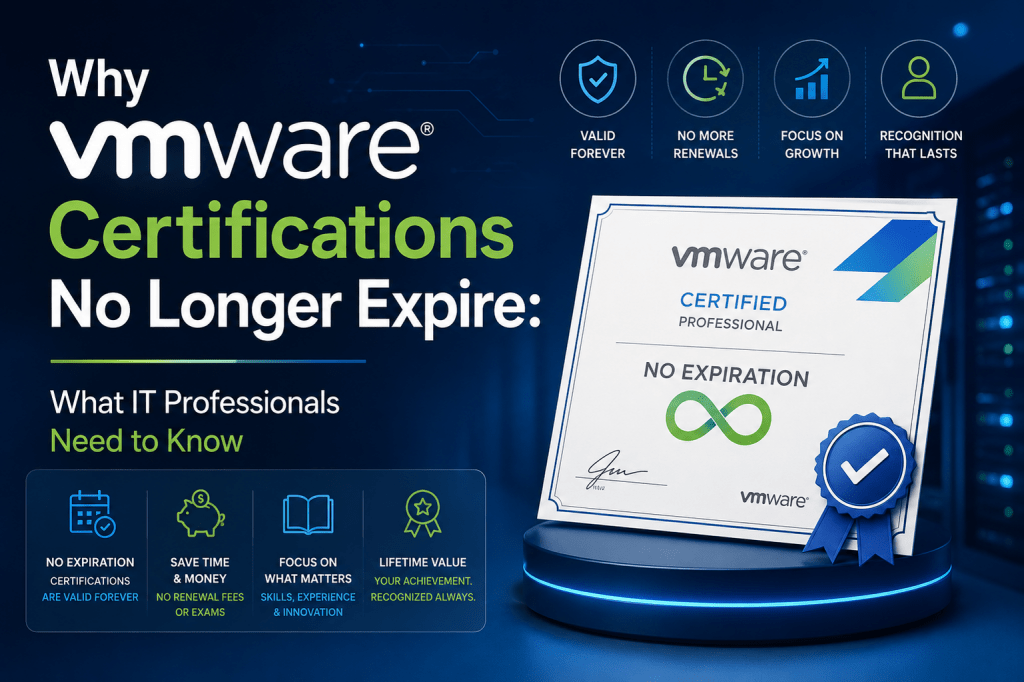
The IT certification industry has changed dramatically over time. Technology companies are constantly updating their certification structures to match the fast-moving demands of the modern tech world. Many organizations now realize that professionals learn differently, work in different environments, and follow different career timelines. Because of this, strict certification expiration rules are no longer viewed as the only way to maintain quality and relevance.
VMware made a major move by removing the mandatory expiration requirement for VMware Certified Professional certifications. This decision attracted attention across the technology industry because VMware certifications have long been considered valuable credentials in virtualization and cloud infrastructure. For years, professionals had to renew their certifications within a limited period to keep them active. That process often created pressure, financial costs, and unnecessary stress for working professionals.
The change signals a larger shift in how certification providers view experience, skills, and professional growth. Instead of forcing every certified individual into a fixed renewal cycle, VMware now allows professionals to decide when it makes sense to update their credentials. This approach recognizes that not every organization upgrades infrastructure at the same pace and not every professional requires constant recertification to remain effective in their role.
The removal of expiration dates also reflects changing attitudes about how technical expertise should be measured. Employers increasingly value practical experience, project success, and real-world problem-solving abilities rather than simply checking whether a certification renewal date is current. VMware’s new direction supports this modern view of professional capability.
Understanding the Value of VCP Certifications
VMware Certified Professional certifications have built a strong reputation in the virtualization market. These certifications validate a professional’s ability to deploy, manage, troubleshoot, and maintain VMware technologies in enterprise environments. Since virtualization became a core component of modern data centers, VMware certifications gained significant value among IT professionals and employers alike.
Organizations rely heavily on virtualization to improve hardware efficiency, reduce operational costs, simplify management, and increase flexibility. VMware became one of the most recognized names in this space, which naturally increased demand for professionals skilled in VMware environments. As businesses expanded their digital infrastructure, certified VMware professionals became highly sought after across industries.
The VCP certification path became popular because it demonstrated practical knowledge of enterprise virtualization systems. Employers often viewed the certification as proof that a candidate understood complex virtualization environments and could manage critical infrastructure effectively. This created strong career opportunities for certified professionals.
Many professionals invested significant time and effort preparing for VMware certification exams. Training courses, labs, practice tests, and hands-on experience were often required to pass the exams successfully. Because of the effort involved, professionals expected long-term value from their certification achievements. Mandatory expiration rules sometimes reduced that sense of long-term value because certifications could become inactive despite years of practical experience.
By removing expiration requirements, VMware acknowledged that professional expertise does not suddenly disappear after a specific timeline. Someone actively working with VMware technologies every day continues building valuable experience even without taking another exam immediately. This recognition helped strengthen the credibility and practicality of the certification program.
The Original Purpose of Recertification
The original recertification policy was introduced with good intentions. Technology changes rapidly, and certification providers want professionals to remain updated with the latest tools, features, and best practices. Mandatory renewals were designed to encourage continuous learning and ensure certified individuals maintained current technical knowledge.
At first glance, the idea made sense. Virtualization platforms evolve over time with new security features, automation capabilities, performance enhancements, and cloud integrations. Employers want skilled professionals who understand modern environments rather than outdated systems. Recertification policies were created to support this goal.
However, the reality of the certification process became more complicated for many professionals. Preparing for recertification exams required extensive study time, exam fees, and training expenses. Many IT professionals already balanced demanding workloads, personal responsibilities, and ongoing projects. The additional pressure of mandatory renewals created frustration for some individuals who already used VMware technologies daily in their jobs.
In many organizations, infrastructure upgrades do not happen frequently. Some companies continue using stable VMware environments for long periods because their systems work reliably and meet business needs. In these situations, forcing professionals to renew certifications on a strict timeline did not always reflect actual workplace requirements.
The previous renewal structure also created situations where experienced professionals lost active certification status simply because they could not schedule exams in time. This sometimes discouraged skilled individuals from continuing within the VMware certification ecosystem altogether. Instead of motivating learning, the process occasionally became a source of stress and dissatisfaction.
VMware eventually recognized these concerns and reconsidered whether mandatory expiration truly served the best interests of certification holders, employers, and the company itself.
Why VMware Removed Certification Expiration
VMware’s decision to remove expiration requirements was influenced by several practical factors. One of the biggest reasons was flexibility. Technology professionals work in very different environments, and a single renewal timeline does not fit everyone equally.
Some professionals work in organizations that upgrade systems frequently. Others maintain long-term stable environments that change very slowly. A fixed recertification requirement treated both groups the same even though their daily responsibilities were completely different. VMware realized professionals should have more control over their certification journey.
Another major factor involved reducing unnecessary stress. Preparing for recertification exams every few years required significant effort. Professionals often had to spend months reviewing material, scheduling study sessions, and preparing for tests while already working full-time jobs. Removing the expiration requirement eliminated much of that pressure.
The change also improved the overall value perception of VMware certifications. Certifications represent investments of time, energy, and money. Professionals want those investments to retain long-term value. When certifications expire automatically, some individuals feel their previous achievements lose recognition even if they remain highly skilled in real-world environments.
VMware also understood that forcing frequent renewals could discourage new learners from entering the certification path. Many professionals hesitate to pursue certifications if they believe constant renewals will become expensive and time-consuming obligations. By removing expiration dates, VMware made the certification process more appealing and accessible.
Employers benefited from the change as well. Organizations can now decide internally whether employees truly need upgraded certifications based on actual business requirements. Instead of following mandatory certification timelines, companies can focus training efforts where they provide the greatest operational value.
The decision also reflects confidence in the market itself. VMware recognized that employers naturally prefer knowledgeable professionals. If newer certifications become necessary, employers and professionals will pursue them voluntarily because of business demand rather than forced compliance.
How the Policy Change Affects Professionals
The removal of certification expiration created immediate benefits for many VMware professionals. One of the most important advantages is peace of mind. Certified individuals no longer need to worry about losing active status simply because a renewal deadline approaches.
This change especially helped experienced professionals who have worked with VMware technologies for years. Their practical knowledge remains valuable regardless of whether they recently completed a renewal exam. The updated policy recognizes ongoing professional experience as meaningful.
For professionals whose certifications had already become inactive, the policy created new opportunities. In some cases, previously expired certifications were restored to active status. This allowed many individuals to continue their certification journey without restarting from the beginning.
The new approach also gives professionals greater control over career planning. Instead of studying for exams because a deadline forces them to, they can choose to upgrade certifications when it aligns with career goals, technology changes, or job opportunities.
Financial savings represent another major advantage. Certification renewals often involve exam fees, training materials, lab environments, and preparation courses. Removing mandatory recertification reduces these recurring costs for both individuals and employers.
The policy change also encourages more thoughtful learning. Professionals can focus on gaining practical skills and relevant experience rather than simply preparing for renewal exams. Learning becomes more connected to real-world needs instead of driven purely by certification timelines.
Many professionals now feel more motivated to pursue VMware certifications because the credentials provide lasting recognition. The certification becomes a long-term achievement rather than a temporary status that disappears after a fixed period.
The Impact on Employers and Organizations
Organizations also benefit from VMware’s updated certification model. Businesses can now align certification upgrades with actual infrastructure plans instead of arbitrary expiration schedules. This creates more efficient workforce planning and training investments.
Many organizations maintain stable virtualization environments for long periods. In these cases, employees may not require immediate training on the newest VMware technologies. The removal of forced recertification allows businesses to prioritize training based on operational requirements rather than certification deadlines.
Companies also save money because they no longer need to continuously fund mandatory recertification exams for employees who already perform effectively in their roles. Training budgets can instead focus on strategic initiatives, new deployments, cloud integration projects, or advanced technologies that provide direct business value.
The change also improves employee satisfaction. Many professionals disliked the pressure associated with constant renewal requirements. Removing this burden can improve morale and reduce frustration among technical staff.
Employers still retain the ability to request updated certifications when needed. For example, organizations adopting new VMware platforms or cloud technologies may still encourage employees to pursue advanced certifications. The difference is that these decisions are now driven by business strategy rather than external certification deadlines.
Hiring managers also benefit because they can evaluate certifications more realistically. Instead of focusing only on renewal dates, employers can consider a candidate’s overall experience, technical background, project work, and practical knowledge.
The policy encourages a more balanced approach to professional development. Experience, continuous learning, and workplace performance become equally important alongside certifications themselves.
Certification Value in a Competitive Market
VMware’s decision also reflects broader competition within the technology certification industry. Professionals today have many certification options across cloud computing, cybersecurity, networking, virtualization, automation, and infrastructure management. Certification providers must adapt to changing expectations if they want to remain attractive to learners.
When certifications require constant renewals, professionals sometimes question whether the investment remains worthwhile. Expensive training, recurring exam fees, and time commitments can discourage participation. VMware recognized that long-term certification value plays a major role in attracting learners.
By removing expiration requirements, VMware strengthened the appeal of its certification program. Professionals are more likely to invest in certifications that maintain long-term recognition and career value. This strategy helps VMware remain competitive in the broader technology training market.
The decision also supports VMware’s reputation within enterprise IT environments. As more professionals become certified and comfortable with VMware technologies, businesses gain easier access to skilled talent. This helps maintain VMware’s strong position within virtualization and cloud infrastructure markets.
Certification programs are not only educational tools but also business ecosystems. VMware benefits when more professionals pursue its certifications because certified experts often influence technology decisions within organizations. Long-term certification value encourages continued engagement with VMware technologies.
The updated policy demonstrates an understanding that modern professionals prefer flexibility. Career growth today is rarely linear. Some professionals specialize deeply in one platform while others shift across multiple technologies. VMware’s flexible certification approach aligns better with these evolving career patterns.
Freedom to Choose When to Upgrade
One of the biggest advantages of VMware’s updated certification model is the freedom it gives professionals to choose their own upgrade timeline. In the past, certification holders often felt forced into renewing credentials simply to prevent expiration, even if their daily work had not changed significantly. This created unnecessary pressure and sometimes pushed people toward certifications that offered little immediate benefit to their actual job responsibilities.
Now professionals can evaluate their own career goals and decide when an upgrade makes sense. Someone working in a stable virtualization environment may not need the newest certification immediately. Another professional involved in cloud migration or infrastructure modernization may choose to upgrade sooner because the latest VMware technologies directly impact their role. This flexibility allows certifications to become more practical and career-focused instead of being tied to rigid deadlines.
The ability to choose when to recertify also improves learning quality. When people study voluntarily because they genuinely want to expand their knowledge, the learning process becomes far more meaningful. Instead of rushing to pass an exam before expiration, professionals can take time to fully understand new technologies, explore advanced features, and build practical experience.
Many professionals felt that mandatory recertification sometimes encouraged memorization rather than genuine skill development. The updated VMware policy helps shift attention back toward real technical understanding. Individuals can focus on learning technologies that directly support their work environments and long-term career paths.
This freedom is especially important in enterprise IT because every organization operates differently. Some companies adopt new technologies rapidly, while others prioritize long-term stability and gradual upgrades. VMware’s updated certification approach acknowledges this reality and supports both types of environments equally.
Reduced Stress for IT Professionals
The removal of expiration requirements significantly reduced stress for many IT professionals. Technology careers already involve continuous learning, troubleshooting, system upgrades, and operational responsibilities. Adding mandatory recertification deadlines on top of daily work created additional pressure that many professionals struggled to manage.
Preparing for VMware exams requires serious commitment. Candidates often spend weeks or months reviewing study materials, practicing in lab environments, and learning new platform features. For individuals managing full-time jobs, family responsibilities, and personal obligations, balancing everything became difficult.
The stress became even greater when approaching expiration deadlines. Professionals worried about losing active certification status, which could potentially affect career opportunities or employer expectations. Some individuals felt trapped in a cycle of constant renewal rather than genuine professional growth.
By removing expiration dates, VMware eliminated a major source of anxiety. Professionals no longer need to fear losing recognition for their achievements simply because they delayed a renewal exam. Their certifications remain valid while they continue gaining real-world experience in their jobs.
This change also supports healthier career development. Instead of forcing people into constant exam preparation, professionals can focus on improving broader technical skills, participating in projects, and developing practical expertise. Learning becomes more natural and less deadline-driven.
Reduced stress also benefits employers because less pressured employees often perform better, remain more engaged, and contribute more effectively to long-term organizational goals. When certifications support growth rather than create frustration, both professionals and businesses benefit.
The Financial Side of Recertification
Certification renewals can become expensive over time. Exam registration fees, official training courses, study materials, practice labs, and preparation resources all add up. For some professionals, especially those paying out of pocket, maintaining certifications created a significant financial burden.
Even when employers covered some costs, organizations still had to allocate training budgets toward recurring recertification requirements. These expenses became particularly challenging for companies managing large IT teams with multiple certified professionals.
VMware’s decision to eliminate mandatory expiration reduced these recurring financial pressures. Professionals now have the option to pursue upgrades when they provide meaningful career value instead of paying simply to maintain active status.
This shift improves the overall return on investment for certification holders. Individuals can invest in certifications knowing their achievements will retain long-term recognition. The certification becomes a lasting professional asset rather than a temporary credential requiring continuous renewal fees.
Financial flexibility also allows professionals to explore broader learning opportunities. Instead of spending resources on repeated renewals, individuals may choose to develop complementary skills in cloud computing, automation, cybersecurity, or networking. This broader skill development can strengthen career growth even further.
For employers, reduced recertification costs free up budgets for more strategic initiatives. Organizations can invest in advanced training programs, infrastructure modernization, cloud migration planning, or emerging technologies that provide direct business value.
The policy change reflects a more realistic understanding of professional development economics. Continuous learning remains important, but mandatory recurring fees are no longer treated as the primary measure of technical competence.
Real-World Experience Versus Exam Cycles
One of the strongest arguments supporting VMware’s decision is the value of real-world experience. Many professionals spend years managing VMware environments daily. They troubleshoot complex virtualization problems, optimize performance, handle infrastructure upgrades, maintain security standards, and support critical business operations.
This hands-on experience often provides deeper expertise than periodic recertification exams alone. A professional actively working with VMware technologies every day continues developing valuable skills regardless of exam schedules. VMware’s updated approach recognizes this practical reality.
In many cases, experienced administrators understand their environments at an advanced level because they encounter real operational challenges that exams cannot fully replicate. They learn through deployments, migrations, outages, scaling projects, and troubleshooting situations that require practical problem-solving abilities.
Mandatory recertification sometimes failed to accurately reflect this real-world expertise. A highly skilled professional could lose active certification status despite years of successful operational experience simply because they missed a renewal deadline.
The updated policy shifts focus toward actual capability rather than administrative timelines. Certifications still matter, but they no longer overshadow practical experience. Employers can evaluate professionals more holistically by considering both certification achievements and real technical contributions.
This approach aligns better with how technology careers actually develop. Skills grow continuously through workplace experience, collaboration, experimentation, and project involvement. VMware’s new model acknowledges that expertise cannot always be measured solely through recurring exams.
At the same time, VMware still encourages professionals to continue learning and upgrading skills when necessary. The difference is that learning now becomes driven by professional relevance rather than mandatory expiration dates.
Why Many Organizations Delay Infrastructure Upgrades
One important reason behind VMware’s policy change involves how businesses manage technology infrastructure. Contrary to popular assumptions, many organizations do not immediately adopt every new software release or platform update. Enterprise environments often prioritize stability, compatibility, and operational reliability over constant change.
Large companies carefully evaluate infrastructure upgrades because virtualization environments support critical business systems. Upgrading too quickly can introduce compatibility issues, downtime risks, or operational disruptions. As a result, organizations frequently continue using stable VMware versions for extended periods.
In these situations, forcing employees to constantly renew certifications on the newest technologies did not always make practical sense. Professionals were being tested on features or platform versions that their organizations had not yet adopted.
VMware recognized this disconnect between certification timelines and real-world infrastructure management. By removing expiration requirements, the company allowed certifications to align more naturally with actual business environments.
Now organizations can plan employee training based on operational strategy rather than external deadlines. If a company plans to modernize infrastructure or adopt newer VMware solutions, employees can pursue upgrades accordingly. If systems remain stable and effective, immediate recertification may not be necessary.
This flexibility benefits both employers and employees. Training efforts become more targeted and meaningful because they directly support real organizational goals. Professionals can focus on mastering the technologies they actually use rather than preparing for forced renewal exams unrelated to current responsibilities.
The updated approach better reflects how enterprise IT environments function in reality. Technology adoption varies greatly across industries, and VMware’s certification structure now accommodates that diversity more effectively.
Restoring Previously Expired Certifications
Another major aspect of VMware’s policy update involved restoring certain previously expired certifications. This decision provided relief for many professionals who had lost active certification status under the old recertification rules.
Previously, once certifications expired, some individuals faced the frustrating possibility of restarting the certification process from the beginning. Even experienced professionals who had worked extensively with VMware technologies sometimes had to repeat training paths and exams simply because their credentials became inactive.
The updated policy changed this situation for many certification holders. Some expired certifications were restored to active status, allowing professionals to continue progressing without restarting their entire certification journey.
This move demonstrated VMware’s recognition that previous achievements still hold value. Experience and knowledge gained through earlier certifications do not suddenly disappear because of missed renewal deadlines. Restoring active status acknowledged the ongoing expertise of long-time VMware professionals.
The decision also improved goodwill within the certification community. Many professionals appreciated that VMware responded to concerns about the old recertification system and implemented changes that better supported certification holders.
For some individuals, the restored certifications opened new career opportunities. Active certification status can influence hiring decisions, promotions, consulting opportunities, and project assignments. Regaining active credentials without restarting the entire process provided significant professional benefits.
The restoration policy also encouraged professionals to remain engaged with VMware technologies. Instead of abandoning the certification ecosystem after expiration frustrations, many individuals now felt motivated to continue learning and upgrading their skills voluntarily.
This approach strengthened VMware’s relationship with its certified community by showing greater respect for long-term professional investment and experience.
Expanded Upgrade Opportunities
VMware also expanded upgrade eligibility within certification tracks. Under previous rules, professionals with older certifications sometimes found themselves excluded from upgrade paths. If too much time passed, they had to restart from the beginning instead of progressing through an update process.
The new approach widened upgrade access by allowing more certification versions to qualify for advancement opportunities. This change reduced barriers for experienced professionals who wanted to modernize their credentials without repeating their entire certification journey.
Expanded upgrade eligibility benefits professionals in several ways. First, it recognizes the value of previous learning and experience. Individuals who earned older certifications already demonstrated technical competence and should not necessarily need to start over entirely.
Second, the updated structure encourages professionals to remain connected to VMware’s certification ecosystem. Easier upgrade paths make continued participation more attractive and practical.
Third, it supports career flexibility. Professionals who paused certification activities for several years can now return more easily when new opportunities arise or business needs change.
The broader upgrade structure also reflects how careers naturally evolve. Technology professionals sometimes shift roles, focus on projects, or prioritize other responsibilities before later returning to certification advancement. VMware’s updated system accommodates these real career patterns more effectively.
Employers benefit as well because experienced employees can update certifications more efficiently without spending excessive time repeating foundational material they already understand.
The expanded upgrade policy demonstrates VMware’s broader goal of simplifying certification management and reducing unnecessary obstacles for professionals seeking long-term career development.
VMware’s Focus on Simplifying Certifications
VMware’s decision to remove expiration requirements was not an isolated change. It formed part of a larger effort to simplify the entire certification experience for professionals and employers. Over time, certification programs can become overly complicated with multiple renewal paths, changing exam requirements, and confusing upgrade rules. VMware recognized that simplification would improve the overall experience for everyone involved.
Many professionals previously struggled to understand certification naming structures, version tracking, and recertification timelines. Keeping track of multiple requirements became difficult, especially for individuals managing busy careers and technical responsibilities. VMware’s updated direction aimed to remove unnecessary complexity and create a more user-friendly certification system.
Simplification benefits professionals because it allows them to focus more on learning and skill development rather than administrative rules. Instead of worrying about expiration deadlines, renewal windows, and version limitations, individuals can concentrate on practical career growth.
The company also recognized that simpler certification structures make hiring easier for employers. Hiring managers often review certifications when evaluating technical candidates. Clearer certification paths help employers quickly understand a professional’s expertise and technology background.
By streamlining certification management, VMware improved the accessibility of its certification ecosystem. Professionals entering virtualization careers now face fewer barriers and less confusion when planning certification goals. This creates a smoother learning experience and encourages greater participation.
Simplification also supports long-term engagement. When certification systems feel manageable and practical, professionals are more likely to continue pursuing advanced credentials and specialized knowledge areas. VMware’s updated approach reflects a broader understanding that learning systems should support career development instead of creating unnecessary obstacles.
The Growing Importance of Flexibility in IT Careers
Modern technology careers are very different from those of the past. Professionals today often work across multiple platforms, cloud providers, automation tools, and infrastructure technologies simultaneously. Career paths are less predictable, and professionals frequently adapt to changing business demands and emerging technologies.
Because of this, rigid certification structures no longer fit the realities of the IT industry. VMware’s updated policy reflects the growing importance of flexibility in professional development. Instead of forcing everyone into the same timeline, the company now allows individuals to shape certification decisions around their actual career situations.
Some professionals specialize deeply in virtualization for many years. Others combine virtualization expertise with cloud engineering, cybersecurity, networking, or DevOps responsibilities. Different career paths require different learning priorities, and VMware’s flexible approach supports this diversity.
The technology industry also changes rapidly. New tools, platforms, and business models constantly emerge. Professionals need freedom to allocate learning time strategically rather than spending all their energy maintaining mandatory certification renewals.
Flexibility is especially important for experienced professionals. Senior engineers, architects, and infrastructure specialists often gain knowledge through large-scale projects, enterprise deployments, and operational leadership. Their expertise evolves through practical experience as much as through formal certification programs.
VMware’s updated model recognizes that professional growth is not always linear. Some individuals may upgrade certifications quickly, while others may focus on workplace experience before returning to formal learning later. Both paths remain valid under the new system.
This flexibility helps certifications remain relevant in a changing industry. Instead of acting as rigid compliance requirements, certifications become tools that professionals can use strategically to support their evolving career goals.
How Employers View Non-Expiring Certifications
The removal of expiration requirements raised questions about how employers might view certifications that no longer require mandatory renewals. Some people initially wondered whether non-expiring certifications would lose value or credibility in hiring processes.
In reality, many employers already place strong emphasis on practical experience alongside certifications. Technical interviews, project history, troubleshooting abilities, infrastructure knowledge, and communication skills often matter more than certification dates alone. VMware’s updated policy aligns with this broader approach to evaluating talent.
Employers understand that experienced professionals continue learning through daily work responsibilities. Someone managing VMware infrastructure for years often develops advanced operational expertise regardless of recent exam activity. Non-expiring certifications allow employers to recognize both foundational certification achievement and ongoing workplace experience.
At the same time, employers still value updated knowledge when necessary. Organizations implementing new VMware technologies or cloud solutions may continue encouraging employees to pursue advanced certifications. The key difference is that upgrades now occur because they provide business value rather than because certifications automatically expire.
Many hiring managers appreciate the flexibility of VMware’s updated model. It allows them to evaluate candidates based on actual capability rather than focusing narrowly on certification timelines. Experienced professionals who previously lost active certification status due to missed renewals can now demonstrate both historical certification achievement and practical expertise more effectively.
The updated approach may also improve workforce retention. Employees often feel more respected when certification programs support their professional development rather than imposing constant administrative pressure. This can strengthen long-term relationships between employers and technical staff.
Ultimately, employers still decide what skills matter most within their organizations. VMware’s updated certification model simply gives businesses and professionals more flexibility in determining when formal upgrades are truly necessary.
Continuous Learning Still Matters
Even though VMware certifications no longer expire, continuous learning remains extremely important in the technology industry. Virtualization, cloud computing, automation, networking, and infrastructure management continue evolving rapidly. Professionals who stop learning entirely risk falling behind regardless of certification status.
VMware’s policy change was never intended to discourage ongoing education. Instead, it shifted responsibility for learning decisions from rigid deadlines to professional judgment and business needs. The expectation is not “stop learning,” but rather “learn when it makes sense for your role and goals.”
Successful IT professionals understand that technology skills require ongoing development. New security threats emerge, infrastructure architectures evolve, and businesses adopt modern operational practices. Professionals must continue building knowledge to remain effective and competitive.
The difference now is that learning becomes more purposeful. Instead of studying only to maintain active certification status, professionals can focus on technologies and skills directly relevant to their careers. This often leads to deeper understanding and more meaningful expertise.
Many professionals may still choose to pursue advanced VMware certifications voluntarily because they want to remain current with evolving virtualization and cloud technologies. Others may combine VMware expertise with skills in automation, Kubernetes, hybrid cloud platforms, or cybersecurity.
Continuous learning also supports long-term career advancement. Senior technical roles often require broader architectural understanding, strategic planning abilities, and knowledge of emerging technologies. Certifications can still play an important role within this growth process.
VMware’s updated policy encourages professionals to think more strategically about education. Instead of following forced timelines, individuals can create personalized learning paths that align with both current responsibilities and future career ambitions.
The Role of Market Demand in Certification Value
One of the most interesting aspects of VMware’s decision is the idea that market demand should determine certification value rather than expiration policies alone. Certifications gain importance because employers recognize them, businesses use the related technologies, and professionals demonstrate valuable skills through them.
VMware essentially shifted responsibility for certification relevance to the market itself. If organizations continue valuing VMware expertise, professionals will naturally pursue certifications and upgrades when beneficial. If certain skills become less relevant over time, the market will adjust accordingly.
This approach reflects confidence in VMware’s position within enterprise infrastructure environments. The company understands that virtualization and cloud management remain critical business technologies. As long as organizations rely on VMware platforms, certified professionals will continue being valuable.
Market-driven certification value creates a more natural relationship between technology adoption and professional development. Professionals upgrade skills because business environments evolve, not simply because administrative deadlines force them to do so.
This model may actually strengthen certification credibility over time. Voluntary learning often carries greater meaning than forced compliance. When professionals choose to pursue advanced certifications based on genuine career goals and business needs, the resulting expertise may become more valuable.
The market-driven approach also benefits employers. Organizations can prioritize training investments according to operational priorities rather than external certification schedules. This creates more efficient workforce development strategies.
For professionals, the shift means certifications become career tools rather than recurring obligations. Individuals can pursue upgrades strategically based on industry trends, employer expectations, salary opportunities, and technical interests.
VMware’s approach reflects broader changes in how the technology industry views professional development. Real-world value increasingly comes from demonstrated capability, ongoing experience, and relevant expertise rather than from maintaining compliance with rigid certification timelines.
The Competitive Advantage for VMware
Removing certification expiration may also provide VMware with a competitive advantage within the technology training industry. Certification providers compete not only through technical content but also through the overall learning experience they offer professionals.
Many IT professionals carefully evaluate certification programs before investing time and money. They consider long-term value, maintenance requirements, career impact, and flexibility. VMware’s updated approach makes its certifications more attractive to individuals seeking stable, lasting professional credentials.
Professionals are more likely to pursue certifications when they know achievements will retain long-term recognition. This can increase participation in VMware certification programs and strengthen the overall VMware talent ecosystem.
The policy change may also improve VMware’s reputation among enterprise professionals. Many individuals appreciate companies that listen to community concerns and adapt policies accordingly. By removing expiration requirements, VMware demonstrated responsiveness to professional feedback and workplace realities.
A stronger certification ecosystem benefits VMware strategically because certified professionals often influence infrastructure decisions within organizations. The more professionals become skilled and comfortable with VMware technologies, the more likely businesses are to continue investing in VMware platforms.
The updated policy also differentiates VMware from certification providers that maintain strict renewal structures. Professionals comparing certification paths may view VMware as more practical, flexible, and supportive of long-term career growth.
At the same time, VMware still encourages continuous learning through upgrade opportunities, advanced certifications, and specialized technology tracks. The company continues supporting professional development while removing unnecessary administrative burdens.
This balance between flexibility and ongoing education strengthens VMware’s position in the broader technology certification landscape.
How the Certification Industry May Evolve
VMware’s decision could influence how other certification providers approach recertification policies in the future. The technology certification industry constantly evolves as companies respond to professional expectations, workforce trends, and changing business environments.
If VMware’s flexible approach proves successful, other organizations may reconsider strict expiration models as well. Certification providers carefully monitor industry reactions, learner engagement, and market adoption when evaluating policy changes.
Many professionals already question whether rigid recertification timelines accurately measure technical competence. Real-world experience, ongoing project work, and practical skill application often provide stronger indicators of expertise than recurring exams alone. VMware’s model acknowledges this reality more directly.
Future certification systems may increasingly combine certifications with skills-based assessments, project portfolios, practical labs, and workplace experience evaluations. The industry may move toward more flexible professional development models overall.
Cloud computing and automation trends also influence certification evolution. Technology environments change rapidly, making it difficult for fixed renewal cycles to match every professional situation. Flexible learning paths may become more common as certification providers adapt to modern IT careers.
At the same time, certifications will likely remain important because employers still need reliable ways to evaluate technical knowledge and foundational expertise. The challenge for certification providers is balancing credibility, flexibility, and practical relevance.
VMware’s updated approach represents one possible direction for the future of professional certifications. It emphasizes long-term value, market-driven relevance, and professional choice rather than strict expiration enforcement.
The broader industry will continue observing how these changes affect learner participation, employer trust, and certification demand over time.
How VMware’s Decision Benefits the Industry
VMware’s decision to remove certification expiration requirements does more than help individual professionals. It also creates positive effects across the broader IT industry. Technology companies, employers, training providers, and certification holders all benefit from a system that focuses more on practical value and less on forced renewal cycles.
For many years, certifications were often treated as mandatory checkboxes that professionals had to maintain continuously regardless of their actual job responsibilities. While certifications remain valuable, the industry has slowly started recognizing that experience and hands-on expertise are equally important. VMware’s updated policy supports this evolving mindset.
The change helps create a healthier relationship between learning and career growth. Professionals can now focus on gaining useful skills instead of constantly worrying about certification deadlines. This encourages more meaningful learning experiences and helps individuals build stronger technical foundations over time.
Training providers may also benefit because professionals who voluntarily pursue advanced learning are often more engaged and motivated. Instead of studying only to keep a certification active, learners now have the freedom to explore technologies because they genuinely want to improve their expertise.
The policy also encourages long-term participation in VMware technologies. Professionals who know their certifications will not expire may feel more comfortable investing time and effort into VMware learning paths. This helps strengthen the overall VMware ecosystem and ensures organizations continue having access to skilled virtualization professionals.
The broader certification industry may also pay close attention to VMware’s success with this approach. If professionals and employers respond positively, other technology companies could eventually adopt similar flexible certification models.
A Better Experience for Working Professionals
One of the strongest advantages of VMware’s updated approach is the improved experience it creates for working professionals. Modern IT careers already involve constant change, demanding workloads, and continuous problem-solving. Mandatory certification renewals often added unnecessary pressure to an already stressful environment.
Many professionals work long hours supporting infrastructure systems that businesses depend on every day. These responsibilities may include handling outages, maintaining security, optimizing performance, supporting remote operations, and managing complex deployments. Finding additional time for repeated recertification preparation was difficult for many individuals.
The removal of expiration deadlines allows professionals to focus more effectively on their actual career responsibilities. Instead of spending energy tracking certification expiration dates, they can prioritize projects, operational improvements, and skill development that directly support business needs.
This flexibility also supports better work-life balance. Professionals no longer feel forced into study schedules simply because a certification renewal deadline is approaching. They can choose learning opportunities at times that fit more naturally into their personal and professional lives.
The updated system also respects experienced professionals who have already demonstrated strong VMware knowledge through years of successful work. Their certifications continue reflecting their expertise without forcing them through repetitive renewal cycles.
This creates a more respectful and realistic professional environment. VMware certifications now function more as lasting career achievements rather than temporary credentials that disappear after a fixed period.
The improved experience may also encourage more professionals to remain active within the VMware ecosystem long-term because the certification process feels more practical, supportive, and sustainable.
Why Employers Still Value Updated Knowledge
Even though VMware certifications no longer expire, employers still value professionals who stay informed about modern technologies and evolving industry practices. Organizations continue expecting IT teams to understand current infrastructure trends, security standards, and operational improvements.
Technology environments are constantly changing. Virtualization platforms increasingly integrate with cloud services, automation systems, software-defined networking, and modern data center architectures. Businesses need professionals who can adapt to these changes and support future technology strategies.
This means updated knowledge still matters greatly even without mandatory recertification requirements. Professionals who continue learning remain more competitive in the job market and better prepared for leadership opportunities.
However, VMware’s updated policy changes how this learning happens. Instead of forcing every professional through the same renewal process, individuals and organizations can now decide when updates are truly necessary.
For example, a company planning a cloud migration project may encourage employees to pursue newer VMware certifications related to hybrid cloud technologies. Another organization maintaining stable virtualization infrastructure may prioritize operational experience instead of immediate certification upgrades.
This flexibility allows employers to align training investments with actual business goals. Learning becomes more strategic and practical rather than driven by external deadlines.
Professionals also benefit because they can choose certifications and training paths that support their specific career ambitions. Someone pursuing architecture roles may focus on advanced infrastructure certifications, while another professional may expand into automation or cloud engineering.
The updated VMware model supports ongoing learning while removing unnecessary administrative pressure. Employers still value growth and updated knowledge, but professionals now have more control over how they pursue that growth.
The Shift Toward Skill-Based Career Growth
VMware’s certification changes reflect a larger shift happening across the technology industry. More organizations are moving toward skill-based hiring and career development rather than relying only on certification timelines.
Companies increasingly evaluate professionals based on practical abilities, project experience, troubleshooting skills, and technical problem-solving capabilities. Certifications remain important, but they are becoming part of a larger picture rather than the only factor determining professional value.
This shift benefits experienced professionals who may have extensive real-world expertise even if they have not recently completed certification renewals. VMware’s updated policy supports this modern approach by recognizing that valuable technical skills continue developing through workplace experience.
Skill-based career growth also encourages professionals to focus on meaningful learning instead of exam preparation alone. Individuals may spend more time working on automation projects, cloud integrations, infrastructure optimization, or security improvements because these activities provide direct career value.
The updated model also supports specialization. Modern IT environments involve many overlapping technologies, and professionals often develop expertise across multiple areas. VMware’s flexible certification structure allows individuals to build diverse skill sets without being overwhelmed by constant renewal requirements.
Organizations benefit from this approach because they gain employees with broader practical capabilities rather than workers focused only on maintaining certification compliance. Teams become more adaptable and better prepared for changing business requirements.
VMware’s policy change aligns well with the future direction of technology careers. Skills, adaptability, and practical expertise are becoming increasingly important in a rapidly evolving industry.
The Long-Term Value of VMware Certifications
VMware certifications continue holding strong value within enterprise technology environments. Virtualization remains a critical part of modern infrastructure, and organizations still depend heavily on VMware technologies to manage workloads, improve efficiency, and support business operations.
The removal of expiration requirements may actually increase the long-term value of VMware certifications because professionals now view them as lasting achievements rather than temporary credentials. This stronger sense of permanence can encourage more individuals to pursue VMware learning paths confidently.
Professionals investing time and money into certification programs want assurance that their achievements will remain meaningful over time. VMware’s updated policy helps provide that confidence by protecting the long-term recognition associated with certification success.
The change also supports career stability. Certified professionals can continue using their VMware credentials throughout their careers while choosing upgrades strategically based on technology changes and business needs.
Employers will likely continue respecting VMware certifications because they represent strong foundational knowledge of virtualization technologies. Combined with real-world experience, these certifications remain highly valuable in infrastructure-focused career paths.
As enterprise technology environments evolve, VMware-certified professionals may also find opportunities expanding into hybrid cloud management, automation, software-defined data centers, and modern infrastructure operations.
The certification itself remains important, but its value now feels more connected to practical expertise and professional growth rather than administrative renewal timelines.
This stronger long-term value benefits both VMware and the professionals who invest in its certification ecosystem.
Conclusion
VMware’s decision to eliminate mandatory certification expiration represents a major shift in how technology certifications are viewed. Instead of forcing professionals into recurring renewal cycles, VMware now allows individuals and employers to decide when upgrades and additional certifications truly make sense.
The change provides greater flexibility, reduces stress, lowers recurring costs, and creates a more realistic connection between certifications and real-world experience. Professionals can now focus more on meaningful skill development and career growth rather than constantly preparing for renewal deadlines.
At the same time, the policy does not reduce the importance of continuous learning. Technology continues evolving rapidly, and successful professionals still need to stay informed, adaptable, and technically capable. The difference is that learning now becomes more strategic, personalized, and aligned with actual business needs.
VMware’s updated certification model also reflects broader changes happening across the IT industry. Employers increasingly value practical expertise, hands-on experience, and problem-solving ability alongside formal certifications. This creates a more balanced and modern approach to professional development.
By removing expiration requirements, VMware strengthened the long-term value of its certifications while giving professionals greater control over their learning journeys. The result is a certification system that feels more flexible, supportive, and aligned with the realities of modern technology careers.
As the technology industry continues changing, VMware’s approach may influence how other certification providers structure their own programs in the future. For many professionals, this shift represents a positive step toward a more practical and sustainable model for technical certification and career growth.