
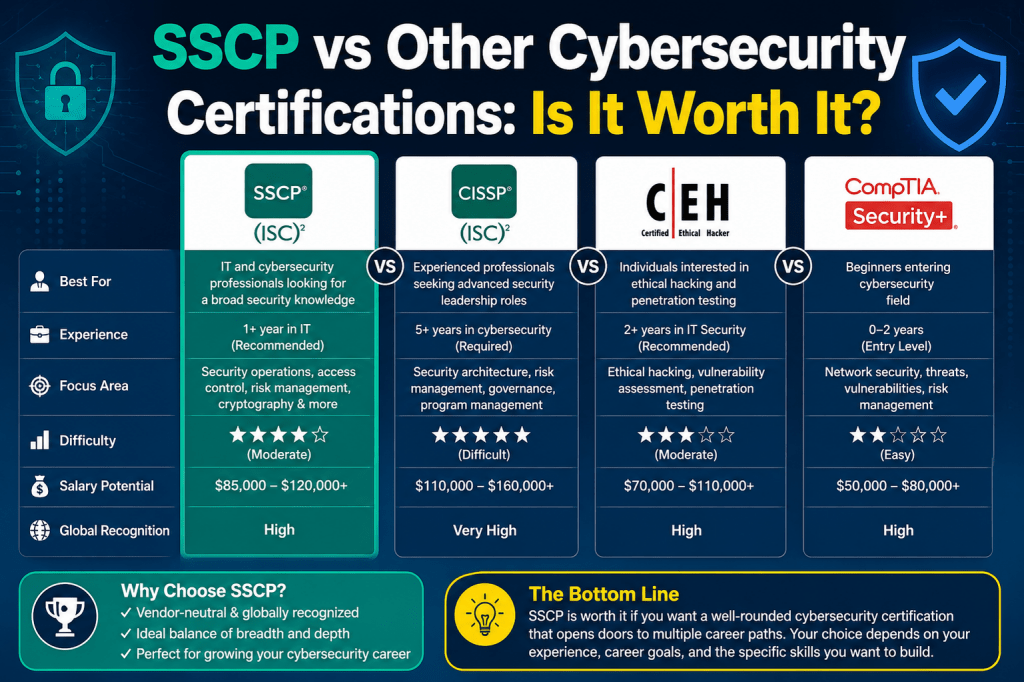
The Systems Security Certified Practitioner certification is often considered one of the most practical and career-focused credentials for people entering or growing within cybersecurity. Unlike certifications that focus heavily on management and executive-level planning, the SSCP emphasizes technical operations, system protection, and real-world security implementation. This makes it especially attractive for IT professionals who want to work directly with infrastructure, security monitoring, access control, and network defense.
Many professionals view the SSCP as a strong bridge between general IT experience and specialized cybersecurity roles. It validates technical skills while also demonstrating a commitment to professional growth. For individuals working in support, networking, systems administration, or infrastructure management, the certification can become an important milestone that helps transition into more security-focused responsibilities.
Why the SSCP Stands Out
One of the biggest reasons the SSCP stands out is its balance between accessibility and technical depth. It is advanced enough to earn respect from employers while still being achievable for professionals early in their cybersecurity careers. Many certifications are either too basic to impress hiring managers or too advanced for newcomers. The SSCP fits into the middle ground, making it valuable for professionals who already understand IT systems but want to strengthen their security expertise.
The certification focuses on operational security skills that organizations need every day. Companies rely on trained professionals to secure servers, manage identity systems, protect networks, monitor threats, and maintain secure environments. The SSCP directly supports those responsibilities, which is why many employers see it as proof of practical capability rather than theoretical knowledge alone.
Another reason the certification has value is its vendor-neutral approach. Instead of concentrating on one company’s products or technologies, the SSCP teaches universal cybersecurity principles that apply across industries and environments. This flexibility allows certified professionals to work with different systems, cloud platforms, and enterprise technologies without being tied to one vendor ecosystem.
Technical Skills That Employers Respect
The SSCP certification is highly focused on hands-on security administration. Employers often search for professionals who can actively secure systems instead of only discussing security frameworks at a high level. The certification demonstrates knowledge in areas such as access management, risk mitigation, security monitoring, encryption, incident response, and infrastructure protection.
Organizations today face constant cybersecurity threats ranging from ransomware attacks to insider threats and phishing campaigns. Because of this, businesses need employees who understand how to maintain secure systems on a daily basis. The SSCP helps prove that a candidate can contribute to those tasks immediately.
Hiring managers often prefer certifications that validate operational experience because those skills are directly connected to business continuity. A professional who can secure user accounts, maintain firewalls, respond to alerts, and reduce vulnerabilities provides measurable value to the organization. The SSCP certification aligns closely with those real-world needs.
A Strong Entry Point Into Cybersecurity
Breaking into cybersecurity can be difficult for newcomers because many job postings require both technical knowledge and experience. The SSCP helps reduce that challenge by giving employers confidence in a candidate’s understanding of security operations. It acts as evidence that the individual has studied essential cybersecurity concepts and understands industry best practices.
For IT professionals already working in technical support, networking, systems administration, or cloud operations, the certification can become a stepping stone into security-focused positions. Instead of starting from scratch, professionals can build upon their existing technical foundation and move into cybersecurity gradually.
This career transition is one of the biggest reasons people pursue the SSCP. It allows professionals to shift from general IT work into a field with stronger growth opportunities, higher salaries, and increasing demand. Since cybersecurity continues expanding across nearly every industry, certifications that help professionals enter the field remain highly valuable.
Career Growth Opportunities
The SSCP certification can support long-term career advancement in several ways. First, it demonstrates initiative and professional dedication. Employers often value candidates who actively pursue certifications because it shows motivation to improve technical knowledge and stay current with industry standards.
Second, the certification can qualify professionals for more advanced job responsibilities. Instead of remaining in entry-level IT support positions, certified individuals may move toward roles involving security operations, system administration, vulnerability management, or network defense.
Third, the certification may strengthen promotion opportunities within existing organizations. Companies frequently prefer promoting internal employees who have proven their expertise through recognized credentials. An employee who earns the SSCP may become a stronger candidate for leadership responsibilities within operational security teams.
Finally, the certification can increase professional credibility during interviews. Technical certifications help validate claims made on resumes and demonstrate commitment to cybersecurity as a long-term career path.
Global Recognition and Industry Reputation
The SSCP is respected because it comes from a well-known cybersecurity organization recognized worldwide. Certifications backed by established security communities often hold more weight in the job market because employers trust the standards behind them.
Global recognition matters because cybersecurity professionals increasingly work in international environments. Organizations operate across multiple countries, manage remote teams, and hire talent from around the world. A recognized certification can therefore improve mobility and expand job opportunities beyond one region or industry.
The certification’s reputation also helps when competing in crowded job markets. Employers reviewing multiple candidates may use certifications as a way to evaluate technical readiness and commitment to professional development. Holding the SSCP can therefore help candidates stand out during the hiring process.
Practical Learning Instead of Pure Theory
A major advantage of the SSCP is its practical orientation. Some cybersecurity certifications focus heavily on policies, governance, and executive-level risk management. While those topics are important, many professionals prefer learning skills they can immediately apply in technical environments.
The SSCP teaches operational concepts that directly impact daily IT and security work. Candidates study topics such as securing networks, managing permissions, monitoring systems, handling incidents, and protecting organizational data. These areas are highly relevant for professionals working with enterprise infrastructure.
Practical learning often improves confidence because students can connect certification concepts to real-world environments. Instead of memorizing abstract theories, candidates learn security procedures that apply to servers, endpoints, user management systems, and business networks.
This practical focus also makes the certification attractive for employers who need security professionals capable of handling operational tasks immediately after hiring.
Building a Foundation for Advanced Certifications
Another reason the SSCP is worth considering is its role as preparation for more advanced cybersecurity certifications. Many professionals eventually pursue senior-level credentials focused on security leadership, architecture, governance, or enterprise risk management. The SSCP can help build the technical foundation needed before advancing toward those certifications.
Cybersecurity careers often develop in stages. Professionals begin with operational responsibilities, gain hands-on experience, and eventually move into leadership or specialized technical roles. The SSCP supports the early and middle stages of that journey by strengthening practical knowledge and validating technical competence.
For professionals planning long-term cybersecurity careers, the certification can therefore serve as both a valuable standalone credential and a preparation tool for future advancement.
The Value of Hands-On Security Knowledge
Modern cybersecurity requires more than theoretical understanding. Organizations need professionals who can respond quickly to threats, troubleshoot issues, and maintain secure systems under pressure. The SSCP certification supports those needs by focusing on technical knowledge and operational effectiveness.
Hands-on security knowledge is especially valuable because many businesses struggle to find qualified cybersecurity talent. Employers frequently report difficulty hiring professionals who can both understand security concepts and apply them effectively in production environments.
The SSCP helps demonstrate that balance. It shows that a candidate understands security principles while also being capable of implementing and managing protective measures within IT systems.
This practical credibility can become a significant advantage during job interviews and technical evaluations.
Cybersecurity Demand Continues Growing
Cybersecurity demand continues rising as organizations face increasing digital threats. Businesses depend heavily on cloud computing, remote access, mobile devices, and online services, which creates additional security challenges. As technology expands, companies require more trained professionals capable of protecting critical systems and sensitive information.
This industry growth increases the value of respected certifications like the SSCP. Employers often use certifications to identify candidates who possess verified security knowledge. In competitive hiring environments, recognized credentials can help professionals secure interviews and improve employment opportunities.
The growing focus on cybersecurity compliance and risk management also contributes to the certification’s value. Organizations must protect customer data, maintain regulatory compliance, and prevent security breaches that could damage reputation and finances. Certified professionals help organizations meet those objectives.
Confidence and Professional Credibility
Beyond career advancement, earning the SSCP can also improve personal confidence. Preparing for the certification requires studying a broad range of security topics and understanding how different security controls work together. This learning process often strengthens problem-solving abilities and technical decision-making skills.
Confidence matters in cybersecurity because professionals frequently handle sensitive systems, respond to incidents, and make decisions affecting organizational security. Strong technical understanding helps professionals act more effectively under pressure.
The certification also provides external validation of skills. Many professionals know they are capable technically, but certifications offer formal recognition that can strengthen credibility with employers, coworkers, and clients.
Who Benefits Most From the SSCP
The certification is particularly valuable for professionals already working in technical IT environments who want to specialize in cybersecurity. System administrators, network administrators, technical support professionals, and infrastructure engineers often benefit significantly because the certification aligns closely with their daily responsibilities.
It is also useful for individuals seeking their first dedicated cybersecurity role. Employers may hesitate to hire candidates without any formal security background, but certifications can help demonstrate commitment and baseline competency.
Professionals interested in operational security rather than executive management may find the SSCP especially rewarding. The certification focuses heavily on implementation and administration rather than only governance and strategic planning.
People who enjoy troubleshooting systems, securing infrastructure, monitoring environments, and responding to technical security challenges often align well with the certification’s objectives.
Comparing SSCP With Other Certifications
Many cybersecurity certifications target different career levels and specializations. Some focus primarily on penetration testing, while others emphasize governance, auditing, or cloud security. The SSCP occupies a practical operational role within the certification landscape.
Compared to more advanced management-oriented certifications, the SSCP places stronger emphasis on technical execution. This makes it particularly useful for professionals who want to remain involved in hands-on security work rather than move immediately into leadership positions.
The certification also differs from highly specialized credentials because it covers a broad range of operational security domains. Instead of focusing on one narrow skill area, it helps candidates develop well-rounded knowledge across infrastructure and security management topics.
This broad technical exposure can help professionals discover which cybersecurity specialties interest them most before pursuing deeper specialization later in their careers.
Professional Development and Continuous Learning
Cybersecurity changes rapidly as new threats, technologies, and attack methods emerge. One benefit of pursuing professional certifications is the encouragement of continuous learning and skill development.
The SSCP supports this mindset by exposing professionals to evolving security practices and industry standards. Certification holders often continue developing their expertise through additional training, hands-on practice, and ongoing education.
Continuous learning is extremely important in cybersecurity because outdated knowledge can quickly become ineffective. Attack techniques evolve constantly, and organizations must adapt their defenses accordingly. Professionals who maintain strong learning habits are often more successful over the long term.
The certification therefore represents more than a single exam. It becomes part of an ongoing professional development journey within the cybersecurity industry.
How Employers View the SSCP
Employers often view the SSCP as evidence of both technical competence and career commitment. Hiring managers understand that preparing for the certification requires effort, discipline, and understanding of operational security concepts.
In many cases, certifications help employers reduce hiring uncertainty. Technical interviews can reveal skills to some extent, but certifications provide additional reassurance that candidates understand industry-standard practices.
Organizations hiring for infrastructure security, system administration, network defense, and operational security positions may especially appreciate candidates with the SSCP because the certification aligns closely with those responsibilities.
It can also help internal employees gain recognition within their organizations. Managers often trust certified professionals with more advanced projects and sensitive responsibilities because certifications demonstrate initiative and verified expertise.
Financial Benefits and Salary Potential
Cybersecurity certifications can contribute to stronger salary potential, particularly when combined with hands-on experience. Organizations are often willing to pay higher salaries for professionals who possess validated technical skills and can help protect business systems effectively.
The SSCP may improve earning potential by qualifying professionals for more advanced technical roles. Security-focused positions generally offer stronger compensation than many entry-level IT support roles because cybersecurity expertise remains in high demand.
Salary outcomes still depend on factors such as experience, location, industry, and job responsibilities. However, certifications often strengthen negotiating power during hiring discussions and promotion reviews.
Professionals who combine certifications with practical experience, communication skills, and problem-solving abilities usually see the strongest long-term career growth.
The SSCP as a Career Investment
Pursuing the SSCP requires time, study, and financial investment, but many professionals consider it worthwhile because of the career opportunities it can create. Certifications often provide returns through improved job prospects, higher earning potential, stronger credibility, and expanded professional knowledge.
The value becomes even greater for professionals committed to long-term cybersecurity careers. The certification can help establish a strong technical foundation that supports future advancement into specialized or leadership roles.
Because cybersecurity continues evolving and expanding, foundational operational certifications remain highly relevant. Organizations consistently need professionals capable of securing systems, managing access, protecting networks, and responding to threats.
For many IT professionals, the SSCP represents an important step toward a more secure, rewarding, and technically advanced career path.
Understanding the SSCP Certification Path
The SSCP certification is often viewed as one of the most practical starting points for professionals serious about building a long-term cybersecurity career. While many certifications focus heavily on advanced theory or executive-level management concepts, the SSCP concentrates on the operational side of information security. This practical approach is one reason why it continues attracting system administrators, network engineers, IT analysts, and infrastructure professionals who want to move deeper into cybersecurity.
Many professionals enter cybersecurity from traditional IT backgrounds. They may already understand networking, server management, cloud systems, or technical support, but they want stronger security knowledge to remain competitive in a rapidly changing industry. The SSCP supports that transition by helping professionals develop technical security skills directly connected to real-world business environments.
Cybersecurity is no longer limited to large corporations or government agencies. Nearly every organization depends on secure systems, protected data, and reliable networks. Because of this, businesses need trained professionals who understand how to implement security measures, monitor risks, and maintain safe digital environments. The SSCP certification helps validate those abilities and shows employers that a candidate understands modern security operations.
Why Practical Security Skills Matter
Technical security skills are extremely valuable because businesses face constant cyber threats. Organizations must defend against phishing attacks, ransomware, unauthorized access attempts, insider threats, and data breaches. These challenges require professionals who can actively manage security controls instead of only discussing security policies in theory.
The SSCP certification focuses on practical security administration, which makes it highly relevant for operational roles. Certified professionals are expected to understand how to secure systems, configure permissions, monitor infrastructure, and respond to incidents. These responsibilities form the foundation of modern cybersecurity operations.
Practical skills matter because employers want professionals who can contribute immediately after being hired. Businesses often operate under tight security requirements, and they cannot afford long onboarding periods for technical staff. Certifications like the SSCP help reassure employers that candidates already possess important operational knowledge.
Another advantage of practical learning is long-term adaptability. Security technologies constantly evolve, but professionals with strong foundational knowledge can adapt more easily to new systems, tools, and environments. The SSCP helps build that foundation by teaching broad security principles applicable across different industries and technologies.
A Certification Designed for Operational Roles
The SSCP certification aligns closely with technical security positions rather than executive leadership roles. This distinction is important because not every cybersecurity professional wants to become a manager or executive. Many professionals prefer working directly with systems, troubleshooting security issues, monitoring infrastructure, and maintaining secure environments.
Operational security professionals play a critical role in organizations because they handle day-to-day defensive activities. They manage user access, monitor alerts, update systems, enforce policies, and help prevent attacks from compromising business operations. Without strong operational security teams, even the best strategic security plans can fail.
The certification’s focus on operational knowledge makes it attractive for roles such as security administrator, systems analyst, network security engineer, infrastructure specialist, and security operations center analyst. These positions require technical expertise combined with security awareness, which is exactly where the SSCP provides value.
Professionals pursuing these career paths often appreciate the certification because it validates hands-on technical knowledge rather than only leadership capabilities. It supports professionals who want to remain close to technology and security implementation.
The Importance of Vendor-Neutral Knowledge
One of the strongest advantages of the SSCP is its vendor-neutral structure. Many technical certifications focus on specific products or platforms. While product-based certifications can be useful, they sometimes limit flexibility because the knowledge centers around one vendor ecosystem.
The SSCP takes a broader approach by teaching universal cybersecurity principles applicable across multiple technologies and environments. This helps professionals develop adaptable knowledge instead of becoming dependent on one platform or product family.
Vendor-neutral learning is valuable because organizations use different technologies depending on their size, industry, and infrastructure needs. A professional who understands core security concepts can apply those principles whether working with cloud platforms, enterprise servers, networking equipment, or hybrid environments.
This flexibility can improve career mobility because certified professionals are not restricted to companies using a specific vendor solution. Instead, they can adapt to different infrastructures while still applying consistent security best practices.
Security Knowledge Beyond Technical Support
Many IT professionals begin their careers in help desk or technical support positions. These roles provide valuable exposure to systems, troubleshooting, networking, and user management. However, advancing beyond entry-level support often requires specialized skills.
The SSCP certification helps professionals move beyond general technical support by introducing deeper security concepts. Instead of focusing only on fixing technical issues, certified professionals learn how to protect systems proactively and reduce organizational risk.
This shift from reactive support to proactive security work is important for career development. Cybersecurity professionals are expected to think strategically about protection, monitoring, and prevention. The SSCP encourages that mindset by teaching candidates how to secure infrastructure and manage operational risks effectively.
Professionals transitioning from support roles often find the certification especially valuable because it builds on existing technical knowledge while introducing specialized cybersecurity responsibilities.
The Growing Importance of Security Operations
Security operations have become one of the most important areas within cybersecurity. Organizations continuously monitor networks, endpoints, cloud services, and user activity to identify suspicious behavior and prevent attacks.
Security operations professionals work in environments where quick thinking and technical accuracy are essential. They investigate alerts, respond to incidents, analyze threats, and maintain protective controls. The SSCP helps prepare professionals for these responsibilities by focusing on operational security principles.
Modern businesses rely heavily on continuous monitoring because cyber threats can emerge at any time. Security teams must detect unusual activity quickly to prevent data loss, downtime, or financial damage. Professionals with operational security expertise are therefore highly valuable across many industries.
The certification’s emphasis on infrastructure security and monitoring aligns well with these industry demands. Employers want professionals capable of supporting security operations teams and maintaining stable defensive environments.
Developing Strong Security Fundamentals
Strong cybersecurity careers begin with strong fundamentals. Professionals who understand networking, authentication, encryption, access control, and system security often adapt more successfully to advanced roles later in their careers.
The SSCP helps candidates build those foundational skills by covering broad operational security concepts. Instead of specializing too early, professionals gain exposure to multiple security domains that support long-term growth.
This broad understanding is valuable because cybersecurity professionals frequently interact with many technologies and teams. Security is connected to networking, cloud computing, software systems, databases, and user management. Professionals who understand how these areas connect are often more effective in real-world environments.
Foundational knowledge also improves problem-solving abilities. Security professionals must analyze issues, identify vulnerabilities, and determine effective responses. A broad technical understanding helps them evaluate situations more accurately and respond more confidently.
A Path Toward Advanced Cybersecurity Careers
While the SSCP is highly valuable on its own, many professionals also view it as preparation for future advancement. Cybersecurity careers often evolve over time as professionals gain experience, specialize in technical areas, or move into leadership positions.
The certification can help professionals prepare for more advanced credentials and responsibilities by strengthening operational knowledge early in their careers. Individuals who later pursue advanced security architecture, governance, or leadership roles often benefit from having strong hands-on technical foundations first.
Employers also tend to respect professionals who understand both technical operations and broader security strategy. Starting with operational certifications can therefore support more balanced career growth over time.
Many cybersecurity leaders began their careers working directly with systems and infrastructure before moving into strategic positions. The SSCP supports that type of progression by emphasizing technical competence and practical understanding.
Building Professional Confidence
Cybersecurity can feel intimidating for newcomers because of the industry’s complexity and constant evolution. The SSCP certification process helps build confidence by encouraging structured learning and deeper understanding of security concepts.
Preparing for the certification often pushes candidates to study topics they may not encounter daily in their jobs. This broader exposure improves technical awareness and strengthens understanding of how security systems interact across organizations.
Confidence becomes especially important during interviews, technical discussions, and incident response situations. Professionals who understand security principles thoroughly are usually more comfortable making decisions, explaining risks, and contributing to team discussions.
The certification also gives professionals a sense of accomplishment that can motivate continued learning and career development. Many people discover new areas of interest during their certification journey, which can influence future specialization choices.
The Role of Certifications in Hiring Decisions
Employers often receive large numbers of applications for cybersecurity positions. Certifications help hiring managers identify candidates who have invested time and effort into professional development.
While certifications alone do not guarantee expertise, they can strengthen resumes and improve interview opportunities. The SSCP specifically signals operational security knowledge, which many organizations value highly.
Some employers use certifications as baseline requirements for certain roles, especially positions involving infrastructure security or regulated environments. Candidates without certifications may still qualify through experience, but certifications often provide an additional competitive advantage.
The SSCP may also help candidates during internal promotion reviews. Organizations frequently encourage employees to pursue certifications because certified staff contribute to stronger security maturity within the company.
Security Awareness Across Business Environments
Cybersecurity is not limited to technical departments anymore. Security awareness affects nearly every part of modern business operations. Organizations must protect customer information, financial systems, intellectual property, and internal communications.
The SSCP helps professionals understand how operational security supports overall business stability. Security controls are not only technical requirements but also business necessities that reduce financial risk and maintain customer trust.
Professionals who understand this connection between technology and business operations are often more effective in their roles. They can explain security needs more clearly, support compliance efforts, and contribute to organizational resilience.
This broader awareness also helps professionals communicate with both technical and nontechnical stakeholders, which is an increasingly valuable skill in cybersecurity environments.
The Challenge of Entering Cybersecurity
Many aspiring cybersecurity professionals struggle with the industry’s experience expectations. Entry-level job postings sometimes request experience that newcomers do not yet possess. This creates frustration for individuals trying to break into the field.
The SSCP can help address this challenge by demonstrating commitment and foundational competency. Employers may view certified candidates more favorably because the certification provides evidence of structured learning and technical understanding.
Although certifications cannot replace real-world experience entirely, they can help candidates become more competitive and improve their chances of securing interviews. Combined with labs, projects, internships, or IT experience, the SSCP becomes even more valuable.
Professionals transitioning from networking, system administration, or cloud support roles often benefit the most because they already possess technical foundations that complement the certification’s objectives.
Long-Term Value in a Changing Industry
Technology changes rapidly, but the need for operational security remains constant. Organizations will always require professionals who can secure infrastructure, manage access, monitor threats, and maintain stable environments.
The SSCP continues holding value because it focuses on core security principles that remain relevant across evolving technologies. While tools and platforms change, foundational operational concepts continue supporting cybersecurity work.
Professionals who build strong security fundamentals often adapt more successfully to emerging technologies such as cloud computing, zero-trust architecture, automation, and artificial intelligence-driven security systems.
This adaptability is essential for long-term career success. Certifications that emphasize foundational operational knowledge therefore tend to remain valuable even as the industry evolves.
Professional Reputation and Industry Trust
Cybersecurity professionals are trusted with sensitive systems and confidential information. Organizations must feel confident that their security teams understand industry standards and best practices.
The SSCP contributes to professional credibility by validating technical knowledge and operational awareness. Certified professionals often gain stronger trust from employers, coworkers, and clients because certifications demonstrate dedication to maintaining professional standards.
Trust is especially important in cybersecurity because mistakes can lead to serious business consequences. Companies therefore prefer professionals who show commitment to ongoing education and skill development.
The certification also signals professionalism and seriousness about cybersecurity careers. Employers generally respect candidates who invest time in improving their expertise and staying informed about security practices.
The Learning Experience Behind the Certification
Studying for the SSCP often becomes valuable even before taking the exam. The preparation process exposes candidates to important cybersecurity concepts, operational procedures, and industry practices that improve overall technical understanding.
Candidates frequently strengthen their knowledge of authentication systems, access control, security monitoring, encryption, risk management, and network protection during their studies. These skills often translate directly into workplace improvements.
The structured learning process can also help professionals identify knowledge gaps and improve weaker technical areas. Many individuals become more confident in discussions about security architecture, operational controls, and infrastructure defense after completing certification preparation.
The educational value alone makes the certification worthwhile for many professionals, regardless of immediate career changes.
A Certification That Supports Real Career Progression
The SSCP is valuable because it aligns closely with actual cybersecurity career progression. Many professionals begin with technical operational roles before moving into specialized or leadership positions later.
By focusing on practical infrastructure security and operational responsibilities, the certification supports the early and middle stages of cybersecurity careers effectively. It prepares professionals for real-world environments where security implementation and monitoring are daily responsibilities.
For individuals serious about building long-term cybersecurity careers, the SSCP represents more than just a credential. It serves as a foundation for continuous learning, stronger technical confidence, improved career opportunities, and deeper understanding of modern security operations.
How the SSCP Supports Long-Term Career Stability
Cybersecurity has become one of the most stable and rapidly growing areas in technology. Organizations continue investing heavily in digital infrastructure, cloud computing, remote work systems, and online services, which increases the need for skilled security professionals. Because cyber threats constantly evolve, companies require trained individuals who can protect systems, monitor risks, and respond to incidents effectively.
The SSCP certification helps professionals position themselves within this growing industry by validating operational security knowledge. Employers often seek candidates who understand practical security implementation because businesses depend on secure environments to maintain daily operations. Professionals who can manage security responsibilities consistently become valuable assets within their organizations.
Career stability in cybersecurity often comes from adaptability and continuous learning. The SSCP encourages both by exposing candidates to multiple security concepts and operational practices. Professionals who develop strong technical foundations are better prepared to adjust as technologies, threats, and business requirements evolve over time.
Unlike some career fields that fluctuate heavily with economic conditions, cybersecurity demand remains strong because organizations cannot afford to ignore digital security. This ongoing demand increases the long-term value of respected certifications that validate technical capability.
The Importance of Security Administration Skills
Security administration is one of the most important areas in operational cybersecurity. Organizations rely on security administrators to manage access controls, secure systems, monitor environments, and support compliance efforts. The SSCP aligns closely with these responsibilities, making it especially useful for professionals working in infrastructure and operations.
Effective security administration requires both technical understanding and attention to detail. Small mistakes in permissions, authentication systems, or configuration settings can create major vulnerabilities. The certification helps professionals understand how to reduce these risks by applying security best practices consistently.
Many companies struggle with balancing usability and security. Security administrators play a key role in maintaining this balance by implementing protective measures without disrupting business productivity. The SSCP teaches concepts that support this operational mindset, helping professionals think critically about system protection and risk reduction.
Security administration also involves ongoing monitoring and maintenance. Cybersecurity is not a one-time setup process. Systems must be updated, reviewed, and protected continuously. Professionals with strong operational security knowledge therefore remain highly valuable across many industries.
Why Organizations Respect Security Certifications
Employers often value certifications because they provide measurable evidence of technical knowledge and professional dedication. While experience remains extremely important, certifications help organizations evaluate candidates more efficiently during hiring and promotion decisions.
The SSCP is respected because it demonstrates practical cybersecurity understanding rather than purely theoretical awareness. Organizations appreciate certifications connected to real-world operational tasks because those skills directly affect business security.
Certified professionals also tend to show stronger commitment to learning and self-improvement. Preparing for a cybersecurity certification requires discipline, focus, and willingness to study complex technical subjects. Employers often interpret this effort as a positive sign of professionalism and motivation.
Another reason certifications hold value is standardization. Companies may use different technologies internally, but certifications provide a common benchmark for evaluating candidate knowledge. The SSCP therefore helps establish credibility across different industries and technical environments.
The Connection Between Experience and Certification
Certifications and hands-on experience work best together. The SSCP alone cannot replace practical work experience, but it can strengthen a professional’s overall profile significantly when combined with real technical responsibilities.
Professionals already working in networking, cloud support, systems administration, or infrastructure operations often gain the most from the certification because they can immediately connect their studies to workplace situations. This combination of theory and practice deepens understanding and improves retention of security concepts.
Hands-on experience also helps candidates perform better during certification preparation because they already understand technical environments. Concepts such as authentication systems, network segmentation, access management, and incident response become easier to understand when connected to real-world work.
At the same time, the certification can help professionals expand beyond their current responsibilities. Someone working primarily in system administration may begin taking on more security-related tasks after earning the SSCP, leading to stronger career progression over time.
How the SSCP Helps With Career Transitions
Transitioning into cybersecurity can feel challenging because many organizations prefer candidates with direct security experience. The SSCP helps reduce this barrier by showing employers that a candidate has invested in developing security knowledge and operational understanding.
IT professionals often use the certification to shift from general infrastructure work into more specialized security roles. For example, a network administrator may pursue the SSCP to move toward network security engineering, while a systems analyst may use it to transition into security operations.
The certification supports these transitions because it covers broad operational topics relevant across many cybersecurity positions. Instead of focusing on one narrow specialty, the SSCP helps professionals build versatile foundational knowledge that can support multiple career directions.
This flexibility becomes especially useful in a rapidly changing industry where professionals may eventually explore cloud security, incident response, risk management, or infrastructure protection roles.
The Real-World Value of Security Knowledge
Cybersecurity knowledge has become valuable far beyond dedicated security departments. Businesses increasingly expect technical employees to understand security principles because digital protection affects nearly every area of operations.
Professionals with security expertise often contribute to infrastructure planning, compliance projects, cloud migrations, and software deployments. Organizations want employees who can identify risks early and help build secure systems from the beginning.
The SSCP supports this broader value by teaching operational security principles that apply across different technical environments. Professionals who understand secure configurations, authentication systems, and infrastructure protection can contribute more effectively to business technology projects.
Security awareness also improves decision-making. Employees who understand cybersecurity risks are more likely to recognize vulnerabilities, follow secure practices, and reduce operational mistakes that could expose the organization to threats.
A Strong Foundation for Specialization
Cybersecurity includes many specialized areas such as penetration testing, cloud security, digital forensics, governance, security architecture, and threat intelligence. Professionals often begin with broad operational knowledge before specializing later in their careers.
The SSCP provides a strong starting point because it introduces candidates to core security concepts used across many specialties. Understanding operational security fundamentals makes advanced learning easier later on.
For example, professionals interested in cloud security still need strong knowledge of identity management, access control, and infrastructure protection. Individuals pursuing incident response benefit from understanding operational monitoring and system administration. Security architects require foundational knowledge of secure infrastructure design and implementation.
Because the certification covers multiple operational domains, it supports future specialization without limiting career flexibility early on.
The Role of Continuous Education in Cybersecurity
Cybersecurity professionals must continue learning throughout their careers because technology and threats evolve constantly. Attack methods that were effective years ago may look completely different today, and organizations continuously adopt new systems and platforms.
The SSCP encourages a mindset of ongoing education and professional development. This attitude is extremely important for long-term success because cybersecurity professionals who stop learning often struggle to remain competitive.
Continuous education benefits both individuals and employers. Professionals improve their technical abilities and career opportunities, while organizations gain employees capable of handling emerging security challenges.
Many successful cybersecurity professionals dedicate significant time to studying new technologies, practicing technical skills, reading industry updates, and exploring evolving security trends. The certification process helps establish these learning habits early.
The Difference Between Tactical and Strategic Roles
One important distinction in cybersecurity careers involves tactical versus strategic responsibilities. Tactical roles focus on operational implementation, technical defense, and infrastructure management. Strategic roles focus more on policy development, governance, risk management, and leadership planning.
The SSCP primarily supports tactical and operational career paths. Professionals who enjoy working directly with systems, monitoring networks, solving technical issues, and implementing protections often find the certification highly aligned with their interests.
Operational roles remain extremely important because organizations require strong technical execution to support broader security strategies. Even the best executive security plans fail without capable operational professionals maintaining systems and responding to threats.
Some professionals eventually transition from operational work into leadership positions after gaining experience. Others prefer remaining deeply technical throughout their careers. The SSCP supports either path by establishing strong operational knowledge early.
How Cybersecurity Certifications Improve Professional Reputation
Professional reputation matters significantly in cybersecurity because organizations trust security professionals with sensitive systems and confidential information. Certifications can strengthen credibility by showing commitment to industry standards and technical competence.
The SSCP contributes to professional reputation because it represents recognized operational security knowledge. Certified professionals often gain increased trust from managers, coworkers, and clients due to the discipline required to earn respected credentials.
Reputation also influences career opportunities. Professionals known for strong technical understanding and reliable security practices are often considered for more advanced responsibilities, leadership opportunities, and specialized projects.
Building a strong reputation takes time, but certifications can support that process by demonstrating serious commitment to cybersecurity as a profession.
The Expanding Scope of Cybersecurity Careers
Cybersecurity careers continue expanding into nearly every industry. Healthcare organizations protect patient data, financial institutions secure transactions, manufacturing companies defend industrial systems, and retail businesses safeguard customer information.
This broad industry demand increases the value of adaptable operational certifications like the SSCP. Professionals with strong security foundations can often apply their knowledge across different sectors and business environments.
The increasing adoption of cloud technologies, remote work environments, and digital services also creates new security challenges that require trained professionals. Organizations need employees capable of protecting distributed systems and managing complex infrastructures securely.
As cybersecurity responsibilities continue growing, professionals with operational expertise remain essential for maintaining secure business environments.
Balancing Technical Knowledge and Business Awareness
Successful cybersecurity professionals often combine technical skills with business awareness. Security decisions affect productivity, customer trust, compliance, and financial stability, so professionals must understand how technical protections support broader organizational goals.
The SSCP helps develop this balance by connecting operational security concepts with business protection needs. Candidates learn not only how security controls function technically but also why those controls matter for organizational resilience.
Professionals who understand both technical and business perspectives are often more effective communicators. They can explain risks clearly, justify security improvements, and collaborate more successfully with leadership teams.
This combination of technical competence and business awareness becomes increasingly valuable as cybersecurity integrates more deeply into organizational strategy.
The Competitive Advantage of Certification Holders
In competitive job markets, certifications can help candidates stand out among large applicant pools. Employers reviewing resumes may use certifications as indicators of technical preparation and professional initiative.
The SSCP can provide an advantage because it demonstrates operational security understanding relevant to many technical positions. Candidates who combine certifications with practical experience often appear more prepared for security-focused responsibilities.
The certification may also improve confidence during interviews because candidates have studied structured security concepts and terminology. This preparation often helps professionals communicate more effectively about security topics during technical discussions.
Competition within cybersecurity continues increasing as more professionals enter the field. Certifications therefore remain useful tools for differentiating skills and demonstrating commitment.
Challenges to Consider Before Pursuing the SSCP
Although the SSCP offers many advantages, professionals should still consider their personal goals before pursuing the certification. It requires time, study effort, and financial investment. Candidates must be willing to dedicate energy to learning security concepts and preparing thoroughly for the exam.
The certification is most valuable for individuals interested in operational cybersecurity and technical infrastructure protection. Professionals focused exclusively on software development, business management, or unrelated technical fields may benefit more from other certifications aligned with their career paths.
Candidates should also understand that certifications alone do not guarantee employment. Real-world experience, communication skills, problem-solving abilities, and professional networking remain extremely important for long-term career success.
However, for professionals serious about operational cybersecurity careers, the SSCP often provides strong value and meaningful career support.
Final Thoughts
The SSCP remains a valuable certification for IT professionals who want to strengthen their cybersecurity knowledge and move into operational security roles. Its practical focus, vendor-neutral approach, and strong industry reputation make it especially useful for professionals working with systems, networks, and infrastructure.
The certification helps validate technical skills while also encouraging continuous learning and professional growth. It supports career transitions, improves credibility, and strengthens foundational security knowledge that can support long-term advancement.
For individuals seeking hands-on cybersecurity careers rather than purely management-focused positions, the SSCP offers a strong balance between accessibility and technical depth. It prepares professionals for real-world security responsibilities and helps build confidence in operational environments.
Whether the certification is worth pursuing ultimately depends on career goals, current experience, and personal interests. However, for many professionals aiming to grow within cybersecurity, the SSCP provides a respected and practical pathway toward stronger opportunities, improved technical expertise, and long-term career development.