
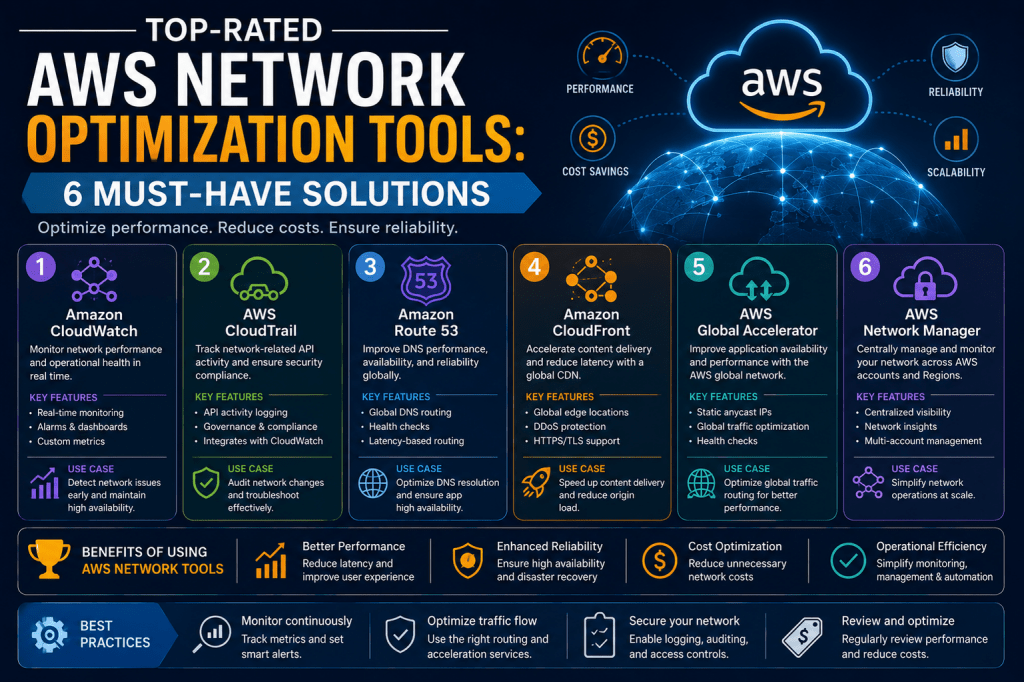
Cloud-based systems depend heavily on efficient networking to ensure consistent application performance, low latency, and reliable data transfer across distributed environments. As workloads scale and architectures become more complex, optimizing network behavior becomes a critical operational requirement rather than an optional enhancement. Amazon Web Services provides a wide set of networking capabilities designed to improve visibility, performance, and control across cloud environments. These tools allow engineers to monitor traffic patterns, automate infrastructure deployment, reduce network bottlenecks, and design scalable architectures that support both cloud-native and hybrid systems. The following sections explain six key services used to optimize network performance and reliability in cloud deployments.
Amazon CloudWatch for Network Observability and Performance Monitoring
Amazon CloudWatch is a foundational service for collecting, analyzing, and visualizing operational data across cloud environments, including detailed network metrics. It provides continuous monitoring of resources such as compute instances, load balancers, and virtual networks, enabling engineers to identify performance degradation before it impacts applications. Through metrics and logs, it becomes possible to observe traffic flow patterns, packet loss behavior, and latency variations across different services. One of its strengths is the ability to correlate network performance data with application-level behavior, helping teams isolate root causes of performance issues. CloudWatch also supports specialized monitoring features for network visibility, including tracking connectivity between cloud and on-premises environments and analyzing internet-facing traffic behavior. Alarm configurations allow automated responses when performance thresholds are exceeded, reducing manual intervention during incidents. This proactive monitoring approach supports continuous optimization by making network inefficiencies visible and measurable, which is essential for maintaining high-performing distributed systems.
AWS CloudFormation for Infrastructure Automation and Network Consistency
AWS CloudFormation enables the creation and management of infrastructure through declarative configuration templates, making it an important tool for consistent network deployment. Instead of manually configuring network components, engineers define desired infrastructure states in structured templates that can be repeatedly deployed across environments. This includes virtual private networks, subnets, routing configurations, gateways, and security boundaries. By treating infrastructure as code, CloudFormation reduces configuration drift and ensures that network architectures remain consistent across development, testing, and production environments. This consistency improves reliability and simplifies troubleshooting because every deployment follows a predictable structure. It also supports scalability by allowing entire network architectures to be replicated across multiple regions with minimal manual effort. Version control of infrastructure definitions further enhances operational stability, enabling teams to track changes and roll back configurations when necessary. As networks grow in complexity, automated infrastructure provisioning becomes essential for maintaining performance and governance across distributed systems.
AWS Direct Connect for High-Performance Hybrid Connectivity
AWS Direct Connect provides dedicated network connections between on-premises environments and cloud infrastructure, offering a more stable alternative to internet-based communication paths. By bypassing public internet routing, it delivers more consistent bandwidth, reduced latency, and improved reliability for hybrid workloads. This makes it particularly valuable for organizations that require predictable network performance for data-intensive applications or real-time processing systems. The dedicated nature of the connection helps reduce exposure to network congestion and external variability, improving throughput stability. It also enables secure data transfer over private network links, which can enhance compliance and operational control. Organizations often use Direct Connect to support large-scale data migrations, hybrid application architectures, and backup systems that depend on continuous connectivity. By integrating with other networking services, it can also support multi-region architectures and centralized network management. The result is a more controlled and efficient connectivity layer between cloud and on-premises systems, improving overall network reliability.
AWS Global Accelerator for Traffic Routing Optimization and Reduced Latency
AWS Global Accelerator improves application performance by directing user traffic through optimized pathways across the AWS global network infrastructure. Instead of relying solely on the public internet, it routes traffic through AWS edge locations and internal backbone networks, reducing variability and improving response times. It assigns static entry points that remain consistent even if backend resources change, simplifying connectivity management. This service is particularly useful for globally distributed applications where users connect from multiple geographic regions and expect consistent performance. By dynamically routing traffic to the nearest healthy endpoint, it reduces latency and improves availability during regional disruptions. It also supports automatic failover mechanisms, ensuring uninterrupted access to services even when infrastructure components experience issues. The ability to influence traffic routing at a global level allows organizations to optimize user experience and maintain consistent performance under varying network conditions.
Amazon VPC Traffic Mirroring for Deep Packet Inspection and Diagnostics
Amazon VPC Traffic Mirroring enables the capture and replication of network traffic flowing through virtual network interfaces for analysis and monitoring. This allows engineers to inspect packet-level data without interrupting production traffic, providing deep visibility into network behavior. It is commonly used for security analysis, anomaly detection, and troubleshooting complex network issues that cannot be identified through high-level metrics alone. By replicating traffic to analysis tools, teams can examine protocol-level interactions, detect unusual patterns, and investigate performance bottlenecks in detail. Filtering capabilities allow selection of specific traffic types based on criteria such as ports, protocols, or source destinations, improving analysis efficiency. This granular visibility is especially valuable in environments where security monitoring and performance optimization must operate together. Traffic mirroring enhances diagnostic capabilities by enabling real-time inspection of network flows, making it easier to identify misconfigurations, latency sources, and potential security risks.
AWS Transit Gateway for Centralized and Scalable Network Architecture
AWS Transit Gateway acts as a central routing hub that simplifies the interconnection of multiple virtual private networks and hybrid network environments. Instead of managing complex point-to-point connections between networks, it enables a hub-and-spoke architecture where all connected networks communicate through a central gateway. This significantly reduces routing complexity and simplifies network management in large-scale environments. It supports thousands of network attachments, allowing organizations to scale their cloud infrastructure without redesigning network topology. Transit Gateway also integrates with hybrid connectivity options, enabling seamless communication between cloud and on-premises systems. Centralized routing control improves visibility and governance over traffic flows, making it easier to enforce network policies and optimize data paths. This architecture enhances operational efficiency by reducing the overhead associated with managing multiple isolated network connections. As organizations expand their cloud footprint, Transit Gateway provides a scalable foundation for maintaining structured and efficient network communication.
Final Perspective on Network Optimization in Cloud Environments
Optimizing cloud networking requires a combination of monitoring, automation, connectivity design, and traffic management strategies. Each of the tools discussed contributes to different aspects of network performance improvement, from real-time observability to architectural scalability. Monitoring systems provide visibility into network behavior, automation ensures consistency in deployment, dedicated connectivity improves reliability, and intelligent routing enhances global performance. Deep traffic inspection allows detailed diagnostics, while centralized routing simplifies large-scale architectures. When used together, these capabilities form a comprehensive framework for building resilient and high-performing cloud networks capable of supporting modern application demands.
In addition, continuous optimization plays a key role as workloads evolve and user demands change over time. Network performance is not a one-time configuration but an ongoing process that requires regular analysis of traffic patterns, latency trends, and resource utilization. Adaptive configurations help ensure that infrastructure remains efficient under varying load conditions. Security considerations also integrate closely with optimization efforts, as secure traffic handling and anomaly detection contribute to both stability and performance. By combining proactive monitoring, scalable architecture design, and intelligent traffic management, organizations can maintain robust cloud networks that consistently deliver reliable performance at scale.