
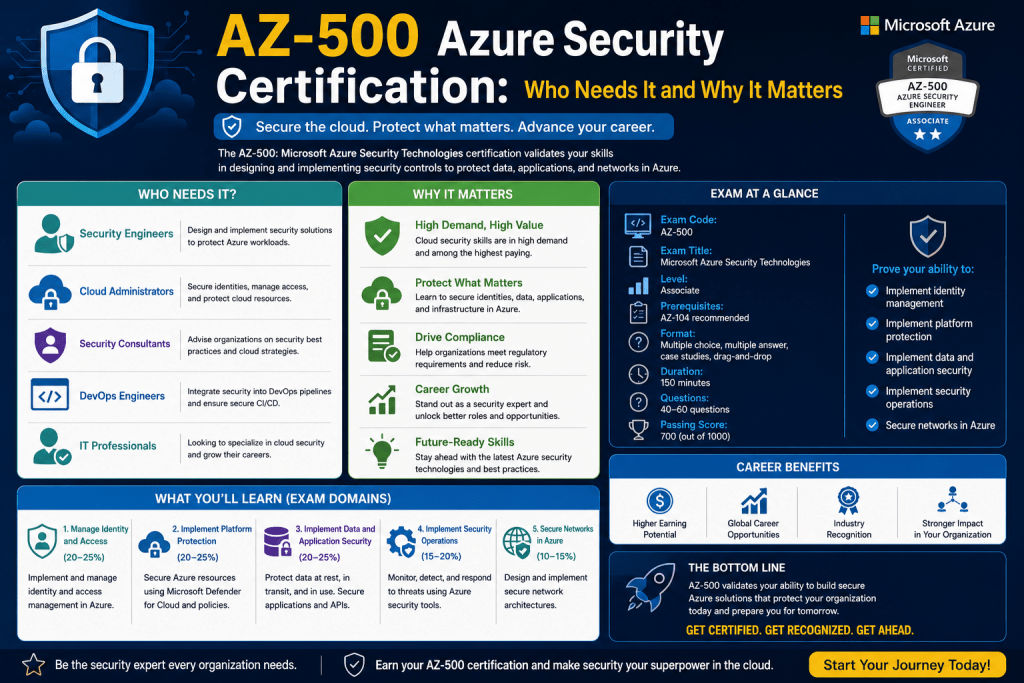
The AZ-500 certification is widely regarded as one of the most focused and technically demanding credentials within the Microsoft Azure ecosystem. It is designed around the principles of cloud security, identity protection, threat detection, and compliance management in Azure environments. Unlike foundational or entry-level certifications, this credential assumes that candidates already possess working knowledge of cloud infrastructure and are ready to specialize in securing it. In today’s environment, where organizations increasingly rely on cloud platforms to store, process, and protect sensitive information, security expertise has become a critical requirement rather than an optional skill.
The AZ-500 stands out because it validates practical ability in implementing security controls rather than just theoretical understanding. This makes it particularly relevant for professionals who aim to strengthen their credibility in cloud security roles or transition into more specialized positions within cybersecurity and cloud operations. However, despite its importance, many individuals are uncertain about whether this certification aligns with their career path. Understanding who benefits most from pursuing it requires examining different professional backgrounds and goals, especially those related to cybersecurity expertise, cloud computing interests, and career advancement ambitions.
Candidates with a Strong Interest in Cybersecurity
One of the most suitable groups for the AZ-500 certification includes individuals who are actively interested in cybersecurity or already working in security-focused roles. Cybersecurity is no longer a niche discipline; it has become a core function of modern IT operations due to the rising frequency and sophistication of digital threats. Cloud platforms, while efficient and scalable, introduce new vulnerabilities that require specialized knowledge to mitigate effectively. The AZ-500 is structured to address exactly these challenges by focusing on securing identity systems, managing access controls, protecting data, and configuring threat protection mechanisms within Azure environments. Candidates with an interest in cybersecurity will find that this certification aligns closely with their professional development because it emphasizes defensive strategies rather than offensive or theoretical concepts alone.
Individuals in this category are typically expected to have some familiarity with basic cloud concepts before attempting the certification. While it is possible for newcomers to eventually pursue it, having a foundational understanding of cloud computing significantly improves readiness. Many cybersecurity professionals begin their journey with general IT or network security roles and gradually move toward cloud security specialization. For them, the AZ-500 acts as a bridge between traditional security practices and modern cloud-based defense strategies. It reinforces essential skills such as monitoring security events, configuring identity governance systems, and managing secure access across distributed environments.
This certification is particularly valuable for those who want to deepen their understanding of identity and access management, which is one of the most critical aspects of cybersecurity today. In cloud environments, identity has effectively become the new perimeter, replacing traditional network boundaries. The AZ-500 emphasizes this shift by requiring candidates to understand how authentication, authorization, and privilege management operate within Azure. Professionals who are passionate about strengthening their cybersecurity expertise will find that this certification not only validates their skills but also expands their ability to handle complex security challenges in real-world environments.
Candidates Focused on Cloud Computing and Infrastructure
Another group that benefits significantly from the AZ-500 certification includes individuals who are focused on cloud computing and infrastructure management. Cloud computing has transformed how organizations build, deploy, and maintain applications and services. Instead of relying on traditional on-premises infrastructure, businesses now operate in highly scalable and distributed cloud environments. However, this transformation has also introduced new security risks, particularly related to misconfiguration, improper access control, and inadequate monitoring. The AZ-500 addresses these concerns by training professionals to secure cloud workloads effectively within Azure.
Candidates in this category are often IT professionals, system administrators, or infrastructure engineers who already work with cloud platforms or are transitioning into cloud-related roles. Their interest lies not only in deploying cloud resources but also in ensuring that those resources remain secure throughout their lifecycle. The AZ-500 is particularly relevant to them because it covers practical security implementations such as configuring virtual network security, managing secure communication channels, and enforcing organizational security policies across cloud environments. These skills are essential for maintaining a secure and stable cloud infrastructure.
For individuals who are still developing their cloud knowledge, it is generally beneficial to first gain familiarity with basic cloud concepts and Azure services before pursuing the AZ-500. Understanding how virtual machines, storage systems, networking components, and identity services interact within Azure provides a strong foundation for advanced security concepts. Without this baseline knowledge, some aspects of the certification may feel complex, particularly those involving the integration of multiple security tools and services.
Cloud computing professionals also benefit from understanding how security integrates into broader infrastructure design. The AZ-500 emphasizes this integration by focusing on real-world scenarios where security is not an isolated function but a core component of system architecture. For example, securing a cloud environment involves not only setting up firewalls or access controls but also ensuring that monitoring systems are properly configured to detect anomalies and respond to threats. This holistic approach makes the certification especially valuable for those aiming to work in cloud architecture or infrastructure security roles.
Candidates Seeking Career Growth and Professional Advancement
A third category of individuals who should consider the AZ-500 certification includes those who are focused on career advancement, job transitions, or salary growth within the IT industry. In competitive job markets, professional certifications serve as strong indicators of validated skills and commitment to continuous learning. Employers often view certifications as evidence that a candidate has invested time and effort into mastering specific technologies or disciplines. The AZ-500, in particular, demonstrates expertise in one of the most in-demand areas of IT: cloud security.
For professionals looking to move beyond entry-level positions, this certification can serve as a significant differentiator. Many IT roles, such as support technicians or general system administrators, provide exposure to infrastructure management but may not offer deep involvement in security operations. The AZ-500 allows individuals in these roles to demonstrate readiness for more advanced responsibilities by proving their ability to manage and secure cloud environments effectively. This can open opportunities for positions that involve greater responsibility, such as cloud security engineering, security operations, or infrastructure protection roles.
From a career development perspective, organizations increasingly prioritize candidates who can contribute to both operational efficiency and security resilience. As cloud adoption continues to expand, businesses face growing pressure to protect sensitive data while maintaining system performance and availability. Professionals who can balance these requirements are highly valued. The AZ-500 certification signals that an individual is capable of addressing these dual priorities by implementing security measures that do not compromise system functionality.
Another important aspect of career growth associated with this certification is its relevance to organizational needs. Many companies struggle to find qualified professionals who can effectively manage cloud security environments. This skills gap creates opportunities for certified individuals to step into roles where demand is high and expertise is limited. As a result, obtaining the AZ-500 can significantly enhance visibility within the job market and increase access to more specialized and higher-responsibility positions.
Practical Skills and Knowledge Areas Covered
Beyond identifying suitable candidates, it is important to understand the type of knowledge the AZ-500 develops. The certification focuses heavily on practical implementation rather than theoretical concepts. It requires familiarity with securing identities, managing security operations, protecting data, and configuring platform security settings within Azure. Candidates are expected to understand how to implement multi-layered security strategies that address both internal and external threats.
Key areas include identity management, where professionals learn how to control access to resources through authentication and authorization mechanisms. Another important area is platform protection, which involves securing compute, network, and storage resources against unauthorized access. Security operations are also a major focus, emphasizing monitoring, threat detection, and response strategies. Finally, data and application security ensure that sensitive information is protected both at rest and in transit.
These skill areas are interconnected, reflecting the reality of modern cloud environments where security cannot be implemented in isolation. Instead, it must be integrated across all layers of infrastructure. Professionals who master these concepts gain the ability to design and maintain secure cloud systems that meet organizational and regulatory requirements.
Conclusion
The AZ-500 certification is designed for individuals who want to specialize in securing cloud environments within Microsoft Azure. It is particularly well-suited for those with a strong interest in cybersecurity, professionals engaged in cloud computing and infrastructure management, and individuals seeking to advance their careers in the IT industry. Rather than serving as an introductory credential, it functions as an advanced validation of skills that are increasingly essential in modern digital environments. As organizations continue to expand their reliance on cloud technologies, the demand for professionals capable of securing these systems will continue to grow. The AZ-500 represents a structured pathway for developing and demonstrating those capabilities, making it a relevant and strategic choice for professionals aiming to strengthen their expertise and long-term career prospects in cloud security.