
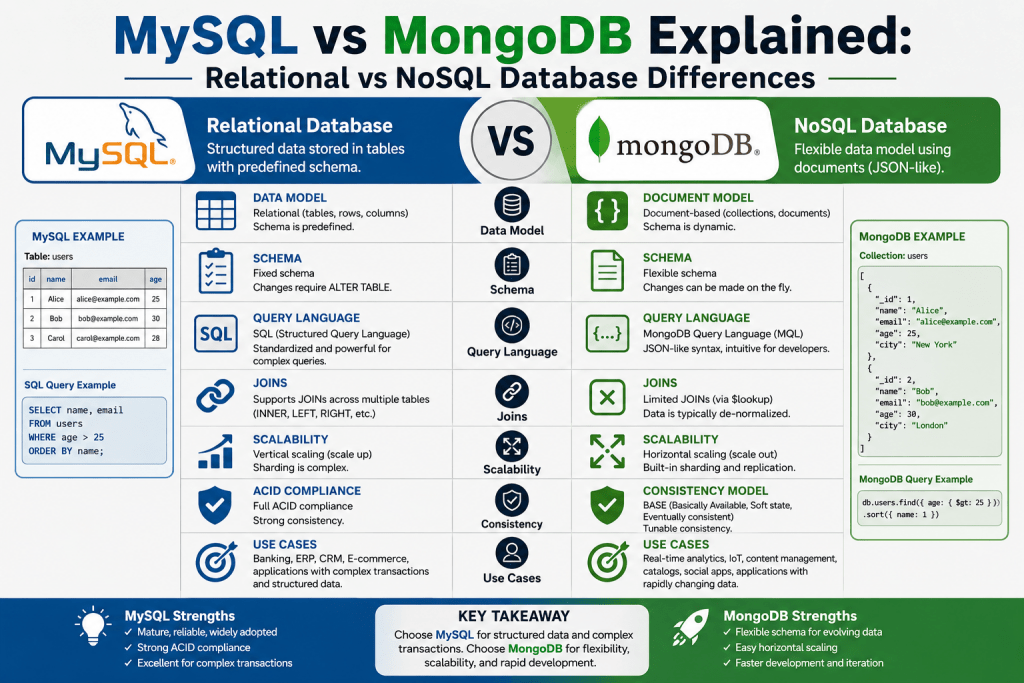
Database selection plays a foundational role in application design because it directly influences how efficiently data is stored, accessed, and scaled as systems grow. Choosing between relational and non-relational databases is not only a technical decision but also a structural one that shapes performance, flexibility, and long-term maintainability. MySQL and MongoDB are two widely used database systems that represent fundamentally different approaches to data management. Understanding how each works helps clarify where they fit best in modern development environments.
MySQL Overview
MySQL is a relational database management system designed around structured data organization. It stores information in tables made up of rows and columns, where relationships between data entities are defined using keys. This structure ensures consistency and predictability in how data is stored and retrieved. MySQL relies on Structured Query Language for performing operations such as inserting, updating, deleting, and querying records. Its relational model is especially useful when data integrity and strict schema definitions are important.
MySQL has been widely adopted across industries due to its reliability, maturity, and performance in handling structured workloads. It is commonly used in systems where relationships between entities are clearly defined, such as financial applications, inventory systems, and traditional business applications. The strict schema approach ensures that data follows predefined rules, reducing inconsistencies in stored information.
MySQL Architecture and Storage
MySQL organizes data in a disk-based storage format where tables are stored in structured blocks. Each table consists of rows that represent records and columns that represent attributes of those records. This layout allows efficient sequential access and structured querying. The storage engine commonly used in MySQL supports transactional integrity, ensuring that operations either complete fully or not at all.
The architecture is optimized for consistency and structured access patterns. Data is stored in a way that allows the database engine to retrieve records efficiently when queries are properly indexed. However, the rigid structure requires that schema definitions be established before data insertion, making schema changes more controlled and deliberate.
MySQL Indexing and Transactions
Indexing in MySQL is a mechanism used to improve query performance by reducing the amount of data scanned during search operations. Indexes act as lookup structures that allow the database to quickly locate specific records. While indexing improves read performance significantly, it introduces overhead during write operations because indexes must be updated whenever data changes.
Transactions in MySQL ensure data integrity by grouping multiple operations into a single unit of work. If any part of the transaction fails, the entire operation can be rolled back to maintain consistency. This makes MySQL highly reliable in environments where accuracy is critical. The system supports different levels of transaction control, allowing flexibility in how changes are committed and managed.
MongoDB Overview
MongoDB is a NoSQL database designed to handle unstructured or semi-structured data using a document-oriented approach. Instead of tables, it stores data in flexible documents that resemble JSON structures. Each document can contain nested fields and varying data formats, allowing for a more dynamic schema design. This flexibility makes MongoDB suitable for applications where data requirements evolve frequently or are not strictly predefined.
MongoDB was developed to address limitations found in traditional relational databases when dealing with large-scale, rapidly changing datasets. It emphasizes scalability, flexibility, and ease of development in distributed environments.
MongoDB Data Model and Storage
MongoDB stores data in collections, where each collection contains multiple documents. Unlike relational systems, documents within a collection do not need to follow a uniform structure. This allows developers to store different types of data in the same collection without rigid schema constraints.
The storage model is optimized for horizontal scaling and high write throughput. Each document contains all related data, reducing the need for complex joins during queries. This denormalized structure improves read performance in many scenarios but may lead to data duplication in certain designs.
MongoDB’s flexible schema allows developers to modify data structures without requiring extensive database migrations, which is particularly useful in agile development environments.
MongoDB Operations and Transactions
MongoDB supports operations on individual documents as well as grouped operations through transactions. Although historically less transaction-focused than relational systems, modern versions include support for multi-document transactions. These transactions ensure consistency when multiple related operations must succeed or fail together.
Instead of relying heavily on joins, MongoDB encourages embedding related data within documents or referencing it in a way that simplifies retrieval. This design reduces query complexity but shifts some responsibility for data modeling to the application layer.
Key Architectural Differences
The core difference between MySQL and MongoDB lies in how they structure and manage data. MySQL uses a structured relational model where data is organized into predefined tables with strict schemas. MongoDB uses a flexible document model where each record can have a different structure.
MySQL emphasizes consistency and relationships, making it suitable for systems where data integrity is critical. MongoDB emphasizes flexibility and scalability, making it suitable for rapidly evolving applications and large-scale distributed systems. These differences influence everything from query design to system scalability and maintenance strategies.
Performance Considerations
Performance in MySQL is often strongest in structured query environments where relationships between tables are well-defined and properly indexed. It performs efficiently in transactional systems with predictable query patterns. However, performance can degrade when handling large volumes of unstructured or highly variable data due to the overhead of joins and schema enforcement.
MongoDB performs well in scenarios involving large-scale data ingestion and flexible querying. Its document-based structure allows faster reads in cases where related data is stored within a single document. Since it avoids complex joins, query execution can be faster for certain workloads. However, performance depends heavily on how data is modeled, and poorly designed schemas can lead to inefficiencies.
Scalability Considerations
Scalability is one of the most significant differences between the two systems. MySQL traditionally scales vertically by increasing hardware resources such as CPU, memory, and storage. While replication and clustering techniques exist, scaling horizontally can be more complex.
MongoDB is designed with horizontal scaling in mind. It supports sharding, which distributes data across multiple servers. This makes it easier to handle large datasets and high traffic loads by adding more nodes to the system. This architecture allows MongoDB to scale more naturally in distributed environments.
Security Considerations
Both systems offer strong security mechanisms, including encryption and access control. MySQL uses role-based access control to define user permissions and supports secure connections through encryption protocols. Its mature ecosystem provides well-established security practices for enterprise environments.
MongoDB also implements role-based access control and supports encryption for data in transit and at rest. Additionally, it provides configurable authentication mechanisms and fine-grained access policies. Both systems can be secured effectively when properly configured, and security differences are generally dependent on implementation rather than inherent design limitations.
Data Modeling and Flexibility
Data modeling in MySQL requires careful planning due to its rigid schema structure. Relationships must be defined in advance, and changes to structure often require migrations. This makes it ideal for systems where data relationships are stable and well understood.
MongoDB offers greater flexibility in data modeling. Since documents do not require a fixed schema, developers can adapt structures as application requirements evolve. This makes it suitable for projects with rapidly changing requirements or diverse data types. However, this flexibility requires disciplined design to avoid inconsistency and redundancy.
Developer Experience and Usability
MySQL has a steeper learning curve for those unfamiliar with relational database concepts. Understanding normalization, relationships, and SQL syntax is essential for effective use. However, it provides powerful querying capabilities and strong data consistency guarantees once mastered.
MongoDB is often considered more approachable for developers due to its flexible schema and JSON-like structure. It allows faster iteration during development because schema constraints are minimal. This can speed up prototyping and development cycles, especially in agile environments.
Use Case Considerations
MySQL is commonly used in applications where data relationships are complex and consistency is critical. Examples include financial systems, enterprise applications, and structured reporting systems. Its reliability and structured nature make it suitable for environments where accuracy is essential.
MongoDB is often used in applications requiring flexibility and scalability, such as content management systems, real-time analytics, and applications dealing with large volumes of unstructured data. Its ability to handle evolving data structures makes it suitable for modern web and mobile applications.
Final Thoughts
MySQL and MongoDB represent two different philosophies in database design, each optimized for specific types of workloads. MySQL focuses on structured data, consistency, and relational integrity, making it ideal for traditional applications with stable schemas. MongoDB focuses on flexibility, scalability, and ease of handling unstructured data, making it suitable for dynamic and large-scale systems. The choice between them depends on the nature of the application, the structure of the data, and the expected growth of the system. Both remain widely used and valuable tools in modern software development, and understanding their strengths allows for more informed architectural decisions.