
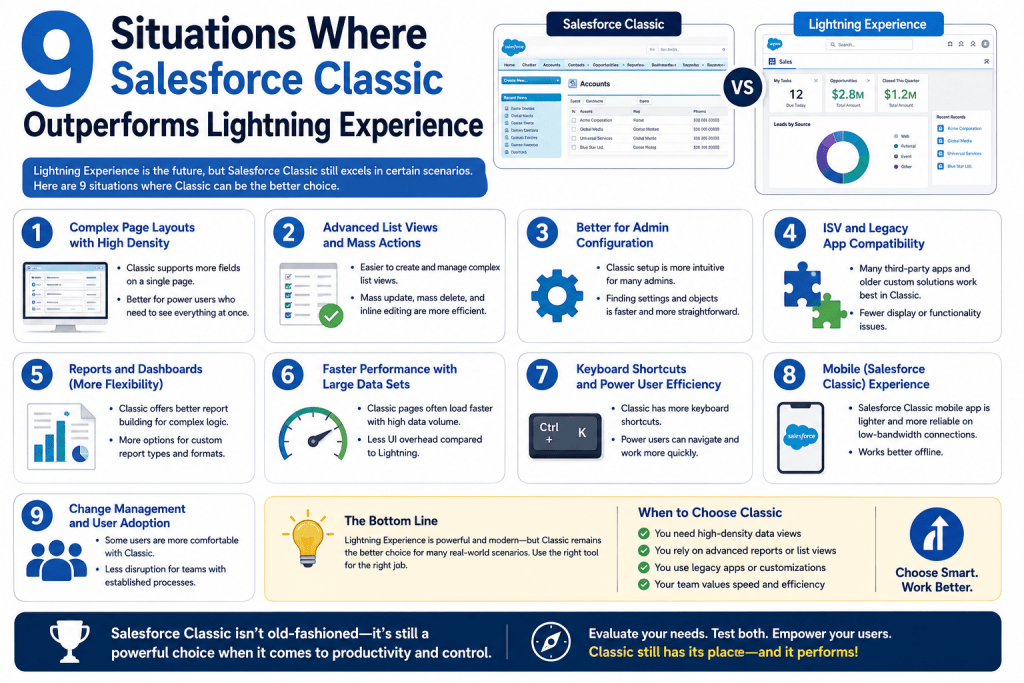
Modern business operations increasingly rely on digital systems that can centralize information, improve collaboration, and reduce manual effort. Customer relationship management platforms have become central to this transformation, helping teams manage sales pipelines, customer communication, and performance tracking in a structured environment. Among these platforms, Salesforce provides two widely discussed interfaces: a legacy version often referred to as Classic and a more modern environment commonly known as Lightning. While both serve the same foundational purpose of managing customer data and business processes, their capabilities and user experiences differ significantly. Understanding when and why to transition toward a more modern interface is essential for organizations aiming to improve efficiency and scalability. The following sections explore key indicators that suggest when adopting a more advanced CRM experience becomes beneficial, along with a deeper comparison of how traditional and modern systems handle everyday business challenges.
Understanding the Difference Between Classic and Lightning Experiences
The older interface presents a more traditional layout focused on text-heavy navigation and a relatively static design structure. It performs core CRM functions such as managing accounts, contacts, and opportunities, but often requires more manual effort and lacks fluid interactivity. In contrast, the modern interface introduces a more dynamic and visually organized environment designed to improve usability and reduce complexity. It incorporates modular components, allowing users to customize pages and workflows without extensive technical expertise. The modern environment also integrates intelligent features that support decision-making through data insights and automation. While the older system still functions for basic operations, it is increasingly considered a foundational layer rather than a forward-looking solution. This difference becomes important as organizations scale and require more adaptive tools to manage growing data complexity and faster decision cycles.
Challenges in Managing Customer Communication
One of the earliest signs that a more advanced CRM environment is needed arises when communication with clients becomes difficult to track. Many organizations struggle with scattered email threads, missed responses, or lack of visibility into past interactions. Without centralized tracking, important messages may be lost or forgotten, leading to inconsistent customer experiences. A more advanced system addresses this by linking communication directly to customer records, ensuring that every interaction is stored in context. This makes it easier to revisit conversations, understand customer needs, and maintain continuity across teams. When communication begins to feel disorganized or reactive rather than structured and proactive, it indicates that the existing tools are no longer sufficient for maintaining professional engagement at scale.
Difficulty in Managing Sales Opportunities
Another clear indicator emerges when tracking potential deals becomes unreliable or inconsistent. In many organizations, opportunities may be recorded in spreadsheets, notebooks, or informal notes, increasing the risk of losing track of important prospects. As sales processes grow more complex, this fragmented approach leads to missed follow-ups and unclear pipeline visibility. A more structured CRM environment allows opportunities to be tracked through defined stages, making it easier to understand where each deal stands. It also enables teams to assign tasks, set reminders, and maintain accountability across the sales cycle. When sales progress begins to depend on memory or informal tracking methods, it becomes a strong signal that a more centralized system is required to maintain consistency and improve conversion rates.
Inefficiency in Sending Customer Communications at Scale
Manual communication with large groups of customers often becomes time-consuming as business operations expand. Sending messages individually not only slows down workflows but also increases the likelihood of inconsistency in messaging. This inefficiency can reduce productivity and limit the ability to engage customers at the right time. A more advanced CRM approach supports structured communication strategies that allow messages to be organized, personalized, and distributed efficiently. By connecting messaging activities with customer records and workflows, businesses can maintain both scale and personalization. When communication processes begin to consume excessive time or create bottlenecks, it becomes evident that automation and centralized messaging tools are necessary for sustained efficiency.
Need for Greater Flexibility in System Design
Businesses often evolve in ways that standard systems cannot fully accommodate. When existing tools force teams to adapt their processes to the system rather than the system adapting to the business, inefficiencies begin to appear. A flexible CRM environment allows customization of layouts, fields, and workflows so that different departments can operate according to their unique requirements. This adaptability is especially important for organizations with specialized processes or rapidly changing operational needs. When employees find themselves working around system limitations rather than within a supportive structure, it suggests that a more configurable environment is needed to support long-term growth and operational alignment.
Lack of Visibility Into Sales Pipeline Progress
Without clear visibility into the sales pipeline, organizations may struggle to forecast revenue or evaluate performance effectively. Relying on manual tracking methods or disconnected tools makes it difficult to understand how deals are progressing over time. This lack of clarity can impact strategic planning and resource allocation. A more advanced CRM structure provides a consolidated view of all opportunities, allowing teams to monitor progress, identify bottlenecks, and adjust strategies accordingly. It also supports historical analysis, helping businesses understand trends and patterns in their sales cycles. When pipeline management becomes unclear or inconsistent, it is a strong indication that improved visibility tools are necessary.
Difficulty Understanding Revenue Performance
Another sign that a more advanced system is needed appears when revenue tracking becomes fragmented or overly manual. Organizations may rely on multiple systems or spreadsheets to calculate performance, leading to inconsistencies and delayed insights. This can make it difficult to assess business health or make informed decisions. A centralized CRM environment enables structured reporting and real-time visibility into financial performance. It allows users to filter, analyze, and compare data across different time periods or categories. When understanding revenue requires excessive manual effort or cross-referencing multiple sources, it becomes clear that a more integrated system is necessary to support accurate decision-making.
Fragmented Data Across Multiple Tools
Many organizations experience inefficiencies when customer data is spread across multiple platforms such as email clients, spreadsheets, and separate databases. This fragmentation creates barriers to collaboration and increases the risk of outdated or inconsistent information. A centralized CRM system resolves this by bringing all customer-related data into a single environment. This ensures that teams are working with the same information and reduces duplication of effort. It also improves accessibility, allowing employees to retrieve relevant data quickly from any location. When data becomes difficult to locate or verify, it indicates that consolidation is necessary to improve operational efficiency and reliability.
Overwhelming Meeting and Activity Management
As teams grow, managing daily activities such as meetings, calls, and follow-ups can become increasingly complex. Without proper tracking, it becomes difficult to understand what actions have been completed and what still requires attention. This can lead to misalignment between team members and missed opportunities. A structured CRM system provides visibility into activity history, allowing managers to monitor progress without constant direct oversight. It also helps ensure accountability by recording interactions tied to specific accounts or opportunities. When managing daily tasks becomes overwhelming or unclear, it signals that better activity tracking is required to maintain organizational efficiency.
Risk of Data Loss and Lack of Centralized Storage
One of the most critical signs that an organization needs a more advanced CRM environment is the risk associated with data loss. Storing information on local devices or disconnected systems increases vulnerability to technical failures, accidental deletions, or hardware issues. When important customer or sales data is lost, it can significantly disrupt operations. A centralized cloud-based structure reduces this risk by ensuring that information is securely stored and regularly maintained. It also allows for data recovery and backup processes that protect against unexpected disruptions. When data security and reliability become concerns, adopting a centralized system becomes essential for continuity and resilience.
Conclusion
As organizations grow, their operational complexity naturally increases, requiring more structured and scalable systems to manage customer relationships, sales processes, and internal collaboration. Signs such as fragmented communication, inconsistent opportunity tracking, inefficient manual processes, and limited visibility into performance all point toward the need for a more advanced CRM approach. Transitioning to a more modern and flexible environment allows businesses to streamline operations, improve data accuracy, and enhance decision-making capabilities. Ultimately, the goal is not just to adopt new tools, but to create a more connected and efficient workflow that supports long-term growth and adaptability in an evolving business landscape.