
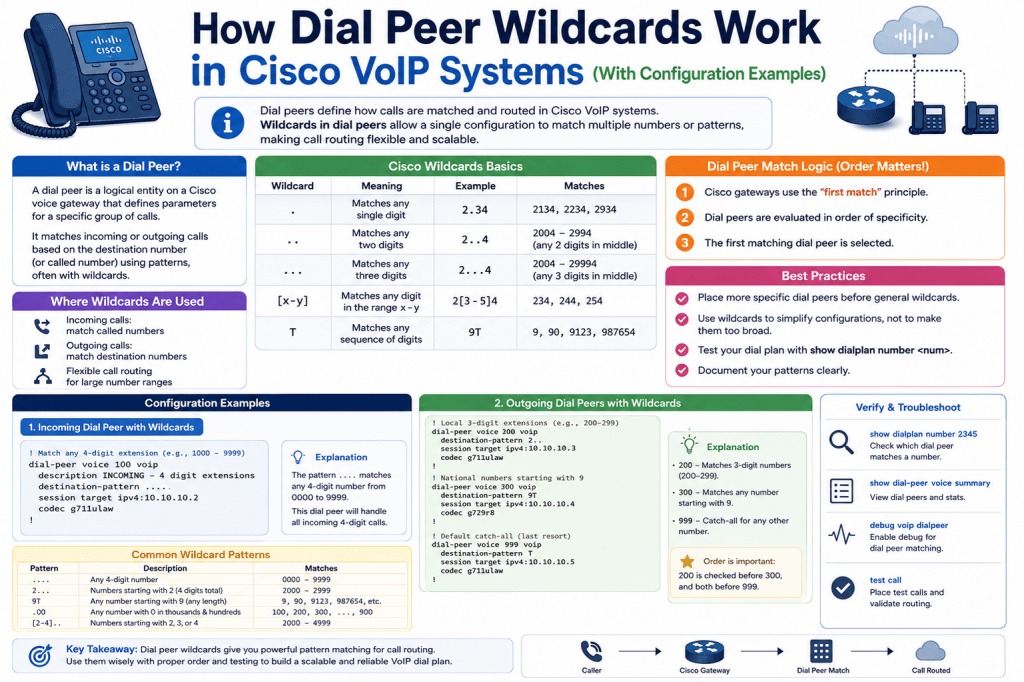
Configuring call routing policies in a voice gateway environment can quickly become complex when every possible number pattern has to be defined individually. In large-scale telephony systems, manually entering every dialable number is inefficient and prone to errors. Dial peer wildcards provide a structured way to simplify this process by allowing pattern-based definitions instead of static entries. In Cisco CUBE environments, these wildcards play a central role in building scalable and manageable dial plans. Rather than treating each phone number as a unique entry, wildcards enable administrators to define rules that match ranges or patterns of numbers. This approach significantly reduces configuration overhead while maintaining precise control over call routing behavior.
Understanding the Role of Dial Peers in Cisco CUBE
Before examining wildcards, it is important to understand dial peers themselves. In Cisco CUBE, dial peers function as routing instructions that determine how voice calls are handled. Each dial peer defines criteria such as the destination pattern, the type of call (voice, VoIP, or POTS), and the next hop for call forwarding. When a call is initiated, the system evaluates available dial peers and selects the most appropriate match based on the dialed number. Without wildcards, each dial peer would need to correspond to a very specific number or prefix, which is not practical in real-world deployments. Wildcards solve this limitation by enabling flexible matching logic within dial peer configurations.
How Wildcards Simplify Dial Plan Design
Wildcards introduce abstraction into dial plan design. Instead of defining every possible extension or external number, administrators can specify patterns that represent entire groups of numbers. This is especially useful in environments where numbering plans follow predictable structures, such as area codes, internal extensions, or service prefixes. By using wildcards, dial plans become more dynamic and easier to maintain. Changes in numbering schemes can often be accommodated by adjusting a single pattern rather than modifying hundreds or thousands of entries. This scalability is one of the main reasons wildcards are widely used in enterprise voice networks.
Dot Notation for Single-Digit Flexibility
One of the simplest wildcard mechanisms in Cisco CUBE is dot notation. A dot represents a single numeric digit from 0 to 9. When placed within a dial peer pattern, each dot acts as a placeholder for any valid digit in that position. For example, a pattern like 20.. represents any number starting with 20 followed by two additional digits. This means it can match numbers ranging from 2000 to 2099. The strength of dot notation lies in its predictability and simplicity, making it ideal for straightforward range-based matching where each position can vary independently. Another example such as 2.55 allows for flexibility in the second digit while keeping the remaining structure fixed, enabling matches like 2055 or 2955 depending on system interpretation.
Plus Notation for Extended Digit Matching
Plus notation extends wildcard functionality by allowing repetition of the preceding digit or pattern. Unlike dot notation, which restricts each position to a single digit placeholder, plus notation enables variable-length matching. For instance, a pattern like 5+23 can match multiple number sequences where the digit 5 repeats one or more times before the fixed sequence 23. This could include 5523, 55523, or even longer variations depending on how many times the repeating digit appears. Plus notation is particularly useful in scenarios where numbering schemes are inconsistent in length but follow a recognizable prefix or structure. It allows administrators to accommodate variable-length dialing patterns without defining each possible combination individually.
Bracket Notation for Controlled Digit Ranges
Bracket notation provides a more precise method for defining allowable digits in a specific position. Instead of accepting any digit from 0 to 9, bracket notation restricts matches to a defined set or range. For example, a pattern like [1-3]22 matches only numbers where the first digit is 1, 2, or 3, followed by the fixed sequence 22. This results in possible matches such as 122, 222, or 322. This level of control is useful when dial plans must align with structured numbering systems where only certain prefixes are valid. Bracket notation effectively combines flexibility with strict validation rules, making it one of the most powerful wildcard tools in dial peer configuration.
Using Ranges and Lists Inside Brackets
Bracket notation can also support more complex definitions beyond simple ranges. Multiple digits can be included within a single bracket set, allowing for non-consecutive matches. For example, a pattern such as [14-6]22 can be interpreted as allowing specific digits like 1, 4, 5, and 6 in the first position, followed by 22. This enables administrators to construct highly specific routing rules without defining multiple separate dial peers. By carefully selecting allowed digits, network designers can enforce dialing policies that align with organizational or regional numbering constraints while still maintaining configuration efficiency.
Excluding Digits Using Negation in Brackets
In addition to inclusion, bracket notation also supports exclusion. By using a negation symbol inside brackets, specific digits or ranges can be excluded from matching. For example, a pattern like [^0-7]22 excludes all digits from 0 through 7 in the first position, allowing only 8 or 9 to match. This results in valid matches such as 822 or 922. Exclusion-based patterns are particularly useful when certain number ranges are reserved for system services, emergency codes, or restricted routing paths. Instead of listing every allowed digit, exclusion simplifies configuration by defining only what should not be matched.
T Notation for End-of-Dialing Detection
T notation introduces time-based logic into dial peer matching. When a pattern ends with T, it signals the system to wait for the user to finish dialing before processing the call. This is commonly used in variable-length dialing scenarios where the system cannot determine the end of the number based solely on digit count. For example, a pattern like 011T is often associated with international dialing structures where the total number length can vary significantly. The system waits for a pause defined by the inter-digit timeout before executing the routing decision. This ensures that all digits are captured before call processing begins.
Understanding Inter-Digit Timeout Behavior
The inter-digit timeout is a timing mechanism that controls how long the system waits between digit inputs before assuming the user has finished dialing. When T notation is used, this timeout becomes critical because it determines when call routing is triggered. If the timeout is too long, users may experience delays after finishing dialing. If it is too short, the system may prematurely route incomplete numbers. Proper configuration of this parameter is essential for maintaining a balance between responsiveness and accuracy in call handling. In many environments, default timeout values are used initially and then adjusted based on user experience and dialing behavior patterns.
Combining Multiple Wildcards in a Single Dial Peer
One of the strengths of Cisco CUBE dial plan design is the ability to combine different wildcard types within a single pattern. This allows for highly expressive routing rules that can accommodate complex numbering systems. For example, a pattern like [1-3].. combines bracket notation with dot notation, meaning the first digit must be 1, 2, or 3, while the next two digits can be any value from 0 to 9. This results in a broad range of possible matches such as 139, 263, or 390. By combining wildcard types, administrators can create hierarchical dialing structures that reflect organizational policies or telephony standards without excessive configuration complexity.
Practical Considerations for Wildcard Design
When designing dial plans using wildcards, careful planning is necessary to avoid overlapping patterns or unintended matches. Since multiple dial peers can potentially match the same number, the system relies on specificity and preference rules to determine which one to use. More specific patterns generally take precedence over broader ones. It is also important to consider scalability, especially in large deployments where dial plans may evolve over time. Poorly designed wildcard structures can lead to routing ambiguity or maintenance challenges. A structured approach that categorizes patterns by function, region, or service type helps maintain clarity and operational stability.
Conclusion
Dial peer wildcards provide a powerful abstraction layer in Cisco CUBE environments, enabling flexible and scalable call routing configurations. By using dot notation, plus notation, bracket-based selection, exclusion rules, and time-based triggers like T notation, administrators can define complex dialing behavior without manually listing every possible number. These mechanisms reduce configuration effort, improve maintainability, and support large-scale telephony architectures. When combined thoughtfully, wildcard strategies allow dial plans to remain both efficient and adaptable to changing communication requirements.