The modern economy is driven by data generated from user activity, business operations, sensors, and digital platforms. A data scientist is responsible for converting this raw and often unstructured information into meaningful insights that guide decisions. The role sits at the intersection of statistics, programming, and business understanding, requiring both technical precision and practical thinking.
At a core level, a data scientist works with large datasets to identify patterns, build predictive models, and support strategic decisions. Unlike roles that focus primarily on reporting past performance, data scientists often focus on forecasting future outcomes. This includes estimating customer behavior, detecting anomalies, and improving operational efficiency.
The work typically involves cleaning and organizing messy datasets, selecting appropriate analytical methods, and building algorithms that can learn from data. These models are then tested and refined until they can reliably support real-world decision-making. Communication is also a key responsibility, as insights must be translated into clear recommendations for non-technical stakeholders.
Core Responsibilities and Day-to-Day Work
The daily activities of a data scientist vary depending on the organization, but they usually revolve around several recurring functions. Data preparation is one of the most time-consuming tasks, as real-world data is rarely clean or structured. This involves handling missing values, correcting inconsistencies, and merging datasets from different sources.
Once the data is ready, exploratory analysis is performed to understand trends and relationships. From there, statistical methods and machine learning techniques are applied to build models that can make predictions or classify information.
A significant portion of the role also involves experimentation. Data scientists often test different approaches to improve model accuracy and reliability. They may compare algorithms, tune parameters, and evaluate performance using validation techniques.
Finally, presenting findings is essential. This includes creating visual representations of data, writing reports, and explaining results in a way that aligns with business objectives.
Understanding Data Scientist Salaries
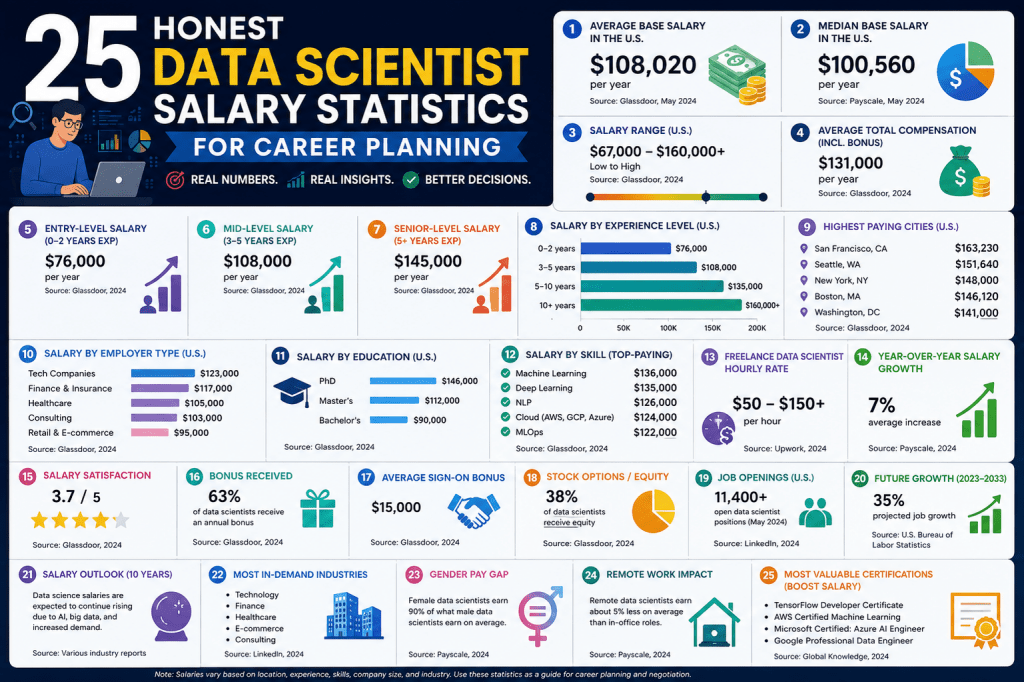
Compensation for data scientists is influenced by a combination of experience, skills, and geographic location. Salaries vary widely because the role exists across industries ranging from technology and finance to healthcare and retail.
On a broad scale, entry-level positions tend to start at moderate income levels compared to other technology roles, but growth potential is strong. Mid-level professionals typically see significant increases as they gain experience in building and deploying models. Senior-level professionals often command high compensation due to their ability to design systems, lead teams, and influence strategic direction.
In general, national salary ranges for data scientists show a progression from moderate earnings at the lower end of the experience scale to substantially higher compensation for experienced professionals. The difference between entry-level and senior roles can be substantial, reflecting both skill development and increased responsibility.
How Location Influences Earnings
Geographic location is one of the strongest factors affecting compensation. Areas with high concentrations of technology companies or financial institutions tend to offer higher salaries due to competition for skilled professionals. Urban centers with advanced digital economies generally pay more than smaller cities or regions with lower demand for data expertise.
In major metropolitan areas, salaries are typically higher but are also balanced by increased living costs. In contrast, smaller cities may offer lower base pay but can provide a more favorable cost-of-living ratio. Remote work has also introduced new dynamics, allowing professionals in lower-cost regions to access higher-paying opportunities traditionally tied to major hubs.
This geographic variation creates a wide distribution of salaries across the field, making location an important consideration when evaluating compensation offers.
Experience and Career Progression
Experience plays a central role in determining salary growth. Early-career professionals often focus on foundational skills such as data cleaning, basic analysis, and introductory model building. At this stage, learning and skill development are the primary focus, and compensation reflects this learning curve.
As professionals move into mid-level roles, they begin handling more complex tasks such as building predictive systems, optimizing algorithms, and collaborating across teams. This stage typically brings noticeable salary growth as responsibility increases.
Senior professionals operate at a more strategic level. They may design entire data systems, guide organizational decision-making, and lead technical teams. Compensation at this level reflects not only technical ability but also leadership and problem-solving influence.
Key Factors That Shape Compensation
Beyond location and experience, several other factors influence salary levels. Technical expertise is one of the most important. Professionals who can work across multiple domains such as machine learning, statistical modeling, and data engineering tend to earn more than those with narrower skill sets.
Industry also matters. Sectors that rely heavily on data-driven decision-making, such as finance, healthcare, and technology, often offer higher compensation compared to industries where data usage is less central.
The ability to work with large-scale systems and cloud-based infrastructure can also increase earning potential. Organizations value professionals who can handle end-to-end workflows, from data collection to model deployment.
Communication skills further impact salary potential. Data scientists who can clearly explain complex findings to non-technical audiences are often seen as more valuable because they bridge the gap between technical teams and decision-makers.
Essential Tools and Technical Skills
A data scientist relies on a combination of programming languages, analytical libraries, and data platforms. Programming knowledge is essential, with commonly used languages supporting tasks such as data manipulation, statistical analysis, and model development.
Data handling tools are used to clean and structure datasets, while specialized libraries support machine learning and statistical computation. These tools allow professionals to build predictive models without having to develop algorithms from scratch.
Visualization tools play an important role in communicating insights. They help transform complex datasets into charts and dashboards that make patterns easier to understand.
In addition, modern data science increasingly depends on distributed computing systems and cloud environments. These platforms allow professionals to process large datasets efficiently and scale their work beyond the limits of local machines.
How to Improve Earning Potential in Data Science
Increasing salary in this field is closely tied to continuous skill development and career positioning. One of the most effective approaches is developing expertise in high-demand areas such as machine learning and artificial intelligence. These specializations are often associated with more complex projects and higher compensation.
Another important strategy is expanding technical capability into data engineering and system deployment. Professionals who can move models from development into production environments are highly valued because they support the full lifecycle of data solutions.
Building a strong portfolio of practical work also helps demonstrate capability. Real-world projects, case studies, and documented results provide evidence of applied skills beyond theoretical knowledge.
Leadership development can also influence salary growth. Transitioning into roles that involve managing teams or guiding technical direction often leads to higher compensation due to increased responsibility.
The Broader Career Landscape
The field of data science continues to evolve as organizations generate increasing volumes of data. This growth creates ongoing demand for professionals who can interpret complex datasets and support decision-making processes.
At the same time, the role is becoming more specialized. Some professionals focus on machine learning systems, while others concentrate on analytics, experimentation, or infrastructure. This diversification allows individuals to align their careers with specific interests and strengths.
Despite differences in specialization, the overall objective remains consistent: turning data into actionable insights that improve outcomes.
Final Thoughts
A career in data science offers strong long-term potential due to its relevance across nearly every industry. Compensation reflects this demand, with salaries shaped by experience, technical depth, industry focus, and location.
While entry into the field requires effort in building foundational skills, progression can be rapid for those who continue to expand their expertise and adapt to evolving technologies. The most successful professionals tend to combine technical ability with strong communication and problem-solving skills.
As organizations continue to rely on data-driven decision-making, the importance of data scientists is expected to remain high. This sustained demand supports both career stability and ongoing opportunities for salary growth over time.