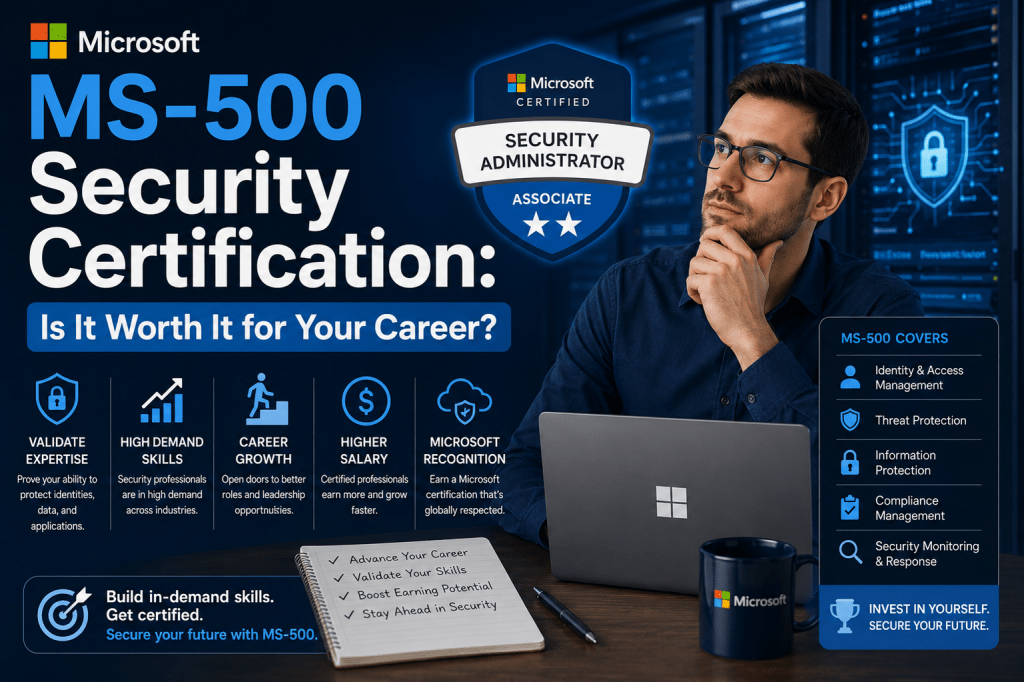
The MS-500 certification is associated with Microsoft’s identity and security administration focus within its cloud-based productivity ecosystem. It is designed around the responsibilities of professionals who manage security controls, identity systems, and compliance configurations in environments that rely heavily on integrated Microsoft services. Rather than concentrating on abstract security theory, it emphasizes practical administration tasks using built-in tools that organizations commonly deploy in enterprise settings.
In many modern workplaces, security is no longer handled by isolated tools or standalone systems. Instead, it is integrated into identity platforms, collaboration suites, and cloud-based infrastructure. This certification sits within that context, aiming to confirm that an individual can manage access control, protect organizational data, and respond to security risks using standardized administrative capabilities.
For individuals entering IT security or those transitioning from general IT support roles, this certification often serves as a structured introduction to real-world security operations in a widely used enterprise ecosystem.
Core Purpose and Focus Areas of the Exam
The MS-500 evaluation is structured around several key domains that reflect day-to-day responsibilities in security administration roles. These domains are centered on applied tasks rather than theoretical knowledge.
A major focus is identity and access management, which includes controlling how users authenticate, how permissions are assigned, and how privileged access is governed. This area ensures that only authorized individuals can access sensitive systems and data, and that their access is limited according to organizational policy.
Another important area involves threat protection. This includes monitoring for suspicious activity, configuring protective mechanisms against malicious behavior, and responding to alerts generated within the system. The emphasis here is on operational security awareness and response rather than deep forensic investigation.
Information protection is also central. This involves safeguarding data through classification, labeling, and policy enforcement. It ensures that sensitive information is handled correctly whether it is stored, shared, or transferred between users and systems.
The final domain focuses on governance and compliance. This includes maintaining organizational standards, auditing system activity, and ensuring that regulatory requirements are met through proper configuration and reporting mechanisms.
Together, these areas form a practical skill set for managing security within a cloud-connected enterprise environment.
Role of Microsoft Ecosystem in Security Administration
Modern organizations often rely on tightly integrated software environments where identity, communication, storage, and security are interconnected. Microsoft’s ecosystem is one of the most widely deployed in enterprise environments, which makes its security framework particularly relevant for IT professionals.
Within such systems, administrators are responsible for ensuring that users are properly authenticated, devices are secured, and data is protected across multiple platforms. Security is not a separate function but embedded within identity services, collaboration tools, and cloud infrastructure.
This integrated approach means that security administrators must understand how different components interact. For example, user identity systems are directly connected to access policies, device management, and data protection rules. A misconfiguration in one area can impact the entire environment.
The MS-500 framework reflects this interconnected structure by focusing on operational control rather than isolated security concepts.
Cost Structure and Accessibility
The certification exam is positioned as an entry-level professional assessment and is typically priced in a standardized range used for similar technical evaluations. While the exam fee itself is relatively straightforward, the overall investment may also include preparation time and study resources.
One notable aspect is that there are no formal prerequisites required to attempt the certification. This makes it accessible to individuals at different stages of their IT careers. However, accessibility does not imply simplicity. The exam assumes familiarity with core administrative concepts and practical exposure to enterprise environments.
Candidates are generally expected to understand system configuration concepts, identity frameworks, and security controls used in cloud-based environments. Without this foundational knowledge, the exam can be challenging even for those with general IT experience.
Skills and Knowledge Expected
The MS-500 evaluation is built around practical knowledge of security administration tasks. It expects familiarity with identity management systems, including how user accounts are created, managed, and secured. It also requires understanding of access control mechanisms such as role-based permissions and conditional access policies.
Threat management skills are also important. This includes recognizing security alerts, responding to incidents, and using monitoring tools to identify suspicious behavior. The ability to interpret security data and take appropriate action is a key expectation.
Data protection knowledge is another essential component. This involves applying rules that determine how sensitive information is classified and protected within an organization. It also includes understanding how to prevent unauthorized sharing or loss of critical data.
Compliance and reporting skills are required as well. Administrators must be able to track system activity, generate reports, and ensure that organizational policies align with regulatory requirements.
Together, these skills form a practical toolkit for managing security in a modern cloud-based workplace.
Who Typically Benefits from This Certification
The value of this certification varies depending on professional experience and career direction. For individuals in early IT roles, such as technical support or helpdesk positions, it can provide a structured introduction to security operations. It helps bridge the gap between basic IT support tasks and more advanced administrative responsibilities.
For network administrators, the certification can serve as an additional layer of specialization. While network professionals often focus on connectivity, performance, and infrastructure, understanding identity and access control adds an important security dimension to their skill set. This is particularly relevant in environments where network and security responsibilities overlap.
For those already working in cybersecurity roles, the certification may be less foundational but still useful in specific contexts. It reinforces knowledge of enterprise security tools and provides structured validation of administrative capabilities. However, experienced professionals may find its scope more introductory compared to advanced security roles.
Career Relevance Across Different Experience Levels
At the early career stage, the certification can help establish credibility and demonstrate familiarity with widely used enterprise systems. It signals that an individual understands core security administration concepts and can operate within structured environments.
At the mid-career level, it can serve as a reinforcement of existing skills or as a stepping stone toward more advanced security roles. Professionals in this stage often use such certifications to formalize their knowledge and align with industry standards.
At more advanced levels, its value becomes situational. Experienced professionals may already possess the skills covered, but the certification can still be useful when transitioning into roles that specifically require platform-focused security administration expertise.
The overall relevance depends less on the certification itself and more on how closely it aligns with an individual’s job responsibilities and career goals.
Practical Skills Developed Through Preparation
Preparing for this certification naturally exposes individuals to a range of practical administrative skills. These include managing user identities, configuring security policies, and implementing access restrictions across systems.
It also encourages familiarity with monitoring tools that track system behavior and identify potential threats. Understanding how to interpret logs, alerts, and reports becomes an important part of the learning process.
Another key area of development is data protection strategy. This includes learning how organizations classify sensitive data and enforce rules to prevent unauthorized access or sharing.
In addition, preparation helps build awareness of compliance frameworks, which are increasingly important in regulated industries. Administrators learn how to ensure that systems meet organizational and legal requirements through proper configuration and oversight.
Strengths and Limitations of the Certification
One of the main strengths of this certification is its practical orientation. It focuses on real administrative tasks rather than abstract concepts, making it directly applicable to workplace environments that rely on similar systems.
Another strength is its alignment with widely used enterprise tools. Since many organizations operate within similar technology ecosystems, the skills covered are often immediately relevant in professional settings.
However, there are limitations to consider. The scope is relatively narrow, focusing primarily on one ecosystem rather than broader security principles that apply across different platforms. As a result, professionals seeking deep expertise in cybersecurity may need additional learning beyond this certification.
It is also more operational than strategic. While it covers how to implement security controls, it does not deeply explore architectural design or advanced threat analysis.
Final Thoughts
The MS-500 certification represents a focused introduction to security administration within a widely used enterprise ecosystem. It emphasizes practical skills such as identity management, threat response, data protection, and compliance enforcement.
Its value varies depending on career stage and professional goals. For early-career IT professionals, it offers structured learning and foundational knowledge. For more experienced individuals, it may serve as validation of existing skills or as preparation for more advanced roles.
While it is not a comprehensive cybersecurity qualification, it plays an important role in building operational security expertise in modern IT environments. Its greatest strength lies in its practical relevance to real-world administrative tasks and its alignment with commonly deployed enterprise systems.