
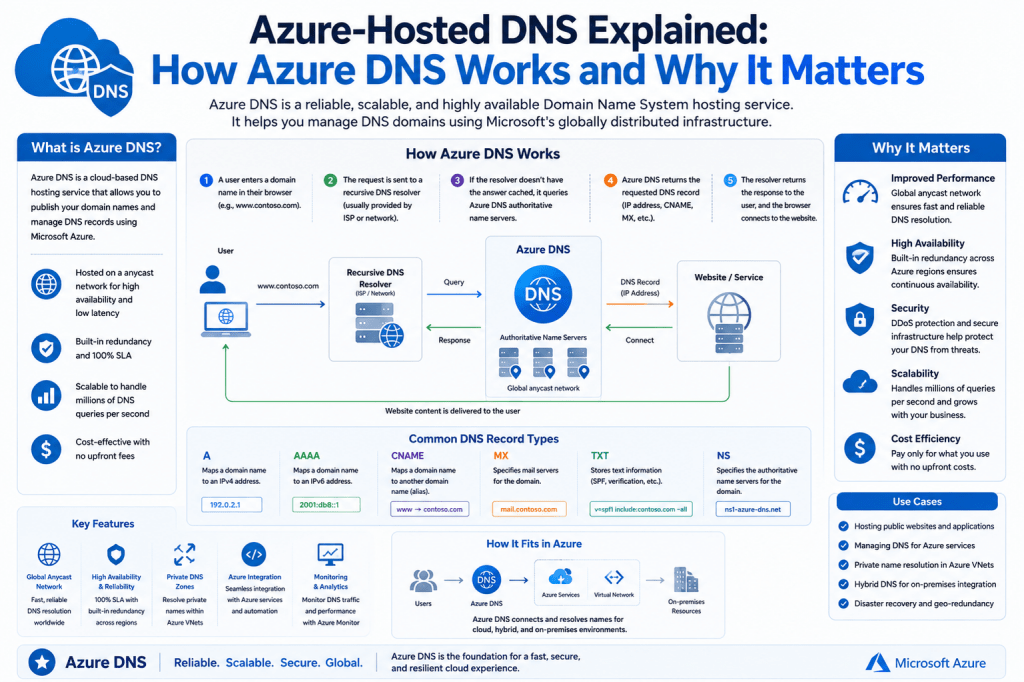
When computing resources are created in a cloud environment, the question of how those resources are accessed becomes essential immediately after deployment. Instead of relying on direct IP-based communication, modern network design favors structured naming systems that allow services to be reached consistently and predictably. This becomes especially important in dynamic environments where virtual machines, databases, and application services may be created, scaled, or replaced frequently. In traditional infrastructure, domain names have long been used to abstract the complexity of underlying IP addresses. The same principle applies in cloud environments, where services need stable identity mechanisms even when their underlying network configuration changes. Azure environments follow this same architectural philosophy by integrating name resolution directly into virtual networking constructs, ensuring that services can communicate in a standardized and manageable way without manual IP tracking.
Role of Naming and DNS in Cloud-Based Communication
In cloud architectures, the reliance on static IP addresses is discouraged because resources are often ephemeral and subject to change. Domain Name System services provide a translation layer between human-readable names and machine-resolvable network addresses. This abstraction allows systems to remain flexible while preserving connectivity. Within Azure-based environments, this concept is deeply integrated into the platform’s networking structure. Every provisioned service that requires network access can be associated with a resolvable name, which simplifies internal communication and reduces operational overhead. DNS is not just a convenience feature but a foundational component that supports scalability, fault tolerance, and service discovery across distributed systems. Without DNS-based resolution, each change in infrastructure would require manual updates to dependent systems, leading to inefficiency and increased risk of configuration errors.
Understanding Azure-Integrated DNS Behavior
Azure provides built-in DNS functionality that works in conjunction with virtual network deployment. When a resource is created within a virtual network, the platform automatically assigns it a fully qualified domain name. This name is generated based on a structured format that ensures uniqueness within the environment. The system ties this naming directly to the virtual network where the resource resides, allowing internal services to reference each other without needing external DNS configuration. This built-in mechanism removes the need for manual entry creation in basic scenarios, simplifying initial deployment workflows. The automatic nature of this system also ensures consistency across resources, which is particularly useful in environments where infrastructure is frequently scaled or redeployed.
Structure of Automatically Assigned Domain Names in Azure
The naming convention used for automatically assigned service names follows a predictable structure that reflects both the resource identity and its network context. Each generated name includes the resource identifier at the beginning, followed by a unique virtual network identifier, and ends with a standardized suffix that designates it as part of the cloud-based internal domain space. This structure ensures that names remain globally unique within the Azure ecosystem while still being meaningful within a specific environment. The inclusion of the virtual network identifier is particularly important because it ties the resource to a specific network boundary, ensuring that name resolution remains scoped and secure. This prevents conflicts and maintains isolation between separate environments that may contain resources with identical names.
Internal DNS Resolution Mechanism in Virtual Networks
Within a virtual network, DNS resolution is handled through an internal resolver provided by the platform. This resolver is responsible for mapping domain names to their corresponding private IP addresses. A predefined system IP address is used as the default DNS resolver within these networks, ensuring consistent resolution behavior across all resources in the same environment. When a resource attempts to communicate with another resource using its domain name, the request is forwarded to this resolver, which then returns the appropriate internal address. This process is transparent to the user and occurs automatically as part of the network stack. The advantage of this approach is that it eliminates the need for external DNS servers for internal communication while maintaining secure and isolated resolution within the virtual network boundary.
Network Isolation and Name Resolution Boundaries
One important characteristic of virtual network-based DNS systems is that name resolution is restricted to the boundaries of each individual network. Resources that reside in separate virtual networks cannot resolve each other’s internal domain names by default. This design choice enforces network isolation and prevents unintended cross-network communication. While this may initially seem restrictive, it is a deliberate architectural decision that enhances security and control. If communication between separate networks is required, additional configuration must be introduced to enable cross-network resolution. Without such configuration, each network operates as an independent DNS domain with its own resolution scope, ensuring that services remain contained within their designated environments.
Configurable DNS Behavior at Different Network Levels
DNS configuration in cloud environments is not fixed and can be adjusted at multiple levels depending on architectural requirements. At the virtual network level, default DNS settings apply to all resources within that network, ensuring uniform behavior across the environment. However, individual network interfaces attached to virtual machines can also override these settings. This allows for granular control over how specific resources perform name resolution. For example, certain workloads may require external DNS servers or specialized resolution rules that differ from the default configuration. By supporting configuration at multiple layers, the system provides flexibility for both simple and complex network architectures. This hierarchical approach ensures that organizations can maintain standardization while still accommodating specialized requirements where necessary.
Service Communication Patterns Using Domain-Based Resolution
Once DNS-based naming is in place, communication between services becomes significantly more streamlined. Instead of relying on static IP addresses, applications can reference other services using consistent domain names. This approach reduces coupling between components and allows infrastructure changes to occur without requiring application-level updates. When a service is moved, recreated, or scaled, its underlying IP address may change, but its domain name remains consistent within the resolution system. This ensures continuity of communication and reduces operational disruption. In distributed application architectures, this method of communication is especially valuable because it allows services to remain loosely connected while still maintaining reliable interaction patterns.
Integration with Larger Network and Application Architectures
DNS-based communication within cloud environments plays a central role in supporting larger architectural patterns such as microservices, multi-tier applications, and distributed databases. In these systems, individual components often need to interact frequently and reliably. By using domain-based resolution, each component can maintain awareness of other services without needing direct knowledge of their physical or network location. This abstraction simplifies system design and improves maintainability. It also supports scalability, as new instances of services can be introduced without requiring changes to existing communication pathways. As cloud environments continue to evolve, this model of abstracted communication remains a foundational principle for building resilient systems.
Role of DNS in Hybrid and Extended Network Environments
In many real-world scenarios, cloud environments do not operate in isolation but instead form part of larger hybrid infrastructures that include on-premises systems. In such cases, DNS becomes a critical integration point between environments. Properly designed name resolution strategies allow services across different environments to communicate seamlessly while maintaining security boundaries. Hybrid DNS configurations often involve careful planning to ensure that name resolution remains consistent and predictable across both local and cloud-based resources. This enables organizations to gradually transition workloads to the cloud without disrupting existing communication structures. The ability to extend DNS functionality across environments ensures continuity and supports long-term architectural evolution.
Operational Considerations and Practical Implications
While automated DNS systems simplify many aspects of cloud networking, they also require careful consideration in larger deployments. Understanding how names are assigned, resolved, and scoped is essential for maintaining reliable system behavior. Misconfigurations at the DNS level can lead to communication failures that are difficult to diagnose because they often appear as application-level issues rather than network problems. Additionally, as environments grow in complexity, maintaining clarity around naming conventions and resolution boundaries becomes increasingly important. Proper planning ensures that services remain discoverable, secure, and efficiently connected throughout their lifecycle.
Conclusion
Domain-based communication within cloud environments provides a structured and scalable approach to managing service interactions. By abstracting IP addresses into consistent naming systems, cloud platforms enable flexible infrastructure that can evolve without disrupting connectivity. Azure’s integrated DNS capabilities support this model by automatically assigning and resolving service names within virtual networks, while still allowing configuration flexibility for advanced scenarios. Understanding how these systems operate, including their resolution boundaries and configuration options, is essential for designing stable and efficient cloud architectures. As modern systems continue to expand in scale and complexity, DNS remains a central mechanism that ensures services can reliably find and communicate with one another across dynamic environments.