
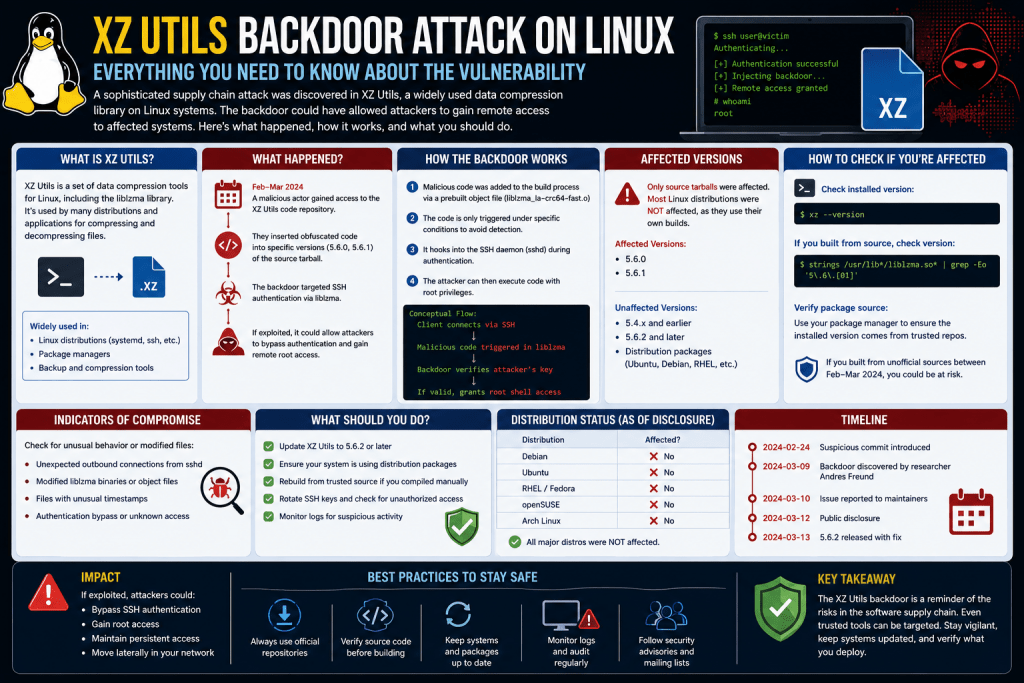
Modern digital infrastructure is built on an enormous foundation of interconnected software components that operate across operating systems, networking stacks, authentication layers, and file processing utilities. These systems are rarely monolithic. Instead, they function as layered ecosystems where thousands of small dependencies interact in predictable and unpredictable ways. Within this structure, even a seemingly insignificant utility can become critical when it is embedded deep within system workflows. The Linux XZ Utils incident represents one of the most significant examples of how a low-level dependency can become a high-impact security risk when compromised over time.
XZ Utils is a compression tool widely used in Linux-based systems to reduce file sizes and improve data handling efficiency. Although it operates quietly in the background, it is deeply integrated into software packaging systems, system updates, and secure communication processes. Because of its performance and reliability, it has been adopted across major Linux distributions, making it a near-universal component in server environments. Its widespread adoption meant that any abnormal behavior in its codebase could potentially affect a large portion of internet-facing systems.
What made the XZ Utils situation particularly important was not just the presence of a vulnerability but the way it was introduced. Instead of a sudden exploit, the issue developed over a long period of time through subtle and carefully staged changes. These changes were embedded within what appeared to be normal development activity, making detection extremely difficult. The nature of this compromise highlights a growing concern in software engineering: the increasing reliance on deeply nested dependencies that are trusted but rarely audited at scale.
The Function and Importance of Compression Tools in Linux Systems
Compression utilities like XZ Utils play a fundamental role in modern operating systems by reducing the size of data for storage and transmission. In Linux environments, these tools are used in package management systems, software deployment pipelines, system backups, and even secure communications. Because operating systems handle massive volumes of files and updates, compression becomes essential for optimizing performance and reducing bandwidth usage.
XZ Utils is specifically known for its high compression ratio and efficiency, making it ideal for distributing large software packages. It is integrated into tools that manage system installations and updates, meaning it operates at a very low level within the system architecture. This level of integration is what makes such utilities powerful but also potentially dangerous if compromised.
Unlike applications that users interact with directly, compression utilities are typically invisible to end users. They operate automatically during background processes, which means they rarely receive direct scrutiny. This lack of visibility contributes to a blind spot in system security, where foundational components are assumed to be safe simply because they are widely used and rarely fail.
When such a component is compromised, the effects are not limited to a single application or service. Instead, they can propagate across multiple layers of infrastructure, potentially affecting authentication systems, file integrity checks, and network services. This cascading effect is what makes compression utilities part of the critical trust boundary in operating system design.
Open Source Software and the Assumption of Transparency
Open source development is built on the principle that publicly available code leads to better security, improved collaboration, and faster innovation. By allowing anyone to inspect, modify, and distribute code, open source ecosystems encourage collective oversight. In theory, this transparency reduces the likelihood of hidden vulnerabilities because more eyes are reviewing the codebase.
However, in practice, the effectiveness of this model depends heavily on active participation and consistent auditing. Large and widely used projects often receive contributions from many developers, but critical infrastructure components are frequently maintained by a small number of individuals. This creates an imbalance between global dependency and local responsibility.
In the case of essential utilities like XZ Utils, the maintenance burden was disproportionately high compared to the number of active maintainers. This means that although the software was used globally, the responsibility for reviewing changes rested on a very small group of contributors. Over time, this can lead to fatigue, reduced review rigor, and increased reliance on trust rather than verification.
The assumption that open source code is inherently secure because it is visible to everyone is, therefore, incomplete. Visibility does not guarantee scrutiny, and widespread usage does not guarantee active maintenance. This gap between theoretical transparency and practical oversight becomes especially significant in long-lived infrastructure projects.
Maintenance Pressure and the Fragility of Critical Dependencies
One of the most overlooked aspects of modern software ecosystems is the concentration of responsibility on individual maintainers. Many widely used open-source projects are supported by volunteers or part-time contributors who manage tools used across global infrastructure. This creates a structural imbalance where a single developer may be responsible for software that underpins millions of systems.
In such environments, maintenance becomes not just a technical task but a psychological and logistical burden. Updates must be reviewed, bug reports must be addressed, and compatibility must be maintained across multiple distributions. Over time, this workload can exceed what a single individual can reasonably manage.
When maintenance pressure increases, projects often seek external contributors to assist with development. While this is generally beneficial, it also introduces new risks. External contributors may not always be fully vetted, and their contributions may not be reviewed with the same level of scrutiny as those from trusted maintainers. This creates an opening where malicious or strategically designed changes can be introduced gradually.
In the XZ Utils ecosystem, the combination of high dependency usage and low maintenance capacity created a fragile environment. The system relied heavily on implicit trust, and that trust became a central factor in how contributions were evaluated. This environment is particularly vulnerable to long-term manipulation strategies that focus on gradual integration rather than immediate exploitation.
The Strategic Infiltration of a Trusted Development Workflow
Unlike traditional security breaches that rely on direct exploitation of vulnerabilities, supply chain compromises often involve long-term infiltration of development processes. In such cases, the goal is not to attack systems directly but to become part of the trusted workflow that produces those systems.
In the XZ Utils case, contributions were introduced gradually over an extended period. Early changes appeared legitimate and aligned with normal maintenance activity, such as performance improvements, code cleanup, and compatibility updates. These types of contributions are common in open-source projects and typically do not raise suspicion.
As time progressed, the complexity and subtlety of changes increased. Modifications were introduced in ways that blended into existing code structures, making them difficult to isolate during review. This incremental approach allowed the contributor profile to remain within expected behavioral norms while gradually increasing influence over the codebase.
This method of infiltration is particularly effective in environments where contributions are accepted based on trust and reputation rather than strict verification protocols. Once a contributor is perceived as reliable, their changes are often reviewed less critically, especially in projects with limited manpower.
The long-term nature of this strategy highlights a fundamental challenge in software security: malicious intent can be hidden within normal development activity when changes are small, consistent, and technically plausible.
Trust Networks and the Human Layer of Software Security
Software security is often discussed in terms of code, systems, and protocols, but human behavior plays an equally important role. In open-source ecosystems, trust is a key currency that determines how contributions are evaluated and accepted. This trust is built over time through consistent participation, technical competence, and perceived goodwill.
However, trust networks are inherently vulnerable to manipulation because they rely on subjective judgment rather than objective verification. Once trust is established, it can reduce the intensity of scrutiny applied to future contributions. This is particularly true in volunteer-driven projects where maintainers must balance review responsibilities with limited time and resources.
The XZ Utils incident illustrates how trust can be systematically exploited within development communities. By embedding themselves into the workflow and contributing positively over time, attackers can gain access to critical decision-making points in the codebase. Once this level of access is achieved, it becomes significantly easier to introduce changes that are structurally difficult to detect.
This dynamic creates a paradox in software security. The same trust that enables collaborative development also creates opportunities for long-term compromise. Balancing openness with rigorous verification remains one of the most complex challenges in modern software engineering.
Early Structural Signals of Ecosystem Vulnerability
Before the discovery of the XZ Utils compromise, there were subtle structural indicators that reflected underlying vulnerabilities in the ecosystem. These indicators did not manifest as direct failures but as patterns in development behavior, such as increased reliance on individual maintainers, growing complexity in contribution pipelines, and rising dependency depth in critical software stacks.
However, these signals are difficult to interpret in isolation. In large-scale software ecosystems, variability in development patterns is normal. Projects evolve, contributors change, and dependencies shift over time. Without a clear baseline of expected behavior, it is challenging to distinguish between healthy evolution and potential risk accumulation.
This ambiguity is a core issue in dependency-driven architectures. The more interconnected a system becomes, the harder it is to identify weak points before they are exploited. In the case of XZ Utils, the vulnerability existed not as a single flaw but as a convergence of structural conditions that made exploitation possible.
These conditions included high dependency usage, low maintenance capacity, trust-based contribution acceptance, and deep integration into system-level workflows. When combined, these factors created an environment where a long-term compromise could remain undetected until late stages of integration.
Emergence of Subtle System Anomalies in Secure Shell Behavior
The first visible signs of the XZ Utils compromise did not appear as an obvious security breach or system failure. Instead, they surfaced as minor irregularities in system behavior that would normally be dismissed as performance noise. In complex Linux environments, secure shell services operate with high efficiency, and minor variations in login latency or CPU usage are often attributed to background processes, system load fluctuations, or network variability. This normal baseline behavior makes it extremely difficult to identify early indicators of deeper systemic issues.
In the case of the XZ Utils incident, one of the earliest anomalies observed involved slight delays in SSH authentication processes. These delays were measured in milliseconds, making them nearly imperceptible under normal usage conditions. However, in high-security environments where performance consistency is expected, even small deviations can signal underlying inefficiencies or unintended processing overhead.
What made these anomalies significant was their consistency under specific conditions. Rather than appearing randomly, they were reproducible in certain system states, suggesting that the behavior was not incidental but structurally embedded. This type of pattern is particularly concerning in authentication systems because SSH is designed to be both fast and secure, minimizing unnecessary processing during login sequences.
At the system level, SSH relies on multiple layers of cryptographic validation, key exchange mechanisms, and authentication modules. Any additional processing introduced into this pipeline can create measurable delays. However, identifying the source of such delays requires deep instrumentation and familiarity with system internals, which is not typically part of routine system administration tasks.
The Role of Compression Libraries in Authentication Workflows
Although compression utilities like XZ Utils are not directly associated with authentication protocols, they can become indirectly involved through system dependencies. Modern Linux distributions often integrate compression libraries into package management workflows, system initialization processes, and security-related operations that involve data handling and verification.
In complex software ecosystems, authentication systems rarely operate in isolation. Instead, they depend on shared libraries that handle memory allocation, data encoding, and compression tasks. These shared dependencies create indirect pathways through which unexpected behavior can influence critical system functions.
In the XZ Utils scenario, the interaction between compression routines and authentication services became relevant due to how system components were linked during runtime execution. When compression libraries are invoked during system initialization or package verification processes, they may execute code paths that indirectly affect authentication timing or resource utilization.
This indirect relationship between compression utilities and secure shell operations highlights a broader architectural challenge in operating system design. Dependencies that appear unrelated at a functional level can still interact at runtime through shared resources, dynamic linking, and system-level integration points.
Understanding these interactions requires a detailed analysis of execution flow across multiple system layers, which is often beyond the scope of standard debugging procedures. As a result, subtle interference patterns can persist undetected within production environments for extended periods.
Behavioral Deviations in System Resource Consumption
Another key indicator of the underlying compromise was abnormal resource consumption during SSH-related operations. In well-optimized systems, authentication processes typically exhibit predictable CPU usage patterns, with minimal variance across repeated login attempts. However, in affected environments, certain authentication sessions showed increased CPU cycles and memory allocation inconsistencies.
These deviations were not severe enough to trigger system alerts or performance degradation warnings. Instead, they manifested as minor inefficiencies that accumulated only under specific conditions. This made them particularly difficult to isolate, as they did not consistently reproduce across all environments or user sessions.
Resource anomalies of this nature often indicate the presence of additional processing layers within system execution paths. In secure systems, even small increases in CPU utilization during authentication can suggest that additional computations are being performed beyond expected cryptographic validation.
The challenge in diagnosing such issues lies in distinguishing between legitimate background processing and unintended execution paths introduced through dependencies. Since modern Linux systems execute hundreds of background processes simultaneously, isolating the source of resource variation requires granular tracing tools and deep system instrumentation.
In the XZ Utils case, these resource anomalies were part of a broader pattern that only became meaningful when correlated with timing delays and execution flow inconsistencies. On their own, each signal appeared benign, but collectively they suggested the presence of hidden logic influencing authentication behavior.
Deep Dependency Chains and Hidden Execution Paths
One of the most critical aspects of modern software ecosystems is the presence of deep dependency chains. These chains occur when a single application relies on multiple layers of libraries, each of which may depend on additional components. Over time, this creates a complex graph of interdependencies that can be difficult to fully map or audit.
In Linux systems, compression libraries like XZ Utils are often integrated into broader frameworks that include package managers, system utilities, and security modules. These frameworks may invoke compression routines indirectly, meaning that code execution can occur in contexts that are not immediately obvious from a high-level perspective.
Hidden execution paths emerge when code is triggered through indirect calls, build scripts, or runtime linking mechanisms. These paths are not always visible in primary source code analysis, especially when execution depends on specific environmental conditions or system configurations.
In the XZ Utils compromise scenario, the malicious behavior was not confined to a single function or module. Instead, it was distributed across multiple components and activated only when certain conditions were met during system initialization or authentication workflows.
This type of design makes detection extremely difficult because traditional static analysis tools focus on direct code execution paths rather than conditional or indirect triggers. As a result, malicious logic can remain dormant until the system reaches a specific operational state.
The Build Process as an Attack Surface
Modern software is not simply compiled from source code into executable binaries. It undergoes a complex build process that includes configuration scripts, compilation flags, dependency resolution, and packaging instructions. Each of these stages introduces potential points of influence where behavior can be modified without altering the primary source code directly.
Build systems often execute scripts that determine how code is compiled and which features are included in the final binary. These scripts can introduce conditional logic that changes system behavior depending on the environment in which the build is performed.
In large-scale projects, build processes are often trusted implicitly because they are considered part of the infrastructure rather than the application logic. However, this separation creates a blind spot in security analysis. If malicious logic is embedded within build scripts or auxiliary configuration files, it may not appear in standard code reviews.
In the XZ Utils case, the build process played a significant role in how the final behavior of the system was shaped. Certain modifications were not immediately visible in the primary codebase but were introduced during the compilation and packaging stages.
This method of embedding behavior within the build pipeline represents a sophisticated form of supply chain manipulation. It allows attackers to influence system behavior without directly modifying the most scrutinized parts of the codebase.
Authentication Pipeline Interaction with System Libraries
Secure shell authentication relies on a series of tightly controlled operations that include cryptographic verification, session negotiation, and identity validation. These processes are designed to minimize latency and maximize security through optimized system calls and validated library usage.
However, these authentication pipelines are not isolated. They depend on system libraries that handle memory allocation, data compression, encoding, and system-level communication. When these libraries are modified or influenced, they can indirectly affect authentication behavior.
In the compromised scenario involving XZ Utils, interactions between compression routines and authentication processes created unexpected behavior within the SSH pipeline. These interactions were not direct function calls but rather indirect dependencies that influenced execution timing and resource allocation.
This type of cross-layer interaction is particularly difficult to detect because it does not violate expected functional behavior. Instead, it subtly alters performance characteristics in ways that are difficult to distinguish from normal system variability.
Understanding these interactions requires deep knowledge of system architecture, including how dynamic linking resolves dependencies at runtime and how shared libraries interact across multiple processes.
Correlation of Multi-Layer System Signals
Individually, the observed anomalies in SSH performance, resource consumption, and execution timing did not provide sufficient evidence of compromise. However, when analyzed collectively, they formed a pattern indicative of deeper systemic influence.
Correlation analysis in complex systems involves identifying relationships between seemingly unrelated signals. In the case of XZ Utils, this meant connecting authentication delays with CPU usage spikes and execution path irregularities within system libraries.
This type of analysis is challenging because modern operating systems are inherently noisy environments. Background processes, scheduled tasks, and dynamic resource allocation all contribute to variability in system behavior. Distinguishing meaningful patterns from normal fluctuations requires extensive historical data and baseline comparisons.
In the XZ Utils scenario, the correlation between multiple subtle signals ultimately suggested the presence of an external influence on system behavior. However, this conclusion was not immediately obvious and required careful step-by-step investigation of system logs, performance metrics, and execution traces.
Transition from Anomaly Detection to Root Cause Investigation
Once anomalies were identified and correlated, the next phase of investigation involved tracing the root cause of the observed behavior. This required moving from symptom-level analysis to structural analysis of system components and dependencies.
Root cause investigation in complex Linux systems involves examining not only application code but also shared libraries, runtime environments, and build configurations. Each of these layers can contribute to system behavior in ways that are not immediately visible from the application layer alone.
In the XZ Utils case, investigators had to analyze how compression utilities interacted with system initialization processes and authentication workflows. This required detailed inspection of dependency chains and execution paths across multiple system layers.
The transition from anomaly detection to root cause analysis marked a critical phase in understanding the full scope of the compromise. It shifted the focus from identifying irregular behavior to understanding how that behavior was introduced into the system in the first place.
The Breakthrough Moment in the Discovery of the XZ Utils Compromise
The identification of the XZ Utils compromise did not occur through automated detection systems or large-scale security monitoring platforms. Instead, it emerged from careful manual observation of unusual system behavior during routine debugging. In complex Linux environments, subtle performance irregularities are often ignored unless they consistently affect functionality. In this case, the anomaly was small enough to be overlooked by most users but significant enough to attract the attention of a technically experienced engineer performing low-level diagnostics.
The breakthrough came when authentication delays in secure shell sessions were investigated more deeply than usual. These delays were not immediately disruptive, but their presence contradicted expected performance baselines for highly optimized SSH implementations. In secure systems, even minor deviations can indicate deeper inefficiencies or unintended processing steps embedded within system libraries.
What made this discovery particularly important was not the anomaly itself, but the persistence of the pattern across different test conditions. When a system behaves inconsistently in a repeatable manner, it suggests that the cause is structural rather than environmental. This distinction is critical in systems engineering because it separates transient performance noise from intentional or embedded logic changes.
The investigation quickly moved from surface-level symptoms to a deeper inspection of system dependencies. Compression libraries, runtime linking behavior, and package management interactions all became relevant areas of analysis. This transition marked the beginning of a deeper forensic exploration into how widely trusted components interact within Linux distributions.
Tracing the Anomaly Through System Dependency Layers
Modern Linux systems are composed of multiple interconnected layers that include kernel functions, system libraries, user-space utilities, and third-party dependencies. Each layer communicates through well-defined interfaces, but the underlying execution paths can become complex due to dynamic linking and shared library usage.
In the case of XZ Utils, the investigation required tracing execution flows through these layered dependencies. Compression utilities, while not directly related to authentication systems, were found to be indirectly involved in system processes that influenced secure shell behavior. This indirect involvement is common in Linux environments, where libraries are reused across multiple subsystems to improve efficiency and reduce redundancy.
Tracing these dependencies revealed that certain execution paths were activated only under specific conditions during system initialization or package processing. These conditional behaviors were not immediately visible in high-level code analysis, which made them difficult to identify without detailed runtime observation.
This type of investigation requires understanding how shared libraries are loaded, how system calls propagate through user-space processes, and how runtime environments resolve dependencies dynamically. Each of these mechanisms introduces potential points where unexpected behavior can be introduced without altering the primary application logic.
The deeper the analysis progressed, the more it became clear that the observed anomalies were not isolated issues but part of a larger structural modification embedded within the system’s dependency network.
The Role of SSH in Exposing System-Level Irregularities
Secure Shell (SSH) is one of the most critical components in Linux-based infrastructure because it provides encrypted remote access to servers and systems. Its design emphasizes security, efficiency, and minimal overhead. As a result, SSH implementations are highly optimized and sensitive to performance deviations.
In the XZ Utils incident, SSH became the primary observable surface where system irregularities manifested. Authentication delays, increased CPU usage during login, and inconsistent session initialization times all pointed toward unexpected processing within the authentication pipeline.
SSH relies on a combination of cryptographic libraries, system authentication modules, and underlying OS services. Any modification in these dependencies can influence how authentication requests are processed. Because SSH is widely used in server environments, even minor anomalies can have significant implications if they indicate deeper system interference.
The investigation into SSH behavior revealed that the anomalies were not caused by the SSH implementation itself but by external dependencies influencing its execution environment. This distinction is crucial because it shifts the focus from application-level debugging to system-level dependency analysis.
By examining how SSH interacts with shared libraries during authentication, investigators were able to identify inconsistencies in execution timing that correlated with compression-related operations. These correlations suggested that non-authentication components were influencing secure login behavior in indirect but measurable ways.
Gradual Construction of a Long-Term Supply Chain Manipulation
One of the most significant characteristics of the XZ Utils compromise was its long-term development strategy. Unlike traditional attacks that rely on immediate exploitation, this scenario involved gradual integration into the software supply chain over multiple years. This approach allowed changes to blend into normal development activity, reducing the likelihood of early detection.
Supply chain manipulation focuses on the trust relationships between developers, maintainers, and users. Instead of attacking systems directly, the goal is to influence components that systems depend on. Once a trusted dependency is modified, the impact propagates automatically to all systems that rely on it.
In this case, the modifications to XZ Utils were introduced incrementally. Early contributions appeared legitimate and aligned with typical maintenance tasks. Over time, more complex changes were introduced that affected deeper parts of the system architecture. This gradual progression made it difficult to distinguish between normal development, evolution, and malicious modification.
The effectiveness of this strategy lies in its ability to exploit trust accumulation over time. As contributors become more familiar and trusted within a project, their changes are subject to less intense scrutiny. This creates an environment where long-term manipulation can occur without triggering immediate suspicion.
The XZ Utils case demonstrates how supply chain attacks can evolve slowly within open-source ecosystems, leveraging normal development practices as a cover for deeper structural changes.
Contributor Behavior Patterns and Trust Accumulation
Open-source development relies heavily on contributor trust. Developers gain credibility over time by submitting useful changes, fixing bugs, and participating in discussions. This credibility influences how future contributions are reviewed and accepted.
In structured projects, maintainers often rely on contributor history to prioritize review efforts. Trusted contributors may have their changes accepted more quickly or with less rigorous inspection, especially in environments where maintainers are under significant workload pressure.
In the XZ Utils situation, contributor behavior followed a pattern consistent with trust accumulation strategies. Initial contributions were small and uncontroversial, designed to establish credibility within the project. Over time, contributions became more complex and impactful, gradually increasing influence over the codebase.
This behavior pattern is particularly effective in decentralized development environments where formal identity verification is limited. Since contributor evaluation is largely based on reputation and technical output, it becomes possible to build trust through sustained participation.
Once trust is established, it can be leveraged to introduce changes that may not receive the same level of scrutiny as those from unknown contributors. This dynamic creates a structural vulnerability within collaborative development ecosystems.
The Complexity of Hidden Logic in Build and Integration Systems
Modern software systems do not operate solely based on source code. Instead, they rely on build systems that compile, configure, and package software into executable forms. These build systems often include scripts, configuration files, and automated processes that determine how code is transformed into final binaries.
In complex projects, build logic can introduce behavior that is not immediately visible in the primary source code. This separation between source code and build process creates an additional layer where modifications can be introduced without direct visibility in code reviews.
In the XZ Utils case, parts of the behavior associated with the compromise were embedded within integration and build processes. These processes influence how components are compiled and linked, which can alter runtime behavior without changing the primary logic of the application.
This architectural characteristic is common in large-scale software systems but introduces significant security challenges. Because build systems are often trusted implicitly, they may not receive the same level of scrutiny as application code. This creates an opportunity for subtle modifications that affect system behavior only after compilation and deployment.
Understanding this layer requires analyzing not only code but also the mechanisms used to transform code into executable artifacts, including compiler behavior, script execution, and dependency resolution.
The Discovery of Coordinated Structural Manipulation
As the investigation deepened, it became clear that the observed anomalies were not random or isolated. Instead, they formed part of a coordinated pattern of structural manipulation within the software ecosystem. This pattern involved multiple layers of the development and deployment pipeline, including source code contributions, build configurations, and dependency interactions.
Coordinated manipulation in software systems is particularly difficult to detect because it does not rely on a single point of failure. Instead, it distributes influence across multiple components, making it appear as normal system evolution when viewed in isolation.
In the XZ Utils scenario, the combination of dependency modification, build system influence, and contributor trust accumulation created a multi-layered structure that enabled persistent integration into system workflows.
This type of manipulation highlights a key challenge in modern software security: the difficulty of distinguishing between legitimate complexity and intentionally introduced structural interference.
Systemic Implications for Global Software Infrastructure
The broader implications of the XZ Utils compromise extend far beyond a single utility or system. It demonstrates how global software infrastructure is built on interconnected dependencies that rely heavily on trust, transparency, and distributed maintenance.
When a single component embedded deep within the dependency chain is compromised, the effects can propagate across entire ecosystems. This is especially true in environments where software is reused extensively across different distributions and platforms.
The incident highlights the importance of understanding software not just as isolated applications but as part of a complex global network of interdependent components. In such systems, security must be considered at every layer, from individual code contributions to system-wide integration processes.
The structural vulnerabilities exposed in this case illustrate how modern software ecosystems require continuous scrutiny, not only at the application level but also within the foundational layers that support them.
Conclusion
The XZ Utils backdoor incident represents one of the most important modern case studies in software supply chain security because it demonstrates how long-term structural manipulation can be more dangerous than direct technical exploitation. Unlike traditional vulnerabilities, which often rely on a single coding flaw or misconfiguration, this scenario evolved through a layered and gradual process that blended into normal software development activity. The result is a security event that challenges many assumptions about how trust, contribution, and verification operate in large-scale open-source ecosystems.
At its core, the incident highlights a fundamental reality of modern computing: most systems are not built from scratch but are assembled from deeply interconnected dependencies. Each dependency, no matter how small or specialized, becomes part of a larger trust network. When a system depends on thousands of external components, the overall security posture becomes a reflection not only of its own code quality but also of the integrity of every upstream contributor. This creates a situation where the weakest or least visible component can disproportionately influence the security of the entire stack.
One of the most important lessons from this event is the concept of “invisible criticality.” XZ Utils was not a widely recognized application in the public sense, yet it played a crucial role in system-level operations across Linux distributions. This is a common pattern in infrastructure software: the most essential components are often those that users never interact with directly. Because they are hidden from view, they are also less frequently audited, less publicly discussed, and less likely to receive sustained security attention. This invisibility creates an environment where long-term risks can accumulate without immediate detection.
Another major takeaway is the fragility of trust-based development systems. Open-source ecosystems depend heavily on voluntary contributions, peer review, and reputation-based evaluation. While this model has enabled extraordinary innovation and global collaboration, it also introduces a structural dependency on social trust. Contributors are often evaluated based on past behavior rather than continuous verification of intent. Over time, this can lead to reduced scrutiny for established contributors, especially in projects where maintainers are under-resourced or overburdened. In such environments, trust becomes both a strength and a vulnerability.
The XZ Utils case also underscores the risks associated with maintenance overload in critical infrastructure projects. Many foundational software components are maintained by a very small number of individuals, sometimes even a single maintainer. These individuals are responsible for code review, bug fixing, feature integration, and security oversight. When the workload exceeds sustainable levels, the review process can become less rigorous simply due to time and cognitive constraints. This creates openings where subtle, well-crafted changes can pass through normal review mechanisms without raising immediate suspicion.
The nature of the compromise itself demonstrates the effectiveness of long-term infiltration strategies. Rather than introducing a single malicious change, the approach relied on gradual integration into the development workflow. Small, seemingly legitimate contributions were introduced over time, building credibility and blending into normal project evolution. This incremental strategy is particularly difficult to detect because each change may appear harmless, while the overall pattern only becomes meaningful when analyzed over a long timeline. This type of threat does not rely on breaking technical safeguards but on exploiting the rhythm and structure of human collaboration.
From a technical perspective, the incident also reveals the complexity of modern dependency chains. In systems like Linux, a single utility can influence multiple layers of functionality through indirect relationships. Compression libraries, build systems, authentication services, and runtime environments are all interconnected in ways that are not immediately visible from a high-level perspective. This means that modifications in one component can have cascading effects across unrelated subsystems. The deeper the dependency chain, the harder it becomes to fully understand the implications of any single change.
Another critical insight is the role of build systems as an underappreciated attack surface. Software is not only defined by its source code but also by how that code is compiled, packaged, and deployed. Build scripts and configuration processes can introduce behavior that is not apparent in the primary codebase. This separation between source and build output creates a layer of abstraction where malicious logic can be embedded in ways that evade traditional code review practices. As systems become more complex, this gap between source visibility and runtime behavior becomes increasingly significant.
The discovery of the XZ Utils backdoor also illustrates the importance of anomaly detection at the system behavior level rather than purely at the code level. The initial indicators were not found in static analysis of source code but in subtle performance irregularities during secure shell authentication. These small deviations in timing and resource usage were critical in prompting deeper investigation. This suggests that effective security monitoring must include behavioral analysis of systems in addition to code inspection.
On a broader scale, the incident emphasizes the need for stronger structural resilience in open-source ecosystems. This does not necessarily mean reducing openness, but rather improving sustainability, funding, and review mechanisms for critical infrastructure projects. When essential components rely on minimal maintenance resources, the entire ecosystem inherits that fragility. Strengthening these foundations requires recognizing open-source infrastructure as critical public digital infrastructure rather than informal volunteer efforts.
Ultimately, the XZ Utils case is not just about a single vulnerability but about a systemic pattern of risk embedded within modern software development practices. It demonstrates how trust, complexity, and dependency can interact to create environments where long-term compromise is possible without immediate detection. It also shows that security is not solely a technical problem but a structural one, shaped by human behavior, organizational constraints, and architectural design choices.