
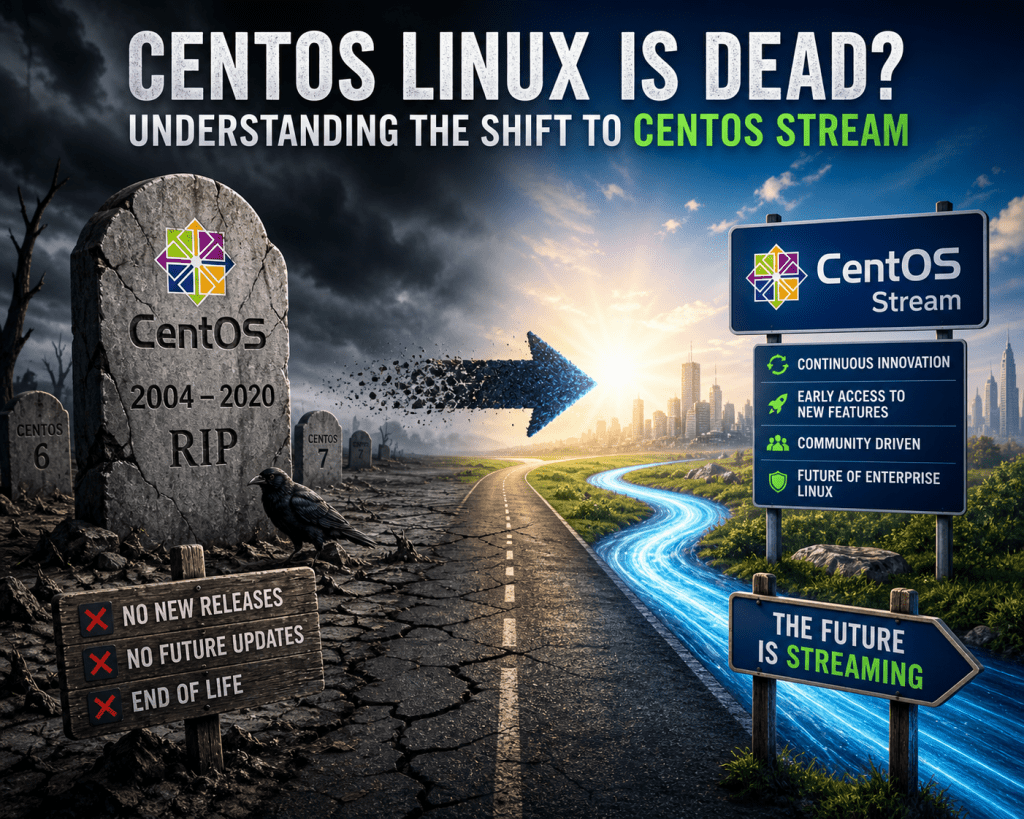
The decision to shift the CentOS Project from CentOS Linux to CentOS Stream represents a structural transformation in how enterprise Linux distributions are developed, delivered, and consumed. CentOS Linux had historically functioned as a downstream rebuild of Red Hat Enterprise Linux, providing a stable, predictable, and freely available alternative that mirrored enterprise-grade behavior without commercial licensing requirements. The introduction of CentOS Stream fundamentally changes this relationship by repositioning CentOS within the development lifecycle of enterprise Linux, moving it from a downstream consumer of stable releases to an upstream contributor of ongoing development changes.
This shift alters not only the technical architecture of CentOS but also the expectations of its user base. Organizations that depended on CentOS Linux typically did so because it provided long-term stability with minimal operational disruption. By contrast, CentOS Stream introduces a continuous delivery model where updates are integrated earlier in the lifecycle, making it more dynamic but less predictable. This adjustment in philosophy has far-reaching implications for infrastructure planning, system reliability strategies, and enterprise adoption patterns.
Historical Role of CentOS Linux in Enterprise Computing Environments
CentOS Linux emerged as a critical component of the Linux ecosystem due to its ability to replicate the functionality of Red Hat Enterprise Linux without associated costs. Built directly from Red Hat’s publicly available source code, CentOS Linux provided binary compatibility with enterprise systems while removing branding and subscription requirements. This made it particularly attractive in environments where budget constraints prevented direct adoption of commercial enterprise Linux distributions.
Over time, CentOS Linux became deeply embedded in a wide range of computing environments. Hosting providers relied on it for server deployments due to its stability and predictable lifecycle. Academic and research institutions adopted it for scientific computing workloads where consistency across clusters was essential. Development teams used it as a staging environment to mirror production systems, ensuring compatibility before deployment to enterprise infrastructure.
The widespread adoption of CentOS Linux was driven primarily by its stability profile. Unlike rolling-release distributions that continuously introduce updates, CentOS Linux followed a point-release model aligned with Red Hat Enterprise Linux. Each major version was supported over an extended lifecycle, often approaching a decade, allowing organizations to maintain systems without frequent disruptive upgrades. This predictability became one of its most defining characteristics.
Technical Architecture: Downstream Versus Upstream Development Model
The distinction between downstream and upstream development models is central to understanding the impact of the CentOS transition. In the downstream model used by CentOS Linux, source code from Red Hat Enterprise Linux is rebuilt after it has been stabilized, tested, and released. This means that CentOS Linux effectively operates as a derivative system, inheriting only finalized features and security updates that have already passed through Red Hat’s internal validation processes.
Fedora→RHEL→CentOS LinuxFedora \rightarrow RHEL \rightarrow CentOS\ LinuxFedora→RHEL→CentOS Linux
This downstream positioning ensures that CentOS Linux remains highly stable, as it does not introduce experimental changes or unverified features. Every update is aligned with the upstream enterprise release cycle, which prioritizes reliability and backward compatibility. This architecture is particularly important in production environments where system behavior must remain consistent over long periods.
In contrast, CentOS Stream shifts this model upstream of Red Hat Enterprise Linux. Instead of waiting for stable releases, CentOS Stream receives updates earlier in the development pipeline. These updates represent the next incremental changes that will eventually be incorporated into future minor versions of Red Hat Enterprise Linux. As a result, CentOS Stream functions as a continuously evolving development preview rather than a static rebuild.
Fedora→CentOS Stream→RHELFedora \rightarrow CentOS\ Stream \rightarrow RHELFedora→CentOS Stream→RHEL
This upstream model introduces a fundamentally different operational behavior. Rather than consuming finalized code, users interact with pre-release components that may still be undergoing testing and refinement. While this allows for faster feedback loops and earlier detection of issues, it also increases variability in system behavior, which can complicate production deployments that depend on deterministic performance.
CentOS Stream and the Rolling Release Paradigm
CentOS Stream adopts a rolling release approach, which contrasts sharply with the point-release structure of CentOS Linux. In a rolling release system, updates are continuously delivered as part of an ongoing development stream rather than being bundled into discrete version releases. This ensures that the system remains current with the latest changes in the upstream development cycle.
The advantage of this model lies in its ability to accelerate innovation. Developers and contributors can observe and interact with changes earlier in the lifecycle, allowing for faster iteration and refinement. This can improve the overall quality of future enterprise releases by identifying issues earlier in the process. It also enables a more transparent development workflow, where the evolution of the operating system is visible in near real time.
However, the same characteristics that enable rapid innovation also introduce potential instability. Because updates are not constrained to fixed release versions, system behavior can change incrementally over time. This makes it more difficult to guarantee long-term consistency, especially in environments where software dependencies require strict version control. Organizations that rely on reproducible system states may find this model challenging to integrate into their operational frameworks.
Organizational Context: Red Hat and IBM Ecosystem Influence
The structural changes in CentOS cannot be fully understood without considering the broader organizational context in which they occurred. The CentOS Project operates in close alignment with Red Hat, which provides significant engineering resources, infrastructure support, and strategic direction. Red Hat itself operates as a major contributor to enterprise open-source software, with Red Hat Enterprise Linux serving as its flagship product.
The acquisition of Red Hat by IBM added another layer of complexity to this ecosystem. IBM’s involvement introduced a larger corporate structure into the governance environment surrounding enterprise Linux development. While there is no direct evidence that IBM dictated specific changes to CentOS, its presence as a parent organization contributed to broader discussions about commercialization, strategic alignment, and long-term sustainability of open-source initiatives.
Within this context, the decision to prioritize CentOS Stream over CentOS Linux reflects a strategic shift toward integrating community development more closely with enterprise release cycles. This alignment is intended to streamline feedback mechanisms between upstream development and downstream enterprise consumption. However, it also changes the perception of CentOS from an independent community-driven rebuild to a more tightly integrated component of a commercial software ecosystem.
Impact of CentOS 8 Lifecycle Adjustments on Enterprise Planning
One of the most significant consequences of the transition was the adjustment to the CentOS 8 lifecycle. Originally, CentOS 8 was expected to follow a long-term support model similar to previous versions, with maintenance updates extending across a multi-year horizon. This expectation allowed organizations to plan infrastructure deployments with confidence in long-term stability.
However, the revised lifecycle shortened the support window considerably, accelerating the end-of-life timeline. This change created operational challenges for systems that had already been deployed under the assumption of extended support. In enterprise environments, operating system lifecycles are closely tied to application dependencies, compliance requirements, and infrastructure budgeting cycles. Sudden changes to these timelines require rapid reassessment of deployment strategies and migration planning.
The reduction in lifecycle support also influenced perceptions of trust within the user community. Stability in enterprise software is not defined solely by technical performance but also by predictability in maintenance commitments. When support timelines are modified after release, it introduces uncertainty that can affect long-term adoption decisions.
Positioning Within the Fedora, CentOS Stream, and RHEL Continuum
The Linux ecosystem surrounding Red Hat Enterprise Linux is structured as a multi-stage development pipeline. Each stage serves a distinct role in the progression from experimental features to stable enterprise deployment. Fedora operates as the upstream experimental distribution, where new technologies and features are introduced and tested. Red Hat Enterprise Linux represents the stable enterprise release, optimized for production environments with long-term support guarantees.
CentOS Linux previously functioned as a downstream reconstruction of Red Hat Enterprise Linux, inheriting its stability characteristics without modification. With the introduction of CentOS Stream, the distribution now occupies an intermediate position between Fedora and Red Hat Enterprise Linux. This repositioning creates a more continuous development pipeline where changes flow through CentOS Stream before being finalized in enterprise releases.
This structural adjustment improves visibility into the development process but also blurs the boundaries between development and production readiness. Each layer in the ecosystem now contributes to a more iterative feedback cycle, where changes are evaluated earlier and refined progressively before reaching enterprise deployment.
Operational Implications for System Stability and Infrastructure Design
From an infrastructure perspective, the transition to CentOS Stream requires a reassessment of deployment strategies. Systems that previously relied on the static nature of CentOS Linux must now account for incremental changes introduced through continuous updates. This affects configuration management practices, testing procedures, and version control strategies.
In environments where stability is critical, such as financial systems or large-scale production services, even minor updates can introduce variability that must be carefully managed. This necessitates more robust validation pipelines and potentially increased reliance on containerization or virtualization to isolate system dependencies.
At the same time, CentOS Stream offers advantages for development and testing environments where early access to upcoming changes can improve compatibility preparation. By aligning more closely with the future state of enterprise Linux releases, developers can proactively adapt their applications to upcoming system changes.
Community Response and Ecosystem Adaptation Trends
The transition has prompted significant discussion within the open-source community, particularly among users who depended on CentOS Linux for production workloads. Concerns have centered around stability, trust, and the availability of free enterprise-grade alternatives. At the same time, some segments of the community recognize the potential benefits of closer integration between development and enterprise release cycles.
This divergence in perspective reflects broader tensions within open-source ecosystems between stability-oriented users and innovation-oriented contributors. As CentOS Stream continues to evolve, its role within this ecosystem will depend on how effectively it balances these competing priorities while maintaining alignment with enterprise requirements.
Revised CentOS Lifecycle and the Impact on Enterprise Planning Models
The restructuring of CentOS fundamentally altered expectations around lifecycle stability, which is one of the most critical factors in enterprise Linux adoption. Traditionally, CentOS Linux followed a predictable long-term support model aligned with Red Hat Enterprise Linux. This meant organizations could deploy systems with confidence that the underlying operating system would remain stable and supported for nearly a decade.
With the transition, this predictability was disrupted, particularly for CentOS 8. Initially expected to follow a standard long-term lifecycle, CentOS 8 experienced a significantly shortened support window. This change forced organizations to reassess infrastructure strategies much earlier than anticipated, introducing urgency into what are normally long-term planning cycles.
Enterprise environments depend heavily on lifecycle guarantees because operating system stability is tightly integrated with application certification, compliance requirements, and hardware refresh cycles. When those timelines change unexpectedly, the ripple effects extend across procurement planning, DevOps pipelines, and security patch management strategies. Even minor lifecycle adjustments can force large-scale migration projects that involve coordination across multiple teams.
The shift also highlighted a structural dependency issue: many organizations had adopted CentOS precisely because it mirrored enterprise behavior without cost barriers. When that equivalence changed, it created a gap between expectation and reality that required immediate architectural adjustments.
CentOS Stream as a Continuous Development Channel
CentOS Stream introduces a continuous delivery model that fundamentally changes how updates flow through the enterprise Linux ecosystem. Instead of receiving fully stabilized, point-release updates, users now interact with a rolling stream of changes that represent the next iteration of Red Hat Enterprise Linux.
This means CentOS Stream acts as a live development branch where features are introduced, tested, and refined before being formally incorporated into enterprise releases. The system no longer waits for full stabilization cycles but instead integrates incremental updates as they are validated upstream.
Continuous Update Flow ΔVersion→Rolling Integration→Enterprise AdoptionContinuous\ Update\ Flow\;\ \Delta Version \rightarrow Rolling\ Integration \rightarrow Enterprise\ AdoptionContinuous Update Flow ΔVersion→Rolling Integration→Enterprise Adoption
This model improves visibility into the evolution of enterprise Linux, allowing developers and contributors to observe changes earlier in the lifecycle. It also enables faster feedback loops, where issues can be identified and corrected before reaching production-grade releases.
However, this continuous flow also introduces variability. Unlike fixed release versions, CentOS Stream does not guarantee long-term consistency for specific package versions. This makes reproducibility more complex, particularly for environments that rely on strict version locking for application stability.
The rolling nature of CentOS Stream means that system administrators must adapt to a more dynamic update environment. Instead of planning upgrades at defined intervals, updates become an ongoing process that requires continuous validation and testing.
Technical Differences Between Stable Releases and Rolling Development Streams
The technical divergence between CentOS Linux and CentOS Stream can be understood through their update philosophies. CentOS Linux functioned as a stable snapshot of Red Hat Enterprise Linux. Once released, it remained largely unchanged except for security patches and critical bug fixes. This created a predictable environment where system behavior remained consistent over time.
CentOS Stream, in contrast, represents a moving target. Updates are introduced continuously as part of the upstream development process. These updates may include feature refinements, performance improvements, or architectural adjustments that have not yet been fully stabilized for enterprise release.
This difference affects several core system characteristics:
First, package stability is no longer fixed. Libraries and system components may evolve incrementally, which can affect dependent applications.
Second, kernel and subsystem behavior may change more frequently. This introduces variability in performance tuning and hardware compatibility testing.
Third, dependency resolution becomes more dynamic. Package managers must handle evolving version relationships rather than fixed release constraints.
These changes shift CentOS Stream closer to a development and testing environment rather than a production-stable system. While this is beneficial for early adoption and feedback, it reduces its suitability for static infrastructure deployments.
Positioning CentOS Stream Within the Fedora and RHEL Ecosystem
The Linux distribution ecosystem associated with Red Hat now operates as a layered pipeline, with each distribution serving a distinct role in the software lifecycle. Fedora operates at the upstream edge, introducing new technologies, kernel updates, and experimental features. It serves as the innovation layer where major changes are first introduced and tested.
Red Hat Enterprise Linux sits at the downstream end of the pipeline, representing the stabilized and production-ready version of enterprise Linux. It prioritizes long-term support, backward compatibility, and operational consistency.
CentOS Stream is positioned between these two layers, acting as an intermediate validation and refinement stage.
Fedora→CentOS Stream→Red Hat Enterprise LinuxFedora \rightarrow CentOS\ Stream \rightarrow Red\ Hat\ Enterprise\ LinuxFedora→CentOS Stream→Red Hat Enterprise Linux
This positioning creates a continuous feedback loop between experimentation and production stability. Changes introduced in Fedora move into CentOS Stream for refinement and then into Red Hat Enterprise Linux once they reach sufficient maturity.
This structure enhances transparency in the development process, allowing stakeholders to observe and contribute to changes before they reach production systems. It also improves the quality of enterprise releases by exposing potential issues earlier in the lifecycle.
However, this pipeline also means that CentOS Stream inherits a hybrid identity. It is neither purely experimental nor fully stable, which creates ambiguity for users trying to determine appropriate use cases. This ambiguity is one of the key challenges introduced by the transition.
Enterprise Migration Pressure and Infrastructure Reassessment
The shift from CentOS Linux to CentOS Stream created immediate migration pressure for organizations that had standardized on CentOS as a production platform. Because CentOS Linux has been widely used as a free enterprise-grade operating system, many infrastructure environments were built with the assumption of long-term stability and compatibility.
When the lifecycle change was announced, organizations were forced to evaluate alternative strategies. These included migrating to CentOS Stream, adopting commercial enterprise Linux subscriptions, or transitioning to alternative community-driven distributions that replicate Red Hat compatibility.
This reassessment is not purely technical. It involves financial planning, operational risk analysis, and compliance considerations. Migration decisions must account for application compatibility, system certification requirements, and internal IT governance policies.
In many cases, organizations rely on standardized operating system environments for regulatory compliance. Any change in the underlying OS distribution can require re-certification of systems, which adds significant overhead to migration efforts.
The urgency of CentOS 8’s shortened lifecycle intensified these challenges. Instead of gradual migration planning, organizations had to accelerate transition timelines, often reallocating resources from other infrastructure projects to address the change.
Stability Versus Innovation Tradeoff in Linux Distribution Strategy
The CentOS transition highlights a fundamental tension in operating system design: stability versus innovation. Stable distributions prioritize predictable behavior, long-term support, and minimal change. Innovation-focused distributions prioritize rapid updates, feature integration, and early access to new technologies.
CentOS Linux was firmly positioned on the stability side of this spectrum. Its design philosophy emphasized consistency, making it suitable for production environments where system behavior must remain unchanged over time.
CentOS Stream shifts this balance toward innovation. By integrating changes earlier in the development lifecycle, it enables faster iteration and closer alignment with future enterprise releases.
This tradeoff is not inherently negative. It reflects different operational priorities. Environments that prioritize development velocity may benefit from earlier access to changes. However, environments that prioritize uptime and consistency may find the increased variability challenging.
The key implication is that CentOS Stream is not a direct replacement for CentOS Linux. It serves a different purpose within the ecosystem, requiring users to reassess how it fits into their infrastructure strategy.
Impact on System Administration and DevOps Practices
The transition to CentOS Stream also affects system administration methodologies. Traditional CentOS environments relied on predictable update cycles, which allowed administrators to plan maintenance windows and test updates before deployment.
With CentOS Stream, updates are more continuous and incremental. This requires a shift toward automated testing pipelines and more dynamic configuration management systems. Tools used in DevOps environments become more critical, as manual update control is less practical in a rolling release system.
Infrastructure as code practices gain increased importance in this context. By defining system configurations declaratively, organizations can more easily manage changes introduced through continuous updates. This reduces the operational burden of maintaining consistency across evolving system states.
Monitoring and observability also become more important. Since system behavior can change incrementally over time, continuous monitoring helps detect deviations or performance regressions early in the lifecycle.
Community Evolution and Distribution Fragmentation Effects
The CentOS transition contributed to broader fragmentation within the enterprise Linux ecosystem. When CentOS Linux was discontinued, it created demand for alternative distributions that could replicate its original role as a free, stable enterprise-compatible operating system.
This led to increased interest in community-driven rebuilds of enterprise Linux, as well as greater diversification of Linux distribution strategies within organizations. Instead of relying on a single dominant free enterprise distribution, users began exploring multiple alternatives based on specific operational requirements.
This fragmentation reflects a broader trend in open-source ecosystems where centralized distribution models evolve into more distributed and specialized alternatives. Each distribution now serves a more narrowly defined role, rather than attempting to occupy a universal position.
Alternatives to CentOS Linux and the Shift in Enterprise Linux Strategy
The discontinuation of CentOS Linux as a downstream rebuild of Red Hat Enterprise Linux created an immediate need for viable replacements. Organizations that had relied on CentOS for production workloads, development environments, and infrastructure standardization were suddenly required to reassess their operating system strategy. This led to rapid growth in alternative distributions that aim to fill the gap left by CentOS Linux while maintaining compatibility with enterprise Linux ecosystems.
These alternatives generally fall into two categories. The first category includes community-driven rebuilds of Red Hat Enterprise Linux that aim to replicate its behavior as closely as possible. The second category includes commercial or hybrid distributions that provide enterprise compatibility with optional support services. Each approach reflects different priorities around governance, stability, and long-term sustainability.
Community-Driven Enterprise Linux Rebuilds
One of the most direct responses to the CentOS Linux transition has been the emergence of community-led projects designed to replicate the original CentOS model. These distributions focus on rebuilding Red Hat Enterprise Linux from publicly available source code while maintaining binary compatibility and long-term stability.
A key example is Rocky Linux, which was created with the explicit goal of restoring the original CentOS vision. It aims to provide a stable, production-ready operating system that is functionally equivalent to Red Hat Enterprise Linux. The project is led by one of the original CentOS founders, which reinforces its alignment with the historical purpose of CentOS Linux.
Another significant alternative is AlmaLinux, which is also designed as a downstream rebuild of Red Hat Enterprise Linux. It focuses on long-term stability and community governance, with an emphasis on maintaining independence from commercial control. Both Rocky Linux and AlmaLinux position themselves as direct replacements for CentOS Linux in enterprise environments.
These distributions share several key characteristics. They prioritize stability over rapid innovation, they follow point-release cycles aligned with Red Hat Enterprise Linux, and they aim to provide long-term support lifecycles similar to traditional CentOS Linux versions. This makes them suitable for organizations that require minimal operational disruption and predictable system behavior.
Commercial Enterprise Linux Alternatives
In addition to community-driven projects, several commercial distributions offer enterprise-compatible Linux systems with varying support models. These distributions are often backed by companies that provide optional paid support, certification services, and extended lifecycle guarantees.
Oracle Linux is one of the most prominent examples. It is fully binary compatible with Red Hat Enterprise Linux and provides both a free version and paid support options. Oracle Linux also includes additional kernel features and performance enhancements that are not present in standard enterprise distributions. This makes it a viable option for organizations seeking enterprise compatibility with optional commercial backing.
Another alternative is CloudLinux, which developed its own enterprise-focused distribution based on Red Hat compatibility. CloudLinux is widely used in hosting environments where system isolation and resource management are critical. Its ecosystem also includes variants designed for specific workloads, further diversifying its use cases.
These commercial alternatives often appeal to organizations that require guaranteed support agreements or vendor-backed service-level commitments. Unlike purely community-driven distributions, they offer structured support contracts, which can be important for enterprise compliance and risk management.
Scientific and Institutional Linux Distributions
Beyond commercial and community rebuilds, several specialized distributions exist that serve academic and research environments. These systems often build upon Red Hat Enterprise Linux compatibility while adding tools and packages tailored for scientific computing, data analysis, and high-performance workloads.
These distributions are typically maintained by research institutions or collaborative academic groups. They prioritize stability and reproducibility, which are essential in scientific computing environments where results must remain consistent over long periods.
In some cases, these systems incorporate additional repositories that include computational libraries, simulation tools, and specialized scientific packages. This makes them particularly useful in fields such as physics, engineering, and bioinformatics, where standard enterprise distributions may not include required tooling by default.
Comparative Positioning of CentOS Replacements in the Linux Ecosystem
The emergence of multiple CentOS alternatives has created a more fragmented but flexible ecosystem. Each distribution occupies a specific position along the stability-to-innovation spectrum, allowing organizations to select systems based on their operational requirements.
Community rebuilds such as Rocky Linux and AlmaLinux occupy the closest position to traditional CentOS Linux. They prioritize stability, long-term support, and binary compatibility with Red Hat Enterprise Linux. Their goal is to function as direct replacements with minimal behavioral differences.
Commercial alternatives such as Oracle Linux introduce additional enterprise features and support structures, making them suitable for organizations that require vendor-backed reliability. These systems often include enhanced kernel options or proprietary tooling that extends their functionality beyond standard enterprise Linux capabilities.
Specialized distributions serve niche environments where domain-specific requirements outweigh general-purpose compatibility. These systems are typically not used as direct CentOS replacements but instead address specialized workloads that require customized software stacks.
Migration Challenges and Infrastructure Transition Complexity
Moving away from CentOS Linux is not a simple package replacement exercise. It involves deep infrastructure considerations that affect system architecture, application compatibility, and operational workflows. Since CentOS Linux was widely used as a baseline operating system for both development and production environments, its replacement requires careful planning.
One of the primary challenges is application compatibility. Many enterprise applications are certified specifically for Red Hat Enterprise Linux or CentOS environments. Migrating to a different distribution requires verification that all dependencies, libraries, and system behaviors remain consistent.
Another major challenge is configuration management. Organizations that rely on automated deployment systems must ensure that scripts, templates, and infrastructure definitions remain valid across new distributions. Even minor differences in package versions or system paths can introduce deployment inconsistencies.
Security compliance is another critical factor. Many organizations operate under regulatory frameworks that require certified operating systems. Migrating to a new distribution may require revalidation of compliance status, which can be time-consuming and resource-intensive.
DevOps Adaptation and Infrastructure Modernization
The transition away from CentOS Linux has also accelerated broader adoption of modern infrastructure practices. Many organizations are using this opportunity to reevaluate their system architecture and move toward more flexible deployment models.
Containerization plays a central role in this shift. By encapsulating applications and their dependencies into isolated containers, organizations reduce reliance on specific operating system distributions. This decouples application behavior from underlying system differences, making migrations between distributions less disruptive.
Infrastructure as code has also become increasingly important. By defining system configurations declaratively, organizations can standardize deployments across different environments, regardless of the underlying Linux distribution. This reduces operational complexity and improves consistency across development, testing, and production systems.
Continuous integration and continuous deployment pipelines further support this transition by automating testing and validation processes. These systems ensure that applications remain compatible with updated operating systems before changes are deployed to production environments.
Long-Term Structural Changes in Enterprise Linux Ecosystems
The CentOS transition reflects broader structural changes in the enterprise Linux landscape. Historically, a small number of dominant distributions provided a relatively stable ecosystem where compatibility was predictable and long-term support was standardized.
The current environment is more diversified. Multiple distributions now serve overlapping roles, each optimized for specific use cases. This diversification increases flexibility but also introduces complexity in decision-making and infrastructure management.
One of the most significant long-term effects is the shift in how organizations evaluate operating systems. Instead of relying on a single default choice, organizations must now assess distributions based on lifecycle guarantees, governance models, support structures, and alignment with internal operational requirements.
This represents a shift from distribution-centric planning to architecture-centric planning. Rather than selecting a single operating system as a foundation, organizations increasingly design systems that can operate across multiple compatible environments.
Strategic Decision-Making in Post-CentOS Infrastructure Planning
In the post-CentOS landscape, strategic infrastructure decisions require a more nuanced evaluation process. Organizations must consider not only technical compatibility but also governance, support availability, and long-term sustainability.
Community-driven distributions offer cost-effective solutions with strong compatibility, but they rely heavily on community governance and volunteer contributions. Commercial distributions provide structured support but introduce licensing considerations and vendor dependencies.
Hybrid approaches are also becoming more common. Some organizations adopt a mix of distributions depending on workload requirements, using one system for production stability and another for development or testing environments.
This layered approach reflects a broader trend toward flexibility in infrastructure design. Rather than relying on a single operating system standard, organizations are building adaptable environments capable of supporting multiple Linux distributions simultaneously.
Evolving Role of Linux Distributions in Enterprise Computing
The transition away from CentOS Linux highlights the evolving role of Linux distributions in modern computing environments. Operating systems are no longer static foundations but dynamic components within larger infrastructure ecosystems.
As cloud computing, containerization, and automation continue to evolve, the importance of underlying distributions is gradually shifting. While still critical for system behavior and compatibility, the operating system is increasingly abstracted by higher-level infrastructure tools.
This abstraction allows organizations to focus more on application delivery and less on operating system management. However, it also increases the importance of understanding how different distributions behave within these abstracted environments.
Final Structural Perspective on the CentOS Transition
The end of CentOS Linux as a stable downstream rebuild represents a turning point in enterprise Linux history. It marks a transition from a single dominant free enterprise-compatible distribution to a more distributed ecosystem of specialized alternatives.
Each alternative now serves a distinct role, whether focused on community stability, commercial support, or specialized workloads. This diversification reflects the broader evolution of open-source ecosystems toward more modular and flexible structures.
At the same time, it places greater responsibility on organizations to make informed infrastructure decisions. The absence of a universal CentOS equivalent means that system design must now account for a wider range of variables, including lifecycle management, update frequency, and governance models.
The result is a more complex but also more adaptable enterprise Linux landscape, where flexibility and strategic planning play a larger role than uniformity or default standardization.
Conclusion
The transition from CentOS Linux to CentOS Stream represents one of the most significant structural changes in modern enterprise Linux history, not because it introduces entirely new technology, but because it redefines expectations around stability, lifecycle guarantees, and the relationship between community distributions and commercial enterprise platforms. For years, CentOS Linux occupied a uniquely trusted position in the ecosystem as a free, production-grade operating system that closely mirrored Red Hat Enterprise Linux without the associated subscription cost. That positioning made it a default choice across a wide range of environments, from small development labs to large-scale hosting infrastructures and research clusters.
What made CentOS Linux particularly valuable was not innovation, but predictability. Organizations adopted it precisely because it minimized operational uncertainty. Once deployed, systems could remain unchanged for long periods, with security updates being the primary source of modification. This stability reduced administrative overhead and allowed infrastructure teams to focus on application delivery rather than constant operating system maintenance. In enterprise environments, that predictability translates directly into reduced risk, simplified compliance management, and more reliable planning cycles.
The introduction of CentOS Stream disrupted that model by shifting the distribution from a downstream rebuild of Red Hat Enterprise Linux to an upstream development platform. Instead of being a stable reflection of enterprise releases, CentOS Stream now serves as a continuous integration point for upcoming changes. This fundamentally alters its role in the ecosystem. It is no longer a static foundation but an evolving preview of future enterprise Linux behavior. While this provides greater visibility into development and potentially accelerates innovation cycles, it also introduces variability that is incompatible with many traditional production use cases.
This shift has forced organizations to reassess not only their operating system choices but also their broader infrastructure strategies. In many cases, CentOS Linux was not chosen as a primary preference but as a pragmatic solution that balanced enterprise compatibility with zero licensing cost. Its removal from the downstream model created a gap that had to be filled quickly, leading to the rapid adoption of alternatives such as community rebuilds and commercial derivatives. This reaction underscores how deeply embedded CentOS Linux had become in infrastructure planning across industries.
The community response to the change reflects a broader tension within open-source ecosystems: the balance between community expectations and corporate-driven development priorities. On one hand, open-source users expect continuity, transparency, and long-term accessibility. On the other hand, organizations like Red Hat operate within commercial frameworks that require alignment between community projects and enterprise product strategy. CentOS Stream can be seen as an attempt to bridge these two worlds by integrating community contributions more directly into the enterprise development pipeline. However, the perception among many users is that this integration comes at the cost of stability and independence.
From a technical standpoint, CentOS Stream introduces a more dynamic update model that aligns closely with modern software development practices. Continuous delivery, rolling updates, and early feature integration reflect broader industry trends toward faster iteration cycles. In development and testing environments, this can be beneficial, as it allows engineers to prepare for upcoming changes in enterprise releases. It also improves transparency, as changes are visible earlier in the lifecycle rather than being introduced only in fully stabilized releases.
However, the same characteristics that make CentOS Stream useful in development contexts also limit its suitability for traditional production environments. Systems that require strict version control, long-term reproducibility, and minimal change over time are inherently less compatible with rolling update models. Even small incremental changes can introduce behavioral differences that require additional validation, testing, and monitoring. This increases operational complexity and reduces the predictability that was previously a defining strength of CentOS Linux.
The emergence of alternatives such as Rocky Linux, AlmaLinux, and Oracle Linux reflects the demand for continuity rather than transformation. These distributions aim to preserve the original CentOS model by maintaining downstream compatibility with Red Hat Enterprise Linux and offering long-term stability guarantees. Their rapid adoption demonstrates that a significant portion of the user base prioritizes consistency over early access to upstream changes. At the same time, the existence of multiple alternatives indicates that the enterprise Linux ecosystem is becoming more fragmented, with no single distribution occupying the universal role that CentOS once held.
This fragmentation has long-term implications for infrastructure design. Organizations can no longer rely on a single free enterprise-compatible standard. Instead, they must evaluate distributions based on specific operational requirements, including lifecycle duration, update frequency, governance model, and support availability. This introduces additional decision-making complexity but also increases flexibility, allowing infrastructure to be tailored more precisely to workload requirements.
Another important outcome of this transition is the acceleration of modern infrastructure practices. As operating system boundaries become less rigid, technologies such as containers, orchestration platforms, and infrastructure-as-code frameworks become more central to system design. These tools reduce dependency on specific distributions by abstracting application environments from underlying operating system differences. In this context, the importance of any single Linux distribution diminishes slightly, while the importance of standardized deployment and automation increases significantly.
Despite these changes, the legacy of CentOS Linux remains influential. Its role in democratizing access to enterprise-grade Linux environments cannot be understated. It enabled widespread adoption of Linux in production systems without financial barriers, contributed to the growth of cloud hosting infrastructure, and served as a foundational learning platform for countless system administrators and engineers. Even as its direct form disappears, its influence persists in the design of successor distributions and in the expectations users bring to enterprise Linux environments.
Ultimately, the transition from CentOS Linux to CentOS Stream is not simply a product change but a reflection of evolving priorities in software development and infrastructure management. It highlights the ongoing shift from static systems toward continuous delivery models, from isolated distributions toward integrated ecosystems, and from uniform standards toward diversified tooling strategies. For organizations and individuals working within this space, the key challenge is no longer selecting a single “correct” distribution, but understanding how each option fits into a broader architectural strategy that balances stability, innovation, and operational efficiency.